Getting to Hongdae: AREX from Incheon Airport and Station Exits
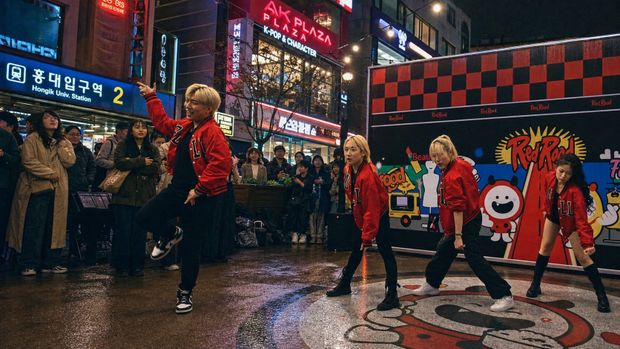
Hongik University Station (홍대입구역) is the primary gateway to Hongdae — one of Seoul's most internationally accessible districts for K-pop fans arriving from abroad. The Airport Railroad Express (AREX) runs a direct, no-transfer service from Incheon International Airport (ICN) to Hongik University Station in approximately 43 minutes from Terminal 1, making the airport-to-Hongdae journey one of the most straightforward in Seoul for international visitors. No line changes are needed: you board AREX at the airport terminal and step off directly beneath the district's main commercial and busking corridor. Three separate rail lines converge at this station — AREX, Seoul Metro Line 2 (the green loop line that encircles the city), and the Gyeongui-Jungang Line, which spans east to west across Seoul and into greater Gyeonggi Province. This cross-network positioning makes Hongik University Station a transit hub rather than a local stop, meaning visitors staying across different parts of the city can reach Hongdae in an untransferred single leg from many neighborhoods.
Quick Answer: AREX runs directly from Incheon International Airport to Hongik University Station in approximately 43 minutes from Terminal 1, with no transfer required. Exits 8 and 9 place you within 1–2 minutes of Red Road's busking corridor and AK Plaza's K-pop merch floors.
Once at the station, exit selection determines which part of Hongdae you surface in — and the district's geography rewards a small amount of planning before you ascend the escalator. Exit 9 is the standard arrival point for Red Road busking and street performances, placing visitors within a 1–2 minute walk of the main pedestrian corridor and the R1 Red Culture Market entrance. Exit 8 is equally useful for reaching AK Plaza's K-pop floors and the northern shopping cluster. Exit 3 leads to the club and live music district along Wausan-ro 21-gil. Exit 6 opens into the quieter Sangsu neighborhood — a lower-density café and bar zone that contrasts with the main commercial strip's energy.
For K-pop fans on a time-compressed itinerary — a layover visit or an evening-only trip from another district — the AREX connection removes airport-to-city navigation as a friction point. A T-Money transit card, available at every airport convenience store, covers AREX, all Seoul Metro lines, and local buses with a single tap, so no separate ticketing is needed at each stage. The Hongik University Tourist Information Center, open 10 AM to 10 PM daily, is positioned inside the station concourse and can assist with current weekend busking schedules and active pop-up store addresses.
📍 서울특별시
⭐ 4.1 (190 리뷰)
🔗 Google Maps에서 보기
Red Road After the 2025 Renovation: Four Smart Busking Zones
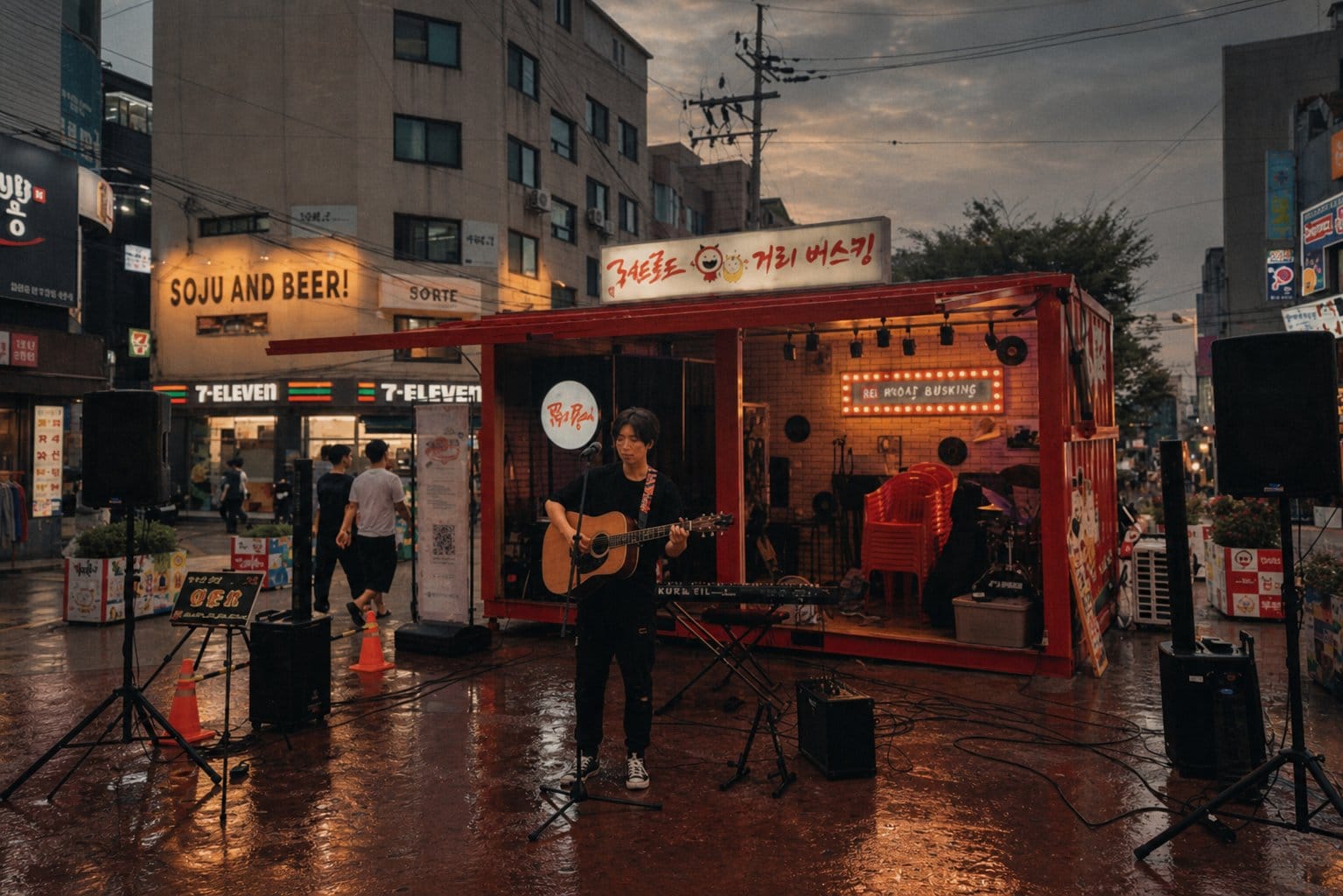
Red Road — the pedestrian corridor officially named Eoulmadang-ro — is Hongdae's cultural backbone and the most internationally recognized public performance space in the district. Following a comprehensive renovation completed by Mapo-gu district office in late 2025, the approximately 2 km corridor running from Hongik University Station toward the Han River is now formally structured into four designated Smart Busking Zones. This restructuring replaced the previous informal arrangement — in which performers selected spots organically and without assigned infrastructure — with clearly marked performance areas, improved lighting systems, and sound infrastructure designed to accommodate multiple simultaneous acts across the full length of the street. The R1 Red Culture Market, anchored at 348-24 Seogyo-dong and approximately 220 meters from Exit 9, bookmarks the northern end with retro-aesthetic staging, flea market stalls, caricature artists, traditional games, and dedicated live performance platforms.
📍 View R1 Red Culture Market on Google Maps
The range of acts distributed across the four zones is deliberately broad. K-pop dance crews — typically four to eight performers in coordinated streetwear executing synchronized choreography to a backing track — occupy the larger platform zones, particularly on weekend evenings when audience density is highest. Solo acoustic buskers and acoustic duo acts fill the intermediate zones from late afternoon, while indie rock bands with compact PA rigs and hip-hop groups round out the performer mix in the southern sections. According to Seoul Metropolitan Government's official tourism resources, the multilingual visitor information portal at redroad.kr serves Korean, English, Japanese, and Chinese visitors with zone maps and seasonal event calendars. For international fans, reviewing the zone layout before arrival makes it easier to locate specific act types rather than arriving and following crowd noise.
Timing is a meaningful variable. Performances begin in the late afternoon and regularly continue through midnight on weekends. The density of performers peaks on Friday and Saturday evenings, when the street operates at close to maximum capacity and multiple simultaneous acts create overlapping audience clusters throughout the corridor. Weekday visits are quieter but not empty — the four-zone structure means at least one or two sections are typically active from early evening. Seasonal closures affect some outdoor performance areas during extreme summer heat (typically late July through early August), so visitors planning visits during that period should verify current conditions through redroad.kr or the station tourist information center.
| Zone | Location / Reference Point | Typical Performance Types | Peak Active Hours |
|---|---|---|---|
| R1 Red Culture Market | 348-24 Seogyo-dong (~220 m from Exit 9) | K-pop dance crews, indie rock, traditional games stage, flea market acts | Afternoon – midnight (Fri–Sat highest traffic) |
| R2 Central Zone | Mid-corridor central plaza (metro construction impact from 2025) | Solo acoustic, duo acts, occasional group showcases | Late afternoon – midnight |
| R3 Mid-Southern Zone | Southward along Eoulmadang-ro toward Sangsu | Hip-hop crews, indie singer-songwriters, open-mic style performances | Evening – late night |
| R4 Southern End | Near Han River approach, Eoulmadang-ro southern terminus | Smaller acoustic sets, emerging local artists, experimental acts | Afternoon – late evening |
The zone format also means that a single Red Road walk — north to south — passes through different performance registers in sequence rather than arriving at a single stage and stopping. Fans interested in K-pop dance performance should orient to R1 and the northern R2 sections; those looking for a more relaxed acoustic atmosphere should continue south toward R3. The GoFarther blog's on-the-ground reporting notes that the corridor's spontaneous energy means the zone types function as tendencies rather than strict programming rules — acts shift and move throughout the evening based on crowd response and available space.
Construction Alert: The Daejang-Hongdae Metro Line and What It Means Through 2031
The most consequential infrastructure development affecting Hongdae in 2026 is not a new venue or retail concept — it is an underground railway project whose above-ground construction footprint overlaps directly with the busking corridor. The Daejang-Hongdae Line (대장홍대선) is a planned 20 km metro corridor with a ₩2.1 trillion budget (approximately US$1.5 billion), designed to connect Bucheon and Goyang in Gyeonggi Province to western Seoul without a transfer. Groundbreaking took place in December 2025, and full opening is projected at approximately 2031. If completed on that schedule, the line would reduce Daejang-dong-to-Hongdae travel time from 50 minutes to 27 minutes — a connectivity improvement for commuters in Bucheon and Goyang, but one that arrives with a significant local cost.
The controversy centers on the siting of Terminal Station 111. According to planning documents reviewed by Korea Times, the terminal station is positioned directly in the central plaza between Red Road's R1 and R2 busking sections. Construction fencing and excavation works across the six-year build period would cut the northern and central zones of the busking corridor off from each other and substantially reduce the usable performance area during the project's most disruptive phase.
"Six-plus years of construction fences will destroy the street's character — performers cannot draw crowds through hoarding boards," — Choi Cha-soo, head of the Hongdae Red Road Emergency Committee, as reported by Korea Times
Choi Cha-soo, a restaurateur and head of the emergency committee that formed in mid-2025, became the public face of organized opposition from July 2025 onward. Local businesses and performers mounted sustained pressure campaigns throughout the second half of 2025, demanding relocation of the terminal station to the eight-lane boulevard near Exit 9 of Hongik University Station. The Ministry of Land, Infrastructure and Transport responded by citing a technical constraint: the proposed alternative site sits approximately 600 meters from existing rail lines, exceeding the Korean standard maximum platform-transfer distance of 180 meters. Adopting the Exit 9 alternative would require redesigning the intermodal connection standard for the project — a revision the Ministry has not agreed to. The dispute remained unresolved entering 2026.
For K-pop fans and Hallyu tourists planning visits across 2026–2031, the practical implication is that the R1–R2 central plaza sections of Red Road are likely to experience progressive disruption as civil works advance. The surrounding retail streets, cafés, and the R3 and R4 zones farther south along Eoulmadang-ro remain fully accessible. Travel and Tour World's 2026 assessment indicates that Hongdae's broader tourism appeal remains intact — the concern is specifically about performer accessibility and spatial continuity in the two northern busking zones, not the district as a whole.
K-Pop Merch and Character Stores: Permanent Shops by Location
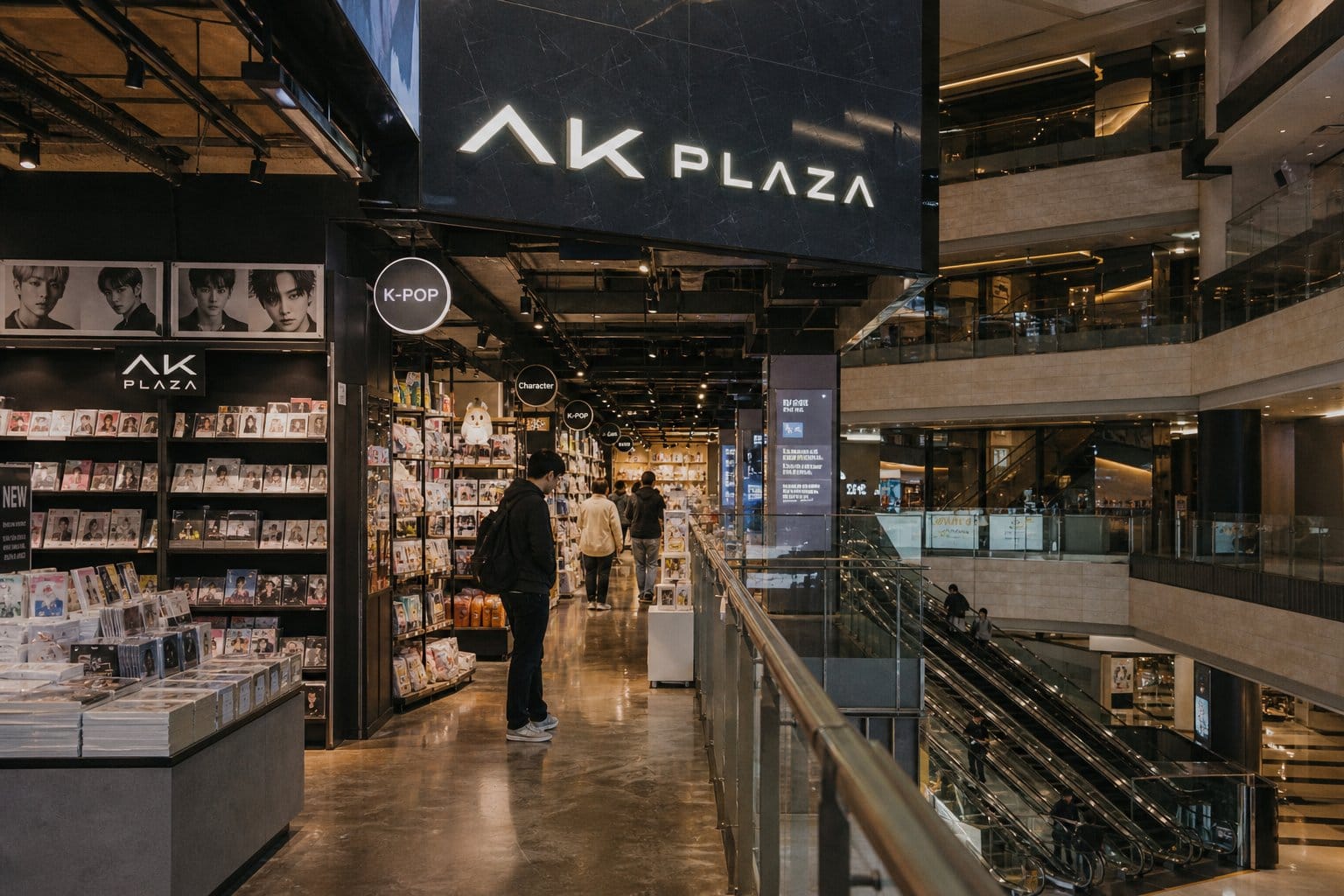
Hongdae's permanent K-pop retail is concentrated within and immediately around AK Plaza — the five-floor shopping complex built directly above Hongik University Station — and along the first several blocks of the main commercial corridor. Unlike pop-up stores (covered separately below), these locations operate year-round with consistent stock of current-group albums, photocard sets, official lightsticks, and character merchandise from licensed sources. WithMuu on the second floor of AK Plaza is the anchor K-pop specialist: it carries albums and official idol merchandise for active groups across major labels including HYBE, SM Entertainment, JYP, and YG. For fans who have just landed at Incheon and want to verify a specific album release or check lightstick stock before navigating the full district, AK Plaza's direct-above-station position makes it a logical first stop before venturing further into the corridor.
📍 서울특별시 마포구 양화로 141
🕒 매일 오전 11:00 ~ 오후 10:00
⭐ 4.7 (1,283 리뷰)
📞 02-322-9631
🔗 Google Maps에서 보기
The Kakao Friends Flagship Store spans three floors of character goods centered on Ryan, Apeach, Muzi, and the full Friends lineup. The range extends from standard stationery and plush figures into branded household goods, seasonal collections, and brand collaboration items. This is a full flagship format — the depth of stock is considerably broader than at airport or department-store outposts of the same brand.
📍 View Kakao Friends Flagship on Google Maps
Line Friends in the L7 building — the hotel-retail complex on the main Hongdae commercial strip — operates both the store and the BT21 Café within the same visit, making it a combined retail-and-experience destination. BTS-connected BT21 character merchandise covers the retail floor, while the adjacent café serves themed food and drink items alongside branded goods. For ARMY groups navigating a Hongdae itinerary, the Line Friends and BT21 Café combination in the L7 building is a consistently high-traffic stop.
📍 View Line Friends Store (L7 Building) on Google Maps
Pop Mart's two-story flagship serves the designer blind-box market rather than idol merchandise specifically — its primary audience is collectors of Labubu, SKULLPANDA, MOLLY, and similar designer toy lines, with rotating collaborations occasionally crossing into K-pop or webtoon IP. Musinsa Kicks, the sneaker flagship from Korea's dominant fashion e-commerce platform, represents the streetwear direction Hongdae's retail is consolidating in 2026 — high-concept, sneaker-first, targeting the same 18–35 demographic that buys albums and attends concerts.
📍 View Pop Mart Flagship on Google Maps
📍 View Musinsa Kicks on Google Maps
| Store | Location | Primary Stock | Key Notes |
|---|---|---|---|
| WithMuu | AK Plaza 2F (directly above Hongik University Station) | K-pop albums, official idol merch, photocard sets, lightsticks | Covers HYBE, SM, JYP, YG active groups; year-round stock |
| Kakao Friends Flagship | Hongdae main commercial district | Ryan, Apeach, Muzi character goods; seasonal collaboration items | 3-floor flagship; broadest Kakao Friends range outside brand HQ |
| Line Friends / BT21 Café | L7 Building, Hongdae commercial strip | BT21 character merchandise; themed café food and drinks | Retail + café experience in one visit; high footfall from ARMY groups |
| Pop Mart | Hongdae main district | Designer blind-box toys; rotating K-pop and webtoon IP collabs | 2-story flagship; Labubu, SKULLPANDA, MOLLY core lineup |
| Musinsa Kicks | Hongdae commercial corridor | Sneakers, streetwear, limited-run footwear releases | High-concept retail format; reflects 2026 Hongdae streetwear direction |
Pop-Up Stores: How to Track Idol Collabs and Limited-Run Drops
Pop-up stores — temporary retail activations running anywhere from a long weekend to four weeks — have consolidated as Hongdae's fastest-moving retail format in 2026. Unlike permanent stores, pop-ups are built around specific campaign windows: a K-pop group's comeback cycle, a brand collaboration tied to an idol endorsement, a webtoon property launch, or a luxury label's seasonal activation targeting the Korean youth market. They open without a fixed address on permanent maps, run their window, and close. For fans whose primary visit motivation is a group-specific pop-up, this format requires a different planning approach than a standard retail itinerary.
No centralized public registry tracks all active Hongdae pop-ups in real time — fan intelligence networks perform that function. Official fandom platforms including Weverse and Bubble publish pop-up announcements tied to artist accounts in the days before opening, and group-specific SNS accounts on Instagram and X are typically the first-look source for location pins, confirmed hours, and any reservation requirements. Korean fan community boards — organized by fansites and official fan clubs — frequently aggregate this information into single summary posts faster than official channels update. For fans working primarily in English, the international-facing accounts of major labels (HYBE Global, SM Entertainment's English channels, JYP Nation) and large international fan unions on X and Instagram are the most reliable secondary sources.
Hongdae has become Seoul's default pop-up host in preference over Gangnam (higher rental cost, older demographic skew) and Itaewon (reduced pedestrian density following 2022 crowd-safety policy changes). The district's foot traffic — particularly in the Exit 9 corridor on weekend afternoons — generates the organic throughput that brands need to justify temporary retail investment. Multiple simultaneous activations are common on weekends, meaning a single Saturday walk from Hongik University Station toward Sangsu can intersect with two or three separate pop-up footprints without deliberately planning for each.
The practical rule for visiting fans: check official SNS accounts 48–72 hours before your planned visit rather than weeks in advance. Pop-up schedules are frequently confirmed or adjusted in the days immediately before opening, and specific address pins (as opposed to general "Hongdae area" references) typically appear only 24–48 hours beforehand. Reservations via Weverse or Naver Smart Store are required for high-demand group activations — check the specific group's official announcement for confirmed entry format before arrival.
Hongdae Free Market: Saturday Art and Indie Music Sessions
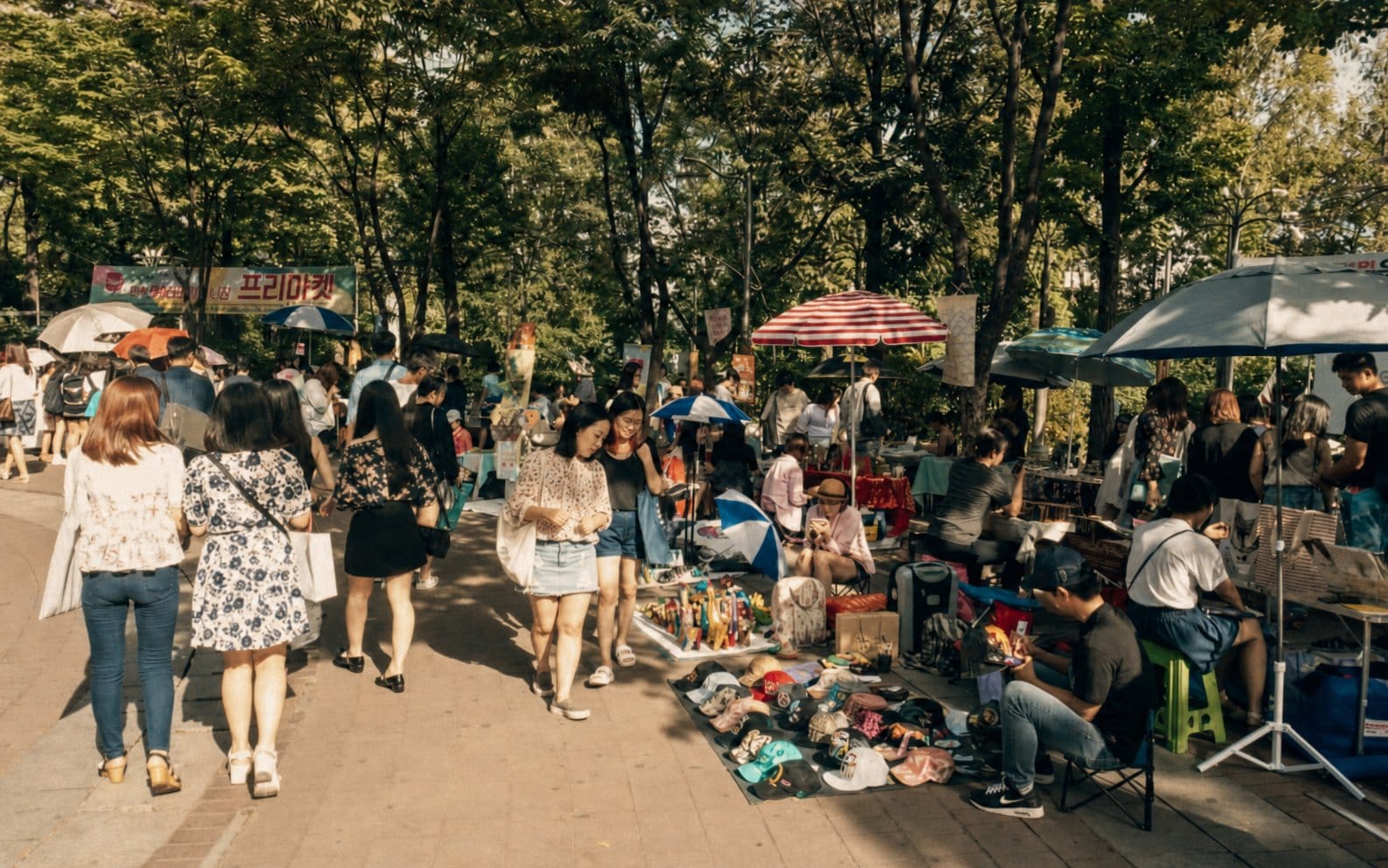
The Hongdae Art Market Free Market (홍대앞 예술시장 프리마켓) has operated every Saturday from 13:00 to 18:00 between March and November since 2002. It is one of Seoul's longest-running outdoor artist markets and functions under a strict original-work-only admission policy maintained by the organizers: mass-produced goods and resale items are excluded, and participating artists apply and are reviewed before receiving a stall. Every object on display is made by the person selling it — a meaningful distinction from the commercial shopping corridor a short walk away.
Despite its Hongdae name association, the market's nearest station is Sangsu Station (상수역, Seoul Metro Line 6), Exit 2, approximately 533 meters from the market site — a shorter and more direct walk than approaching from the main Hongik University Station exits. This catches many visitors off-guard, particularly those following general Hongdae area directions. The market is located near Seogyo-dong, in the transition zone between the main commercial district and the quieter Sangsu-dong neighborhood.
📍 서울특별시 마포구 서교동 347-20
⭐ 4.6 (9,211 리뷰)
📞 02-336-7715
🔗 Google Maps에서 보기
The Afternoon Stage runs alongside the craft stalls, featuring indie musicians and emerging artists performing throughout the market's active hours. Cultural workshops and Living Creation Tours are also periodically scheduled within the season, adding a participatory element beyond browsing. The market closes entirely from December through February — no winter dates run under any circumstances. For confirmed weekly scheduling and any session cancellations due to weather or event conflicts, the organizers can be contacted at 02-325-8553 or followed on Instagram at @artfreemarket.
For K-pop fans building a full Saturday itinerary, the 13:00–18:00 free market window integrates well with an afternoon-start day. The market runs its complete duration before Red Road busking peaks in the early evening, allowing both experiences within a single visit without scheduling conflict. The Sangsu Station approach also positions visitors to pass through the Gyeongui Line Forest Park linear trail — a 6 km green corridor of indie bookstores, creative studios, and streetside cafés — as a natural connector between the two areas.
Nightlife After 10 PM: Live Music, Club Street, and Late-Night Walks
Hongdae's nightlife circuit begins in earnest around 10 PM and runs without a hard closing time on weekends, with many bars and clubs remaining open through to dawn on Friday and Saturday nights. The club district is concentrated along Wausan-ro 21-gil — a network of narrow streets running perpendicular to the main shopping corridor — where Club FF, Crossroad, and a cluster of smaller indie venues collectively form one of Seoul's most genre-diverse live music and nightclub scenes. The area has traceable roots in the 1990s independent music movement that emerged around Hongik University's art school, and that arts-school heritage remains visible in the programming range: indie rock and singer-songwriter sets sit alongside EDM rooms, K-pop cover act bars, hip-hop nights, and acid jazz venues within the same block radius.
📍 Club St, 싱가포르
🔗 Google Maps에서 보기
"Hongdae's club circuit has retained its arts-school identity even as the genre mix has expanded from indie rock to EDM and K-pop covers — the two coexist rather than displace each other," observes Travel and Tour World in its 2026 review of the district's cultural position amid the metro construction debate.
Red Road performances continue through midnight on Friday and Saturday evenings, providing a transitional layer between the family-accessible afternoon programming and the full late-night circuit. As shopping closes — typically between 9 and 10 PM — street food carts and pojangmacha (포장마차) tented stalls activate along the main pedestrian strip, sustaining the street's energy through the transition. The shift in the district's character after 10 PM is pronounced: the afternoon crowd skews mixed-age, including families, daytime tourists, and casual shoppers; after 10 PM, the demographic tightens to a predominantly 20s and 30s local and international visitor population.
The club circuit runs Thursday through Saturday, with Thursdays drawing a predominantly local university crowd and Fridays and Saturdays attracting a wider mix that includes visitors from outside Seoul. Noraebang (노래방 — private karaoke rooms) operate around the clock throughout the district and are among the more accessible late-night options for mixed groups, since the private-room format removes the performance pressure of public karaoke while maintaining the participatory energy. Zzang Games Arcade operates four floors of gaming until 2 AM on weekdays and 3 AM on Fridays, with free entry, offering a non-club late-night option that suits groups who want to stay active without navigating the bar circuit.
Frequently Asked Questions
Can I get to Hongdae directly from Incheon Airport?
Yes. The Airport Railroad Express (AREX) runs a direct service from Incheon International Airport to Hongik University Station with no transfer required. The journey takes approximately 43 minutes from Terminal 1. Hongdae is one of Seoul's most airport-accessible entertainment districts — you exit the arrivals hall, board AREX at the airport station, and arrive directly beneath the main shopping and busking corridor. A T-Money card purchased at the airport covers the full fare without separate ticketing at each stage of the journey.
When do K-pop dance crews and buskers perform on Red Road?
Performances begin in the late afternoon and continue through to midnight on weekends. Friday and Saturday evenings are the highest-traffic windows, with the corridor operating at near-full performer and audience density. The late 2025 renovation divided the approximately 2 km Eoulmadang-ro corridor into four designated Smart Busking Zones, so performances are distributed along the full length of the street rather than concentrated at a single platform. K-pop dance crews gravitate toward the northern R1 zone; acoustic and singer-songwriter acts tend to fill the mid and southern sections. Weekday visits are quieter but not empty.
Will the Daejang-Hongdae Line construction affect the busking zone during my visit?
Groundbreaking for the Daejang-Hongdae Line took place in December 2025, with construction expected to continue through approximately 2031. The planned terminal station (Station 111) is positioned in the central plaza between the R1 and R2 busking zones, making those two northern sections the most affected by construction fencing and excavation. The surrounding shops, cafés, and the R3 and R4 southern zones of Red Road remain fully accessible. Visitors in 2026 may encounter construction activity in the northern plaza area; checking current conditions via redroad.kr before arrival is recommended for those specifically planning a busking itinerary.
Where can K-pop fans find official idol merchandise in Hongdae?
The primary year-round stock point is WithMuu on the second floor of AK Plaza, located directly above Hongik University Station and stocking albums and official merchandise for active groups across HYBE, SM, JYP, and YG labels. Line Friends in the L7 building carries BT21 character goods and runs a BT21 Café in the same location. For active group campaign merch, pop-up stores appear regularly throughout the year in the Hongdae–Sangsu corridor. Check official SNS accounts and Weverse 48–72 hours before your visit for current pop-up addresses, since location pins are typically released only in the days immediately before opening.
Is the Hongdae Free Market open every week?
The Hongdae Free Market (홍대앞 예술시장 프리마켓) runs every Saturday from 13:00 to 18:00 between March and November. It is closed entirely from December through February. Only original handmade work is sold — mass-produced and resale items are not admitted by the organizers. The nearest station is Sangsu (Seoul Metro Line 6, Exit 2), approximately 533 meters from the market site — not the main Hongik University Station. Follow @artfreemarket on Instagram or call 02-325-8553 for confirmed weekly dates and any weather-related cancellations.
Hongdae in 2026: Planning Your Visit
Hongdae in 2026 is a district in productive tension between its independent arts origins and its current function as one of Seoul's primary K-pop retail and live performance destinations. The four-zone Smart Busking format on Red Road is the most structured version of the corridor's performance culture to date — better infrastructure, consistent multilingual access, and geographic spread across the full 2 km stretch. At the same time, the Daejang-Hongdae Line construction introduces the first major spatial constraint the corridor has faced since the busking culture took hold in the 1990s. How those two forces interact across the remainder of the decade will shape the district's character for the next generation of visitors.
For fans building a Hongdae itinerary, the practical framework is consistent regardless of which groups are currently active. Arrive via AREX and use Exit 9 as your primary orientation point. Check AK Plaza's WithMuu on arrival for current permanent stock. Verify pop-up locations via official SNS 48–72 hours before your planned visit. If you are visiting on a Saturday between March and November, the Free Market (13:00–18:00, Sangsu Exit 2) integrates cleanly with an afternoon-to-evening schedule that ends on Red Road after dark. Let the Smart Busking Zone structure guide you south along the corridor as the evening progresses — the experience accumulates across zones rather than concentrating at a single stop.
The Daejang-Hongdae Line debate will not reach formal resolution in 2026, and visitors should treat the R1–R2 central plaza sections as subject to evolving site conditions. The broader district — transit access, permanent retail, club circuit, Free Market — continues to operate without disruption. On current trajectory, Hongdae remains one of Seoul's most accessible and K-pop-fan-oriented districts, with infrastructure, retail density, and live performance culture that collectively reward both first-time and return visits.
Last updated: 2026-05-18. Article compiled with reference to Korea Times reporting (December 2025), Seoul Metropolitan Government multilingual tourism resources (english.visitseoul.net), and multiple Korea travel publications active through May 2026.
This article was written using information collected and analyzed by NAMANE's in-house K-pop research AI engine. We use AI technology to bring you faster, broader coverage, and in the process some details may occasionally differ from the latest facts. For important information such as dates, venues, and prices, please double-check with official sources.


