
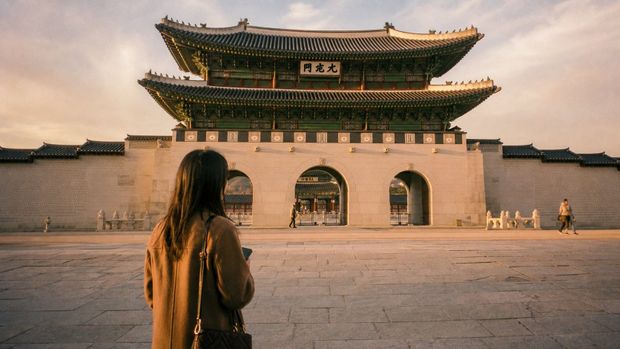
1&query=익선동+Ikseon-dong+Seoul+Jongno" target="_blank" rel="noopener noreferrer">View Ikseon-dong on Google Maps
Where to Eat in Jongno: Century-Old Institutions and Local Spots
Jongno holds an unusual concentration of restaurants with documented histories spanning a century or more — a function of the district's continuous occupation as an active city center across political changes that disrupted commerce elsewhere in Seoul. Eating here is less about trend-driven novelty and more about institutions that have maintained consistency through longevity. Prices across the board remain lower than in Gangnam or Itaewon for comparable quality, and the formats range from ox-bone broth houses open since before the Korean War to Buddhist vegetarian set menus to late-night street tent bars.
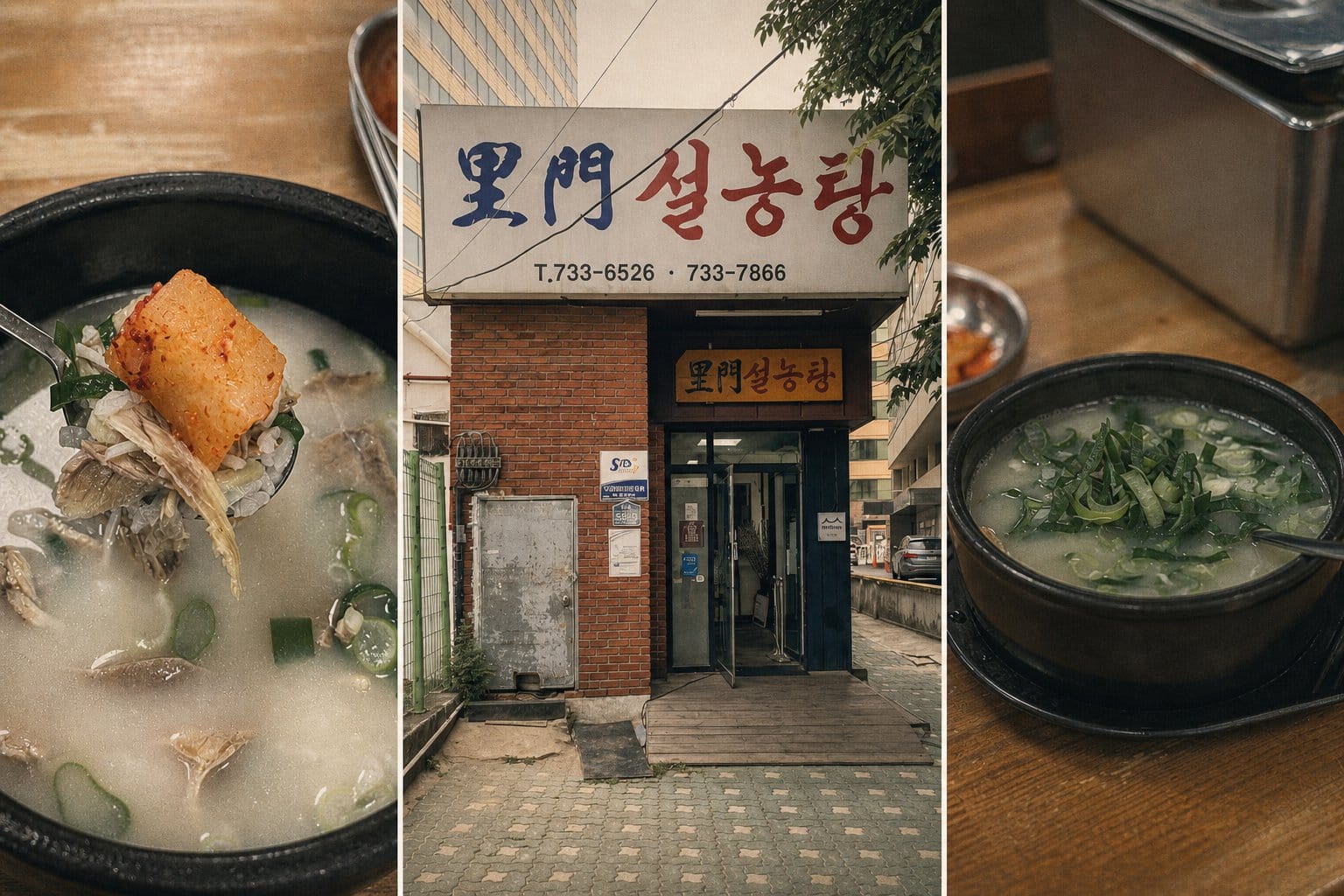
이문설농탕 | Imun Seolnongtang
Imun Seolnongtang (이문설농탕), established around 1904 , is recognized as the oldest surviving restaurant in South Korea. Its specialty is seolnongtang — ox-bone broth simmered for hours until the liquid turns milky white — served with rice, green onions, and salt to season at the table. A bowl starts at ₩12,000 . The restaurant sits a short walk from Jonggak Station on Insadong-gil. Seating is communal, service is efficient, and the menu is intentionally short — ordering is straightforward even without Korean language.
📍 38-13 Ujeongguk-ro, Jongno District, Seoul
🕒 Monday–Saturday 8:00 AM – 3:00 PM, 4:30 – 9:00 PM / Sunday 8:00 AM – 3:00 PM, 4:30 – 8:00 PM
⭐ 3.9 (2,592 reviews)
📞 02-733-6526
🔗 View on Google Maps
토속촌 | Tosokchon
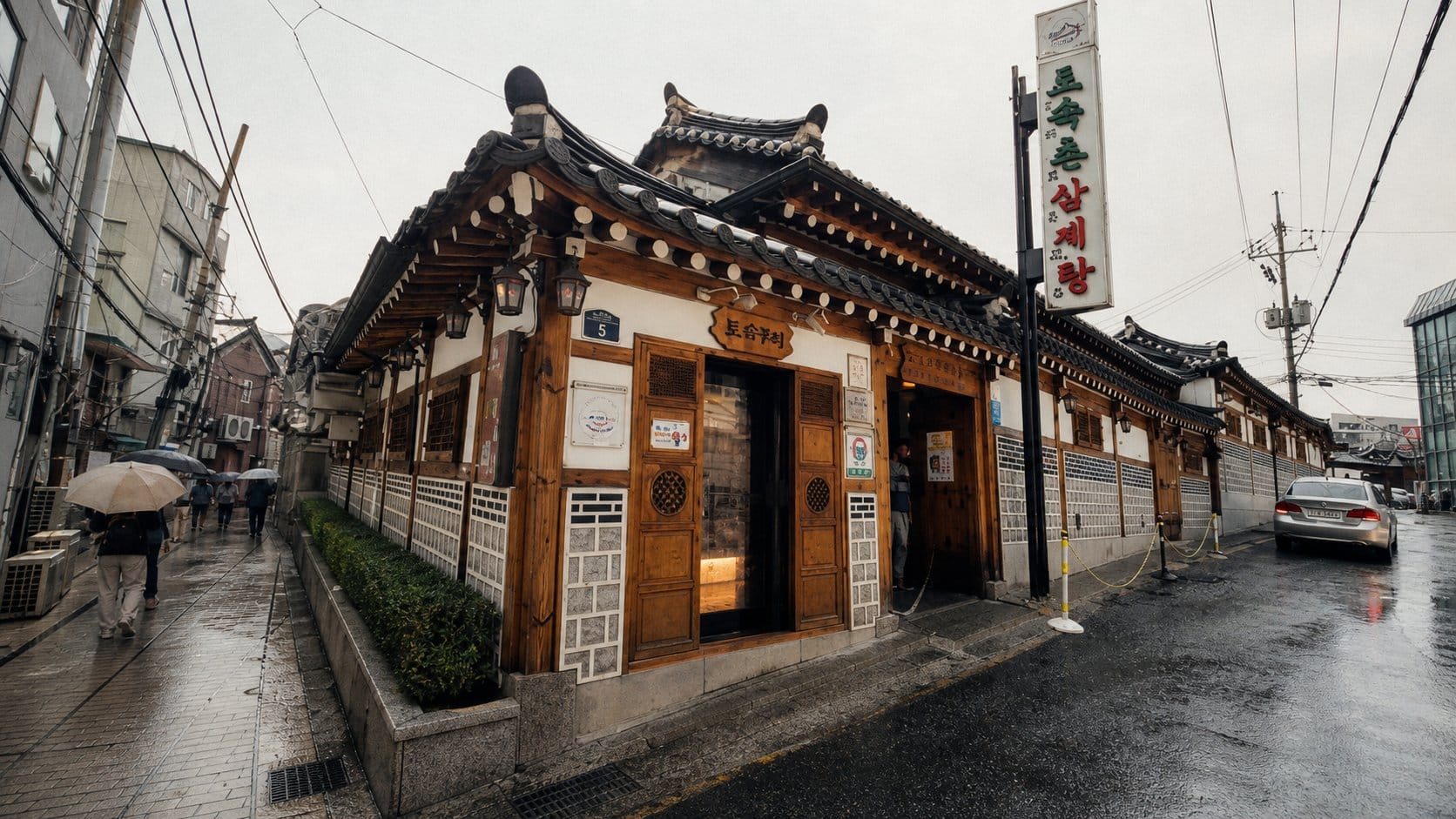
Tosokchon (토속촌), near Gyeongbokgung Station, is Jongno's most-visited specialist for samgyetang — a whole young chicken stuffed with ginseng, glutinous rice, and jujube, simmered in a clear, deeply savory broth. Budget ₩17,000–20,000 per bowl and expect a queue of 15–30 minutes on weekend lunches; the line moves steadily. Samgyetang is traditionally consumed during the hottest days of summer in Korean food culture, though Tosokchon draws visitors throughout the year. Travie, a Korean travel media outlet covering Seoul dining , identifies Tosokchon's samgyetang among the defining dining experiences of Jongno for first-time visitors to the district. The dish is substantial and is best treated as a full meal rather than a first course.
📍 5 Jahamun-ro 5-gil, Jongno District, Seoul
🕒 Daily 10:00 AM – 10:00 PM
⭐ 4.2 (11,851 reviews)
📞 02-737-7444
🔗 View on Google Maps
광장시장 | Gwangjang Market
Gwangjang Market (광장시장), established in 1905 , is Seoul's oldest traditional market and is best entered from Jongno 4-ga Station. The inner food alley — a dense corridor of individual vendor stalls each specializing in a narrow category — is the primary draw. Standard orders include bindaetteok (mung bean pancakes freshly pressed on cast iron), yukhoe (beef tartare dressed with sesame oil and Asian pear), and makgeolli (unfiltered rice wine) poured from communal ceramic bowls. The market is busiest between 11:00 and 19:00 ; arriving before noon secures seating at the more popular stalls before the lunch peak.
📍 88 Cheonggyecheon-ro, Jongno District, Seoul
🕒 Daily 9:00 AM – 10:30 PM
⭐ 4.2 (43,888 reviews)
📞 02-2267-0291
🔗 View on Google Maps
조계사 인근 사찰음식 | Temple Food near Jogyesa Temple
The cluster of Buddhist vegetarian restaurants on Ujeongguk-ro surrounding Jogyesa Temple — Korea's chief Buddhist institution — offers temple-food set menus from ₩15,000 . Temple cuisine excludes the five pungent vegetables prohibited in Buddhist cooking — garlic, green onion, wild chive, garlic chive, and asafoetida — resulting in dishes that rely on fermented pastes, wild greens, and layered seasoning for depth. The atmosphere is considerably quieter than palace-adjacent lunch options and suits visitors seeking a low-noise midday break between heritage sites.
📍 71 Gyeonji-dong, Jongno District, Seoul
🕒 Monday–Saturday 11:30 AM – 3:00 PM, 6:00 – 9:30 PM / Sunday Closed
⭐ 4.2 (453 reviews)
📞 02-733-2081
🔗 View on Google Maps
For late-night eating, the pojangmacha (street tent bars) around the elevated walkway near Jongno 3-ga serve grilled skewers (꼬치) and fish cake soup (어묵국) from ₩3,000 , staying open past midnight. The atmosphere is informal and primarily domestic — most menus are Korean-only. Vendors in this area come to life visibly after sundown, with the alleyway near the May Hotel area particularly active after dark (video: It's A Bountiful Life). Pointing at neighboring tables or skewer display racks is a reliable ordering approach that requires no prior Korean language knowledge.
When to Visit Jongno: Seasonal Conditions and Key Events
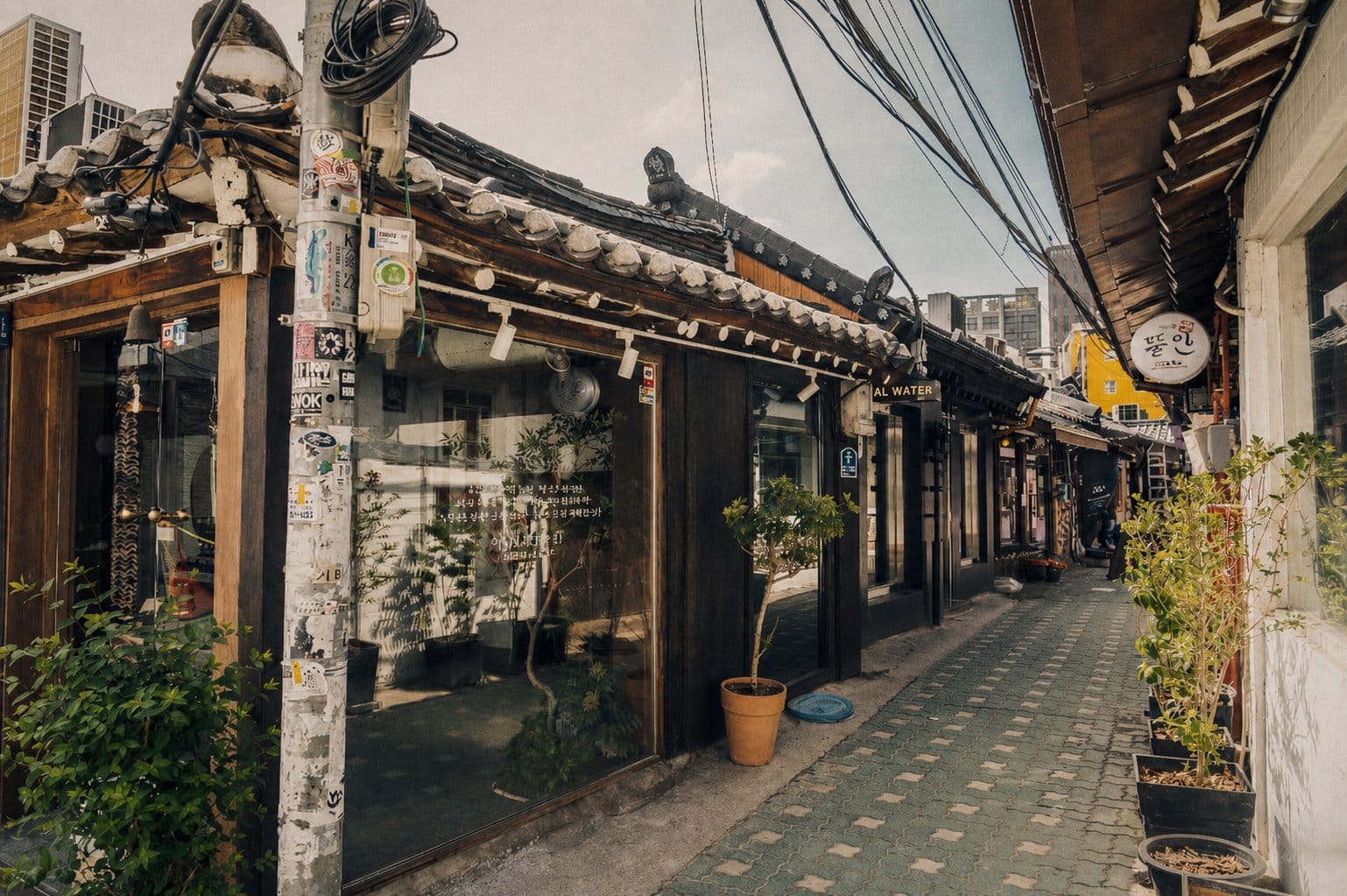
Jongno's walkable, outdoor-centric layout means seasonal conditions have a direct effect on the visit experience. The district is worthwhile across all four seasons, but there are genuine differences in crowd levels, weather comfort, and event availability that factor meaningfully into planning — particularly for visitors coordinating Jongno alongside K-pop concerts or other timed events in Seoul.
Spring (March–May) brings cherry blossoms in early April near the palace walls and along Changgyeonggung's grounds, drawing significant weekend foot traffic. The Jongmyo Jerye on the first Sunday of May — falling on May 3 in 2026 — is the most significant traditional public ritual event of the year in this district. Arrive early for viewing positions; the perimeter fills well before the ceremony begins and late arrivals have limited sightlines.
Summer (June–August) is humid and frequently above 30°C, which reduces comfort during extended outdoor walks across palace stone courtyards. The Jogyesa Temple lotus lantern festival (연등회) — a UNESCO Intangible Heritage event — typically spans late spring through early summer and is visually striking at dusk, when thousands of paper lanterns illuminate the temple precinct and surrounding Ujeongguk-ro street. If the schedule permits, this event alone justifies a late-May or early-June arrival in Jongno.
Autumn (September–November) offers mild temperatures in the 10–22°C range, peak foliage conditions around the palace walls and Bukchon hillside, and lower crowds than spring. Repeat visitors to Seoul consistently identify this period as the most practical combination of weather, color, and walkability across the district. Photography conditions peak in late October through early November, when ginkgo trees along Sejong-daero turn yellow and the palace courtyards carry a quieter quality than any other season.
Winter (December–February) brings uncrowded palace grounds and clean sightlines across the stone courtyards, but hillside lanes in Bukchon become icy — appropriate footwear is necessary rather than optional. Palace ticket prices remain unchanged year-round with no winter discount applied . Early morning visits in winter offer near-empty palace grounds — an unusual opportunity in a district that carries heavy visitor volume for most of the calendar year.
2026 planning note: Major national holidays including Chuseok (falling in late September 2026) and Seollal (late January 2026) cause palace closures on and around the holiday dates. Confirm exact 2026 closure dates through the Cultural Heritage Administration's official calendar at cha.go.kr before booking accommodation around those periods, as closures are not always on the holiday date itself.
Practical Information: Tickets, Etiquette, and Staying in Jongno
Jongno requires less advance logistical preparation than many comparable heritage districts — English signage is standard across all major sites and subway stations, transit connections are direct, and the core visitor flows are well-managed. A few specifics are worth confirming before arrival to avoid arriving at a fully booked guided tour slot or a closed gate on a holiday.
Tickets and advance booking: The integrated 4-palace pass (₩10,000 ) is available at any palace gate with no online pre-purchase required. Changdeokgung's Secret Garden guided slots sell out significantly in advance on peak spring and autumn weekends — book via the Cultural Heritage Administration portal before arrival to guarantee access. Cheong Wa Dae is free but requires online registration in advance; available slots fill quickly on weekends. Most palace gates are within 10 minutes on foot of Anguk or Gyeongbokgung Station.
Residential neighborhood etiquette: Bukchon Hanok Village and Ikseon-dong are active residential areas where people live and work year-round. According to Visit Seoul's official Bukchon guidance, the community asks visitors to keep groups below 10 people, avoid noise after 17:00, and refrain from photographing through windows or into private courtyards . A community quiet curfew runs from 17:00 through 10:00 the following morning . Notices are posted in English, Japanese, and Chinese at lane entrances. These guidelines were formalized in response to incidents where visitor volume disrupted daily residential life.
📍 View Bukchon Hanok Village on Google Maps
Accommodation: Boutique guesthouses and mid-range hotels cluster near Insadong and Anguk Station, typically priced at ₩80,000–150,000 per night . Properties adjacent to Ikseon-dong book out early on Friday through Saturday nights due to the neighborhood's late-night bar scene. For palace proximity, options near Gyeongbokgung Station include properties with mountain-facing rooms overlooking Bugaksan.
Stay Maru Jongno, a reviewed property in the area, sits 530 m from Insadong and 1.2 km from Changdeokgung Palace , with blackout curtains, individual soundproofing, and a shared kitchen available to all guests (video: Seoul, South Korea🛏️). Stay VI Jongno is similarly positioned under 700 m from Insadong Walking Street, with complimentary American breakfast, 24-hour express check-in, and individual climate control per room (video: Seoul, South Korea🏨). Both properties operate as strictly non-smoking with sanitation protocols between guest stays.
ATMs and language access: All major convenience store chains — CU, GS25, 7-Eleven — in the district accept foreign cards. KEB Hana and Woori Bank branches near Gwanghwamun provide English-language ATM interfaces. English signage is standard at all heritage sites and subway stations; Insadong restaurant menus frequently include English and Japanese. Further east toward Jongno 3-ga, pojangmacha menus are often Korean-only — pointing at neighboring tables or displayed skewer items is a reliable workaround that requires no language preparation.
Frequently Asked Questions
How long should I set aside for Jongno?
One full day of 8–9 hours covers the main heritage sites plus one neighborhood walk — a practical sequence is Gyeongbokgung in the morning, Bukchon or Changdeokgung in the early afternoon, and Insadong from mid-afternoon onward. Add a second day if you want to include an Ikseon-dong evening, Gwangjang Market as a dedicated stop, and Jongmyo Shrine without rushing between sites. The integrated 4-palace pass remains valid across multiple days, so splitting palace visits across two mornings is a practical option that reduces afternoon fatigue from extended stone-courtyard walking.
Which subway line is most useful for visiting Jongno?
Line 3 serves the western heritage core directly, with Gyeongbokgung Station (Exit 5) for the main palace and Cheong Wa Dae, and Anguk Station (Exits 1 and 6) for Bukchon Hanok Village and Insadong. Jongno 3-ga Station — where Lines 1, 3, and 5 intersect — is the most effective interchange for the eastern side of the district, including Ikseon-dong and Gwangjang Market. For visitors arriving from Incheon Airport, Line 1 from Seoul Station to Jonggak Station is the most direct routing into the Insadong corridor, with a total journey of approximately 65 minutes .
Is Jongno free to explore?
Many areas in Jongno are accessible at no cost: Gwanghwamun Plaza, Jogyesa Temple grounds, the Insadong pedestrian street, and the Ikseon-dong neighborhood require no entry fee. Palace visits require the integrated 4-palace ticket at ₩10,000 , though hanbok-wearing visitors enter free (hanbok rental near palace gates approximately ₩20,000 ). Cheong Wa Dae is free with advance online registration. The National Palace Museum and Seoul Museum of History charge no general admission fee .
What is the best time of year to visit Jongno in 2026?
Autumn — October through early November — offers the most consistent combination of mild temperatures (10–22°C), foliage conditions around the palace walls, and manageable crowd levels. Late March through early May is favorable for cherry blossoms and the Jongmyo Jerye ceremony (May 3, 2026 ), but spring weekend crowds at peak sites are notably heavier. Both seasons require advance booking for Changdeokgung's Secret Garden, where timed entry slots sell out well before the visit date.
Is Jongno a practical base for K-pop fans visiting Seoul?
Jongno is a heritage district rather than a live-music hub, and none of Seoul's major concert venues are located within the district. However, its central subway connectivity makes it a workable base for event visitors: Hongdae (Line 2, approximately 25 minutes), COEX Arena (Line 2, Samseong Station, approximately 35 minutes), and Olympic Park (Line 5, Olympic Park Station, approximately 40 minutes from Jongno 3-ga) are all reachable within one transit connection. Visitors attending evening concerts can spend a full day across Jongno's heritage and food areas and reach most major Seoul venues in time for evening events without backtracking across the city.
Watch / Sources
- It's A Bountiful Life — Seoul, Korea, Jongno, Hotel May Area & Review
- Seoul, South Korea🛏️ — Stay Maru Jongno - Luxury for This Price?
- Seoul, South Korea🏨 — STAY VI JONGNO - Best Surprise Hotel
Planning Your Jongno Visit: What to Confirm Before You Arrive
Jongno rewards visitors who arrive with a loose structure rather than a rigid hour-by-hour itinerary. The district's density means worthwhile diversions — a temple courtyard, a tea house alley, a calligraphy shop, an unexpected market vendor — appear between the designated sites and are worth absorbing without schedule pressure. The core practical decisions to confirm in advance are limited to two: booking the Changdeokgung Secret Garden slot through the Cultural Heritage Administration portal, and registering for Cheong Wa Dae online. Everything else — food, transit, neighborhood wandering — is accessible without prior reservation and responds well to flexible planning.
For K-pop fans using Seoul primarily for concert visits, Jongno provides a counterpoint that holds its own as a standalone destination rather than a gap-filler between event days. A morning palace walk and midday Gwangjang Market stop can be completed before a 19:00 concert call time at any major Seoul venue, with time to spare. The combination of heritage depth, low per-site cost, and direct subway access to all major event districts makes Jongno one of the more versatile bases in Seoul for a trip that balances concerts with city exploration.
Seoul's heritage access continues to expand: additional sections of Cheong Wa Dae grounds were opened in phases following the initial 2022 public access , and restoration work at Gyeonghuigung is ongoing as documented by Visit Seoul's Gyeonghuigung page. Confirm current access conditions against the Cultural Heritage Administration calendar and Visit Seoul's official listings before finalizing an itinerary, as site availability can shift between seasons.
Last updated: 2026-05-29. Article reviewed against available Cultural Heritage Administration, Visit Seoul, Wikivoyage, Korea Insider, and Travie sources as of May 2026. Prices, operating hours, and access conditions are subject to change — verify against official sources before travel.
This article was written using information collected and analyzed by NAMANE's in-house K-pop research AI engine. We use AI technology to bring you faster, broader coverage, and in the process some details may occasionally differ from the latest facts. For important information such as dates, venues, and prices, please double-check with official sources.


