
How Much Does 4 Days in Korea Cost? Summary by Tier
A 4-day trip to South Korea — Seoul-focused, excluding international flights — costs roughly $150–$344 per person at budget tier, $430–$870 at mid-range, and $1,140–$2,450+ at luxury . The 2026 exchange rate sits at approximately 1 USD = 1,380–1,500 KRW , a position that works in favor of international visitors. Knowing which tier fits your plans — and where K-pop fan activities like guided tours, idol cafés, and merch shopping sit within that budget — is the essential starting point before you book anything.
Quick Answer: A 4-day South Korea trip costs $150–$344 (budget), $430–$870 (mid-range), or $1,140–$2,450+ (luxury) per person, excluding flights. In 2026, 1 USD ≈ 1,380–1,500 KRW, making Seoul genuinely affordable for international fans attending K-pop concerts or fan events.
The mid-range and above tiers are where most K-pop fan itineraries land. Guided fan tours through the SM, HYBE, and JYP entertainment districts, visits to idol-themed cafés, and merch runs at dedicated fan retail spots add $50–$120 in dedicated fan activity spending per person . Budget travelers can trim this by attending free outdoor street performances in Hongdae and skipping guided tours — but if a fan tour is on the agenda, mid-range is the realistic floor for a comfortable trip.
The table below breaks down spending by category across all three tiers, based on a 4-day, 3-night Seoul trip per person. All figures are in USD at 2026 rates .
| Category | Budget Tier | Mid-Range Tier | Luxury Tier |
|---|---|---|---|
| Accommodation (3 nights) | $45–$135 (hostel dorm) | $150–$360 (guesthouse / 3-star hotel) | $480–$1,200+ (5-star hotel) |
| Food (4 days) | $60–$120 (markets + convenience stores) | $200–$320 (restaurants + 1–2 BBQ nights) | $400–$600+ (fine dining) |
| Local Transport (4 days) | $15–$25 (subway only) | $25–$50 (subway + occasional taxi) | $80–$200 (taxis / private transfers) |
| Airport Transfer (round trip) | $7–$14 (AREX local train) | $14–$26 (AREX Express or limousine bus) | $112–$152+ (private taxi) |
| Activities / Attractions | $20–$50 (palaces, free spots) | $80–$150 (N Tower + fan tour) | $200–$300+ (premium tours + theme park) |
| Connectivity (4 days) | $9 (pocket WiFi) | $9 (pocket WiFi) | $9–$46 (pocket WiFi or local SIM) |
| Total (per person, excl. flights) | $150–$344 | $430–$870 | $1,140–$2,450+ |
Airport Transfer: Incheon to Seoul Cost Options
Incheon International Airport sits roughly 70 km west of central Seoul, and the cost of getting into the city varies considerably depending on which option you choose. The cheapest is the all-stop AREX local train at approximately $3.50 one way (video: Angelica & Aileen Wanders). It makes multiple intermediate stops before reaching Seoul Station, where it connects directly to Seoul's wider subway network — useful for traveling onward to Hongdae, Myeongdong, or any other neighborhood without an additional transfer fee.
The AREX Express cuts the journey to 45 minutes and costs $7 one way . It operates non-stop between Incheon Airport and Seoul Station, running from 5:30 AM to 10:30 PM daily. This is the better option when you arrive tired after a long-haul flight, are heading to a concert the same evening, or simply want to reach the city quickly. Both AREX services accept the T-money card — purchased at Incheon Airport vending machines for 4,000 KRW (~$2.65) — with any remaining balance refundable .
The airport limousine bus (5:00 AM–11:00 PM) costs 18,000 KRW (~$12–$13) and takes 60–90 minutes depending on your destination in Seoul . Its key advantage is routing directly to major hotel districts and neighborhoods including Hongdae and Myeongdong, saving you the effort of navigating the subway with luggage from Seoul Station. Worth considering if the limousine line serves your accommodation area.
Taxis from Incheon run $50–$70 plus a mandatory $6 Incheon expressway toll . For solo travelers that's expensive. Split among three or more passengers, however, the $56–$76 total becomes competitive — particularly for late-night arrivals when AREX schedules are less convenient. Round-trip budget summary: $7–$20 by public transit (AREX local or express), $24–$26 by limousine bus (both ways), or $112–$152 by taxi (both ways).
Accommodation for 3 Nights: Price Range by Type
A 4-day Seoul trip means 3 nights of accommodation. The price range is genuinely wide: hostel dorm beds start at $15 per night ($45 for 3 nights), while 5-star hotels run $160–$400+ per night ($480–$1,200+ total) . For K-pop fans, neighborhood matters as much as price point. Staying within walking distance of Hongdae's music venues and street art, or close to a major concert hall, reduces per-day transit costs and removes the stress of navigating unfamiliar routes after a late show.
Hostel dorm beds in Hongdae and Myeongdong run $15–$45 per night, with options near Hongdae's main strip available from around $30–$35 . Hongdae's concentrated energy — busking musicians, pop-up fan meetups, murals — means you're rarely bored between activities. Private guesthouse rooms push prices to $30–$60 per night, with K-Guesthouse Dongdaemun Premium representing a solid mid-range pick from $57/night in a central location .
📍 View K-Guesthouse Dongdaemun Premium on Google Maps
3-star hotels sit in the $50–$120/night range, or $150–$360 for 3 nights. Seoul Central Hotel at approximately $50/night represents the stronger-value end of this tier — reliable facilities, central location, and good transit access . 5-star hotels open at $160/night and have no practical ceiling; the 3-night total spans $480–$1,200+ .
📍 View Seoul Central Hotel on Google Maps
"Hongdae is consistently the top pick for visitors who want direct access to Seoul's indie music scene and street art culture. Budget dorm beds near the main strip run $30–$35 a night, and the neighborhood itself keeps you entertained without needing to take the subway after dark." — Editorial team, Klook South Korea Budget Guide
| Accommodation Type | Price Per Night (USD) | 3-Night Total (USD) | Best For |
|---|---|---|---|
| Hostel dorm bed | $15–$45 | $45–$135 | Solo budget travelers, fan groups |
| Private guesthouse room | $30–$60 | $90–$180 | Couples, small fan groups |
| 3-star hotel | $50–$120 | $150–$360 | Comfort-focused mid-range budgets |
| 5-star hotel | $160–$400+ | $480–$1,200+ | Luxury / VIP concert experience |
Food Costs: What to Expect at Every Price Point
Seoul is one of the most accessible cities in Asia for eating well without spending much. Budget travelers can realistically eat on $15–$30 per day through convenience stores, street market stalls, and fast-casual chains . Convenience stores like CU and GS25 sell triangular kimbap for 1,200–1,800 KRW and pre-made rice dishes for 3,500–5,500 KRW ($2.35–$3.65) . Fast-casual chain 싸다김밥 (Ssadakimbap — literally "cheap kimbap") offers cheese kimbap for 4,500 KRW ($3) and pork cutlet omelet for 10,000 KRW ($6.65) (video: Angelica & Aileen Wanders).
Street markets push the value even further. Gwangjang Market in Jongno offers kalguksu (handmade noodle soup) at 7,000–8,000 KRW (~$5) per bowl — made internationally famous by Netflix's Street Food Asia featuring vendor Yun Sun. Mungbean pancakes (빈대떡) at Gwangjang run around 5,100 KRW (~$3.40) .
📍 View Gwangjang Market on Google Maps
At Namdaemun Market, hotteok (stuffed sweet pancakes) cost just 2,000 KRW (~$1.35) per serving (video: Angelica & Aileen Wanders) — one of the most satisfying cheap snacks available in Seoul.
📍 View Namdaemun Market on Google Maps
"Seoul's street markets are where your food budget goes furthest — at Gwangjang alone, you can eat kalguksu, mungbean pancakes, and still have change from $12. The quality is remarkable for the price, and portions are generous enough you won't need to eat again for hours." — Angelica & Aileen Wanders, 2026 Korea Food Guide: 50 Budget Eats
Step up to mid-range dining and Korean BBQ defines the experience. Samgyeopsal (grilled pork belly) costs around 16,000 KRW ($10.65) per person , while a full Korean BBQ dinner runs 20,000–50,000 KRW ($13–$33) depending on the cut and restaurant grade . A bowl of gukbap (rice and soup) at a neighborhood restaurant is 10,000 KRW ($6.65) . Café culture is a notable line item for K-pop fans: the average Seoul café coffee runs approximately 8,000 KRW ($5.35) . Near Hongdae, Cafe Popo serves fruit sandwiches at 4,500 KRW ($3) and iced caramel macchiatos at 5,500 KRW ($3.65) (video: Angelica & Aileen Wanders) — a popular stop for fans between venue visits.
📍 View Cafe Popo (Hongdae) on Google Maps
Over 4 days, total food spend ranges from $60–$120 on a strict budget (markets, convenience stores, fast-casual chains) to $200–$320 at mid-range (sit-down meals, 1–2 BBQ dinners, daily café stops), and $600+ at the fine dining or Michelin level. There is no tipping culture in Korea, which keeps every meal slightly cheaper than comparable dining in Japan or Western Europe.
Getting Around Seoul: Subway, T-Money Card, and Taxis
Seoul's subway network is among the most efficient in Asia, and for a 4-day visit it is the primary tool for getting around. A single journey costs 1,400–1,550 KRW (~$0.93–$1.10) with a T-money card . On an active touring day — crossing from Hongdae to Insadong, then Myeongdong, then back — you'll typically take 4–8 trips, adding up to $3.70–$8.80 per day. Over 4 days, the subway total comes to $15–$35 per person .
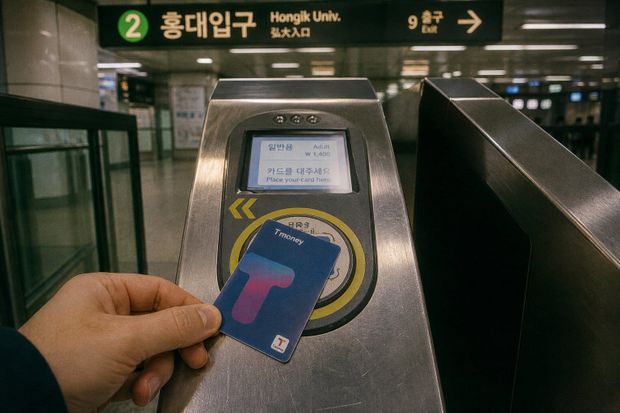
The T-money card is the single most important purchase you can make on arrival. It costs 4,000 KRW (~$2.65) at Incheon Airport vending machines or any convenience store (video: Angelica & Aileen Wanders). It works on the subway, city buses, and AREX trains — load it with cash, use it across all transit, and any remaining balance is refundable. Buying it immediately on arrival at Incheon eliminates the need to purchase single-use tickets at every station, saves a small amount per ride, and makes transfers seamless.
Taxis in Seoul are metered and reasonable by global city standards. The base fare is 3,500 KRW ($2.35), and a typical city ride runs 7,000–15,000 KRW ($4.65–$10) . Their practical use case on a fan trip is post-concert transport: after a show wraps at 10 PM or later, catching a taxi directly from the venue rather than waiting out the post-concert subway surge is often worth the $5–$10 cost. Download Kakao T before your trip — Korea's leading ride-hailing app supports English and card payment, making it straightforward to use without Korean language knowledge.
Activities and Attractions: Free, Low-Cost, and Splurge
Seoul delivers strong value on activities even before accounting for K-pop-specific experiences. The city's most rewarding public spaces are free: the Namsan hiking trails leading to the base of N Seoul Tower, Hongdae's street performance district and surrounding mural areas, and the National Museum of Korea — one of the world's largest national museums — all cost nothing to enter . These alone can fill a meaningful portion of a 4-day itinerary.
📍 View Namsan Hiking Trails on Google Maps
📍 View National Museum of Korea on Google Maps
At the low-cost level, a royal palace combination ticket covering multiple palaces including Gyeongbokgung costs 6,000 KRW (~$4) — significant value given the scale of the sites. N Seoul Tower observation deck admission is 29,000 KRW (~$19) . Bukchon Hanok Village, the preserved Joseon-era neighborhood north of Gyeongbokgung, is free to walk through and a popular stop for fans interested in traditional Korean aesthetics distinct from the pop culture downtown.
📍 View N Seoul Tower on Google Maps
📍 View Bukchon Hanok Village on Google Maps
Splurge-tier options include Lotte World theme park at 62,000 KRW (~$41) per entry and a DMZ day tour at approximately $50 per person .
📍 View Lotte World on Google Maps
For K-pop fans, guided fan tours are the standout activity category. These tours — covering the SM Entertainment building area, HYBE headquarters in Yongsan, JYP and YG districts, idol-themed cafés, and fansign venue locations — typically run $50–$120 per person for a half-day experience . Booking through Creatrip or Klook often yields bundled pricing and English-language guides with current knowledge of fan event locations.
Connectivity: Pocket WiFi vs Local SIM for 4 Days
Staying connected in Seoul is a practical necessity — real-time map navigation, fan community updates, translation of Korean menus, and checking live event schedules all depend on a reliable data connection. The two standard options are pocket WiFi rental and a local SIM card, and for a 4-day trip the math clearly favors one.
Pocket WiFi rental costs approximately $2.30 per day, bringing a 4-day total to around $9.20 (video: Angelica & Aileen Wanders). Units are available for pickup at Incheon Airport on arrival — no advance shipping required — and support multiple simultaneous device connections, making them practical for travel companions who want to share a single rental. A local SIM with unlimited data for 30 days costs approximately $46 .
For a 4-day stay, pocket WiFi at $9.20 is roughly 80% cheaper than a 30-day SIM at $46. The SIM only becomes more economical at trip lengths of three weeks or longer. The decision is straightforward: pick up pocket WiFi at the Incheon Airport rental counter, return it on departure, and use the $37 you save elsewhere on the trip — probably another BBQ dinner.
Final Budget Summary: What to Realistically Set Aside
Pulling together all cost categories — accommodation, food, transport, airport transfers, activities, and connectivity — here is what a realistic 4-day Seoul budget looks like per person, excluding international flights .
Budget tier ($150–$344): Hostel dorm for 3 nights, street market and convenience store meals, AREX Express for both airport transfers, subway-only local transport, pocket WiFi, and one or two paid attractions such as palace combination tickets. This is a workable approach for fans who prioritize the experience over comfort and have flexibility in accommodation.
Mid-range tier ($430–$870): Private guesthouse or 3-star hotel, a mix of restaurants with one Korean BBQ dinner, AREX Express or limousine bus, subway with occasional taxis for late nights, a K-pop fan tour, and one larger attraction (N Seoul Tower or a day tour). This is where most international K-pop visitors actually land — it covers the fan activity budget while remaining significantly cheaper than comparable trips to Tokyo or London.
Luxury tier ($1,140–$2,450+): 5-star hotel, fine dining throughout, private airport transfers, taxis as primary local transport, VIP or premium fan experiences, and add-on activities including Lotte World. Even at this level, Seoul is competitively priced relative to major cities in Japan or Western Europe.
A few practical notes on payment in Korea. There is no tipping culture — do not tip at restaurants, cafés, or in taxis. Cards are accepted at most restaurants and shops. Keep a modest amount of cash on hand — 10,000–20,000 KRW is sufficient for smaller street vendors and market stalls. Your T-money card handles all subway, bus, and AREX fares. Using card for restaurants, small cash for markets, and T-money for transit covers virtually every spending scenario in Seoul without friction .
Frequently Asked Questions
How much money do I need for 4 days in Korea in 2026?
Plan on $150–$344 per person at budget level (hostel dorm, street food, subway, AREX Express for airport), $430–$870 at mid-range (private guesthouse or 3-star hotel, restaurant meals including one Korean BBQ night, a K-pop fan tour), or $1,140–$2,450+ at luxury (5-star hotel, fine dining, private transfers, premium experiences). All figures exclude international flights. The 2026 exchange rate of approximately 1 USD = 1,380–1,500 KRW is favorable for visitors arriving from North America, Europe, and Oceania .
What is the cheapest way to get from Incheon Airport to Seoul?
The AREX all-stop local train at approximately $3.50 one way is the least expensive option . If you prefer speed, the AREX Express costs $7 and completes the journey in 45 minutes, running from 5:30 AM to 10:30 PM. Both services require a T-money card, available at Incheon Airport vending machines for 4,000 KRW (~$2.65). The airport limousine bus at 18,000 KRW (~$12–$13) is also worth considering if its route serves your accommodation neighborhood directly, since it avoids a subway transfer with luggage.
Is food in Korea expensive for tourists?
No — Seoul is one of the most affordable cities in Asia for eating well. Budget travelers can sustain on $15–$30 per day through convenience stores (triangular kimbap from 1,200 KRW), fast-casual chains like 싸다김밥 (full meals from $3–$7), and street market stalls where dishes run $1.35–$5. Gwangjang Market and Namdaemun Market offer filling meals for well under $6. Mid-range restaurant dining including Korean BBQ runs $50–$80 per day. There is no tipping culture in Korea, which keeps every meal slightly cheaper than equivalent dining in Japan or Western Europe .
Do I need cash in Korea or can I use a credit card?
Cards are accepted at the vast majority of restaurants, hotels, and shops throughout Seoul. Cash is primarily useful at smaller street market stalls and outdoor food vendors. A T-money card — purchased for 4,000 KRW at Incheon Airport and loadable with KRW — is essential for all subway, bus, and AREX transit. The practical approach: pay by card at restaurants and shops, keep 20,000–30,000 KRW in cash for markets and convenience store purchases, and keep your T-money loaded for transit. You will not need to carry large amounts of cash at any point in Seoul .
How much do K-pop fan tours in Seoul cost?
Guided K-pop fan tours in Seoul — covering the entertainment agency building districts (SM, HYBE/Big Hit, JYP, YG), idol-themed cafés, fansign location walks, and merch shopping routes — typically cost $50–$120 per person for a half-day experience . Booking through Creatrip or Klook often includes bundled pricing and English-speaking guides with up-to-date knowledge of current fan event locations and idol café openings.
Watch / Sources
- Angelica & Aileen Wanders — Korea 2026 Travel Guide: Best Places to Visit & Things to Do • Itinerary & Expenses • Budget Vlog
- Angelica & Aileen Wanders — 2026 Korea Food Guide: 50 Budget Eats (w/ Prices) • Best Restaurants & Street Food Trip • Seoul Vlog
- Angelica & Aileen Wanders — Busan 2026 Travel Guide: Best Places to Visit & Things to Do • Itinerary & Costs • Korea Budget Vlog
Planning Your Korea Budget: Where to Go From Here
A 4-day trip to Korea sits within reach across almost every travel budget — the question is where you want to concentrate your spending. Fans attending a K-pop concert on a fixed date should book accommodation in the neighborhood closest to the venue well in advance; prices in Hongdae, Mapo, and Jamsil spike noticeably around major concert dates at venues like KSPO Dome or Jamsil Olympic Stadium. Once accommodation is confirmed, the remaining costs — food, transit, and activities — are highly manageable and adjustable on the ground without advance planning.
The two biggest budget variables are accommodation tier and whether you incorporate a dedicated K-pop fan tour. Those two items together can swing your total by $200–$400 per person. Everything else — airport transfers via AREX, daily subway rides, pocket WiFi, and street market meals — is predictable, low-cost, and requires minimal advance decision-making. Building a 10–15% contingency into your budget for fan merchandise, spontaneous café stops, and last-minute activity upgrades is practical advice for any trip that centers on a specific artist or event.
Seoul's combination of efficient public transit, genuinely affordable street food, and a dense concentration of K-pop cultural venues makes it one of the most accessible cities in Asia to visit on a constrained budget. The cost floor is low; the ceiling is shaped primarily by concert tier and hotel preference — not by the city itself.
Last updated: 2026-05-28. Prices are based on 2026 research data at an exchange rate of approximately 1 USD = 1,380–1,500 KRW. Venue admission fees, transit fares, and accommodation rates are subject to change; verify current figures before travel.
This article was written using information collected and analyzed by NAMANE's in-house K-pop research AI engine. We use AI technology to bring you faster, broader coverage, and in the process some details may occasionally differ from the latest facts. For important information such as dates, venues, and prices, please double-check with official sources.


