
Last updated: July 29, 2026.
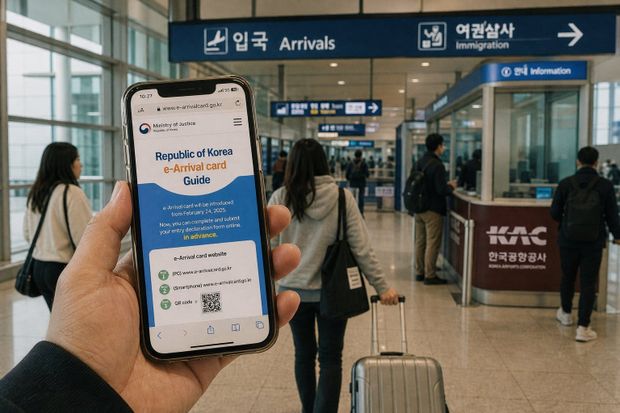
For K-POP fans flying into Seoul for a concert, festival, fan meeting, or comeback trip, Korea’s arrival paperwork is now something to handle before landing. The practical rule is simple: check whether you need the e-Arrival Card, use only the official government site, and submit close to your flight date.
Do you need Korea’s e-Arrival Card before your trip?
Most foreign nationals entering South Korea need an arrival declaration, and Korea’s official e-Arrival Card is the online version of that immigration form. The card can be submitted within 3 days before arrival based on Korea Standard Time and becomes invalid 72 hours after submission, so fans should complete it shortly before departing for Korea rather than weeks ahead.
Quick Answer: Most foreign nationals entering Korea need an arrival declaration, now available through the official free e-Arrival Card site. Submit it within 3 days before arrival; it loses validity after 72 hours if you have not entered Korea.
Korea launched the online e-Arrival Card system on February 24, 2025, as the Ministry of Justice’s digital alternative to the paper arrival card previously submitted to immigration officers. During the transition period, electronic and paper arrival cards were both accepted through December 2025.
The official service is free and is available through Korea’s e-Arrival Card website. The official site describes the basic submission flow as terms agreement with an email address, passport information, travel itinerary, information review, and submission .
For concert travelers, the key distinction is that an arrival card is not the same thing as a visa, K-ETA, Q-Code, or customs declaration. The e-Arrival Card records immigration arrival information such as passport details, flight or vessel information, stay address, contact details in Korea, purpose of entry, and occupation, according to Korea Immigration Service guidance . If you are flying in for a show at a Seoul venue, prepare your passport, flight number, hotel or stay address, and email before starting.
Use caution with unofficial arrival-card pages. Korea’s official e-Arrival Card materials state that the service has no fee, and the official website identifies itself as the Korean e-government website . GOV.UK also tells travelers that there is no fee to submit Korea’s e-Arrival Card and directs them to the official e-Arrival Card website for the process .
Korean nationals do not need the e-Arrival Card, and several foreign traveler groups are exempt as well. Korea’s K-ETA guidance says valid K-ETA holders are exempt from submitting the arrival card, while Visit Korea says the temporary K-ETA exemption for covered visa-free countries and regions has been extended through December 31, 2026. That makes the pre-trip checklist country-specific: confirm your visa or K-ETA status, then decide whether the e-Arrival Card applies to your trip.source
Who is exempt from Korea’s arrival card requirement?

Korea’s arrival card exemption mainly covers people whose entry identity is already handled through Korean nationality, resident registration, a valid K-ETA, selected organized tourist or transfer categories, or crew status. The practical rule is simple: if you are a short-term foreign visitor without a valid K-ETA or another listed exemption, you should expect to submit Korea’s e-Arrival Card before immigration inspection.
The official exemption list includes registered residents in Korea, including permanent residents and domestic residence reporters, foreign nationals holding a valid K-ETA, specified group tourist categories, specified visa-free transfer passengers, and airline crew members . The K-ETA application guide also says travelers with K-ETA approval are exempt from submitting the arrival card when entering Korea .
For visiting fans, the point that causes the most confusion is K-ETA. K-ETA is an electronic travel authorization for eligible visa-free travelers, not a visa, and it does not guarantee entry into Korea. However, travelers who already hold a valid K-ETA are exempt from submitting an arrival card, which means they normally do not need to complete the e-Arrival Card separately before landing .
Korea has also extended the temporary K-ETA exemption for covered visa-free countries and regions through December 31, 2026. Visit Korea says covered travelers may still apply for K-ETA to receive K-ETA benefits, including arrival-card exemption, but the standard application fee applies .source
| Traveler type | Is Korea’s e-Arrival Card needed? | K-ETA relevance | What to prepare |
|---|---|---|---|
| Korean national | No | Not relevant for entry as a Korean national | Korean passport or accepted Korean travel document |
| Registered foreign resident, permanent resident, or domestic residence reporter | No, if the resident status is valid | Usually not the deciding document | Passport plus valid Korean residence or domestic residence documentation |
| Short-term foreign visitor with a valid K-ETA | No, because valid K-ETA holders are arrival-card exempt | K-ETA is separate from the e-Arrival Card and is not a visa | Passport used for K-ETA, valid K-ETA record, flight and stay details for immigration questions if asked |
| Visa-free traveler covered by the temporary K-ETA exemption | Usually yes, unless the traveler separately holds valid K-ETA | K-ETA may be optional during the temporary exemption period through December 31, 2026 | Passport, flight or vessel details, Korean address, local contact information, occupation, and email address |
| Certain group tourist categories | No, if the traveler falls under the listed exempt group | Handled through the relevant group travel status, not individual K-ETA | Passport and group travel documentation from the tour operator or visa process |
| Some visa-free transfer passengers | No, if the transfer category qualifies | Usually separate from K-ETA | Passport, onward ticket, and transfer itinerary |
| Airline crew | No, when entering under crew status | Not normally relevant for crew entry | Crew identification and documents required by the carrier and immigration authorities |
| Ordinary short-term visitor without valid K-ETA or another exemption | Yes | K-ETA may remove the arrival-card step only if valid and applicable | Passport, itinerary, Korean stay address, contact details, occupation, and email address |
The safest way to decide is to identify your status before you start the form: Korean national, registered resident, K-ETA holder, covered temporary K-ETA-exempt traveler, group tourist, transfer passenger, crew, or ordinary visitor. If your status is uncertain, use the official e-Arrival Card site and the K-ETA guide rather than third-party summaries.
How do you submit Korea’s e-Arrival Card correctly?
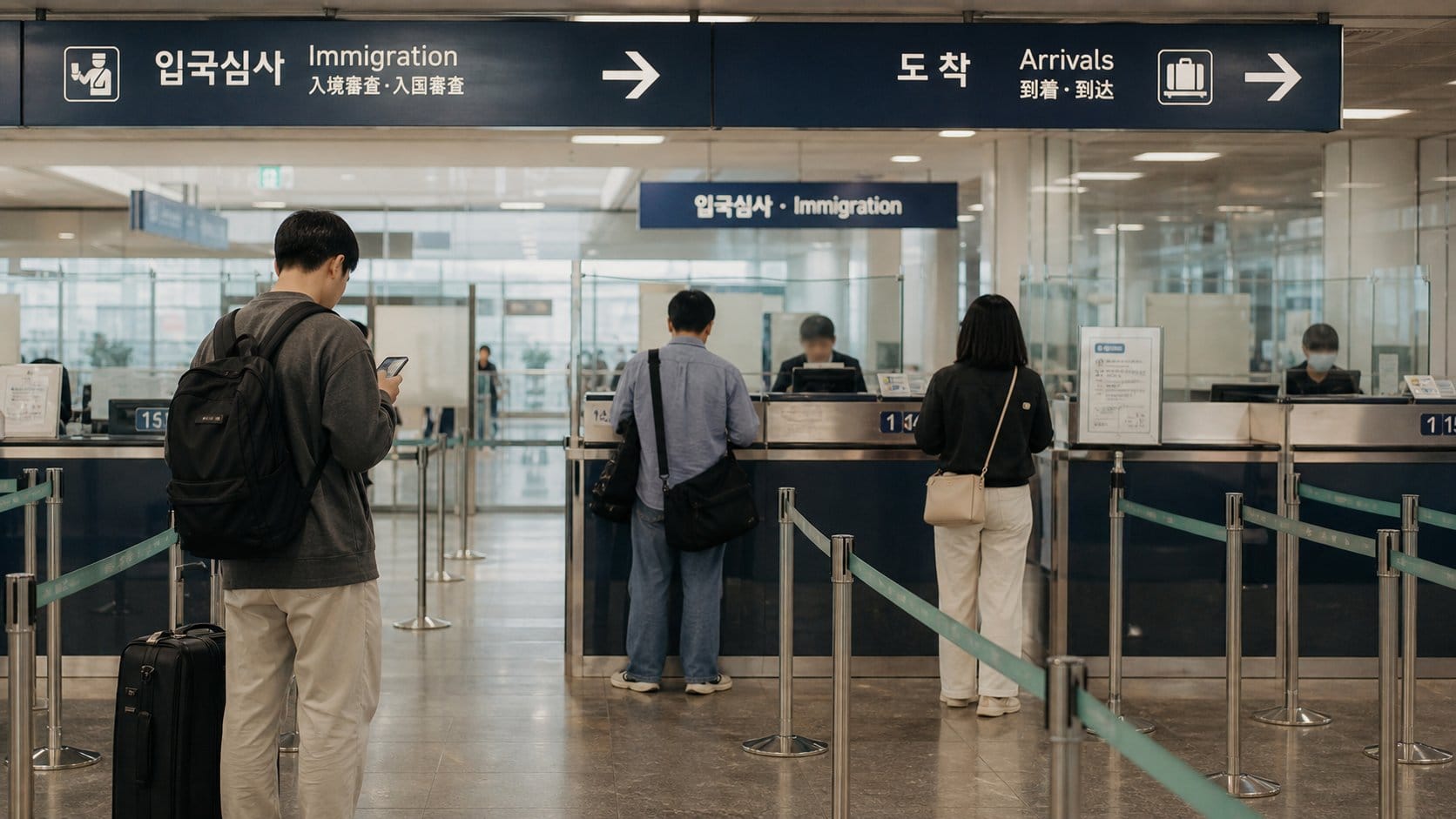
Korea’s e-Arrival Card is submitted through the official Ministry of Justice website by confirming terms with an email address, entering passport details, adding itinerary and stay information, reviewing the form, and submitting it online. The official service is free, and the main page lists individual submission for 1 to 9 people and group submission for 2 to 1,000 people .
Use only the official e-Arrival Card website, not a search-ad landing page or a travel-service site asking for card payment. The official process starts with an email-based agreement step, then moves through passport information, entry and stay details, final review, and submission . For most travelers, the practical work is not difficult; the main risk is rushing the form without your address, flight number, or passport details ready.
Before starting, prepare the information immigration actually asks for: your passport, flight or vessel number, entry and departure information, purpose of entry, address and contact details in Korea, occupation, and email address. Korea’s immigration notice says travelers should prepare a passport, flight or vessel number, planned stay address, and email address, and that the form asks for entry, departure, purpose, and stay information . For K-POP event travel, that usually means checking the spelling of your hotel or guesthouse address before you open the form.
- Passport: Use the same passport you will present at airline check-in and Korean immigration.
- Flight or vessel number: Copy it from your airline booking, not from a fan group chat or old itinerary screenshot.
- Korean address: Enter the hotel, guesthouse, residence, or other stay address you will use on arrival.
- Contact details: Add your Korean contact number if available; if not, prepare the contact information tied to your accommodation or trip.
- Purpose and occupation: Keep the answer factual, such as tourism, event attendance, study, work, or family visit, depending on your actual trip.
- Email address: Use an inbox you can access while traveling because the issuance number is sent by email.
The passport step can be completed by uploading a passport bio-page image so the system can read the information automatically. If the upload or auto-fill does not work, travelers can enter the passport details manually, which is the expected fallback rather than a reason to restart on another website . Check names, passport number, date of birth, and nationality carefully before review, because these fields must match the document you use at the airport.
After you review the form, submit it only when the passport, itinerary, Korean address, and purpose of entry are correct. The official site presents the process as a government declaration, not a paid approval product . Treat the final review screen like an immigration document check: slow down, compare it against your passport and booking, then submit through the official site.
What happens after submission, and what if your plans change?

After you submit Korea’s e-Arrival Card, there is no separate approval wait: Korea Immigration Service guidance says the submitted declaration is reflected as filed and does not need separate approval . The key rule is timing: the e-Arrival Card is valid for 72 hours after submission, and if you do not enter Korea within that validity period, the declaration becomes invalid and must be submitted again .
For a concert trip, that means the completion screen is not the same thing as a visa decision, a ticket confirmation, or an airport fast-track pass. It is a recorded arrival declaration that immigration officers can retrieve when you reach inspection. The official e-Arrival Card guide says the issuance number is sent to the declarant’s email and that carrying the e-Arrival Card is not required for entry inspection, though knowing the issuance number may help .
If your plans change after submission, update the declaration before immigration inspection rather than waiting until you are at the counter. Korea allows travelers to check and edit submitted e-Arrival Card information on the official website before immigration inspection when purpose of entry, stay information, or departure date changes; the guide also notes that arrival date corrections are limited to within 3 days from the initial submission date .
- Do use the official service: submit, check, and edit your form through Korea’s e-Arrival Card website, e-arrivalcard.go.kr.
- Do save the completion email: keep the issuance number available until you have cleared immigration .
- Do update changed stay details: revise changed purpose, stay information, or departure date before inspection if those details are no longer accurate .
- Don’t pay a copycat site: the official e-Arrival Card service is free .
The safest workflow is simple: submit close enough to arrival that the 72-hour validity covers your landing time, then recheck your flight, accommodation, and Korean contact details before you reach the immigration hall . If a delay pushes your arrival outside the validity window, make a new submission through the official site instead of trying to reuse the expired declaration.
How is the e-Arrival Card different from Q-Code, customs, and other Asia arrival forms?
Korea’s e-Arrival Card is an immigration arrival declaration, while Q-Code is a health declaration and customs remains a separate arrival process. The practical point for visiting fans is to treat these as different checkpoints: submit the immigration card through the official e-Arrival Card site when required, check whether health reporting applies to your route, and answer customs questions separately after baggage claim .
The e-Arrival Card belongs to the immigration step. It replaces the old paper arrival card for travelers who are required to make an arrival declaration, and the official service is free through Korea’s e-Arrival Card website . That is why it asks for entry-facing details such as passport information, itinerary, stay address, Korean contact details, and purpose of entry .
Q-Code is different because it is operated as Korea’s health-entry channel, not as an immigration card. Travelers arriving from or transiting through strict quarantine inspection required areas may need to submit Q-Code or complete a paper health questionnaire, and symptomatic travelers from quarantine inspection required areas may also need to submit a Q-Code or paper health questionnaire. GOV.UK says failure to complete required health screenings could result in a fine of up to KRW 10 million . The Korea Disease Control and Prevention Agency’s Q-Code page identifies the system as a health declaration system upon entry .
- Immigration: use Korea’s e-Arrival Card when you are in a traveler category that must submit an arrival declaration .
- Health: use Q-Code or a paper health questionnaire only when the quarantine rules for your travel history require it .
- Customs: answer customs questions as a separate arrival process, especially if you are carrying declarable goods, cash, food, medicine, or items for resale.
- Airport flow: after landing, expect immigration inspection, baggage claim, customs, payment or SIM setup, and onward transport to happen as separate steps rather than as one combined form.
Korea is also part of a wider regional move toward digital arrival declarations. Singapore’s SG Arrival Card is a clear comparison point: Singapore discontinued paper disembarkation and embarkation cards from March 27, 2020, and travelers generally submit the SG Arrival Card with electronic health declaration within 3 days before arrival . Korea’s own e-Arrival Card uses a similar short pre-arrival window and a free official channel, with submission allowed within 3 days before arrival and validity lasting 72 hours after submission .
The same pattern now appears across Asia under different names, including Singapore’s SG Arrival Card and other country-specific digital arrival declarations. The names are easy to mix up, but the habit should be consistent: use the official government channel, submit inside the country’s stated pre-arrival window, and do not treat an arrival declaration as a visa, visa waiver, or travel authorization.
For a concert trip, the clean workflow is simple. Finish the e-Arrival Card before you fly if you need it, check Q-Code only for applicable health-entry conditions, keep customs separate, and save your arrival energy for the parts that matter after landing: collecting bags, setting up payment or transit, and getting to your hotel or venue without having to solve paperwork at the counter.
Frequently asked questions
Is Korea’s e-Arrival Card free?
Yes. Korea’s official e-Arrival Card service is free through the Ministry of Justice website. The official guide says the e-Arrival Card is free, and GOV.UK also states that there is no fee to submit it .
When can I submit Korea’s e-Arrival Card?
You can submit Korea’s e-Arrival Card within 3 days before arriving in Korea, based on Korea Standard Time, and the submitted declaration is valid for 72 hours after submission . If you do not enter Korea during that validity window, the declaration becomes invalid.
Do K-ETA holders need Korea’s e-Arrival Card?
No. Travelers with a valid K-ETA are exempt from submitting Korea’s arrival card, but K-ETA is separate from a visa and does not guarantee entry into Korea .
Can I edit my Korea e-Arrival Card after submitting it?
Yes. After submitting Korea’s e-Arrival Card, you can check and edit information on the official website before immigration inspection if your purpose of entry, stay information, or departure date changes .
Is Q-Code the same as Korea’s e-Arrival Card?
No. Q-Code is Korea’s health declaration system, while the e-Arrival Card is an immigration arrival declaration submitted through Korea’s Ministry of Justice e-Arrival Card service .
Enjoyed this article? Subscribe to get new stories by email whenever they're published.
This article was written using information collected and analyzed by NAMANE's in-house K-pop research AI engine. We use AI technology to bring you faster, broader coverage, and in the process some details may occasionally differ from the latest facts. For important information such as dates, venues, and prices, please double-check with official sources.


