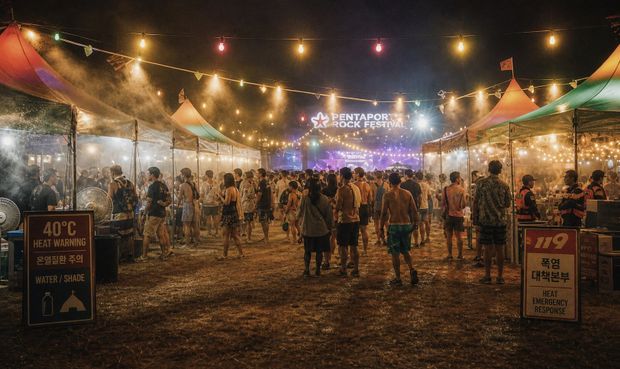
K-POP and K-rock fans who attended Incheon's 2026 Pentaport Rock Festival — where Xdinary Heroes, QWER, Hyukoh, and Silica Gel were among 66 acts performing across three days — did so during Korea's most extreme heat wave in 122 years. For anyone with tickets to outdoor K-POP or K-rock shows in Korea this August, the numbers from that weekend are worth reading before you head to the venue.
Korea's 2026 Heat Wave: The Numbers Every K-POP Outdoor Concert Attendee Should Know
South Korea is enduring the most extreme heat wave in its 122-year meteorological record, with documented consequences for outdoor concerts, festivals and public events. On August 2, 2026, Yangsan in South Gyeongsang Province recorded 42.5°C (108.5°F) — the highest temperature ever officially measured in Korea — marking the fifth consecutive day above 40°C in the region . The Korea Meteorological Administration confirmed the records, which have driven heat illnesses and deaths, dried reservoirs, killed livestock and forced changes to vacations and festivals nationwide .
The health toll is concrete. According to the Korea Disease Control and Prevention Agency (KDCA), 1,781 people were treated for heat-related illnesses nationwide between May 15 and early August, with 13 heat-linked deaths . The impact skews older — according to KDCA data, people aged 65 and over are about 21% of the population but 29.5% of heat-illness patients . South Gyeongsang alone logged 161 cases, surpassing Seoul's 158 despite roughly one-third the population .
Younger, healthy attendees are not automatically safe. A man in his 20s with an underlying condition died of heat illness in Busan — a death a KDCA official called "unusual" given his age, according to the Korea JoongAng Daily . For a K-POP festival crowd standing in direct sun, that detail reframes the risk for any age group.
Authorities have escalated accordingly. The Ministry of the Interior and Safety raised its heat-wave response to Level 2 on August 2, stepping up preparedness and the distribution of disaster relief supplies, according to the Kyunghyang Shinmun , while top-tier severe heat warnings were expanded across Busan, Ulsan and South Gyeongsang — regions where conditions are deemed severe enough to threaten lives, according to the Seoul Economic Daily . Those alert levels are the backdrop against which every open-air K-POP and K-rock lineup this month is being planned, modified or moved.
That backdrop explains a pattern now visible across Korea's summer concert calendar: major K-POP award shows and arena tours — including the SBS Gayo Daejeon Summer on August 9 at KINTEX in Goyang — are choosing indoor venues. Fans attending outdoor stadium events later this month, including BIGBANG's "XX : COSMOS" world tour launch at Goyang Stadium on August 21–23 , should plan for the same conditions that hospitalized seven people at Pentaport earlier this month.
Pentaport 2026: Xdinary Heroes, QWER, and 64 Acts — Seven Hospitalized at Korea's Largest Rock Festival
The 2026 Incheon Pentaport Rock Festival became the clearest test case of what those alert levels mean on a live open-air site: seven people were hospitalized for heat-related conditions across its three days . Korea's largest rock festival ran July 31–August 2, 2026 at Songdo Dalbit Festival Park in Yeonsu-gu, Incheon, with a lineup of 66 domestic and international acts — including K-rock acts Xdinary Heroes and QWER alongside major Korean indie and alternative performers Hyukoh, Silica Gel, and SUMIN . None of the incidents were fatal, but the pattern shows how quickly extreme heat translates into medical events even at a well-resourced festival.
The hospitalizations fell across the first two days of the three-day event. On July 31, three attendees suffered heat syncope or heat cramps. On August 1, three more attendees reported similar conditions — including a man in his 20s who collapsed around 6 p.m. and regained consciousness at the hospital — and one vendor employee working the grounds was also hospitalized that day .
| Date | Cases | Reported symptoms |
|---|---|---|
| July 31, 2026 | 3 attendees | Heat syncope / heat cramps |
| Aug. 1, 2026 | 3 attendees + 1 vendor employee | Heat syncope / heat cramps; one attendee (man in 20s) collapsed ~6 p.m., recovered at hospital |
Organizers had built mitigation into the site in advance. A large designated "Cool Zone" gave attendees a place to escape direct sun in shade or air conditioning, and it was equipped with radio broadcast relay so fans resting there could keep following performances instead of missing sets — a design detail that lowers the incentive to stay in the crowd through the hottest hours . When attendees collapsed, on-site emergency responders provided immediate first aid before transporting them for hospital care, and no deaths were reported at the festival .
The takeaway for K-POP and K-rock fans planning to attend outdoor shows this month is that infrastructure helps but does not eliminate risk. Pentaport had cooling shelters, medical staff and broadcast relays in place, and still logged seven hospitalizations during peak heat. The venue's mid-evening incident — a collapse around 6 p.m., well after the noon peak — is a reminder that accumulated heat exposure over a full festival day, not just the hottest single hour, is what tips attendees into heat syncope.
📍 인천광역시 연수구 송도동 센트럴로 350 송도달빛축제공원
⭐ 4.2 (22 리뷰)
📞 1899-7188
🔗 Google Maps에서 보기
How Korean Events Are Adapting: Indoor Moves, Evening Slots, and Suspended Afternoon Programs
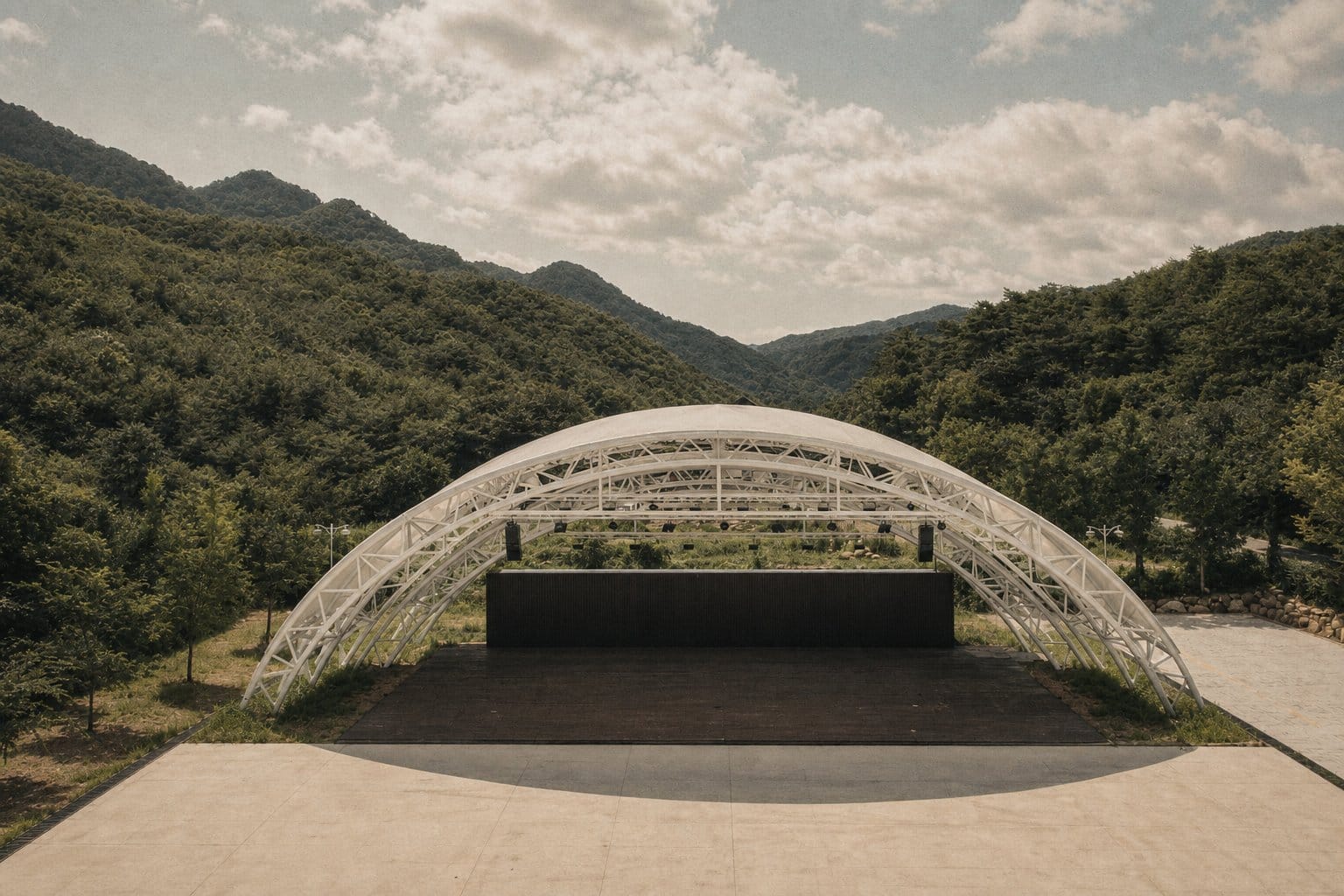
Korean festivals and concert organizers are adapting to the 2026 heat wave with three concrete tactics: moving shows indoors, shifting to evening-only slots, and suspending afternoon programs once temperatures cross fixed thresholds. South Gyeongsang Province directed every municipality to adjust schedules, scale back programs, or cancel activities outright based on real-time heat severity . For fans holding tickets this August, that means a listed start time is now provisional — the local reading, not the printed lineup, decides whether an outdoor set happens.
The clearest example of a hard threshold is Miryang's "Super Festival" (Aug. 7–9), which suspends programming between 2 p.m. and 7 p.m. whenever the air temperature reaches 36°C or above . In the same city, the Summer Performing Arts Festival took the more drastic route and moved nearly all of its shows indoors — and still achieved roughly 80% seat occupancy, evidence that fans will follow a lineup into an air-conditioned hall rather than skip it .
Further south, evening programming has become the default model. Sancheong-gun's Shining Summer Night Festival runs 5 p.m.–10 p.m., and Hapcheon-gun's Ghost Park Masquerade runs 6 p.m.–11:30 p.m. through Aug. 16, with both counties shifting their events past sunset to sidestep the afternoon peak entirely . Where a festival keeps daytime programming, the mitigation is physical infrastructure: Goseong-gun's Chunsureun Festival (July 30–Aug. 1) centered its events on water activities, added shade canopies across the entire venue, and deployed water stations and large electric fans throughout the grounds .source
The practical patterns for K-POP and K-rock concert attendees break down as follows:
- Threshold suspensions: daytime programs pause when the temperature hits ~36°C — check the organizer's channels the morning of the event, not just the printed schedule (Miryang Super Festival) .
- Indoor relocations: outdoor sets may be moved to a hall with little notice; occupancy stays high (~80% at Miryang's performing arts festival), so seating fills fast .
- Evening-only slots: in South Gyeongsang, expect 5 p.m.–11:30 p.m. windows as the norm rather than the exception (Sancheong, Hapcheon) .source
- On-site cooling: shade canopies, misting fans, and water stations are increasingly standard — locate them on arrival (Goseong Chunsureun Festival) .
The provincial directive frames these moves as safety triage rather than programming choices. As the South Gyeongsang provincial government instructed municipalities, events should "adjust schedules, scale back programs, or cancel activities" according to heat severity . For K-POP fans with outdoor tickets, the takeaway is procedural: confirm the format the day of, arrive prepared for an evening or indoor session, and treat any afternoon outdoor set as subject to same-day suspension.
Heat Illness Warning Signs at K-POP Concerts — and When to Call 119
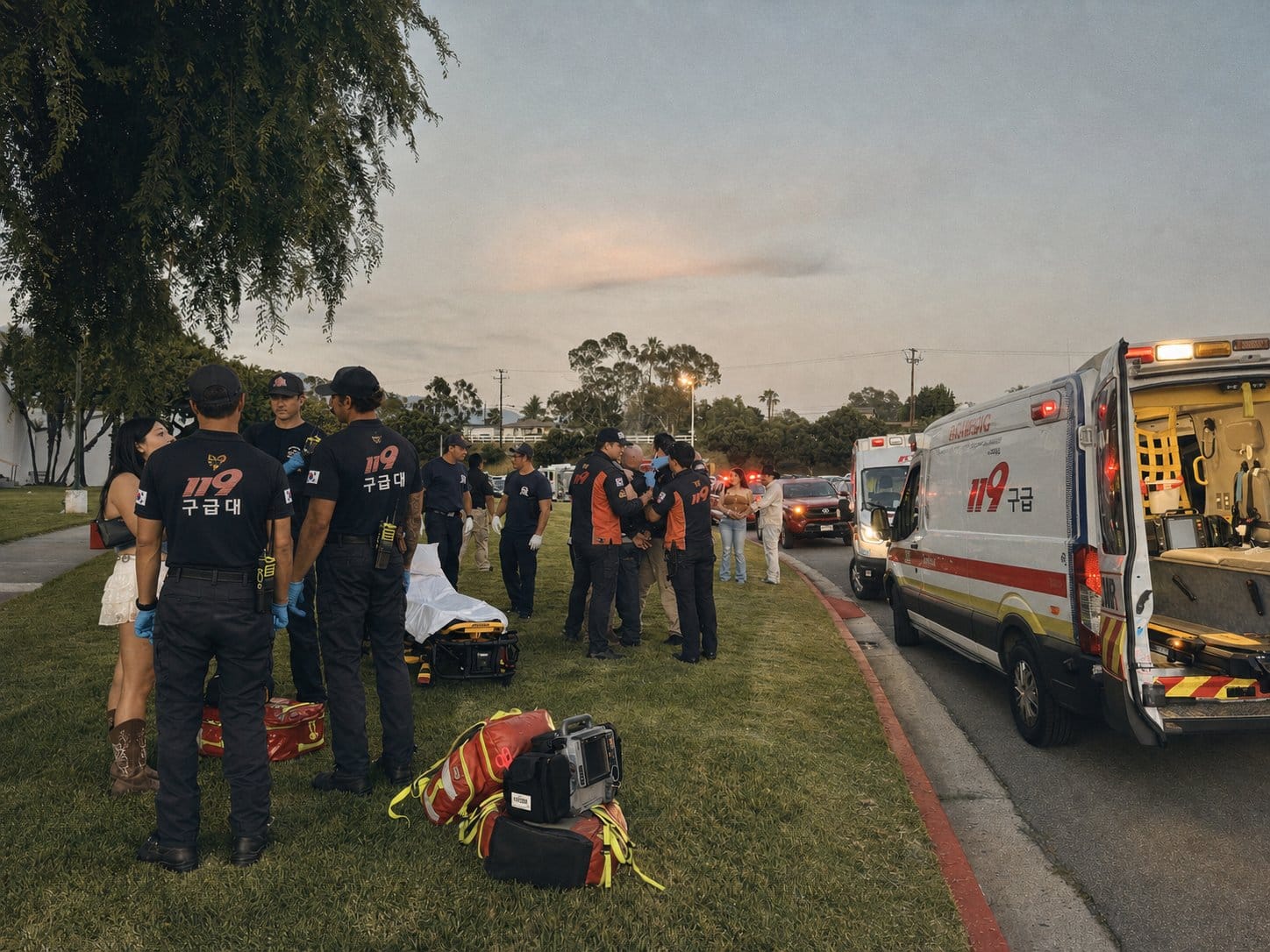
Heatstroke at a concert is a life-threatening emergency, and the trigger point is closer than raw thermometer readings suggest. Seoul's 2026 Heat Wave Citizen Action Guide measures risk by "apparent" (feels-like) temperature rather than air temperature, because humidity sharply raises real danger. A severe heat-wave warning now triggers at an apparent temperature of roughly 38°C, the threshold where mortality risk rises materially — a number every fan should track alongside the forecast.
Quick Answer: Call 119 immediately if a concert-goer shows dizziness, rapid pulse, vomiting, unstable breathing, confusion, loss of consciousness, or sudden absence of sweating. Move them to shade, cool the body with water, and transport to an emergency room — Korea logged 1,781 heat-illness cases by early August 2026.
The emergency signs of heatstroke are specific and, in a dense K-POP crowd, easy to miss until they escalate. Watch companions for dizziness, a rapid pulse, vomiting, unstable breathing, confusion or loss of consciousness, or the sudden absence of sweating — any combination requires immediate action, not a wait-and-see approach. These symptoms mark the point where the body has stopped regulating its own temperature, and delay measured in minutes changes outcomes.
Age is not the reliable filter fans might assume. The Korea Disease Control and Prevention Agency flagged the heat-illness death of a man in his 20s with an underlying condition in Busan as "unusual" given his age . Geography and outdoor exposure weigh heavily: South Gyeongsang Province logged 161 heat-illness cases against Seoul's 158, despite roughly one-third the population — a reminder that a healthy 25-year-old K-POP fan standing through an afternoon outdoor set in the southeast is genuinely exposed.
"[The death of a man in his 20s from heat illness is] unusual," a KDCA official noted, given his age (source: Korea JoongAng Daily).
If someone collapses or shows the warning signs, the response sequence is fixed: call 119, move the person into shade, and begin cooling the body immediately with water or anything available. Do not wait for symptoms to stabilize before transporting them to an emergency room. At Pentaport, emergency responders gave immediate first aid to a man in his 20s who collapsed around 6 p.m. on August 1, and he regained consciousness at the hospital — the same protocol works whether you are staff or the stranger standing next to the person who goes down.
Practical Safety Checklist for K-POP and K-Rock Outdoor Concert Fans in Korea This August
Getting through an outdoor K-POP or K-rock concert safely in Korea's 2026 heat wave comes down to five habits: pick evening sessions, hydrate before you feel thirsty, find the Cool Zone on arrival, watch your companions, and expect the schedule to change. Each one is drawn directly from how festivals and health authorities have responded to record temperatures this summer, and together they cover the failure points that put seven people in hospital at Pentaport .
- Choose evening or night sessions wherever possible. Southern festivals have already moved into after-dark windows for a reason: Sancheong-gun's Shining Summer Night Festival runs 5 p.m.–10 p.m. and Hapcheon-gun's Ghost Park Masquerade runs 6 p.m.–11:30 p.m. through August 16 . If a lineup offers the same act at an afternoon and an evening slot, take the evening one.source
- Hydrate continuously, before and during the event. Heat cramps and heat syncope — the exact conditions logged among the July 31 and August 1 Pentaport cases — can arrive before you feel obviously thirsty. Drink on a schedule, not on demand.
- Locate the Cool Zone and nearest air-conditioned rest area immediately on arrival. Pentaport's large Cool Zone carried radio broadcasts so attendees could keep following the festival while they cooled down . For official cooling shelters near any venue — senior centers, welfare halls, libraries — use the Safety Didimdol app, the Living Safety Map (safemap.go.kr), or the National Disaster Safety Portal (safekorea.go.kr) .
- Watch your companions, not just yourself. Pale skin, slowed responses, or suddenly stopped sweating are early warning signs — do not dismiss them as ordinary crowd fatigue. The heat toll this summer has been severe enough that a man in his 20s died of heat illness in Busan, which a KDCA official called "unusual" for that age .
- Expect program changes and check before you head to the main stage. Once local air temperature hits 36°C, or apparent (feels-like) temperature approaches 38°C, afternoon acts may be suspended, shifted, or moved indoors — the thresholds Miryang and other municipalities now apply . Check the organizer's social channels the day of the show, not just the printed timetable.
The through-line is simple: in a summer that produced Korea's highest-ever reading of 42.5°C , the K-POP and K-rock concert experience now includes the heat plan. Build the checklist into your day, treat a Cool Zone as part of the venue rather than an afterthought, and be ready to skip an afternoon set the moment conditions cross the line — the music is still there after sundown.
Last updated: 2026-08-03.
Frequently asked questions
Are K-POP and K-rock outdoor concerts still happening in Korea during the August 2026 heat wave?
Yes, but with significant adjustments. The Incheon Pentaport Rock Festival — featuring Xdinary Heroes, QWER, Hyukoh, and Silica Gel among its 66 acts — went ahead on July 31–August 2, 2026 with on-site safety infrastructure, including a large Cool Zone, while South Gyeongsang festivals cut afternoon programming, moved shows indoors, or shifted entirely to evening hours . Major indoor K-POP events such as the SBS Gayo Daejeon Summer at KINTEX (August 9) are proceeding as planned. Always check each event's official channels for real-time schedule changes before you travel to the venue.
At what temperature do Korean outdoor concerts suspend programs?
Most venues use 36°C air temperature or an apparent (feels-like) temperature around 38°C as the intervention threshold — the level Seoul's 2026 action guide links to materially higher mortality risk. Miryang's Super Festival, running August 7–9, 2026, is the clearest public example: it adjusts programming between 2 p.m. and 7 p.m. whenever temperatures reach 36°C or above . Below those thresholds, most outdoor sets continue as scheduled.
What are the warning signs of heatstroke I should recognize at a concert?
The warning signs are dizziness, rapid pulse, vomiting, unstable breathing, confusion, loss of consciousness, or the sudden absence of sweating . Heatstroke is a life-threatening emergency: call 119 immediately, move the person to shade or air conditioning, and begin cooling the body at once. Do not wait to see whether symptoms improve on their own, and stay with the person until emergency responders arrive.
Where can I find cooling shelters near a K-POP festival or concert venue in Korea?
Official cooling shelters — senior centers, welfare halls, and libraries — are mapped through the Safety Didimdol app, the Living Safety Map at safemap.go.kr, and the National Disaster Safety Portal at safekorea.go.kr . Most large festival venues also designate a marked Cool Zone on-site, confirmed at Pentaport 2026, where the shelter carried radio broadcasts so attendees could keep following the show while cooling down .
Is this heat wave significantly worse than past Korean summers, or is this normal for August?
It is significantly worse than a typical Korean summer. Yangsan's 42.5°C on August 2, 2026 is the highest temperature ever measured in Korea's 122-year official record. The region's five consecutive days above 40°C and the 1,781 heat-illness cases treated nationwide from May 15 through early August sit well outside historical norms , which is why event schedules — including those for K-POP and K-rock outdoor concerts — are being modified across the country.
Enjoyed this article? Subscribe to get new stories by email whenever they're published.
This article was written using information collected and analyzed by NAMANE's in-house K-pop research AI engine. We use AI technology to bring you faster, broader coverage, and in the process some details may occasionally differ from the latest facts. For important information such as dates, venues, and prices, please double-check with official sources.


