
Why Does Everyone Get Their Own Rice While the Banchan Is Shared?
The table fills before you finish ordering: kimchi, seasoned bean sprouts, braised potatoes, pickled radish, a sheet of gim. Nobody ordered them, nobody pays for them separately — and figuring out who they belong to is the first thing a visiting diner gets wrong.
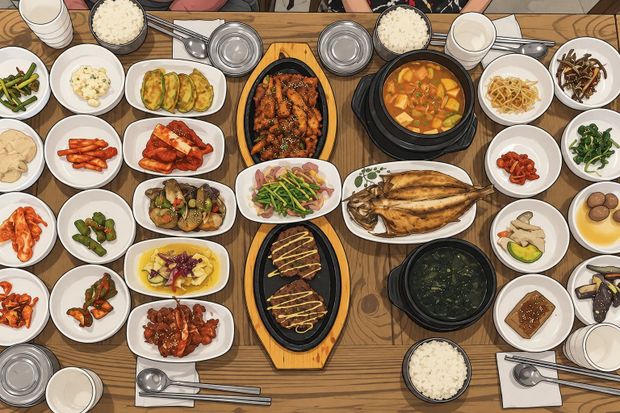
Everyone gets their own rice because Korean service places rice and soup individually in front of each diner, while banchan, kimchi and the main dish sit in the middle for the whole table to reach. That layout is called 한상차림 (hansang-charim) — every dish set out at once in an open pattern rather than delivered as Western-style courses, so diners share the same plates but each person assembles a different bite against their own bowl of rice, according to the Korea Tourism Organization .
Quick Answer: Rice and soup are personal; banchan are communal. Korea's hansang-charim format sets every dish out at once — two private bowls in front of each diner, small shared plates in the middle. The Academy of Korean Studies names nine formal table types by occasion, from the everyday bansang to the banquet gyojasang; the everyday restaurant table is a simplified bansang.
This is the structural rule most first-time diners miss. Banchan is not an appetizer round to be cleared before the main event — it is the meal's architecture, a shared field of complementary small plates arranged around two private bowls. You alternate between them bite by bite for the entire meal, which is why the spread does not shrink when your grilled pork or stew arrives. It was never a separate course.
The formal system behind it is more specific than the restaurant version suggests. The Academy of Korean Studies' Encyclopedia of Korean Culture names nine table-setting types by occasion rather than by dish count — everyday bansang, the noodle-course jangguksang, the drinking table juansang, celebration keunsang, the banquet gyojasang, the tea-reception damdamsang, the pre-wedding immaetsang, the first-birthday dolsang and the ancestral-rite jeryesang — and notes that most of these historically followed the principle of a separate table per diner . The table in front of you at a neighbourhood kimchi-jjigae shop is the plainest of these, an everyday bansang: rice, soup, and whatever the kitchen made that morning.
The everyday name for it is 백반 (baekban). VisitKorea describes a baekban as steamed rice, soup and several side dishes served as a set — presented as a backbone of Korean meal tradition rather than a restaurant giveaway . That framing matters for how you behave at the table: the small plates are not a bonus the restaurant threw in, and they are not yours alone.
"Rice and soup, along with spoons and chopsticks, are placed directly in front of the diner. Beyond that, the main dish takes its place, with seafood, meat, and vegetable dishes arranged around it." — Korea Tourism Organization, describing the hansang-charim table setting (source: Korea Tourism Organization).
Read it that way and the rest of the meal makes sense — including who reaches first, how much you take at a time, and what happens when a dish runs empty.
How Many Banchan Is Normal — and What Is 'Cheop'?
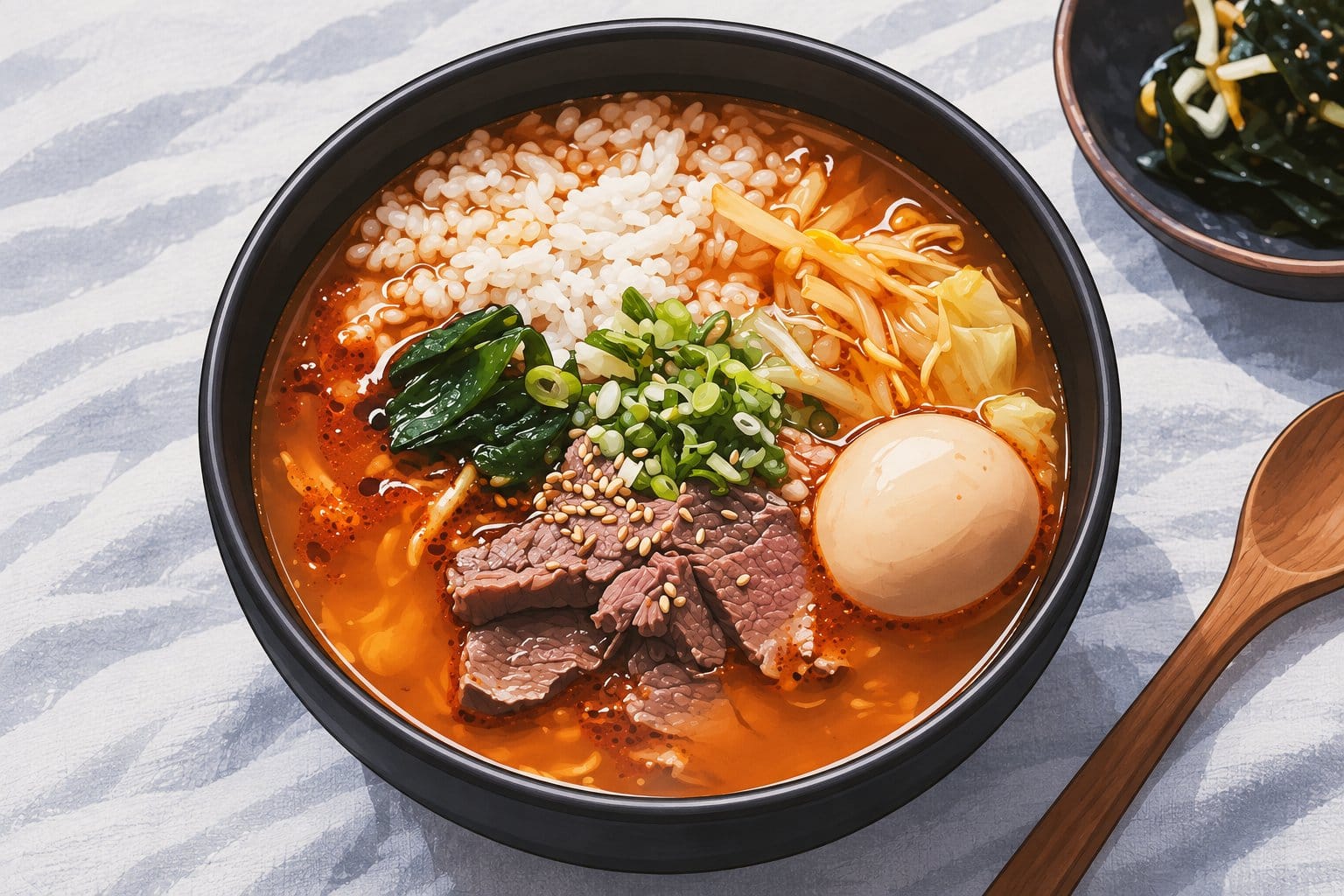
The number of banchan on a Korean table has a formal name and a counting system: 첩 (cheop). The Academy of Korean Studies' Encyclopedia of Korean Culture defines 반상 (bansang) as a setting composed of rice plus banchan, with staple and subsidiary dishes deliberately paired, and classifies formal settings from 3-cheop up to 12-cheop . The 12-cheop spread was historically reserved for the royal court . In an everyday restaurant you are usually looking at something closer to three to six dishes.
The counting is narrower than it looks, because the staples are exempt. Rice, soup, stew, sauces and kimchi are never counted toward the cheop number . So a "3-cheop" home meal is not three dishes total — it is rice, soup and kimchi plus three additional side dishes. That is why a modest 백반 (baekban) set meal can look crowded: VisitKorea describes baekban as steamed rice, soup and several side dishes, treating that combination as the backbone of Korean meal tradition rather than a restaurant giveaway .
What goes into the count is governed by contrast rather than quantity. The Encyclopedia of Korean Culture notes that banchan are chosen so as not to repeat the same ingredient or cooking method twice, and to balance foods, tastes and nutrition across the spread . The same balancing logic shows up in how formal Korean table settings are classified: the Academy of Korean Studies names nine types by occasion — bansang for everyday rice meals, jangguksang for noodles, juansang for drinking, gyojasang for banquets, damdamsang for tea, and others for weddings, first birthdays and ancestral rites — most historically served one table per diner . Food writers add the aesthetic layer: odd numbers (3, 5, 7, 9) read as yang and auspicious, and a well-composed spread aims for five colours — green, red, yellow, white and black .
The vegetable-heavy default has a datable origin. Buddhist influence from the Three Kingdoms period brought royal prohibitions on meat, which pushed Korean cooks toward increasingly sophisticated vegetable preparation; even after the Mongol invasions lifted the meat bans, the vegetable-forward habit stayed embedded in the repertoire . Individual dishes kept evolving well after that. Japchae, one of the most recognisable banchan, began in the early 17th century as a noodle-less beef-and-vegetable stir-fry and only picked up sweet-potato starch noodles roughly 400 years later . The count is traditional; the contents are not fixed.
Why Koreans Share Banchan — and the Exception Most Guides Skip
Koreans share banchan because the side dishes were historically cooked in batches and served on tables built for adding people, not for separating them. Korea.net's account of communal eating culture points to low, portable tables that made it easy to seat one more diner, to village meals where the guest count was fluid, and to households that made banchan in large quantities alongside neighbours . Batch cooking plus expandable tables produced a durable habit: eat from the common dishes, and closeness follows.
The exception most guides skip is that Korea's dining history also contains the opposite form. The same government portal's coverage of the 소반 (soban) — the traditional one-person table — shows that Confucian dining used individual settings deliberately, to reduce friction between diners and to show respect for the individual at the table . Rank, gender and generation were often served separately, each person with their own small table. So the crowded shared spread in front of you is not an unbroken 2,000-year inheritance; it is a modern layering of communal habit onto a tradition that held both forms at once.
That matters practically, because it explains why the etiquette feels inconsistent from place to place. A restaurant that plates each diner's portion individually is not breaking with Korean tradition — it is drawing on the other half of it. The constant across both forms is the structure: your rice and soup are yours, and what sits between the bowls is negotiated with everyone else at the table.
Kimchi is the clearest evidence that the communal instinct is real rather than romanticised. In 2013 UNESCO inscribed "Kimjang, making and sharing kimchi in the Republic of Korea" on the Representative List of the Intangible Cultural Heritage of Humanity, describing it as a collective practice that reaffirms family cooperation and reinforces community identity . Kimjang is organised labour — neighbours salting cabbage together over days, then distributing the results across households. The single most common banchan on any Korean table is, by its own heritage listing, a food defined by being made and shared rather than bought and portioned.
"Kimjang reaffirms Korean identity and is an excellent opportunity for strengthening family cooperation. Kimjang is also an important reminder for many Koreans that human communities need to live in harmony with nature," — UNESCO Intangible Cultural Heritage inscription decision, 2013 (source: UNESCO ICH, 2013-12)
The Table Rules That Actually Matter
Korean table etiquette reduces to a handful of rules that a first-time diner can absorb in one meal: rice bowl on the left, soup bowl on the right, spoon and chopsticks laid to the right of the soup, never chopsticks standing upright in rice, and no one starts until the eldest person picks up their spoon. Korea Heritage Service guidance sets the formal arrangement as rice bowl left, soup bowl right, spoon to the right of the soup bowl and chopsticks to the right of the spoon , and Korea.net's manners guide gives the same layout in shorter form — rice left, soup right, spoon left, chopsticks right (source: Korea.net). The rest is a matter of remembering that the spoon belongs to rice and soup, and the chopsticks belong to the banchan.
Three prohibitions are worth learning before anything else. Never leave chopsticks or a spoon standing upright in a rice bowl — the shape mirrors incense burned for the dead. Use a spoon rather than chopsticks for rice, and do not lift the rice or soup bowl off the table to bring it to your mouth, a habit that reads as normal in Japan and as poor manners in Korea (source: Visit Seoul; Korea.net). Facts About Korea, the official KOCIS/Ministry of Culture, Sports and Tourism resource, adds the details people miss: do not bend too close to the dishes, never hold spoon and chopsticks together in one hand, and try not to chew noisily. Dishes are passed with both hands, and both utensils are returned to their original position when you finish — laying the spoon flat on the table is the signal that you are done .
The shared plates have their own logic. Take a small amount at a time rather than loading your plate, and take the piece you touch first — Visit Seoul's etiquette guidance specifically warns against picking through a communal dish for the choice pieces or pulling out the parts you do not want (source: Visit Seoul). Move food from the common platter onto your own plate before eating it, and never return a used spoon to a shared side dish (source: Korea Tourism Organization). At a barbecue table the same principle governs the grill: let one person manage the meat rather than four sets of tongs reaching at once (video: Gothamist).
| Situation | Do | Avoid |
|---|---|---|
| Table layout | Rice bowl left, soup right, spoon then chopsticks to the right of the soup | Rearranging the set the server laid out |
| Eating rice | Spoon | Chopsticks; lifting the bowl off the table |
| Resting utensils | On the rim of a bowl during the meal | Standing chopsticks upright in rice |
| Starting the meal | Wait for the eldest to pick up their spoon | Beginning first at a table with elders |
| Shared banchan | Small portions; take the piece you touch first | Digging for choice pieces; used spoon in the dish |
| Finishing | Return utensils to their original position | Rushing far ahead of the group |
One more habit closes the loop: say "잘 먹겠습니다" before eating and "잘 먹었습니다" after, keep your pace close to the table's, and skip the tip — tipping is not customary in Korean restaurants (source: Let's Seoul, 2025). How strictly the elders-first rule is enforced varies by table; at a casual lunch with friends nobody will count. The utensil rules, by contrast, hold everywhere.
Are Banchan Refills Really Free — and How Do You Ask?
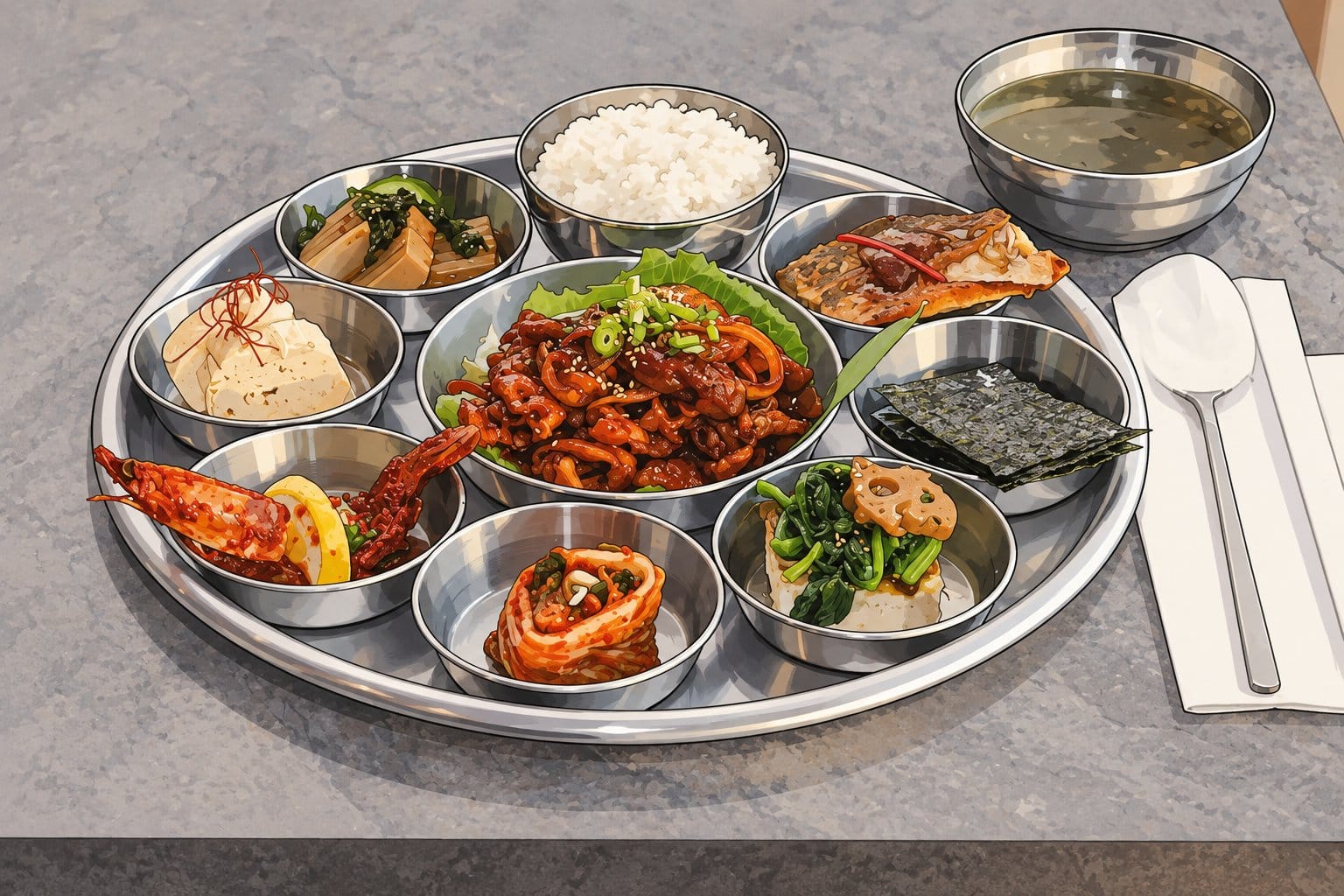
Yes — extra banchan and water are normally free in Korean restaurants, and you ask for them out loud. The Korea Tourism Organization's dining guidance notes that Korean restaurants generally do not charge for water or additional side dishes, and that a growing number of places run self-service systems for both . What is not free is unlimited: a refill is a top-up of a dish you actually finished, not a second buffet run.
At mid-range restaurants and most Korean BBQ chains, the refill often happens at a 셀프바 (self bar) — a counter near the kitchen or the drinks fridge stocked with kimchi, salad greens, sauces, pickled radish and sometimes a soup urn. Take a clean plate from the stack, serve what you want with the tongs or ladle left in each tray, and put the utensil back in the same tray rather than carrying it to your table. Water is usually on the same counter, in a dispenser with stainless cups.
Where there is no self bar, you flag a server. Korean restaurants do not run a check-back culture, so standing by your table looking hopeful gets you nothing — say "여기요" (yeogiyo) or "저기요" (jeogiyo) clearly, or press the buzzer mounted on the table edge. Then use one of two phrases:
- 반찬 좀 더 주세요 (banchan jom deo juseyo) — "more side dishes, please." Works anywhere; point at the empty dish while you say it.
- 리필 주세요 (refill juseyo) — "a refill, please." Common at BBQ and chain restaurants, where staff read it instantly.
- 물 좀 주세요 (mul jom juseyo) — "some water, please," if there is no self-serve dispenser.
Read the room on how much to ask for. Locals typically refill one or two dishes they actually like — the kimchi, the bean sprouts, the steamed egg at a BBQ table — rather than the whole lineup. Banchan built on fish or meat (braised mackerel, seasoned dried squid, japchae with beef) cost the kitchen real money and are often capped at one free refill, or quietly declined the second time; nobody will be rude about it, but the answer may be no.
The reason to take only what you will finish is regulatory, not just polite. Korean food-safety rules hold that food once served or displayed to a customer generally cannot be reused, with narrow exceptions for items such as intact whole produce or covered self-serve foods handled with utensils . Banchan you leave untouched on the table is thrown away — it does not go to the next diner. Ordering a third refill of kimchi you will not eat is not thrift; it is waste with a legal paper trail behind it.
Hygiene Since 2020, and How to Order at Korean BBQ
Sharing etiquette in Korea gained a formal hygiene layer in 2020, and it is still visible on tables today. In June 2020 the Korean government announced meal-culture improvement measures built on three tasks: portioning shared food onto personal dishes, hygienic management of spoons and chopsticks, and mask-wearing by restaurant staff . That is why so many restaurants now set out an extra small plate per diner, and why serving utensils appear beside the communal plates rather than only in the kitchen.
Attitudes moved with the policy. A survey of 1,000 office workers aged 19–59, summarised in a July 2020 policy briefing, found 53% were avoiding communal stew-type menus after COVID-19, 48.8% used a clean spoon to portion such dishes, and 73.4% said individual caution was needed when sharing food . Disease-control guidance issued to restaurants on 4 July 2020 pointed the same way: hand hygiene, masks before and after eating, communal tongs for shared foods, and less talking while eating because of droplet spread .
The practical version is short:
- If tongs, a ladle or 공용 젓가락 (communal chopsticks) are on the table, use them — and put them back in the same spot, not into your own bowl.
- Move food from the shared platter to your personal plate before eating it .
- Never return a used spoon to a shared dish .
Korean BBQ is where this meets ordering strategy, because banchan arrives in its densest form there. Start with one meat portion (1인분) per person rather than guessing high, since each serving is sized for one person and the rice, ssam and side dishes are built to fill out the rest of the plate; ordering another round once the first is finished is normal and expected . A second round takes two minutes; many all-you-can-eat shops charge a leftover fee. Beginners frequently over-order meat and under-use the ssam and banchan already in front of them (video: Gothamist).
The takeaway is one sentence you can carry into any Korean restaurant: your rice bowl is yours, everything in the middle is everyone's, and the modern rule is to share the table without sharing a used spoon.
Frequently asked questions
Do you have to pay for banchan refills in Korea?
Generally no. Korean restaurants normally serve water and additional side dishes at no extra charge, and a growing number run self-service systems for both . Mid-range and barbecue restaurants often set up a 셀프바 (self bar) counter stocked with kimchi, salad, sauces and sometimes soup, so you refill your own plate rather than calling a server. The practical limit is informal rather than posted: banchan built on fish or meat are frequently held to one free refill, and staff may decline a second round. Take only what you will finish — Korean food-safety rules hold that food already provided to a customer generally cannot be reused, with narrow hygiene-based exceptions , so leftovers are discarded.
What's the polite way to ask for more banchan?
Get a server's attention first, then ask directly. Say "여기요" or "저기요" aloud, or press the table buzzer if the restaurant has one — standing quietly beside the counter or making eye contact rarely works in a busy Korean dining room. Then use "반찬 좀 더 주세요" (banchan jom deo juseyo, "more side dishes please") or the shorter "리필 주세요" (refill juseyo). Naming the dish you want makes it faster: "김치 좀 더 주세요" for kimchi. If a self-bar counter is present, refill there instead of asking — that is what it is for. Return any communal tongs or ladle to the same spot when you are done .
Why does everyone get their own rice bowl but share the side dishes?
Because the Korean meal is served as 한상차림 (hansang-charim) — every dish laid out at once in an open pattern rather than in courses. The Korea Tourism Organization describes the table as rice and soup placed directly in front of each individual diner, with the main dish, kimchi and the remaining side dishes arranged around them . Rice and soup are the personal anchor; banchan are the shared field you build each bite from, which is why two people at the same table can eat the same meal quite differently. Western dining moves one plate at a time through courses; the Korean table gives you the whole composition simultaneously and lets you pace it yourself .
Is it rude to pick through banchan for the best pieces?
Yes. Visit Seoul's official etiquette guidance states that soups, stews and side dishes are usually communal, and specifically warns against rummaging through a shared dish for the choice pieces or pulling out bits you do not want . The working rule is simple: take the piece you touch first, take a small amount at a time, and move it to your own plate rather than eating straight from the communal dish . Never dip a used spoon into a shared side dish — since the 2020 meal-culture changes, that reads as a hygiene problem as much as a manners one.
How many banchan dishes make a 'proper' Korean meal?
Formality is counted in 첩 (cheop), and settings run from 3-cheop to 12-cheop. The Academy of Korean Studies' Encyclopedia of Korean Culture defines 반상 (bansang) as rice plus banchan, with side dishes chosen so they do not repeat the same ingredient or cooking method and so that foods, tastes and nutrition stay balanced . Rice, soup, stew, sauces and kimchi are not counted in that number , so a 3-cheop home meal already means rice, soup and kimchi plus three more dishes. The 12-cheop setting was reserved for the royal court . In an ordinary restaurant today, four to eight dishes is routine and nobody is counting.
Enjoyed this article? Subscribe to get new stories by email whenever they're published.
This article was written using information collected and analyzed by NAMANE's in-house K-pop research AI engine. We use AI technology to bring you faster, broader coverage, and in the process some details may occasionally differ from the latest facts. For important information such as dates, venues, and prices, please double-check with official sources.


