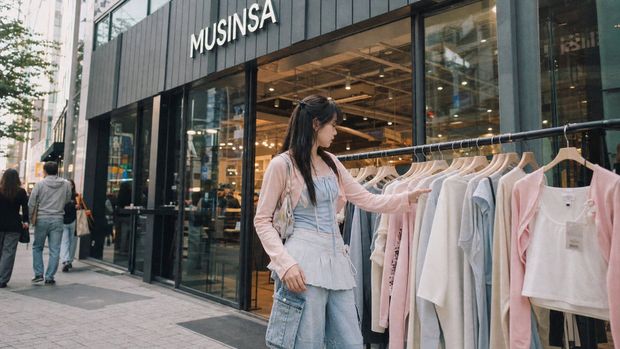
Watch an idol step off a plane in Incheon on a Monday, and by the weekend a near-identical piece can be sitting in your Musinsa cart. That compression — from viral photo to shoppable listing in days — is the quiet machinery behind Seoul's fashion influence in 2026.
Why Idol Looks Reach Musinsa in Under a Week
Seoul's speed-to-shelf pipeline turns an idol's airport or stage look into a purchasable product in roughly five to seven days. An outfit goes viral the same day it's photographed, Seoul brands cut samples within 24–48 hours, and the finished piece lands live on Musinsa inside a week . This is no longer the exception — it's the acknowledged operating norm of the market, and it's why a look documented in Gangnam on Tuesday feels ubiquitous by the next Monday.
The commercial engine underneath is substantial. The global Korean fashion market is projected to reach roughly USD 30.8 billion by 2033, expanding at about a 24% CAGR from 2025, driven almost entirely by K-pop and K-beauty's online-first reach . That growth curve rewards exactly the behavior the pipeline enables: fast replication of a proven, fan-validated look, sold globally the moment demand spikes.source
Musinsa functions as the infrastructure layer that makes this work. Brands upload; fans order from anywhere. The turnaround rivals Zara's fast-fashion cadence, but with two differences that matter — a higher quality floor and no private-label race to the bottom, because the sellers are independent labels defending their own names rather than an in-house factory chasing the cheapest possible margin. The result is speed without the disposability that usually comes with it.
Industry observers now treat Seoul's trend anticipation as a documented skill rather than coincidence. Covering Seoul Fashion Week FW26, NSS Magazine (published February 9, 2026, photographed by Jimin Jeon) noted Korean attendees' "remarkable ability to anticipate trends that will influence looks throughout the fashion month" . That foresight is precisely what the under-a-week pipeline monetizes: when a city can read the trend early and manufacture it fast, the gap between runway, stage, and checkout collapses.
The rest of this guide maps how that output actually looks on the street — the five distinct style codes Seoul is shipping, and where each one is designed, worn, and sold.
The Five Seoul Style Codes — Mapped
Seoul's 2026 output sorts into five style codes, and the most workable map comes from Fuga Studios, which groups them under one shared layering rule: "three layers visible, one hidden" . That rule is the connective tissue — whether an outfit reads minimal or maximal, it is built to show controlled depth without clutter. The five codes are K-Minimal, K-Streetwear, K-Soft/Y2K Seoul, K-Genderless/Avant, and K-Pop Stage, each with a distinct silhouette logic, a dominant idol reference, and its own brand cluster.
K-Minimal runs clean vertical lines and monochrome beige, cream and black in soft fabrics, tied to the NewJeans aesthetic and labels like Andersson Bell. K-Streetwear layers oversized silhouettes over baggy or acid-wash denim finished with statement sneakers — the Ader Error and Andersson Bell crowd. K-Soft/Y2K Seoul leans pastel, with baby tees, low-rise bottoms, hair clips and mini bags, referencing IU and Karina. K-Genderless/Avant uses sharp tailoring, asymmetry and blurred gender lines via Wooyoungmi, Juun.J and Pushbutton, while K-Pop Stage stacks bold graphics, layered chains and sculptural accessories in the lineage of G-Dragon, Stray Kids and Lisa .
| Code | Silhouette Rule | Dominant Idol Reference | Key Brands | Price Entry (KRW) |
|---|---|---|---|---|
| K-Minimal | Clean vertical lines, monochrome soft fabrics | NewJeans | Andersson Bell | ~₩100,000+ |
| K-Streetwear | Layered oversized over baggy/acid-wash denim | Ader Error crowd | Ader Error, Andersson Bell | ~₩100,000+ |
| K-Soft / Y2K | Pastel, baby tees, low-rise, mini bags | IU, Karina | Y2K Seoul labels, thisisneverthat | ~₩100,000+ |
| K-Genderless/Avant | Sharp tailoring, asymmetry, blurred lines | — | Wooyoungmi, Juun.J, Pushbutton | ~₩500,000+ |
| K-Pop Stage | Bold graphics, layered chains, sculptural accessories | G-Dragon, Stray Kids, Lisa | PAF, Gentle Monster | ~₩500,000+ |
Price entries follow the two-tier structure sources cite: mid-range labels such as thisisneverthat, MMLG and Beanpole run roughly ₩100,000–₩300,000, while the luxury tier — Wooyoungmi, POST ARCHIVE FACTION and Gentle Monster — starts around ₩500,000 .
In practice the codes bleed into one another. Seoul Fashion Week FW26 street style, photographed by Jimin Jeon and published February 9, 2026, showed K-Soft accessories layered onto K-Minimal outfits and K-Pop Stage graphics grafted onto K-Genderless tailoring — proof the five categories are reference points, not walls . The sections that follow take each code in turn.
K-Minimal: Clean Lines and the NewJeans Effect
K-Minimal is Seoul's most disciplined code: a monochrome palette of beige, cream, and black rendered in soft but structured fabrics, organized around strict vertical lines so nothing competes with the silhouette. There is no superfluous volume — the look reads as calm and tailored, and its dominant 2026 reference point is NewJeans' off-duty aesthetic, the pared-back styling that anchors the whole category . If the other four codes add one bold element, K-Minimal removes it.
The code descends directly from the Acubi aesthetic — a muted, Y2K-inflected look built on wide-leg trousers, layered knits, minimalist sneakers, and low-contrast neutrals that set Seoul's visual baseline . What 2026 does is strip out the Y2K warmth and tighten everything: the softness stays in the fabric, but the lines get sharper and the styling more austere. The result is closer to a quiet uniform than a trend.
Andersson Bell is the anchor brand. It sits in the internationally recognized tier of K-fashion labels and pairs clean tailoring with the muted palette the code depends on . Its Insadong flagship — one of several stores clustered near the district's hanok-style New Balance and Adidas outlets — is reported to price below European retail, a meaningful gap for visiting fans (video: Josh Dominic).
Below the flagship tier, K-Minimal has a fast-expanding cult layer that keeps the code accessible. LOW CLASSIC, Recto, and Amomento supply the same restrained lines at mid-range entry prices, roughly ₩100,000–₩300,000, versus the luxury tier that starts near ₩500,000 . That spread is part of why the look travels so well: a monochrome coordinate set reads as expensive without requiring a luxury budget, which is exactly the appeal of the NewJeans off-duty template it borrows from.
K-Streetwear: Baggy Denim, Ader Error, and the Updated Silhouette
K-Streetwear is Seoul's most visible daily code — layered oversized silhouettes, acid-wash or baggy denim, and a statement sneaker, worn as everyday uniform rather than costume. On any given Saturday it dominates the sidewalks of Hongdae and Seongsu-dong, where the look reads less as a trend and more as the district's resident dialect. Fuga Studios files it as the "Ader Error and Andersson Bell crowd," governed by the same "three layers visible, one hidden" rule that structures the rest of Seoul's style map .
The reference brand here is Ader Error, an anonymous creative collective founded in 2014 and known for irreverent humor, oversized unisex pieces, and a signature blue palette . What makes it instructive is how it grew: Ader Error built global recognition on brand concept rather than idol endorsement, an inversion of the usual K-fashion route, even though J-Hope of BTS is a documented repeat wearer . The label's Seoul store leans into that identity with moving shoe displays, in keeping with its collective-over-celebrity ethos (video: Josh Dominic).
The 2026 update to the code is structural. Plain oversizing has given way to architected volume: 80s shoulder-pad blazers broken up by a cinched waist or a utility belt, creating a modern "balloon" or hourglass line instead of a shapeless drape . It is the streetwear translation of the year's wider "Refined Maximalism" — one bold, sculptural element deliberately set against pared-back pieces underneath. Seoul Fashion Week FW26 street-style coverage read the same instinct on the runway fringes, with critics noting the crowd's forecasting fluency.
"Korean attendees show a remarkable ability to anticipate trends that will influence looks throughout the fashion month," — Seoul Fashion Week FW26 street-style report (source: nss magazine, 2026-02).
Entry into the code is accessible. thisisneverthat and Andersson Bell both anchor K-Streetwear at roughly ₩100,000–₩300,000, the same mid-range band that keeps K-Minimal within reach . The statement-sneaker half of the equation is where scarcity enters: Kith Seoul stocks exclusive New Balance 990v4s not sold elsewhere in the city, one reason the shop functions as a pilgrimage stop for the sneaker-led wing of the code (video: Josh Dominic).
K-Soft / Y2K Seoul: Pastels, Low-Rise, and the IU–Karina Reference
K-Soft — also labeled Y2K Seoul — is the code built on pastel tones, baby tees, low-rise bottoms, hair clips, and mini bags, a look Fuga Studios maps as a direct Tokyo crossover carrying distinctly Korean proportions . The 2026 editorial reference points are narrow and specific: IU as a solo artist and Karina of aespa anchor how the code reads on stage and in airport documentation . Where K-Minimal strips contrast out, K-Soft leans into it through color — low-saturation pastels stacked against the same "three layers visible, one hidden" grammar that governs every Seoul code .
The code has absorbed the year's outdoor shift rather than resisting it. Gorpcore has matured into what editors call "Granola-Chic": Gore-Tex or technical shells layered over organic linen in moss green, ochre, and sand — a functional outer over a soft inner that keeps the palette earthy rather than neon . That layering logic lets a technical shell sit convincingly over a pastel baby tee, which is why Granola-Chic reads as an extension of K-Soft instead of a separate wardrobe.
Sustainability functions as structure here, not a footnote. Upcycled denim and thrifted vintage mixing — crocheted vests, floral midi skirts, and silk scarves paired with chunky sneakers — are treated as on-code choices rather than contrarian ones . Seongsu-dong's thrift-and-boutique density, including staff-shadowed shops like Kar Soul, gives the code a physical sourcing base rather than an aspirational one (video: Josh Dominic).
Running underneath is an Eco-Futurism sub-thread: recycled and organic materials favored by environmentally conscious fan bases surface in K-pop-adjacent capsule drops, bridging K-Soft's soft palette and the sculptural energy of K-Pop Stage . It is the connective tissue that keeps K-Soft from reading as pure nostalgia — the pastels are Y2K, but the materials and sourcing point forward.
K-Genderless/Avant and K-Pop Stage: Seoul's Two Edge Codes
Seoul's two boldest codes sit at opposite temperaments but share one engine. K-Genderless/Avant is defined by sharp tailoring, deliberate asymmetry, and blurred gender lines — male idols in lace and pearls, female idols in power suits — while K-Pop Stage runs on bold graphics, layered chains, and sculptural accessories drawn from gaming and performance culture . Both treat structure, not logos, as the primary signal.
The Avant code's brand anchors are Wooyoungmi, Juun.J, and Pushbutton, which pair precise cuts with fluid silhouettes to unsettle conventional gender lines . These are luxury-tier labels: entry pricing at houses like Wooyoungmi starts around ₩500,000, well above the ₩100,000–₩300,000 mid-range band .
The technical extreme of this code is POST ARCHIVE FACTION (PAF), founded in 2018 by Dongjoon Lim and Sookyo Jeong, which blends sportswear with futuristic outerwear . PAF earned rare establishment respect through a guest slot at Pitti Uomo, collaborated with running brand On, and counts A$AP Rocky as a documented wearer. Its FW2026 collection, titled "Drifter," is built on intentionally "mistailored" technical garments — asymmetry engineered as a design principle rather than an accident .
K-Pop Stage takes the same structural instinct in a louder direction. Its reference trio is G-Dragon, Stray Kids, and Lisa, whose stage and airport looks lean on harness bags, tech-belts, and soft-fabric "shoulder armor" borrowed from gaming aesthetics . These are the "structural accessories" that recur across 2026 analysis — pieces that add sculpted volume without relying on a print or a wordmark.
That is where the two codes converge. The year's defining shift from oversized to "architectural" volume means a harness bag or a sculpted shoulder piece now does the work a logo once did: it identifies the wearer, signals the reference, and carries the silhouette . Genderless tailoring and stage maximalism read as distant on a mood board, but both resolve into the same rule — one built element, precisely placed.
Seoul's runway crowd tends to reach these codes before the rest of the calendar does. In its Seoul Fashion Week FW26 street-style coverage, published February 9, 2026, nss magazine credited Korean attendees with a "remarkable ability to anticipate trends that will influence looks throughout the fashion month" — a lead time that helps explain why avant tailoring and stage-ready hardware move from the front row to production so quickly.
Where Seoul Actually Shops Each Code
Seoul sorts its five style codes by district, so the fastest way to shop a look is to go where that code concentrates. Seongsu-dong is the K-Genderless/Avant heartland, Hongdae anchors K-Streetwear, and Insadong hosts a K-Minimal and K-Streetwear crossover — while Musinsa aggregates all five online and ships globally, reportedly stocking idol looks within a week of their first appearance . October, at roughly 20–21°C, is cited as an ideal window for walking these districts .
In Seongsu-dong, the POST ARCHIVE FACTION (PAF) concept space runs a Left/Right/Center product logic that modifies prior seasons like an evolving uniform, and the Kar Soul boutique is known for staff who shadow each customer through the fitting; the surrounding thrift and indie stores make it the avant heartland (video: Josh Dominic) .
Hongdae, a nightlife district, is K-Streetwear by concentration: Gentle Monster's immersive eyewear flagship, the three-floor Worksout sneaker shop, and the football-themed Neil Crack cafe-store sit within walking distance of one another (video: Josh Dominic) .
Insadong now blends heritage architecture with global sneaker retail — an Andersson Bell flagship priced below its European stockists, a hanok-style New Balance store, and an Adidas outlet carrying Asia-exclusive Sambas — which makes it the natural K-Minimal and K-Streetwear crossover stop (video: Josh Dominic) . For collaborations, Kasina holds sold-out Nike releases unavailable elsewhere in Korea .
| District | Must-Visit Stores | Best Code Match | Practical Note |
|---|---|---|---|
| Seongsu-dong | PAF concept space, Kar Soul, indie thrift hubs | K-Genderless/Avant | PAF's Left/Right/Center logic evolves each season; thrift-heavy blocks |
| Hongdae | Gentle Monster flagship, Worksout, Neil Crack | K-Streetwear | Nightlife district; stores cluster within walking distance |
| Insadong | Andersson Bell, hanok New Balance, Adidas | K-Minimal / K-Streetwear | Andersson Bell priced below EU; Adidas stocks Asia-exclusive Sambas |
| Online | Musinsa, Kasina | All five codes | Musinsa ships globally; Kasina holds Korea-only Nike collabs |
The takeaway is a simple route: shop the code, not the whole city. Pick the district that matches the look you want, use Musinsa to fill the gaps the shelves miss, and time a trip for October when the weather cooperates . Treat these store and district details as mid-2026 vlog observations, and confirm current hours and prices before you go.
Frequently asked questions
What is Musinsa, and why do Seoul brands use it to drop idol-inspired pieces?
Musinsa is Korea's dominant online multi-brand fashion platform, aggregating indie and mid-range labels in one storefront. Its low upload friction lets brands list new pieces within days of an idol airport or stage moment going viral, which is why documented looks reportedly reach production and Musinsa listings inside a week . It also ships internationally, so overseas fans can buy the same pieces Seoul shoppers see.
Which K-pop idols have the biggest influence on Seoul streetwear in 2026?
Each of Seoul's five style codes maps to specific idol reference points. G-Dragon, Stray Kids, and Lisa anchor the K-Pop Stage code; NewJeans members anchor K-Minimal; IU and Karina anchor K-Soft/Y2K; and J-Hope of BTS is a repeat wearer of Ader Error within K-Streetwear . Rather than one dominant taste-maker, influence is distributed — each idol cluster feeds a different visual code .
What makes Ader Error different from other Korean streetwear brands?
Ader Error is an anonymous Seoul creative collective founded in 2014, known for irreverent humor, oversized unisex pieces, and a signature blue palette . Its distinction is that it built global recognition on brand concept rather than idol endorsement; J-Hope of BTS wears it regularly, but the label does not trade on that association . That concept-first approach is cited as proof K-fashion can scale internationally without a celebrity face.
Can I buy Seoul streetwear brands without visiting Korea?
Yes. Musinsa ships globally, and thisisneverthat ships internationally, so most mid-range labels are reachable from abroad . Ader Error and Gentle Monster run international standalone stores, and POST ARCHIVE FACTION (PAF) is carried by select EU and US retailers . Andersson Bell has European stockists too, but prices are lower at its Insadong flagship, per on-the-ground reporting .
How is K-fashion's rapid idol-to-shelf turnaround different from fast fashion?
The speed is comparable to fast fashion, but the quality ceiling and stated values differ. Sustainability — upcycled denim, organic fabrics, and Granola-Chic technical layering — is cited as a core 2026 value across all five codes, not a marketing add-on . Luxury-tier labels such as PAF and Wooyoungmi operate on considered construction at price points starting around ₩500,000, well above disposable fast-fashion economics .
Enjoyed this article? Subscribe to get new stories by email whenever they're published.
This article was written using information collected and analyzed by NAMANE's in-house K-pop research AI engine. We use AI technology to bring you faster, broader coverage, and in the process some details may occasionally differ from the latest facts. For important information such as dates, venues, and prices, please double-check with official sources.


