
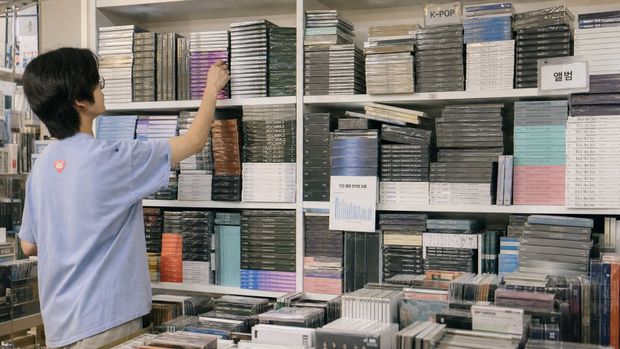
K-pop's most repeated 2025–2026 headline — "boy-group album sales are collapsing" — is half right. Unit counts really have fallen for two straight years, but the way those numbers are measured, and what they leave out, changes the story considerably.
What the Numbers Actually Show: Two Years Below 100 Million
K-pop album distribution fell to roughly 93.5 million copies in 2025, down from about 120 million in 2023, marking a second consecutive year under the symbolic 100-million benchmark . The 2024 reading sat at 98.9 million, a 17.7% drop from 120.2 million in 2023 . So the trend line is real — but it is a multi-year correction from a fandom-bulk-buying peak, not a sudden 2026 cliff.source
Quick Answer: K-pop album distribution fell to about 93.5 million copies in 2025 from roughly 120 million in 2023 — a second straight year below the 100-million benchmark. The decline is a correction from a 2021–2023 buying peak, not a market collapse, and unit counts now diverge from rising revenue.source
One measurement caveat frames every figure here. Circle Chart records distribution volume — shipments minus returns across CD, LP, USB, KiT and platform-album formats — not direct end-consumer sell-through . Hanteo's first-week, fan-purchase data can diverge significantly from Circle totals, which is why two trackers can describe the same release differently. Treat "sales" in most headlines as shipped volume, not units that reached a fan's shelf.
The top end thinned out too. The count of million-selling albums dropped from 9 in the first half of 2024 to 7 in the first half of 2025, and no release had cleared 3 million units by mid-2025 — a bar Seventeen had passed the prior year . Cumulative top-400 sales reached about 90.9 million units through November 2025, down roughly 2.56 million from the same window in 2024 .source
| Year | Album distribution (copies) | Change vs. prior year | Above 100M? |
|---|---|---|---|
| 2023 (peak) | ~120.2 million | — | Yes |
| 2024 | 98.9 million | −17.7% | No |
| 2025 | ~93.5 million | ~−5.5% | No |
| 2025 (top-400, through Nov) | 90.9 million | −2.56M vs. 2024 period | — |
The shape that matters: a steep 2023-to-2024 drop, then a shallower 2024-to-2025 slide. That deceleration, plus the gap between Circle's shipped volume and what fans actually buy, is the foundation for everything that follows — including why falling units have not meant falling money.
Why Units Are Falling: Structural Causes, Not a One-Cycle Slump

The unit decline is structural, not the product of one weak release cycle. Three durable shifts — China's curbs on fan-funded bulk-purchasing, environmental backlash against plastic CD packaging, and labels pulling back on mass multiple-version launches — removed the artificial volume that inflated the 2021–2023 peak. Domestic trackers attribute the two-year slide to these causes rather than to any single underperforming comeback .
The largest single driver to disappear was China. Group-buying campaigns, in which fan organizations pooled money to purchase tens of thousands of copies for chart and fansign goals, were a primary engine of bulk volume until Chinese authorities tightened rules on large fan-funding and mass purchasing. Yonhap, citing Circle Chart, lists those curbs alongside a sluggish domestic market and reduced fan-targeted bulk-purchase marketing as the leading reasons overall album sales fell to about 93.5 million copies in 2025 .source
Environmental concern is the second structural brake. Growing scrutiny of single-use plastic CD packaging — a recurring criticism of multi-version launches that ship dozens of variants per release — has trimmed casual and impulse buying, a factor the Chosunbiz/Nate read of Circle data cites directly . In response, labels have scaled back the saturation strategy of stacking many editions onto a single comeback after fandom complaints, reducing the bulk-purchase incentives that once padded shipment figures.
The clearest sign that the change is structural, not cyclical, is who now leads the charts. As critic Lim Hee-yun put it, "Idols used to dominate the charts thanks to mass fan activity, but that's no longer the case" . The mid-2025 digital top 10 held seven solo artists and only three idol groups — aespa, IVE and BOYNEXTDOOR — while digital consumption for the top-400 songs fell 6.4% year-over-year and 49.7% from the 2019 peak .
Taken together, these forces reset the baseline rather than dent it temporarily: the mass-buying behavior that produced 120-million-unit years is being regulated, discouraged and de-incentivized at once. That reset explains why the volume figures keep sliding — and why, as the next section shows, the groups that survive it best are a narrowing tier.
Which Boy Groups Are Still Selling: The 2025–26 Leaderboard
The groups that survive the contraction best sit at the very top of the boy-group tier, led by Stray Kids. Per Circle's 2025 data, Stray Kids moved nearly 7 million units to top all artists, with Seventeen, NCT Wish, ENHYPEN, BOYNEXTDOOR and ZeroBaseOne filling out the next band . Boy groups, in other words, still own the volume even inside a shrinking market — the question is no longer whether they sell, but how few of them carry the totals.source
Quick Answer: Stray Kids led every artist in 2025 with close to 7 million Circle units , followed by Seventeen, NCT Wish, ENHYPEN, BOYNEXTDOOR and ZeroBaseOne — a narrow top tier still posting million-plus launches while the field behind them thins.
Stray Kids' standing is not measured in units alone. The group notched a 7th Billboard 200 No. 1 and headlined Stade de France and Tottenham Hotspur Stadium, pairing chart volume with stadium-scale touring (video: K-contents Voyage) . That breadth is what distinguishes the leaders from the mid-tier, where even established acts have slid hard: Seventeen's annual total fell from about 16 million in 2023 to 8.96 million in 2024 — the sharpest single-group contraction among veteran groups.
Early 2026 confirms the top tier is still performing at multi-million scale. The table below tracks the year's leading boy-group launches.
| Release | Group | Month | Circle volume |
|---|---|---|---|
| ARIRANG | BTS | March 2026 | 4.75M+ combined (CD/Weverse/LP) |
| 7TH YEAR | TXT | April 2026 | 1.67M (1.93M across formats) |
| — | NCT WISH | April 2026 | 1.40M |
| — | &TEAM | April 2026 | 1.27M |
BTS's fifth studio album reached 4,753,755 in combined volume, the highest of any 2026 release to date , while April topped out with TXT's 1,668,464 copies (1,934,435 across formats), ahead of NCT WISH at 1,398,022 and &TEAM at 1,271,052 .
The spread between top and middle has widened all the same. The number of artists exceeding 3 million units fell from 11 to 7 in 2024, and no group cleared 5 million that year . A handful of flagship rosters keep posting the headline figures; the tier capable of doing so is simply smaller than it was at the 2023 peak.source
ZeroBaseOne's 80% Drop: What Roster Disruption Does to First-Day Sales
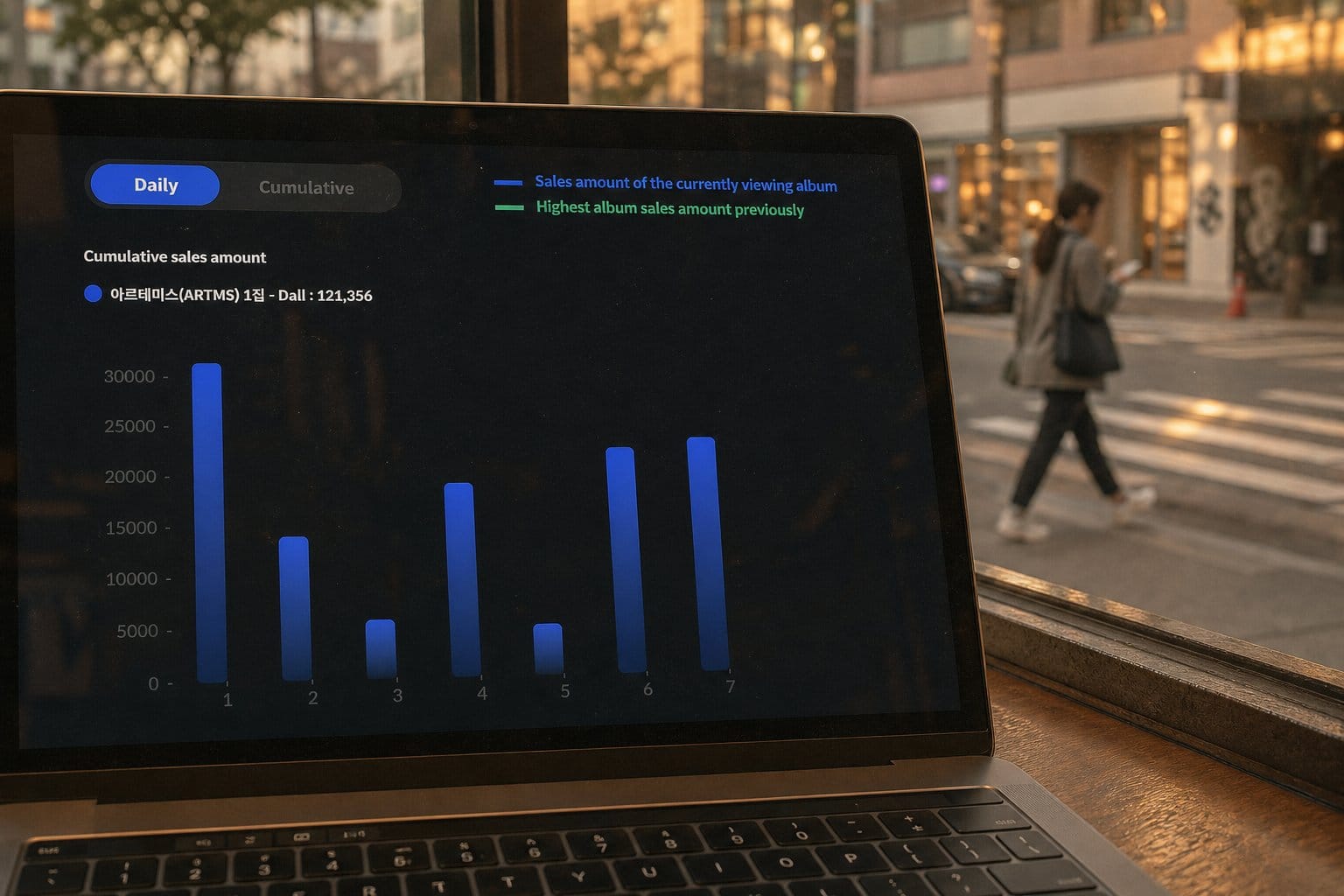
ZeroBaseOne posted the sharpest single-group plunge of the cycle, and it traces directly to a thinner roster rather than a weaker market. After four members — Zhang Hao, Ricky, Kim Gyuvin and Han Yujin — exited in March 2026 when their project-group contracts expired, the remaining five-member lineup's Ascend (released May 18, 2026) sold 198,045 first-day copies, roughly 80% below the nine-member lineup's prior low of 1,013,921 first-day copies for Blue Paradise .
The gap is too large to read as a normal comeback dip. ZeroBaseOne began as a fixed-term project group, so the March 2026 departures were a scheduled contract expiry, not a scandal or a hiatus — yet the album that followed lost four-fifths of its opening-day volume . Commentators have split over the cause without settling on one. Some attribute the fall to the loss of member-specific fanbases, each of which historically drove its own bulk-purchase activity for fansign entries and photocard collecting. Others point to pre-order logistics disrupted by the lineup change, and to post-contract-expiry fan disengagement, as supporters reassessed their commitment to a reshaped group .
There is no clean single explanation, and that ambiguity is itself the lesson. The case study shows how boy-group unit counts depend structurally on full-roster fandom mobilization. A partial lineup is not a proportionally smaller version of the same product: cut a nine-member group to five and the sales do not fall by four-ninths, because each member anchors a distinct buying cohort and the multi-version, multiple-copy purchasing behaviour that inflates opening figures is itself tied to per-member collectibles. When the roster contracts, several of those purchase drivers disappear at once. ZeroBaseOne's result is the clearest 2026 illustration that the headline numbers rest on active, complete fandoms — and that disrupting the roster removes far more volume than the member count alone would suggest.
Albums as Participation Tickets: How the Format Became Merchandise
A modern K-pop album is increasingly a participation token rather than a music purchase, which is why distribution counts can stay high even as listening demand softens. The Korea Times reported in January 2026 that albums are "increasingly resembling merchandise," sold in multiple versions with randomized photocards, bundled goods and limited editions, so a single release can be bought repeatedly by one fan . Under that model, the unit total is partly a proxy for fandom engagement depth, not for how many people are actually listening.
The mechanics are explicit. Labels issue parallel A/B/C/D editions of the same album, each with different packaging and a randomized photocard, encouraging collectors to buy the full set or chase a specific member's card. Fansign attendance then layers a second incentive on top: entry is run as a lottery in which a physical proof-of-purchase is the ticket, so heavy buyers submit dozens — frequently 50 to 100 or more copies — for a single slot . Those purchases register fully in Circle's chart, which measures distribution volume — shipments minus returns across CD, LP, USB, KiT and platform formats — rather than direct end-consumer sell-through . The result is an opening-week figure inflated well beyond organic demand whenever a comeback pairs strong fansign appeal with per-member collectibles.
This is also why streaming cannot be read as the destination for what physical is losing. Digital consumption for Circle's top-400 songs fell 6.4% year-over-year in 2025, and is down 49.7% from the 2019 peak . Both the physical and digital channels are contracting at once, which means the participation-driven layer of album buying — fansign entries, version completion, photocard lotteries — is propping up unit counts even as the underlying audience for the music narrows.
For readers tracking the "sales collapse" story, the practical takeaway is to separate two questions: how many copies shipped, and how many distinct fans are engaged. A release that moves a million units on a few thousand high-volume buyers describes a deep but concentrated fandom, not a broad one. The merchandise logic explains both the resilience of flagship boy-group launches and the fragility exposed when a roster shrinks or fansign incentives fade.
Export Revenue Tells the Opposite Story
Falling unit counts have not dragged down K-pop's album revenue — export figures point in the opposite direction. The Korea Customs Service reported that CD album exports reached $120 million in the first quarter of 2026, up 159% year-over-year and a quarterly record, with 94 of 131 importing countries setting their own Q1 highs . So while domestic shipments slid below 100 million units for a second straight year, the money tied to physical albums kept climbing.source
The destination mix shows why. In Q1 2026 the United States led export share at 28.8%, ahead of Japan (25.3%), the EU (16.5%), China (14.4%) and Taiwan (6.9%) . International buyers typically purchase at full retail price, outside the bulk-discount and fan-funding mechanics that inflated — and then deflated — domestic unit counts. A smaller pile of copies sold abroad can be worth more per unit than a larger pile moved through a Korean fansign campaign.
The full-year picture for 2025 carries the same signal. Yonhap, citing customs data, put 2025 album export value at a record $301.7 million, up 3.4% even as global unit counts fell — led by Japan at $80.6 million, China at $69.7 million and the United States at $64 million . Fewer copies, more revenue: the export ledger reads as a value story, not a volume one.source
Label earnings confirm that the major companies are growing rather than contracting. HYBE reported Q1 2026 revenue of 698.3 billion won, up 40%, with recorded-music revenue near 271.5 billion won, largely on the strength of BTS's return . SM Entertainment posted 279.1 billion won in revenue and 38.6 billion won in operating profit for the same quarter, drawing on albums, concerts and merchandise and licensing .source
The takeaway for fans tracking the "album sales plummet" headline: the metric that fell is domestic distribution volume, not the industry's top line. Revenue has migrated toward higher-margin export sales, touring and fan platforms, so a declining unit chart and a rising revenue chart can — and now do — coexist.
What the Rest of 2026 May Reveal

The full-year 2026 verdict is still open: public Circle Chart data runs only through April and Korea Customs Service export figures through the first quarter, so the headline numbers fans will cite in January 2027 do not yet exist. The second-half comeback cycle — not the slow spring — will set the final unit tally, and a single mega-release can distort the aggregate. BTS's ARIRANG alone contributed a combined 4,753,755 copies across CD, Weverse and LP formats to Q1 totals , enough to lift a quarter on its own and temporarily mask softness among mid-tier groups.
Three indicators are worth watching as the year resolves:
- The 3-million line. No 2025 release crossed 3 million units, a mark Seventeen had cleared a year earlier . Whether any non-BTS, non-BLACKPINK title reaches it in 2026 — TXT's 7TH YEAR led April at 1,668,464 copies (1,934,435 across formats) — will signal whether demand is broadening or staying top-heavy.
- The 100-million benchmark. Annual top-400 volume has fallen short for two straight years ; a rebound above it would mark a genuine turn rather than a one-album spike.
- Export trajectory. Q1 2026 CD exports hit a record $120 million, up 159% year-over-year . Whether that pace holds will show if overseas demand keeps offsetting domestic contraction.
The likeliest path is continued bifurcation rather than recovery or collapse. Flagship IP keeps expanding through stadium tours, fan platforms and exports — 2025 album export value already set a record at $301.7 million — while mid-tier and roster-disrupted groups compete for a shrinking domestic physical-fandom pool. For fans, the practical read is simple: judge 2026 not by one aggregate unit figure but by which groups break the 3-million line and where the export money lands.
Last updated: 2026-06-03. Figures reflect Circle Chart data through April 2026 and Korea Customs export data through Q1 2026; full-year totals were not yet available at publication.
Frequently asked questions
What is Circle Chart, and is it the same as actual K-pop album sales?
Circle Chart is not a direct measure of consumer sell-through. It records distribution volume — shipments to retailers minus returns — across CD, LP, USB, KiT and platform-album formats, rather than how many copies fans ultimately bought . Hanteo, by contrast, captures first-week fan-purchase data and can diverge from Circle, especially when bulk-purchase campaigns inflate early figures . Both are valid, but they measure different things, so headlines calling Circle numbers "sales" can overstate end-consumer demand.
Which K-pop boy groups sold the most albums in 2025?
Stray Kids led all artists — not only boy groups — with nearly 7 million Circle units in 2025, followed by Seventeen, NCT Wish, ENHYPEN, BOYNEXTDOOR and ZeroBaseOne . Stray Kids also extended their international chart record, scoring a seventh Billboard 200 No. 1 and headlining stadiums including Stade de France and Tottenham Hotspur Stadium . Boy groups remained the volume leaders even as aggregate units fell.
Why did ZeroBaseOne's album sales drop by around 80% in 2026?
The drop followed a roster change, not a collapse in popularity. Four of the original nine members — Zhang Hao, Ricky, Kim Gyuvin and Han Yujin — departed in March 2026 as their project-group contracts expired . The remaining five-member lineup's release 'Ascend' (May 18, 2026) posted 198,045 first-day copies, against more than 1 million first-day copies (1,013,921 for 'Blue Paradise') under the full nine-member roster — a roughly 80% decline . The case shows how directly boy-group unit counts depend on roster size and full fandom mobilization.
Are K-pop labels losing money as album unit sales decline?
Major labels are not. HYBE reported Q1 2026 revenue of 698.3 billion won, up 40% year-over-year, with recorded-music revenue near 271.5 billion won on BTS's return . SM posted 279.1 billion won in revenue and 38.6 billion won in operating profit, tied to albums, concerts and merchandise/licensing . Album exports also hit a quarterly record of $120 million in Q1 2026, up 159% year-over-year . The unit-count decline has not translated into a company-level revenue decline.
What is driving the gap between K-pop's falling unit count and rising export revenue?
The buyer mix is shifting toward higher-priced international markets. Overseas fans — particularly in the U.S. and Europe — generally purchase at full retail price, without the bulk-discount and campaign-inflated dynamics common in Korea and China. In Q1 2026 the U.S. was the top export destination at 28.8%, ahead of Japan (25.3%), the EU (16.5%) and China (14.4%) . For 2025, album export value reached a record $301.7 million, up 3.4% despite lower unit sales . When fewer units sell at higher per-unit prices — boxsets, LPs and limited editions among them — total dollar revenue can still rise.
Watch / Sources
Official Sources
This article was written using information collected and analyzed by NAMANE's in-house K-pop research AI engine. We use AI technology to bring you faster, broader coverage, and in the process some details may occasionally differ from the latest facts. For important information such as dates, venues, and prices, please double-check with official sources.


