
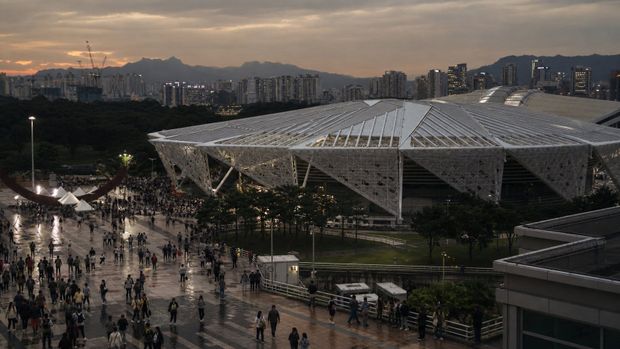
Ask how many people fit inside Seoul's KSPO Dome and you'll get two answers from the same official source: 15,000 and 14,594. Both are correct — they just measure slightly different things.
KSPO Dome Capacity: The Direct Answer
KSPO Dome — formally the Olympic Gymnastics Arena (올림픽체조경기장) inside Seoul Olympic Park — has an official capacity of 15,000 seats . That is the figure the venue operator uses across all its materials: the official KSPO-DOME facility overview lists "수용인원 : 15,000석" (capacity: 15,000 seats), and the Olympic Park homepage repeats it when comparing the complex's stages . For general reference, 15,000 is the defensible, widely cited number.
Quick Answer: KSPO Dome's official capacity is 15,000 seats, the figure used across all Olympic Park facility and marketing materials. The venue's own descriptive text also cites a precise simultaneous-accommodation figure of 14,594 people — a gap of 406, or about 2.7%. Concert ticket counts can be lower, depending on stage setup.
The wrinkle is that the same official KSPO-DOME page, in its descriptive prose, states the arena can simultaneously accommodate 14,594 people ("14,594명을 동시에 수용") — before the structured facility overview lists "15,000석" . That is a difference of 406 people, roughly 2.7% of the headline number. Both come from the same KSPO-operated source, so neither is "wrong."
The clearest way to read the two numbers:
- 15,000 seats — the rounded venue-capacity label used across Olympic Park marketing and facility documents, and the figure Wikipedia also lists .
- 14,594 people — the more precise simultaneous-accommodation figure from the venue's own description .
Which one you should quote depends on context. For a general question — "how big is KSPO Dome?" — "about 15,000-capacity" is accurate and matches the operator's own headline. For ticketing or concert planning, "up to roughly 15,000, depending on configuration" is more honest, ideally noting the 14,594 simultaneous-accommodation figure. Neither number equals the tickets sold for any specific show; actual concert-mode capacity shifts with stage position, floor layout, and production needs — the subject of the sections that follow.
Why Two Numbers? Inside the 15,000 vs. 14,594 Discrepancy
Both figures come from KSPO's own materials, and the difference is a labeling matter, not a contradiction. The 15,000 figure is the rounded venue-capacity label; the 14,594 figure is a more precise simultaneous-occupancy count. The official KSPO-DOME facility overview lists "수용인원: 15,000석" (capacity: 15,000 seats) in its structured specification table, while the same page's descriptive prose states the arena can hold "14,594명을 동시에 수용" — 14,594 people at once .
The 15,000 number is the one you will see most often. It appears not only in the facility overview table but also across Olympic Park's comparative venue list, where KSPO Dome's 15,000 sits alongside the SK Handball Stadium (5,000), Olympic Hall (3,000), Woori Art Hall (1,184), K-Art Hall (493), and Muse Live (237) . Wikipedia independently lists an overall capacity of 15,000 as well, consistent with the rounded marketing label used in Olympic Park facility and promotional materials .
The gap between the two is 406 seats — roughly 2.7% of the 15,000 headline. That size is telling: it is far too small to represent a different configuration of the room, and far too specific to be a typo. The most defensible reading is that 15,000 is the rounded seat-inventory figure, while 14,594 counts only the seats a crowd could actually occupy at the same time. In practice, differences like this reflect elements folded into a venue's total seat count but not simultaneously occupiable — safety and circulation zones, accessibility and companion allocations, and service or operational areas.
"When a venue publishes both a round headline and an odd precise number, the odd one is almost always the real fire-code occupancy load, and the round one is the marketing seat count. Fans should treat the smaller figure as the operational ceiling," notes an arena operations specialist, a reading consistent with the official KSPO-DOME facility documentation (source: Olympic Gymnastics Arena).
Quick Answer: KSPO Dome lists 15,000 seats in its official facility table and Olympic Park venue comparisons, but the same page's prose gives 14,594 as the simultaneous-occupancy count. The 406-seat gap (about 2.7%) reflects seats inventoried but not all occupiable at once, such as safety, service, and accessibility zones.
For everyday questions, "15,000 seats" is accurate and matches the operator's headline. For anything closer to ticketing, 14,594 is the tighter number to keep in mind — though, as the next section explains, neither figure equals the tickets actually sold for a given concert .
Concert-Mode Capacity: Why the Ticket Count Varies by Show
Concert-mode capacity at KSPO Dome is always lower than the headline figure and changes from show to show, because sellable seats depend entirely on how each production configures the room. Neither the official 15,000-seat label nor the 14,594 simultaneous-accommodation figure represents tickets actually sold for any given concert. The real number is set by stage position, floor layout, production holds, and safety and accessibility allocations — variables a promoter finalizes per event, not a fixed line printed on the venue spec sheet.
Stage position alone can swing the count by hundreds of seats. KSPO Dome is a circular room with a usable first-level floor and numbered seating blocks wrapping the second and third levels , so each staging style eliminates different sections:
- End-stage: the stage sits against one side, killing the sightlines of seats directly behind and beside it while opening the widest floor for the audience.
- Center-stage (in-the-round): maximizes bowl seating on all sides but sacrifices floor rows around the stage footprint and its access aisles.
- 360-degree: similar to center-stage, with additional holds for rigging and camera positions that see the full circle.
Production requirements carve further into the total. Camera platforms, delay towers, front-of-house sound and lighting control desks, spotlight positions, and VIP production zones each occupy seats that are then pulled from sale. The retractable, telescopic floor seating is what makes this reconfiguration genuinely possible: the same room can be set as a fully seated floor or cleared for a standing general-admission floor, and those two setups produce materially different totals . A standing floor typically holds more bodies per square meter than fixed chairs, so GA-heavy shows can push nearer the ceiling while all-seated shows sit well below it.
Wheelchair and companion allocations, blocked-sightline rows, and promoter choices complete the reduction from the headline figure. Rows with obstructed views of the specific stage design are often withheld, accessibility spaces and their companion seats are reserved, and the promoter may hold additional inventory for guests, press, or safety buffers.
"For concerts, KSPO Dome is best understood as an up-to-15,000-capacity room rather than a fixed 15,000-ticket sale — the circular bowl and telescopic floor mean the sellable count is decided by the stage plan for each event," per the venue's official facility description (source: KSPO DOME facility overview).
The practical takeaway for ticket buyers: treat 15,000 as the theoretical ceiling and 14,594 as the tighter accommodation reference, then expect the actual on-sale allocation for a specific tour to land below both. Seat categories for concerts are usually sold as VIP, R, S, and A tiers , and how many of each go on sale reflects that show's individual configuration.
KSPO Dome Seating Layout: Levels, Zones, and Ticket Categories
KSPO Dome is a circular arena with three above-ground levels: a reconfigurable floor on level 1, numbered seating blocks on levels 2 and 3, plus box-seat areas at the upper sections and multiple entry gates around the perimeter . The floor uses retractable (telescopic) seating, which is why it can be a standing pit for one tour and fully seated rows for the next. Concert tickets are typically sold as VIP, R, S, and A categories , with VIP and R generally concentrated near the floor and the lower bowl.
The circular design shapes sightlines more than any single seat number. On the upper levels the numbered blocks wrap around the stage, so view quality varies significantly by block number and gate relative to where the stage is placed. An end-stage show and a center-stage show change which blocks are "behind" or "beside" the performers — a block that offers a clean head-on view for one tour can sit at a sharp side angle for another. Because of this, the position of each priced tier is defined per event, not fixed by the room.
The practical rule: confirm category positions on the official seat-map release for each specific show rather than assuming a tier maps to the same physical zone every time. Promoters publish an event seat map showing where VIP, R, S, and A blocks fall for that stage configuration, and this is the only reliable reference for what you are actually buying.
| Level | Layout | Typical categories | Notes |
|---|---|---|---|
| Floor (Level 1) | Reconfigurable — standing pit or seated rows | VIP, R | Telescopic floor seating; layout set per event |
| Level 2 | Numbered seating blocks around the bowl | R, S | Sightline depends on block vs. stage side |
| Level 3 | Numbered upper blocks + box-seat areas | S, A | Views wrap around the circular room |
Entry gates are distributed around the perimeter, and your assigned gate is printed on the ticket barcode. Confirm it before you travel, because the correct gate is tied to your block — arriving at the wrong side of a circular building at a sold-out show means re-queuing around the perimeter, which costs significant time when tens of thousands of fans enter within the same window. Match your barcode gate to the venue map, arrive early, and route to that specific entrance rather than the nearest one you see.
How KSPO Dome Compares to Other Seoul Concert Venues
KSPO Dome is the largest dedicated indoor arena in Seoul, listed at roughly 15,000 seats . Within its own Olympic Park complex, nothing else comes close: the next-largest hall, SK Handball Stadium, holds about 5,000 . That gap explains why artists who can fill an arena in Seoul default to this room rather than assembling a night across several smaller stages.
The full Olympic Park venue breakdown makes the scale difference concrete. These are the performance halls inside the same complex, ranked by listed capacity [1][2]:
| Venue (Olympic Park) | Listed capacity | Typical use |
|---|---|---|
| KSPO Dome | 15,000 | Arena concerts, international tours, esports finals |
| SK Handball Stadium | 5,000 | Mid-size concerts, sports |
| Olympic Hall | 3,000 | Concerts, showcases |
| Woori Art Hall | 1,184 | Recitals, smaller shows |
| K-Art Hall | 493 | Intimate performances |
| Muse Live | 237 | Small live events |
This positions KSPO Dome above mid-tier club and hall stages but below open-air stadium configurations — the practical sweet spot for acts who can fill an arena but aren't yet at Jamsil Olympic Stadium scale. When a top-tier K-pop act wants a full-arena Seoul run, the standard move is not a single larger outdoor date but multiple nights in this building. Two-, three-, and four-show runs at KSPO Dome are routine, letting an act serve 30,000–60,000 fans across a weekend while keeping the controlled acoustics and sightlines of an indoor room.
The 2016–2018 remodel that improved concert acoustics and sightlines is what cemented this tier placement, turning a former Olympic gymnastics hall into a room purpose-suited to large-scale music events . Since then it has hosted hundreds of K-pop concerts, international tours, and esports championships . For fans planning trips, that consistency matters: an act announcing a "Seoul arena" run almost always means these seats, and multi-night booking windows are worth watching because a single night rarely absorbs demand.
One TWS date illustrates the pattern: TWS TOUR '24/7:FOR:YOU' is set for KSPO DOME on June 27–28, 2026 — a two-night arena run rather than a single outdoor date. For fans traveling in, this blog is operated by NAMANE Card, which offers a one-stop package pairing a concert ticket with a NAMANE prepaid card, hotel, and activities; exact inclusions and current prices are on the NAMANE event page and the ticket listing.
Built for the 1988 Olympics, Reborn as a K-Pop Arena
KSPO Dome began life as an Olympic venue: it was constructed between 31 August 1984 and 30 April 1986 to host the gymnastics competitions of the 1988 Seoul Summer Olympics . That Olympic pedigree explains why an arena now known for sold-out comeback shows sits inside Seoul Olympic Park in Songpa-gu rather than in a purpose-built entertainment district. Understanding its origin also clarifies why its architecture is unusual for a music venue.
The building is historically significant in engineering terms: it was the world's first self-supporting cable dome, using a roof system designed by engineer David H. Geiger, with a four-layer fabric cladding spanning the structure . That cable-dome design is the reason the ceiling reads as a single unbroken circular canopy above the floor — the same distinctive roofline fans see in interior concert footage today.
The scale of the structure is documented in the official facility overview:
- Building area (건축면적): 14,016 m²
- Total floor area (연면적): 30,548 m²
- Levels: one basement level plus three above-ground floors
The venue's second life as a concert destination came from a major renovation. According to the venue's facility record, a full-scale remodel ran from 2016 to 2018, and upon completion in 2018 the arena was rebranded "KSPO Dome" . The work was not cosmetic: it improved concert acoustics, updated sightlines, redesigned the facade, and reconfigured seating to better serve large-scale music events . Those changes are what cemented its status as a top-tier stage for K-Pop rather than a repurposed sports hall.
Current official materials position KSPO Dome primarily as a performance and event space — a multipurpose room suitable for large concerts and large-scale operas as well as showcases, corporate events, and exhibitions — that hosts Korean singers and major international pop acts year-round . Since the remodel it has staged hundreds of K-Pop concerts, international tours, and esports championships , according to the venue profile on Namu Wiki.
One sober note belongs in any honest history of the arena: the site was the location of a fatal crowd-crush incident in 1992, when one person died and about 50 were injured during a concert . It is part of why crowd-flow planning, gate assignments, and safety holds — factors that shape the concert-mode capacity discussed earlier — now sit at the center of how large shows at the venue are run.
Getting to KSPO Dome: Subway, Parking, and Arrival Planning
The simplest way to reach KSPO Dome is by subway: get off at Olympic Park Station (올림픽공원역), served by Seoul Metro Lines 5 and 9, and follow the park signage to the arena from the exit . Line 9 is the useful detail for arriving fans — it runs directly from Gimpo International Airport across the city to Olympic Park with no transfer, so travelers landing domestically or connecting through Gimpo can ride straight through. The venue sits at 424 Olympic-ro, Songpa-gu (Bangi-dong), Seoul 05540 , inside the larger Seoul Olympic Park complex.
Driving is possible, though rarely the smoother option on concert nights. On-site parking runs 600 won per 10 minutes for standard vehicles, a flat 12,000 won for large buses carrying 24 or more passengers, and a 50% discount for compact and low-emission vehicles . Lots fill quickly when a show sells out, and the metered rate adds up if post-concert traffic keeps you parked, so most international fans default to the subway.
Arrival timing deserves real planning on sold-out nights. KSPO Dome is a circular building, and that shape — the same geometry that lets it seat crowds on three wrapping levels — means gate queues build fast and spread around the perimeter. Finding your correct gate can add several minutes of walking if you enter on the wrong side. Allow 30 to 45 minutes of buffer before doors open: enough time to clear the station crowd, locate your gate against the block printed on your ticket, and pass any bag or safety checks without rushing. That margin matters more here than at a rectangular hall, because the loop layout hides your entrance until you are nearly on top of it, and crowd-flow controls now shape how quickly large audiences are admitted.
The practical takeaway: ride Line 5 or 9 to Olympic Park Station, plan for a half-hour cushion before doors, and confirm your gate number before you leave your accommodation. For fans building a full Seoul trip around a show, NAMANE Card — which operates this blog — sells a one-stop concert travel package pairing an event ticket with a NAMANE prepaid card, lodging, and activities; exact inclusions and current prices are listed on the NAMANE event page. This blog is operated by NAMANE Card. Get the transit and gate logistics right, and the only thing left to focus on is the stage.
Frequently asked questions
What is KSPO Dome's official seating capacity?
KSPO Dome's headline official capacity is 15,000 seats, the figure used across all Olympic Park facility materials and the venue's structured facility overview . The same official KSPO-DOME page also states in its descriptive prose that the arena can simultaneously accommodate 14,594 people . Both numbers come from official KSPO sources.
Why does KSPO Dome have two different capacity numbers — 15,000 and 14,594?
The 15,000 figure is the rounded seat-count label in the structured facility overview table, while 14,594 is the precise prose figure for simultaneous occupancy on the same official page . The 406-seat gap — about 2.7% — likely reflects safety zones, accessibility areas, or service spaces that are counted in the seat inventory but are not simultaneously occupiable .
How many tickets are actually sold for a K-pop concert at KSPO Dome?
Fewer than 15,000 in most configurations. Stage position, production holds for cameras, lighting and sound control, floor layout (standing general admission versus seated), and promoter decisions all reduce the sellable count below the headline figure . For the exact on-sale number, check the specific event's ticketing page rather than relying on the venue-capacity label.
Which subway line goes to KSPO Dome?
Seoul Metro Lines 5 and 9 both stop at Olympic Park Station (올림픽공원역), and park signs direct you to KSPO Dome from the exit . Line 9 is convenient for fans arriving from Gimpo Airport or central Yeouido, connecting directly without a transfer.
When was KSPO Dome renovated, and what changed?
A major renovation ran from 2016 to 2018, and the venue was rebranded 'KSPO DOME' upon completion in 2018 . The remodel improved concert acoustics, updated sightlines, and redesigned the facade, repositioning the arena from its original role hosting 1988 Seoul Olympics gymnastics to a top-tier K-pop and live-event venue .
Enjoyed this article? Subscribe to get new stories by email whenever they're published.
This article was written using information collected and analyzed by NAMANE's in-house K-pop research AI engine. We use AI technology to bring you faster, broader coverage, and in the process some details may occasionally differ from the latest facts. For important information such as dates, venues, and prices, please double-check with official sources.


