
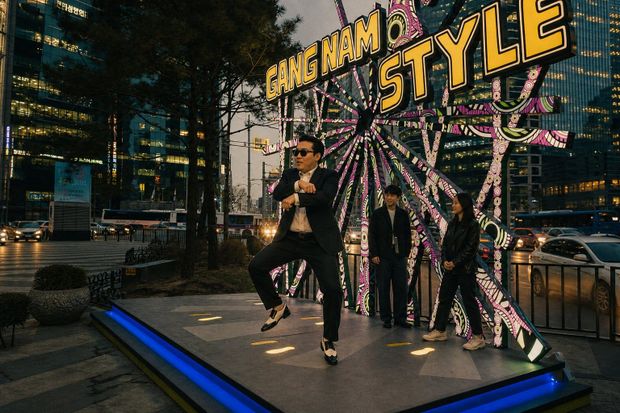
Gangnam Before the Song: Seoul's Wealthiest District
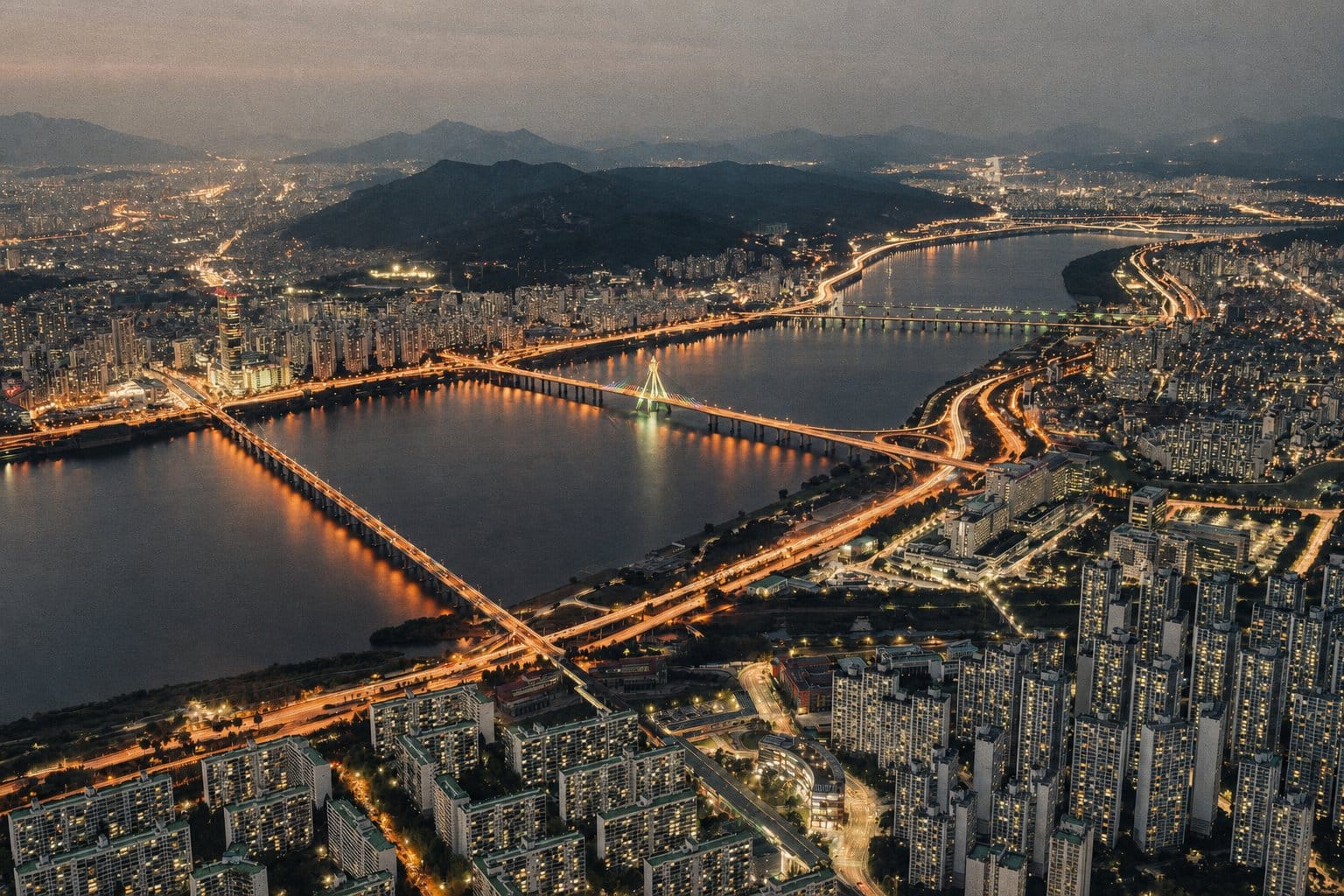
Gangnam-gu is Seoul's wealthiest municipal district, covering approximately 39.5 km² on the southern bank of the Han River . Its transformation from semi-agricultural land into one of Asia's most expensive real estate zones began in the 1970s and 1980s, driven by government-directed urbanization that pushed high-density residential and commercial construction south across the Han River from the historic city center. Within two decades, Gangnam had become a byword for Korean wealth — a status it has maintained for over forty years. Property prices in the district consistently rank among the highest in Asia, rivaling comparable addresses in Tokyo, Hong Kong, and Singapore . For Koreans, the name "Gangnam" carries a weight that no English translation fully captures: it is simultaneously a geographic designation, an economic category, and a form of social aspiration. Understanding what the district signified to domestic audiences is the prerequisite for grasping why PSY's 2012 song landed with such precision — and why its irony was so immediately legible to Korean listeners while remaining entirely invisible to everyone else.
Quick Answer: "Gangnam Style" is a 2012 satirical pop song by South Korean artist PSY that mocked class-aspiring youth in Seoul's wealthiest district. Released on July 15, 2012, it became the first YouTube video in history to reach 1 billion views and topped charts in more than 30 countries — launching K-pop onto a genuinely global stage.source
The district's internal geography is essential to the song's meaning. Four sub-neighborhoods define Gangnam's social texture in distinct registers. Apgujeong (압구정) and Cheongdam (청담) are the traditional cores of luxury consumption — flagship boutiques, high-end medical clinics, and the agency buildings that manage K-pop's largest stars. Samseong-dong (삼성동) is the commercial and convention spine, anchored by the COEX complex. Sinsa-dong (신사동), and its main artery Garosu-gil, carries a more gallery-and-boutique character that draws a slightly younger, fashion-forward crowd. Koreans navigate these status distinctions fluently — knowing which sub-neighborhood signals what about a person's class position is part of everyday Seoul social literacy .
The concentration of the entertainment industry in Gangnam is not incidental. SM Entertainment, YG Entertainment, and JYP Entertainment — the three companies that have defined Korean pop music's commercial era — all operate principal offices within the district . Their proximity to Gangnam's hagwon cram schools, luxury apartment towers, and aesthetic medicine clinics is part of the same economic geography that PSY's song satirizes. By the 2000s, Gangnam had become a stage where Korean anxieties about class mobility and conspicuous display were performed and observed in concentrated, daily form.source
By the time PSY wrote "Gangnam Style" in 2012, the word "Gangnam" in everyday Korean speech already functioned as shorthand for a particular kind of studied affluence — an identity performed as much as inherited. Koreans were fluent in its social implications without needing them explained. The song's comedy depended entirely on that fluency. For international audiences who had never encountered Gangnam, the word meant something else entirely — or nothing beyond the beat itself.
PSY: A Decade of Domestic Controversy Before Global Fame
Park Jae-sang — known professionally as PSY — was born in 1977 in Seoul into a family whose wealth derived from South Korea's semiconductor manufacturing industry . That biographical detail carries weight: PSY came from precisely the class of Gangnam-adjacent privilege whose performance of status he would spend his career lampooning. Over a decade of establishing himself as a domestic hip-hop comedian, he built an artistic identity on deliberate unglamorousness — broad physical comedy, explicit content, and a stage persona that consistently violated the polished norms of Korean idol culture. Government fines for explicit lyrics became part of his public story rather than setbacks to it . By 2012, PSY was a well-known and divisive figure in Korea — commercially viable, recognizable, but definitively not an idol. Not Gangnam.
"Gangnam Style is poking fun at people trying very hard to be something they're not," — PSY, Park Jae-sang, as cited by Encyclopædia Britannica
"Gangnam Style" was released on July 15, 2012, as the lead single from Psy 6 (Six Rules), Part 1, his sixth mini-album . The song was entirely PSY's concept, written with a Korean domestic audience clearly in mind. The target was a type he had observed across his career: young people from outside Gangnam's genuine elite who adopted the district's surface markers of status — the fashion, the posture, the implied wealth — as a form of constructed identity. PSY was acutely positioned to observe this social type, having grown up adjacent to that world without fully belonging to it.
The timing of the release mattered too. By mid-2012, smartphone penetration was driving rapid growth in Korean social media use, and YouTube had emerged as a primary vehicle for music video distribution even within Korea. PSY and YG Entertainment understood that the video format was the song's primary delivery mechanism — and that the horse-riding dance had to be front and center . The song was conceived as K-pop comedy for a domestic audience. What happened globally in the weeks that followed was not part of any plan.
The Satire Korean Audiences Actually Understood
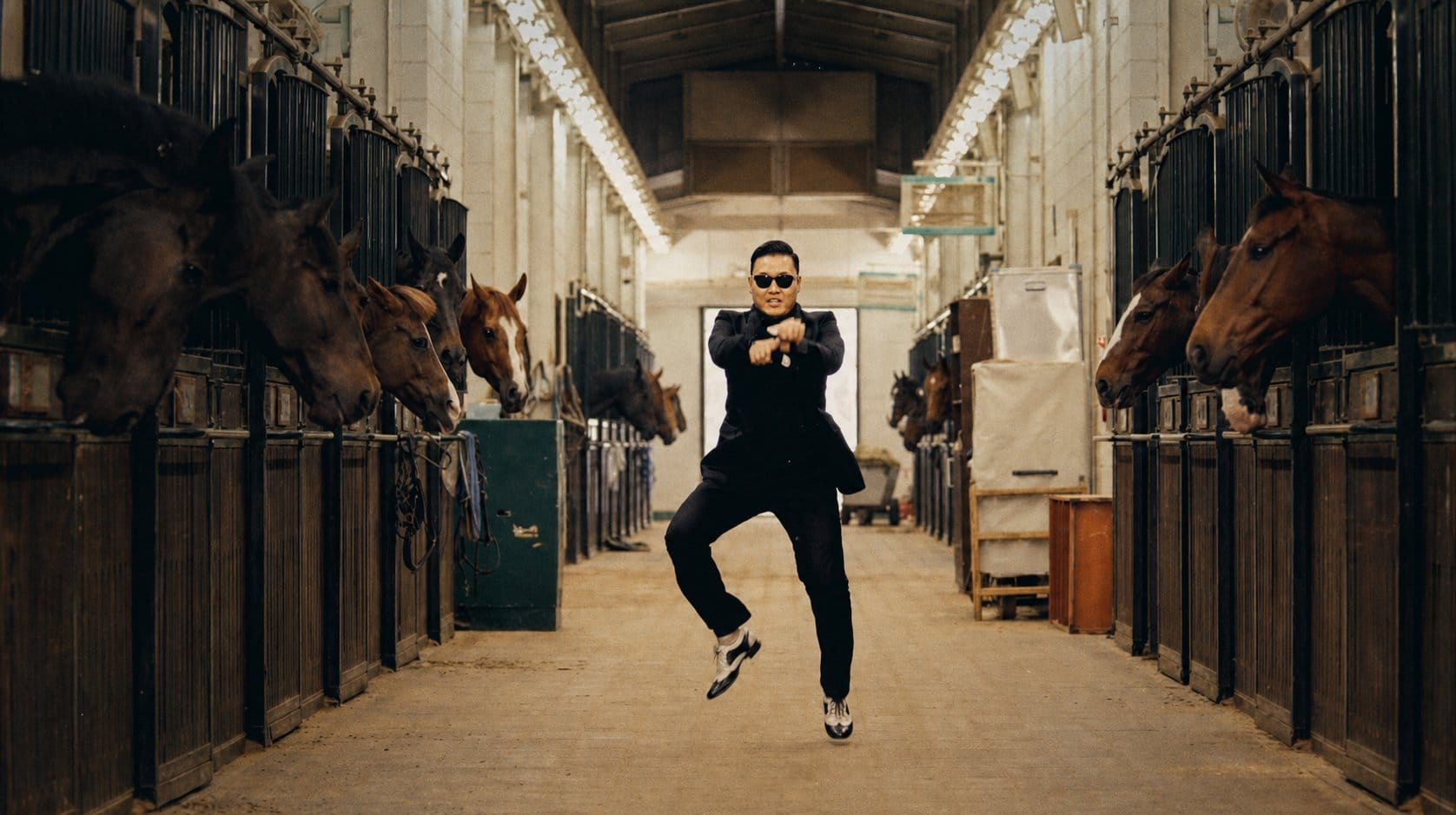
The central joke of "Gangnam Style" operates through social incongruity — and it was only fully legible to viewers who understood what Gangnam meant. PSY deliberately constructed the music video as a sequence of unglamorous settings: a parking garage, a horse stable, a children's playground, a public bus . In each setting, he performs the posture and swagger of Gangnam élite — creating comedy through the gap between the pretension and the reality. The horse-riding dance, which became the video's global signature, is itself part of this logic: a literal mimicry of equestrian leisure — a leisure activity associated with old-money status — rendered absurd in a parking garage. For domestic Korean audiences, the satirical mechanics were immediately clear. No subtitle was required.
PSY described the video's visual design in terms of deliberate contrast: placing himself in what he called "unstylish locations" while maintaining full Gangnam swagger, so that the gap between setting and behavior was the joke . The choice of a horse stable is not arbitrary — horse riding in Korea carries connotations of inherited elite status that most urban Koreans will never access. Placing the horse-riding dance in a literal stable, surrounded by actual horses, is a punchline whose architecture requires cultural literacy to appreciate fully.
"I tried to capture the lifestyle of what it means to act 'Gangnam' when you are not actually from there. It's comedy — but it's also something real," — PSY, Park Jae-sang, discussing the song's visual concept, as reported by uDiscover Music
The structural comedy of the video extends to its casting. Korean comedian Yoo Jae-seok appears in a yellow suit at a nightclub. The video's opening shot — PSY lounging under a beach parasol — is immediately revealed to be a children's sandpit. These are gags calibrated for audiences fluent in Korean celebrity culture and Seoul's specific social geography. For international viewers who encountered the video in August 2012, none of this subtext was accessible. They saw an energetic, visually inventive music video with a contagious beat and a physically irresistible dance .
This structural split — domestic satire carried invisibly by a globally accessible pop hook — is arguably what made the song's crossover both unprecedented and difficult to replicate. The irony was available to those with cultural context and entirely invisible to those without it. Crucially, it was non-obstructive in either case: the satire did not need to be decoded to enjoy the song. That is an unusual property for a comedy track to possess, and it explains why the song's humor never alienated the international audience that had no access to its punchline. For the Korean viewer, the laugh was sharp and specific. For everyone else, it was simply a spectacle.
The Viral Explosion That Broke YouTube's Counter
"Gangnam Style" recorded 500,000 views on its first day on YouTube — July 15, 2012 . That number, significant by 2012 standards for a Korean-language video with no Western marketing infrastructure, began rising faster than any music video the platform had previously tracked. By August 2012, the video was averaging over 3 million views per day . The acceleration was driven by a clearly traceable mechanism: celebrity amplification operating through nascent social media. T-Pain's tweet on July 29, 2012 was the first major Western-market signal. Within days, Britney Spears, Katy Perry, Tom Cruise, and Robbie Williams had all publicly engaged with the video . Each mention reached tens of millions of followers and created a new wave of first-time viewers who then shared independently. The cascade was self-reinforcing in a way that had not been observed at this scale before.source
On December 21, 2012, "Gangnam Style" became the first YouTube video in history to reach 1 billion views . The milestone prompted broad cultural commentary on the changing geography of media consumption and the platform's emergence as a genuine global equalizer. But the engineering consequence that followed is, in retrospect, equally remarkable: YouTube's public view counter was hard-coded to a 32-bit integer, with a maximum value of 2,147,483,647 — approximately 2.15 billion . As "Gangnam Style" approached that ceiling in late 2014, YouTube's engineering team was forced to upgrade the counter to a 64-bit system — extending the theoretical maximum to 9,223,372,036,854,775,807. YouTube announced the change with characteristically dry self-awareness, noting that only one video had made it necessary. The engineering patch became international news in its own right.source
The video held the record as YouTube's most-viewed of all time from November 24, 2012 — the date it overtook Justin Bieber's "Baby" — until July 10, 2017, when Luis Fonsi's "Despacito" surpassed it . Nearly five years at the top of the platform's all-time ranking is a duration that distinguishes the video categorically from conventional viral content, which typically peaks sharply and decays to near-zero within months. "Gangnam Style" continued drawing significant daily views through 2013, 2014, and beyond — sustained by YouTube's algorithmic recommendation systems and the platform's continued expansion into markets with limited internet access in 2012.
As of 2025–2026, the video stands at approximately 4.98 billion views, placing it among the five most-viewed YouTube videos ever recorded . That count continues to grow organically, at a fraction of its 2012–2013 rate but at volumes that would still be notable for newly released content. The YouTube counter incident remains the single clearest illustration of how genuinely unprecedented the video's scale was: the platform's engineers had built their infrastructure without any scenario in which one piece of content could approach two billion views. A South Korean comedy pop song rendered that assumption obsolete.
Chart Records Across 30+ Countries
"Gangnam Style" topped music charts in more than 30 countries during autumn 2012, including Australia, Canada, France, Germany, Italy, Spain, and the United Kingdom . That breadth of simultaneous number-one positions — achieved by a Korean-language track with no English-language lyrics and no prior Western major-label distribution infrastructure — was without precedent in the recorded history of the global music charts. The song peaked at number two on the US Billboard Hot 100, at the time the highest chart position ever reached by a South Korean artist . Pan-European chart domination combined with near-peak US performance established the song as genuinely global rather than regionally popular in a handful of markets.
| Market | Chart | Peak Position | Notable Date |
|---|---|---|---|
| United States | Billboard Hot 100 | #2 | Oct–Nov 2012 |
| United Kingdom | UK Singles Chart | #1 | Oct 6, 2012 |
| Australia | ARIA Singles Chart | #1 | Sep–Oct 2012 |
| Canada | Canadian Hot 100 | #1 | Oct 2012 |
| France | SNEP Singles Chart | #1 | Sep–Oct 2012 |
| Germany | Official German Charts | #1 | Sep–Oct 2012 |
| Italy | FIMI Singles Chart | #1 | Oct 2012 |
| Spain | Promusicae Chart | #1 | Oct 2012 |
| South Korea | Gaon Digital Chart | #1 | Jul 2012 |
The UK milestone of October 6, 2012 carried particular historical weight: PSY became the first South Korean musician to reach number one on the UK Singles Chart . The UK chart — one of the most closely tracked in global music — had not been topped by a Korean artist in its decades of operation. The achievement was noted by music industry commentators, cultural analysts, and politicians in equal measure.
"PSY is a force for world peace," — Ban Ki-moon, United Nations Secretary-General, speaking to journalists in late 2012, as reported by Euronews
Ban Ki-moon — himself South Korean — made the remark in a press encounter that was itself widely circulated. The political dimension of the song's reception extended further: US Representative John Lewis, UK Prime Minister David Cameron, and then-MP Boris Johnson all publicly performed the horse-riding dance in 2012 . The South Korean government formally recognized the song's cultural impact: PSY received the Order of Cultural Merit, one of the country's highest honors for contributions to Korean culture internationally .
What the Song Changed: K-Wave, Language Barriers, and Global Perception
"Gangnam Style" arrived at a precise structural moment in the global music industry — one where YouTube had reached sufficient scale to function as a standalone global distribution channel, social media sharing was mainstream across most internet-connected markets, and smartphone video was near-ubiquitous in wealthy countries . These three conditions had not previously existed simultaneously. The song exploited all three: a YouTube-native video strategy, celebrity-amplified viral social sharing, and a dance that any smartphone camera could record. The convergence was not entirely accidental — PSY and YG Entertainment understood the YouTube ecosystem — but the scale of what resulted exceeded any planning.
The clearest structural impact was the demonstration that language was not a ceiling for global chart success. Before "Gangnam Style," the prevailing assumption in Western music industry circles held that non-English-language tracks required either translation or Western major-label partnership to reach mainstream Anglo-American audiences. PSY reached number two on the US Billboard Hot 100 with an untranslated Korean song distributed via YouTube, without a US major-label deal in place at the time of initial release . That single data point made the old assumption structurally untenable. K-pop labels updated their international marketing strategies in direct and documented response.
The Korean government and Korea's entertainment industry both credited "Gangnam Style" with accelerating the broader K-Wave (한류, Hallyu) cultural export strategy. The song demonstrated at scale — a scale no previous Korean cultural export had approached — that Korean pop content could penetrate markets with no prior relationship with Korean media . That demonstration had immediate investment consequences: it justified increased marketing spend on international K-pop promotion, opened doors to Western label partnerships, and created an audience of hundreds of millions of global listeners with at least a surface-level reference point for Korean popular culture.
The lineage from "Gangnam Style" to BTS's 2017–2020 global breakthrough and BLACKPINK's subsequent crossover is not a straight causal line, but it is real. Each of those later breakthroughs built on infrastructure — distribution relationships, Western industry openness, audience familiarity, media access — that PSY's 2012 moment helped establish. Music historians and cultural analysts consistently identify "Gangnam Style" as the first mass K-pop introduction for hundreds of millions of global listeners who had no prior context for Korean popular music . PSY's breakthrough did not cause what BTS achieved. But it proved the concept at a moment when proof was needed — and acted upon.
The Word 'Gangnam' as a Lasting Global Signifier

One of the more durable consequences of PSY's song is linguistic: "Gangnam" entered the global vocabulary as usable shorthand for aspirational urban wealth and conspicuous consumption — applicable in contexts with no connection to Seoul or Korea . This is a genuinely uncommon outcome for a pop song: the track's primary noun — a South Korean administrative district — became a cross-cultural signifier recognizable to people who have never visited Korea and know nothing of the district's actual geography or history. The word functions in English-language journalism and conversation as a quick marker for a particular kind of performed affluence, without requiring further explanation. That kind of semantic entry into a language other than one's own is a measure of cultural impact that transcends chart performance.
| Date | YouTube Milestone | Significance |
|---|---|---|
| July 15, 2012 | Upload date; 500,000 views on Day 1 | Unprecedented first-day figure for a Korean-language video |
| July 29, 2012 | T-Pain tweet; celebrity amplification begins | Triggered cascading Western mainstream exposure |
| November 24, 2012 | Became the most-viewed YouTube video of all time | Overtook Justin Bieber's "Baby" |
| December 21, 2012 | First YouTube video to reach 1 billion views | Forced YouTube to upgrade from 32-bit to 64-bit view counter |
| July 10, 2017 | Lost most-viewed record to "Despacito" | Held the #1 position for nearly five years |
| 2025–2026 | ~4.98 billion total views | Among the five most-viewed YouTube videos ever recorded |
The horse-riding dance generated an imitation culture that spread across every inhabited continent. Military units, city councils, political figures, university sports teams, and flash mobs filmed their own versions in numbers that reached into the millions across platforms . The dance's particular structural simplicity — requiring no props, no partner, and no athletic ability — made it accessible to a wider range of imitators than almost any previous signature move from a pop music context. This imitation economy is itself a marker of the song's unusual cultural penetration.
In Gangnam itself, a bronze horse statue was installed near COEX's east gate as a permanent tribute to PSY's global moment . The statue plays the song from adjacent speakers and has become an informal landmark for fans visiting the district — a tangible connection to the video's cultural geography, located fittingly in the commercial heart of the district the song was satirizing.
📍 서울특별시 강남구 삼성동 85길 11
🕒 매일 24시간 영업
⭐ 5 (1 리뷰)
📞 050-6982-0831
🔗 Google Maps에서 보기
More than a decade after release, the video's view count continues to grow at a rate that would be notable for newly released content, let alone 2012 material. YouTube's recommendation algorithm surfaces "Gangnam Style" to new cohorts of users — including many who were children or not yet born when the video was first uploaded — creating a kind of permanent generational entry point into K-pop cultural history . Its sustained algorithmic relevance, as much as its initial viral peak, defines the video's lasting significance.
Frequently Asked Questions
What does 'Gangnam Style' actually mean?
"Gangnam Style" refers to the lifestyle associated with Gangnam-gu, Seoul's wealthiest district. "Gangnam" translates literally as "south of the river" — the Han River that bisects Seoul — and functions in Korean as shorthand for aspirational urban affluence. PSY's song uses the phrase satirically rather than celebratorily: rather than honoring Gangnam wealth, it mocks the performance of that wealth by people who adopt the district's surface markers of status without belonging to its genuine elite. The song's target was specifically the nouveau riche and class-aspiring youth who treated Gangnam identity as a costume rather than a lived reality. International audiences who lacked this cultural context received the phrase as a catchy, energetic hook — which served the song's global crossover equally well, even if the punchline was completely lost in translation.
Why did the song go viral globally when its satire was Korea-specific?
The domestic satire and the global viral engine operated entirely independently of each other. For Korean audiences, the joke was in the incongruity between Gangnam swagger and deliberately unglamorous filming locations — a comedy of class pretension recognizable to anyone who knew what Gangnam meant. For international audiences, none of that subtext was accessible — and none of it was needed. The electronic beat, the memorable and phonetically fun chorus, and particularly the horse-riding dance created viral conditions that required no cultural context whatsoever. The dance could be imitated on a smartphone camera with no props, no partner, and no prior knowledge of Korea. Celebrity amplification — beginning with T-Pain's tweet on July 29, 2012 and rapidly extending to Britney Spears, Katy Perry, and others — provided the initial Western mainstream exposure. YouTube's global reach at a moment of rapidly expanding smartphone adoption did the rest. The satire was invisible to the global audience; the spectacle was not.
What is the story behind YouTube's view counter breaking?
YouTube's public view counter was encoded as a 32-bit integer — a standard programming data type with a fixed maximum value of 2,147,483,647 (approximately 2.15 billion). As "Gangnam Style" approached that ceiling in late 2014, YouTube's engineering team upgraded the counter to a 64-bit system, extending the theoretical maximum to over 9.2 quintillion views. YouTube announced the change publicly and noted, with some wry humor, that only one video had made the upgrade necessary. The announcement itself became widely reported international news — an unusual case of a software infrastructure update attracting mainstream media coverage. In concrete engineering terms, the episode illustrated how genuinely unprecedented the video's scale was: YouTube's architects had built the platform without the possibility in mind that any single piece of content could approach two billion views. A Korean pop song forced them to reconsider the architecture.
Did Gangnam Style change how K-pop artists approached international markets?
Yes, in documented and measurable ways. Before "Gangnam Style," the standard K-pop internationalization model relied on physical regional rollouts, translated content, and traditional media partnerships for non-Korean markets. PSY reaching number two on the US Billboard Hot 100 with an untranslated Korean track — via YouTube, without a US major-label deal at initial release — demonstrated that viral internet distribution could substitute for conventional Western industry infrastructure. K-pop labels including SM Entertainment, YG Entertainment, and JYP Entertainment updated their international marketing strategies in direct response, investing more heavily in YouTube-native content formats and English-language social media presence. The infrastructure buildout that followed ultimately supported BTS's global breakthrough in 2017–2020 and BLACKPINK's subsequent crossover into mainstream Western markets. "Gangnam Style" did not cause those later achievements, but it provided the working proof-of-concept at a moment when the Korean entertainment industry needed evidence that the investment was justified.
Where was Gangnam Style filmed, and can you visit those locations?
The music video was shot across multiple Seoul locations, including the COEX area in Samseong-dong (Gangnam), Dongtan racecourse, the surroundings of the Seoul Arts Center in Seocho, and a rooftop in Yeouido. The most consistently visited callback site is the bronze horse statue installed near COEX's east gate in Gangnam, where the song plays from adjacent speakers year-round — making it an accessible and recognizable landmark for visitors tracing the video's cultural geography . For fans interested in K-pop's broader Gangnam geography, K-Star Road in the Cheongdam and Apgujeong area — featuring the GangnamDol character bear sculptures representing major K-pop groups — is the neighborhood's other principal fan destination. A dedicated Gangnam travel guide covers these visitor sites in comprehensive detail, including transport and neighborhood-by-neighborhood breakdowns.
Gangnam Style in Retrospect: A Pivot Point That Held
"Gangnam Style" occupies an unusual position in cultural history: a song whose domestic meaning — sharp satire of class aspiration in a specific South Korean district — was entirely invisible to the global audience that made it one of the most-viewed pieces of media ever recorded. The split between what Korean audiences understood and what international audiences experienced was not a failure of translation. It was structurally what made the crossover possible. The satire travelled inside the hook; the joke stayed at home. Both audiences got exactly what they came for.
What the song proved — that a non-English track could reach the top of charts across 30+ countries through internet distribution alone, that language was not a structural barrier, that YouTube was a genuinely global platform rather than a predominantly English-language one — these proofs had consequences extending far beyond PSY's own career. The K-wave infrastructure that followed, the international marketing investments that K-pop labels made in the song's wake, the Western industry openness to Korean pop content that BTS and BLACKPINK ultimately benefited from: all of these trace a line back to July 15, 2012 .
The view counter still ticks. The horse-riding dance is still imitated in corners of the internet that were not yet active in 2012. The word "Gangnam" still functions in English-language journalism as a marker for performed wealth, exported from a Seoul district to the global lexicon by a three-minute comedy pop song. For content conceived as domestic Korean satire, the cultural half-life has been extraordinary.
Last updated: 2026-05-23. This article draws on published records from Wikipedia, uDiscover Music, Encyclopædia Britannica, Euronews, and the History Channel, reviewed against K-pop industry reporting current to the article date.
This article was written using information collected and analyzed by NAMANE's in-house K-pop research AI engine. We use AI technology to bring you faster, broader coverage, and in the process some details may occasionally differ from the latest facts. For important information such as dates, venues, and prices, please double-check with official sources.


