

What Is Quelpart? The Direct Answer
Quelpart — also spelled Quelpaert, Quelpaërt, or Quelparte — is the European name for Jeju Island, South Korea's largest island, off the southern coast of the Korean Peninsula . It is not a separate place or a lost territory: it is simply what Western maps, travelogues, treaties, and scientific literature called Jeju for roughly three and a half centuries before modern Korean romanization replaced it .
Quick Answer: Quelpart is the historical European name for Jeju Island, South Korea's largest island. It appears in Dutch VOC shipping records by 1648 and stayed the standard Western term until "Jeju" was adopted on July 7, 2000 — even Article 2(a) of the 1951 Treaty of Peace with Japan still called it "Quelpart."
The name first surfaces in Dutch East India Company (VOC) shipping records around 1648 and entered mainstream Western cartography after VOC mariner Hendrik Hamel published his Korea journal in 1668 . It remained the standard Western diplomatic term into the mid-20th century: Article 2(a) of the Treaty of Peace with Japan, signed in San Francisco on September 8, 1951, has Japan renounce claims to Korea "including the islands of Quelpart, Port Hamilton and Dagelet" — a 17th-century Dutch trading-company name frozen into post-war international law .
The modern spelling "Jeju" only replaced it on July 7, 2000, when South Korea adopted the Revised Romanization system . That timing matters for anyone researching the island: virtually every pre-2000 Western archive — maps, expedition reports, and natural-history records — is indexed under Quelpart or Quelpaert, not Jeju.
Two Theories Behind the Name: Dutch Ship or Korean Citrus Grove?

The name "Quelpart" has two leading origin stories — a Dutch dispatch ship and a misheard Korean phrase for a citrus grove — and both may be true at once. The precise origin is not fully settled, but the etymology recurs in the same two threads across Western sources . What is clear is that neither name is Korean in form; each is a European artifact of 17th-century maritime contact.
The Dutch-ship theory traces the name to the Dutch East India Company (VOC). "Kelpart" was VOC slang for a small dispatch vessel, or galiot, and the ship De Brack reportedly sighted the island around 1642 . The island may have been named after that class of vessel — or, conversely, the vessel named for its destination. Coming from French, the name is attested in Dutch no later than 1648 .
The citrus-grove theory reads "Quelpart" as a phonetic corruption of the Korean gyul-bat (귤밭), "orange grove." Sailors reportedly asked what the island was called, misheard a reply about its coastal citrus groves, and the phonetic accident traveled onto Dutch charts as if it were the place name . This is a living echo of the island's tangerine culture that still defines it today.
These two explanations may be complementary rather than rival: the VOC dispatch ship itself may have been named after the Korean term, connecting both chains of transmission through the same misheard syllables . And Quelpart was not even the island's first European label — 16th-century Portuguese charts marked it Ilha de Ladrones, "Island of Thieves," predating the Dutch name entirely .
| European name | Language / origin | Approx. period | Meaning or source |
|---|---|---|---|
| Ilha de Ladrones | Portuguese | 16th century | "Island of Thieves" |
| Quelpart / Quelpaert | Dutch (via French) | attested by 1648 | VOC ship slang and/or gyul-bat (귤밭) |
The island thus carried at least three distinct European identities before Quelpart became the dominant Western name — a reminder that the label was shaped by sailors and cartographers, not by the Koreans who lived there .
Hendrik Hamel's 1653 Shipwreck: How One Journal Locked the Name in Western Consciousness
Hendrik Hamel was the Dutch East India Company mariner whose 1653 shipwreck and later journal fixed "Quelpart" permanently in Western consciousness. Sailing the yacht De Sperwer from Batavia toward Dejima (Nagasaki), Japan, Hamel was driven onto the island's southern coast by a typhoon in August 1653; of 64 crew, 28 died and 36 survived . That single event turned a sailors' label into a documented place on European maps.
The name itself predated Hamel — Dutch records already carried "Quelpaert" by 1648 — but it was the shipwreck's aftermath that gave the word its reach. Under Joseon Korea's strict isolationist policy, the survivors were held captive for roughly 13 years, from 1654 to 1666 . Hamel and several companions finally escaped to Japan in 1666 and reached the Netherlands in 1668.
There he published Journael van de Ongeluckige Voyage van 't Jacht de Sperwer — the first detailed Western eyewitness account of Korea . The book was translated into French almost immediately and into English in 1732, giving European cartographers their first systematic firsthand description of the island . Its practical value was twofold:
- Position: the Journael let mapmakers fix the island's precise location off the southern peninsula, not just a rumored dot.
- Name: it anchored "Quelpaert" on Dutch, French, and British Admiralty charts, granting the label a roughly two-century institutional lock-in it would not otherwise have had .
As the antiquarian map dealer Swaen summarizes the record,
"Hendrik Hamel was the first Westerner known to have visited Korea, and his journal became the earliest firsthand European account of the country," — Paulus Swaen, Old Maps & Prints (source: Swaen).
The consequence is that a name born from Dutch ships and possibly misheard Korean was cemented not by conquest or settlement but by one castaway's account. Because European institutions copied Hamel's placement and spelling for over two centuries, "Quelpart" outlived every rival label and became the default Western identity of the island that Koreans already knew by other names .
Dutch, French, and British Charts: How 'Quelpart' Became the Western Cartographic Standard
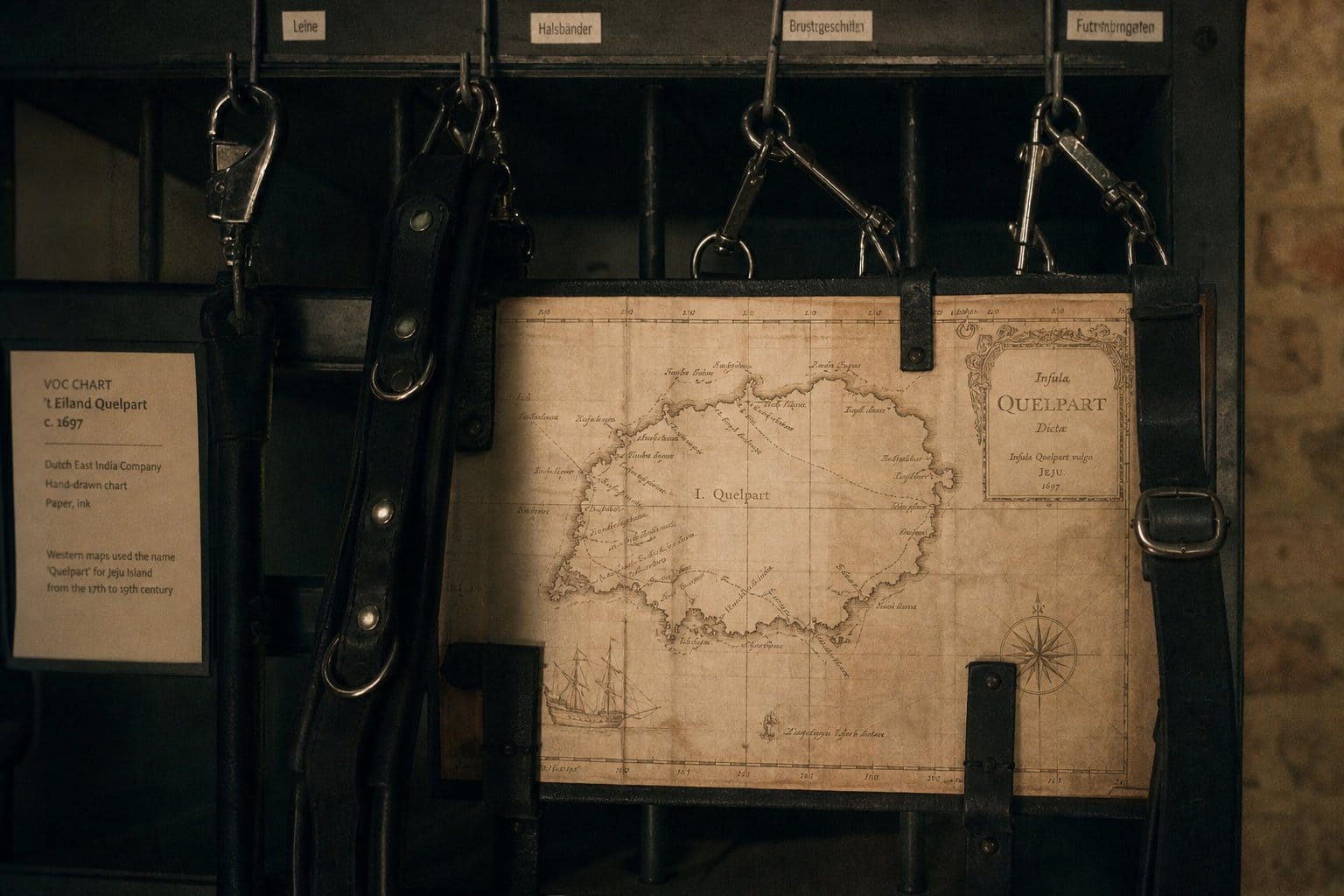
"Quelpart" became the Western cartographic standard through repetition across three colonial map-making traditions rather than any single decision. The earliest confirmed Western record is not Hamel's account but Dutch East India Company (VOC) documentation from 1648 — five years before the 1653 shipwreck. That timing matters: it establishes "Quelpaert" as a pre-existing trade-route notation used by VOC navigators, not a label Hamel invented, which is why cartographers treated it as an authoritative existing name once his journal circulated.
After the 1668 publication went mainstream, the same root word propagated in slightly different national spellings, each tradition copying and adapting the last :
- Dutch maps: "Quelpaert" (and the shortened "Quelpart"), carrying the VOC's original orthography.
- French charts: "Quelpaërt," with the diaeresis marking French pronunciation.
- British Admiralty charts: "Quelpart," the form that later entered English-language diplomacy and hydrography.
These were variant spellings of one name, and their consistency across Dutch, French, and British hydrographic offices gave the label institutional durability through the 18th and 19th centuries . Even the Japanese annexation of 1910 did not immediately displace it: colonial-administration maps gradually introduced the Japanese reading Saishū (済州), yet Western diplomatic and scientific documents kept using Quelpart well into the 20th century .
The practical consequence is unavoidable for anyone working with old archives. Historians and naturalists reading 18th- and 19th-century Western expedition logs, travelogues, and natural-history journals must search "Quelpart" or "Quelpaert" — the romanized Korean forms that replaced them arrived only later, with "Cheju" standard until South Korea adopted "Jeju" on 7 July 2000 . A keyword search for "Jeju" returns effectively nothing before that date, so the Western spellings remain the only reliable retrieval key for pre-modern sources.
Why a 1951 Peace Treaty Still Used a 17th-Century Dutch Name
The reason a modern peace treaty reached for a 17th-century Dutch name is that post-war diplomacy borrowed its geography from authoritative Western reference maps, not from local usage. Article 2(a) of the Treaty of Peace with Japan, signed in San Francisco on 8 September 1951, has Japan renounce Korea "including the islands of Quelpart, Port Hamilton and Dagelet" . By then Koreans had called the island Jeju for centuries and romanized it as "Cheju," yet the drafters used the Dutch-derived cartographic label that still dominated Western atlases.
"Japan recognizing the independence of Korea, renouncing all right, title and claim to Korea, including the islands of Quelpart, Port Hamilton and Dagelet." — Article 2(a), Treaty of Peace with Japan, San Francisco, 8 September 1951 (source: Treaty of Peace with Japan text)
The choice reflects a consistent diplomatic convention: treaties named places as the authoritative English- and French-language maps of the day named them. Under the McCune–Reischauer system in use since around 1900, Korean romanization would have produced "Cheju," and only on 7 July 2000 did South Korea's Revised Romanization standardize the spelling "Jeju" . In 1951 the negotiating powers defaulted to the label their own reference works carried, and that label was Quelpart.
The other two islands in the same clause confirm the pattern. All three names are Eurocentric cartographic inventions rather than Korean toponyms:
- Quelpart — the Dutch-derived Western name for Jeju-do (제주도), attested in VOC records by 1648 .
- Port Hamilton — the British name for Geomun-do (거문도).
- Dagelet — the French name for Ulleung-do (울릉도).
The consequence is durable. Because the San Francisco treaty remains in force as a foundational document of the post-war Northeast Asian order, "Quelpart" is permanently embedded in the region's legal architecture, formally identifying modern Jeju Island in binding international law. A name born of Dutch ships and Hendrik Hamel's shipwreck outlived the maps that carried it, surviving in the one place least likely to be revised — a treaty text. Researchers reading that clause today encounter the same retrieval problem as archivists: the Korean island is present, but only under its Western alias .
Quelpartensis: The Name That Survives in Scientific Latin

The word "Quelpart" persists most durably not in atlases but in biology, where dozens of species endemic to Jeju carry the Latin epithet quelpartensis in their official binomial names. The spider Nesticella quelpartensis and several endemic beetles described in the early 20th century still bear it . Because scientific names are governed by strict priority rules, a place being renamed cannot erase the epithet — so Quelpart lives on permanently in the taxonomic record.
A major source of these names was the American naturalist Malcolm P. Anderson, whose 1914 expedition — written up under the title Forty Days in Quelpart Island — generated several new taxa tied to the island . Every organism he and his contemporaries described was registered under "quelpartensis" at a time when Western science still knew the island only by its Dutch-derived name.
Under the International Code of Zoological Nomenclature, a validly published species name cannot be retracted simply because a geographic name has changed. The epithet is anchored to the original description, not to current cartography. That principle means "Quelpart" will remain embedded in the biological literature indefinitely, long after "Jeju" replaced it on every modern map — a parallel to the way the name survives, frozen, in the 1951 treaty text.
There is also a living, edible echo of how the name may have originated. One leading etymology holds that "Quelpart" is a corruption of the Korean gyul-bat (귤밭), "citrus grove" . Today Jeju's Hallabong tangerines and its coastal orange groves remain the island's most famous agricultural product — a present-day trace of the very groves that may have handed European sailors the name in the first place. From Latin nomenclature to a bag of citrus, the old alias keeps quietly surfacing.
The Full Name Chronology: Tamna → Quelpart → Cheju → Jeju
Jeju has carried at least five names across a thousand years, and each shift marks a change in who held sway over the seas around it — never a change in the island or its Korean identity. Long before European contact it was Tamna (탐라), an independent island kingdom that became a vassal state under the Goryeo dynasty in 938 AD; the Goryeo court later applied the Korean toponym Jeju (제주), which ran unbroken in Korean usage from then on .
Quick Answer: The island's name sequence runs Tamna → Ilha de Ladrones → Quelpart → Saishū → Cheju → Jeju. Western usage moved from "Quelpaert" (c. 1648) to romanized "Cheju," then to "Jeju" when South Korea adopted Revised Romanization on July 7, 2000.
The Western names tracked shifting maritime and colonial power. Portuguese charts of the 16th century labeled it Ilha de Ladrones, "Island of Thieves"; Dutch and French mapmakers fixed "Quelpaert / Quelpart" from around 1648 until roughly 1900; Japanese occupation from 1910 imposed the reading Saishū . In the West the historic label then yielded to romanized Korean — "Cheju" under McCune–Reischauer until 2000, and "Jeju" thereafter .
| Name | Language / convention | Approx. period |
|---|---|---|
| Tamna (탐라) | Independent kingdom, then Goryeo vassal | Pre-938 → 938 AD |
| Ilha de Ladrones | Portuguese charts | 16th century |
| Quelpaert / Quelpart | Dutch / French / British | c. 1648 – c. 1900 |
| Saishū | Japanese colonial reading | 1910 – 1945 |
| Cheju | McCune–Reischauer romanization | c. 1900 – 2000 |
| Jeju (제주) | Revised Romanization | July 7, 2000 – present |
For anyone digging through archives, the practical rule is a lookup matrix: search "Quelpart" / "Quelpaert" in pre-2000 Western sources, "Saishū" in Japanese colonial-era records, 제주 throughout Korean and classical texts, and "Jeju" in post-2000 English material . The takeaway is simple: five names, one island. Every relabeling recorded a passing shift in cartographic or geopolitical convention, while Tamna's people and their Korean island endured unchanged beneath all of them.
Frequently asked questions
What does 'Quelpart' mean?
There are two competing explanations, and both may be correct. The first is that "Quelpart" comes from Dutch East India Company (VOC) slang for a small dispatch ship, or galiot — a class associated with the vessel De Brack around 1642 . The second is that it is a phonetic corruption of the Korean gyul-bat (귤밭, "citrus grove"), which sailors reportedly misheard as the island's name . The two theories can coexist, since the ship itself may have been named after the same Korean term.
Why does the 1951 San Francisco Peace Treaty say 'Quelpart' instead of 'Jeju'?
Because "Quelpart" was still the standard Western diplomatic and cartographic name for the island in 1951. Article 2(a) of the Treaty of Peace with Japan, signed in San Francisco on September 8, 1951, has Japan renounce claims to Korea "including the islands of Quelpart, Port Hamilton and Dagelet" . Drafters relied on authoritative contemporary maps that still used the European name; South Korea did not standardize the Revised Romanization "Jeju" until July 7, 2000 .
Are Quelpart and Jeju Island the same place?
Yes — they are the identical location. "Quelpart," along with the variant spellings Quelpaert, Quelpaërt, and Quelparte, are earlier European names for what is today Jeju Island (제주도), South Korea's largest island, lying off the southern coast of the Korean Peninsula . The same island was inscribed by UNESCO as the "Jeju Volcanic Island and Lava Tubes" World Heritage property in 2007 .
Who was Hendrik Hamel and what does he have to do with the name 'Quelpart'?
Hendrik Hamel (1630–1692) was a VOC sailor and the first Westerner known to have visited Korea. In August 1653 a typhoon wrecked his yacht De Sperwer off the island's southern coast, and he was held captive in Joseon Korea for about 13 years before escaping in 1666 . His journal, published in 1668, was the first detailed Western eyewitness account of Korea and led European cartographers to standardize "Quelpaert" on their maps for over two centuries .
Does the name 'Quelpart' still appear anywhere today?
Yes, in three active contexts. First, it remains in the text of the still-in-force 1951 San Francisco Peace Treaty, Article 2(a) . Second, it survives permanently in Latin biological nomenclature through species epithets such as quelpartensis — for example the spider Nesticella quelpartensis — which cannot be renamed under zoological naming rules . Third, it is the only searchable form in pre-2000 Western scientific and archival literature about the island .
Enjoyed this article? Subscribe to get new stories by email whenever they're published.
This article was written using information collected and analyzed by NAMANE's in-house K-pop research AI engine. We use AI technology to bring you faster, broader coverage, and in the process some details may occasionally differ from the latest facts. For important information such as dates, venues, and prices, please double-check with official sources.


