
K-Pop Fan Arrival Plan: AREX, T-Money, and First Transit Moves
This seven-day route is built for K-pop fans who need reliable transit more than a generic sightseeing checklist: Seoul days stay close to Hongdae, Seongsu pop-ups, COEX/Gangnam fan stops, and DDP, while the Busan leg leaves room to adjust if a concert, pop-up, or showcase date moves.
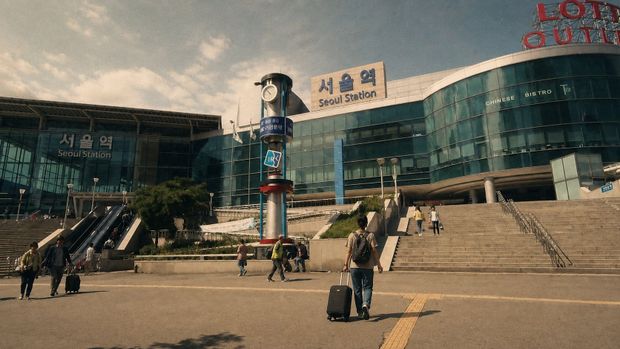
The AREX Airport Railroad connects Incheon International Airport (ICN) and Seoul Station. The nonstop Express Train takes about 43 minutes from Terminal 1 to Seoul Station and about 51 minutes from Terminal 2, based on the official AREX timetable; all-stop trains take longer but can be paid with regular transit cards . Online agencies may sell discounted vouchers, but compare the final voucher price with official AREX booking channels before payment because promotional prices change. Before boarding, pick up a T-Money rechargeable transit card at the GS25 or CU convenience stores located in the Incheon arrival hall. T-Money covers Seoul and Busan subway lines, city buses, and many convenience store purchases, making it the single most practical purchase of the trip. Load a starter balance in KRW, then top up as needed through Day 7 instead of buying separate cash fares for each ride.
Quick Answer: For a K-pop fan route, take AREX into Seoul Station, keep T-Money for Seoul and Busan local transit, reserve KTX or SRT only after fixing any concert or pop-up dates, and use Line 2 neighborhoods such as Hongdae, Seongsu, and Gangnam as your Seoul base. AREX Express timing varies by terminal, with the official timetable showing about 43 minutes from Terminal 1 and about 51 minutes from Terminal 2 to Seoul Station .
T-Money transfer discounts are applied automatically when you tap correctly between eligible buses and subway gates, so it is the right default for a fan itinerary that jumps between neighborhoods. Check the current transfer window and fare table in the station or your routing app before travel, then top up at GS25, CU, or 7-Eleven convenience stores near major metro stations. The same T-Money card works on Busan's metro when you arrive on Day 5, so there is no need to purchase a separate local card.
Seoul Subway Line 2 - the circular green line - is the backbone of this K-pop fan route. It connects Hongdae in the northwest (live music venues and fan-friendly nightlife), Seongsu in the east (brand pop-ups and creative studios), and Gangnam/COEX in the south, linking the neighborhoods most relevant to Days 1 through 4. Treat Line 2 as a high-frequency daytime line, but check Naver Maps, Kakao Maps, or the posted station timetable before any late-night move because first trains, last trains, and intervals vary by station and date. For navigation in both cities, Naver Maps and Kakao Maps deliver accurate real-time routing; Google Maps has documented data-gap limitations in South Korea and is not reliable for public transit directions .
Seoul Days 1–2: Historic Districts, Creative Neighborhoods, and Evening Markets
Seoul's first two days balance Joseon-era alleyways, a gallery-lined pedestrian street, and an east-side creative district that draws a younger domestic crowd alongside international visitors. Ikseon-dong, a cluster of restored hanok houses in Jongno District, converts traditional wooden courtyard architecture into independent cafes, wine bars, and boutiques — the lanes are compact and flat, making the area walkable in under two hours and consistently photographed by visitors in their 20s and 30s . Adjacent Insadong runs north to south along a partially pedestrianized main road, offering the Jogyesa Temple courtyard at its north end, Ssamziegil open-air mall mid-block with locally made ceramics and craft goods, and a continuous line of art galleries and tea houses throughout. Together, Ikseon-dong and Insadong form the cultural core of central Seoul's Day 1 route, walkable between the two in approximately 10 minutes.
Ikseon-dong is best visited on a weekday morning. By early afternoon on weekends, the narrow passages between hanok buildings slow foot traffic significantly. The district pairs well as a morning start before moving south to Insadong around midday. Jogyesa Temple, adjacent to Insadong's gallery strip, is one of the few Buddhist temples in central Seoul fully open to non-Buddhist visitors throughout the day; the courtyard contains white pine trees estimated at over 500 years old and runs cultural events during major Buddhist holidays including Buddha's Birthday .
📍 서울특별시 종로구 청계천로 88
🕒 매일 오전 9:00 ~ 오후 10:30
⭐ 4.2 (43,884 리뷰)
📞 02-2267-0291
🔗 Google Maps에서 보기
📍 View Insadong on Google Maps
Visit Seoul frames Seongsu-dong around its industrial-to-creative shift: former factories and warehouses have become select shops, workshops, cafes, and culture complexes. That is why this itinerary uses Seongsu as a lower-tourist-density contrast to palace districts and central shopping streets .
Seongsu, in eastern Seoul along Line 2, functions as the itinerary's Day 2 afternoon stop. Known informally as Seoul's creative quarter, the neighborhood clusters specialty coffee roasters, upcycle concept stores, and muraled factory-conversion buildings into a walkable grid. Tourist density is noticeably lower than central Seoul; most cafes and stores here serve primarily Seoul's young professional and design community, with menus in Korean and English. An afternoon in Seongsu connects directly by metro (15 minutes) to the evening anchor: Dongdaemun Design Plaza .
The Dongdaemun Design Plaza (DDP) is designed by Zaha Hadid and opened in March 2014 . Its fluid titanium and aluminum exterior is dramatically lit from dusk onward, making it one of Seoul's most photographed architectural subjects at night. The DDP functions as a cultural venue and exhibition center; entry to the exterior grounds is free. Surrounding the building are late-night street food stalls and the 24-hour Dongdaemun fashion market complex — accessible to anyone who wants to extend the evening. The adjacent Gwangjang Market, one of Korea's oldest traditional markets, is open for dinner service and is well known for bindaetteok (mung-bean pancakes) and raw marinated beef .
📍 View Dongdaemun Design Plaza on Google Maps
Seoul Days 3–4: Gangnam, COEX, and a DMZ Day Trip Option
Seoul's south bank, anchored by Gangnam District, introduces a different register — large commercial infrastructure, wider boulevards, and the convergence of K-pop fan culture with one of Seoul's oldest active temples. The COEX Underground Mall covers more than 85,000 square meters across multiple connected buildings, placing it among Asia's largest underground commercial complexes. Inside, the Starfield Library — a three-story floor-to-ceiling bookshelf installation — is open to the public at no charge and functions as a reliable photo stop independent of any shopping intent. K-Star Road, on Hallyu Street adjacent to COEX, features giant character bear statues representing major K-pop labels and agencies, directly relevant to fans tracking artist affiliations. Both are walkable from Samseong Station on Line 2.
📍 View COEX Mall on Google Maps
"Bongeunsa inside Gangnam is one of the most striking contrasts in the city — a working temple with roots dating to 794 CE, surrounded on three sides by the glass towers of Korea's financial district. It's not a museum piece: monks conduct ceremonies here daily and the complex receives practicing Buddhist visitors alongside tourists." — A Passion and a Passport, Seoul travel feature
Bongeunsa Temple sits approximately a 10-minute walk from COEX. Entry is free, and the complex contains several wooden shrine halls in the Joseon architectural tradition. A 30-minute walk-through is sufficient for most itineraries; the temple also runs a longer Temple Stay program for visitors wanting deeper cultural engagement. The visual contrast between the lacquered wooden gates and the surrounding corporate towers is one of the most widely reproduced images in Seoul travel coverage — and the setting is quieter than most tourist sites in the area during weekday mornings .
📍 View Bongeunsa Temple on Google Maps
Day 4 presents the itinerary's most significant fork: the DMZ or Hongdae. A guided tour to the Demilitarized Zone from Seoul — covering the Joint Security Area, infiltration tunnel history, and Korean War context — costs approximately ₩50,000–80,000 per person . Tours must be booked at least two weeks in advance; morning departures from central Seoul sell first, and spring and autumn peak-season slots can reach capacity a month ahead. The DMZ is a strong choice for travelers with a history or geopolitics focus.
For K-pop and subculture-focused visitors, Hongdae is the more relevant Day 4 option. Hongik University's surrounding district has remained Seoul's independent music hub for decades: live venues for indie and alternative acts populate the backstreets, street performers occupy the university plaza on weekends, and the design galleries are open to visitors. The Han River — reachable via Yeouido Hangang Park, roughly 20 minutes from Hongdae on Line 5 — provides a low-cost afternoon wind-down: rent a blanket, pick up convenience-store food, and spend an hour watching the river traffic before a quiet evening. Neither the DMZ nor Hongdae requires significant advance logistics beyond the DMZ booking itself .
Seoul to Busan: KTX vs SRT — Fares, Booking Windows, and Departure Logistics
The KTX (Korea Train eXpress) is the standard high-speed rail connection between Seoul Station and Busan Station, covering approximately 325 km in 2.5 to 3 hours depending on service type and stops . Standard one-way fares run approximately ₩59,800 (~$44) in 2026 . The SRT (Super Rapid Train), operated separately from Suseo Station in southern Seoul, covers the Busan route for approximately ₩52,600 (~$39) — a saving of around ₩7,200 that requires an additional subway leg to reach Suseo from central Seoul hotels . For travelers based in Hongdae, Myeongdong, or Gangnam, the extra transit time to Suseo typically offsets the fare difference. The earliest practical KTX departure from Seoul Station is approximately 7:30 AM, arriving in Busan by 10:30 AM — efficient enough to begin sightseeing before noon.
| Route | Train | Departure Station | Standard Fare (2026) | Journey Time | Notes |
|---|---|---|---|---|---|
| Seoul → Busan | KTX | Seoul Station | ₩59,800 (~$44) | ~2h 30m – 3h | Direct from central Seoul; most frequent departures; English booking available |
| Seoul → Busan | SRT | Suseo Station | ₩52,600 (~$39) | ~2h 10m – 2h 30m | Slightly cheaper; Suseo requires extra subway leg from most tourist areas |
| Busan → Seoul | KTX | Busan Station | ₩59,800 (~$44) | ~2h 30m – 3h | Return journey; same pricing as outbound |
| Busan → Seoul | SRT | Busan Station | ₩52,600 (~$39) | ~2h 10m – 2h 30m | Terminates at Suseo, not Seoul Station; factor in onward subway time |
Booking timing is the most critical logistics variable for this itinerary. During cherry blossom season (late March through early April) and the Chuseok national holiday period, morning KTX departures sell out weeks in advance . Tickets open one month before the departure date on the Korail website (korail.com), which has an English-language interface. The SRT system books through the SR app and website, which are Korean-only but navigable with browser translation. Third-party platforms including KKday and Creatrip offer pre-purchased KTX tickets with English customer support at a modest markup — a practical option for travelers who find the Korail interface difficult.
The Korea Rail Pass (KR Pass) grants unlimited train travel for a fixed number of consecutive days. For this 7-day itinerary with a single Seoul–Busan one-way journey, the pass does not provide cost savings — the break-even point requires at least three inter-city rail journeys . Travelers adding Gyeongju or Daegu segments should recalculate, but for a direct Seoul–Busan route without additional high-speed rail legs, individual tickets remain cheaper than the pass. Tickets are purchasable at Seoul Station's automated machines and ticket counters with an international credit card, or through the Korail mobile app.
Busan Day 5: BIFF Square, Jagalchi Market, and Gwangalli Beach
Arriving in Busan by mid-morning positions you well for a tight day circuit through three of the city's most visited spots — all accessible on Busan Metro Lines 1 and 2 without a taxi. BIFF Square — the street food district anchored by the Busan International Film Festival's original outdoor screening zone — sits adjacent to Nampo Station on Line 1. The square's food stalls run throughout the day serving twigim (fried assorted snacks), sundae (blood sausage), and the item the square is most identified with: seed hotteok from the Seunggi Ssiat Hotteok stall . This crispy pan-fried sweet pancake filled with seeds and brown sugar syrup has been featured on multiple Korean food television programs; expect a queue of 20–40 minutes during midday and early afternoon.
📍 부산광역시 중구 구덕로 58-1
🕒 매일 24시간 영업
⭐ 4.1 (19,861 리뷰)
🔗 Google Maps에서 보기
Jagalchi Fish Market, a short walk from Nampo Station, is Korea's largest seafood market . The ground floor hosts live tanks and cut-to-order fish counters; upstairs restaurants prepare hoe (raw fish) platters with kimchi, doenjang-jjigae, and rice. Prices for a hoe platter typically run ₩20,000–40,000 per person depending on fish selection and portion, negotiated directly at the counter. The market operates daily from early morning through evening, with peak activity before noon when the freshest catches are on display. The surrounding Jagalchi waterfront also has outdoor seafood vendors active from late afternoon onward.
📍 View Jagalchi Fish Market on Google Maps
Gwangalli Beach is the evening destination. The 1.4 km stretch of sand is reachable in approximately 20 minutes from Nampo via Line 1 to Seomyeon, then Line 2 to Gwangalli Station. The Gwangan Bridge — a 7.4 km dual-deck suspension bridge spanning the bay — runs a synchronized LED light show at 8 PM and 10 PM nightly, with an additional 9 PM performance on Fridays and Saturdays . The beachfront bar and cafe strip fills rapidly after the 8 PM show; arriving 30 minutes early for a waterfront table is advisable. No admission fee — the show is visible from the full length of the beach.
📍 View Gwangalli Beach on Google Maps
Busan Day 6: Haedong Yonggungsa Temple and the Sky Capsule Coastal Rail
Haedong Yonggungsa Temple, built in 1376 during the Goryeo Dynasty, is the only coastal Buddhist temple in South Korea — positioned directly on ocean-facing cliffs in northeastern Busan . The approach descends 108 stone steps to the main shrine halls, which sit at near wave level and are framed by granite outcroppings. The temple is busiest between 10 AM and 2 PM on weekends; arriving before 9 AM substantially reduces visitor density and produces cleaner photographs of the ocean-facing pagoda, the main gateway, and the twelve zodiac stone statues lining the steps. Entry is free. The site is approximately 30 km from central Busan — a 40-minute bus ride from Haeundae Station — making it a natural first stop if you're departing from the Haeundae hotel area.
📍 부산광역시 해운대구 청사포로 116 청사포정거장 2F
🕒 매일 오전 9:30 ~ 오후 7:30
⭐ 4.5 (6,287 리뷰)
📞 051-701-5548
🔗 Google Maps에서 보기
"The Sky Capsule sells out on weekends — sometimes the entire day — within hours of tickets opening online. If you want it on a Saturday, book 5–7 days ahead at minimum. Same-day availability is essentially zero on any sunny weekend." — Trazy Korea Blog, Busan coastal travel feature
The Haeundae Blueline Park Sky Capsule operates retro-style glass pods along 4 km of a former coastal rail track, traveling at 4 km/hr over a 30-minute one-way journey . Tickets cost approximately ₩15,000 per person and are bookable through the Haeundae Blueline Park website and platforms including KKday. Each pod seats 2–4 passengers, with floor-to-ceiling glass providing unobstructed ocean views on one side and the forested Dalmaji Hill on the other. Advance booking is mandatory — same-day walk-up tickets are not reliably available on weekends or public holidays .
📍 View Haeundae Blueline Park on Google Maps
After the Sky Capsule, Haeundae Beach — directly adjacent to the line's southern terminus — provides a natural afternoon wind-down: over 1.5 km of white sand with rooftop cafes along the strip and fresh seafood restaurants in the streets immediately behind the beach . The three Day 6 sites — Haedong Yonggungsa, the Sky Capsule, and Haeundae Beach — are geographically spread across northeastern Busan in a way that makes independent transit time-consuming. A guided coastal day tour priced around ₩50,000–80,000 per person typically covers transport between all three, plus optional stops at Cheongsapo Fishing Village for seafood lunch and Gamcheon Culture Village for its hillside murals, and is worth considering if you want to minimize transit logistics .
7-Day South Korea Budget Breakdown: What the Trip Actually Costs
A realistic 7-day Seoul-to-Busan trip costs approximately ₩80,000–120,000 per day for budget travelers (hostel dormitory, street food, public transit only) and ₩150,000–250,000 per day at mid-range (standard hotel private room, sit-down restaurants, one paid activity per day) . These daily figures exclude the one-time KTX ticket and any guided day tours, which are better treated as discrete trip costs. The full transport budget for the 7-day route — AREX from the airport, Seoul metro top-ups across four days, the one-way KTX, and Busan metro across three days — totals approximately ₩114,000 (~$84) per person . That figure assumes a single one-way KTX journey to Busan; add ₩59,800 for the return to Seoul by rail.
| Category | Cost Range | Notes |
|---|---|---|
| AREX (Incheon → Seoul Station) | ₩8,700 advance / ₩11,000 counter | One-time arrival cost; book via Creatrip or ticket machine |
| Seoul metro, 4 days (T-Money) | ~₩30,000 | Based on 4–6 trips/day at ₩1,350 base fare with transfers |
| KTX Seoul → Busan (one-way standard) | ₩59,800 (~$44) | Book 1–4 weeks ahead during peak season; SRT alternative ₩52,600 |
| Busan metro, 3 days (same T-Money) | ~₩15,000 | T-Money from Seoul works directly on Busan subway lines |
| Total transport (one-way to Busan) | ~₩114,000 (~$84) | Per person; add ₩59,800 for return KTX to Seoul |
| Accommodation — budget hostel/guesthouse | ₩30,000–50,000 / night | Busan averages 10–15% less than Seoul for comparable properties |
| Accommodation — mid-range hotel | ₩80,000–150,000 / night | Standard business hotel or boutique guesthouse; both cities |
| Street food meals (per meal) | ₩3,000–8,000 | Tteokbokki, hotteok, kimbap, egg bread from market stalls |
| Sit-down restaurant meal (per person) | ₩10,000–20,000 | Bibimbap, samgyeopsal, jjigae; excluding alcohol |
| Jagalchi seafood platter (hoe set) | ₩20,000–40,000 / person | Raw fish with kimchi and banchan; price varies by fish selection |
| DMZ guided day tour | ₩50,000–80,000 / person | One-time cost; book 2+ weeks ahead; includes transport from Seoul |
| Haeundae Blueline Park Sky Capsule | ~₩15,000 / person | Advance booking required; sold out frequently on weekends |
| Namsan N Seoul Tower cable car | ~₩12,000 round trip | Tower observation deck admission is additional |
| Gyeongbokgung Palace entry | ₩3,000 (free in hanbok rental) | Hanbok rental from nearby shops: ₩20,000–30,000 |
Accommodation pricing shows a consistent geographic pattern. Seoul's Hongdae and Myeongdong neighborhoods anchor the tourist hostel market, with dormitory beds from ₩25,000–40,000 per night and private guesthouse rooms from ₩50,000–80,000 . Busan's Haeundae and Gwangalli areas offer comparable quality at 10–15% lower rates. The gap between Seoul and Busan pricing becomes more pronounced at the upscale end, where Busan's beachfront properties occasionally undercut equivalent Seoul hotels by a wider margin. Mid-range travelers can often step up one accommodation tier in Busan for the same budget they used in Seoul.
Food costs are low by international standards across both cities. A full day of eating — convenience store breakfast, street food or market lunch, sit-down dinner — runs ₩15,000–35,000 per person. The Jagalchi hoe platter is the trip's single most expensive meal at ₩20,000–40,000 but functions as a combined lunch-and-dinner for most visitors given portion size. Most temples, public parks, and architectural landmarks in both cities charge no admission: Bongeunsa Temple, Haedong Yonggungsa Temple, Gwangalli Beach, Seongsu, and all subway station areas are free to access. The main paid cultural activities are the DMZ guided tour, the Sky Capsule, the Namsan cable car, and the Gyeongbokgung observation platform .
Booking Order and Seasonal Timing: How to Lock In the Route
Executing this itinerary without last-minute friction comes down to a clear booking sequence: KTX or SRT tickets first (the most capacity-constrained element), then accommodation, then guided tours and ticketed experiences like the DMZ or Sky Capsule. Street food, metro rides, market visits, and most temple entries require no advance booking and are best left to spontaneous day-of decisions. KTX seats between Seoul and Busan open for purchase one month before departure on the Korail website; the SRT booking window follows the same schedule. Locking the train date before booking hotels allows you to choose accommodation near the correct departure station — Seoul Station for KTX, Suseo for SRT — and avoid last-minute neighborhood changes .
Spring — late March through April — is the route's most popular window. Cherry blossom season draws peak visitor numbers, accommodation prices in Seoul rise 20–30% above baseline, and popular morning KTX departures book out weeks in advance . The blossoms typically peak in late March in Seoul and extend slightly later toward Busan's coastal parks, meaning a southward itinerary naturally tracks the season. Budget 4–6 weeks advance planning for spring travel, particularly for the train and any central-neighborhood accommodation.
Fall — October through mid-November — provides a strong alternative. Autumn foliage appears across Seoul's palace grounds, along Haedong Yonggungsa's hillside approach, and through Busan's northeastern coastal parks. Crowds are slightly lighter than spring and accommodation pricing is more stable, though popular weekend dates still fill early. Summer (July–August) and winter (December–February) present weather trade-offs worth weighing before booking: typhoon risk and heavy humidity in summer, sub-zero temperatures and potential high-wind closures at exposed coastal sites in winter . Both off-peak seasons offer meaningfully lower accommodation rates. The DMZ tour and Haedong Yonggungsa Temple operate year-round; the Sky Capsule closes during high-wind alerts, which are more frequent between November and February.
Frequently Asked Questions
How much does the KTX from Seoul to Busan cost in 2026?
A standard one-way KTX ticket from Seoul Station to Busan Station costs approximately ₩59,800 (~$44) in 2026 . The SRT from Suseo Station in southern Seoul is slightly cheaper at approximately ₩52,600 (~$39), but requires an additional subway journey to reach Suseo from most central Seoul neighborhoods. A Korea Rail Pass does not provide cost savings for a single Seoul–Busan return trip — the pass only saves money when you make three or more inter-city rail journeys during the same trip. Book directly via the Korail website (English available) or through KKday or Creatrip for English-language customer support.
How many days should I spend in Seoul vs. Busan on a 7-day trip?
The standard split for a 7-day South Korea trip is 4 nights in Seoul and 2–3 nights in Busan. Seoul's highlights — Jongno, Insadong, Gangnam, Seongsu, Hongdae — are spread across distinct neighborhoods separated by meaningful transit time, so four days allows comfortable coverage without rushing. Busan's main draws are coastal and concentrated in two geographic zones: the central Nampo/BIFF Square area and the northeastern Haeundae/Haedong coast. Two to three days is sufficient to cover both zones without feeling pressed. Travelers anchoring the trip around a specific concert or K-pop event at BEXCO or another Busan venue may choose 3 nights Busan and 3 nights Seoul, adjusting the Day 5 transfer accordingly.
What is the T-Money card and where do I get one?
The T-Money card is a rechargeable contactless transit card accepted on all Seoul Metro lines, Busan Metro lines, city buses throughout South Korea, and some taxi services. It provides a slightly lower per-trip fare than paying cash on certain routes and enables the free transfer window — tap onto a bus and then a subway (or vice versa) within 30 minutes, and the system deducts only a distance supplement rather than a full second fare . Purchase the card immediately after clearing customs at the GS25 or CU convenience stores in the Incheon Airport arrival hall. The card itself costs approximately ₩2,500–4,000 and is loaded separately with your starting balance. Top up at any GS25, CU, or 7-Eleven throughout the trip. The same card transfers directly to Busan's metro system with no re-registration required.
Do I need to book the Haedong Yonggungsa Sky Capsule in advance?
Yes — advance booking is required for the Haeundae Blueline Park Sky Capsule. Pods sell out, sometimes within hours of the booking window opening for weekend dates . For weekday visits, booking 3–5 days ahead is generally sufficient. For Saturdays, Sundays, and Korean public holidays, book 5–7 days ahead at minimum through the Haeundae Blueline Park official website or platforms including KKday. Same-day walk-up availability is not reliably offered on weekends. Haedong Yonggungsa Temple itself has no booking requirement and is free to enter, but arriving before 9 AM significantly reduces crowd density on the 108 stone steps and at the main clifftop shrine halls.
What is a realistic daily budget for a week in South Korea?
Budget travelers using a hostel, street food meals, and public transit typically spend ₩80,000–120,000 (~$60–90) per day, excluding one-time costs such as the KTX ticket and guided day tours . Mid-range travelers using a standard hotel private room, sit-down restaurants, and one paid activity per day typically spend ₩150,000–250,000 (~$110–185) per day on the same exclusions. The KTX one-way ticket (₩59,800) and a DMZ guided tour (₩50,000–80,000) are the two largest single-cost items and should be budgeted as discrete one-time expenses rather than averaged into daily spending. Most temples, public parks, beaches, and architectural landmarks — including Haedong Yonggungsa, Bongeunsa Temple, and Gwangalli Beach — are free to access .
Planning Your Seoul–Busan Route: What to Prioritize
The Seoul-to-Busan week is structurally modular: the KTX transition is the only fixed logistical point, and every other element adjusts around traveler interest without breaking the underlying route. K-pop fans may reorganize Day 3 around Hongdae and K-Star Road rather than the DMZ; visitors with a history focus may anchor Day 1 at Gyeongbokgung Palace and the Changing of the Royal Guard ceremony. The transit infrastructure — T-Money, Line 2 in Seoul, Lines 1 and 2 in Busan — remains consistent across all variations. Most of the itinerary's practical complexity concentrates in just three booking decisions: the KTX date, the DMZ reservation, and the Sky Capsule time slot .
Seasonal timing is the single most consequential planning decision on this route. Spring cherry blossom season (late March–April) is the aesthetic peak and the most competitive booking window simultaneously — commit to KTX tickets and central-neighborhood accommodation 4–6 weeks ahead. Fall (October) provides a quieter, similarly photogenic alternative with more accommodation flexibility at most price tiers. The itinerary functions in any season, but summer typhoon risk and winter cold at exposed coastal sites — Haedong Yonggungsa's ocean-level steps and Gwangalli beachfront — are real factors worth weighing before fixing flight dates .
For travelers arriving with a concert or festival date already anchored — a Busan BEXCO K-pop showcase, an SMTOWN event, or a domestic artist tour stop in Seoul — use that fixed date as the itinerary's spine and build transit and sightseeing days around it. The Korea Tourism Organization's event calendar at Visit Korea publishes domestic concert and festival listings seasonally, useful for cross-referencing your travel window against scheduled events before committing to flight dates .
Last updated: 2026-05-23. Transport fares, transit card rates, and venue schedules reflect 2026 data compiled from Creatrip, KKday, and Korea Tourism Organization sources. Verify fares and operating hours directly with Korail, SR, and venue operators before travel.
This article was written using information collected and analyzed by NAMANE's in-house K-pop research AI engine. We use AI technology to bring you faster, broader coverage, and in the process some details may occasionally differ from the latest facts. For important information such as dates, venues, and prices, please double-check with official sources.


