
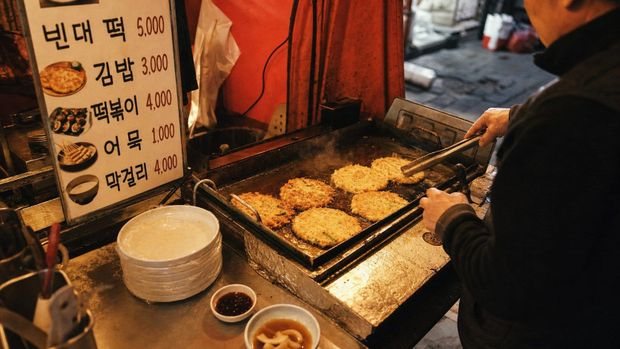
How to Choose a Seoul Night Market: Quick Comparison
Seoul's night markets split cleanly into two practical tiers: traditional covered halls that operate year-round and late-evening street-food districts that activate after 9 PM. Picking the right one depends on four variables — your budget per person, how late you plan to eat, whether you want a sit-down lane or a standing-snack circuit, and how close you need to stay to a concert venue or your hotel. The good news for navigation: all six core markets listed here are reachable by subway with no taxi required, and each section below includes the exact station and exit number.
Quick Answer: Seoul has six major night-market destinations reachable entirely by subway. For variety and late hours, Dongdaemun stays open until 5 AM; for traditional Korean street food, Gwangjang (established 1905) is the benchmark; for the lightest crowds with a genuinely local feel, Mangwon near Hongdae is the practical pick. Budget ₩15,000–30,000 per person for a full evening.
The decision framework is straightforward. If your priority is maximum food variety, Namdaemun and Gwangjang offer the widest category range — kalguksu noodles, bindaetteok pancakes, yukhoe beef tartare, and rice-wine pairings all in a single covered space. If you need to eat after midnight following a late concert, Dongdaemun and Namdaemun are your only reliable options — both stay active well past 1 AM . If you want low tourist density and prices that reflect what Seoul residents actually pay, Mangwon in Mapo-gu is the consistent answer. The Euljiro beer alleys and Jongno pojangmacha tent bars work best as a wind-down after an earlier market stop rather than as standalone first destinations.
A routing note for K-POP fans navigating concert logistics: Dongdaemun History & Culture Park station (Lines 2, 4, 5) and Namdaemun's Hoehyeon Station (Line 4) sit within 30–40 minutes of most major Seoul concert venues by metro — including KSPO Dome, Olympic Hall, and Jamsil Arena. Fans arriving from an evening show at Yes24 Live Hall or Hongdae-area clubs can reach Mangwon Market on foot in under 10 minutes, requiring zero subway time after a long show. Plan the market visit as the final leg of your evening, not a detour.
| Market | Best For | Hours (Peak) | Avg Spend / Person | Nearest Subway Exit |
|---|---|---|---|---|
| Namdaemun | 24-hr food variety, wholesale energy | 24 hours (peak after 10 PM) | ₩8,000–15,000 | Hoehyeon (Line 4) Exit 5 |
| Gwangjang | Traditional Korean dishes, local atmosphere | Until midnight | ₩15,000–25,000 | Jongno 5-ga (Line 1) Exit 8 |
| Dongdaemun District | Late-night shopping + street snacks | Until 5 AM | ₩10,000–30,000 | DHCP (Lines 2, 4, 5) Exit 1 |
| Mangwon | Local neighborhood feel, near Hongdae | From 6 PM | ₩8,000–15,000 | Mangwon (Line 6) Exit 1–2 |
| Jongno Pojangmacha | Tent-bar drinking culture, soju evening | Peak 8–10 PM | ₩25,000–45,000 | Jongno 3-ga (Lines 1, 3, 5) |
| Euljiro Beer Alley | Budget draft beer + dried squid pairing | Evenings from ~7 PM | ₩20,000–25,000 | Euljiro 3-ga (Lines 2, 3) |
| Yeouido / Bangpo (seasonal) | Riverside atmosphere, chimaek weekends | Apr–Oct weekends, from 7 PM | ₩8,000–15,000 | Yeouinaru (Line 5) Exit 3 |
Namdaemun Market: 24-Hour Food Alleys and 2026 Standout Vendors
Namdaemun Market (남대문시장) is Seoul's largest traditional market, with more than 10,000 vendors spread across a block-deep grid of covered alleys accessible from Hoehyeon Station (Line 4, Exit 5). Unlike Gwangjang's single-hall layout, Namdaemun organizes its food offer by category: a dedicated kalguksu (knife-cut noodle) corridor, a separate hotteok (sweet or savory pancake) alley, and a main walkway lined with twigim (tempura) and kimbap stalls. The market is technically open 24 hours, but its character shifts dramatically depending on arrival time — morning visits are queue-free and oriented toward wholesale shoppers, while evenings become a dense, energetic food event.
"The biggest market in all of Korea — there were 10,000 vendors and I couldn't believe the size of it." — KarissaEats, food and travel vlogger (video: KarissaEats)
Kalguksu (knife-cut wheat noodles in an anchovy-based broth) costs ₩7,000–9,000 per bowl . The dedicated hotteok alley charges ₩5,000 for two pieces , filled with a brown-sugar and cinnamon syrup that pools when bitten into. The preparation technique here is worth noting: vendors pre-fry items in bulk to reduce wait times, then re-fry each individual portion to order — a double-frying method that produces a noticeably crispier outer shell compared with single-fry competitors (video: Doobydobap). Apply this as a selection criterion: stalls that re-fry to order signal higher-quality output.
The standout vendor for 2026 is Tong Tong Kimbap (통통김밥), which appeared on Korean television earlier this year . The stall offers 20 kimbap varieties; the two-roll combination of bulgogi kimbap and a premium brown rice roll costs approximately ₩7,500 and includes a complimentary bowl of hot broth soup with every order. Lines build from mid-afternoon. Arriving at 7:00 AM bypasses queues entirely (video: KarissaEats) — the pre-rush morning window is suited to travelers on an early transit schedule before a check-in or afternoon activity.
Timing strategy: Namdaemun runs two overlapping cycles. The daytime phase (10 AM–7 PM) is wholesale-driven — food stalls are open but foot traffic is retail-oriented and relatively thin. After 10 PM, wholesale produce and goods buyers move through the market, the food lanes fill with a working crowd rather than sightseers, and the atmosphere shifts into a sharper, more local register. For K-POP fans with a central Seoul concert on the schedule, Namdaemun works well as a post-show destination as late as 11 PM–midnight — precisely when the market hits its operational peak.
Jongno Historic Food District: Covered Lanes, Night Stalls, and Pojangmacha
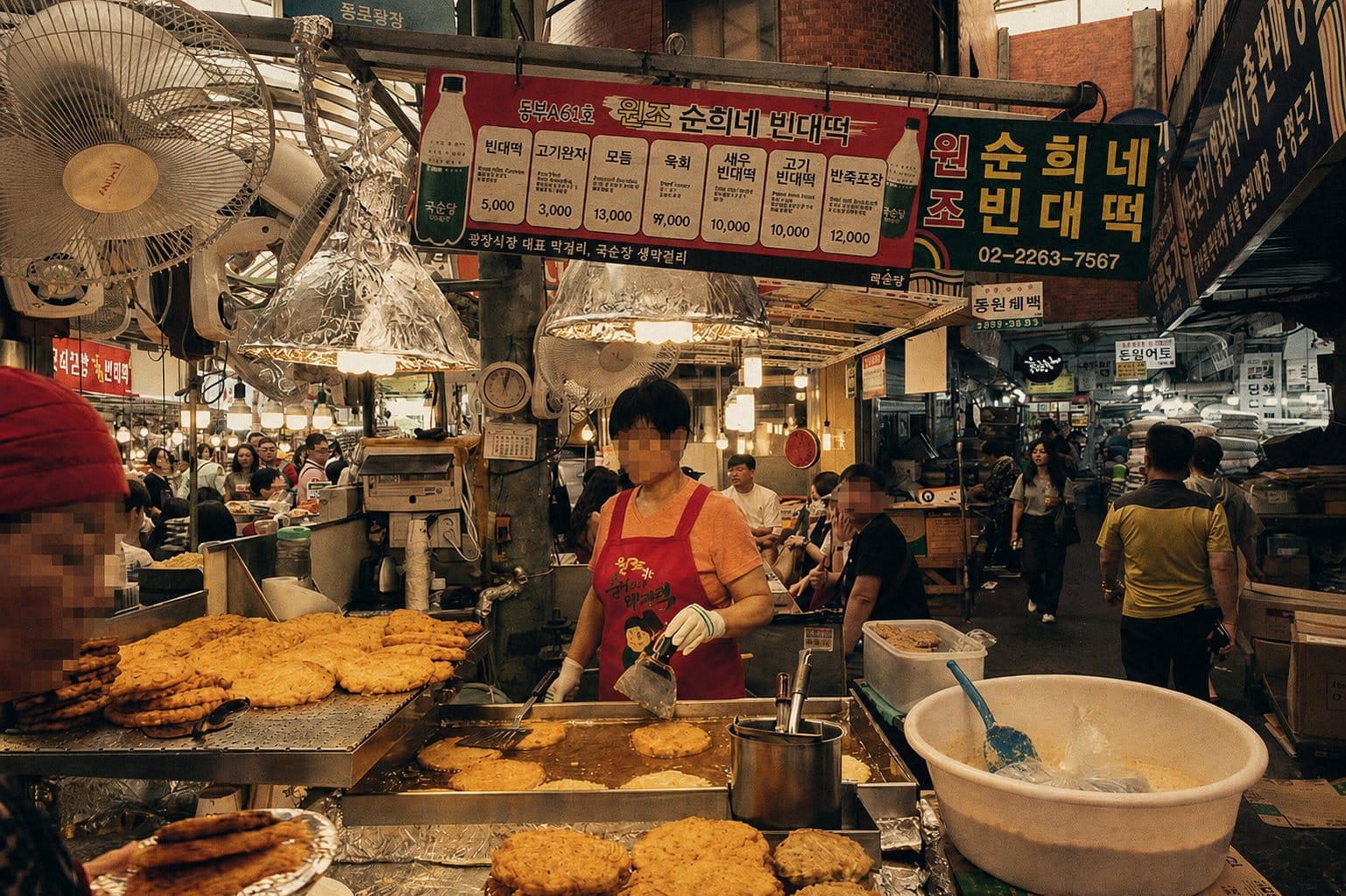
The Jongno corridor between Gwangjang Market and Jongno 3-ga station contains two distinct food experiences that pair naturally as a single evening circuit: the covered Gwangjang Market hall for sit-down traditional Korean dishes from around 7 PM, followed by the open-air pojangmacha (포장마차) tent bars along Jongno 3-ga from 9 PM onward. The two locations are a 15-minute walk apart or two subway stops — the transition is easy and the combined spend for both legs typically runs ₩30,000–45,000 per person.
Gwangjang Market
Gwangjang Market (광장시장), established in 1905 as Korea's first permanent covered market, operates a food hall that has remained structurally unchanged since its mid-century configuration. The covered interior lane at Jongno 5-ga Station (Line 1, Exit 8) runs until approximately midnight . Standard orders here include bindaetteok — thick mung-bean pancakes fried in lard, served in cut sections at ₩5,000–8,000 ; mayak gimbap (small, lightly-seasoned rice rolls nicknamed "addictive kimbap") at ₩3,000 ; yukhoe beef tartare at ₩12,000–18,000 ; and makgeolli rice wine at ₩5,000 per jug . A full evening with drinks runs ₩15,000–25,000 per person.
📍 88 Cheonggyecheon-ro, Jongno District, Seoul
🕒 Daily 9:00 AM – 10:30 PM
⭐ 4.2 (43,859 reviews)
📞 02-2267-0291
🔗 View on Google Maps
A significant operational change takes effect on June 1, 2026: Gwangjang begins enforcing a real-name shop registration system paired with a QR-code complaint mechanism designed specifically for foreign travelers . In practical terms, stall vendors will now be listed by registered name rather than anonymous stall number, and the QR code provides a direct route to file a pricing or service complaint. This is a material transparency improvement for visitors who historically had no recourse against overcharging. Scan the QR code at your vendor's stall before ordering if prices are not posted on a board.
The corn-infused hotteok variant documented at several Jongno-area stalls offers a distinct alternative to the standard brown-sugar filling (video: Doobydobap). These use a yellow corn-dough base and come in two versions: savory (chapchae glass noodles — made from sweet potato starch, called dangmyeon — with onion, carrot, and Chinese chives) and sweet (cinnamon, brown sugar, sunflower seeds, and black sesame). The corn dough crisps harder on the griddle press than standard hotteok dough, producing a thicker, crackling shell. Look for the yellow color as the visual identifier — standard hotteok dough is white or cream-colored.
Jongno 3-ga Pojangmacha Tent Bars
The pojangmacha (포장마차) tent-bar strip along Jongno 3-ga is one of Seoul's most recognizable late-night formats: orange vinyl awnings, low plastic stools, communal tables, and a food-and-drink tab that builds naturally across multiple rounds. Peak hours run 8–10 PM . Food plates cost ₩15,000–30,000 ; a full tab with soju runs ₩25,000–45,000 per person . Cash is strongly preferred — carry ₩30,000–50,000 in small bills for this district specifically. Seating is communal by design; solo diners and groups are placed together without social friction.
📍 132 Jong-ro, Jongno District, Seoul
⭐ 4.1 (25 reviews)
🔗 View on Google Maps
Dongdaemun Night District: Fashion Complexes and Late-Night Street Snacks
Dongdaemun is less a single market and more a late-night ecosystem anchored by fashion wholesale towers — Doota!, Hello apM, and Migliore — that trade until 5 AM . Street food stalls surrounding the complex operate on the same nocturnal schedule, making this the most reliably late food option in Seoul. The nearest station is Dongdaemun History & Culture Park (Lines 2, 4, 5) ; the district reaches full activation after 10 PM, and arriving earlier means you're mostly looking at a partially-lit street rather than an operating market.
The street-food circuit runs the perimeter of the fashion towers. Tteokbokki (chewy rice cakes in gochujang sauce) costs ₩3,000–5,000 per cup ; sundae (blood sausage stuffed with noodles and vegetables) is typically sold beside it as a set pair. Hotteok and kimbap stalls are scattered throughout the outer perimeter and remain open past midnight. A complete food loop around the complex costs ₩10,000–30,000 depending on how many stalls you stop at . The format is entirely mobile — no seating, eating while walking, no language required beyond pointing.
For K-POP fans: Dongdaemun History & Culture Park station sits 30–40 minutes from Jamsil Arena and KSPO Dome by direct subway line, making it a viable post-concert stop even after a Jamsil-area show ends at 10–11 PM. The fashion complex's interior shopping crowd and the food-stall crowd operate on separate schedules — arriving at 11 PM means active food stalls with manageable density before the post-midnight wholesale rush begins.
Mangwon Market: Mapo's Local Neighborhood Alternative
Mangwon Market (망원시장) in Mapo-gu operates on a different logic from the central Seoul markets: it's a residential neighborhood market first, with food stalls calibrated for after-work local diners rather than organized tourist itineraries. Access via Mangwon Station (Line 6, Exit 1–2) . Evening stalls fire from 6 PM; the walk from the Hongdae entertainment strip takes under 15 minutes on foot, making Mangwon one of the few markets on this list that requires no subway transfer after a show.
"Mangwon is Seoul's best local-neighbourhood alternative — a working market where prices reflect what residents actually pay rather than what tourists expect to pay." — Korea Insider
That pricing gap is real and consistent. Dakkochi (grilled chicken skewers) run ₩2,000–3,000 each ; a tteokbokki-and-sundae combination is ₩6,000–8,000 ; japchae glass noodles cost ₩7,000 . Compare those figures against the Gwangjang or Namdaemun equivalents, and Mangwon runs 20–30% cheaper across most categories. The tradeoff is a narrower food range — no yukhoe tartare or exotic regional dishes here, just clean execution of grilled and stewed staples.
There are no English menus at Mangwon. Pointing-and-gesture ordering works reliably — stall vendors at neighborhood markets are accustomed to the interaction. For solo diners, Mangwon has a distinct daytime advantage: banchan shops sell individual side-dish portions of pre-made items — kongnamul (soybean sprouts), gamja jorim (spiced braised potato), japchae — that can be assembled into a coherent solo meal for under ₩8,000, well below the cost of any full stall order. Standard stall portions at most markets default to two-person sizes; solo travelers who order at Mangwon's evening stalls should ask for a half portion (반만 주세요, ban-man ju-seyo) — not always honored, but always understood.
For fans attending a Hongdae-area show at Yes24 Live Hall, Muv Hall, or KT&G Sangsangmadang, Mangwon is the lowest-friction post-concert food option on this list — no subway, no planning, just a 10-minute walk east from the main Hongdae exit cluster.
Euljiro and Jongno 3-ga Beer Alleys: Nogari and Draft Beer After Dark
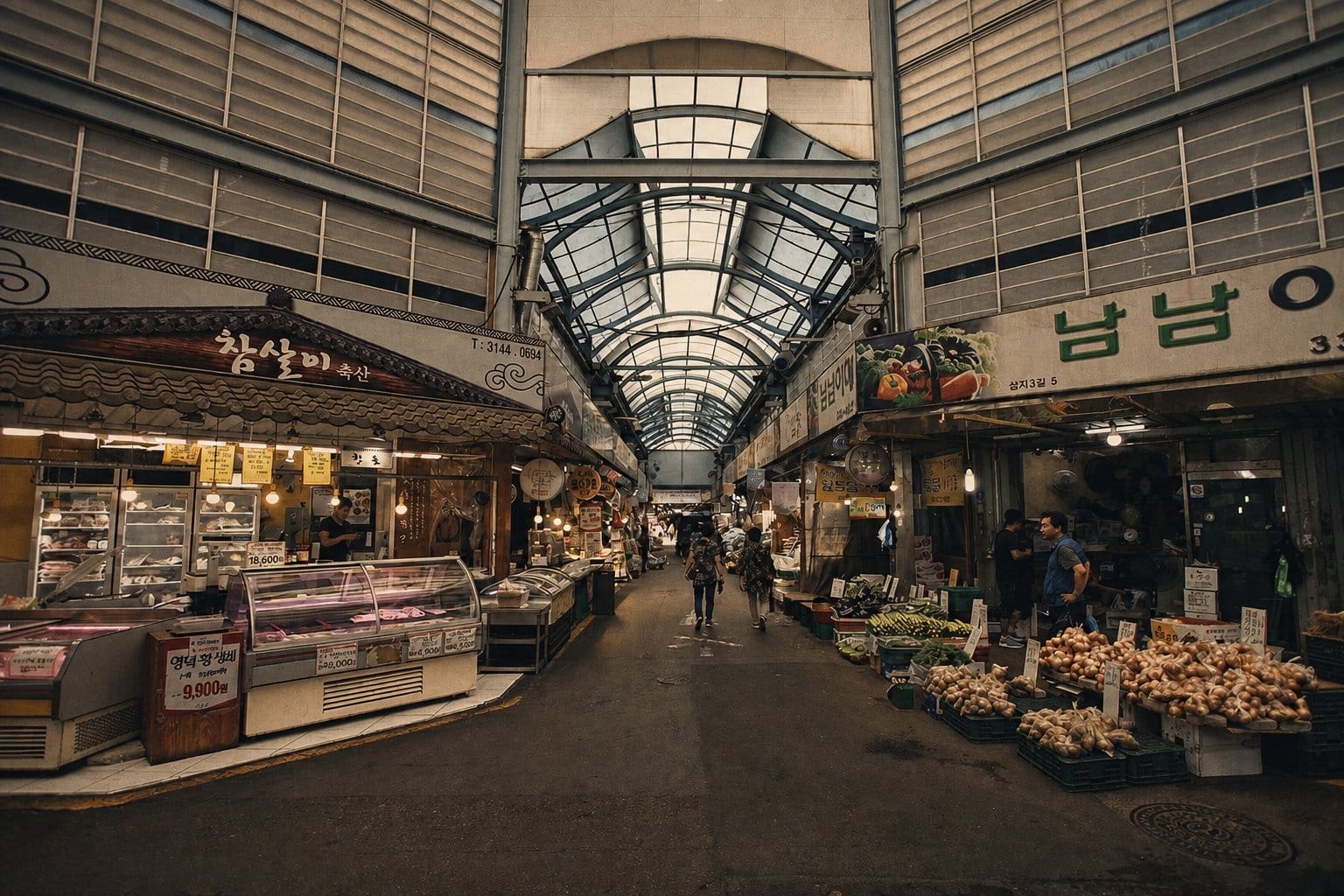
The Euljiro beer alleys (을지로 맥주골목) adjacent to Euljiro 3-ga Station (Lines 2, 3) represent one of Seoul's most economical after-dark rituals: dried squid (nogari) and cold draft beer at prices that have stayed essentially flat for years. A single piece of nogari costs ₩2,000–2,500 ; a 500 cc draft beer runs ₩4,500–5,000 . A two-person evening of nogari and draft beer runs approximately ₩20,000–25,000 total — one of the cheapest ways to spend two hours in central Seoul.
A 10-minute walk connects the Euljiro beer alley with Jongno 3-ga's pojangmacha strip, making the two natural complements for a long evening: start with draft beer and nogari around 8–9 PM in Euljiro, then drift east toward the tent bars for a later round. The combination keeps the per-person total manageable — the Euljiro portion is cheaper than almost any other food district in central Seoul, which offsets the slightly higher pojangmacha tab that follows. Solo visitors find this pairing works particularly well: the beer-alley format is a seated bar rather than a standing-snack circuit, and single diners are normal rather than conspicuous.
Adjacent to the beer alleys, gukbap (국밥 — soup with rice) stalls serve in thick earthenware pots called 뚝배기 (ttukbaegi) that retain heat through a slow meal (video: Doobydobap). The preparation is customizable: after the bowl arrives, you adjust the saltiness tableside using fermented shrimp sauce (새우젓/saeujeot), gochugaru chili flakes, garlic, and perilla seed powder (들깨가루/deulkkae-garu), all provided in small dishes at the table. The result is a deeply savory, fully adjustable soup-rice that functions as either a standalone light dinner or a base-layer buffer before a drinking session.
Seasonal Riverside Markets: Yeouido and Bangpo (April–October Only)
The Han River food-truck festivals at Yeouido and Bangpo Han River Park operate on weekends only from April through October and are fully closed from November through March. They serve a purpose distinct from the covered markets — the appeal is atmospheric rather than culinary, and the food category range is narrower than any traditional market on this list. If your Seoul trip falls outside the April–October window, skip this section entirely; there is nothing to visit.
📍 Yeouido Han River Park — View on Google Maps
📍 Bangpo Han River Park — View on Google Maps
The signature offer is chimaek (치맥) — fried chicken and beer consumed open-air with a river view . Pricing runs higher than traditional markets: ₩8,000–15,000 per person for a light meal . Arrive by 7 PM on weekends to secure a spot near the water — peak crowds fall between 8–10 PM in warmer months, and riverside seating fills fast. Entry to the park is free .
Access to Yeouido is via Yeouinaru Station (Line 5, Exit 3) ; for Bangpo, the nearest station is Express Bus Terminal (Lines 3, 7, 9). The Banpo Bridge Rainbow Fountain runs on a timed schedule during summer evenings and is visible from the riverside seating area — a secondary draw that makes this a reasonable activity pair for visitors who have already covered one or two traditional markets earlier in the day. This venue functions best as atmosphere-plus-snack rather than as a food destination in its own right. Visitors who arrive expecting the food variety of Gwangjang or Namdaemun will be underwhelmed; visitors who arrive for riverside summer evening energy will find exactly that.
Budget Breakdown: What Each Market Costs Per Person
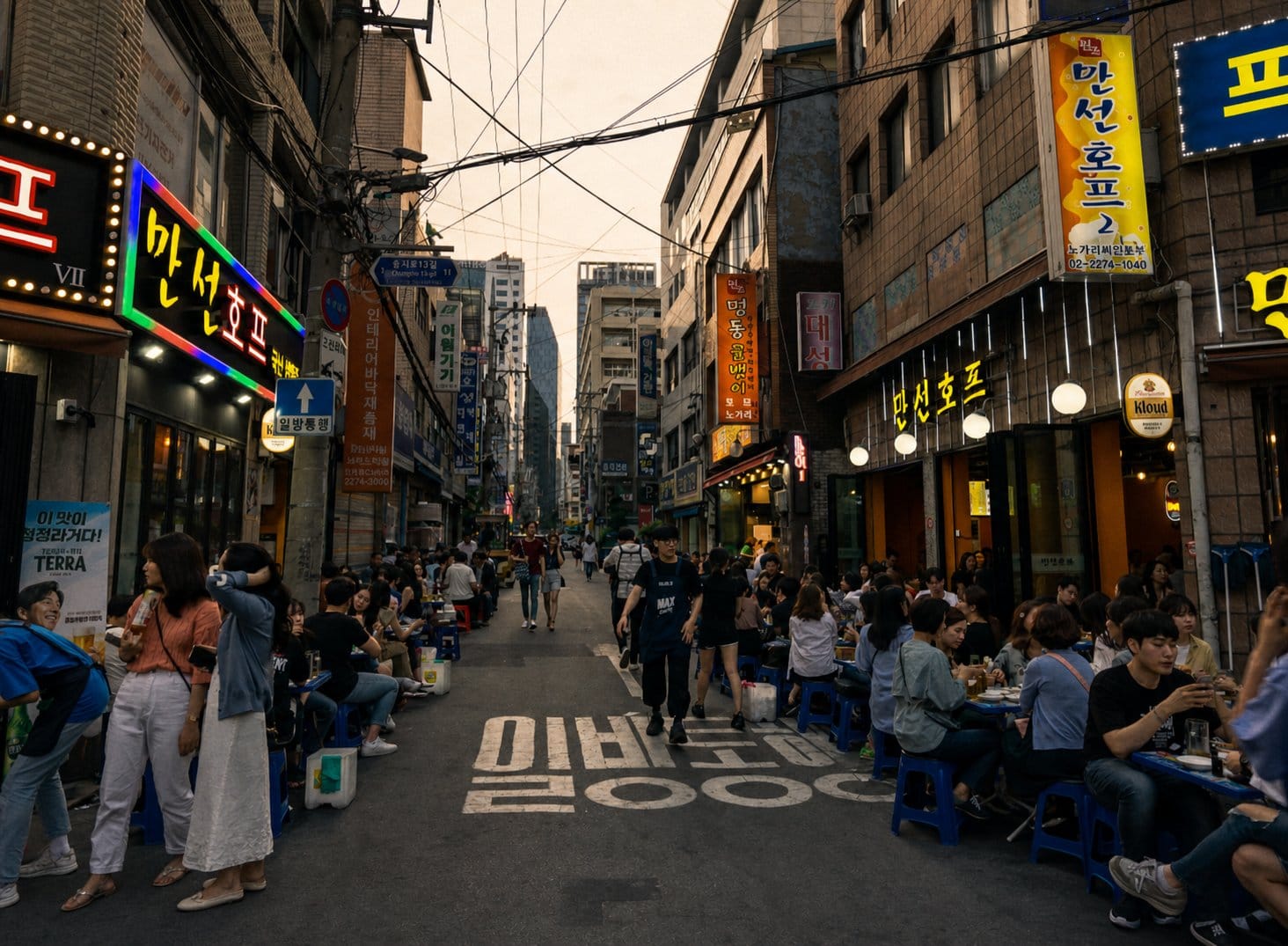
Seoul night market pricing in 2026 spans from ₩2,000 snacks to ₩45,000 full tent-bar evenings depending entirely on where you sit and how long you stay. The table below captures realistic per-person spend across three levels: a light snack stop, a full meal without alcohol, and a complete evening including drinks. All figures reflect eating at stalls rather than at sit-down restaurants inside market precincts — the latter typically adds 30–50% to the food total.
| Market | Light Snack | Full Meal (No Drinks) | Full Evening with Drinks | Realistic Total Range |
|---|---|---|---|---|
| Namdaemun | ₩3,000–5,000 | ₩7,000–12,000 | ₩12,000–20,000 | ₩8,000–20,000 |
| Gwangjang | ₩3,000–8,000 | ₩12,000–18,000 | ₩15,000–25,000 | ₩15,000–30,000 |
| Dongdaemun District | ₩3,000–5,000 | ₩10,000–20,000 | ₩15,000–30,000 | ₩10,000–30,000 |
| Mangwon | ₩2,000–4,000 | ₩7,000–12,000 | ₩10,000–18,000 | ₩8,000–20,000 |
| Jongno Pojangmacha | ₩5,000–10,000 | ₩15,000–25,000 | ₩25,000–45,000 | ₩20,000–45,000 |
| Euljiro Beer Alley | ₩2,000–5,000 | ₩10,000–15,000 | ₩20,000–30,000 | ₩20,000–30,000 |
| Yeouido / Bangpo (seasonal) | ₩8,000–10,000 | ₩12,000–20,000 | ₩20,000–35,000 | ₩15,000–35,000 |
Cash vs. card in 2026: Most traditional stall vendors remain cash-only. T-money transit cards are accepted at select stalls , but this is inconsistent and unreliable as a primary payment method. Carry ₩20,000–30,000 cash per person as a working buffer before heading out. ATMs are available inside both Namdaemun Market and Gwangjang Market . Larger sit-down restaurants inside market precincts are more likely to accept credit cards — individual stall vendors almost universally do not.
Best-value communal snack: A ₩5,000 twigim (tempura) assortment — a mix of battered and fried vegetables, fish cake, and seaweed rolls — feeds approximately three people as a shared starter (video: Doobydobap). Order one at each market stop to pace your budget without skipping any venue. Solo travelers should be aware that stall portions at most traditional markets default to two-person sizes; at Namdaemun and Gwangjang, requesting a half portion (반만 주세요, ban-man ju-seyo) is understood, though not always accommodated. The twigim assortment is one of the few street-food formats that divides naturally into individual pieces, making it the practical solo-diner workaround.
Frequently Asked Questions
When are Seoul night markets most crowded, and how can I avoid peak queues?
Crowd timing varies by market and should be planned separately for each. Namdaemun is most active after 10 PM when wholesale buyers arrive; arriving at 7:00 AM bypasses all queues and finds the food alleys functional but unhurried. Gwangjang Market and Jongno pojangmacha tent bars peak between 8–10 PM on both weekdays and weekends. Dongdaemun's peak falls between 11 PM and 2 AM, later than any other market on this list. Across all six markets, Tuesday through Thursday evenings are consistently lighter than Friday and Saturday nights — if your schedule allows a weekday visit, the difference in queue length and stall-side crowding is significant.
Do Seoul night markets accept credit cards or only cash in 2026?
Most traditional stall vendors in Seoul's night markets operate cash-only in 2026. T-money transit cards are accepted at some stalls, but relying on this as a primary payment method is unreliable — availability varies by vendor and changes without notice. Budget ₩20,000–30,000 cash per person before heading out. If you need to withdraw while at a market, ATMs are available inside both Namdaemun Market and Gwangjang Market. Larger sit-down restaurants operating within market precincts — as opposed to individual stall vendors — are more likely to accept credit cards, particularly at Gwangjang where the food-hall restaurants have higher ticket sizes.
Which Seoul night market works best for solo travelers?
Namdaemun and Gwangjang both have counter-seating layouts suited to solo diners — the stall format seats you in a row alongside other customers rather than at an isolated table, which removes any awkwardness. Jongno pojangmacha tent bars are built entirely around communal seating: solo customers are seated at shared tables as a matter of course, and this is a normal social format rather than an exception. Mangwon Market's daytime banchan shops sell individual side-dish portions that function well as solo meal assembly. Avoid ordering full stall portions alone if possible — standard sizes at most markets default to two-person quantities, and a ₩5,000 twigim assortment is a better way to sample stalls individually without committing to a full portion.
Are Seoul night markets open year-round, including winter?
Namdaemun, Gwangjang, Dongdaemun District, Jongno pojangmacha, and the Euljiro beer alleys are all open year-round, including the winter months — Namdaemun technically 24 hours, Gwangjang until approximately midnight. Winter visits are entirely viable; the covered format of Gwangjang and Namdaemun provides warmth, and pojangmacha tent bars add plastic sheeting in cold weather that traps heat effectively. The exception is the Han River riverside food-truck events at Yeouido and Bangpo, which operate only on weekends from April through October and are fully closed November through March.
Which night market is most convenient after a concert at Hongdae or Dongdaemun-area venues?
After a Hongdae-area show — Yes24 Live Hall, Muv Hall, or KT&G Sangsangmadang — Mangwon Market is walkable in under 10 minutes from most venue exits, requiring no subway transfer. After a concert at a Jamsil or Olympic Park venue, Dongdaemun or Jongno 3-ga is 30–40 minutes by subway and worth the trip; Dongdaemun in particular operates most actively between 11 PM and 2 AM, which aligns with post-concert arrival windows. Namdaemun suits post-concert arrivals as late as 11 PM–midnight: it peaks precisely during that window when wholesale buyers arrive and the food alleys are at their fullest. For any venue near central Seoul with a Line 4 or Line 2 connection, Namdaemun or Dongdaemun respectively becomes the path-of-least-resistance option.
Watch / Sources
- Doobydobap — Eating the BEST KOREAN STREET FOOD in SEOUL
- KarissaEats — I Only Ate Street Food for 24 Hours in Seoul, South Korea!
- Strictly Dumpling — Top 10 BEST Korean STREET FOOD Markets in South Korea!
Where to Go: Practical Recommendations
The six markets and two seasonal riverside parks above cover enough range for multiple evenings. For a single-night circuit that delivers the widest range per hour, the highest-return combination is Gwangjang Market for sit-down bindaetteok and makgeolli from 7 PM, followed by a subway or taxi hop to Jongno 3-ga's pojangmacha strip from 9 PM onward — budget ₩30,000–40,000 per person for both legs. For the deepest late-night option, Dongdaemun at midnight is the only district that is more alive at 2 AM than at 10 PM. For the most economical full evening, Euljiro beer alley into Jongno pojangmacha keeps a two-person tab under ₩50,000 total.
For K-POP fans building a market visit around a Seoul concert schedule: plan the food stop on the same subway line as the venue rather than backtracking across the city. Namdaemun fits any evening that ends in central Seoul before midnight. Mangwon is the clear call for every Hongdae-area show. Dongdaemun remains viable even after a Jamsil-area concert via the direct Line 2 connection. The single most important operational change this year is the Gwangjang real-name registration and QR-complaint system taking effect June 1, 2026 — scan the vendor QR before you order, especially if prices aren't visibly posted on a board.
No single market covers everything. The practical approach is to treat two or three markets as a loose circuit rather than a single destination: start earlier and lighter, build toward heavier food later, and factor in that most markets hit their best energy in the 9–11 PM window regardless of location.
Last updated: 2026-05-30. Article reviewed against vendor pricing, market hours, and 2026 operational updates including the Gwangjang Market real-name registration system effective June 1, 2026.
This article was written using information collected and analyzed by NAMANE's in-house K-pop research AI engine. We use AI technology to bring you faster, broader coverage, and in the process some details may occasionally differ from the latest facts. For important information such as dates, venues, and prices, please double-check with official sources.


