
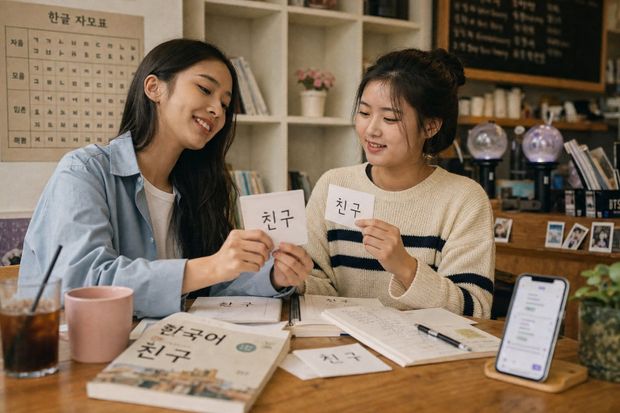
What Chingu (친구) Actually Means in Korean
Chingu (친구) is the Korean word for "friend," but its meaning is more precisely bounded than a direct translation suggests. Pronounced chin-gu — where "chin" rhymes with "bean" and "gu" sounds like "goo," with roughly equal stress on both syllables — the word applies exclusively to a person born in the exact same calendar year. This is not a flexible guideline or a cultural preference: it is a structural feature of Korean social relations rooted in centuries of Confucian thought about age, hierarchy, and mutual obligation. Two people can share years of genuine warmth and care, and still not be each other's chingu if one was born even a single year before the other (source: The Soul of Seoul). For learners coming from English or other languages where a single word covers everyone from a casual acquaintance to a lifelong companion regardless of age, this restriction is often the first real window into how Korean society organizes its most fundamental human connections.
Quick Answer: Chingu (친구), pronounced chin-gu, is the Korean word for "friend" — but it applies only to someone born in the exact same year. Emotional closeness alone does not qualify a relationship as chingu. Anyone older or younger requires a different term: oppa, unni, hyung, noona, or dongsaeng, depending on relative age and the speaker's gender.
The "ch" in chingu is aspirated — similar to the "ch" in "cheese" — and the Hangul spelling 친구 reflects this clearly: 친 (chin) + 구 (gu). Learners sometimes stress the second syllable, but natural Korean speech places roughly equal weight on both. Getting the pronunciation right matters beyond phonetics: saying the word confidently is often the first signal to a Korean speaker that a foreigner has genuinely engaged with the language rather than simply borrowed it from song lyrics or subtitles.
What makes chingu conceptually distinct from "friend" in English is that emotional closeness cannot override the age rule. Korean social structure treats relationships categorically: each pairing between two people carries a defined set of speech levels, name suffixes, and relational vocabulary determined by their birth years. The informal name endings "-a" (after a consonant, as in Jimin-a) and "-ya" (after a vowel, as in Soyeon-ya) that chingu exchange freely with each other cannot be used with anyone even one year older without risking genuine social friction. Chingu, therefore, is not simply a vocabulary item — it is an entry point into the entire framework of Korean social hierarchy that shapes every interpersonal exchange (source: Learn Korean 24).
Internationally, chingu has become one of the most widely recognized Korean words outside Korea, carried into dozens of languages by K-pop and K-drama fandom. Fans often encounter it in variety show subtitles, song lyrics, and idol social media before they realize the cultural weight it carries. That informal adoption — using chingu to mean "friend" in the broad English sense — is understandable and generally received with good humor by Korean speakers. But it also strips away the age-specific precision that makes the word so distinctly Korean in its native context.
Korea's Age Hierarchy: Oppa, Unni, Hyung, Noona, and Dongsaeng
Korea's system of age-based relational labels is not simply a matter of politeness — it is a grammatically functional structure that shapes which words, verb endings, and speech levels are appropriate in any given exchange. The framework is rooted in Confucian social philosophy, which organizes society around hierarchies of age, role, and mutual responsibility. In practice, this means that before two Koreans fall into comfortable conversation, they often establish each other's birth year — a question that is both socially expected and linguistically necessary. Once ages are known, the relational label is assigned: the older person becomes oppa, hyung, unni, or noona to the younger, and the younger becomes dongsaeng. Only exact same-year peers achieve the symmetrical status of chingu, where neither party outranks the other and informal speech can flow freely in both directions (source: The Soul of Seoul).
| Term | Hangul | Speaker Gender | Refers To | Typical Context |
|---|---|---|---|---|
| Oppa | 오빠 | Female | Older male | Female speaker addressing an older brother figure, older male friend, or male idol |
| Hyung | 형 | Male | Older male | Male speaker addressing an older brother figure or senior male peer |
| Unni | 언니 | Female | Older female | Female speaker addressing an older sister figure or senior female |
| Noona | 누나 | Male | Older female | Male speaker addressing an older sister figure or senior female |
| Dongsaeng | 동생 | Any | Younger person | Gender-neutral term for a younger person; 남동생 (male) or 여동생 (female) to specify gender |
| Chingu | 친구 | Any | Same-year peer | Mutual, symmetrical — used only between those born in the same calendar year |
The speech level distinction is equally significant. Between chingu, names are used freely with the informal suffixes "-a" or "-ya," and verb endings drop to their casual forms. With anyone holding a senior relational label, the formal "-ssi" suffix is expected until the older party explicitly invites informality. That invitation is not a small gesture: it marks a deliberate social shift and is often remembered as a meaningful moment in a developing relationship. Breaching the convention — even unintentionally — can cause genuine offense, regardless of how close two people feel.
"I had known her for over two years. We had coffee regularly, talked for hours. Then one afternoon I slipped into informal speech — just once — and she stopped me mid-sentence and corrected me. Calmly, but firmly. The closeness we had built didn't change the rules."
— Expatriate account documented by The Soul of Seoul
These social norms extend well beyond everyday friendship into Korean institutions. A widely-shared 2023 AMA thread on Reddit by a Korean military service member described how military hierarchies mirror civilian age norms almost exactly: different intakes maintain strict formality regardless of personal familiarity, and the oppa/hyung/chingu framework plays out in institutional settings with the same force it carries in civilian life. The relational labels are not learned once as vocabulary — they are re-enacted in every Korean social context, every day.
Every Way to Say 'Friend' in Korean: Chingu Vocabulary
Korean offers a range of vocabulary for describing friendships beyond the base word chingu (친구), allowing speakers to express degrees of closeness, length of acquaintance, and social context with precision. The most common expansions use 친한 (chin-han, meaning "close" or "intimate") as a modifier: 친한 친구 (chin-han chin-gu) means close friend, a step warmer in emotional weight than plain chingu. For the concept of a best friend, Korean has the formal compound 가장 친한 친구 (ga-jang chin-han chin-gu), where 가장 means "most" — making the full phrase translate as "the closest friend." In everyday spoken Korean, this is shortened to 절친 (jeol-chin), the casual equivalent of "bestie" in English, widely used in texts, social media posts, and variety show captions. Each of these terms still carries the same-year age restriction that governs chingu itself (source: Learn Korean 24).
| Term | Romanization | Literal Meaning | Typical Usage |
|---|---|---|---|
| 친구 | chingu | Friend | Core same-year friend term; general and neutral in register |
| 친한 친구 | chin-han chin-gu | Close friend | Emphasizes emotional closeness; suitable for both formal and casual speech |
| 가장 친한 친구 | ga-jang chin-han chin-gu | Closest / best friend | Formal expression; more common in written Korean than in spoken conversation |
| 절친 | jeol-chin | Best friend (colloquial) | Casual shorthand; the rough equivalent of "bestie"; frequent in texts and social media |
| 오랜 친구 | o-raen chin-gu | Old friend | Emphasizes the duration of a friendship rather than its emotional intensity |
| 학교 친구 | hak-gyo chin-gu | School friend | Specifies where the friendship formed; common in autobiographical speech |
| 제 친구 | je chin-gu | My friend | Formal possessive; informal equivalent is 내 친구 (nae chin-gu) |
Korean possessives work differently from English. In formal or polite speech, "my" is expressed as 제 (je), making 제 친구 the appropriate form when speaking carefully — such as when introducing a friend to someone older or in a professional setting. In casual speech among chingu, 내 친구 (nae chin-gu) takes over naturally. The shift in possessive mirrors the broader speech-level system: even the phrase "my friend" sounds different depending on the register of the conversation around it.
절친 (jeol-chin) deserves particular attention because it appears frequently in K-drama subtitles and idol group social media. K-pop idols regularly use it to describe members of other groups who share their birth year — a visible, real-world demonstration of the same-year restriction in action. When idols from the same debut year publicly call each other 절친, they are applying the chingu rule accurately and making it observable to millions of international fans who might otherwise never encounter its practical meaning (source: Mt. Kimchi).
How K-Pop Fandoms Spread Chingu Worldwide
Korean vocabulary has traveled into global fan communities at a pace that no classroom could replicate, and chingu is among the most widely adopted words in that migration. Academic research published in 2023 — "The International K-Pop Fandom and Fandom Lexicon: The Globalisation of Korean Words Through Social Media" — documented how terms including chingu, oppa, unni, and saranghae entered the everyday social media language of fans on Twitter/X, TikTok, fan Discord servers, and Weverse, often among audiences who had little or no other Korean-language exposure. The mechanism is consistent across platforms: fans absorb vocabulary from subtitled content, idol social media posts, and community shorthand, then carry those words into their own interactions without formal instruction. This process has accelerated since the global breakthrough of Korean music and drama, and continues to expand as each new artist generation introduces fresh waves of international listeners to Korean vocabulary.
The study found that Korean fandom vocabulary spread fastest when terms served clear social and emotional functions — helping fans express relationships and group belonging in ways that English alone did not cover with the same cultural specificity. Chingu, oppa, and saranghae migrated because they filled real communicative gaps in fan community language.
— Key finding, The International K-Pop Fandom and Fandom Lexicon, ResearchGate, 2023
A critical shift happens in this cross-cultural migration: the loss of the age restriction. International fans use chingu in its broadest sense — simply meaning "friend" — without observing the same-year rule that makes the word so precisely defined in Korean. Korean speakers generally understand this as a natural effect of vocabulary borrowing across cultures and extend genuine flexibility in response. However, a fan who understands and correctly applies the age-specific meaning signals something meaningfully different: authentic engagement with Korean social norms, not just borrowed fandom vocabulary.
Commercial K-pop culture has recognized chingu's global brand value. Fashion Chingu is a K-pop merchandise and fan culture platform whose name directly leverages the word's warmth to signal community belonging to an international audience (source: Fashion Chingu). The brand assumes its audience already associates chingu with friendship and K-pop fandom, without necessarily knowing the same-year rule — a commercially reasonable bet, given how effectively the word's emotional resonance has crossed languages.
On fan platforms like Weverse and Discord servers, chingu appears alongside oppa and unni as part of a shared vocabulary that creates community identity. New fans encounter these words early, absorb them from veteran fans, and integrate them into their own speech before they have studied a single formal Korean lesson. The social function this vocabulary serves — helping fans feel closer to both the artists and to each other — explains its remarkable durability across language communities worldwide.
Chingu App: AI Korean Learning for K-Pop Fans (2024–2026)
The Chingu app (getchingu.com), developed by MangoLab, is a deliberate commercial application of the word's emotional warmth. Its central premise — framing AI companions as "a real Korean friend" — positions language learning as relationship-building, designed for fan-motivated learners who want conversational fluency rather than textbook grammar. The app launched on iOS in 2024 , with Android and web versions roadmapped, positioning itself against Duolingo and conversational AI language tools in the growing Korean-learner market. The name choice is not incidental: by calling the AI companions your chingu — your peer, not a teacher — MangoLab consciously inverts the authority dynamic that makes many learners anxious about speaking Korean aloud.
The app's eight named AI companions each have a distinct personality, voice, and social context designed to reflect situations a learner might realistically encounter. Minjun and Jihye function as tutors; Jimin is a K-pop singer; Junho is a K-drama actor; Doyun runs a café; Haeun is a K-pop idol; Soyeon is a florist; and Minseo is an illustrator . The diversity of contexts is intentional: practicing with Junho involves entertainment industry vocabulary and casual banter, while Doyun's café setting introduces service Korean and ordering language. Each companion adapts automatically to the learner's demonstrated level, addressing the persistent mismatch between structured lessons and real conversation (source: Chingu / MangoLab).
The feature set reflects the app's conversational priority. Voice calls offer real-time Korean subtitles and adaptive inline corrections — mistakes are addressed during the conversation itself rather than in a separate grammar review. Text chat includes translation suggestion chips and grammar feedback that appear directly in the conversation flow. Structured lessons run from Hangul basics through TOPIK-level conversation, with the system auto-adapting to the learner's level rather than requiring manual placement.
The app operates on a freemium model: the free tier allows approximately 10–15 messages per day with one companion, while the Chingu+ premium subscription at $9.99 per month or $59.99 per year unlocks all eight companions, unlimited messaging, and extended voice calls . Annual pricing positions it below many comparable language apps while offering a narrower, fan-culture-specific experience. For learners motivated by K-pop and K-drama rather than academic study, that narrower focus is the appeal (source: Chingu Blog, 2026).
Using Chingu Correctly: What Fans Should Know Before Speaking Korean
Knowing the word chingu is one thing; knowing when to use it is what matters in real Korean conversations. The practical rules are clear and consistent: chingu applies only to someone born in the same calendar year as the speaker. Anyone older requires oppa, hyung, unni, or noona — depending on relative age and the speaker's gender. Anyone younger is dongsaeng. Korean speakers extend genuine flexibility to foreigners using chingu loosely, understanding the cultural gap, but correctly applying the age-specific meaning signals authentic engagement with Korean social norms rather than surface-level vocabulary borrowing (source: Learn Korean 24).
The question fans most commonly ask is whether they can call a K-pop idol their chingu. The precise answer: only if you share the same birth year. Most international fans are either older or younger than the artists they follow, which means the correct relational label is oppa, unni, or noona. Using chingu for an idol of a different age would be technically incorrect by Korean social norms — though in a fandom context, no Korean speaker takes this literally. What accurate usage signals is that you understand how Korean relationships are structured, which is a form of cultural awareness that Korean speakers do notice and appreciate.
Learning oppa, unni, hyung, noona, and dongsaeng alongside chingu is not optional for anyone planning to interact with Korean speakers in a sustained way. These terms determine speech level, and speech level governs verb endings, name suffixes, and sentence formality across every exchange. A fan who addresses an older Korean acquaintance with the informal speech appropriate for a chingu is not just making a vocabulary error — they are signaling social misjudgment, which is harder to recover from than a mispronounced vowel.
As a gateway into Korean language study, fan vocabulary is genuinely effective. Chingu, saranghae, oppa, and the other age terms are low-barrier entry points that carry real emotional weight. Learners who encounter these words through music and variety content arrive with motivation that structured textbooks rarely manufacture on their own. The words fans already know and care about become natural scaffolding for formal grammar, verb conjugation, and reading comprehension that deepens with continued study.
Frequently Asked Questions
Can I call my favorite K-pop idol my chingu?
Technically, chingu applies only if you share the same birth year as the idol. Most fans are either older or younger than the artists they follow, which means the correct relational term is oppa (older male, addressed by a female speaker), unni (older female, female speaker), hyung (older male, male speaker), noona (older female, male speaker), or dongsaeng if you are older than the idol. Internationally, fans use chingu loosely to mean "friend," and Korean speakers understand this as a cultural difference rather than a mistake. However, using the age-appropriate term correctly is a recognizable signal of genuine cultural knowledge — one that Korean speakers notice and tend to receive warmly.
What is the difference between chingu and jeol-chin (절친)?
Chingu (친구) is the general Korean word for friend, with the cultural restriction that it applies only to a same-year peer. Jeol-chin (절친) is a colloquial shortening of 가장 친한 친구 (ga-jang chin-han chin-gu), meaning "closest friend" or "best friend." Where chingu is neutral and general, jeol-chin carries the affectionate, casual register of "bestie" in English — informal, slightly playful, and warm. It appears frequently in Korean texts, social media posts, and variety show captions, and K-pop idols often use it to describe close same-age friends in other groups. You might say chingu when introducing someone to a third party, and jeol-chin when you want to emphasize the depth of that friendship.
How is chingu pronounced correctly?
Chingu is two syllables: "chin" — which rhymes with "bean," not with the word for the body part — followed by "gu," which sounds like "goo." Stress is roughly equal across both syllables, with no strong emphasis on either. The "ch" is aspirated, similar to the "ch" in "cheese" rather than a softer sound. In Hangul, the spelling is 친구: 친 (chin) and 구 (gu). Hearing the word spoken by native speakers in K-drama audio or variety show content before attempting it yourself is the most reliable way to internalize the correct sound — a few focused listens tend to be more useful than phonetic description alone.
Is the Chingu AI app free to use?
The Chingu app (getchingu.com), developed by MangoLab, uses a freemium model. The free tier provides access to one AI companion with a daily message limit of approximately 10–15 messages. The Chingu+ premium subscription, priced at $9.99 per month or $59.99 per year, unlocks all eight named companions, unlimited messaging, and extended voice call sessions with real-time Korean subtitles and adaptive corrections. The app launched on iOS in 2024, with Android and web versions roadmapped for later release. For current pricing and availability, check the official site at getchingu.com directly, as subscription tiers may have been updated since this article was written.
Why does Korean have different words for older and younger friends instead of just one?
Korean social structure, shaped by Confucian philosophy, organizes interpersonal relationships around hierarchies of age and role rather than around a neutral concept of equal-status friendship. The relational labels — oppa, hyung, unni, noona, dongsaeng — are not merely polite titles. Each label is grammatically functional: it determines which speech level, verb endings, and name suffixes are appropriate within that relationship. Using informal speech with a senior, or formal speech with a peer, carries distinct social meaning that native speakers read immediately. For language learners, this means Korean vocabulary and Korean social norms are inseparable systems: understanding who someone is to you determines not just what you call them, but how you conjugate every verb in the conversation.
Chingu: One Word, Three Registers
Chingu operates on at least three distinct registers in contemporary culture. In its native Korean context, it is a precisely bounded social term that applies only to same-year peers, determines speech level, and reflects a Confucian-rooted framework in which age shapes every interpersonal interaction. In global K-pop fandom, it has become a widely adopted informal word for "friend" across dozens of languages — emotionally resonant, easily borrowed, and largely stripped of its age-specific precision in transit. And in commercial contexts, it has become a brand signifier: from the Fashion Chingu merchandise platform to MangoLab's AI language app, the word's warmth has been recognized as a tool for building international community and motivating Korean learners who arrive through fandom rather than formal study.
For fans, the word's journey across these three registers is itself instructive. Chingu spread into international fan vocabulary because it was emotionally useful — it expressed something about fandom relationships that English did not cover as well. That is exactly how language spreads naturally, and it is why researchers studying the globalization of Korean through K-pop fan communities identified it as one of the most functionally durable borrowed terms. The distance between using chingu loosely and using it correctly is the distance between recognizing a word and understanding the social world it comes from. Both are worth knowing, and neither cancels the other out.
Whether you are approaching Korean through an AI companion app, absorbing vocabulary from idol social media, or planning to visit Korea and connect with fans or locals in person, the age-hierarchy vocabulary — chingu, oppa, unni, hyung, noona, dongsaeng — forms the foundation of Korean social language. It does not take long to learn. It does take attention to use well. And getting it right opens conversations that a generic "friend" can never quite access.
Last updated: 2026-05-22. Article reviewed to reflect Chingu app features and pricing current as of May 2026.
This article was written using information collected and analyzed by NAMANE's in-house K-pop research AI engine. We use AI technology to bring you faster, broader coverage, and in the process some details may occasionally differ from the latest facts. For important information such as dates, venues, and prices, please double-check with official sources.


