
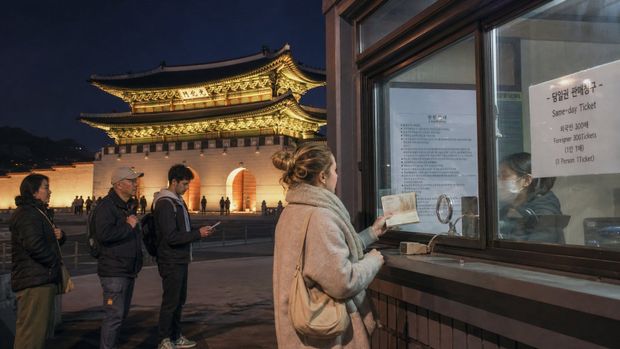
How Many Foreign Visitors Get Into Gyeongbokgung's Night Opening?
Seoul in September is less about finding places than about hitting windows — and the narrowest window of the month opens at a ticket booth in front of Gwanghwamun, where exactly 300 same-day tickets are held for foreign visitors each night. Everything else on this five-day plan bends around that number.source
Gyeongbokgung's autumn night viewing admits 3,300 visitors per evening, and only 300 of those seats are reserved for foreign visitors as same-day walk-up tickets at the Gwanghwamun ticket booth . The remaining 3,000 are advance online tickets, which opened for reservation on August 26 . The walk-up allotment requires a passport, caps purchases at two per person, and sells out early in the day .
Quick Answer: Gyeongbokgung's 2026 autumn night opening runs September 2 to October 2, closed Mondays and Tuesdays, 19:00–21:30 with last entry at 20:30. Of the 3,300 daily tickets, 300 are held as same-day walk-up entries for foreign visitors at the Gwanghwamun booth (passport required, two per person). Admission is 3,000 KRW.
The Korea Heritage Service lists the second-half 2026 night viewing as September 2 through October 2, closed Mondays and Tuesdays, running 19:00 to 21:30 with last entry at 20:30 . Admission is 3,000 KRW . Travel listings reporting the same window agree with the primary source .
There is a second door, and it is the one most visiting fans end up using: anyone wearing full hanbok enters free, day or night, without an advance reservation, and the rule applies to Korean and foreign visitors alike . The dress standard is enforced strictly — jeogori paired with chima or baji together. A durumagi worn alone, or a jeogori thrown over jeans, does not qualify (video: Paddy Doyle). Rental shops cluster around the palace's east and west gates, so the hanbok route is often faster than queueing for one of the 300.
| Entry channel | Daily quota | Cost | How to secure it |
|---|---|---|---|
| Advance online ticket | 3,000 | 3,000 KRW | Reservations opened Aug 26; book before arrival |
| Foreign-visitor walk-up | 300 | 3,000 KRW | Gwanghwamun ticket booth, same day only, passport required, max 2 per person |
| Full hanbok | No cap | Free | No reservation; jeogori + chima/baji worn together |
Two dates frame the rest of the trip. The palace was founded in 1395 , and its illuminated night route covers Gwanghwamun, Heungnyemun, Geunjeongjeon, Gyeonghoeru, Sajeongjeon, Gangnyeongjeon, Gyotaejeon and Amisan . Because night viewing is closed Mondays and Tuesdays, and because the Seoul International Fireworks Festival is fixed to Saturday, September 5 , the practical build is a Wednesday-to-Sunday run with the palace on the first available night.
Day 1: Gwanghwamun Ticket Line to Gyeongbokgung's Illuminated Courtyards
Day 1 runs on a single hard deadline: the 300 on-site foreigner tickets at the Gwanghwamun ticket booth, sold on the day with a passport and a two-ticket-per-person limit . Those 300 sit on top of 3,000 advance online tickets inside a 3,300-visitor daily cap, and admission is 3,000 KRW . Arrive at the booth well before gates open at 19:00 — the foreigner allotment is reported to sell out early . If the queue looks long, the hanbok route is the reliable fallback: visitors in full hanbok enter free, day or night, with no advance reservation, and the rule applies to Korean and foreign visitors alike .
Rental shops around Gwanghwamun and Bukchon make that a same-afternoon decision, but the dress code is checked at the gate. A jeogori paired with a chima or baji qualifies; a durumagi worn alone, or a jeogori thrown over jeans, does not . Budget an hour before 19:00 for fitting and the walk back.
Gyeongbokgung Palace | 관광
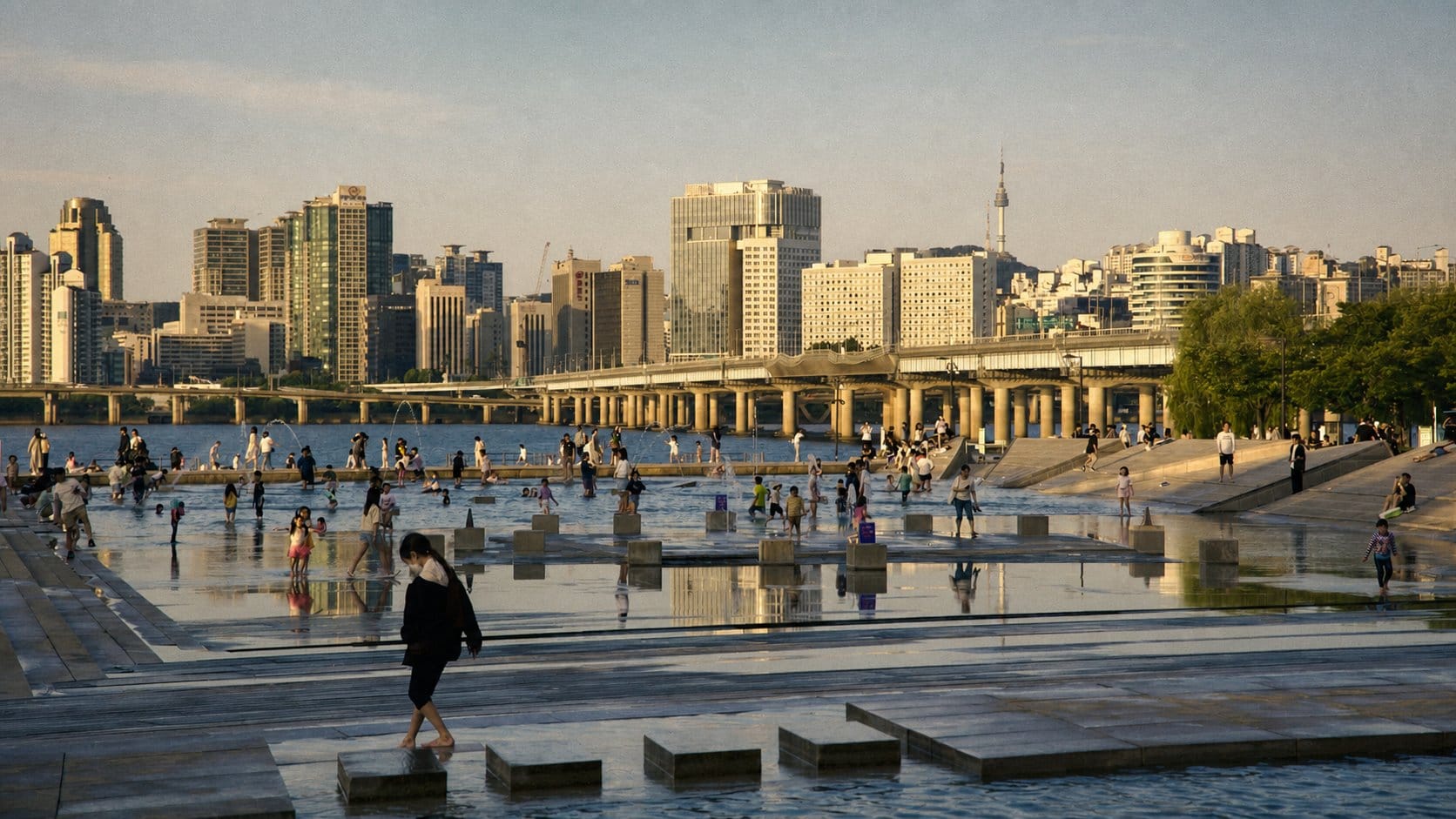
Founded in 1395, Gyeongbokgung is the main Joseon palace and the only one lit for a ticketed night route in this window . The illuminated sequence runs Gwanghwamun → Heungnyemun → Geunjeongjeon → Gyeonghoeru → Sajeongjeon → Gangnyeongjeon → Gyotaejeon → Amisan . Walked in order at an unhurried pace, it fits the 19:00–21:30 window with room to stop, and Gyeonghoeru — the banquet pavilion that reads as floating on its pond — is the frame most people come for, best taken just after blue hour . Geunjeongjeon and Gyeonghoeru are also the two stops BTS used for "IDOL" and "Mikrokosmos" in hanbok-inspired outfits during NBC's Tonight Show Starring Jimmy Fallon "BTS Week" special in September 2020 — the same pavilion-over-water framing that makes Gyeonghoeru worth the wait here .
Blue hour is the moving part. Seoul's sunset is roughly 19:01 on September 1 and 18:17 by September 30 , so the useful reflection window at Gyeonghoeru lands around 19:45 early in the run and closer to 19:05 by the October 2 finish. Early in September that means entering at 19:00 and heading for the pond first, before the sky goes flat black; late in the run, the same shot is already gone by the time a slow walk reaches it (video: Flora and Note).
One structural caveat to plan around: Geunjeongjeon Woldae access is restricted from September 2 to October 31 , which removes the raised-terrace foreground and several tripod positions in front of the throne hall. The workable substitute is a lower, wider frame from the Geunjeongmun courtyard, using the stone haetae and the courtyard's rank stones as foreground instead of the platform. Last entry is 20:30 , so anyone arriving after the fireworks-week crowds should treat 20:00 as the real cutoff.
📋 주소 · 사직로 161, 종로구 · 야간관람 19:00–21:30 (마지막 입장 20:30, 월·화 휴관) · 3,000 KRW
💡 Passport in hand at the Gwanghwamun booth before opening; if the 300 tickets are gone, full hanbok gets you in free with no reservation.
📍 161 Sajik-ro, Jongno District, Seoul
🕒 Monday 9:00 AM – 6:30 PM / Tuesday Closed / Wednesday–Sunday 9:00 AM – 6:30 PM
⭐ 4.6 (46,785 reviews)
📞 02-3700-3900
🔗 View on Google Maps
Day 2: Yeouido or Ichon for the Seoul International Fireworks Festival (Sept 5)
The Seoul International Fireworks Festival lands on Saturday, September 5, 2026 at Yeouido Hangang Park, and it is the one date in this itinerary that cannot be moved . Hanwha pulled the 2026 edition roughly three weeks earlier than 2025's September 27 show, explicitly to clear the September 24–26 Chuseok holiday and capture more inbound visitors . The fireworks themselves run about 20:00 to 21:10; everything else that day is positioning.
The wider civic program is longer than the show. Seoul's September schedule lists the footprint as September 4 from 13:00 to 20:20 and September 5 from 13:00 to 22:00, spread across both Yeouido and Ichon Hangang Parks, covering the eve event, citizen programs, invited international teams and food trucks . This year's theme is "Your Infinite Colors," with teams from Korea, the United States and the United Kingdom; the UK team, Pyrotex Fireworx, opens the sequence at 20:00 .
Yeouido Hangang Park | 관광
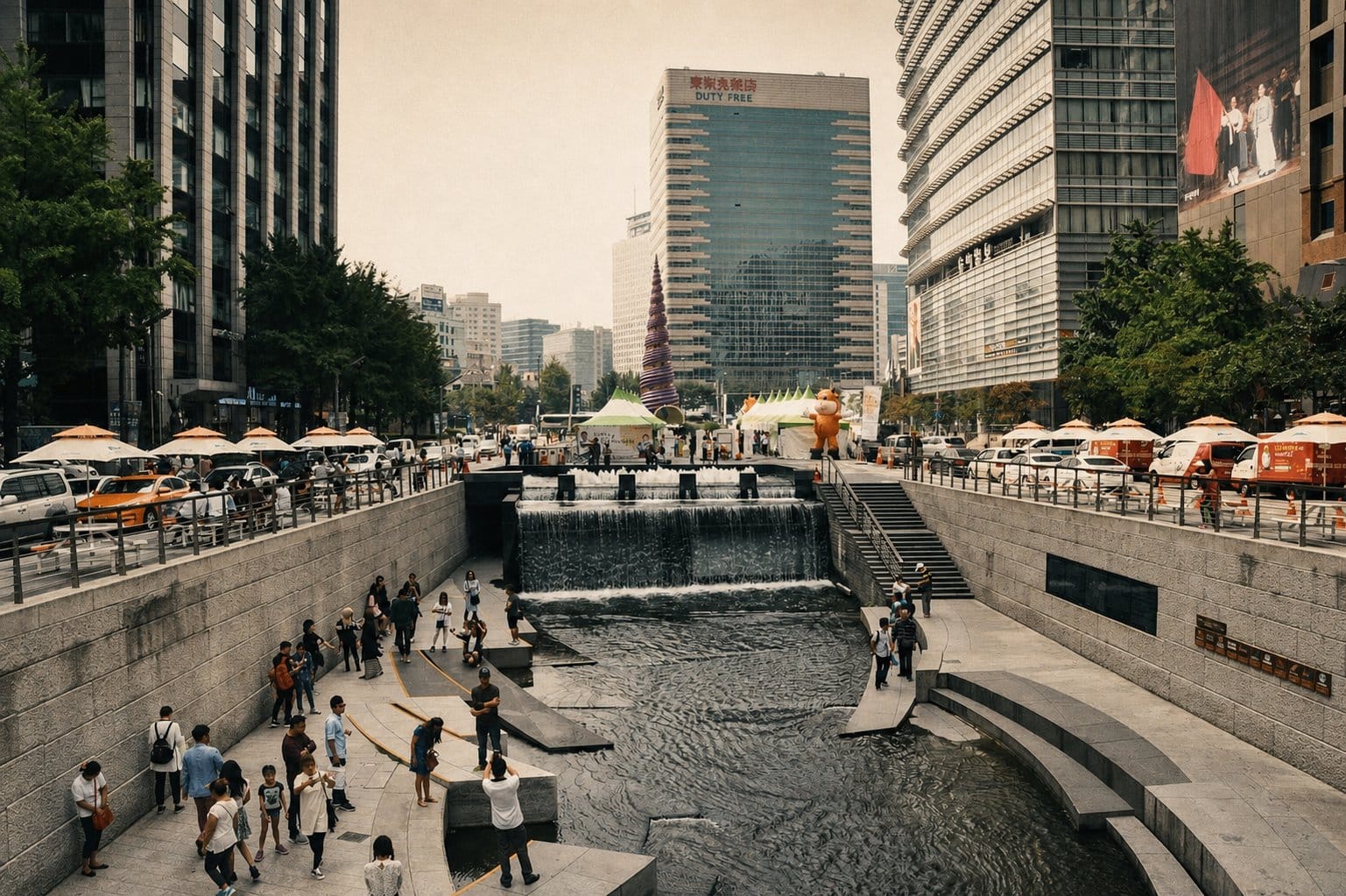
Yeouido is the primary site and the loudest one — the launch barges sit directly offshore, so the bursts fill the frame vertically with almost no skyline compression. General viewing here is free and unticketed, which is exactly why free ground fills from late morning on show day . Choose it if you want crowd energy and scale in the shot rather than a clean composition.
📋 주소 · 여의동로 330, 영등포구 · 9월 5일 13:00–22:00 (불꽃 20:00–21:10) · 무료 일반관람
💡 Line 5 Yeouinaru is closest; Line 9 National Assembly is walkable and usually less compressed on the way out.
📍 330 Yeouidong-ro, Yeongdeungpo District, Seoul
🕒 Daily Open 24 hours
⭐ 4.5 (18,331 reviews)
📞 02-3780-0561
🔗 View on Google Maps
Ichon Hangang Park | 전망
Ichon sits across the river and trades scale for context: the bursts land smaller in frame but sit against the Yeouido skyline, which is the more reproducible photograph. It is inside the official festival footprint on both days, so facilities and staffing are in place rather than improvised . Crowds are real but noticeably thinner than the Yeouido bank.
📋 주소 · 이촌로72길 62, 용산구 · 9월 4일 13:00–20:20 / 9월 5일 13:00–22:00 · 무료
💡 Arrive by 17:00 for a riverbank spot; a tripod is workable here in a way it usually is not at Yeouido.
📍 62 Ichon-ro 72-gil, Yongsan District, Seoul
🕒 Daily Open 24 hours
⭐ 4.4 (1,077 reviews)
📞 02-3780-0551
🔗 View on Google Maps
Nodeulseom 'Orange Play' paid zones | 체험
If you would rather buy certainty than queue for it, the paid zones — including the Nodeulseom "Orange Play" areas — run from 110,000 to 220,000 KRW and give controlled, capacity-limited viewing . The island's mid-river position gives an angle neither bank offers. Seats are limited and sell before show week.
📋 주소 · 노들섬, 양녕로 445, 용산구 · 9월 5일 · 110,000–220,000 KRW
💡 Book ahead; the price gap mostly reflects sightline and seating type, not programming.
📍 445 Yangnyeong-ro, Yongsan District, Seoul
🕒 Monday Closed / Tuesday–Friday 10:00 AM – 9:00 PM / Saturday–Sunday 10:00 AM – 10:00 PM
⭐ 4.6 (415 reviews)
📞 02-749-4500
🔗 View on Google Maps
| Vantage point | Cost | Frame | Arrive by |
|---|---|---|---|
| Yeouido Hangang Park | Free, unticketed | Vertical, close, maximum scale | Late morning |
| Ichon Hangang Park | Free, unticketed | Skyline compression across the river | ~17:00 |
| Nodeulseom "Orange Play" | 110,000–220,000 KRW | Mid-river, controlled capacity | Booked in advance |
Getting out is the part most visitors underestimate. Staged road closures begin in the afternoon and station entry is restricted immediately after the show, so walking one or two stops before boarding is usually faster than joining the Yeouinaru scrum . Have a T-money card loaded before you arrive — around 3,000 KRW at a 7-Eleven — because ticket machines are the single worst queue on the river that night (video: Flora and Note). Repeat visitors describe the post-show walk as its own part of the evening rather than an inconvenience, and the riverside path stays lit and busy well past 22:00 (video: Paddy Doyle).
One etiquette note that matters more in a crowd this size: wait for the green light even when a closed street looks empty, and keep off the priority seats near subway doors when you finally board (video: Anna Lee). Sunset on September 5 falls at about 18:55 , which gives roughly an hour of blue hour and river reflection before the first shell — the best window of the night for everything that is not a firework.
Day 3: DDP Seoul Light's Autumn Facade and a Cheonggyecheon Golden-Hour Walk
Seoul Light DDP 2026 Autumn is a free media-art projection on the 222-metre facade of Dongdaemun Design Plaza, running September 3–13, daily from 19:30 to 22:30 under the theme "DAYBREAKER" . Because the image is thrown onto a building rather than into the sky, it is the one night target on this itinerary that survives rain — which makes Day 3 the natural buffer if the fountain or the fireworks get weathered out. Pair it with a golden-hour walk along Cheonggyecheon and the whole day needs no tickets and no reservations.
Dongdaemun Design Plaza | 관광
DDP's curved aluminium shell functions as a single continuous screen, and the 2026 autumn programme leans on names that carry weight in Korean art history rather than generic visuals. The line-up includes Nam June Paik x VERSEDAY, Yoo Youngkuk x Hayoun Kwon, Cheongguyeongeon x 2GREY, and a DDP 365 Light laser work by Yun Jeho, with live performances on selected evenings — IDIOTAPE plays September 3 from 20:00 to 20:40 . The practical constraint is not light but bodies: the plaza fills in front of the strongest projection wall, so a clean composition usually means arriving before the 19:30 start or waiting out one full show cycle and shooting the repeat.
📋 주소 · Dongdaemun Design Plaza, Jung-gu, Seoul · 영업시간 · Seoul Light projections 19:30–22:30 daily, September 3–13, 2026 · 특징 · free admission, 222 m projection facade, theme "DAYBREAKER"
💡 If September 3 is your DDP night, budget for the IDIOTAPE set at 20:00–20:40 and expect the densest crowd of the eleven-day run; any other evening trades the live act for a much easier shooting position.
📍 281 Eulji-ro, Jung District, Seoul
🕒 Daily 10:00 AM – 8:00 PM
⭐ 4.4 (31,936 reviews)
📞 02-2153-0000
🔗 View on Google Maps
Cheonggyecheon | 거리
Cheonggyecheon is a restored canal completed in 2005 that runs close to 11 km through central Seoul, sunk below street level so the traffic noise drops away as soon as you take the stairs down . It is the lowest-effort filler on this trip: no gate, no closing time, and street performers appear reliably along the central stretches after dark (video: Paddy Doyle). Walking it west to east from Gwanghwamun toward Jongno 5-ga puts you at the market end just as the light goes, then leaves a short metro hop to DDP for 19:30.
📋 주소 · Cheonggyecheon-ro, Jongno-gu / Jung-gu, Seoul · 영업시간 · open walkway, no closing time · 특징 · ~11 km restored canal, completed 2005, evening street performances
💡 Sunset falls around 18:43 on September 13 , so start the walk about 90 minutes earlier to get both reflected daylight on the water and the lit bridges afterwards.
📍 Jongno District, Seoul
🕒 Daily Open 24 hours
⭐ 4.6 (10,988 reviews)
📞 02-2290-7111
🔗 View on Google Maps
Gwangjang Market | 맛집
Gwangjang Market sits roughly three minutes on foot from Jongno 5-ga station, directly on the Cheonggyecheon line of march, and it is where the day's one real meal belongs . The stalls that draw the queues serve kalguksu (knife-cut noodles), dumplings and bibimbap, eaten standing or shoulder-to-shoulder at a counter rather than at a table . Prices are cash-friendly and portions are small enough to order across two or three vendors, which is the sensible approach on a night when dinner has to finish before a 19:30 projection.
📋 주소 · 88 Changgyeonggung-ro, Jongno-gu, Seoul (Jongno 5-ga station, ~3 min walk) · 대표메뉴 · kalguksu, dumplings, bibimbap
💡 A topped-up T-money card — about 3,000 KRW at any 7-Eleven — covers the two short hops between Gwanghwamun, the market and DDP without queueing for single-journey tickets.
📍 88 Cheonggyecheon-ro, Jongno District, Seoul
🕒 Daily 9:00 AM – 10:30 PM
⭐ 4.2 (44,258 reviews)
📞 02-2267-0291
🔗 View on Google Maps
Ikseon-dong | 거리
Ikseon-dong is a compact grid of restored hanok lanes a short hop north of the Cheonggyecheon corridor, now filled with small cafes, bars and dessert shops behind original tiled roofs . One of those dessert shops, Hotel Seine, occupies a 50-year-old pink former hotel building that kept its original signage, and the retro interior it built around that history is what supplied the photographs seen displayed in Man-wol's room throughout the K-drama Hotel del Luna . The alleys are narrow enough that a tripod is impractical after dark, but the low rooflines and warm shop lighting hold up well handheld. It works either as a pre-dinner detour from Jongno or as the place to end the night if DDP finishes early.
📋 주소 · Ikseon-dong, Jongno-gu, Seoul · 특징 · restored hanok lanes with cafes and bars, adjacent to the Bukchon hanok area
💡 Search for it in Naver Map rather than Google Maps — Google's Korean walking directions are unreliable, and the Ikseon alleys are exactly where that gap shows (video: Flora and Note).
📍 Ikseon-dong, Jongno District, Seoul
🔗 View on Google Maps
Day 4: Banpo's Moonlight Rainbow Fountain and Car-Free Jamsugyo Sundays
Day 4 belongs to Banpo Hangang Park, where the Moonlight Rainbow Fountain runs on Jamsugyo Bridge every night through October 31, 2026 . In September and October the schedule is a 15-minute show at 12:00 and 19:30, then 20-minute shows at 20:00, 20:30 and 21:00, pushed from 380 water jets lit in multiple colours . Schedule a Sunday and the same riverbank also gives you a car-free bridge deck and a marked sunset photo zone.
The fountain is the one item on this five-day plan that can be cancelled while you are already standing at the railing. Seoul suspends shows when wind exceeds 7 m/s, when rain passes 2 mm per hour, or when river turbidity rises above 15 NTU — all three are same-day calls, so check hangang.seoul.go.kr before you leave your accommodation rather than after you arrive . A cancelled 20:00 show does not always mean the 21:00 slot is cancelled too, so it is worth staying if the wind eases.
Jamsugyo Bridge & Banpo Hangang Park | 관광 · 전망
Jamsugyo is the lower deck of the double-level Banpodaegyo crossing, and the Moonlight Rainbow Fountain is mounted along its span so the water arcs outward over the Han River. On Sundays this autumn the deck itself becomes the attraction: the Car-Free Jamsugyo Bridge Festival runs for eight consecutive Sundays from September 6 to October 25, 2026, closing the bridge to vehicles across Jamsugyo and Banpo Hangang Park . Admission is free, some individual programs are paid, and the festival's lit photo installations along the open deck give a clean, unobstructed sunset vantage point — which is the practical reason to pick a Sunday over any other day of the week . The stacking works because everything happens within a few hundred metres: open bridge deck in the afternoon, sunset from the photo zone, then the fountain sequence from 19:30 onward. Seoul's official Hallyu tourism guide names this same stretch of Banpo Hangang Park as the riverside spot where Itaewon Class's Yi-seo, played by Kim Da-mi, goes to unwind on-screen .
Sunset timing is what makes or breaks the sequence, and it moves quickly across the month — roughly 18:55 on September 5 and 18:17 by September 30 . Early in September, blue hour lands almost exactly on the 19:30 show. By the last week you will have finished shooting the sky more than an hour before the first evening fountain, so plan the gap with food or a walk along the park path. Seoraeseom, the small island just west of the bridge, carries cosmos and buckwheat flowers in autumn, though no dedicated September cosmos festival was announced for 2026 — the official Hangang picnic concert is an October program .
📋 주소 · Banpo Hangang Park, Sinbanpo-ro 11-gil, Seocho-gu, Seoul · 영업시간 · fountain shows 12:00, 19:30, 20:00, 20:30, 21:00 (Sept–Oct); park open 24 hours · 특징 · 380-jet Moonlight Rainbow Fountain on Jamsugyo Bridge, car-free deck every Sunday Sept 6–Oct 25
💡 Take Line 9 to Sinbanpo Exit 1 or Gubanpo Exit 2 — both put you on the Banpo side within a short walk . Arrive by 19:00 for a riverbank position on the west side, which keeps the fountain arcs between you and the city lights; the bridge deck itself is better for wide sunset frames than for the fountain, since you end up above the jets rather than facing them.
📍 40 Sinbanpo-ro 11-gil, Seocho District, Seoul
🕒 Daily Open 24 hours
⭐ 4.4 (7,927 reviews)
📞 02-3780-0541
🔗 View on Google Maps
Day 5: Haneul Park's Late-September Grasses and the Shuttle Queue Math
Haneul Park in Mapo-gu is a grass plateau built on the capped Nanjido landfill and opened in 2002 as one of Seoul's five World Cup parks . It holds silver grass (eulalia), native grass beds, wildflower meadows and sunflower fields on a flat top with an observatory over the Hangang, and entry is free, with opening hours varying by month in a roughly 05:00–22:00 band . Plan it as the final day of the trip, at golden hour, and treat the grasses as a bet rather than a booking.
The honest framing matters here. The park's official Silver Grass Festival is an October program, and the research consensus is that peak saturation — the pale, backlit sea of eulalia that circulates in photos — lands in October, not September . A late-September visit catches the colour turning: green still dominant at the base, plumes only partly silvered, sunflowers and wildflower beds carrying more of the frame than the grasses do. That is a real subject, just a different one from the October postcard. If you need certainty rather than a turn, the substitution is a daytime one — the 2026 Seoul International Garden Show runs May 1 to October 27 at Seoul Forest and Maeheon Citizen's Forest, 12:00–19:00 , which also works as the rain-day swap for this slot.
Haneul Park | 관광 (Sky Park, Mapo-gu)
The plateau sits well above the surrounding riverside, so the whole visit is really a question of how you get up. Three options exist: the 291-step stairway, a longer sloped path, or the Maengkkongi shuttle train at 3,000 KRW round trip . The shuttle is the obvious choice on paper and the worst one on an autumn weekend afternoon, when queues have been reported reaching 40 minutes . The queue math is straightforward: 40 minutes of waiting for a ride that saves roughly the same walking time, spent during the exact window when the light is changing fastest. Walk the stairs, keep the shuttle for the descent if your legs are done, and note that sunset on September 30 is 18:17 — about 45 minutes earlier than on September 1 , so a late-month visit needs to be on the plateau by around 17:15.
📋 Mapo-gu, Seoul (World Cup Park cluster) · hours vary by month, roughly 05:00–22:00 · free entry · silver grass, sunflower field, Hangang observatory
💡 Early morning or late afternoon gives softer light and thinner crowds . Bring wind protection — the plateau is exposed and the grasses only look good when there is enough wind to move them, which is also enough wind to ruin a slow shutter. And keep your feet off the benches at the observatory; it reads as rude to Korean visitors sharing the space (video: Anna Lee).
📍 95 Haneulgongwon-ro, Mapo-gu, Seoul
⭐ 4.5 (8,296 reviews)
📞 02-300-5501
🔗 View on Google Maps
Budget, Transit and Packing Notes for a September Seoul Photo Trip
A five-day September photo trip in Seoul runs on a low fixed floor and one optional spike. The only paid admission on this itinerary is Gyeongbokgung's night ticket at 3,000 KRW ; DDP Seoul Light, the fireworks general viewing at Yeouido and Ichon, the Moonlight Rainbow Fountain, the car-free Jamsugyo deck and Haneul Park are all free . Budget roughly 5,000–8,000 KRW a day for metro and bus rides on T-money and 15,000–30,000 KRW for meals, and a full day lands near 25,000–40,000 KRW.
The one line item that can dwarf everything else is the fireworks. If you choose a reserved seat instead of a free riverbank spot, Nodeulseom "Orange Play" and other paid zones run 110,000 to 220,000 KRW — three to eight times the rest of the trip's admissions combined. Haneul Park's Maengkkongi shuttle train at 3,000 KRW round trip is the only other optional cost worth planning for.
Sunset is the parameter that reshuffles every arrival time, and it moves fast. Seoul's sunset falls at about 19:01 on September 1, 18:55 on September 5, 18:43 on September 13, and 18:17 by September 30 . That is roughly 45 minutes of drift across the month, so an arrival plan copied from a late-August blog will put you at the river a full blue hour late by the final week. Reset your target times week by week rather than trusting one fixed number:
- Blue-hour window: plan to be in position 20–30 minutes before the listed sunset time, not after it.
- Gyeongbokgung: night gates run 19:00–21:30 with last entry at 20:30 , so early-September evenings give you almost no dark sky at the start of the session — late-September dates suit the Gyeonghoeru reflection better.
- Banpo fountain: the 20:00, 20:30 and 21:00 shows run 20 minutes each in September and October , all comfortably after dark all month.
- Haneul Park: the plateau loses light earliest because the observatory sits exposed with no westward cover.
On logistics, buy a T-money card at any 7-Eleven for about 3,000 KRW and top it up in cash so you never queue at a ticket machine (video: Flora and Note) . Download Naver Map rather than relying on Google Maps, which has limited Korean map data and no walking directions, and use Papago instead of Google Translate for menus and staff questions . Confirm fountain and outdoor programs same-day on hangang.seoul.go.kr, since shows are cancelled for wind above 7 m/s, rain over 2 mm per hour, or turbidity above 15 NTU .
Pack for a month that cools unevenly: the monsoon humidity is gone but afternoons still run warm, so layers plus a light shell beat a single jacket. A compact tripod matters more than a second lens here — every marquee frame on this itinerary is a night or blue-hour exposure. Two etiquette notes that photographers break most often: wait for the pedestrian signal even on an empty street, and keep cameras and staged shots out of the three priority seats nearest each subway door and the pink seats reserved for pregnant passengers (video: Anna Lee). Hand over your passport, ticket or card with both hands at the Gwanghwamun booth and anywhere else.
The concrete takeaway: build the week around three immovable dates — September 5 for the fireworks, September 3–13 for DDP, and Sundays from September 6 for Jamsugyo — then slot Gyeongbokgung nights on any Wednesday-through-Sunday and Haneul Park into the last week. Everything else is a 3,000 KRW ticket and a T-money tap.
Frequently asked questions
How do I get one of the 300 foreigner tickets for Gyeongbokgung's night opening?
The 300 daily foreigner tickets are walk-up only, sold at the Gwanghwamun ticket booth with a passport, maximum two per person, and they are separate from the 3,000 advance online tickets that make up the rest of the 3,300-visitor daily cap . Admission is 3,000 KRW, and the booth channel sells out early in the day, so arriving well before the 19:00 opening rather than near the 20:30 last entry is the practical difference between getting in and not . Night viewing runs September 2 to October 2, 2026, closed Mondays and Tuesdays, so the booth operates Wednesday through Sunday only .
Is Gyeongbokgung's night opening free if I wear hanbok?
Yes. Visitors in full hanbok enter Gyeongbokgung free, day or night, with no advance reservation, and the rule applies equally to Korean and foreign visitors . "Full" is enforced strictly: a jeogori worn together with a chima or baji qualifies, while a durumagi alone, or a jeogori over jeans, does not . Rental shops around Gwanghwamun and Bukchon supply complete sets, and staff at the gate check the combination rather than the fabric or price, so a basic rental clears the same bar as an expensive one (video: Paddy Doyle).
When exactly are the 2026 Seoul fireworks, and do I need a ticket?
The Seoul International Fireworks Festival is on Saturday, September 5, 2026, at Yeouido Hangang Park, with the fireworks themselves running roughly 20:00 to 21:10 . General viewing at Yeouido and Ichon Hangang Parks is free and unticketed; only the Nodeulseom "Orange Play" zones are paid, priced from 110,000 to 220,000 KRW . Hanwha moved the 2026 edition about three weeks earlier than the 2025 date of September 27 to avoid the September 24–26 Chuseok holiday . Free riverside spots fill from late morning.
Will Haneul Park's silver grass be at peak in September?
No. The Seoul Silver Grass Festival at Haneul Park is an October event, and peak saturation of the eulalia plumes lands in October rather than September . A late-September visit catches the grasses turning, alongside wildflower meadows and sunflower fields, so treat it as a golden-hour bonus stop rather than the reason to build a day around Mapo-gu . Entry is free, and reaching the plateau means the 291-step stairway, a sloped path, or the Maengkkongi shuttle train at 3,000 KRW round trip, where autumn weekend queues can reach 40 minutes .
What happens to the Banpo fountain show if it rains?
The Moonlight Rainbow Fountain is suspended when wind exceeds 7 m/s, rainfall exceeds 2 mm per hour, or river turbidity rises above 15 NTU, so a wet evening can cancel the sequence outright . Check hangang.seoul.go.kr the same day rather than relying on the published schedule, which lists 12:00 and 19:30 shows at 15 minutes and 20-minute shows at 20:00, 20:30 and 21:00 through the March 16–October 31 season . Seoul Light DDP is the weatherproof substitute: the 222 m facade projection runs September 3–13, daily 19:30–22:30, free, and is unaffected by rain .
Enjoyed this article? Subscribe to get new stories by email whenever they're published.
This article was written using information collected and analyzed by NAMANE's in-house K-pop research AI engine. We use AI technology to bring you faster, broader coverage, and in the process some details may occasionally differ from the latest facts. For important information such as dates, venues, and prices, please double-check with official sources.


