
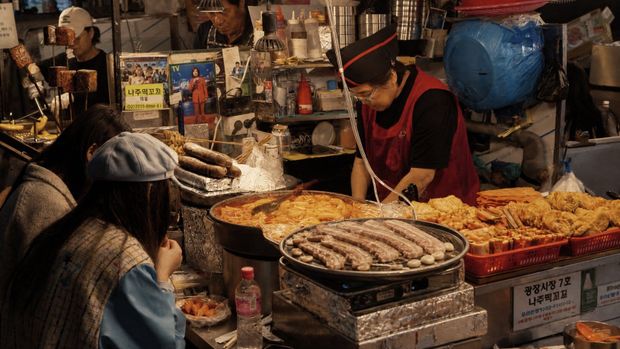
Korean Food Prices at a Glance: The Full Tier Range
Korean food prices span a wider range than most visitors expect — from ₩1,000 street snacks to multi-course tasting menus above ₩150,000 per person, sometimes within blocks of each other in central Seoul. The 2025–2026 exchange rate sits at approximately ₩1,400 per USD , meaning a filling street-food lunch costs under $3 while a premium Korean BBQ dinner with drinks can clear $40 per person before you consider Hanu beef. Six distinct price tiers define the market: street food and market stalls, convenience store meals, casual neighborhood restaurants, Korean BBQ, full-service mid-range dining, and fine dining. Understanding which tier fits your day — and which part of the city serves each one — is the most useful planning tool for a Korea trip on any budget.source
Quick Answer: Korean food costs range from ₩1,000 ($0.75) for a single street snack to ₩150,000+ ($107+) per person at fine-dining restaurants. Most casual restaurant meals run ₩8,000–₩12,000 ($6–$9), and Korean BBQ starts around ₩15,000 ($11) per person at neighborhood pork grills. A realistic daily food budget falls between ₩25,000 ($18) for budget travel and ₩100,000+ ($71+) for a day that includes BBQ with drinks.
Seoul's restaurant prices run roughly 10–20% higher than provincial cities such as Busan for the same meal category . A bowl of bibimbap that costs ₩8,000 in Busan may run ₩10,000–₩12,000 in a Seoul tourist corridor. That gap holds across most categories — street food, casual diners, and mid-range restaurants all skew higher in the capital — though it is noticeably smaller than the price difference between Seoul and either Tokyo or Hong Kong.
South Korea's grocery prices run approximately 47% above the OECD average for fresh produce . That figure refers to supermarket shopping, not to eating out. Restaurant meals — particularly in the casual and street-food tiers — remain competitive with global-city standards. The disconnect between high grocery prices and affordable eat-out prices is one of the more counterintuitive features of the Korean food economy, and it works strongly in favor of visitors who plan to eat at markets and neighborhood restaurants rather than self-catering.
| Price Tier | Category | KRW Range (per person) | USD Range (per person) | Representative Dishes |
|---|---|---|---|---|
| 1 — Street Food | Markets & stalls | ₩1,000–₩4,000 | $0.75–$3 | Tteokbokki, odeng, kimbap, hotteok, kimmari |
| 2 — Convenience Store | GS25 / CU / 7-Eleven | ₩3,000–₩6,000 | $2–$5 | Triangle kimbap, instant noodles, rice box, sandwich |
| 3 — Casual Restaurant | Neighborhood diners | ₩7,000–₩12,000 | $5–$9 | Bibimbap, doenjang jjigae, gukbap, budae jjigae |
| 4 — Korean BBQ (Pork) | Neighborhood grill / all-you-can-eat | ₩15,000–₩35,000 | $11–$27 | Samgyeopsal, neck cuts, 무한리필 pork sets |
| 5 — Mid-Range / Full-Service | Table-service restaurants | ₩12,000–₩25,000 | $9–$19 | Grilled fish set, braised seafood, multi-course lunch set |
| 6 — Fine Dining / Premium Hanu | Michelin / tasting menus / Hanu beef BBQ | ₩50,000–₩430,000+ | $38–$292+ | Tasting menus, Korean native cattle (한우) BBQ |
Street Food and Market Stalls: Korea's Cheapest Eating
Street food and traditional market stalls represent Korea's most accessible price tier — most individual items cost between ₩1,000 and ₩4,000 per piece, making it possible to graze through multiple flavors for well under $5 total . Tteokbokki (chewy rice cakes in spicy-sweet gochujang sauce), odeng (fish cake skewers simmered in mild broth), and individual kimbap rolls are the most common and cheapest options. Hotteok — a pan-fried stuffed pancake sold at outdoor stalls — comes in savory form (chapchae filling: glass noodles, Chinese chives, and carrots) or sweet form (cinnamon, brown sugar, and black sesame seeds), and rarely costs more than ₩2,000 per piece (video: Doobydobap) .
Shared platters sharpen the value further. A mixed fried assortment — vegetable tempura, squid, stuffed pepper, and kimmari (fried glass-noodle rolls) — runs approximately ₩7,000–₩8,000 and comfortably feeds three people . Kimmari is served alongside a spicy tteok dipping sauce that comes with the order (video: Doobydobap). These platters make street food disproportionately economical for groups — the per-person cost drops to under ₩3,000 when two or three people order together.
University-area food streets offer some of the lowest prices in any major Seoul neighborhood. In Hongdae, Sinchon, and Hyehwa — dense student districts where vendor competition is intense — nearly every item is priced under $5 (video: Strictly Dumpling). A full meal of homemade kimbap rolls plus a bowl of instant ramen at a university-area stall comes in under ₩6,000 total . Traditional markets extend the same logic to a broader range of ingredients: vendors at Gwangjang Market and Namdaemun Market sell individual Korean banchan (side dishes) à la carte, making them exceptionally convenient for solo diners who want variety without ordering full portions at multiple restaurants .
📍 View Gwangjang Market on Google Maps
📍 View Namdaemun Market on Google Maps
Convenience Store Meals: GS25, CU, and 7-Eleven
Korea's convenience store food culture occupies a distinct tier between street food and casual restaurants — one that visitors from outside East Asia consistently underestimate. GS25, CU, and 7-Eleven branches sell triangle kimbap, hot instant noodles prepared at in-store hot-water stations, sandwiches, and bento-style rice boxes, all priced between ₩3,000 and ₩6,000 per item . In-store microwaves and hot-water dispensers are designed for on-site eating — seating areas or standing counters are standard in most branches — and this is a routine meal format for Korean locals, not a tourist workaround.
Quality is a genuine differentiator at this tier. Fresh stock rotates multiple times daily, and items like seasoned rice balls, fish-sausage sticks, soft-boiled eggs in soy marinade, and egg salad sandwiches are produced to standards that count as a proper meal by any measure. A full convenience-store meal — two items plus a drink — rarely exceeds ₩8,000–₩9,000 total , making it the fastest and most consistent sub-$7 meal option available 24 hours a day.
For visitors attending concerts at large Seoul venues, convenience stores near the arena are a practical solution for the post-show dining crunch. Restaurants near major event spaces back up sharply in the 90 minutes after a performance ends; queues at sit-down restaurants can run 30–45 minutes without a reservation. A convenience store handles pre-show and post-show hunger without the wait, and branches within 5–10 minutes of large venues are routinely stocked and open around the clock.
Casual Local Restaurants: What Neighborhood Diners Charge
Neighborhood restaurants — the kind with handwritten menus, communal banchan refills served throughout the meal, and a single house specialty — are the backbone of affordable Korean eating. A standard portion of bibimbap (mixed rice bowl with seasoned vegetables, egg, and gochujang), doenjang jjigae (soybean paste stew with tofu and vegetables), or sundubu jjigae (soft tofu stew with egg in a stone pot) runs ₩8,000–₩12,000 at a Seoul neighborhood diner and ₩7,000–₩12,000 in Busan . These prices include rice and several refillable side dishes; the meal is complete without ordering anything additional.
Gukbap — a hearty soup served with rice in a thick earthenware stone pot that retains heat throughout the meal — sits at the same ₩8,000–₩12,000 price point . The earthenware vessel keeps the broth near-boiling until the final spoonful, a practical feature that distinguishes it from standard soup servings. It is one of the most complete single-dish meals available at this price range, and common at standalone gukbap diners found in most residential neighborhoods.
Budae jjigae — often translated as "Army stew" — combines spam, hot dogs, ramen noodles, rice cakes, kimchi, bean sprouts, octopus, and tofu in a deep spicy-savory broth. Its origin traces to the period after the Korean War, when US military base provisions merged with local cooking traditions to create an entirely new dish . Today it is a citywide staple, typically priced at ₩7,000–₩10,000 per single-serving portion, with prices trending slightly higher in upscale Seoul neighborhoods such as Itaewon and Gangnam .
University districts provide a notable outlier at the low end of the casual restaurant range. In Hongdae, Sinchon, and Hyehwa, competition for student customers drives prices measurably below the city average. A rice bowl topped with pork belly, a whole slice of spam, a fried egg, and kimchi has been documented at ₩3,000 (~$2.15) at specific university-district spots (video: Strictly Dumpling) . This is not a city-wide price point, but it is a credible illustration of what dense student demand does to local food economics. Busan and other provincial cities run 15–20% cheaper than Seoul across the casual dining category — a real variable for visitors combining Seoul with a wider Korea itinerary.
Korean BBQ: Price Tiers from Neighborhood Grills to Premium Hanu
Korean BBQ is the most variable food category in the country by price per person. The same basic format — meat cooked over fire at the table — spans from ₩15,000 per person at a no-frills neighborhood pork grill to over ₩400,000 per person for prime Hanu (한우) beef at a dedicated high-end venue . This is not a quality spectrum that scales smoothly between those points — it represents two fundamentally different dining experiences that happen to share the same name. Understanding which version you are booking, and budgeting accordingly, matters before you sit down.
At the neighborhood end, a charcoal-grill pork restaurant specializing in less common cuts — back of neck (항정살), cheek meat (볼살), and nose meat — delivers a full meal for approximately $16 USD per person . General pork BBQ across Seoul — samgyeopsal, pork belly, neck cuts — ranges ₩15,000–₩35,000 ($11–$27) per person before drinks . All-you-can-eat (무한리필) BBQ restaurants sit within the same ₩15,000–₩35,000 range and cycle multiple pork cuts over the course of the meal — the most cost-efficient format for groups of three or more.
"The cheaper cuts — cheek meat and nose meat — have more fat marbling and flavor than the standard samgyeopsal that most tourists order. You're paying less and getting more interesting meat." — Seyong Lim, owner, Imane Twit Kogi, Seoul (source: Andrew, Steven, and Adam)
📍 View Imane Twit Kogi on Google Maps
One practical detail first-time visitors often miss: many Korean BBQ restaurants place large bags at each table so diners can store their coats and prevent the fabric from absorbing smoke during the meal (video: Andrew, Steven, and Adam). It is a small but telling detail about how thoroughly the dining format has been designed around the experience of eating.
At the premium end, dedicated Hanu (한우 — Korean native cattle, raised under strict national certification standards) restaurants charge up to $292 per person for a full meal of aged, high-grade cuts . The marbling quality of top-grade Hanu competes directly with A5 Wagyu in flavor density. The experience — individual charcoal braziers, expansive side-dish spreads, tableside grilling service — is in a different category from neighborhood pork BBQ, and worth planning as a once-per-trip occasion if the budget allows. Regardless of which BBQ tier you choose, budget an additional ₩40,000+ per person on any dinner that includes soju or beer — alcohol adds up faster than the meat.
| BBQ Type | KRW per Person | USD per Person (approx.) | What's Included |
|---|---|---|---|
| All-you-can-eat pork (무한리필) | ₩15,000–₩35,000 | $11–$27 | Multiple pork cuts, unlimited refills, banchan side dishes |
| Neighborhood charcoal pork grill | ~₩22,000 | ~$16 | Samgyeopsal, specialty neck and cheek cuts, banchan |
| Mixed pork + beef mid-range | ₩35,000–₩60,000 | $25–$43 | Higher-grade pork, marbled beef cuts, premium banchan spread |
| Premium Hanu (한우) BBQ | ₩150,000–₩400,000+ | $107–$292+ | Certified Korean native cattle cuts, tableside grilling service |
Coffee and Cafés: Drink Prices Across Seoul
Seoul's café density is among the highest of any major city, and competition between independent roasters and chain cafés keeps drink prices broadly reasonable. An espresso costs approximately ₩3,600 ($2.50) and a cappuccino around ₩5,200 ($3.60) at a standard independent café; specialty drinks — matcha lattes, signature house blends, nitro cold brew — reach ₩6,000 ($4.50) at roasters in Seongsu, Yeonnam, and Mangwon, which have the highest concentration of concept cafés in the city . These neighborhoods are worth visiting even when coffee is not a priority — many of the spaces double as design-forward venues with architecture worth the walk.
Dessert cafés occupy a sub-category with slightly higher price points. Bingsu (shaved milk ice topped with red beans, condensed milk, or seasonal fruit), dalgona-inspired drinks, and artisan soft-serve typically cost ₩5,000–₩10,000 per item . Portion sizes are generous — a standard bingsu is routinely served in a bowl designed for two. Splitting one dessert between two people brings the per-person cost to ₩2,500–₩5,000, making it a low-spend rest stop that fits naturally into a full-day itinerary between neighborhoods.
A café stop between areas — Myeongdong to Dongdaemun, Hongdae to Seongsu, Insadong to Bukchon — functions as both a break and a low-cost supplement to the day's food budget. A single café visit running ₩4,000–₩6,000 is one of the more consistent ways to manage energy and pacing during a long day without adding meaningful spend to the overall food total.
Mid-Range and Fine Dining: Full-Service Restaurants and Tasting Menus
Full-service table restaurants — where staff take your order, dishes arrive in sequence, and the meal takes an hour or more — occupy the middle tier of Seoul's dining market. In tourist corridors such as Myeongdong and Insadong, a lunch set for grilled fish, braised seafood, or a multi-dish Korean table spread runs ₩12,000–₩25,000 per person . Dinner at the same venues trends 10–20% higher; popular restaurants in these corridors fill quickly on weekends, and early arrival or a reservation is advisable for groups.
At the upper end, Seoul's Michelin-starred and creative tasting-menu restaurants — concentrated in Gangnam, Jongno, and Itaewon — charge ₩50,000–₩150,000+ per person, with reservations often required weeks in advance . The price is comparable to equivalent restaurants in Tokyo and Hong Kong, but Seoul's mid-range tier is measurably cheaper than either city — making it an unusually viable destination for mixing high and low dining without the budget pressure that characterizes Japan or Hong Kong.
For visitors staying in serviced apartments or guesthouses with kitchen access, self-catering is worth pricing out for longer stays. Per Numbeo's 2026 South Korea food price data: a liter of milk costs ₩2,920 ; a dozen eggs ₩4,223 ; a kilogram of chicken fillets ₩11,612 ; a kilogram of beef ₩33,676 ; and apples ₩11,044/kg . Self-catering reduces daily food spend significantly but requires proximity to a large supermarket and a functioning kitchen setup — most short-stay visitors will find it more efficient to eat out and take advantage of the affordable restaurant tiers.
Daily Food Budget by Trip Style: How Much to Plan
Breaking down daily food costs by travel style gives a more actionable picture than per-dish averages. Four realistic archetypes cover most visitor patterns, from solo travelers on a strict budget to groups with a special-occasion dinner planned.
Budget traveler — street food, convenience stores, and one sit-down meal per day: ₩25,000–₩40,000/day (~$18–$29) . This tier is fully viable and includes genuinely good food. University-area food streets, traditional market stalls, and GS25 or CU cover two of the three daily meals without any meaningful compromise on taste or variety.
Comfortable traveler — two proper restaurant meals, one café stop, and market snacks: ₩60,000–₩100,000/day (~$43–$71) . This budget covers a neighborhood jjigae lunch, an afternoon café visit, and a full table-service dinner — a complete eating day with no deliberate frugality required.
Special occasion day — one Korean BBQ dinner with drinks, plus a café stop and market snacks: ₩80,000–₩150,000/day (~$57–$107). The BBQ dinner drives most of the cost: a neighborhood pork grill at ~₩22,000 per person plus two rounds of soju reaches ₩40,000+ before the meal ends. Adding premium Hanu upgrades the day budget into the ₩150,000–₩300,000 range per person .
Concert-day planning note: restaurant lines near large Seoul venues spike sharply in the 90 minutes before and after performances. Stocking up at a nearby convenience store before the show — triangle kimbap, a rice box, or a fish-sausage stick from GS25 or CU — handles pre-show hunger at ₩5,000–₩6,000 and avoids both the queue and the elevated prices at venue-adjacent restaurants. The same applies post-show: at major venue areas including Jamsil and the KSPO Dome district, sit-down restaurant wait times after a large concert can exceed 45 minutes without a reservation.
Frequently Asked Questions
How much does a typical meal cost in Seoul?
Casual restaurant meals in Seoul typically run ₩8,000–₩12,000 ($6–$9) and include rice and several banchan side dishes . Street food items start at ₩1,000 ($0.75) for single-piece snacks like odeng or tteokbokki. Korean BBQ ranges from ₩15,000 ($11) at a neighborhood pork grill to ₩35,000+ ($25+) per person for mid-range cuts before drinks are ordered. Fine dining and Michelin-level restaurants charge ₩50,000–₩150,000+ ($38–$107+) per person, with reservations usually required.
Is Korean BBQ expensive?
It depends entirely on which tier you choose. Neighborhood pork BBQ — samgyeopsal and specialty cuts like cheek meat and neck cuts — costs around $16 per person at a local charcoal grill . All-you-can-eat (무한리필) BBQ falls within the same ₩15,000–₩35,000 range and is the most cost-efficient format for groups of three or more. Premium Hanu (한우) beef at a dedicated high-end venue can reach $292 per person — that is an entirely different dining category, not a typical BBQ outing.
Can you eat well in Korea on a tight budget?
Yes. University-area food streets in Hongdae, Sinchon, and Hyehwa price most items under $5, and a meal of kimbap plus instant noodles costs under ₩6,000 total (video: Strictly Dumpling) . Convenience stores (GS25, CU, 7-Eleven) offer triangle kimbap, rice boxes, and instant noodles at ₩3,000–₩6,000 per item . Budae jjigae and gukbap at neighborhood diners provide filling, high-quality meals for ₩7,000–₩10,000. A daily food budget of ₩25,000–₩40,000 is fully workable across Seoul without sacrificing the quality of what you eat.
How much should I budget for food per day in Seoul?
Budget travelers relying on street food, convenience stores, and one sit-down meal should plan ₩25,000–₩40,000/day (~$18–$29) . A comfortable mix of two restaurant meals, a café stop, and snacks runs ₩60,000–₩100,000/day (~$43–$71). Add ₩20,000–₩40,000 on any day that includes Korean BBQ with a round of drinks — soju and beer add up faster than the food cost itself.
Are Korean convenience store meals actually worth eating?
Yes — and this is not a niche opinion among tourists. Triangle kimbap, instant noodles prepared at in-store hot-water stations, and bento-style rice boxes at GS25, CU, and 7-Eleven are fresh, priced at ₩3,000–₩6,000, and widely eaten by Korean locals as a routine meal, not an emergency fallback . In-store seating and microwave access make on-site eating standard. For visitors attending concerts or arriving in Seoul late at night, convenience stores open 24 hours provide one of the most reliable meal options available — and one of the better-value ones at any hour.
Watch / Sources
- Doobydobap — Eating the BEST KOREAN STREET FOOD in SEOUL
- Strictly Dumpling — 20 BEST Korean Cheap Eats in Seoul South Korea
- Andrew, Steven, and Adam — $16 vs. $292 Korean BBQ in Korea
Deciding How to Eat in Korea: A Practical Framework
The clearest takeaway from the full price range is that Korea's food economy rewards intentional planning over default mid-range spending. The gap between a ₩3,000 university-district rice bowl and a ₩400,000 Hanu dinner is real, but both are available in the same city on the same day. The practical question is how to allocate across that range rather than defaulting to the same restaurant tier for every meal. A workable pattern: use street food and convenience stores for one or two daily meals, reserve casual restaurants for one proper sit-down, and treat Korean BBQ and fine dining as scheduled events — not daily defaults.
On concert days, the logistics shift slightly. Pre-loading at a convenience store before the show and skipping the post-show restaurant rush saves time and money in equal measure. During non-event days, Gwangjang Market and Namdaemun Market deliver the highest food-per-won return in the city, particularly for solo travelers who want variety across multiple small portions rather than committing to one restaurant's menu.
Provincial pricing works in your favor whenever the itinerary extends beyond Seoul. Busan runs 15–20% cheaper for casual meals , and smaller cities such as Jeonju — closely associated with bibimbap — combine lower food costs with some of the most regionally distinctive cooking in the country. If your Korea itinerary covers two or more cities, adjust the daily food budget downward for any non-Seoul days accordingly.
Last updated: 2026-05-30. Prices reflect 2025–2026 market rates at an exchange rate of approximately ₩1,400 per USD. Individual restaurant prices vary; grocery data sourced from Numbeo South Korea 2026. This article is reviewed when exchange rate movements exceed 5% or new seasonal price data is available.
This article was written using information collected and analyzed by NAMANE's in-house K-pop research AI engine. We use AI technology to bring you faster, broader coverage, and in the process some details may occasionally differ from the latest facts. For important information such as dates, venues, and prices, please double-check with official sources.


