
Seoul's Late-Night Food Culture: What Is Yasik?
Yasik (야식) is the Korean practice of eating after 10 PM, a custom so deeply embedded in Seoul's social fabric that the capital operates a genuine 24-hour food economy across every major district. Unlike cities where kitchens close before midnight, Seoul's late-night dining accelerates after 11 PM, sustained by three overlapping forces: entertainment districts where bars and noraebang karaoke rooms run until dawn, an office culture that routinely keeps workers at their desks past 9 PM, and the rhythm of K-POP concerts and club events that spill crowds onto the streets well past midnight. According to Go Farther, soup houses, K-BBQ restaurants, and street stalls fill every hour between midnight and dawn across the city. Three formats define the nocturnal food scene: pojangmacha orange-canvas tent stalls, which are portable and alley-based, running from early evening into the small hours; indoor 24-hour restaurants including soup houses and BBQ chains; and market-adjacent night stalls near Dongdaemun and Gwangjang that stay open until 5 AM.
Quick Answer: Yasik (야식) — Seoul's culture of eating after 10 PM — powers a genuine 24-hour food economy city-wide. Pojangmacha tent stalls, 24-hour soup houses, and night-market carts serve everything from ₩1,000 fish-cake skewers to whole-chicken hotpots well past 3 AM across Jongno, Euljiro, Dongdaemun, Hongdae, and Gangnam.
The concept of yasik is not a fringe habit — it is structural. Delivery apps Baemin and Coupang Eats cover virtually the entire city on a 24/7 basis , and convenience store chains GS25, CU, and 7-Eleven operate round the clock at nearly every block. A triangle kimbap, cup ramen, and canned coffee at any of these stores costs ₩3,000–5,000 — the cheapest fallback in the city. For visitors, the practical implication is significant: there is no meaningful window between midnight and 5 AM when finding a hot meal in Seoul becomes genuinely difficult.
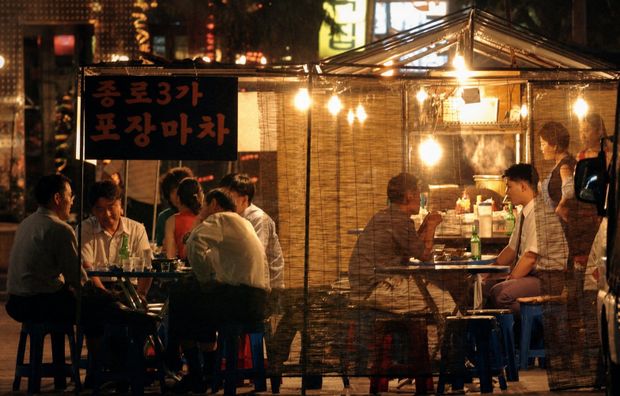
Pojangmacha — literally "covered cart" — are the most photogenic element of Seoul's night food circuit. The orange canvas tents, plastic stools, and communal folding tables that line alleys in Jongno, Euljiro, and Mapo are not nostalgic relics; they are a functioning social institution. As of 2025, Mapo-gu has designated official Pojangmacha Preservation Zones concentrating licensed tents in specific corridors , signalling that city government views these stalls as cultural infrastructure worth protecting rather than phasing out.
"Seoul's entertainment districts, combined with a work culture that often runs late, mean that demand for food between midnight and 3 AM is not an exception — it is the baseline." — Go Farther Travel
Seasonality shapes the late-night menu. Spring draws diners to crispy pajeon with makgeolli rice wine; summer shifts preference toward cold naengmyeon noodles; autumn revives outdoor grills and braised jokbal trotters; winter sees budae-jjigae army stew hotpot, priced at ₩16,000–22,000, dominate pojangmacha menus . For K-POP fans planning a Seoul trip around a specific concert date, knowing which late-night corridor sits closest to your venue is as useful as knowing which station exit to use.
Jongno 3-ga Pojangmacha Street: Seoul's Iconic Orange-Tent Strip
Jongno 3-ga Pojangmacha Street is a 200-metre corridor of orange-canvas tent stalls running between Exits 5 and 6 of Jongno 3-ga Station , and it is the most recognisable pojangmacha strip in Seoul. Stalls open around 5–6 PM daily and run until approximately midnight on weekdays, extending to 2–4 AM on weekends . The atmosphere — low plastic stools, steaming pots of fish-cake broth, orange light pooling on damp pavement — is what most international visitors picture when they think of Seoul street food. Prices are deliberately accessible: a full evening including soju runs ₩25,000–45,000 per person , making it a viable post-concert option on almost any budget. The strip is almost entirely cash-only — bring small bills, as vendors rarely carry change for large denominations.
The signature dishes at Jongno 3-ga reflect the classic pojangmacha repertoire. Gochujang tteokbokki — chewy rice cakes in a sweet-spicy red pepper sauce — is the anchor order at most stalls, sold at ₩4,000–5,000 per plate . Alongside it, vendors sell gimmari (deep-fried seaweed rolls), squid fritters, and sweet potato fritters at ₩1,000 per piece — the affordable snacking format that makes it easy to try six or seven items in a single sitting. Odeng fish-cake skewers cost ₩1,000–1,500 per skewer and come with free refills of the hot broth in which they simmer , a tradition that functions as much as a warming drink as it does a side dish.
Soju is the default pairing — a 360 ml bottle runs ₩4,000–5,000 at most stalls and is typically shared between two or three diners. First-time visitors are advised to sit down, point at what neighbouring diners are eating, and let the vendor bring out a selection. Menus are rarely in English, but pointing and holding up fingers for quantity works reliably across the strip. The stalls nearest to Exit 5 attract the most tourist foot traffic and are more likely to display plastic food models or picture boards.
| Dish | Portion | Price (₩) | Classic Pairing |
|---|---|---|---|
| Gochujang tteokbokki | One plate (~8–10 rice cakes) | 4,000–5,000 | Soju or draft beer |
| Gimmari (seaweed roll) | Per piece | 1,000 | Soju |
| Squid fritter | Per piece | 1,000 | Soju |
| Odeng fish-cake skewer | Per skewer + free broth refills | 1,000–1,500 | Hot broth (complimentary) |
| Soju (360 ml bottle) | One bottle (shared 2–3 people) | 4,000–5,000 | Any of the above |
| Full evening per person (incl. drinks) | — | 25,000–45,000 | — |
📍 서울특별시 종로구 종로 132
⭐ 4.1 (25 리뷰)
🔗 Google Maps에서 보기
Euljiro Nogari Alley and Hoegi Pajeon Street: Two More Late-Night Zones
Euljiro Nogari Alley is a clutch of outdoor plastic-table bars tucked behind Euljiro 3-ga Station, accessible from Exits 4, 5, or 6, that has become one of Seoul's most talked-about nocturnal eating districts over the past several years. Nicknamed "Hipji-ro" by younger Seoulites — a blend of "hip" and "Euljiro" — the district operates from 7 PM to 2 AM and is closed on Sundays . Its centrepiece is nogari, grilled dried pollack, sold at ₩10,000–15,000 per serving and consumed at tables set into lanes so narrow that two people can barely pass. Draft beer or soju are the standard accompaniments, and the combination of salty, chewy dried fish and cold beer has made this alley a reliable post-concert draw for crowds arriving from nearby Myeongdong and City Hall.
What distinguishes Euljiro from other entertainment districts is the texture of the surrounding blocks. Functioning metal workshops, printing shops, and signage suppliers remain active in the daytime, lending the alleys a material honesty that newer developments in Hongdae or Gangnam cannot replicate. That contrast — industrial grime alongside a cluster of trendy bars and food stalls — has made it fashionable with a younger crowd seeking an alternative to the better-known strips of central Seoul. According to Trazy Blog, the area's reputation spread quickly through social media from around 2022 onward, bringing in a broader demographic while retaining its 1970s workshop aesthetic. For concert attendees whose show ends in the central corridor, it is a twenty-minute subway ride from most major downtown venues.
📍 서울특별시 중구 을지로3가 을지로13길 15
⭐ 4 (426 리뷰)
🔗 Google Maps에서 보기
Hoegi Station Pajeon Alley, positioned near Exit 1 of Hoegi Station on Seoul Metro Line 1, operates on a markedly different schedule: open from noon to 4 AM daily , making it one of Seoul's longest-running continuous late-night corridors. The canonical order here is crispy pajeon — a Korean savoury pancake pressed flat on an oiled griddle until the edges are lacquered and crunchy — paired with a ceramic jug of makgeolli lightly fermented rice wine, priced at ₩6,000–8,000 per serving . The pairing of hot, oily pancake and cold, slightly fizzy makgeolli is a combination Koreans describe as straightforwardly logical: rich food, light drink, complementary temperature contrast. Haemul pajeon (seafood pancake) and kimchi pajeon are the two variants most commonly on offer.
Dongdaemun After Dark: Night Market Stalls Open Until 5 AM
Dongdaemun's night market is one of the few food zones in Seoul that genuinely operates until 5 AM, and its longevity is not driven by tourist demand alone. The adjacent wholesale fashion district — one of the largest in Asia — generates a sustained appetite at unusual hours: buyers, pattern makers, and night-shift warehouse workers need food at 1 AM, 3 AM, and 4:30 AM in equal measure. Street stalls are active from around 8 PM , with the densest concentration of carts clustered around the Dongdaemun Design Plaza perimeter and the alleys between the major wholesale towers. For concert attendees whose venue sits in the Dongdaemun or Jongno corridor, this is the most convenient late-night eating district: plentiful, inexpensive, and reliably open regardless of what hour the show ends.
The street-cart menu at Dongdaemun spans nearly every register of Korean snack food. Grilled corn, priced at ₩2,000–3,000 , and hotteok sweet pancakes at ₩1,500–2,000 are the most casual items — bought while walking and eaten in two bites. More substantial options include tteokbokki at ₩5,000–8,000 , dak kkochi chicken skewers (chunks of chicken and spring onion grilled on sticks and coated in sweet soy or spicy gochujang) , and mayak gimbap — bite-sized rice rolls nicknamed "narcotic kimbap" for their addictive quality — at ₩3,000 . For a more filling option, gopchang-bokkeum stir-fried beef tripe at ₩8,000–15,000 is the most distinctive item on the circuit — rich, chewy, and best ordered with soju.
A short walk toward Jongno 5-ga leads to Dak Hanmari Alley, centred on 247-3 Jongno 5-ga . The speciality is dak hanmari — a whole chicken simmered in a clear, ginger-scented broth and served with hand-cut kalguksu noodles and a sharp chilli-vinegar dipping sauce. The strip operates 10 AM to midnight , with a per-person cost of approximately ₩15,000–18,000 . It is one of the city's more communal eating experiences: large shared pots, crowded rooms, and the ritual of adding noodles to the broth once the chicken has been stripped.
| Item | Portion | Price Range (₩) |
|---|---|---|
| Grilled corn | One cob | 2,000–3,000 |
| Hotteok (sweet pancake) | One piece | 1,500–2,000 |
| Tteokbokki | One serving | 5,000–8,000 |
| Dak kkochi (chicken skewer) | Per skewer | 2,000–3,000 |
| Mayak gimbap | One set (~8 mini rolls) | 3,000 |
| Gopchang-bokkeum (stir-fried tripe) | One portion (1–2 persons) | 8,000–15,000 |
| Dak hanmari (whole chicken + noodles) | Per person (group pot) | 15,000–18,000 |
📍 서울특별시 중구 청계천로 274
🕒 월요일–금요일 오전 12:00 ~ 오후 6:00, 오후 10:00 ~ 오전 12:00 / 토요일 오전 12:00 ~ 오후 6:00 / 일요일 휴무일
⭐ 4.1 (515 리뷰)
📞 02-2265-3531
🔗 Google Maps에서 보기
📍 View Dak Hanmari Alley on Google Maps
24-Hour Comfort Food: Haejangguk, Seolleongtang, and Jangchung-dong Jokbal
Haejangguk (해장국) is a category of restorative bone or broth soups served round the clock at dedicated soup houses, and its name translates directly as "hangover soup" — a descriptor that explains both when and why it is ordered. The broth base varies by restaurant: pork-bone (dwaeji-gukbap), ox-blood (seonji-guk), and sundae (blood sausage and offal) are the three most common variants, all priced at ₩9,000–13,000 per bowl . Branches are densest around Hongdae, Mapo, and Myeongdong — entertainment nodes where demand for a stomach-settling meal at 3 AM is structural rather than incidental. For any visitor whose concert night extends into a full evening out, haejangguk is the straightforward final stop: high in sodium, rich in collagen, and served within minutes of being seated.
"A bowl of haejangguk at 2 AM is not just a meal — it is the structural endpoint of a Korean night out, and every entertainment district in the city is built around that fact." — Hotel Stay Inn Seoul
Seolleongtang is a related but distinct comfort food: a milky, ivory-coloured ox-bone broth simmered for 12 hours or more until it reaches an opaque, gently fatty consistency . It arrives unseasoned at the table — diners add salt, ground pepper, and sliced green onions themselves — alongside rice, kimchi, and thin-sliced beef. At ₩10,000–14,000 per bowl , seolleongtang houses open 24 hours across most districts and represent one of the most reliable post-concert eating options in the city. The mild flavour and light preparation also make it a practical first Korean meal for visitors who are cautious about spicier dishes.
Jangchung-dong, just south of Dongdaemun, is Seoul's designated jokbal corridor — a strip of restaurants specialising in braised pig trotters simmered in soy sauce, ginger, and spices until the skin is lacquered and yielding. A large serving runs ₩35,000–55,000 and is designed to feed three to four people . The classical accompaniment is cold naengmyeon buckwheat noodles; the contrast between rich, fatty pork and ice-cold broth noodles is a pairing Seoulites treat as self-evidently correct. Most Jangchung-dong jokbal houses stay open late into the night and see a reliable late influx from nearby clubs and evening events.
📍 서울특별시 구로구 구로동 가마산로 271
🕒 매일 24시간 영업
⭐ 3.8 (4 리뷰)
📞 02-8383-1776
🔗 Google Maps에서 보기
District by District: Late-Night Eating in Hongdae, Itaewon, and Gangnam
Hongdae is Seoul's university and live-music district, clustered around Hongik University Station on Line 2, and its late-night food scene is probably the most extreme in the city measured by operating hours alone. K-BBQ restaurants on the Sangsu-dong border strip run until 5–6 AM on weekends , sustained by clubs, live venues, and street performers that keep the area active until sunrise. Dakgalbi Alley near Exit 9 — where marinated chicken is stir-fried on cast-iron pans at the table — remains lively until 3–4 AM . The neighbourhood signature is chimaek — a half-and-half platter of fried chicken with draft beer — priced at ₩18,000–22,000 . For fans attending a show at AX-Hall or Yes24 Live Hall, both within easy walking or one-stop subway distance of Hongdae Station, the local BBQ strip is the default post-show option.
📍 1F, 176 이태원로 용산구 서울특별시 대한민국
🕒 매일 24시간 영업
⭐ 4.6 (337 리뷰)
📞 02-794-1132
🔗 Google Maps에서 보기
Itaewon and the adjacent Gyeongnidan-gil strip form Seoul's most internationally diverse eating corridor. Halal-certified restaurants cluster around Itaewon Station Exit 3 , serving Middle Eastern staples, South Asian dishes, and kebabs at ₩5,000–8,000 . Burgers run ₩12,000–20,000 and Mexican options ₩12,000–18,000 — a range that extends past midnight on weekends. Gyeongnidan-gil runs uphill from Exit 2 and holds a denser cluster of independent restaurants, some remaining open until 2–3 AM. The international character of the district makes it the practical choice for visitors who want non-Korean food after a long concert day.
📍 View Gyeongnidan-gil on Google Maps
Gangnam represents Seoul's premium tier of late-night dining. K-BBQ chains in the district operate around the clock at higher-end locations, and post-club naengmyeon houses — serving cold buckwheat noodles at ₩12,000–16,000 — cater to a crowd that expects table service alongside their midnight noodles. Korean-Chinese restaurants serving jajangmyeon and tangsuyuk sweet-and-sour pork remain a strong secondary option around Gangnam Station and Sinnonhyeon, where club and business crowds sustain demand well past 2 AM. For fans whose concert is at KSPO Dome or COEX Artium, Gangnam's food scene is the natural post-show choice — premium by Korean standards, still affordable by most international comparisons.
One practical note on transport: Seoul's Night Owl bus network (N-prefix routes including N13, N15, N16, and N37) runs between 11 PM and 5 AM at a flat fare of ₩1,500–2,400 and connects Hongdae, Itaewon, Gangnam, and Jongno in a single circuit. Kakao T taxis are the fastest option after midnight but carry a 20–40% night surcharge from midnight to 4 AM above a ₩4,800 base fare . For short hops between neighbouring late-night districts, the N-bus is both cheaper and often faster than waiting for a taxi.
Frequently Asked Questions
What time do pojangmacha stalls open and close in Seoul?
Most pojangmacha stalls open between 5 and 6 PM and close around midnight on weekdays. On weekends, the majority of Jongno 3-ga pojangmacha extend to 2–4 AM. Hoegi Station Pajeon Alley is the longest-running option, open from noon to 4 AM every day. Dongdaemun's night-market stalls operate from around 8 PM to 5 AM, sustained by the adjacent wholesale fashion district's overnight workforce. Euljiro Nogari Alley runs 7 PM to 2 AM but is closed on Sundays.
Are Seoul street food stalls cash-only?
Traditional pojangmacha are almost universally cash-only — carry ₩10,000–50,000 in small bills to avoid problems with change. Some stalls in Euljiro and around Dongdaemun have begun accepting card payment, but this cannot be guaranteed; it is safer to assume cash and treat card acceptance as a bonus. ATMs are available at GS25, CU, and 7-Eleven convenience stores on virtually every block in central Seoul, so resupplying cash mid-evening is straightforward at any hour.
Which area has the best late-night food after a K-POP concert?
The answer depends on your venue. If the show is at KSPO Dome or COEX Artium, head to Gangnam for upscale K-BBQ or a naengmyeon house. For Jamsil Olympic Stadium, Jangchung-dong jokbal is the local option, or take a taxi to Hongdae. For shows at Hongdae AX-Hall or Yes24 Live Hall, you are already in the right neighbourhood — the local K-BBQ strip runs until 5–6 AM on weekends and Dakgalbi Alley near Exit 9 stays active until 3–4 AM. Jongno-area venues put you closest to the pojangmacha belt and Dongdaemun night stalls.
What is haejangguk and why is it eaten late at night?
Haejangguk (해장국) translates literally as "hangover soup" — a rich, deeply flavoured bone or broth soup designed to settle the stomach after drinking. Pork-bone, ox-blood, and sundae (blood sausage) are the three most common bases, all priced at around ₩9,000–13,000. It is served 24 hours a day near entertainment districts precisely because of its post-drink reputation: the high sodium content and long-simmered warmth of the broth are widely considered practical remedies for a rough end to the evening. A full bowl served with rice, kimchi, and side dishes is a complete meal in its own right, not just a supplement.
Can tourists order at a pojangmacha without speaking Korean?
Yes — solo diners and international visitors are a regular sight at most pojangmacha, particularly along Jongno 3-ga. Pointing at dishes that other diners are eating, or holding up one or two fingers to indicate quantity, works reliably at almost every stall. Many vendors at higher-traffic spots display plastic food models or picture boards near the entrance. Having the Korean name of a dish on your phone — 떡볶이 (tteokbokki), 어묵 (odeng), 파전 (pajeon), 기마리 (gimmari) — and showing it to the vendor removes any remaining ambiguity. The experience is genuinely accessible without any Korean language ability.
Planning Your Late-Night Seoul Eating Route
Seoul's overnight food scene is not a single destination but a city-wide infrastructure running in parallel with the entertainment calendar. The most useful frame for a visiting K-POP fan is venue-proximity: identify where your concert is, then match the late-night corridor that makes logistical sense. Jongno and Euljiro put you at the heart of the pojangmacha belt; Hongdae and Mapo give you the longest operating hours for sit-down BBQ; Dongdaemun offers the widest range of street-cart snacking until 5 AM; Gangnam and Itaewon provide the most diverse sit-down options. Transport is straightforward on the Night Owl bus network until 5 AM, with Kakao T taxis filling gaps when speed matters more than cost.
Budget-wise, Seoul's late-night food is accessible across almost every format. A full pojangmacha evening with multiple dishes and soju runs ₩25,000–45,000 per person . Sit-down comfort food — haejangguk or seolleongtang — comes in at ₩9,000–14,000 for a full bowl with accompaniments . Street-cart snacking at Dongdaemun costs ₩5,000–10,000 if you limit yourself to hotteok, grilled corn, and mayak gimbap. Carry cash, keep a charged phone for navigation and taxi-hailing, and note that Korean convenience stores are both a fallback meal and a cash source at any hour. The city after midnight is not winding down — it is operating at a different frequency, and the food infrastructure is built accordingly.
Last updated: 2026-05-21. This article reflects operating hours, prices, and venue information as reported by sources published in 2025. Hours and prices are subject to change; confirm current details on arrival or via Naver Maps before visiting a specific location.
This article was written using information collected and analyzed by NAMANE's in-house K-pop research AI engine. We use AI technology to bring you faster, broader coverage, and in the process some details may occasionally differ from the latest facts. For important information such as dates, venues, and prices, please double-check with official sources.


