
The Seoul–Busan–Gyeongju Circuit: Route Logic and Best Travel Windows
The Seoul–Busan–Gyeongju circuit is a three-city rail route that organizes a week in South Korea into a logical sequence: four nights in Seoul, two nights in Busan, and a day trip to Gyeongju on the final day. The framework minimizes backtracking while covering the country's main historical, cultural, and culinary draws in one continuous corridor. KTX high-speed rail is the backbone connecting all three stops — Seoul Station to Busan takes approximately 2.5–3 hours, and Busan to Gyeongju runs about 1.5 hours by train or express bus, according to A Passion and a Passport. Planning around South Korea's two peak travel seasons — spring cherry-blossom season from late March through April, and autumn foliage from October through November — determines how far in advance KTX seats need to be secured. During peak windows, trains on the Seoul–Busan corridor fill weeks ahead. The route works equally for first-time visitors and for returning K-pop fans who want structured travel time beyond Seoul's concert venues and agency buildings.
Quick Answer: This seven-day South Korea itinerary runs Seoul (4 nights) → Busan (2 nights) → Gyeongju (day trip) via KTX high-speed rail. Seoul to Busan takes approximately 2.5–3 hours; Busan to Gyeongju adds 1.5 hours. Book KTX seats at least two weeks in advance during spring and autumn peak seasons.
The 4-2-1 split reflects each city's visitor density and the depth each destination can sustain in a single trip. Seoul carries the widest range of attractions: Joseon-era palace complexes, the modern Gangnam business and culture district, the creative Seongsu neighborhood, and the option of a DMZ day tour to the North Korean border. Busan delivers a concentrated coastal experience in two days — a clifftop Buddhist temple, an aerial gondola ride over Haeundae Beach, and a seafood market that rewards a full afternoon without requiring more time than that. Gyeongju, compact and dense in UNESCO-listed sites, fills one day comfortably without rushing, then feeds travelers directly back to Seoul by evening KTX for international connections at Incheon Airport.
K-pop fans extending stays beyond Seoul will find Busan particularly relevant as a fan-travel destination: idol groups have filmed content and music videos at Gamcheon Culture Village and along the Gwangalli waterfront, while Haeundae has hosted fan meetings and K-drama productions across multiple seasons. Gyeongju's Silla-era landscapes — Bulguksa Temple, the royal burial mounds at Tumuli Park — serve as recurring historical K-drama backdrops. These overlaps embed fan-destination visits organically into the wider circuit, rather than treating them as detours.
Days 1–2: Historic Seoul — Palaces, Hanok Villages, and Street Markets
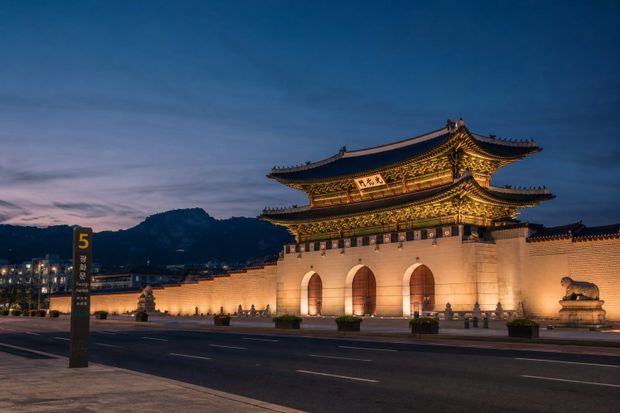
Historic Seoul centers on the northern district anchored by Gyeongbokgung Palace — the largest of the five Joseon Dynasty royal palaces, built in 1395 and closed every Tuesday. Visitors who rent hanbok (traditional Korean dress) at the rental shops lining the surrounding streets receive free or discounted entry to the palace grounds, a detail worth factoring into Day 1 planning. Adjacent Bukchon Hanok Village preserves 600 years of residential hanok architecture across a hillside between Gyeongbokgung and Changdeokgung; according to Visit Seoul, the neighborhood holds a TripAdvisor rating of 4.2 out of 5 from 5,407 reviews and is most comfortable before 10 AM, when the alleys begin filling with tour groups. East of Gyeongbokgung, Changdeokgung Palace is a UNESCO World Heritage Site whose Secret Garden section requires an advance reservation to enter. The two-day arc closes with Gwangjang Market's street-food vendors and the traditional teahouses and antique shops of Insadong, the neighborhood most associated with craft and gallery culture in central Seoul.
Gyeongbokgung Palace grounds span roughly 410,000 square meters and contain both the National Folk Museum of Korea and the National Palace Museum within the compound. The Gyeonghoeru Pavilion — a large banquet hall set on a rectangular pond and supported by 48 stone columns — is among the most photographed structures in Seoul. Allow two to three hours for a full circuit of the grounds. The main gate, Gwanghwamun, faces the grand civic plaza of the same name, making the transition between palace and city easy to navigate on foot.
📍 서울특별시 종로구 계동길
🕒 매일 오전 10:00 ~ 오후 5:00
⭐ 4.4 (23,950 리뷰)
📞 02-2133-1371
🔗 Google Maps에서 보기
Bukchon Hanok Village's narrow alleys connect the two palace districts at a hillside grade that offers partial views over the city below. The recommended entry point is Anguk station (Line 3). Because Bukchon is an active residential neighborhood, visitors are asked to keep noise levels low — the upper alleys near the main viewpoint are particularly close to occupied homes. The pre-10 AM window applies here: it avoids both tour groups and the midday heat in warmer months.
📍 View Bukchon Hanok Village on Google Maps
Changdeokgung Palace is the best-preserved of Seoul's five palaces and the one most consistently used by the Joseon royal family during the dynasty's later centuries. The Secret Garden — Huwon — covers roughly 78 acres of forested grounds with pavilions, ponds, and stone-paved paths. Entry to the garden requires a separate ticket and an advance booking through the Korea Tourism Organization portal or the official palace website; guided tours run at fixed times in English.
📍 View Changdeokgung Palace on Google Maps
Gwangjang Market, operating since 1905, is one of Seoul's oldest traditional markets and its food hall is the main draw. Bindaetteok (mung bean pancakes), mayak kimbap (small sesame-seed rice rolls), and yukhoe (raw beef tartare) are the market's signature dishes. Vendors cook from low stalls and serve directly onto communal tables — eating here is as much a social experience as a culinary one. The market runs daily, with weekday mornings being the least crowded window.
📍 View Gwangjang Market on Google Maps
Insadong's central pedestrian street — Insa-dong-gil — lines up teahouses, handmade ceramics shops, calligraphy supply stores, and small galleries rotating Korean contemporary art. The Ssamziegil courtyard market, off the main street, is popular with younger visitors for its independent retail mix. Insadong works naturally as an early afternoon stop on Day 1, with Namsan Seoul Tower available as an optional evening destination for city panorama views before returning to the hotel.
📍 View Insadong on Google Maps
| Attraction | Day | Admission (approx.) | Hours | Key Note |
|---|---|---|---|---|
| Gyeongbokgung Palace | Day 1 | ₩3,000 (free with hanbok rental) | 09:00–18:00 (Mar–Oct); closed Tuesday | Largest Joseon palace; built 1395 |
| Bukchon Hanok Village | Day 1 | Free | Open area; best before 10 AM | TripAdvisor 4.2/5 (5,407 reviews); residential — quiet hours apply |
| Changdeokgung + Secret Garden | Day 2 | ₩8,000 (palace + garden combined) | 09:00–17:30; closed Monday | UNESCO World Heritage Site; Secret Garden requires advance reservation |
| Gwangjang Market | Day 2 | Free entry (food costs separate) | Daily ~08:00–21:00 | Bindaetteok, mayak kimbap; operating since 1905 |
| Insadong | Day 1 or 2 | Free (shopping/food extra) | Shops ~10:00–20:00 | Teahouses, galleries, Ssamziegil courtyard market |
| Dongdaemun Design Plaza (DDP) | Day 2 | Free (ticketed exhibitions vary) | 10:00–21:00 (exhibition halls) | Zaha Hadid design; shopping complex and rotating exhibitions |
Days 3–4: Modern Seoul — Gangnam, Seongsu, and the Han River
Modern Seoul divides across two distinct districts that each represent a different register of the city's contemporary identity. Gangnam — south of the Han River — is home to the main offices of South Korea's largest K-pop agencies, including HYBE, SM Entertainment, and JYP Entertainment, as well as COEX Mall, which contains the Starfield Library: a publicly accessible architectural landmark rated 4.4 out of 5 from 463 reviews on Visit Seoul. The library is free to enter and open to all visitors, frequently cited as one of Seoul's most visually distinctive interior spaces. Seongsu, across the city in the eastern district, has developed into Seoul's creative-industry hub — a former industrial zone now occupied by independent coffee roasters, design studios, and rotating gallery pop-ups. The Han River connects both days in the evening: the Hangang Eland Cruise covers the Yeouido stretch past the National Assembly, while Banpo and Ttukseom riverbank parks offer informal picnic settings. Day 4 holds flexibility for a DMZ tour, a visit to Dongdaemun Design Plaza, or additional time in Hongdae's live music district.
Seongsu functions as Seoul's most dynamic street-level creative zone — independent coffee roasters, upcycled design workshops, and rotating gallery pop-ups that shift with each season. For K-pop fans, the neighborhood also hosts periodic fan-facing events and photo exhibitions organized by entertainment labels with offices in the area. (Source: A Passion and a Passport)
The HYBE Insight museum in Yongsan — HYBE's fan-facing exhibition space — is separate from the Gangnam agency cluster but a natural addition for BTS and HYBE-label fans. SM Entertainment's Kwangya@Seoul in Seongsu combines merchandise, interactive installations, and a café in one facility; the retail and café areas are open without advance tickets, though exhibition spaces may require booking. Both destinations fit within the Day 3 Seongsu and Gangnam loop without requiring a dedicated travel day.
📍 서울특별시 영등포구 여의동로 330
🕒 매일 24시간 영업
⭐ 4.5 (18,145 리뷰)
📞 02-3780-0561
🔗 Google Maps에서 보기
📍 View Seongsu District on Google Maps
Day 4 is the itinerary's main divergence point. A DMZ (Demilitarized Zone) day tour from Seoul runs approximately ₩45,000–₩80,000 per person ($35–$60 USD), bookable through operators including Klook; a valid passport is required for entry at all checkpoints. Full-day tours typically cover Imjingak Peace Park, the Third Infiltration Tunnel, and Dora Observatory. For travelers who prefer to remain in the city, Dongdaemun Design Plaza — Zaha Hadid's fluid stainless-steel complex — is free to enter and open daily, with design exhibitions, a fashion wholesale district, and a rooftop garden.
📍 View Dongdaemun Design Plaza on Google Maps
Day 5: KTX to Busan — Arrival, Seafood, and Waterfront Lights
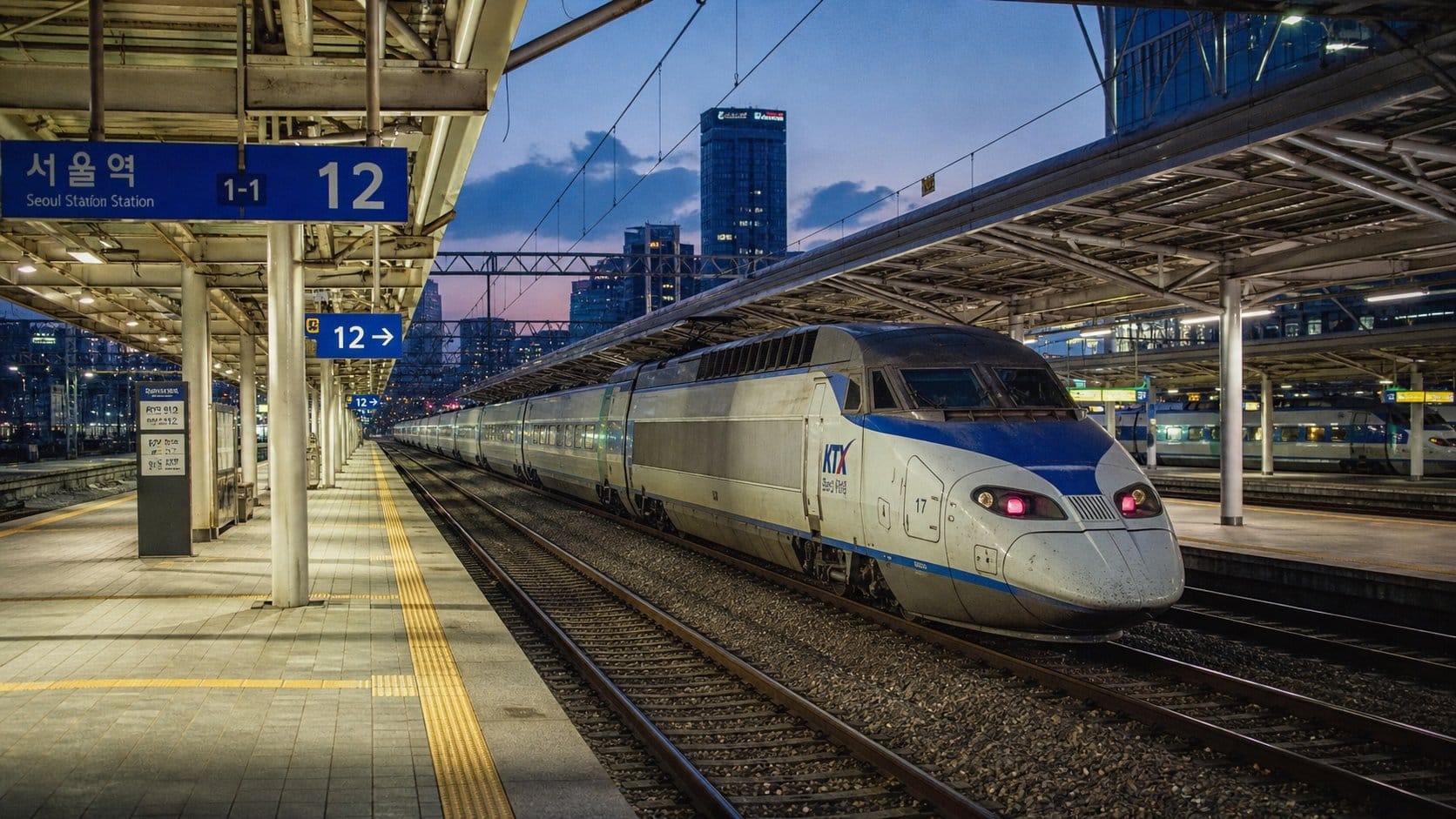
Day 5 shifts from Seoul to Busan via KTX high-speed rail — a journey of roughly 325 km that takes approximately 2.5–3 hours from Seoul Station, with a one-way fare of around $90 USD per person in standard class. An alternative is the SRT train departing from Suseo station in southeastern Seoul, which runs the same corridor at comparable speed on a slightly different timetable. During spring cherry-blossom season (late March–April) and autumn foliage (October–November), trains fill weeks in advance — booking at least two weeks ahead is the minimum threshold during peak windows, according to A Passion and a Passport. On arrival at Busan Station in Dong-gu, the Nampo-dong waterfront district is the natural first stop: BIFF Square — the street-food plaza tied to the history of the Busan International Film Festival — runs through the neighborhood center, and Jagalchi Market, South Korea's largest seafood market, is a short walk away. In the evening, Gwangalli Beach offers a quieter first-night alternative to Haeundae, with the Gwangan Bridge running LED light displays at 8 PM and 10 PM nightly.
Jagalchi Market sets the immediate tone for Busan — the noise, the salt air, the vendors pulling live catches from water tanks and serving raw platters on the spot. It is the clearest single-stop expression of why Busan's food culture operates on a different register from Seoul's. (Source: Visit Busan)
BIFF Square takes its name from the Busan International Film Festival, one of Asia's largest film events held annually in October. The square's celebrity handprint plaques and outdoor screening installations make it a recognizable landmark even outside festival season. The surrounding Nampo-dong streets concentrate street-food vendors selling hotteok (sweet pancakes filled with brown sugar and nuts) and tteokbokki, making the district one of Busan's densest food corridors for an arrival afternoon.
📍 View BIFF Square on Google Maps
Jagalchi Market, established after the Korean War as a base for the city's fishing trade, now spans a dedicated multi-story market building and an outdoor vendor corridor along the waterfront. Ground-floor live-tank stations allow customers to select fish and shellfish for immediate preparation — raw sashimi-style platters (hwe) and grilled catches are both available. A mid-sized hwe platter typically runs ₩20,000–₩50,000, varying by season, species, and vendor, according to Becksplore Travel. The outdoor section along the dockside is equally worth exploring for its grilled shellfish and dried seafood stalls.
📍 View Jagalchi Market on Google Maps
Gwangalli Beach runs 1.4 km along the Suyeong-gu waterfront and is fronted by a dense strip of restaurants and cafés. The beach itself is narrower than Haeundae, making it feel more contained for a first Busan evening. The Gwangan Bridge — 4.2 km in length, one of Korea's longest road bridges — spans the bay in the background, with its nightly LED light display running year-round on two showings at 8 PM and 10 PM, with themed color schemes on public holidays and during festival periods.
📍 View Gwangalli Beach on Google Maps
Day 6: Busan in Depth — Clifftop Temple, Sky Capsule, and Culture Village
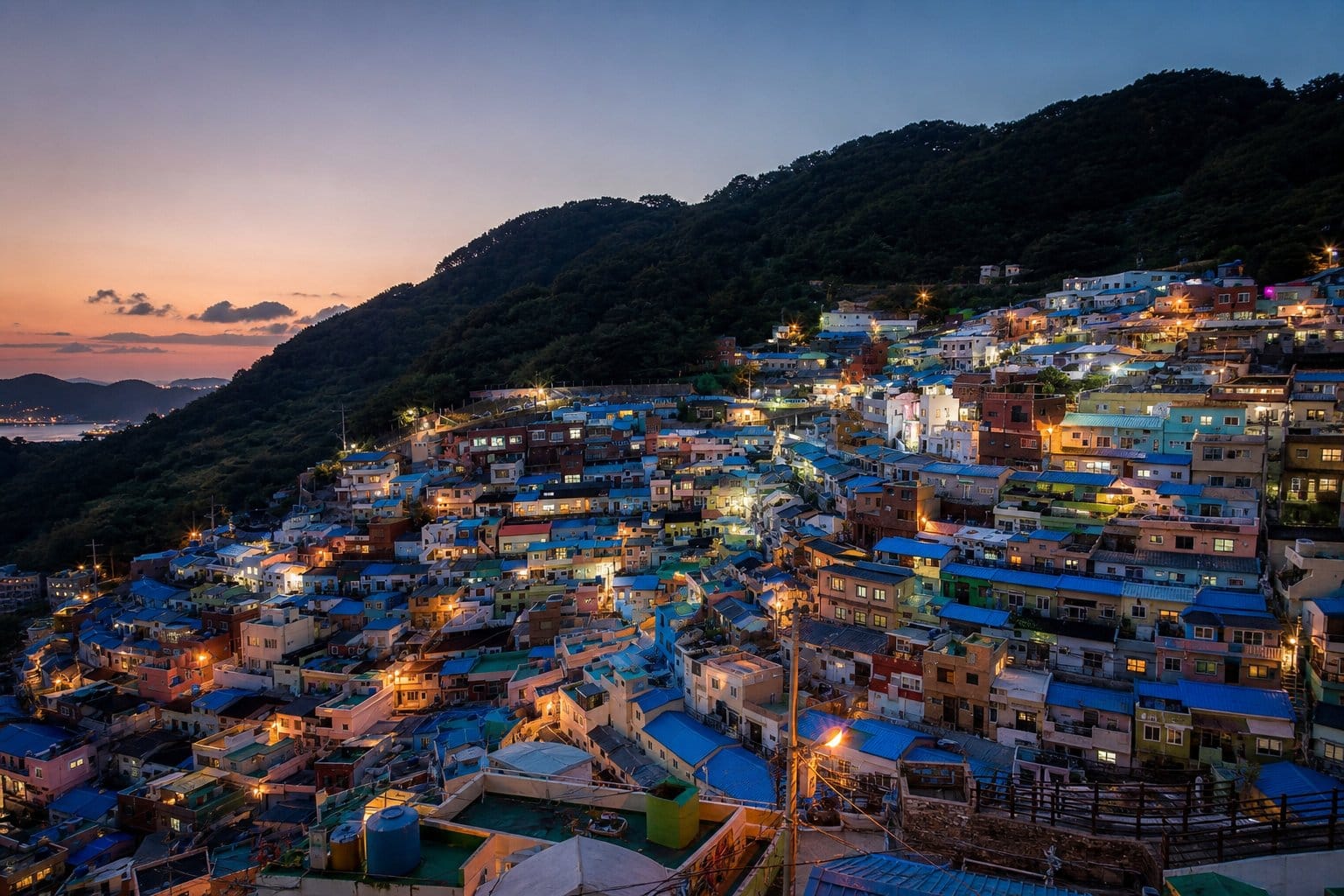
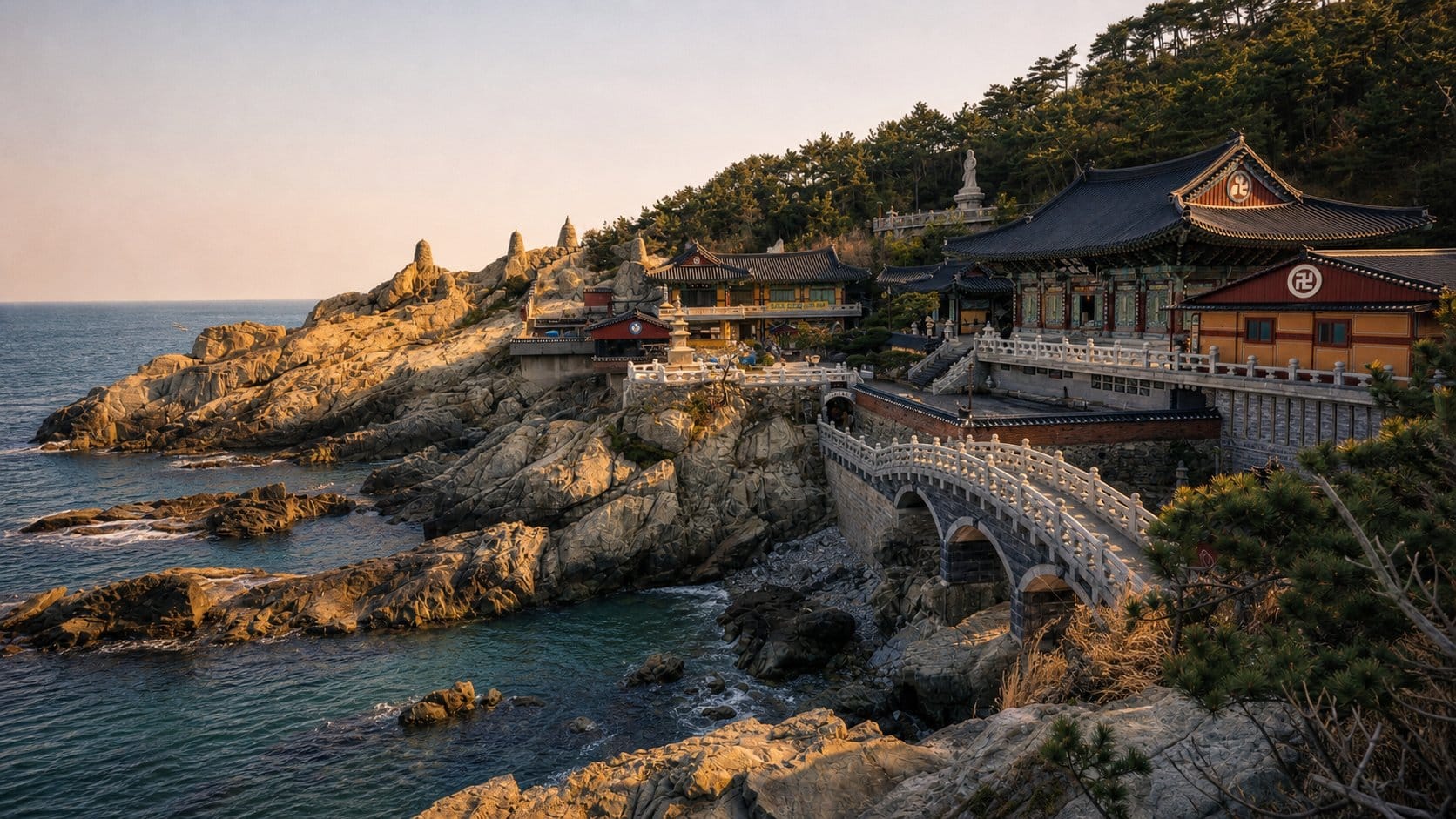
Day 6 covers Busan's most distinctive landmarks in a geographic sweep from the city's northeastern coastal cliffs to its southwestern hillside village. Haedong Yonggungsa Temple is one of the only Buddhist temples in Korea built directly on coastal cliffs above the sea — a location that sets it architecturally apart from inland temple complexes and makes an early morning visit notably atmospheric before tour traffic arrives after 9 AM. Mid-morning, the Haeundae Blueline Park Sky Capsule runs a 4 km elevated gondola ride over Haeundae Beach, taking approximately 30 minutes and costing around ₩30,000 per person. The afternoon moves to Gamcheon Culture Village — the hillside neighborhood of color-coded houses and community murals that Visit Busan identifies as the city's top cultural attraction. For travelers who prefer fewer visitors, nearby Huinnyeoul Culture Village offers a similarly artistic experience at lower foot-traffic levels. The day closes at Taejongdae Park on Yeongdo Island, with its Yeongdo Lighthouse and coastal cliff walks over the Korea Strait.
Haedong Yonggungsa Temple was originally built in 1376 and later rebuilt following destruction during the Japanese colonial period. The complex descends a cliff face in a series of stone terraces, with a Haesu Gwaneum Buddha statue positioned at the waterline on a coastal rock formation. The approach path from the parking area passes through a vendor corridor with traditional snacks and religious items. In spring, surrounding hillsides bloom with cherry blossoms and azaleas, creating a visual contrast with the stone architecture and ocean spray below.
📍 View Haedong Yonggungsa Temple on Google Maps
The Haeundae Blueline Park Sky Capsule connects Cheongsa Station to Songjeong Station along a 4.1 km elevated track above the shoreline. The glass capsules — each holding two to four passengers — move at a pace slow enough for photography in both directions. Advance booking through the Blueline Park website is recommended for spring and summer weekends, when the ride sells out by mid-morning. A Beach Train runs the same track at a lower price for those who prefer not to use the capsule format.
📍 View Haeundae Blueline Park on Google Maps
Gamcheon Culture Village developed in the 1950s as a refugee settlement during the Korean War and was transformed through an arts-based urban regeneration project beginning in 2009. The color-coded houses — primarily blue, yellow, and pink — cascade down a hillside in the Saha-gu district, interspersed with murals, sculpture installations, and small community galleries. A self-guided map available at the entrance marks key artworks including the "Little Prince" statue at the village's highest viewpoint. The neighborhood's compressed hillside layout means most of the main circuit covers in one to two hours on foot.
📍 View Gamcheon Culture Village on Google Maps
Huinnyeoul Culture Village, located along the Yeongdo coastline, is a former fishing village now converted into an arts district with galleries, cafés, and ocean-facing terraces — a quieter counterpart to Gamcheon for those who prefer the same aesthetic with smaller crowds. Taejongdae Park, at the southern tip of Yeongdo Island, runs a tourist tram circuit along coastal cliffs past the Yeongdo Lighthouse to a viewpoint where, on clear days, Japan's Tsushima Island is visible across the Korea Strait.
📍 View Huinnyeoul Culture Village on Google Maps
📍 View Taejongdae Park on Google Maps
Day 7: Gyeongju — Capital of the Silla Kingdom
Gyeongju served as the capital of the Silla Kingdom for nearly 1,000 years — from 57 BC to 935 AD — and is commonly described as the "Kyoto of Korea" for the density of intact historical sites within and immediately around the city. It lies approximately 1.5 hours from Busan by KTX or ITX-Saemaeul train, or by express bus from Busan Central Bus Terminal. The Day 7 anchor is two twin UNESCO World Heritage Sites on Mt. Tohamsan: Bulguksa Temple, founded in 751 AD, and Seokguram Grotto, containing one of East Asia's most significant Buddhist sculptures. A full visit to both sites takes three to four hours, including the uphill shuttle or trail to the grotto. The city-center circuit — Tumuli Park's royal Silla burial mounds and Anapji Pond for late afternoon reflections — fills the remainder of the day. Return to Seoul by evening KTX is practical for Incheon Airport connections; trains run until approximately 9 PM, according to Becksplore Travel.
Bulguksa Temple is widely regarded as the most representative monument of Unified Silla Buddhist architecture on the Korean Peninsula. The complex includes two stone staircases — Cheongungyo and Baengungyo — that are designated national treasures, as well as the Dabotap and Seokgatap stone pagodas in the main courtyard. The temple was constructed under the direction of Kim Daeseong during the mid-8th century and expanded over subsequent Goryeo and Joseon periods. Entry is approximately ₩6,000 for adults.
📍 View Bulguksa Temple on Google Maps
Seokguram Grotto, accessible by shuttle bus from the Bulguksa parking area or by a 40-minute uphill trail, contains a granite rotunda housing a 3.5-meter seated Buddha figure considered a masterwork of East Asian Buddhist sculpture. The chamber is preserved behind glass to regulate humidity, but the full interior is viewable through the entrance. Combined admission to Bulguksa and Seokguram is available at the temple ticket office and represents better value than purchasing separately.
📍 View Seokguram Grotto on Google Maps
Tumuli Park — formally named Daereungwon — is an enclosed garden containing 23 royal Silla burial mounds, the largest of which is Cheonmachong (the Heavenly Horse Tomb), open for interior viewing. The park sits in Gyeongju city center, walkable from the main rail and bus terminals. Five minutes from the park entrance, Cheomseongdae Observatory (632 AD) is one of the oldest surviving astronomical observatories in Asia and a brief but historically significant stop on the walk toward Anapji Pond.
📍 View Tumuli Park (Daereungwon) on Google Maps
Anapji Pond — officially Donggung and Wolji — was built in 674 AD as a pleasure garden for the Silla royal family. The restored pavilions on the eastern bank reflect in the water during late afternoon, and the site is illuminated after dark, making an early evening visit viable before the return train to Seoul or Busan.
📍 View Anapji Pond (Donggung and Wolji) on Google Maps
Transport Passes, Estimated Costs, and Booking Checklist
The practical logistics of this seven-day circuit — rail passes, transit cards, accommodation benchmarks, and daily food costs — shape the overall budget more than any single attraction admission. The Korea Rail Pass (KR Pass) offers unlimited KTX and standard train travel for three, five, or seven consecutive days, and is the most cost-effective option for travelers making a Seoul–Busan round trip plus the Gyeongju leg. For shorter rail use, individual KTX tickets purchased through the KORAIL website or the Let's Korail app are straightforward alternatives with no pass overhead. The T-money card (₩3,000 for the card itself, fully reloadable) is the standard payment method for Seoul and Busan metro systems, buses, and taxis — sold at convenience stores throughout Incheon Airport and in both cities. Mid-range hotel rates run ₩100,000–₩180,000 per night in Seoul and ₩80,000–₩150,000 in Busan, based on benchmarks compiled by A Passion and a Passport. Daily food costs range sharply by eating style: street market dishes run ₩3,000–₩15,000 per item, while sit-down restaurants average ₩10,000–₩30,000 per meal.
Navigation throughout South Korea is most reliable via Naver Maps or Kakao Maps, both of which provide real-time Korean public transit data that Google Maps does not fully index for local routes, according to There She Goes Again. Connectivity options include eSIMs purchasable before departure — QR-code activation at Incheon is available for most carriers — and physical SIM cards at the airport's Olleh and SKT kiosks. South Korean Won (KRW) exchanges at approximately 1,350 KRW per USD as of early 2026. Tipping is not customary, though some upscale restaurants in Seoul include a service charge on the bill. South Korea is largely cashless, but carrying some won is practical for traditional markets and smaller food stalls.
| Category | Item | Estimated Cost (KRW) | Estimated Cost (USD approx.) | Notes |
|---|---|---|---|---|
| Rail | KTX Seoul → Busan (one-way, standard) | ~₩59,800 | ~$45–$50 | Price varies by seat class; SRT from Suseo is comparable |
| Rail | KR Pass (5-day unlimited) | ~₩170,000 | ~$130 | Covers Seoul–Busan round trip + Gyeongju leg |
| Transit | T-money Card (card + initial load) | ₩3,000 + load | ~$2.50 + load | Sold at all Incheon Airport convenience stores; valid nationwide |
| Accommodation | Seoul mid-range hotel (per night) | ₩100,000–₩180,000 | $75–$135 | Myeongdong, Insadong, or Hongdae areas recommended |
| Accommodation | Busan mid-range hotel (per night) | ₩80,000–₩150,000 | $60–$115 | Haeundae (beach access) or Nampo-dong bases |
| Food | Street market dish | ₩3,000–₩15,000 | $2.50–$12 | Gwangjang Market, BIFF Square vendors, Jagalchi outdoor stalls |
| Food | Sit-down restaurant meal | ₩10,000–₩30,000 | $8–$23 | Per person, excluding drinks; Korean BBQ at higher end |
| Food | Jagalchi seafood hwe platter | ₩20,000–₩50,000 | $15–$38 | Price by size and species; grilled options at lower end |
| Activity | DMZ Day Tour (Seoul departure) | ₩45,000–₩80,000 | $35–$60 | Via Klook and other operators; valid passport required |
| Activity | Haeundae Blueline Sky Capsule | ~₩30,000 | ~$23 | Advance booking recommended for weekend departures |
Frequently Asked Questions
How long does the KTX take from Seoul to Busan?
The KTX high-speed train from Seoul Station to Busan takes approximately 2.5–3 hours, depending on whether the service is a direct express or stops at intermediate stations such as Daejeon or Dongdaegu. The SRT (Super Rapid Train), which departs from Suseo station in southeastern Seoul rather than Seoul Station, runs the same corridor at comparable speed with a slightly different schedule. Both services require reserved seats — open-seating is not available on high-speed trains. During spring cherry-blossom season (late March–April) and autumn foliage season (October–November), trains on the Seoul–Busan corridor routinely sell out two to three weeks in advance. Booking through the KORAIL website, the Let's Korail app, or consolidated booking platforms is the most reliable approach during those peak windows.
Is Gyeongju worth a full day trip from Busan?
Gyeongju is well-suited to a full day trip from Busan and does not require an overnight stay for a thorough visit. The train or express bus journey from Busan takes approximately 1.5 hours each way. The two UNESCO-listed anchor sites — Bulguksa Temple and Seokguram Grotto — require three to four hours combined, and Tumuli Park adds one to two hours. Anapji Pond works as a late afternoon addition before the return train. Travelers who want to go deeper can spend a night in Gyeongju to add the National Museum of Gyeongju, Cheomseongdae Observatory, and the Yangdong Folk Village without feeling pressed. For the seven-day circuit as structured, a day trip is sufficient to cover the main UNESCO sites comfortably.
Where can K-pop fans visit on this itinerary?
Seoul holds the most concentrated fan destinations. In Gangnam and Yongsan, the agency buildings for SM Entertainment, JYP Entertainment, and HYBE are accessible by public transit. HYBE Insight in Yongsan is a museum-format exhibition space dedicated to HYBE-label artists; SM's Kwangya@Seoul in Seongsu combines merchandise, interactive content, and café facilities in one location. Hongdae's live music venues and independent stages represent the origin point of much of Korea's idol-adjacent underground culture. In Busan, Gamcheon Culture Village and the Gwangalli waterfront have served as filming locations in idol music videos and variety content. Gyeongju's Bulguksa Temple and the broader Silla-era landscape appear regularly as historical K-drama backdrops and have been used in artist photoshoots requiring ancient or heritage settings.
Do I need a visa or K-ETA to enter South Korea?
Citizens of more than 112 countries — including the United States, United Kingdom, EU member states, Australia, Canada, and Japan — can enter South Korea visa-free for stays of 30–90 days, depending on the bilateral agreement in place. The K-ETA (Korea Electronic Travel Authorization), introduced in 2021 as a pre-travel registration requirement, was suspended for many eligible nationalities in 2023 and had not been reinstated as of early 2026. However, requirements can change on short notice, and travelers should verify current entry conditions on the Korean e-Government portal (egov.go.kr) or the relevant Korean embassy website before booking flights. The K-ETA suspension may be reversed or modified without extended advance announcement.
What is the best time of year to follow this Seoul–Busan route?
Spring and autumn are the most favorable seasons for the Seoul–Busan–Gyeongju circuit. Late March through April brings cherry blossoms across Seoul's Yeouido area, Haeundae in Busan, and through Gyeongju's palace grounds — visually strong conditions but also the year's most crowded and price-elevated travel window. October through November delivers vivid autumn foliage at historic sites in both Seoul and Gyeongju, with cooler temperatures that suit walking-heavy days across all three cities. Summer (June–August) brings high heat, humidity, and the monsoon season (jangma), which significantly limits outdoor sightseeing. Winter (December–February) is cold — particularly in Seoul and Gyeongju — but is the least crowded season with the lowest hotel rates, and represents a reasonable option for travelers who prioritize cost and availability over weather.
Planning Your Seoul–Busan–Gyeongju Week
The Seoul–Busan–Gyeongju circuit holds together as a seven-day structure because the three cities don't duplicate each other — they layer. Seoul delivers four days of cultural and urban depth without exhausting its range. Busan provides a coastal and culinary contrast that would feel incomplete in less than two nights. Gyeongju closes the trip with 1,000 years of compressed Silla history at a pace that suits a single day, then feeds directly back to Seoul for international connections at Incheon. The KTX corridor makes each leg manageable without internal flights or disruptive transit time.
For K-pop fans, the circuit integrates fan-destination visits into a wider travel structure rather than requiring a dedicated fan-tour framework. HYBE, SM, and JYP proximity in Seoul, idol filming locations in Busan, and K-drama historical backdrops in Gyeongju appear as organic parts of the route. Travelers with concert dates or fan events anchoring the Seoul leg can adjust the Busan and Gyeongju portions accordingly — either compressing both or treating the Gyeongju day trip as optional if Seoul demands additional time.
The logistics that matter most to confirm in advance: KTX reservations for the Seoul–Busan segment (two to four weeks ahead during peak seasons), Changdeokgung Secret Garden reservations, and Haeundae Blueline Sky Capsule booking for any weekend visit. The T-money card and a local eSIM handle nearly all ground-level logistics from the moment of arrival at Incheon.
Last updated: 2026-05-13. This article was reviewed using current information from Visit Seoul, Visit Busan, the Korea Tourism Organization, and independent travel reporting. Attraction hours, admission prices, and transit fares are subject to change — verify details directly with operators before travel.


