The short answer: A jjimjilbang (찜질방 / "steam-heat room") is a Korean public wellness complex combining gender-separated bathing halls with mixed-gender sauna rooms, ondol heated floors, snack bars, and overnight sleeping areas — typically open 24 hours for a flat entry fee of ₩10,000–₩20,000 per adult.
Walk through any major Seoul district after midnight and you will notice a particular type of neon sign glowing from upper floors of commercial buildings: 찜질방. Dozens of foreign travelers pass these signs every night without stopping, because the concept does not translate neatly. It is not a gym. It is not a hotel. It is not a Western-style spa. What a jjimjilbang actually offers — hours of heated relaxation, cultural ritual, restorative sleep, and ₩2,000 baked eggs — is genuinely unlike anything in most visitors' home countries. By 2025, jjimjilbangs had become one of the top five cultural activities searched by international visitors to Korea, according to a global wellness travel feature published by Travel and Tour World.
This guide answers the jjimjilbang meaning question with full practical depth: what the Korean word means, what you will find zone by zone inside, how to navigate your first visit without awkward guesswork, which facilities in Seoul are most foreigner-accessible, and what the etiquette rules actually are — including the tattoo policy. Whether you are planning an overnight stay between flights, a post-hike recovery session, or a 90-minute cultural detour from Dongdaemun, every section below should pass the "would I highlight this on my phone?" test.
What Does Jjimjilbang Mean in Korean?
Quick Answer: Jjimjilbang (찜질방) breaks down as jjim (찜, steam or heat) + jil (질, the act of doing) + bang (방, room). Literally: "the room where you do steam-heating." In practice, a jjimjilbang is a Korean public bathhouse-spa hybrid open 24 hours at ₩10,000–₩20,000 per adult — a format with no direct Western equivalent.
Jjimjilbang (찜질방) is a Korean compound noun built from three syllable blocks: jjim (찜), referring to steam or heat-cooking; jil (질), indicating the act or process of doing something; and bang (방), meaning room or chamber. The literal translation — "a room for steam-heating" — understates what the modern facility delivers. Today's jjimjilbangs are multi-floor complexes with specialized heated rooms calibrated to different temperatures and therapeutic materials (salt, charcoal, clay, jade), gender-separated bathing wings with cold plunge pools and herbal tubs, and common areas where families, couples, and solo travelers sleep on ondol-heated floors wearing matching spa uniforms.
The distinction between a jjimjilbang and a mokyoktang (목욕탕, traditional public bathhouse) matters for planning purposes. A mokyoktang is a bathhouse only — gender-separated bathing, no mixed-gender common areas, no sleeping option, and typically no snack bar. A jjimjilbang incorporates the mokyoktang function as one wing of a much larger facility, then adds the signature mixed-gender sauna and relaxation space that has made the format globally recognizable through K-dramas and K-pop media. The two words are not interchangeable, and showing up at a neighborhood mokyoktang expecting jjimjilbang amenities is one of the most common first-timer planning errors.
The historical roots run deep. Korean communal bathing traditions date back centuries, incorporating hygiene ritual and thermal medicine philosophy similar in structure to Roman thermae and Japanese onsen. The modern 24-hour jjimjilbang format, however, emerged in the 1990s as a direct response to economic conditions: as Korean real estate premiums made overnight hotel stays unaffordable for working-class travelers, jjimjilbangs filled the gap as an affordable, socially acceptable rest stop (source: The Anthropologist, 2015). When a structurally similar dynamic played out in Japan in the 1960s with the rise of capsule hotels and manga cafés, those formats remained niche and somewhat stigmatized. Korean jjimjilbangs, by contrast, became mass-market cultural infrastructure — a space simultaneously practical and ceremonial, used by everyone from construction workers to families celebrating weekends.
What's Inside a Jjimjilbang: A Zone-by-Zone Breakdown
First-time visitors often describe their initial confusion at the entrance desk: you receive a wristband, a locker key, and a folded set of shorts and a T-shirt — then a staff member gestures you through a door without further explanation. Understanding the zone structure before you arrive eliminates that uncertainty. Every standard jjimjilbang organizes into two distinct spatial categories: the gender-separated bathing area and the mixed-gender common area. Moving between them requires no more than reading the door signs, and major facilities in Seoul now include English text throughout (source: KoreaeTour Jjimjilbang Seoul Guide).
The Mixed-Gender Common Area and Sauna Rooms
The common area is where most visitors spend the majority of their time. Upon entry you change into the provided spa uniform — typically brightly colored shorts and a matching T-shirt — and move freely through heated rooms, relaxation halls, and snack bars wearing it. The heated rooms (the jjimjil rooms proper) vary by material and therapeutic aim:
- Hwangto room (황토방): Red clay walls, 40–50°C. Associated with skin circulation and joint relief. The most traditional room type, found in virtually every jjimjilbang.
- Charcoal room (숯방): Black charcoal-lined walls, similar temperature range. Credited with air purification and detox functions.
- Salt room (소금방): Himalayan or sea salt panels, slightly cooler at 35–40°C. Claimed benefits include respiratory support and skin softening.
- Ice room (얼음방): Chilled to 10–15°C, a deliberate contrast room. Moving between hot and cold rooms in sequence — thermotherapy alternating vasodilation and vasoconstriction — is one of the core jjimjilbang rituals.
- Far-infrared or pyramid rooms: Found in upscale facilities. Use infrared heating rather than ambient heat, allowing longer stays at lower perceived temperatures.
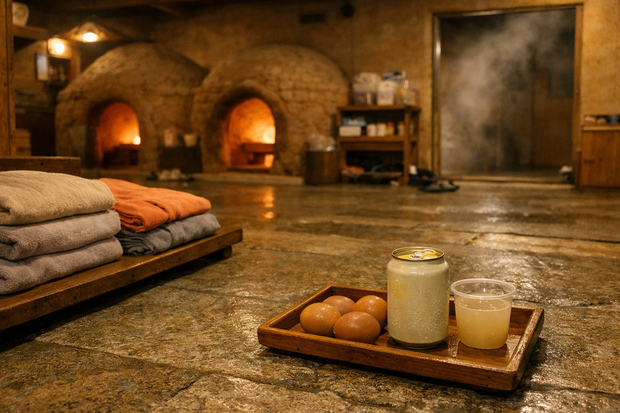
Ondol (온돌) heated flooring — Korea's ancient underfloor radiant heating system — runs throughout the common area. Many visitors simply stretch out on the floor with a wooden block pillow (provided by the facility), close their eyes, and remain there for hours. Sleeping overnight on ondol floors is standard practice, not unusual or discouraged. The combination of radiant heat from below and natural sweating makes ondol rest one of the more restorative experiences the format offers.
The Gender-Separated Bath Zone
The bathing area is accessed through a separate gendered door. Nudity is required — this is non-negotiable and enforced. Swimwear is not permitted in the bathing zone because soap residue and fabric compromise shared water hygiene. The protocol: shower thoroughly at an individual shower station before entering any bath, then soak in hot water tubs, cold plunge pools, herbal baths, or whirlpool jets at your own pace. Most experienced visitors spend 30–60 minutes in the bathing zone, alternating between hot soaks and cold plunges (source: The Soul of Seoul, Korean Bath House Guide).
The seshin (세신) service — a body scrub using a rough exfoliation mitt called an Italy towel (이태리 타월) — is available in the bath zone for an additional ₩20,000–₩30,000. A trained scrubber works systematically across every area of skin, removing dead cells in a way that leaves the body noticeably smoother. No Korean language is required to book seshin; pointing at the service board and mimicking a scrubbing motion works at any facility. Note that seshin is unavailable during overnight cleaning hours, typically 1:00–4:00 AM at most 24-hour jjimjilbangs.
Sleeping Halls, Snack Bars, and What to Eat
Beyond saunas and baths, full-service jjimjilbangs include sleeping halls with individual mat spaces and blankets for overnight stays, snack counters or small restaurants, TV lounges, game rooms, and massage chairs. Two foods are inseparable from the jjimjilbang experience: sikhye (식혜), a chilled sweet fermented rice drink sold in aluminum cans that has become the format's unofficial signature beverage, and maek-ban-seok eggs (맥반석 달걀), baked eggs cooked in the heat of the facility's own sauna rooms. Both cost ₩1,000–₩3,000 and are charged to your wristband account. Larger facilities like SPAREX Dongdaemun also offer luggage storage — a practical option for visitors needing a rest stop between accommodation check-outs without wanting to drag bags around the city (source: Trazy SPAREX Dongdaemun listing).
How to Use a Jjimjilbang: Step-by-Step for First-Time Visitors
The process of using a jjimjilbang is more structured than it appears from outside. Following the correct sequence reduces etiquette errors and ensures you experience each zone as intended. A full cycle — common area, bathing, optional scrub, rest, snacks — takes two to four hours for a first-time visitor and as long as you want if you stay overnight.
- Pay at the front desk (₩10,000–₩20,000). Receive a wristband locker key and a folded spa uniform. Some facilities charge a small fee for towel rental if you prefer not to use the provided small towel.
- Store belongings in your locker. Put on the spa uniform. Do not shower yet — the bathing area comes later.
- Explore the mixed-gender common area first. Try the heated rooms in order of intensity: start with the salt or hwangto room, add the charcoal room, then contrast with the ice room. Spend 10–20 minutes per room. Drink water at the dispensers between rooms — dehydration accelerates significantly in heated environments.
- Rest on the ondol floor. The floor in the common area is always heated. Find an open spot, take a block pillow, and let your body temperature normalize before the bath zone.
- Enter the gender-separated bath zone. Remove your uniform. Shower thoroughly at an individual station before touching any shared bath — use soap and shampoo fully. Enter the warm tub first, then the hot, end with the cold plunge.
- Optional: seshin body scrub. Ask staff in the bath area — no language needed, pointing works. Pay via your wristband charge account.
- Return to the common area, eat, rest, or sleep. Your wristband covers snacks from the counter — pay the accumulated total at exit.
- Exit and settle your account at the front desk. Most facilities do not allow re-entry after exit; plan your timeline accordingly.
What to Bring (and What the Facility Provides)
Most jjimjilbangs provide a spa uniform, a small towel, shampoo, body wash, and a hair dryer. What you genuinely need to bring from outside: flip-flops or waterproof sandals (the bath floor is a communal surface), a change of comfortable clothes for after-exit, personal skincare items if you prefer them to generic provided soap, and any specific medications or contact lens supplies. A NAMANE Card — Korea's reloadable prepaid card designed specifically for foreign visitors — simplifies payment for wristband charges and any facility extras where some smaller jjimjilbangs may have limited international card acceptance. You can review how to load and refill the card at the NAMANE service manual before your visit. Do not bring valuables you cannot lock securely; most facilities offer safes at the front desk for a small fee.
Best Jjimjilbangs in Seoul for Foreign Visitors in 2026
Not all jjimjilbangs are equally accessible to international visitors. Neighborhood mokyoktangs are typically Korean-only in signage, may have stricter tattoo enforcement, and rarely have English-speaking staff. The five facilities below are specifically suited for foreign visitors based on English signage availability, tattoo policy flexibility, proximity to transit, and documented foreigner-friendly procedures (source: Traverse Blog Jjimjilbang Beginners Guide).
| Facility | Subway Access | Hours | Adult Entry (₩) | Key Notes |
|---|---|---|---|---|
| SPAREX Dongdaemun | Dongdaemun area (Lines 1/2/4/5) | 24/7 (cleaning 12:30–4:00 AM) | ~12,000–15,000 | Largest in the area; luggage storage; seshin ₩25,000+; near DDP shopping complex |
| Insadong Spa & Sauna | Jonggak Station (Line 1), Exit 3 | Daily, closes ~7 PM | ~10,000–15,000 | Central for sightseeing; compact; good for a daytime window between cultural attractions |
| Spa Lei (Women-Only) | Sinsa Station (Line 3), Exit 1 | 24/7 typical | ~15,000–20,000 | Women-only; upscale; infrared and oxygen rooms; quieter atmosphere than mixed facilities |
| Supsok Hanbang Land | Dongnimmun Station (Line 3), Exit 4 | 6:30 AM–10:00 PM | ~10,000–15,000 | Rustic setting; traditional clay kilns; outdoor areas; mountain-adjacent views |
| Lotte Boseok Sauna (Spa 5) | Gangnam area (Line 2) | 24/7 | ~12,000–18,000 | Modern multi-floor complex; reviewed in detail by TripByTrip, November 2025 |
Prices shown are verified estimates as of early 2026 and may vary by time of day or day of week at some facilities. Confirm current rates via Naver Maps or Kakao Maps before visiting. For advance ticket booking at SPAREX Dongdaemun, the facility is listed on Trazy with English-language booking support. For planning a full Seoul day that combines a jjimjilbang stop with other neighborhood highlights, transit planning is straightforward from any of these subway-adjacent locations.
Jjimjilbang Etiquette: Rules Foreign Visitors Often Miss
Most etiquette errors at jjimjilbangs are not offensive — they are signs of unfamiliarity and Koreans generally respond with patience rather than confrontation. A few rules, however, are firm. Knowing them in advance prevents disruption for everyone sharing the space.
- Shower before entering any shared bath. This is enforced, not suggested. Enter the individual shower station, soap and rinse fully, then approach the bathing pools — even if you "don't feel dirty."
- Keep your voice low in sleeping areas. The overnight sleeping hall operates like a quiet environment — normal speaking volume is considered inconsiderate. Many Koreans use jjimjilbangs for genuine rest between work shifts.
- Do not wear your spa uniform into the bath zone. The uniform belongs in the common area. Remove it before entering the gender-separated bathing area and put it back on before returning to common spaces.
- No cameras or phones in bathing and changing areas. This is a hard rule enforced by staff and by Korean law. Any recording in gendered private areas constitutes serious criminal conduct.
- Return your uniform and towels at exit. The uniform is facility property. Most jjimjilbangs post a small fine of ₩5,000–₩10,000 for missing items.
The Tattoo Policy — More Flexible Than You Think
Korean public bathing facilities historically prohibited tattoos due to their longstanding association with organized crime. That policy has evolved considerably over the past decade and enforcement varies dramatically between facility types. Major tourist-area jjimjilbangs — SPAREX Dongdaemun, Spa Lei, and Lotte Boseok Sauna — have explicitly loosened restrictions to accommodate international visitors, for whom tattoos carry no such cultural association. Smaller neighborhood mokyoktangs, by contrast, may still post strict prohibition signs and enforce them without exception.
The practical approach: if you have visible tattoos, call ahead or check recent visitor reviews on Naver Maps specifically mentioning 문신 (tattoo). Look for 문신 가능 (tattoo allowed) or 문신 불가 (tattoo not allowed) in Korean-language reviews. When uncertain, choose the larger foreigner-targeted facilities listed in the table above — they accommodate tattoos in almost all documented recent cases. Understanding broader Korean cultural etiquette and social norms before your trip will also help you navigate situations like this with greater confidence.
Jjimjilbang vs. Mokyoktang vs. Western Spa: What's the Difference?
The three formats serve overlapping but distinct purposes, and the differences matter when deciding what to visit. When Western hotel chains began opening upscale spas in Seoul in the early 2000s — charging ₩80,000–₩200,000 for equivalent services — Korean jjimjilbangs held their market position because they offered something fundamentally different: a social, multi-hour wellness environment rather than an appointment-based service transaction. When similar all-in wellness complexes emerged in Japan in the 1960s and 1970s, they remained niche, associated with specific subcultures. Korea's jjimjilbang, by contrast, became embedded in mainstream daily life across income levels — a democratization of wellness that explains their current cultural durability.
| Feature | Jjimjilbang (찜질방) | Mokyoktang (목욕탕) | Western Hotel Spa |
|---|---|---|---|
| Entry fee | ₩10,000–₩20,000 | ₩5,000–₩10,000 | ₩80,000–₩200,000+ |
| Mixed-gender common area | Yes (uniform required) | No | Usually yes |
| Gendered bathing zone | Yes (nudity required) | Yes (nudity required) | Sometimes (swimwear) |
| Heated sauna rooms | Yes — multiple types | Sometimes 1 type | Usually 1 steam room |
| Overnight sleeping | Yes (many 24-hour) | No | No |
| Food and snack service | Yes (snack bar / restaurant) | No | Sometimes (poolside bar) |
| Body scrub (seshin) | ₩20,000–₩30,000 extra | ₩15,000–₩25,000 extra | ₩100,000+ extra |
| English signage | Often (major tourist spots) | Rarely | Yes |
| Reservation required | No — walk-in | No — walk-in | Usually yes |
When jjimjilbangs were first covered extensively in English-language international travel media — roughly 2013–2016, coinciding with K-drama streaming expansion — most coverage framed them as curiosities or daring cultural challenges. By 2025, the framing reversed: jjimjilbangs now appear in mainstream outlets alongside Gyeongbokgung Palace and Bukchon Hanok Village as core Seoul itinerary items. The format's durability lies precisely in its accessibility — no reservation, no dress code beyond the provided uniform, and an entry fee comparable to a fast-food meal means the barrier to a two-hour restorative experience remains exceptionally low.
For visitors managing payment across multiple Seoul activities and transit, a NAMANE Card — Korea's reloadable Korean prepaid card for foreigners — works at major jjimjilbang payment terminals alongside standard international credit cards. Comparing Korean travel payment options including T-money and WOWPass before your trip helps you decide which card to load first.
Frequently Asked Questions
Can foreigners use a jjimjilbang without speaking Korean?
Yes, at major tourist-area facilities. SPAREX Dongdaemun, Spa Lei, and Insadong Spa & Sauna all have sufficient English signage and staff experience with international visitors to navigate without Korean language skills. The process — pay, receive wristband and uniform, follow the zone layout — is largely self-explanatory once inside. The wristband payment system for extras (snacks, scrub service) eliminates most transaction language barriers. Smaller neighborhood mokyoktangs are harder to navigate in English, but they are also not the recommended starting point for first-time visitors.
Are tattoos allowed in Korean jjimjilbangs?
It depends on the facility. Major jjimjilbangs serving foreign visitors — including SPAREX Dongdaemun and Lotte Boseok Sauna (Spa 5) in Gangnam — generally accommodate tattoos without issue as of 2025–2026. The historical ban was rooted in associations between tattoos and organized crime, and enforcement has relaxed considerably in tourist-area facilities. Smaller local bathhouses may still prohibit tattoos strictly. Check Naver Maps reviews for the specific facility before visiting, searching for 문신 (tattoo) in visitor comments. When uncertain, choose a larger foreigner-friendly facility from the recommended list above.
What should I wear inside a jjimjilbang?
In the mixed-gender common area: the spa uniform provided at entry — loose shorts and a T-shirt in the facility's color. In the gender-separated bathing zone: nothing — nudity is required and swimwear is prohibited in the shared pools. You change in the locker room before entering the bathing zone and change back before returning to the common area. The locker room provides individual shower stations, hair dryers, and basic toiletries. Bring personal skincare items if you have preferences beyond generic provided soap.
How much does a jjimjilbang cost in Seoul in 2026?
Standard adult entry ranges from ₩10,000 to ₩20,000 depending on the facility and time of day. Overnight rates at 24-hour facilities are typically ₩2,000–₩5,000 higher than daytime rates at some locations. Optional add-ons: seshin body scrub (₩20,000–₩30,000), towel rental if not provided (₩2,000–₩3,000), and food and drinks charged to your wristband at exit. A complete four-hour visit including seshin and traditional snacks costs most visitors ₩35,000–₩50,000 total — significantly less than any comparable wellness experience in Seoul's hotel spa circuit.
Can I sleep overnight at a jjimjilbang?
Yes, at 24-hour facilities. SPAREX Dongdaemun and Lotte Boseok Sauna both operate around the clock and accommodate overnight guests in communal sleeping halls with ondol-heated mat spaces. Most facilities pause certain services (seshin scrubs, some food items) during a cleaning window between 1:00 and 4:00 AM — factor that into your overnight plan. An overnight jjimjilbang stay is a legitimate option for travelers with an early-morning Incheon departure who want to avoid paying for a hotel on their last night. Bring earplugs if you sleep lightly; the sleeping hall is communal.
Is a jjimjilbang different from a mokyoktang?
Yes, significantly. A mokyoktang (목욕탕) is a traditional public bathhouse: gender-separated bathing only, no mixed-gender common areas, no sauna rooms, no sleeping quarters, no food service, and typically shorter hours (6 AM–10 PM). Entry costs ₩5,000–₩10,000. Mokyoktangs serve neighborhood regulars and are generally Korean-language only in signage. A jjimjilbang incorporates the bathing function but adds extensive common areas, multiple sauna types, sleeping zones, snack bars, and 24-hour operation. For first-time foreign visitors, jjimjilbangs offer a far more complete and navigable experience than mokyoktangs.
Bringing It All Together
Understanding the jjimjilbang meaning — "the room where you do steam-heating" — is the beginning, not the end of what the format delivers. What makes a jjimjilbang worth planning around is harder to compress into a definition: the particular combination of thermotherapy, communal quiet, ondol floor warmth, and Korean wellness ritual that produces a feeling of physical reset unavailable at a gym, hotel pool, or Western spa. Most foreign visitors who try it describe the experience as one of their Seoul trip highlights, not despite its strangeness but because of it.
The practical barriers are lower than they appear from outside. Major tourist-area jjimjilbangs in Seoul — particularly SPAREX Dongdaemun and Spa 5 in Gangnam — are foreigner-accessible without Korean language skills, accommodate tattoos, and operate 24 hours. The total cost for a meaningful visit including seshin and traditional snacks runs ₩35,000–₩50,000. That is competitive with any cultural activity in Seoul requiring the same time investment and producing a comparable memory. Set a time boundary before you go in — experienced visitors say three to four hours is the ideal first-visit length. Use the full sauna cycle, try the cold plunge, let the ondol floor do its work, and eat at least one baked egg.
For managing the entry fee and wristband charges conveniently, a NAMANE Card works at major jjimjilbang terminals alongside standard cards. Load it before your visit and review how to use it in the NAMANE service manual. The rest reveals itself once you're inside.
Last updated: 2026-04-28. This guide is reviewed and refreshed when official sources (KTO, Visit Seoul, ticketing platforms) update their information.
Related Articles
This article was written using information collected and analyzed by NAMANE's in-house K-pop research AI engine. We use AI technology to bring you faster, broader coverage, and in the process some details may occasionally differ from the latest facts. For important information such as dates, venues, and prices, please double-check with official sources.


