
Korea's K-Pop Concert Ecosystem at a Glance
Seoul and Greater Seoul form the world's most concentrated geography for K-pop live events, supporting a calendar that runs without pause from weekly television music-show recordings at broadcast studios through sold-out stadium tours filling outdoor venues of up to 70,000 seats. According to the Korea Tourism Organization, the region draws international audiences from Japan, China, Southeast Asia, and increasingly North America and Europe throughout the year. Venues span an unusually wide range: at the intimate end, university halls and underground clubs seat fewer than 1,000 attendees; at the other extreme, outdoor stadiums rival the largest arenas on earth. Each format serves a distinct tier of artist and event type — a major group's comeback tour anchors a dome or stadium, while a fan meeting or debut showcase lands in a mid-capacity hall. A first-time visitor planning a trip around a concert should map this landscape before choosing accommodation and transport, since proximity to a specific venue shapes every logistic that follows.
Quick Answer: Korea's K-pop concert venues range from 800-seat university halls to 70,000-capacity outdoor stadiums, concentrated in Seoul and Greater Seoul. KSPO Dome (~15,000 seats) and Gocheok Sky Dome (~25,000) handle the bulk of major indoor shows. INSPIRE Arena near Incheon Airport, opened December 2023, features 360-degree staging that reduces stage distance across most seating sections.
The weekly music-show ecosystem runs in parallel with the concert calendar on a reliable schedule. SBS Inkigayo airs Sundays, KBS Music Bank on Fridays, and MBC Music Core on Saturdays. Audience applications for these recordings are free or low-cost and provide direct access to live performances — typically two to three songs per act — in a broadcast-studio setting. They represent a practical entry point for fans whose target group is not currently on a concert tour, and they require advance applications through each broadcaster's official website (source: WhatMyTrip K-pop Concert Guide).
The annual award-show calendar places multiple major acts at specific venues on defined dates. The 2026 calendar includes the Golden Disc Awards (January 10, 40th edition), Seoul Music Awards (June 20, INSPIRE Arena), MyK Festa (June 26–27, KINTEX), Seoul WaterBomb (July 4–6, KINTEX), Melon Music Awards (December 20, Gocheok Sky Dome), and SBS Gayo Daejeon (December 25, INSPIRE Arena) (source: Trazy Annual K-pop Festivals; KoreaTravelEasy 2026 Guide). These events feature multiple acts on a single night and carry their own ticketing timelines separate from standard concert tours.
The table below provides a working reference for the main venues discussed in this guide, including indoor or outdoor classification, capacity, nearest subway access, and the type of event each typically hosts.
| Venue | Type | Capacity | Nearest Subway Station | Typical Event |
|---|---|---|---|---|
| KSPO Dome (Olympic Gymnastics Arena) | Indoor | ~15,000 | Olympic Park (Lines 5 & 9) | Major idol tours, fan meetings |
| Gocheok Sky Dome | Indoor (domed) | ~25,000 | Sindorim (Lines 1 & 2) | Headline tours, award shows (Melon Music Awards) |
| Jamsil Indoor Stadium | Indoor | ~11,000 | Sports Complex (Lines 2 & 9) | Mid-scale idol concerts |
| Olympic Main Stadium (Jamsil) | Outdoor | ~70,000 | Sports Complex (Lines 2 & 9) | Stadium tours (renovation until Dec 2026) |
| INSPIRE Arena | Indoor | ~15,000 | No subway — airport shuttle required | Major tours, year-end shows (SBS Gayo Daejeon) |
| Blue Square / Mastercard Hall | Indoor (underground) | ~1,400–2,000 | Hangangjin (Line 6) | Fan meetings, showcases |
| Yes24 Live Hall | Indoor | ~1,500 | Multiple central lines | Debut showcases, sub-unit concerts |
| Peace Hall, Kyung Hee University | Indoor | 4,400 | Hoegi (Line 1) | Label events, charity performances |
| Goyang Stadium | Outdoor | ~40,000–43,000 | KINTEX (GTX-A Line) | Festival events, large touring acts |
| BEXCO (Busan) | Indoor | Varies by hall | Centum City (Lines 2 & Dong-hae) | Southern Korea large-scale K-pop events |
KSPO Dome: Seoul's All-Round Concert Benchmark
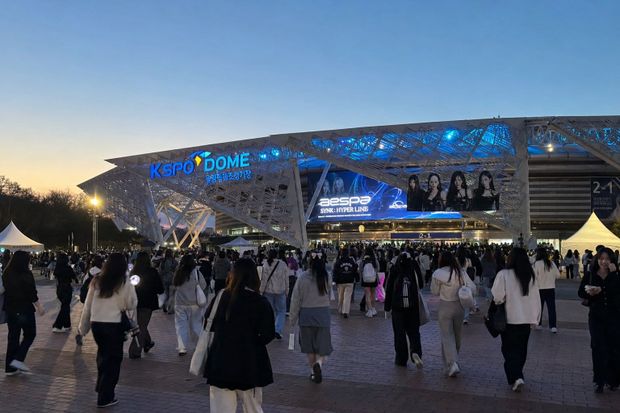
KSPO Dome is the venue most consistently recommended by K-pop concert attendees as a reference point for first-time visitors — a ~15,000-seat arena built for the 1988 Seoul Olympics inside Olympic Park in Songpa-gu, rebranded from its original name to KSPO Dome in 2018. Its three-floor seated layout distributes VIP, R, S, and A tiers across positions that retain strong sightlines from virtually every section, making seat quality less of a concern here than at larger or older venues. The arena is accessible via Subway Lines 5 or 9 to Olympic Park Station, with a walk of approximately 5 to 10 minutes to the venue entrance. BTS, BLACKPINK, and EXO have all treated a KSPO Dome date as a career milestone — the venue's reputation in the Korean market operates as a signal of an act's commercial standing, making a booking there meaningful beyond the event itself (source: NOL Concert Venue Guide).
"KSPO Dome is consistently rated the best all-round concert venue in Seoul — the three-floor seated layout offers excellent sightlines across all tier levels, and its position inside Olympic Park gives the surrounding event a wider sense of occasion that more functional arenas cannot replicate." — NOL, Concert Venue Editorial
The bag policy at KSPO Dome is clearly defined and consistently enforced: any bag larger than A3 size must be checked at the venue's cloakroom for KRW 5,000 (approximately USD 3.50–4.00 at May 2026 exchange rates). This check happens at entry, so arriving with an oversized backpack adds a step to the security process. A compact crossbody bag or small tote fitting within A3 dimensions clears entry without issue. Outside food and professional camera equipment with detachable lenses are also restricted, consistent with standard K-pop concert policy at this venue tier (source: Agoda Seoul Travel Guide).
Olympic Park amplifies the surrounding experience in ways that standalone arenas cannot match. The grounds — containing rose gardens, public art installations, and wide walking paths — fill with fans two to three hours before and after a show. Fan-organized pop-up stalls for unofficial goods, photo card trading sessions, and fan community gatherings cluster along the park's main paths during these windows. Arriving two to three hours early accounts for merchandise queues, which can run 60–90 minutes for headlining acts, and for the pre-show social dimension that many attendees treat as integral to the overall experience (source: WhatMyTrip K-pop Concert Guide).
For accommodation, hotels in Songpa-gu and along the Line 9 corridor toward Yeouido offer the most practical base for a KSPO Dome show. These neighborhoods are served by Lines 5 and 9, keeping post-show return journeys straightforward. Booking 2 to 3 months in advance is advisable for peak-season events — inventory near Olympic Park depletes quickly after a major show is announced. If the concert runs past 11:30 PM, having Kakao Taxi installed before the day provides a reliable fallback as the last metro approaches its final service.
Gocheok Sky Dome and Jamsil Complex: High-Capacity Choices
Gocheok Sky Dome is Korea's largest indoor concert venue, with a capacity of approximately 25,000, and it anchors the high-capacity end of Seoul's event circuit. Home to the annual Melon Music Awards — confirmed at Gocheok for December 20, 2026 — and a regular host for headline touring acts, the venue sits a 5-minute walk from Sindorim Station's Exit 1, served by Lines 1 and 2, two of the busiest and most connected lines on the Seoul Metro network. Its domed structure eliminates weather as a variable and supports large-format productions. Upper-level seats can sit notably far from the main stage at this scale; binoculars are strongly recommended for anyone in the second or third ring (source: Scream FM London Seoul Concert Venue Overview). One crowd management note specific to Gocheok: exiting through Gaebong Station after the show is significantly less congested than routing through the main Guil Station exit.
Post-show crowd flow planning is worth building into the logistics for any Gocheok event. When 20,000-plus fans funnel toward a single metro station simultaneously, platform wait times can extend 30 to 45 minutes. The Gaebong Station route adds a few minutes of walking but substantially reduces that queue. If the concert ends after 11:00 PM, it is worth checking last-service times for Gaebong specifically — it operates on a branch line and may run an earlier final departure than Sindorim. The Seoul Metro app or Naver Map provides real-time departure information.
The Jamsil Sports Complex is a separate multi-venue campus in Songpa-gu, served by Sports Complex Station on Lines 2 and 9. The Jamsil Indoor Stadium, at approximately 11,000 capacity, operates a closed circular three-floor layout suited to mid-scale acts — a step up from club-format venues but with a more contained atmosphere than a dome. Acts at a transitional career stage — having outgrown 1,500-seat halls but not yet filling 15,000-seat arenas — frequently book Jamsil Indoor as a logical next step.
The Olympic Main Stadium at the same complex — approximately 70,000 capacity and outdoors — hosted some of K-pop's largest concerts before entering major renovation in November 2023 (source: NOL Concert Venue Guide). Reopening is currently expected in December 2026. Any visitor planning travel around an event announced at this venue should verify the renovation status through official channels before making non-refundable bookings.
INSPIRE Arena: The Purpose-Built Venue Next to Incheon Airport
INSPIRE Arena is Korea's first purpose-built concert arena, opened in December 2023 on Yeongjongdo Island in Incheon — the same island that houses Incheon International Airport. At approximately 15,000 seats it matches KSPO Dome in capacity, but differs substantially in design philosophy: the floor plan is built around 360-degree staging, positioning the performing area centrally rather than at a fixed end-stage, which brings the stage closer to a higher proportion of seats than conventional proscenium formats allow. The 2026 calendar already confirms two anchor events at INSPIRE: Seoul Music Awards on June 20 and SBS Gayo Daejeon on December 25 (source: KoreaTravelEasy 2026 Guide). Attendees who have experienced both KSPO Dome and INSPIRE have noted a meaningful reduction in perceived stage distance even from sections that would be peripheral in an older end-stage layout (source: WhatMyTrip K-pop Concert Guide).
"INSPIRE Arena is a fundamentally different experience compared to Korea's older venues — the 360-degree staging eliminates the back-of-arena problem, and infrastructure built from scratch in 2023 reflects the production scale of current K-pop tours in ways that retrofitted older spaces cannot match." — KoreaTravelEasy, 2026 K-pop Concert & Tour Guide
The practical trade-off is transport. INSPIRE Arena has no direct subway connection — a significant consideration in a city where metro access defines the standard approach to concert logistics. A free shuttle runs approximately 15 times daily from Incheon International Airport, with each journey taking around 15 minutes. From central Seoul — Hongdae, Myeongdong, or Gangnam — the combined journey to the shuttle stop and then to the venue takes between 1 and 1.5 hours in normal conditions (source: Scream FM London Seoul Concert Venue Overview). Planning the return shuttle schedule before the concert ends is not optional — it is the single most critical logistics step for this venue.
The adjacent INSPIRE Entertainment Resort, a 5-star property on the same campus, eliminates the transport equation for visitors who book a stay. A concert-and-accommodation package makes particular sense for international fans arriving or departing through Incheon, since the resort sits within easy walking distance of both the arena and the airport shuttle stop. Rates climb sharply in the weeks before confirmed event dates; booking 2 to 3 months ahead is practical for the SBS Gayo Daejeon and Seoul Music Awards dates specifically.
From a trip-planning standpoint, INSPIRE Arena fits most naturally into itineraries structured around Incheon Airport as an arrival or departure point rather than a multi-week Seoul city stay. For visitors based in central Seoul, the 1–1.5 hour one-way journey is manageable but demands careful coordination with the post-show shuttle operating hours.
Mid-Scale and Intimate Seoul Venues
Not every K-pop event in Seoul takes place in a 15,000-seat arena. A distinct tier of smaller venues handles fan meetings, debut showcases, sub-unit concerts, and label charity performances — formats where the artist-to-audience ratio is deliberately compressed and the atmosphere differs substantially from a stadium show. These events are frequently where long-term fan loyalty develops: closer physical access to an artist at a pivotal career moment, in a room small enough for the audience to feel collective rather than anonymous. Three settings cover most of this mid-scale and intimate bracket in Seoul: Blue Square / Mastercard Hall, Yes24 Live Hall, and the university halls at Kyung Hee and Yonsei. Knowing which acts use which spaces helps visitors plan around events that may not appear in general concert listings but are well-known within dedicated fan communities (source: Scream FM London Seoul Concert Venue Overview).
Blue Square / Mastercard Hall is an underground venue near Hangangjin Station on Subway Line 6, in Yongsan-gu between the Itaewon and Han River areas. It is a favored setting for fan meetings and smaller headlining sets — events where an established act chooses a contained atmosphere over an arena. The underground configuration produces a distinct acoustic quality, and the surrounding Itaewon and Haebangchon restaurant district makes a pre-show dinner straightforward without a significant detour. Line 6 connects to several central Seoul transfer points without requiring cross-platform changes at major hub stations.
Yes24 Live Hall, at approximately 1,500 capacity, appears regularly on debut showcase and sub-unit concert announcements. Its central Seoul location and uncomplicated public transport access make it a recurring venue for early-career K-pop events. For fans tracking a group before it has scaled to KSPO Dome-level bookings, a Yes24 Live Hall date is often a defining early fandom experience. Tickets move quickly because capacity is limited and the audience pool is committed.
The university hall category provides two architecturally distinctive settings. Peace Hall at Kyung Hee University seats approximately 4,400 on a Gothic Revival campus in northeastern Seoul, reachable from Hoegi Station on Line 1. The campus architecture gives events held there an unusual visual context; the hall is used for label showcases and charity performances rather than commercial tours. Centennial Hall at Yonsei University, at around 800 seats, sits near Sinchon Station and the Hongdae area — one of the densest entertainment and dining districts in Seoul, making evening event logistics straightforward on all sides (source: NOL Concert Venue Guide).
Venues Outside Seoul: Goyang, Incheon, and Busan
Korea's concert infrastructure extends well beyond Seoul's city limits, with significant venues in Goyang, Incheon, and Busan serving regional touring legs and large festival-format events. Goyang — a city in northern Gyeonggi Province bordering Seoul — is home to Goyang Stadium, an outdoor venue with a capacity of approximately 40,000 to 43,000. Access improved substantially with the GTX-A Line's KINTEX Station, connecting Goyang to central Seoul in a fraction of the time previously required by local subway. The adjacent KINTEX convention center hosts festival-format award events and multi-act showcases throughout the year, though its flat, wide floor configuration is less acoustically suited to standard single-act concerts than purpose-built arenas (source: Scream FM London Seoul Concert Venue Overview). Both venues appear on the 2026 event calendar: MyK Festa (June 26–27) and Seoul WaterBomb (July 4–6) are confirmed at KINTEX (source: Trazy Annual K-pop Festivals).
Incheon contributes two large outdoor venues to the regional calendar. Incheon Asiad Main Stadium at approximately 30,000 capacity and Incheon Munhak Stadium at approximately 50,500 serve larger touring acts operating across the Greater Seoul metropolitan area. Both are reachable by subway, offering an alternative to the parking and traffic constraints that characterize central Seoul venues for events drawing regional audiences.
In southern Korea, BEXCO in Busan functions as the primary large-scale venue for K-pop events beyond the capital region. Korea's second city has a population of approximately 3.3 million, and BEXCO's convention and exhibition infrastructure accommodates concerts, fan meetings, and award events on a scale no other southern city currently matches. Travel from Seoul to Busan by KTX high-speed rail takes approximately 2.5 hours. A day trip is technically feasible but tight: last KTX departures back to Seoul typically run until around 10:00–11:00 PM from Busan Station, and post-show crowd clearance at a large venue takes time. Building in an overnight stay near Centum City Station removes that pressure and allows for a less rushed experience (source: WhatMyTrip K-pop Concert Guide).
| Venue | City / Region | Capacity | Transport Access | Travel from Central Seoul |
|---|---|---|---|---|
| Goyang Stadium | Goyang, Gyeonggi | ~40,000–43,000 (outdoor) | KINTEX Station (GTX-A Line) | ~30–40 min via GTX-A from Suseo |
| KINTEX Convention Center | Goyang, Gyeonggi | Varies by hall | KINTEX Station (GTX-A Line) | ~30–40 min via GTX-A from Suseo |
| Incheon Asiad Main Stadium | Incheon | ~30,000 (outdoor) | Munhak Stadium Station (Line 1) | ~60–80 min by subway |
| Incheon Munhak Stadium | Incheon | ~50,500 (outdoor) | Munhak Stadium Station (Line 1) | ~60–80 min by subway |
| BEXCO | Busan | Varies by hall | Centum City Station (Lines 2 & Dong-hae) | ~2.5 hours by KTX |
Ticketing for International Fans: Platforms and Presale Strategy
Buying K-pop concert tickets as a foreign visitor requires navigating an infrastructure built primarily for Korean domestic users — a system where mobile number verification, Korean ID input, and Kakao Pay integration are standard checkout steps. Four platforms carry the majority of concert inventory: Interpark (the largest database, but requiring Korean ID verification for most transactions), YES24 Ticket (a mobile-friendly app with a clear interface), Melon Ticket (integrated with Kakao Pay and the broader Kakao ecosystem), and NOL — formerly Interpark Global — which is built specifically for international fans, offering an English-language interface and international payment card support. For most overseas buyers without a Korean phone number or resident registration number, NOL is the practical starting point; the NOL platform directly addresses the verification barriers that cause international purchases to fail on domestic platforms (source: WhatMyTrip K-pop Concert Guide).
"International fans who attempt Interpark without a Korean phone number consistently encounter verification walls at checkout — NOL was purpose-built to remove exactly those barriers, with international card acceptance rates that domestic platforms do not match for overseas transactions." — KoreaTravelEasy, 2026 K-pop Concert & Tour Guide
Fan club presale access is the most critical strategic element for premium seating. Presale windows typically open 24 to 48 hours before general sale, and this is where floor, VIP, and lower-tier preferred seats are allocated. Qualifying requires an active official fan club membership registered weeks in advance — not days before the sale. For groups under HYBE, SM Entertainment, JYP Entertainment, or YG Entertainment, fan club registration is managed through each label's dedicated platform (Weverse, SM Membership, and equivalents) and involves annual fees. That investment pays off when attending a specific group's concert is the primary objective of the Korea trip (source: WhatMyTrip K-pop Concert Guide).
Overseas buyers without a Korean phone number face a specific bottleneck at the one-time password stage of checkout. The recommended approach is linking a passport-verified account to the preferred ticketing platform several days before the sale — not the night before — which allows time to resolve account-level issues while customer support is reachable. General sale tickets for dome or stadium-scale shows from major acts sell out within minutes; entering the queue with payment details already saved is a minimum requirement for any chance of success.
Tour package operators offer an alternative for high-demand events. Companies such as KoreaTravelEasy bundle concert tickets with accommodation and transport, bypassing several verification barriers. For major award shows — Golden Disc Awards, Melon Music Awards, or SBS Gayo Daejeon — where general sale inventory is effectively unavailable to overseas fans by the time account verification is resolved, a package operator may be the only realistic access route. Upcoming 2026 events and tour packages are also tracked through resources like Soompi's 2026 K-pop tour masterlist.
Concert Day Logistics: Getting There, Bag Rules, and Etiquette
On concert day, Seoul's subway network is the most reliable transport option for every major venue in this guide. Driving to any large-scale K-pop concert is not recommended: parking at and around major venues is severely constrained, post-show road congestion routinely adds 60 to 90 minutes to an exit, and the Seoul Metro runs efficiently until approximately 11:30 PM to midnight, covering the end time of most shows. Loading a T-Money card before the day handles all subway and bus fare payments without queuing at ticket machines; the card also works at convenience stores across the city. Identifying the correct subway exit and walking direction to the venue entrance before arriving — available on Naver Map or Kakao Map — removes one variable from a day that already involves multiple coordination points (source: Korea Tourism Organization). For shows that run past the last metro service, having Kakao Taxi installed and ready provides a direct fallback.
Bag restrictions vary by venue, and reviewing them before packing is worth two minutes of preparation to avoid a problem at the security gate. At KSPO Dome, anything larger than A3 must be checked at the cloakroom for KRW 5,000. At larger stadiums and outdoor venues, restrictions may be stricter or structured differently on a per-event basis. The official concert notice — posted on the ticketing platform by the organizer for each specific show — is the definitive source for that event's rules. Common restrictions across most K-pop concert venues include: professional camera equipment with detachable lenses, selfie sticks, and food or beverages brought from outside the venue. Arriving 30 to 60 minutes before doors open at larger stadiums accounts for security queue time without rushing (source: NOL Concert Venue Guide).
Korean concert culture has established participation norms worth understanding before attending. Lightsticks — official fan merchandise specific to each group — are carried by most fans and synchronized during certain songs to produce collective light displays across the arena. Bringing the group's official lightstick is not required for entry, but enables participation in that visual element and signals fan community membership to other attendees. Fanchants are choreographed audience call-and-response sequences, timed to specific lyrics or instrumental breaks; fan communities publish guides for each album cycle ahead of tours, and familiarizing yourself with a few key chants for the likely setlist is a common preparation step (source: WhatMyTrip K-pop Concert Guide).
Photography and video recording rules are set per event by the organizer and vary by artist — some shows permit fancam recording during specific songs; others prohibit any recording. The official concert notice specifies what applies to that particular show. If assistance is needed on the day, the 1330 Korea Travel Helpline (+82-2-1330) provides multilingual support around the clock and can clarify venue-specific rules, transport options, or general visitor questions (source: Korea Tourism Organization).
Frequently Asked Questions
Do I need a Korean phone number to buy K-pop concert tickets as a foreigner?
Many Korean ticketing platforms — including Interpark and Melon Ticket — use Korean mobile number verification as a standard checkout step, creating a barrier for overseas buyers. The most practical alternative is NOL (formerly Interpark Global), which is built specifically for international fans, accepts international payment cards, and does not require a Korean phone number for most purchases (source: NOL). Linking a passport-verified account to your preferred platform several days before the ticket sale opens — not hours before — is strongly advisable; this allows time to resolve account-level issues before the sale window, which can close within minutes for major acts. Tour package operators such as KoreaTravelEasy bundle concert tickets with accommodation and transport, bypassing most verification steps — a practical option for first-time visitors or high-demand award show events where general sale access is difficult.
Which K-pop concert venue in Seoul is best for a first-time visit?
KSPO Dome is the venue most consistently recommended for a first K-pop concert experience in Korea. At approximately 15,000 seats, it is large enough to host major acts — BTS, BLACKPINK, and EXO have all held concerts there — while remaining manageable in scale compared to dome-size venues. Its three-floor layout with VIP, R, S, and A tier seating delivers strong sightlines from most positions, reducing the risk of a poor-value seat. Access via Subway Lines 5 or 9 to Olympic Park Station, followed by a 5–10 minute walk, is among the most straightforward of any major Seoul venue. The surrounding Olympic Park grounds add a pre- and post-show dimension — fan gatherings, goods stalls, photo card trading — that standalone arenas cannot offer. The bag policy (A3 size limit, KRW 5,000 cloakroom fee for larger bags) is clearly defined and consistently applied (source: NOL Concert Venue Guide).
How far in advance should I buy K-pop concert tickets?
The timeline depends on which sale tier you are targeting. Fan club presales — which offer the best seating positions, including floor and lower-tier sections — open 24 to 48 hours before general sale. Qualifying requires an active official fan club membership registered weeks in advance, not days before the sale. For general sale, tickets to dome or stadium-level shows from major acts frequently sell out within minutes; entering the queue with payment details already saved is a minimum requirement. International fans using NOL or YES24 Ticket should allow additional lead time to resolve any account verification issues before the sale date. Award show tickets — Golden Disc Awards, Melon Music Awards, SBS Gayo Daejeon — are typically the most difficult to obtain through general sale, and tour package operators are often the realistic access route for those events (source: WhatMyTrip K-pop Concert Guide).
Is INSPIRE Arena worth the trip from central Seoul?
For visitors routing through Incheon International Airport — arriving or departing during the same trip — INSPIRE Arena integrates naturally into the itinerary. The free shuttle from the airport runs approximately 15 times daily and covers the journey in about 15 minutes; the adjacent INSPIRE Entertainment Resort provides on-site accommodation that eliminates the transport equation entirely. For visitors based in central Seoul with no Incheon routing, the 1–1.5 hour one-way journey without a subway link is the key planning consideration — coordinating the return shuttle after the show is non-negotiable. On venue quality: the 360-degree staging brings the stage meaningfully closer to a higher proportion of seats than older arena formats, and the infrastructure is current-generation. For SBS Gayo Daejeon (December 25, 2026) and Seoul Music Awards (June 20, 2026), INSPIRE Arena is the confirmed location regardless of the travel effort involved (source: KoreaTravelEasy 2026 Guide).
What items are restricted at K-pop concerts in Korea?
Restrictions vary by venue and event organizer, so reading the official concert notice posted on the ticketing platform for your specific show is the most reliable preparation step. Common patterns across most K-pop concerts in Korea include: bag size limits (A3 maximum at KSPO Dome, with a KRW 5,000 cloakroom fee for bags exceeding this), prohibitions on professional camera equipment with detachable lenses, selfie sticks (prohibited at virtually all venues), and food or beverages brought from outside the venue. Photography and video rules are set per event — some shows permit fancam recording during certain songs, while others prohibit recording entirely. Arriving 30 to 60 minutes before doors open at larger stadiums accounts for security queue time. The 1330 Korea Travel Helpline (+82-2-1330) can clarify venue-specific rules and provide multilingual assistance on the day (source: NOL Concert Venue Guide).
Planning Your Visit: Bringing It Together
Korea's K-pop concert infrastructure in 2026 is broader and more accessible for international visitors than at any previous point — a combination of purpose-built venues like INSPIRE Arena, improved transport links to Goyang via the GTX-A Line, and ticketing platforms increasingly oriented toward overseas fans. The consistent planning framework across all venue sizes applies regardless of scale: identify the event and venue early, secure fan club presale access well in advance, book accommodation within reasonable subway range 2 to 3 months ahead, and build the transport plan around the Seoul Metro rather than road access.
Venue selection affects the experience in ways that go beyond seat quality. The 11,000-seat contained atmosphere of Jamsil Indoor Stadium produces a different concert dynamic than the 25,000-seat dome at Gocheok Sky Dome, which differs again from INSPIRE Arena's 360-degree stage configuration. Each venue also carries specific logistics that reward preparation: Gocheok's Gaebong exit strategy, KSPO Dome's A3 bag policy, INSPIRE's shuttle coordination after the show. Treating these as known variables rather than day-of discoveries transforms a logistically demanding event into a manageable one.
For first-time visitors, combining a weekly music-show recording — free or low-cost, available most weekends year-round — with a planned concert at KSPO Dome covers both ends of the K-pop live experience range within a single trip. From there, the wider venue landscape opens according to the artists and events on the calendar during the weeks you are in Korea. The KPop Official Korea schedule provides a regularly updated event listing; the 1330 Korea Travel Helpline (+82-2-1330) remains a reliable multilingual resource for logistics questions before and during your visit (source: Korea Tourism Organization).
Last updated: 2026-05-07. This article reflects venue information, event calendar data, and ticketing platform details available as of May 2026. Venue renovation schedules and event announcements are subject to change — verify current status through official venue and organizer channels before finalizing travel bookings.
Related Articles
- KSPO Dome vs Gocheok Sky Dome vs Inspire Arena: A Foreign Fan Venue Guide
- DDP K-POP and Taekwondo Free Show Guide: Family Recommendations
- Post-SMTOWN COEX Artium Closure: SM Fan Guide in Seoul
- K-POP Photocard Trading Etiquette: Trusted Seoul Locations
- Guide for Foreigners: How to Buy K-POP Concert Tickets in Korea


