
How Many Days Do You Need in Seoul?
Four to six days is the range most consistently recommended for first-time visitors to Seoul — long enough to move between the city's historic northern districts and contemporary southern neighborhoods without feeling hurried. At five days, a traveler can visit the major palaces, spend a morning at a traditional market, walk a riverside park in the evening, and still find time to wander a creative neighborhood without watching the clock. Seoul is a dense and layered city: a single district like Jongno-gu holds centuries of stacked history, while a short subway ride across the Han River drops you into the gleaming commercial towers of Gangnam. According to Visit Seoul, the city's official tourism portal, planning at least four days gives visitors a meaningful experience across both sides of the river. A three-day visit typically means cutting entire neighborhoods from the schedule.
Quick Answer: Five days is the practical standard for a first visit to Seoul — enough time to cover Gyeongbokgung Palace, Bukchon Hanok Village, Gwangjang Market, Seongsu-dong, and an evening at Han River Park. Extending to seven days adds a DMZ day trip and the Yeonnam-dong café district west of Hongdae.
The five-day framework works because Seoul's main points of interest cluster naturally into day-sized groupings. The historic north — palaces, hanok villages, and traditional markets — sits within walking distance or a short metro ride. The modern south — Gangnam's commercial core, the creative streets of Seongsu-dong, and the Bongeunsa Temple — forms a logical second cluster. Linking them is the Han River, which provides a natural midpoint on Day 3 with its cable car ride, tower views, and riverside park access. The structure is self-contained enough that individual days can be swapped without disrupting the overall flow, which matters for travelers whose plans shift around weather or jet lag.
A 7-day extension is worthwhile for anyone with flexibility. Days 6 and 7 open room for the DMZ day trip — typically booked two to three days in advance through licensed operators — and a slower wander through Yeonnam-dong, the tree-lined café district west of Hongdae that rewards an unhurried afternoon. According to Real Korea Insider's 2026 Seoul itinerary guide, a full week also allows a cooking class or a day trip to Nami Island without crowding the core city schedule.
"A first-time visitor who tries to do Seoul in two or three days will leave feeling they barely scratched the surface. Four to five days is the range where you stop rushing and start actually experiencing the city." — Korea Tourism Organization, official visitor planning guidance (source: Visit Seoul)
Fewer than three days is genuinely limiting. A two-night stay leaves enough time for Gyeongbokgung Palace and Myeongdong shopping, but nothing more. Travelers connecting through Incheon or spending a long weekend in Seoul should focus on a single well-defined district rather than attempting a city-wide overview that ends up being a blur of transit stops.
Historic Seoul: Palaces, Hanok Villages & Ancient Alleys
Historic Seoul is anchored by four Joseon-era palaces, two of which are well-suited to a first visit. Gyeongbokgung Palace (경복궁), built in 1395 as the primary seat of the Joseon Dynasty, is the largest and most centrally placed of the four. It spreads across nearly 60 acres at the northern end of central Seoul, framed by Bugaksan Mountain behind and the Gwanghwamun Gate in front. Standard admission costs ₩3,000 (~$2.20), but visitors who rent traditional hanbok clothing from the shops lining the palace's side streets receive free entry — a popular option that also suits the surroundings well. The twice-daily changing of the guard ceremony at Gwanghwamun Gate runs at 10am and 2pm daily and is free to watch from the plaza. Just east, Changdeokgung Palace (constructed 1405) offers a quieter, more intimate experience through its UNESCO-listed Secret Garden (Huwon) — a 78-acre landscape garden accessible only by timed guided tour, according to Bon Traveler's Seoul travel guide.
"The Secret Garden at Changdeokgung is one of the few places in Seoul where the surrounding city fully disappears — the guided-tour format keeps visitor numbers limited enough that it remains genuinely quiet, something rare in a city of ten million." — Seoul heritage travel guide (source: Bon Traveler)
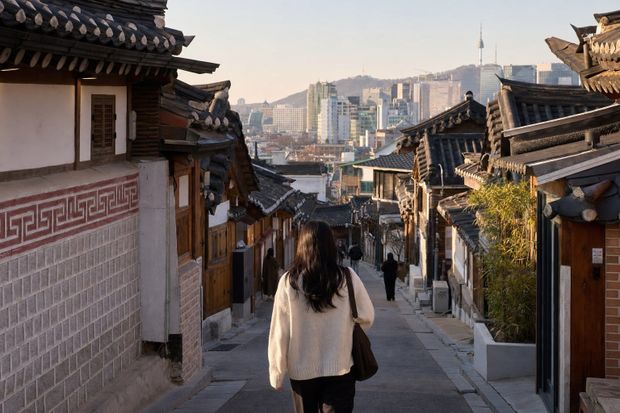
Bukchon Hanok Village sits on the hillside between Gyeongbokgung and Changdeokgung, preserving hundreds of traditional hanok homes along a network of narrow alleyways. The neighborhood is still residential — many homeowners live there year-round — which means visitor etiquette carries real weight: low voices, no photography through private gates, and avoiding the alleys before 10am when residents are beginning their mornings. The city's official visitor-friendly hours run 10am to 5pm, and weekday mornings between 10am and noon are the least crowded window by a meaningful margin. The viewpoint near the upper section of the village, where curved grey-tiled rooftops layer down toward the city below, is one of the most recognizable views in Seoul and rewards the uphill walk.
Immediately below Bukchon lies Ikseon-dong (익선동), Seoul's oldest surviving hanok block and a distinct neighborhood in character. Where Bukchon remains primarily residential and historic, Ikseon-dong has been repurposed at street level: the ground floors of century-old hanok structures now house boutique cafes, small-batch cocktail bars, and vintage clothing shops. The narrow lanes between buildings are too tight for vehicles, which gives the area a different spatial quality from anywhere else in the city. It draws a younger local crowd and fits naturally as an afternoon stop after the palace circuit — the transition from 600-year-old palace grounds to a hanok cafe takes about ten minutes on foot.
Insadong (인사동) sits a short walk south from both Gyeongbokgung and Ikseon-dong and functions as Seoul's traditional arts corridor. The main street runs with tea houses, Korean paper (hanji) shops, art galleries, and vendors selling hotteok (sweet filled pancakes) and other snacks. Weekday mornings pass more quietly than weekend afternoons, when the street can become genuinely congested. Ssamziegil, a courtyard shopping center built into a former factory block near Insadong's southern end, houses independent designers and makers and provides a good alternative to the main street's tourist-facing shops. The combination of Gyeongbokgung in the morning, Bukchon and Ikseon-dong at midday, and Insadong in the afternoon covers historic Seoul in a single well-paced day without compressing any individual stop.
One practical note: Seoul operates a combined palace ticket (통합관람권) covering Gyeongbokgung, Changdeokgung, Deoksugung, and Gyeonghuigung for ₩10,000, valid for one month. For visitors planning to see two or more palaces across the trip, this represents clear savings over individual entry fees and removes the need to buy tickets separately at each gate.
Modern Seoul: Gangnam, Seongsu-dong & Creative Neighborhoods
Modern Seoul spreads across the southern bank of the Han River and into a stretch of former industrial zones that have quietly become some of the city's most interesting areas to spend an afternoon. Gangnam — the commercial district made familiar globally through more than a decade of cultural exports — is a useful starting point rather than a destination in itself: wide boulevards, flagship retail, and the general density of activity that comes with being Seoul's highest-income ward. The more compelling stops sit at its edges. Seongsu-dong, a former industrial zone on the northern bank of the Han River directly across from Gangnam, has spent the last several years transforming into what is commonly called 'Seoul's Brooklyn' — a comparison that fits loosely but usefully. Independent cafes, concept stores, and street art studios occupy converted factory buildings and warehouses, making it one of the city's trendiest neighborhoods heading into 2025–2026, according to Real Korea Insider.
Seongsu-dong's appeal lies in its lack of polish. Unlike Sinchon or parts of Hongdae, which have developed a formulaic commercial character over the years, Seongsu-dong still feels like a work in progress: a specialty coffee roaster next to a shoe workshop next to an architecture studio. The weekend pop-up culture is active here — brands and creative studios use the neighborhood for temporary installations — so the streetscape shifts regularly. The area's galleries and studio spaces draw a design-literate local crowd that is distinct from the K-beauty shoppers of Myeongdong or the nightlife crowd of Itaewon, making it a useful window into how Seoul's younger creative class actually spends its weekends.
Inside the COEX Mall in Gangnam, the Starfield Library is a specific stop worth including even for travelers with no particular interest in books. It is a two-storey open-stack library built into the mall's central atrium, with floor-to-ceiling shelves and reading areas at multiple levels. Entry is free. The visual impact of the space is immediate enough to understand why it has become one of Seoul's most photographed interiors, as noted in Real Korea Insider's 2026 guide. It sits a five-minute walk from Bongeunsa Temple (봉은사), a functioning Buddhist temple founded in 794 CE whose wooden prayer halls and stone lanterns stand in direct visual contrast to the glass office towers immediately surrounding them. The temple receives far fewer visitors than Gyeongbokgung despite being in one of Seoul's most accessible and heavily-trafficked locations.
Hongdae (홍대), in the northwest of the city near Hongik University, occupies a different register entirely. Where Gangnam projects commercial ambition and Seongsu-dong channels creative energy, Hongdae runs on street performance, art school culture, and a nightlife scene oriented toward a predominantly 20s crowd. Weekend street performances happen regularly in the open plaza areas. The neighborhood's indie music venues — ranging from standing-room basement stages to slightly larger clubs — draw travelers interested in Korean independent music rather than the polished K-pop productions of Gangnam. During the day, the surrounding streets hold a mix of vintage clothing shops, independent bookstores, and the kind of low-overhead restaurants that tend to produce good food at honest prices. Mangwon Market sits a 15-minute walk from Hongdae station, making the two a natural pairing for a neighborhood-focused day.
Seoul Food Guide: Markets, Street Eats & Local Meals
Eating well in Seoul is straightforward once you understand the city's pricing tiers — and they differ enough that knowing them before arrival saves both money and frustration. Street food runs ₩1,000–5,000 (~$0.75–$3.60) per item and is available throughout the day in any busy neighborhood: skewers, tteokbokki (spicy rice cakes), hotteok (sweet filled pancakes), and egg bread are standard examples. Sit-down meals at local restaurants average ₩8,000–15,000 (~$5.80–$10.90) for a main dish, rice, soup, and several banchan (side dishes). Most restaurants targeting a local lunch crowd post a 점심 특선 (lunch special) sign that delivers the same meal for noticeably less than the dinner price — a consistent pattern worth building around when planning mid-day stops. The clearest price gap between tourist-area and neighborhood-level spending shows up in Myeongdong: street food there runs 30–50% more than equivalent items in Hongdae or around Mangwon Market, according to Tunex Travels. Understanding this before you arrive prevents overpaying for something readily available three subway stops away.
Gwangjang Market (광장시장), founded in 1905, is Seoul's oldest continuously operating market and the most referenced food destination for first-time visitors — with good reason. The covered market's interior food rows concentrate on a small number of dishes executed consistently well: bindaetteok (mung bean pancakes, pan-fried to order at open stalls), mayak kimbap (small rice rolls nicknamed 'narcotic kimbap' for their addictive quality), and a variety of tteok (rice cakes) in sesame, red bean, and savory varieties. Individual plates cost ₩3,000–5,000 (~$2.20–$3.60). The market spans multiple floors, but the ground-level food rows are the core draw. Arriving before noon on a weekday keeps the experience manageable; weekend evenings are dramatically more crowded and navigating the stalls becomes more difficult.
Mangwon Market (망원시장), in the Mapo district near the Han River, operates as a neighborhood market rather than a tourist destination — which is precisely its appeal. The stalls open early and cater to local residents buying breakfast and groceries. A full breakfast meal runs ₩8,000–12,000, and the atmosphere is noticeably less performative than Gwangjang. Arriving between 8am and 10am offers the clearest sense of how a working Seoul neighborhood market actually operates. The surrounding Mangwon-dong area, while not typically featured on itineraries, is pleasant to walk through before the rest of the city wakes up and pairs naturally with Hongdae later in the morning.
For sit-down meals throughout the trip, a simple orientation is to eat where office workers eat at lunchtime. A restaurant with a handwritten 점심 특선 sign in the window and a queue of locals at noon is a reliable indicator of quality and value: set menus typically include a main dish, rice, soup, and several banchan for ₩8,000–12,000. Korean barbecue (삼겹살, grilled pork belly) is widely available at evening hours and tends to run ₩13,000–18,000 per person before drinks. Jjigae (stew) restaurants — serving kimchi jjigae, doenjang jjigae, and sundubu jjigae — provide some of the most affordable and filling sit-down meals in any neighborhood. Naver Map is the standard tool for finding specific restaurants in Seoul; Google Maps' restaurant data for the city is noticeably thinner by comparison, so downloading Naver before arrival is worthwhile.
5-Day Seoul Itinerary: Day-by-Day Plan
A five-day Seoul itinerary works best when organized around geographic clusters rather than attempting to sweep the entire city each day. Each day in the framework below stays within a connected zone, reducing transit time and leaving room for unplanned stops. The sequence builds from historic north Seoul on Day 1 through to a neighborhood-and-departure structure on Day 5, with city views and the Han River anchoring the midpoint on Day 3. Each day is self-contained: dropping or rearranging individual days doesn't collapse the overall structure, and the order reflects logical geographic flow rather than a strict priority ranking. This framework aligns with the approach outlined in Tunex Travels' 2025–2026 Seoul first-timer guide and Real Korea Insider's 2026 itinerary. Travelers extending to a full week can add the DMZ and Yeonnam-dong on Days 6 and 7.
| Day | Theme | Key Stops | Planning Notes |
|---|---|---|---|
| Day 1 | Historic North | Gyeongbokgung Palace → Bukchon Hanok Village → Insadong | Arrive at palace by 9:30am for the 10am guard ceremony. Weekday preferred for Bukchon. |
| Day 2 | Markets & Streams | Gwangjang Market breakfast → Cheonggyecheon Stream → Myeongdong | Myeongdong street food is 30–50% pricier than Hongdae. K-beauty retail is concentrated here. |
| Day 3 | Views & Parks | Namsan Cable Car + N Seoul Tower → Itaewon/Hannam dining → Yeouido Han River Park | Cable car ₩16,000 round-trip. Sunset-to-night transition (approx. 7–9pm) is most rewarding. |
| Day 4 | Modern Seoul | Gangnam → Bongeunsa Temple → Seongsu-dong galleries → COEX Starfield Library | Starfield Library entry free. Bongeunsa is active daily. Seongsu-dong: allow 2–3 hours. |
| Day 5 | Neighborhoods & Departure | Mangwon Market breakfast → Hongdae → AREX express to Incheon Airport | AREX: 43 min, ₩9,500–11,000. Allow at least 3 hours before long-haul departure at Incheon. |
Day 1 — Historic North: Arriving at Gyeongbokgung Palace by 9:30am positions you for the 10am changing of the guard ceremony at Gwanghwamun Gate. After the ceremony, the palace grounds themselves take 60–90 minutes to walk through comfortably. From the palace's northern exit, Bukchon Hanok Village is a 15-minute walk; the hillside alleyways reward a slow pace, with particular attention to the upper viewpoint overlooking the city. Insadong fills the afternoon with art shops, traditional teahouses, and Ssamziegil courtyard, which hosts independent designers and makers at more accessible price points than the main street.
Day 2 — Markets & Streams: Gwangjang Market opens early and operates through the afternoon. Arriving for breakfast before the lunchtime crowd thickens makes navigation easier and the stall vendors less rushed. After the market, Cheonggyecheon Stream — a 10.9km urban waterway uncovered and restored in 2005 — runs through the city center and provides a surprisingly quiet walking route away from street traffic. Myeongdong in the afternoon and evening concentrates the city's densest K-beauty retail; sampling is widely offered in most shops, and prices are consistent across the major brand stores. The street food stalls are convenient but, as noted, cost more than comparable snacks elsewhere.
Day 3 — Views & Parks: The Namsan Cable Car (남산 케이블카) departs from the Myeongdong side and costs ₩16,000 round-trip. N Seoul Tower sits 262 metres above sea level on Namsan Mountain and delivers an unobstructed panoramic view of the city across all directions. The observation deck operates until 11pm, and the transition from sunset to full-city-lights between roughly 7pm and 9pm (varying by season) is the most visually distinctive time to visit. After descending, the Itaewon and Hannam-dong strip offers Seoul's widest range of international dining options. Yeouido Han River Park is a 20-minute subway ride from Itaewon and stays active well into the evening; locals arrive with convenience store picnic supplies for river-side sessions.
Day 4 — Modern Seoul: Gangnam station and the immediate surrounding streets give a street-level sense of commercial Seoul at full speed. Bongeunsa Temple, a 10-minute walk from the COEX Mall, is an active functioning site that remains open to visitors throughout the day despite its busy surroundings. Seongsu-dong is one subway stop across the river (Seongsu station, Line 2) and repays a full two to three hours of walking — longer on weekends when pop-up installations are more likely to be active. The COEX Starfield Library closes the day back in Gangnam with 30–45 minutes in one of the city's most striking indoor spaces at no cost.
Day 5 — Neighborhoods & Departure: Mangwon Market (Mangwon station, Line 6) works well as a final Seoul breakfast before the journey to the airport. Hongdae, a 10-minute subway ride away, provides a last look at independent shops and street art through the late morning. The AREX Airport Express from Seoul Station to Incheon Airport Terminal 1 runs every five to ten minutes and takes 43 minutes; fares run ₩9,500–11,000 depending on terminal and ticket type. Allow a minimum of three hours before long-haul departure at Incheon, which is a large airport with security queues that grow during peak periods.
Getting Around Seoul: Metro, T-Money & Airport Transfer
Seoul's metro is one of the most visitor-accessible urban rail systems in Asia — 23 color-coded lines, English signage at every station, and a flat fare of ₩1,400 (~$1.00) per ride when using a T-Money card. The system operates from 5:30am to midnight daily, with trains running every three to five minutes on core lines during peak hours. Stations are consistently clean, well-signed, and equipped with elevators and escalators at most exits. English-language station announcements and digital departure boards are standard at every stop, making navigation manageable from day one without knowledge of Korean. The metro is the default way to move between all major districts: Gyeongbokgung, Hongdae, Myeongdong, Gangnam, and Seongsu-dong all sit on or within a short transfer of the main circular Line 2, which loops through the city's core neighborhoods. Learning the Line 2 stations alone gives immediate access to most of the five-day itinerary, according to Tunex Travels.
The T-Money card (티머니) is the central transit tool for any visit. It is a reloadable contactless card covering subway rides, city buses, and some taxis. The card costs ₩2,500 and is available at GS25, CU, and 7-Eleven convenience stores throughout the city, as well as at station vending machines. Adding credit is done at the same vending machines or at convenience store counters in increments from ₩1,000 upward. The practical advantages over single-use tickets are threefold: slightly lower fares per ride, free transfers between subway and bus within a 30-minute window, and no need to navigate a ticket machine in a second language under time pressure. Loading ₩20,000–30,000 on arrival covers the first day comfortably and topping up takes under a minute at any convenience store.
Rush hours — 7:30–9:00am and 5:30–7:30pm on weekdays — are noticeably congested on the central lines, particularly Line 2. Where the itinerary allows, scheduling major cross-city transit movements outside these windows improves the experience. Taxis are metered at a base fare of ₩4,800 with a 20% surcharge after 10pm; for short hops within a district a taxi is sometimes faster than the subway, but for cross-city travel the metro is consistently both faster and cheaper. Naver Map handles Seoul transit routing more accurately than Google Maps for this market — downloading it before leaving home is strongly recommended. The Korea Tourism Organization's 24/7 multilingual 1330 Hotline, referenced on the Visit Seoul portal, provides real-time assistance in English for travelers who need navigation help on arrival.
From Incheon Airport, the AREX express train (공항철도) runs directly to Seoul Station in 43 minutes for ₩9,500–11,000. This is the clear choice for both arrival and departure: faster and substantially cheaper than an airport taxi, which runs ₩70,000–90,000 for the same route depending on traffic. A regular all-stop AREX service also runs at a lower fare but takes approximately 66 minutes with multiple intermediate stops. The express service departs every five to ten minutes and connects directly to Seoul Station, where Line 1 and Line 4 of the metro provide onward connections to most accommodation zones.
Seoul Trip Budget: What to Expect per Day
Seoul is one of the more affordable major capital cities for travelers at comparable experience levels — costs sit well below Tokyo, Hong Kong, or Singapore across accommodation, food, and transport. The city's budget range is genuinely wide: a careful traveler can stay under $50/day all-in, while a mid-range trip covering a hotel, sit-down meals, and paid attractions runs $120–$187/day. These figures include accommodation, meals, transport, and site entry fees; international flights are excluded throughout. According to Tunex Travels' 2025–2026 guide, a complete 5-day mid-range solo visit totals approximately $600–$935 before flights — a reasonable benchmark for trip planning. Luxury travelers spending at high-end Gangnam and Itaewon hotels with fine dining can reach $320–$635/day. The spread between budget and luxury is wider than in cities where a mid-range floor is imposed by limited hostel supply; Seoul's guesthouse and dorm accommodation is genuine and well-located.
| Traveler Type | Daily Budget (USD) | Accommodation | Food Style | 5-Day Total (approx.) |
|---|---|---|---|---|
| Budget | ~$50/day | Hostel dorm (₩20,000–35,000/night) | Street food + local jjigae and bibimbap restaurants | ~$250 |
| Mid-range | $120–$187/day | 3-star hotel or guesthouse (₩80,000–150,000/night) | Mix of markets, lunch specials, and sit-down dinners | $600–$935 |
| Luxury | $320–$635/day | 4–5 star hotel in Gangnam or Itaewon | Fine dining, Korean BBQ restaurants, rooftop bars | $1,600–$3,175 |
For budget travelers, Seoul's cost structure is genuinely favorable. Metro fares are ₩1,400 per ride. Gyeongbokgung Palace entry is ₩3,000. Gwangjang Market breakfast plates cost ₩3,000–5,000. A filling jjigae or bibimbap at a local lunch spot runs ₩8,000–10,000. A dorm bed in a well-located guesthouse starts around ₩20,000–35,000 per night. Many of Seoul's most worthwhile spaces — Bukchon Hanok Village, Cheonggyecheon Stream, COEX Starfield Library, Bongeunsa Temple, Han River parks — charge no entry fee. The city's free-to-access public spaces are extensive enough that a ₩100,000 (~$75) daily budget covers a genuinely full schedule.
Mid-range travelers should factor in one or two paid attractions per day — N Seoul Tower (cable car ₩16,000), Changdeokgung's Secret Garden guided tour (₩8,000) — alongside accommodation in the ₩80,000–150,000 range and evening meals that include a drink or two. The Discover Seoul Pass, available through Visit Seoul, bundles entry to multiple attractions with unlimited transit access. The 24-hour, 48-hour, and 72-hour versions are all available; comparing the included attraction list against your planned itinerary before purchasing is worthwhile, as the value depends on how many of the covered sites you actually intend to visit.
A practical currency note: the South Korean won (₩) operates in large denominations relative to its purchasing power — ₩10,000 is approximately $7.30 at mid-2026 rates. Most establishments in tourist districts accept international credit cards without issue. Traditional markets (Gwangjang, Mangwon) remain largely cash-based, so keeping ₩30,000–50,000 in cash for market days is advisable. ATMs at GS25 and 7-Eleven convenience stores reliably accept foreign cards, typically with modest transaction fees that are lower than airport exchange counters.
Frequently Asked Questions
How many days should a first-time visitor spend in Seoul?
Four to six days covers Seoul's main areas without rushing; five days is the practical standard for a first visit. Five days gives enough time to visit the Joseon palaces, explore Bukchon Hanok Village, spend a morning at a traditional market, walk through a creative neighborhood like Seongsu-dong, and fit in an evening at Han River Park — without compressing any single stop into a rushed 30-minute visit. Fewer than three days means skipping entire districts. A 7-day itinerary adds room for the DMZ day trip — typically booked two to three days in advance through licensed operators — and the Yeonnam-dong café district west of Hongdae, which rewards an unhurried afternoon walk.
Is Seoul affordable for budget travelers?
Yes, Seoul is highly affordable for budget travelers, who average approximately $50/day all-in. Street food at markets like Gwangjang costs ₩1,000–5,000 (~$0.75–$3.60) per plate. Sit-down local restaurant meals run ₩8,000–15,000 (~$5.80–$10.90). Metro fares are ₩1,400 per ride with a T-Money card. Gyeongbokgung Palace entry is ₩3,000. A dorm bed in a well-located guesthouse starts around ₩20,000–35,000 per night. Many of the city's most compelling spaces — Bukchon Hanok Village, Cheonggyecheon Stream, COEX Starfield Library, Bongeunsa Temple, and the Han River parks — are entirely free to visit. A ₩100,000 (~$75) daily budget covers a genuinely full schedule without skipping anything significant.
Do I need to speak Korean to navigate Seoul?
No. Seoul's metro provides full English signage at every station — platform signs, exit maps, and in-carriage announcements are all bilingual. Most restaurants in tourist-facing neighborhoods (Myeongdong, Insadong, Hongdae) use bilingual or picture menus. At traditional markets like Gwangjang and Mangwon, pointing and basic numbers handle most transactions without difficulty. Translation apps — Papago is the most accurate for Korean, Google Translate also functions well — cover any written signs or menus that aren't bilingual. The Korea Tourism Organization operates a 24/7 multilingual 1330 Hotline for visitors who need real-time English assistance anywhere in the country. Downloading Naver Map before departure handles navigation more effectively than Google Maps for Seoul.
What is a T-Money card and do I need one?
A T-Money card is a reloadable contactless transit card that works on Seoul's subway, city buses, and some taxis. The card itself costs ₩2,500 and is available at GS25, CU, and 7-Eleven convenience stores throughout the city, as well as at station vending machines — available at almost any convenience store near any metro station. It is strongly recommended for first-time visitors: fares are slightly cheaper per ride than single-use paper tickets, the card enables free transfers between subway and bus within a 30-minute window, and it removes the need to buy individual tickets at vending machines in a second language. Load ₩20,000–30,000 on arrival for the first day and top up at any convenience store counter when the balance runs low.
What are the best food stops for a first visit to Seoul?
Gwangjang Market (est. 1905) is the standard starting point: bindaetteok (mung bean pancakes) and mayak kimbap (small narcotic rice rolls) cost ₩3,000–5,000 per plate, and the ground-level food rows are one of the city's most atmospheric eating experiences. Mangwon Market works well for a local-style breakfast earlier in the trip — stalls open early, prices run ₩8,000–12,000 for a full meal, and the crowd is local rather than tourist-facing. For sit-down meals throughout the visit, look for restaurants displaying a 점심 특선 (lunch special) sign at lunchtime — these typically include a main dish, rice, soup, and banchan (side dishes) for ₩8,000–12,000, often significantly less than the dinner menu. Avoid treating Myeongdong street food as representative of Seoul's general price level; it runs 30–50% higher than equivalent items in Hongdae or around Mangwon.
Planning Your Seoul Visit: Practical Next Steps
Seoul in 2026 remains one of Asia's most visitor-accessible cities — the metro is genuinely navigable from the first day, English support is consistent in tourist areas, and the cost of food and transport stays reasonable even at mid-range spending levels. The city rewards a slightly slower approach: the neighborhoods that prove most memorable — Bukchon's residential alleyways in the early morning, Seongsu-dong's converted factory cafes on a Saturday afternoon, Mangwon Market before the rest of the city wakes up — work better when they are given room rather than treated as timed boxes on a checklist. Building flexibility into each day, rather than packing in every stop, consistently produces a more satisfying first visit.
A few practical steps before departure make the arrival sequence significantly smoother. Complete South Korea's electronic e-Arrival Card before boarding. Purchase a data eSIM in advance for immediate connectivity on landing — airport SIM options exist but move slowly during peak arrival periods at Incheon. Download Naver Map before leaving home; it handles Seoul transit routing and restaurant search more accurately than Google Maps for this market. Book the DMZ day trip (if it's on the itinerary) at least two to three days in advance, as tours fill quickly and some operators require advance registration due to the site's access requirements. For a broader overview of planning resources including the Discover Seoul Pass, attraction booking, and accommodation advice, the Museum of Wander's Seoul travel guide is a useful supplementary reference.
Spring (late March to May) and autumn (September to November) are the consensus seasons for comfortable weather: cherry blossoms from approximately late March, and red-gold foliage across the city's parks and palace grounds from mid-October. Both seasons carry higher accommodation prices and larger crowds at major attractions, so key experiences — cooking classes, DMZ visits, and popular day trips — benefit from advance booking. Summer is hot and humid with periodic heavy rain; winter is cold but dry and carries the city's lowest accommodation rates. Seoul operates year-round without meaningful seasonal closures, and its indoor offerings — traditional markets, Buddhist temples, libraries, and the full range of restaurants — remain accessible regardless of which season you visit.
Last updated: 2026-05-07. This article was reviewed against current transit fares, palace entry fees, and attraction details for the 2026 travel season.


