
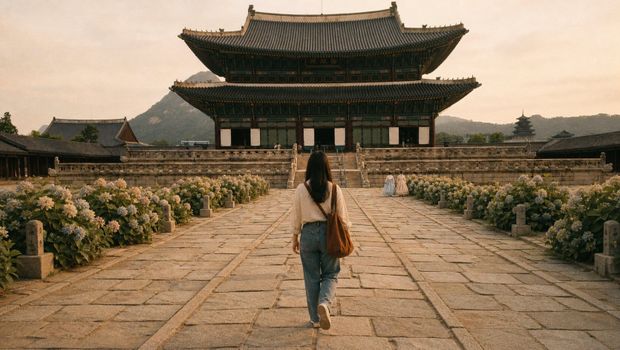
What Opened in May 2026: The New 4.3 km Garden Corridor
Jongno District's new 4.3-kilometre roadside garden corridor is a continuously planted pedestrian walkway linking Gyeongbokgung Palace through Samcheong-ro, Hyoja-ro, and Cheongwadae-ro, completed in May 2026 after three years of construction at a total cost of 346 million won (approximately USD $230,000) . Unlike a standard urban pavement supplemented with a narrow planting strip, the corridor was conceived from the outset as a strolling garden: every section carries a distinct botanical identity keyed to its street character and seasonal calendar. Entry along the entire corridor is free, with no reservation required at any time of day.
Quick Answer: The Gyeongbokgung–Cheong Wa Dae garden corridor is a free, open-access 4.3 km pedestrian walkway completed in May 2026 . No booking is needed. A separate free guided tour in 8 languages is available via Visit Seoul with 3 days' advance booking required. Note: Cheong Wa Dae interior grounds have been closed since August 1, 2025.
The most recently completed section is the Cheongwadae-ro stretch, renovated between November 2025 and May 2026. Roughly 700 hydrangea shrubs — a mix of mountain and panicle varieties — were installed along the central road divider, supplemented by year-round seasonal plantings that shift the palette from spring pinks and whites through summer's full blooms into the muted tones of late autumn and early winter . The design draws on traditional Korean garden aesthetics: granite planters, natural stone edging, and low ground cover frame the taller plantings rather than competing with them. Along the final stretch, the blue-tiled roofline of Cheong Wa Dae is visible through the foliage — a sight line that was previously blocked by traffic infrastructure.
The Hyoja-ro section introduces azaleas, Prunus japonica, and Corylopsis (winter hazel) alongside a pre-existing ginkgo canopy . In late October and November the ginkgo avenue turns a dense gold — one of the two peak photography windows across the full corridor. The Samcheong-ro section, completed in 2024, uses natural stone and flowering plants to serve as a cultural transition point between the palace district and the Bukchon Hanok Village area to the east.
Together the three sections read differently in every season. The 346-million-won investment is also notably restrained by Seoul urban development standards: no monumental installations, no commercial signage, and no lighting infrastructure that competes with the existing palace wall atmosphere. The focus is on plants, pedestrian pace, and uninterrupted sight lines — to the palace walls on one side and, at the corridor's northern terminus, to the Blue House compound beyond.
📍 View Gyeongbokgung Palace on Google Maps
Cheong Wa Dae in 2026: What's Open and What's Closed
Cheong Wa Dae (the Blue House) has been closed to the public since August 1, 2025, when the presidential office returned to the compound after a three-year period of unprecedented public access . From May 2022 through July 2025, the Blue House drew 8.5 million visitors — the first time in Korean history the compound was open to ordinary visitors . The presidential office formally returned on December 29, 2025 . The Nokjiwon rear garden — which contained 120 species of trees and commemorative plantings from former administrations — and the Sangchunjae residential complex are both inaccessible . For anyone arriving with memories of that open period: that access is now permanently over.
That said, the immediate area still offers several alternatives worth mapping before your visit. The table below shows what remains open, what is closed, and what functions as a practical substitute for each closed element.
| Location | Status (2026) | Cost | Visitor Note |
|---|---|---|---|
| Cheong Wa Dae interior compound | Closed since Aug 1, 2025 | N/A | Presidential security in effect; no public access |
| Nokjiwon rear garden (120 tree species) | Closed | N/A | Inside the secured compound perimeter |
| Sangchunjae residence | Closed | N/A | Inside the secured compound perimeter |
| Blue House Plaza (exterior photo spot) | Open | Free | Designated photography positions across the street; heavier police presence than during the open period |
| Cheongwadae Sarangchae Museum | Open | Free | Presidential history exhibits; virtual office photo opportunity; faces the Blue House directly; no booking required |
| MMCA Samcheong (courtyard and café) | Open | Free (courtyard); gallery admission separate | Blue House roofline visible from courtyard; no hiking required; café operates museum hours |
| Bugaksan trails (Samcheong Park approach) | Partially open | Free | Physical passport required at security checkpoints; drones prohibited; adds 1.5–2 hours to the walk |
The Cheongwadae Sarangchae Museum is the most practical substitute for visitors who had expected to enter the compound . It faces the Blue House directly, its exhibits cover presidential history in enough depth to provide the context that interior tours once delivered, and the virtual office photo station has become a popular alternative to the in-compound photography that was possible during the open period. Admission is free and no advance booking is required.
The MMCA Samcheong courtyard is a quieter fallback. The museum was built on historic Joseon-era government grounds, and its outdoor courtyard frames a clear view toward the Blue House's distinctive tiled roofline without requiring any hike or additional preparation. It is a natural mid-route rest point on the garden corridor walk, situated roughly halfway between Gyeongbokgung and the Blue House Plaza.
📍 View Cheongwadae Sarangchae Museum on Google Maps
📍 View MMCA Seoul (Samcheong) on Google Maps
Guided Tour vs. Self-Guided Walk: Which to Choose
Visit Seoul's official "Gyeongbokgung Stonewall Walkway and Cheong Wa Dae Course" is a 2-hour guided walking tour that covers the same corridor in sequence, with expert narration at each historical stop . It is available in eight languages — Korean, English, Chinese, Japanese, Vietnamese, Malay, Indonesian, and Thai — and departs from Gyeongbokgung Station, Line 3, Exit 5, finishing near Yeongchumun Gate. The guided option adds contextual value that the physical corridor alone cannot supply: at Dongsipjagak (Joseon's only free-standing palace watchtower) and at the MMCA grounds, the architectural and dynastic context substantially changes what a visitor is looking at. For first-time visitors with an interest in Korean history, that context is the central justification for booking.
"The Gyeongbokgung Stonewall Walkway and Cheong Wa Dae course covers the transition from Joseon royal architecture to the modern presidential precinct — it is the only walking programme in the series where visitors can follow five centuries of Korean governance within a single route." — Visit Seoul, programme overview, 2026
The table below separates the two options across the criteria most relevant to a visitor deciding how to approach the corridor.
| Factor | Official Guided Tour | Self-Guided Walk |
|---|---|---|
| Booking required | Yes — minimum 3 days in advance; slots open on the 15th of the prior month | No — walk any time, any day |
| Group size | Minimum 3, maximum 10 participants per session | Any size, individual or group |
| Departure times | Weekdays 10:00 and 14:00; weekends 10:00, 14:00, 15:00 | Any time |
| Languages supported | 8 (Korean, English, Chinese, Japanese, Vietnamese, Malay, Indonesian, Thai) | Self-directed; supplementary audio guides available separately |
| Weather dependency | Cancelled during heatwave, typhoon, heavy rain, or severe air-quality warnings | Walk at own discretion regardless of advisory level |
| Historical narration at stops | Yes — Dongsipjagak, MMCA, Jongchinbu site, Cheong Wa Dae precinct | No — visitor researches context independently |
| Accessibility programmes | Available on request — contact Visit Seoul in advance | Flat terrain throughout; suitable for all fitness levels |
| Cost | Free (2026 programme) | Free |
The decision framework is straightforward. Book the guided tour if: this is your first visit, you have a strong interest in Korean history and architecture, you can commit to the three-day advance booking window, and you are visiting in a group of at least three. Walk independently if: you are returning to the area, arriving spontaneously, primarily visiting to photograph the garden plantings and K-drama filming spots, or travelling solo. The corridor itself covers the same ground either way.
A note for solo travellers: the minimum of three participants per guided tour session means solo bookings only proceed if two other participants have already registered for the same slot. Check the VisitSeoul booking calendar on the 15th of the prior month — early-month slots tend to have fewer confirmed participants than late-month ones. Special accessibility programmes are arranged separately from standard group slots; contact Visit Seoul at least one week before your intended visit date .
K-Pop and K-Drama Filming Spots Along the Route
The Gyeongbokgung stonewall walkway — the stone-walled outer perimeter of the palace that runs along the central section of the corridor — is one of Seoul's most consistently used production backdrops. Its uninterrupted grey stone face, palace-roof sight lines, and complete absence of commercial signage create a neutral surface that reads unmistakably Korean in any filming context. Productions including Mr. Sunshine, The Red Sleeve, and Kingdom have all used sections of this wall . The MMCA Samcheong courtyard has served as an exterior location for idol photoshoots and drama sequences — its combination of Joseon-era architectural context and open courtyard space accommodates both still photography and dynamic video setups equally well.
"The Bukchon and Gyeongbokgung stonewall stretch is one of the most actively filmed locations in Seoul — there is almost always a production crew or content team working there on any given weekday morning." — Hey Roseanne, K-Pop Demon Hunters filming location guide, 2025
Demon Hunters (2025), a K-pop-adjacent animated production, used palace-adjacent streets for location photography referenced in the film's visual design — specific wall sections and gate angles along the garden corridor stretch appear in Jinu's flashback sequences . For fans recreating those shots, the relevant stretch runs between the west gate of Gyeongbokgung and the Dongsipjagak watchtower corner: the wall texture and gate ironwork are the identifiable visual elements. Morning light from the east creates directional illumination across the stone face that photographs consistently well across focal lengths.
The Cheongwadae-ro stretch gained additional contemporary K-pop relevance in April 2026 when Felix of Stray Kids was photographed in the Blue House precinct during a state luncheon for French President Macron . The new corridor's clean botanical lines and seasonal hydrangea planting have also been used as a content backdrop by multiple K-pop teams during the first spring bloom of the completed installation in May 2026 — the freshly planted Cheongwadae-ro section in particular offers an aesthetic that reads distinctively Korean without relying on the same stone wall compositions used in most palace-district content.
For fan photography across the full route: arrive before 9:00 AM on weekdays. Both the stonewall corridor and the Blue House Plaza exterior are at their least crowded in the hour before the main visitor wave, and the morning light is directional rather than flat. Afternoon visits produce more even lighting but substantially more foot traffic in frame.
📍 View Gyeongbokgung Stonewall Walkway on Google Maps
Season by Season: Best Time to Walk the Corridor
The corridor's planted sections were designed for year-round botanical interest, which means no season is categorically unsuitable — but two windows stand out as significantly stronger for photography and overall atmosphere. Spring and autumn both offer peak conditions on different sections of the route, and the planting choices reinforce that split intentionally.
Spring (March–May): Cherry blossom trees near the palace walls bloom from late March through mid-April, overlapping with the azalea season on Hyoja-ro. By May, the Cheongwadae-ro hydrangea planting reaches its first full spring display — the corridor's most photogenic state as a whole, with multiple flowering species at peak simultaneously . Spring is the most crowded window, particularly on weekends during cherry blossom peak — early weekday mornings are the practical workaround.
Summer (June–August): Panicle hydrangeas along Cheongwadae-ro peak in July and August, producing the most architecturally dramatic floral display of the year. Seoul's summer heat is significant, however. Heat advisories can trigger guided tour cancellations, and the corridor walk is fully exposed in several sections. Self-guided walkers in summer should plan an early start, carry water, and check weather conditions the morning of their visit before committing to the Bugaksan add-on.
Autumn (October–November): The Hyoja-ro ginkgo canopy turns dense gold in late October. October through November is also Seoul's least humid season, making it the more comfortable of the two peak windows for extended walking. Warm ambient light and fallen leaves add texture to the stone wall face — this is when the stonewall section photographs most richly. Visitor numbers are substantial but more manageable than peak spring.
Winter (December–February): Year-round seasonal plantings maintain colour along Cheongwadae-ro even in the coldest months. Visitor numbers drop significantly, all corridor sections and museums remain open, and the guided tour continues unless specific weather alerts are in effect. For visitors who value clear sightlines and quiet over peak bloom, winter offers a version of the corridor that most spring and summer visitors never see.
Bugaksan Trail Add-On: Aerial Views Over the Blue House
Bugaksan Mountain provides the only above-roofline views of Cheong Wa Dae available to the public in 2026. Rising directly behind the Blue House compound, the mountain's southern slopes offer clear sight lines over the distinctive tiled roof and compound grounds that no street-level position can match — including the Blue House Plaza exterior spot and the MMCA courtyard view. Adding the Bugaksan circuit to the garden corridor walk extends the total outing by 1.5 to 2 hours and involves a moderate ascent on natural trail surfaces. It is physically more demanding than the flat garden corridor, but it is also the only way to see the compound from above.
The most reliable trailheads are via Samcheong Park to the east and along the Seoul Fortress Wall approach to the west . The Chunchugwan (Press Center) approach to the south is frequently restricted by presidential security personnel and should not be treated as a primary option — guards may turn visitors away without explanation and without a defined schedule for when access resumes. Plan Samcheong Park as your default trailhead.
Three firm requirements apply at security checkpoints on the trail:
- Physical passport only. Phone screenshots of passport identification pages are not accepted at any checkpoint. Plan 10 to 15 additional minutes for the check-in process .
- Drones are prohibited without exception. Military jamming systems are actively operated in this zone. Flying a drone on or near Bugaksan may result in immediate equipment seizure, a substantial fine, or arrest. This is a national security restriction, not a local regulation with discretionary enforcement .
- Trail access can change on short notice if the presidential security situation shifts. Check trail conditions the morning of your visit before departing.
The Visitkorea forest walk (Course 4) covers 3.9 km from Baekakjeong through Cheong Un Dae at 293 m elevation and Baekakma Peak at 342 m to Changui Gate, with a logged completion time of approximately 1 hour 37 minutes . The views south across Gyeongbokgung and the Gwanghwamun plaza from the upper sections are among the most comprehensively documented in north Seoul photography — and they are only available from this elevation.
📍 View Samcheong Park (Bugaksan trailhead) on Google Maps
Walk Route at a Glance: Start, Stops, and Return
The full Gyeongbokgung–Cheong Wa Dae corridor is 4.3 km one-way on flat terrain, requires no ticketing or reservation to complete independently, and suits all fitness levels . Budget 2 to 3 hours to include a stop at the Cheongwadae Sarangchae Museum. The ordered sequence below maps the stops used by both the official guided tour and the recommended self-guided route.
Start: Gyeongbokgung Station, Seoul Metro Line 3, Exit 5 . This is the departure point for the official guided tour and the most direct street-level entry to the stonewall walkway.
- Dongsipjagak — the only surviving free-standing watchtower in Joseon palace architecture, located at the south-east corner of the palace perimeter. The first historically significant stop from Exit 5 and a focal point on the guided tour's narration.
- MMCA Samcheong (National Museum of Modern and Contemporary Art) — courtyard and café with a clear Blue House roofline view. Built on Joseon-era government office grounds; the café is a natural mid-route rest stop.
- Jongchinbu Government Office site — historical marker along Samcheong-ro; the original location of a Joseon royal kinship management bureau. Narrated stop on the guided tour.
- Cheongwadae-ro garden stretch — the newly completed section of the corridor (November 2025–May 2026) with approximately 700 hydrangea shrubs along the central divider . Best in May (mountain hydrangeas) and July–August (panicle hydrangeas).
- Blue House Plaza (Cheongwadae Plaza) — designated exterior photography positions facing the compound gates. The Blue House tiled roof is visible from here; police presence is heavier than during the 2022–2025 open period.
- Cheongwadae Sarangchae Museum — recommended stop; free admission; presidential history exhibits and virtual office photo station. Faces the Blue House directly.
- Yeongchumun Gate — the western gate of Gyeongbokgung Palace and the formal end point of the guided tour route.
Return options from the route's end:
- Bus from Gyeongbokgung bus stop back toward Gwanghwamun or central Seoul
- Taxi from Blue House Plaza — consistently available at the designated stand near the museum
- Continue north on foot to Samcheong Park for the Bugaksan trail add-on (adds 1.5–2 hours; physical passport required)
The corridor is entirely flat throughout the base route — the only gradient is a slight incline on Cheongwadae-ro approaching the Blue House area. No specialist footwear is needed. The route is stroller-accessible and the Sarangchae Museum has step-free entry.
📍 View Dongsipjagak on Google Maps
📍 View Yeongchumun Gate on Google Maps
Frequently Asked Questions
Is Cheong Wa Dae (Blue House) open to visitors in 2026?
No. The interior grounds of Cheong Wa Dae have been closed to the public since August 1, 2025, when the presidential office permanently returned to the compound . From May 2022 through July 2025, the Blue House was open to the public for the first time in Korean history, attracting 8.5 million visitors over that three-year period . That access is now permanently over. In 2026, the Nokjiwon rear garden (120 tree species) and Sangchunjae residence inside the compound are inaccessible. What remains open: the Blue House Plaza exterior for photography from across the street, and the Cheongwadae Sarangchae Museum (free admission, no booking required) which faces the compound and offers presidential history exhibits alongside a virtual office photo opportunity. The MMCA Samcheong courtyard provides a Blue House roofline view without any hiking.
Do I need to book the Gyeongbokgung–Cheong Wa Dae guided walking tour in advance?
Yes. The official Visit Seoul guided tour requires a minimum of three days' advance booking through the VisitSeoul website . Monthly slots open on the 15th of the prior month and sessions are capped at a maximum of 10 participants, meaning popular dates fill quickly after the slot release. A minimum of 3 people is required per session — solo travellers should check whether spaces in an existing booking are available at the time of booking. The tour is free and available in eight languages: Korean, English, Chinese, Japanese, Vietnamese, Malay, Indonesian, and Thai. Tours are cancelled during heatwave alerts, typhoons, heavy rain, or severe air-quality warnings, so verify conditions the night before your booked session.
Can I walk the new garden corridor without joining a guided tour?
Yes. The full 4.3 km garden corridor is freely accessible at any time with no reservation required . To walk it self-guided, start at Gyeongbokgung Station, Seoul Metro Line 3, Exit 5 — the same departure point as the official tour. Follow the stonewall walk north-west through Samcheong-ro, along Hyoja-ro, and down Cheongwadae-ro to the Blue House Plaza and the Sarangchae Museum. Key landmarks en route include Dongsipjagak (the Joseon free-standing watchtower at the palace's south-east corner), the MMCA Samcheong courtyard (mid-route rest stop with Blue House view), and the new hydrangea planting on Cheongwadae-ro. The terrain is entirely flat, suitable for all fitness levels, and stroller-accessible. Allow 2 to 3 hours at a leisurely pace including a stop at the museum.
Why do I need a physical passport to hike Bugaksan near the Blue House?
Bugaksan's southern slopes overlook the active presidential compound at Cheong Wa Dae, placing the trail within a national security perimeter. All visitors must pass through manned checkpoints where valid government-issued photo identification is verified in person — phone screenshots of passport pages are explicitly not accepted at any checkpoint . Plan an additional 10 to 15 minutes for this check-in process. Additionally, drones are strictly prohibited on and around Bugaksan: military jamming systems are actively operated in this zone, and flying a drone here can result in immediate equipment seizure and potential arrest. This is a national security restriction, not a local ordinance — it applies regardless of drone size, registration status, or operator experience.
What K-dramas and K-pop content was filmed near Gyeongbokgung and the Blue House area?
The Gyeongbokgung stonewall walkway has been used in productions including Mr. Sunshine, The Red Sleeve, and Kingdom, among others . The MMCA Samcheong courtyard has served as an exterior location for idol photoshoots and drama sequences. Demon Hunters (2025) used palace-adjacent streets for location photography referenced in its visual design — the stonewall stretch between Gyeongbokgung's west gate and Dongsipjagak is the primary fan recreation section, with the wall texture and gate ironwork as the identifiable elements . For fan photography, arriving before 9:00 AM on weekdays minimises crowd interference at both the stonewall corridor and Blue House Plaza exterior. Felix of Stray Kids was photographed in the Blue House precinct in April 2026 during a state luncheon , giving the area a current K-pop reference point beyond its historical associations.
Planning Your 2026 Visit: What to Expect and Where to Focus
The Gyeongbokgung–Cheong Wa Dae garden corridor is a coherent addition to Seoul's pedestrian landscape — a 4.3 km botanical walkway that connects one of Korea's most significant historical sites with the precinct of its former presidential compound, at no cost and with no booking required for independent visitors . The May 2026 completion of the Cheongwadae-ro section means this is the corridor's first full season at its intended scale, and the combination of new hydrangea planting, existing ginkgo avenues, and the stonewall backdrop creates a route that photographs and reads distinctively across every season.
The central decision for 2026 is how to approach the Cheong Wa Dae situation directly: the interior compound is closed and the closure is not temporary. The Sarangchae Museum and Blue House Plaza exterior are the correct substitutes — the museum's free access, central location, and virtual photo station cover the experience that most first-time visitors came for. The MMCA Samcheong courtyard handles the above-street roofline view without any additional planning. Visitors who need the true above-roofline perspective should treat the Bugaksan add-on as a separate, prepared excursion: bring a physical passport, confirm trail access the morning of, and leave the drone at home.
For K-pop and K-drama visitors, the stonewall stretch and MMCA courtyard remain the production-relevant locations, optimally accessed before 9:00 AM on weekdays. The new Cheongwadae-ro garden section is already functioning as a content backdrop in its own right during its first spring bloom. For deciding between the guided tour and independent walk: the guided option adds genuine historical context that the corridor alone does not provide, but requires advance planning; the self-guided route is available any time and covers the same ground. Both are free.
Last updated: 2026-05-28. Information reflects confirmed access conditions, tour schedules, and site status as of late May 2026. Cheong Wa Dae access conditions and Visit Seoul tour availability should be verified directly with Visit Seoul before travel.


