
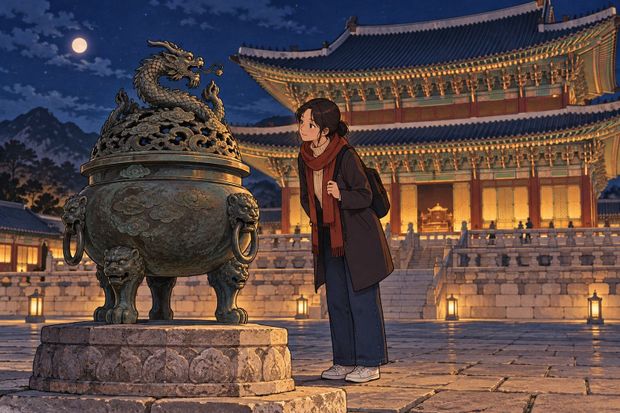
The two dragon-shaped lids on the incense burners outside Geunjeongjeon, Gyeongbokgung's main throne hall, went missing around 1961–1962. Replicas went back on display in December 2025 . This November, the people who studied those burners will talk about them in a newly painted hall a short walk away, and only 30 people can attend each talk.
What Is the 2026 Heungbokjeon Royal Culture Academy, and How Do You Book a Seat?
The 2026 Heungbokjeon Royal Culture Academy is a series of four free expert lectures on Saturdays (Nov. 7, 14, 21 and 28, 2026) at Heungbokjeon, a hall inside Gyeongbokgung in Jongno-gu, Seoul . It is run by the Gyeongbok Palace Management Office, which sits under the Korea Heritage Service's Royal Palaces and Tombs Center. The Korea Heritage Service announced the series in a press release on Oct. 12, 2026 (source: Korea Heritage Service, 2026-10).
Quick Answer: Gyeongbokgung is holding four free Saturday lectures at Heungbokjeon on Nov. 7, 14, 21 and 28, 2026. They cover palace architecture and royal incense burners. Each session has 30 seats, given first come, first served. Online booking opens Monday, Oct. 19, 2026 at 2 p.m. on royal.khs.go.kr.
Seats are the limiting factor. According to the Korea Times, each session takes 30 people on a first-come, first-served basis. Applications open online on Monday, Oct. 19, 2026 at 2 p.m. on the Royal Palaces and Tombs Center website, royal.khs.go.kr . The four sessions have different speakers and topics, so book each date you want on its own. Questions go to the Gyeongbok Palace Management Office at 02-3700-3900 .
The series has two themes, and you can pick one or attend all four dates:
- Palace architecture and history: the opening talk looks at parts of Gyeongbokgung that no longer exist. It uses historical plans such as the Bukgwoldohyeong, an old architectural drawing of the northern palace.
- Incense burners and court fragrance: three talks cover the bronze burners in front of the throne halls, how they compare with others in East Asia, and the incense used in royal rituals during the Joseon dynasty (1392–1910) .
The lectures have also moved from weekdays to weekends. According to News1, the Gyeongbok Palace Management Office made the change so more members of the public could attend. It also split the program into two themes to give people more choice . This helps visitors from abroad: a Saturday talk is easy to fit around a weekend concert or fan event in Seoul. One Korean outlet, Segye Ilbo, said the talks were on Fridays. The official release says Saturday, and Nov. 7, 2026 is a Saturday.
The coverage leaves one gap. None of the published reports give a start time or running time for the lectures. They also don't say whether the talks are in Korean only, though all four speakers are Korean scholars or writers. Before you plan your day around a session, check the official booking page on royal.khs.go.kr for the time, the language and any late changes. Also note that the program is free, but palace admission is a separate matter. The Royal Palaces and Tombs Center English site lists the current Gyeongbokgung opening hours and entry rules.
Who Is Speaking Each Saturday, and What Will Each Session Cover?
Four speakers lead the 2026 Heungbokjeon Royal Culture Academy, one each Saturday in November. On Nov. 7, writer Lee Man-hee talks about the palace's architecture. Professor Lee Yong-jin covers East Asian incense burners on Nov. 14. Former professor Jang Kyung-hee compares the throne-hall burners on Nov. 21, and Dr. Ha Su-min explains Joseon royal incense on Nov. 28 . The first session is about the palace's buildings. The other three are about the objects and rituals tied to the incense burners in front of Geunjeongjeon, the main throne hall. According to the Korea Heritage Service, the program is split into these two themes this year so attendees can pick the one they care about.
The schedule below is drawn from the Korea Heritage Service release and the Korea Times English report (2026-10), which gives the English renderings of names and titles .
| Date (Sat.) | Speaker | Topic | Who it suits |
|---|---|---|---|
| Nov. 7, 2026 | Lee Man-hee, writer | Lost spaces of Gyeongbokgung, traced through the Bukgwoldohyeong plan | Architecture and palace-history fans |
| Nov. 14, 2026 | Lee Yong-jin, art history professor, Dongguk University graduate school | Incense burners across East Asia and where the Geunjeongjeon burner fits | Object and art-history fans |
| Nov. 21, 2026 | Jang Kyung-hee, former conservation professor, Hanseo University | The throne-hall burners at Gyeongbokgung and Deoksugung compared | Object and craft fans; visitors who have seen the restored lids |
| Nov. 28, 2026 | Ha Su-min, PhD, Korea National University of Heritage | Incense types used in Joseon royal ceremonies and how the court obtained them | Ritual and court-culture fans |
Nov. 7: Lee Man-hee on the palace that no longer stands
Lee Man-hee opens the series. He draws on years of on-site work at the palaces and on his book Secrets of the Palace No One Tells You (『아무도 말해주지 않는 궁궐의 비밀』) . His main source is the Bukgwoldohyeong, an old architectural plan of the northern palace. He uses it to show where buildings once stood on ground that is now open courtyard or path. The title above follows the Korea Heritage Service release. Asia Economy prints the book title slightly differently, so search for the Korean title if you want to find the book.
Nov. 14: Lee Yong-jin on East Asian incense burners
Lee Yong-jin is a professor of art history at Dongguk University's graduate school. His talk surveys incense burners from across East Asia, then places the Geunjeongjeon burner within that tradition to show what is distinctively Korean about it . It is the broadest of the three object-focused sessions and works well as an introduction if you are new to the subject.
Nov. 21: Jang Kyung-hee on the two throne halls
Jang Kyung-hee, a former professor of cultural heritage conservation at Hanseo University, compares the incense burners in the main throne halls of two palaces. Gyeongbokgung was the principal palace of Joseon, and Deoksugung was the principal palace of the Korean Empire. She looks at how each set of burners was made and what it meant . She was also the principal researcher on the project that recreated the missing Geunjeongjeon lids. According to Korean Vibe, those lids went on public display on Dec. 24, 2025 . This is probably the only session where the speaker worked on the object being discussed.
Nov. 28: Ha Su-min on royal incense itself
The series closes with Ha Su-min, who holds a PhD from the Korea National University of Heritage. Her session moves from the burners to what was burned in them: the types of incense used in Joseon royal ceremonies and how the court obtained them . It suits fans of historical dramas who want to know more about the court rituals that sageuk show on screen.
If you can only book one date, decide by interest. Pick Nov. 7 for the buildings. Pick Nov. 21 for the lids and the burners you can see on the Geunjeongjeon terrace. Pick Nov. 14 or Nov. 28 for the wider art history or the ritual side of the story. Each session has 30 seats, so it helps to have a second choice ready when registration opens.
Why Do the Gyeongbokgung Incense Burners Matter? The Lids Stolen in the 1960s
The Geunjeongjeon incense burners matter because they are a pair of 19th-century bronze vessels that spent about 60 years without their lids, and they only became whole again in December 2025. Geunjeongjeon is Gyeongbokgung's main throne hall. The two identical burners stand on either side of it. The Korea Heritage Service (KHS) estimates the original lids went missing around 1961–1962 . It unveiled re-created lids on Dec. 23, 2025, and they have been on permanent public display since Christmas Eve, Dec. 24, 2025 . Three of the four Heungbokjeon lectures build on that project.
The burners date from the rebuilding of Gyeongbokgung under King Gojong. According to Korean Vibe's December 2025 report on the KHS announcement, they are believed to have been cast in 1866, the third year of Gojong's reign. The bronze came from a large bell that once stood west of Gwanghwamun Gate, which was melted down for the purpose . Each burner was built in the same form:
- Body: a tripod cauldron shape with two handles and three legs
- Lid: topped with a dragon, the symbol of the king
- Mounting: only the body was fixed to its stone base, so the lid could be lifted off
The way the burners were mounted explains how the lids were lost. The bodies stayed bolted to their stone bases. The dragon lids sat loose on top, and they disappeared in the early 1960s. For the six decades after that, visitors walking up to Geunjeongjeon saw two open cauldrons. If you have seen the hall in older photos or drama scenes from before December 2025, those are the lidless burners.
The replicas were made by craftspeople, not by machine. KHS worked with Won Kwang-sik, who holds the National Intangible Cultural Heritage title for cast iron craftsmanship (jucheoljang), and with his trainee Won Cheon-su. Together they cast two new lids, one for each burner . Some later coverage says "lid" in the singular. The December 2025 announcement is clear that there were two.
That project is the reason the incense-burner theme is in this year's academy. The KHS press release links the Nov. 14, 21 and 28 sessions directly to the lid re-creation carried out the previous December . Each session takes a different angle on the same objects:
- Nov. 14: Professor Lee Yong-jin places the Geunjeongjeon burner within the wider East Asian incense-burner tradition to show what makes it Korean.
- Nov. 21: Jang Kyung-hee compares the throne-hall burners of Gyeongbokgung and Deoksugung.
- Nov. 28: Dr. Ha Su-min covers what was actually burned in them: the incense used in Joseon royal rituals and how the court obtained it .
The Nov. 21 comparison comes from the person who did the research behind the replicas. The Korea Times describes Jang, a former professor of cultural heritage conservation at Hanseo University, as the researcher who "led research for the reconstructed lid" . Her talk sets Gyeongbokgung, the main palace of the Joseon dynasty, against Deoksugung, the main palace of the Korean Empire. It looks at how each pair of burners was made and what they were meant to signal . Deoksugung's throne hall is Junghwajeon, so a good way to follow the talk is to see the Junghwajeon burners in person, a short subway ride from Gyeongbokgung. Our sources do not say how many burners of this type survive across Korea's palaces, and the academic literature on dragon-lid burners in throne halls is not among the sources linked here. Jang's session is the most direct way to hear that research from someone who worked on it.
What Is Heungbokjeon, the Hall Hosting the Lectures?
Heungbokjeon is a hall inside Gyeongbokgung in Seoul's Jongno-gu. It has just been repainted with dancheong, the colourful decorative painting traditionally applied to the timber of Korean palace and temple buildings. The Korea Heritage Service's release of Oct. 12, 2026 calls the venue "Gyeongbokgung's Heungbokjeon, now painted with dancheong" . Each Saturday lecture is also a chance to spend time in a newly finished building, not just a meeting room.
The new paint is the main reason the venue itself is news. The Korea Times calls it "a newly painted hall" that will open its doors to visitors this November . The Korea Heritage Service put the dancheong in the headline of its own release, and Korean wire coverage such as News1 repeats that framing . None of these sources says whether the outside, the inside or both were painted. Because seats are capped at 30 per session, the people attending are among the few who will see the space this way during the program .
Most of Gyeongbokgung as it stands today dates from King Gojong's reconstruction in the 1860s. That is the same project in which the Geunjeongjeon incense burners are believed to have been cast, in 1866 . Heungbokjeon's own history is not covered by the release or the articles linked here. That includes how the Joseon court used the hall, what happened to it in the colonial period, and when its modern restoration was finished. For those details, rely on the palace's information panels next to the building, not on summaries from other sites.
Things to look for on the day:
- The dancheong itself: new paint looks brighter and more saturated than the weathered colour on older halls nearby. Comparing the two is a quick way to see what restoration changes.
- The setting for Lee Man-hee's Nov. 7 talk: his lecture covers parts of Gyeongbokgung that no longer exist. Listening to it from inside a palace hall puts his historical maps in a real setting .
- The walk to Geunjeongjeon: the incense burners covered in the Nov. 14 and Nov. 21 sessions stand in front of the main throne hall on the same palace grounds. You can see them before or after the talk.
Heungbokjeon | Heritage hall and lecture venue
For the 2026 academy, Heungbokjeon works as a small lecture hall for a free four-week series on Saturdays, Nov. 7–28, run by the Gyeongbok Palace Management Office . Its main draw is the new dancheong. You get to see restored palace architecture up close while experts talk about the same palace.
📋 Inside Gyeongbokgung, Jongno-gu, Seoul · Lectures on Saturdays, Nov. 7, 14, 21 and 28, 2026 · Newly painted dancheong; 30 seats per session; enquiries 02-3700-3900
💡 The release does not say where in the palace grounds Heungbokjeon is. Arrive early, ask at the ticket booth or check the palace map, and leave time to find the hall before your session starts.
📍 161 Sajik-ro, 종로1.2.3.4가동 Jongno District, Seoul
🕒 Daily 9:00 AM – 6:00 PM
⭐ 4.9 (18 reviews)
🔗 View on Google Maps
How Do You Get to Heungbokjeon Inside Gyeongbokgung?
To reach Heungbokjeon, enter Gyeongbokgung Palace in Jongno-gu, central Seoul, and walk north past the throne hall Geunjeongjeon. The hall is in the palace's inner quarters, so getting through the gate is only the first step. Gyeongbokgung Station on Seoul Subway Line 3 and Gwanghwamun Station on Line 5 are the closest stations . Allow 10 to 15 minutes to walk from the gate to the lecture hall.
The palace is large, and the way from the main entrance runs through several courtyards. Most visitors come in from the south through Gwanghwamun Gate. From there, the path north passes Heungnyemun Gate and the courtyard of Geunjeongjeon. That courtyard is also where the incense burners with the recreated dragon lids stand. You can see them on your way to the hall before a lecture about them. Heungbokjeon is further into the residential section, past the throne hall complex.
Station exits and gate opening arrangements can change. Check the directions on the Royal Palaces and Tombs Center's English Gyeongbokgung page before you go, and pick the exit closest to the gate you plan to use.
- Subway: Gyeongbokgung Station (Line 3) is next to the palace's western side. Gwanghwamun Station (Line 5) is south of Gwanghwamun Gate . Confirm the exit number on the official page or in the station.
- Inside the grounds: Head north past Geunjeongjeon toward the inner residential quarters. If you aren't sure of the way, ask at the ticket booth or check the palace map at the entrance.
- Enquiries: The Gyeongbok Palace Management Office is on 02-3700-3900 .
The Heungbokjeon Royal Culture Academy is free . Getting into the palace is a separate matter. The Korea Heritage Service release and the Korea Times report do not say whether registered participants pay the regular palace admission or get in free. Plan to buy a regular ticket unless your booking confirmation says otherwise. Check the current fee and the palace's weekly closing day on the official palace site before you travel. All four sessions are on Saturdays: Nov. 7, 14, 21 and 28, 2026 .
The published coverage does not give a lecture start time. Look for it on the booking page at royal.khs.go.kr when you register, and plan your arrival from that. On a Saturday in November there may be queues at the ticket booth and crowds on the main path. Arrive at the palace gate at least 30 minutes before the session so you have time to buy a ticket, walk past Geunjeongjeon and find Heungbokjeon. Each session has only 30 seats . If you are late, you may miss the opening part of a talk you had to compete to book.
When Should You Visit, and How Do You Make the Most of a 30-Seat Talk?
Pick the Saturday that matches your interest, and apply for it the moment booking opens. Online applications open on Monday, Oct. 19, 2026 at 2 p.m. on the Royal Palaces and Tombs Center website (royal.khs.go.kr) . Each session takes 30 people on a first-come, first-served basis . Seats in a free program this small can fill quickly, so preparation matters more than the day you choose.
Here is how to give yourself the best chance of getting a seat:
- Treat each Saturday as its own booking. The four lectures are listed as separate sessions. If you want more than one, plan to apply for each one when registration opens, rather than expecting a single pass to cover the whole series.
- Get your login ready before 2 p.m. Open royal.khs.go.kr ahead of time and sort out any account or sign-in step in advance, so you are not filling in forms while seats go.
- Overseas visitors: check the form early. The press release does not say what personal details the application asks for. Korean booking sites sometimes ask for a Korean mobile number or identity check. Look at the form before Oct. 19 so it does not catch you out.
- Keep the phone number handy. For questions, the Gyeongbok Palace Management Office takes calls on 02-3700-3900 .
The four Saturdays suit different readers:
- Nov. 7, lost architecture: for anyone curious about the parts of Gyeongbokgung that no longer stand. Writer Lee Man-hee works from historical plans such as the Bukgwoldohyeong .
- Nov. 14 and Nov. 21, the burners and the lids: for readers who want the full incense burner story. The first session places it across East Asia. The second compares the burners at Gyeongbokgung and Deoksugung, and is led by the researcher behind the lid reconstruction .
- Nov. 28, ritual and fragrance: for anyone interested in what Joseon court ceremonies actually smelled like, including the types of incense used and how the court obtained them .
If you can attend only two sessions, Nov. 14 and Nov. 21 go well together. After the talk, walk to the Moon Terrace in front of Geunjeongjeon and look at the two burners. Their re-created dragon lids have been on permanent public display since Dec. 24, 2025 . Seeing the objects right after hearing how they were researched and cast is the most direct way to connect the lecture to the palace.
Two notes on the reporting. First, language: none of the published reports say whether the lectures are given only in Korean or come with interpretation. If you do not speak Korean, call the Management Office before you apply rather than assuming either way. Second, the day of the week: one Segye Ilbo subheadline says the talks are on Fridays. The Korea Heritage Service release and other outlets say Saturdays, and Nov. 7, 2026 is a Saturday . Plan around Saturdays.
If you came to Korea for K-culture, the palace rooflines, dancheong colours and throne-hall settings you see in music videos and historical dramas come from places like this. The academy is a free way to learn about the real objects behind those images, in a room of 30 people instead of a crowd. In short: pick your Saturday now, be online at 2 p.m. on Oct. 19, check the language question by phone, and save time after the talk for the burners on the Moon Terrace.
Frequently Asked Questions
Is the Heungbokjeon Royal Culture Academy free?
Yes. The Korea Heritage Service lists all four Heungbokjeon Royal Culture Academy lectures as free . Heungbokjeon is inside Gyeongbokgung, so you still have to go through the palace gate to get there. The announcement does not say whether people with a booking get in without a regular palace ticket. Check the Korea Heritage Service announcement and the booking page before you go, or call the Gyeongbok Palace Management Office on 02-3700-3900 .
When does booking open and how do I apply?
Online booking opens on Monday, Oct. 19, 2026 at 2 p.m. Korea time. You apply on the Royal Palaces and Tombs Center website, royal.khs.go.kr . Each lecture has its own sign-up and takes 30 people, first come, first served, according to The Korea Times . Seats are limited, so sign in to the site a few minutes before 2 p.m.
What dates are the lectures?
There are four lectures, all on Saturdays in November 2026 . One Korean report said Fridays, but the official announcement says Saturdays, and Nov. 7, 2026 is a Saturday. None of the published reports give a start time, so check the booking page for it.
- Nov. 7: Writer Lee Man-hee talks about parts of Gyeongbokgung that no longer exist, using the Bukgwoldohyeong, an old floor plan of the palace.
- Nov. 14: Professor Lee Yong-jin of Dongguk University compares incense burners across East Asia and explains what makes Korea's different.
- Nov. 21: Jang Kyung-hee, a former professor at Hanseo University, compares the throne-hall incense burners at Gyeongbokgung and Deoksugung.
- Nov. 28: Ha Su-min, who holds a PhD from Korea National University of Heritage, explains the types of incense used in Joseon royal rituals and how the court got them.
What happened to the Geunjeongjeon incense burner lids?
Two bronze incense burners stand outside Geunjeongjeon, the main throne hall of Gyeongbokgung. Each one originally had a dragon-shaped lid. Only the bodies were fixed to their stone bases, and the Korea Heritage Service estimates the lids went missing around 1961–1962 . The burners are believed to have been cast in 1866 from a melted-down bell. The Korea Heritage Service announced copies of the two lids on Dec. 23, 2025, and they have been on permanent display since Dec. 24, 2025, according to Korean Vibe . They were cast with master craftsman Won Kwang-sik, who holds a national intangible cultural heritage title for cast-iron work.
Where is Heungbokjeon?
Heungbokjeon is a hall inside Gyeongbokgung Palace in Jongno-gu, central Seoul. The building has just been painted with new dancheong, the traditional colour patterns used on palace buildings, according to the News1 report on the Korea Heritage Service announcement . The Gyeongbok Palace Management Office runs it. For general information about the palace, see the Royal Palaces and Tombs Center's English site. After the lecture, you can walk over to Geunjeongjeon to see the incense burners with their new lids.
📍 161 Sajik-ro, 종로1.2.3.4가동 Jongno District, Seoul
🕒 Daily 9:00 AM – 6:00 PM
⭐ 4.9 (18 reviews)
🔗 View on Google Maps
Enjoyed this article? Subscribe to get new stories by email whenever they're published.
This article was written using information collected and analyzed by NAMANE's in-house K-pop research AI engine. We use AI technology to bring you faster, broader coverage, and in the process some details may occasionally differ from the latest facts. For important information such as dates, venues, and prices, please double-check with official sources.


