
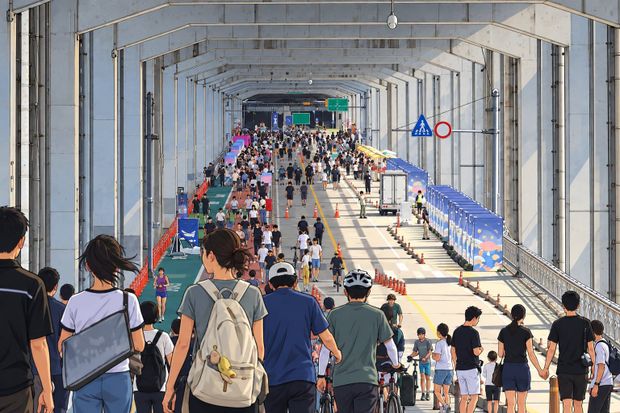
From midnight on Monday, October 26, 2026, cars will no longer be allowed on Jamsugyo, the low bridge under Banpo Bridge. Seoul will rebuild it as the first Han River bridge used only by pedestrians and cyclists. If you are visiting Seoul this autumn, Sunday, October 25, is the last car-free festival day before construction starts.
When does Jamsugyo Bridge close to cars, and what happens next?
Jamsugyo Bridge closes to all vehicles at 00:00 on Monday, October 26, 2026. The Seoul Metropolitan Government (SMG) announced the closure on October 8. It starts right after this year's last Car-Free Jamsugyo festival on Sunday, October 25 . Construction will then turn it into Seoul's first pedestrian-only bridge over the Han River. According to the Seoul Metropolitan Government, the work is due to finish by August 2027 .
Quick Answer: Seoul closes Jamsugyo (Jamsu Bridge) to cars at 00:00 on October 26, 2026, after the last car-free Sunday on October 25. For most of the construction period, people can still walk and cycle across. The bridge is due to reopen as Seoul's first pedestrian-only Han River bridge by August 2027.
This is the first time cars will be fully banned from the bridge since it opened in 1976 as a road link between the north and south banks of the Han River . Pedestrians and cyclists have already been sharing it with cars for years. In 2008, the city turned two of its four lanes into space for walking and cycling .
The city's main reason for choosing this bridge is its traffic numbers. The Korea Times reports that Jamsugyo carried about 20,200 vehicles a day on average last year. That is roughly one-fifth of the about 100,000 a day on other Han River bridges . Cars will now use Banpodaegyo, the upper deck, instead. SMG's traffic study expects travel speeds to drop only slightly, with no change in the road's overall service level .
Key dates for visitors:
| Date | What happens | Can you walk or cycle across? |
|---|---|---|
| Sundays, Sept. 6 – Oct. 25, 2026 | Car-Free Jamsugyo "Tteobuktteobuk" festival | Yes, across the full width of the bridge |
| Oct. 26, 2026, 00:00 | Bridge closes to all vehicles; construction begins | Yes, on paths kept separate from the work zones |
| About 1.5 months between May and August 2027 | Paving work | No; detour via Banpodaegyo (exact dates not yet announced) |
| By August 2027 (second half of 2027) | Pedestrian bridge finished | Yes, as a pedestrian-only bridge |
For most of the construction period, you can still cross on foot or by bike. According to the Korea Herald, the exception is a full closure of about six weeks for paving in 2027. During that time, everyone must cross via Banpodaegyo instead . If your trip is in mid-2027, check Seoul's notices before you go. The exact dates have not been published yet.
A note on names: Seoul's official English materials call it "Jamsugyo." Press outlets such as Korea JoongAng Daily and SBS use "Jamsu Bridge." Both names refer to the same bridge, which runs between Yongsan on the north bank and Banpo Hangang Park on the south bank.
What is Jamsugyo, and why is this closure a first?
Jamsugyo is a low road bridge across the Hangang (Han River). It opened in 1976 to connect the river's northern and southern banks . The closure is a first because cars have always used the bridge. Even after part of it was given to pedestrians in 2008, vehicles kept two lanes. From October 26, 2026, that changes for the first time in about 50 years .
According to the Seoul Metropolitan Government, the bridge has been an important transport link for Seoul residents since it opened. Its layout is different from most crossings in the city. Jamsugyo is the lower deck of the two-level Banpo Bridge (Banpodaegyo) structure, and it sits closer to the water than any other Hangang bridge . Standing on it, you are only a short distance above the river, with Banpodaegyo's upper deck directly overhead.
The bridge has been partly reclaimed for walkers before, but never fully. Here is how its use has changed:
- 1976: Opens as a road bridge with four lanes, two in each direction .
- 2008: Two of the four lanes are converted into space for pedestrians and cyclists. Cars still use the other two .
- September 6 – October 25, 2026: The Car-Free Jamsugyo festival closes the bridge to cars on Sundays only .
- October 26, 2026, 00:00: Vehicles are banned completely, and work begins to turn it into Seoul's first pedestrian-only Hangang bridge .
Traffic volume helps explain why Jamsugyo was chosen. The bridge carried about 20,200 vehicles a day on average last year. Other Hangang bridges carry about 100,000 a day, so Jamsugyo handled roughly one-fifth as much . Cars that used it will now cross on Banpodaegyo above. The city's traffic-impact analysis expects only a small drop in travel speeds and no change in the road's overall level of service .
For visitors, the result is simple. The two lanes that stayed open to cars after 2008 will become walking and event space. The city plans to finish this work by August 2027, in the second half of the year . Until then, Jamsugyo is a construction site with separated walking and cycling paths, not a finished promenade. Plan any visit with that in mind.
How do you spend the last car-free Sunday, Oct. 25?
Sunday, October 25, 2026 is the final Car-Free Jamsugyo "Tteobuktteobuk" festival day. It is also your last chance to cross the bridge while it still has its current road layout. The festival has run every Sunday since September 6, 2026, and ends that day . The full closure to cars begins at 00:00 on Monday, October 26 , so plan to be off the bridge before midnight.
The sources we reviewed (Korea Times, SBS) do not publish a stage line-up, performer list or exact hours for the October 25 festival. Check the Seoul Metropolitan Government's official notices the week before. The plan below covers only the walk itself and does not assume any programme.
A Yongsan resident told SBS it would be "great to come play with family" once cars are gone from the bridge, according to SBS News.
A simple four-part day plan
- Morning: pick a side. From the north, you walk down from the Yongsan/Itaewon side. The city's 2027 plan will remove the road lanes in the north-end underground passage to make this route easier, but that change has not happened yet . From the south, you start at Banpo Hangang Park near Somesevit.
- Midday: cross at river level. Jamsugyo is the lower deck of the two-level Banpo Bridge structure. It sits closer to the water than any other Hangang bridge , so the river is right beside you the whole way.
- Afternoon: break on the south bank. The Banpo Hangang Park lawns and the Somesevit area are the natural places to rest, eat and wait for the light to change.
- Evening: leave early. Don't cut it close to midnight. Head for transit well before 00:00, when the vehicle ban starts.
Jamsugyo Bridge | Landmark
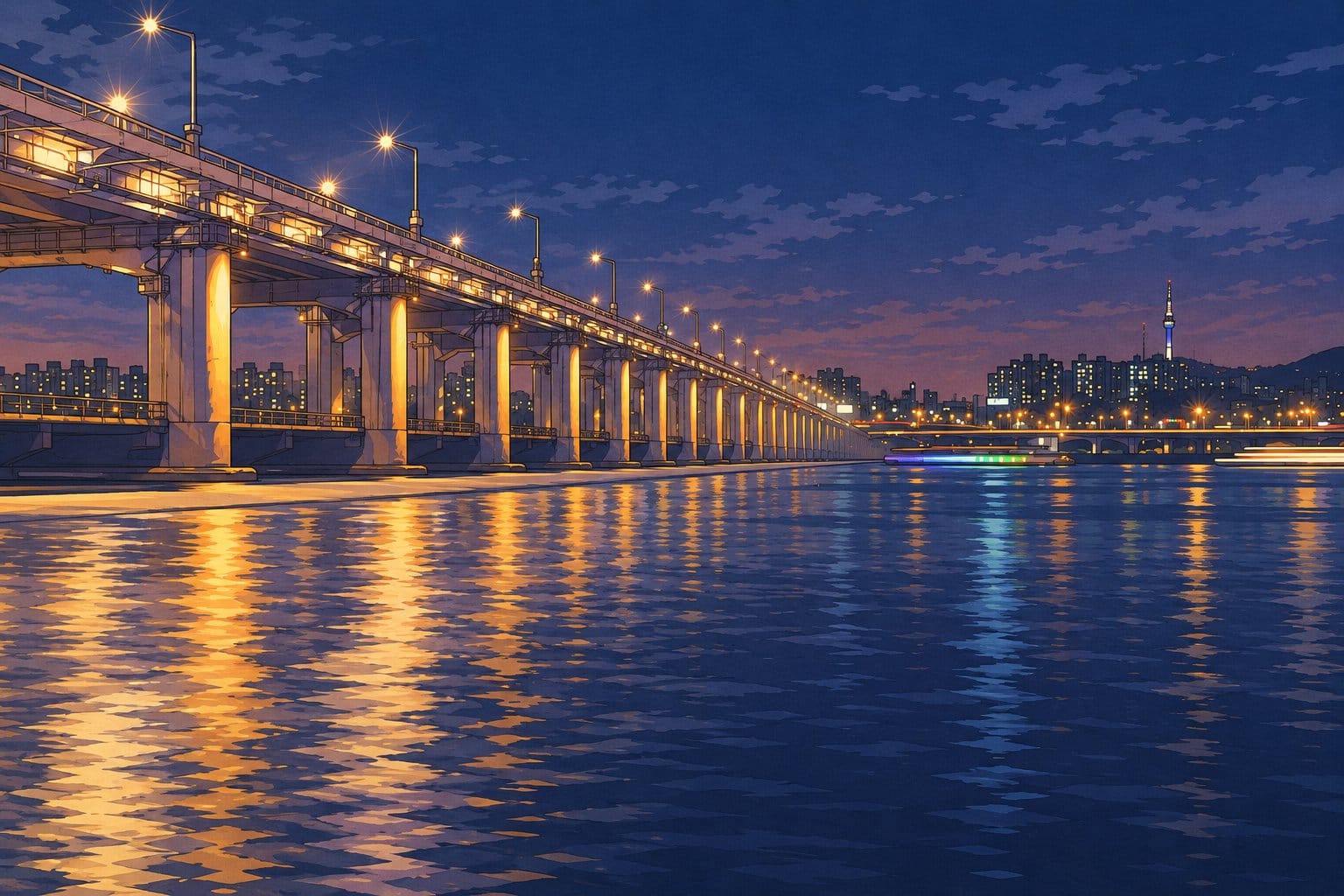
Jamsugyo opened in 1976 as a road bridge linking the two banks of the Hangang . Two of its four lanes have been given to pedestrians and cyclists since 2008 . On October 25 you can walk the full width of the bridge for the last time before construction separates the work zones from the walking and cycling paths .
📋 Lower deck of Banpodaegyo (Banpo Bridge), between Yongsan-gu and Seocho-gu · Festival day: Sunday, Oct. 25, 2026; vehicle closure from 00:00 Oct. 26 · Feature: the Hangang bridge closest to the water
💡 Walk across once in daylight and once after dark. The water level and the bridge lights make it feel like two different places.
📍 Banpo-dong, Seocho District, Seoul
⭐ 4.4 (1,196 reviews)
🔗 View on Google Maps
Banpo Hangang Park & Somesevit | Riverside park
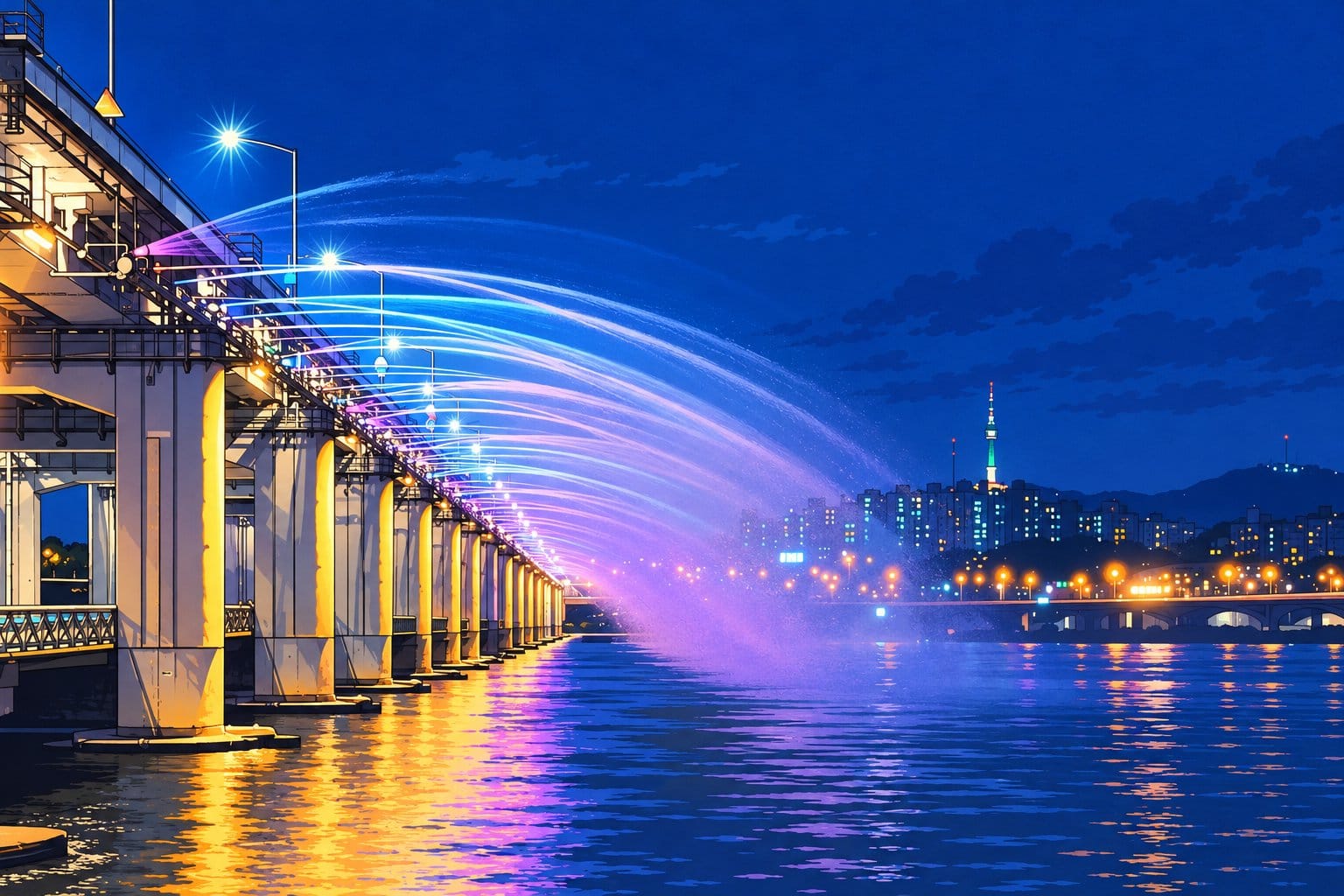
At the south end of Jamsugyo, Banpo Hangang Park and the Somesevit floating islands are the main rest stop for a festival-day crossing. The south-end bus stops are named after them: "Banpo Hangang Park, Somesevit" (반포한강공원·세빛섬) .
📋 South bank of the Hangang, Seocho-gu · Nearest stops: "Banpo Hangang Park, Somesevit" (until the closure), then "South End of Banpodaegyo Bridge, Hangang Park Entrance"
💡 Bring a mat or a light layer for sitting on the lawn. You'll be right at river level.
📍 40 Sinbanpo-ro 11-gil, Seocho District, Seoul
🕒 Daily Open 24 hours
⭐ 4.4 (7,971 reviews)
📞 02-3780-0541
🔗 View on Google Maps
📍 View on Google Maps (Somesevit)
Getting there and away
City bus routes 740 and 405 currently cross Jamsugyo. They move to Banpodaegyo in both directions as part of the vehicle closure, and at the same point the two "Banpo Hangang Park, Somesevit" stops close . On the evening of October 25, check the stop signage before you count on a late bus from those stops. From October 26, use the "South End of Banpodaegyo Bridge, Hangang Park Entrance" stops instead .
Meals, breaks and packing
Late-October evenings in Seoul are usually cool, and an open river deck can feel windier than the streets above. This is general seasonal advice, not a forecast. Dress in layers, bring a windproof outer layer, and wear comfortable shoes, since a round trip from Yongsan to Banpo adds up. Eat before you go or plan a meal on the south bank, and carry water. With no published festival programme, assume food options on the bridge itself are limited.
Which buses and routes change after Oct. 26?
Starting at 00:00 on October 26, 2026, all car traffic that used Jamsugyo moves to Banpodaegyo, the upper deck of the same two-level structure. Seoul city bus routes 740 and 405 will cross the river on Banpodaegyo in both directions . Because of the reroute, the two "Banpo Hangang Park · Somesevit" stops at the bridge's south end will close. If you ride either route, use the nearby "South End of Banpodaegyo Bridge, Hangang Park Entrance" stops instead (source: Seoul Metropolitan Government, 2026-10).
The change affects two specific stops and two named routes. According to the Seoul Metropolitan Government, one "Banpo Hangang Park · Somesevit" (반포한강공원·세빛섬) stop serves each direction, and both will close . The replacement stops are called "South End of Banpodaegyo Bridge, Hangang Park Entrance" (반포대교남단·한강시민공원입구) . Keep the Korean names handy. Seoul's bus displays and map apps often show stop names in Korean first, and searching in Hangul is the quickest way to find the right stop.
| Item | Before Oct. 26, 2026 | From Oct. 26, 2026 (00:00) |
|---|---|---|
| Bus 740 | Crossed the Hangang via Jamsugyo | Crosses via Banpodaegyo in both directions |
| Bus 405 | Crossed the Hangang via Jamsugyo | Crosses via Banpodaegyo in both directions |
| "Banpo Hangang Park · Somesevit" stops (south end, one per direction) | In service | Closed |
| "South End of Banpodaegyo Bridge, Hangang Park Entrance" stops | In service | Use these instead of the closed stops |
| Private cars and other vehicles | Could use Jamsugyo | Sent to Banpodaegyo; Jamsugyo closed to all vehicles |
The announcement covers only the river crossing and these two stops. It does not list changes to other parts of either route. Before your trip, check the live route in a map app rather than relying on older screenshots or saved directions.
The city says the impact on road traffic should be limited. According to The Korea Times, Jamsugyo carried about 20,200 vehicles a day on average last year. That is roughly one-fifth of the about 100,000 vehicles a day on other Hangang bridges . SMG's traffic-impact analysis expects only a small drop in travel speeds once vehicles are detoured, with no change in the road's overall level of service (source: The Korea Herald, 2026-10) . That is the city's forecast, not a measured result. Real conditions on Banpodaegyo after October 26 have not been reported yet.
For a fan staying in Yongsan or around Itaewon and heading to Banpo Hangang Park or the Somesevit islands, the practical changes are:
- By bus: On 740 or 405, get off at "South End of Banpodaegyo Bridge, Hangang Park Entrance". The "Somesevit" stop at the south end is closed.
- By taxi or car: Expect your driver to cross on Banpodaegyo. Jamsugyo has no vehicle access from October 26 .
- On foot or by bike: The vehicle closure does not end walking or cycling on the bridge. The next section explains how access works during construction.
Can you still walk or cycle across during construction?
Yes, for most of the construction period. After Jamsugyo closes to cars at 00:00 on October 26, 2026, pedestrians and cyclists can keep crossing on paths kept separate from the work zones . The one exception is a paving phase in 2027. During that phase the bridge closes to everyone for about 1.5 months .
The Korea JoongAng Daily also reports that walkers and cyclists keep their access while work goes on around them . If you're in Seoul this winter or early next spring, you can still walk the low deck between the Banpo Hangang Park side and the Yongsan side of the river. Expect fencing, machinery and narrower lanes instead of the open roadway people had during this autumn's Sunday festivals.
The 2027 paving window: about six weeks with no crossing
According to Seoul Metropolitan Government's Media Hub, paving work is scheduled sometime between May and August 2027. During that work, walking and cycling on Jamsugyo will be fully blocked for about 1.5 months, or roughly six weeks . Seoul hasn't announced the exact start and end dates. Any specific week you see quoted elsewhere is a guess, not an official schedule.
- Now through spring 2027: Pedestrian and bicycle crossing stays open on separated paths .
- About 1.5 months between May and August 2027: Closed to walkers and cyclists for paving. Dates not yet published .
- By August 2027 (second half of 2027): Planned completion of the wider pedestrian deck and other improvements .
Detour via Banpodaegyo
While the paving block is on, use Banpodaegyo, the upper bridge that sits directly above Jamsugyo . You still cross the river at the same point, but on the upper level and alongside vehicle traffic, so the crossing is less relaxed than the low deck. Cyclists on the Hangang riverside paths should allow extra time to get up to the upper deck and back down.
📍 Banpo-dong, Seocho District, Seoul
⭐ 4.5 (5,463 reviews)
📞 02-3780-0578
🔗 View on Google Maps
Planning a spring or summer 2027 trip
If your trip is built around a concert or fan event in Seoul between May and August 2027 and you want a riverside walk on Jamsugyo, keep that walk flexible:
- Check the Seoul Metropolitan Government English site and the Seoul Media Hub again closer to your dates. That's where the closure window is most likely to be announced.
- Have a backup in the same area, such as the Banpo Hangang Park riverbank on the south side, so a closed bridge doesn't cost you the evening.
- If you're cycling, plan a route that can switch to Banpodaegyo without a big detour.
Outside that roughly six-week window, you can still cross on foot or by bike before the bridge's planned 2027 reopening as a full pedestrian space.
What will the finished pedestrian bridge look like?
When it reopens, Jamsugyo will be a pedestrian-only deck low over the Hangang. Under the Seoul Metropolitan Government (SMG) plan, it will have 22 new river-viewing spots and glass-floor sections over its two navigation channels. SMG says the wider deck, paving and other improvements will be finished by August 2027. Seoul's Korean-language announcement gives the reopening as the second half of 2027 . The city plans to use the space for cultural events and festivals rather than as a crossing only (source: Seoul Metropolitan Government, 2026-10).
Jamsugyo already sits closer to the water than any other Hangang bridge, and the design builds on that. According to The Korea Herald and Korea JoongAng Daily, the plan includes these features:
- 22 viewing spots along the deck for looking at the river up close .
- Glass-floor sections at the bridge's 2 navigation channels, so you can look straight down at the water and passing boats .
- A wider pedestrian deck and new paving across the whole span, due by August 2027 .
- A walkable north end: the road lanes in the underground passage on the Yongsan side will be removed and turned into pedestrian space. That should make it easier to walk to the river from Yongsan and the Itaewon area .
The final plan drops one part of the original design. The design-competition proposal included a raised pedestrian deck above the main walkway. SMG removed it during the design process, citing flood safety and other factors . Seoul's Korean announcement says the city has also finished consultations on the revised design with the Han River Basin Environmental Office (source: Seoul Media Hub, 2026-10). The bridge you walk in late 2027 will therefore be a single level at river height, with no upper walkway.
Planned uses include seasonal outdoor festivals, street performances and flea markets. Under the plan, these would build on the Sunday car-free festival format the bridge has hosted . No line-ups, schedules or organisers for events on the finished bridge have been announced. Fans who follow Hangang busking and pop-up markets should watch for a separate announcement closer to the reopening rather than plan around specific events now.
None of the coverage reviewed for this article quotes a city official on the redesign. The only named public reaction came from a resident interviewed by SBS:
A Yongsan resident told SBS it would be "great to come play with family" on the bridge without cars (source: SBS News, 2026-10).
This is one person's view, not a measure of how the reopened bridge will be used. SMG has not published visitor estimates or a full events programme, and the exact dates of the 2027 paving shutdown are also not yet public. The fixed facts so far are the August 2027 completion target, the 22 viewing spots, the two glass-floor sections and the pedestrian route from the north end. These are the details to check against SMG's next update (source: Seoul Economic Daily, 2026-10).
How should you budget and plan a Jamsugyo walk now versus 2027?
Walking or cycling across Jamsugyo costs nothing. The only real expenses are getting there and eating nearby. Your plan depends on when you go. October 25 is the last car-free festival Sunday. From 00:00 on October 26, cars are banned and construction begins. Walkers and cyclists keep separated paths for most of the build, except for a full closure of about 1.5 months sometime between May and August 2027. The finished bridge is due by August 2027 (source: Korea Times, 2026-10).
For budgeting, these are our rough estimates, not official figures. The bridge itself is free. Plan for two single bus or subway fares per person on a T-money card, plus whatever you choose to eat. A casual riverside snack or convenience-store picnic costs much less than a sit-down meal at Somesevit. Check current fares and menus on the day, because none of the sources we reviewed list prices.
Checklist by time window
- Before October 26 (the final Sunday is October 25): This is the last chance to walk the road lanes during the festival. Bring a light jacket, because the bridge sits lower over the water than any other Hangang bridge and gets wind off the river (source: Korea Herald, 2026-10).
- October 26 to spring 2027: You can still cross on paths kept apart from the work zones. Wear closed shoes, expect barriers and narrower lanes, and pack warm layers for winter evenings by the river.
- May to August 2027: Walking and cycling will be fully blocked for about six weeks during paving, and you will need to detour over Banpodaegyo (source: Seoul Mediahub, 2026-10). The exact dates have not been published, so check SMG notices before a summer trip. Carry water and sun protection in the summer heat.
- After the reopening (by August 2027, second half of 2027): Plan around the 22 viewing spots and the two glass-floor sections, and keep an eye out for event listings (source: Korea JoongAng Daily, 2026-10).
Banpo Hangang Park | Park
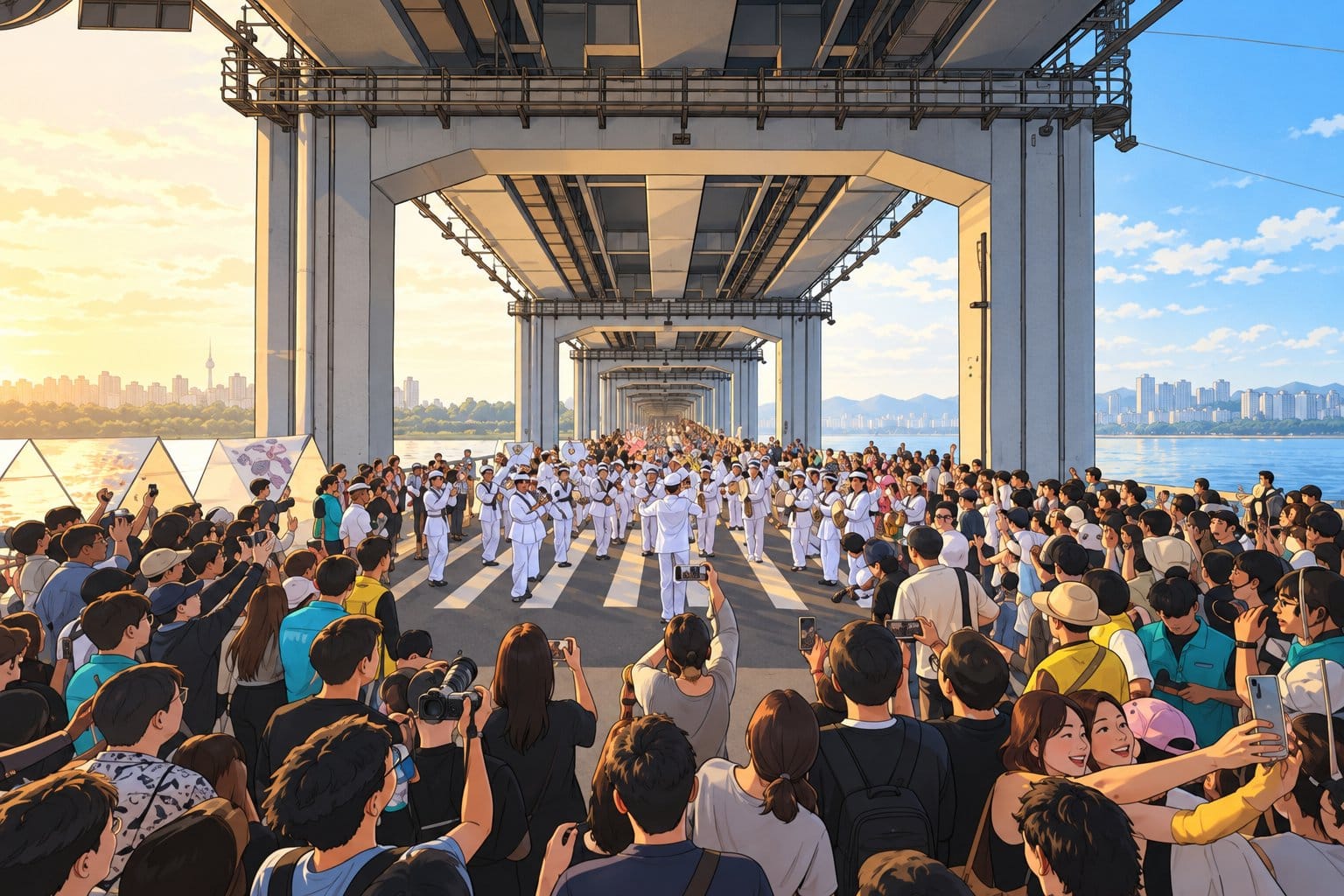
Banpo Hangang Park is on the south bank at the Jamsugyo and Banpodaegyo end. It is the natural place to start or finish a crossing. One change matters for bus riders: from October 26, the "Banpo Hangang Park, Somesevit" stops at the bridge's south end close in both directions, because routes 740 and 405 will run over Banpodaegyo instead (source: Seoul Metropolitan Government, 2026-10).
📋 Location: south bank of the Hangang at Banpodaegyo and Jamsugyo · Feature: riverside park at the bridge's southern end
💡 After October 26, get off at the "South End of Banpodaegyo Bridge, Hangang Park Entrance" stop.
📍 40 Sinbanpo-ro 11-gil, Seocho District, Seoul
🕒 Daily Open 24 hours
⭐ 4.4 (7,971 reviews)
📞 02-3780-0541
🔗 View on Google Maps
Somesevit | Landmark
Somesevit is a group of floating islands next to Banpo Hangang Park, and it gave its name to the bus stop that is closing. If you combine it with a Jamsugyo walk, you can cover the bridge, the park and the islands on foot without getting back on transit. The sources we reviewed do not give its opening hours or prices, so check before you go.
💡 Use the replacement Banpodaegyo south-end stop and walk along the park.
📍 서울특별시 세빛둥둥섬
⭐ 4.2 (188 reviews)
🔗 View on Google Maps
The key takeaway is this: if you want one more walk across the road lanes before cars are banned, go on October 25. If you are planning a summer 2027 trip, check SMG's announcement of the exact paving dates before you book.
Frequently asked questions
What time does Jamsugyo close to vehicles?
Jamsugyo (Jamsu Bridge) closes to all vehicles at 00:00 on Monday, October 26, 2026. The closure starts right after the last Car-Free Jamsugyo festival Sunday on October 25 . That festival has run every Sunday since September 6, 2026 . Cars that used Jamsugyo will be sent to Banpodaegyo, the bridge directly above it. According to the Korea Herald, this is the first time in the bridge's roughly 50-year history that cars will be banned from it completely.
Can I still walk or cycle on Jamsugyo during construction?
Mostly yes. For most of the construction period, pedestrians and cyclists can keep crossing on paths kept separate from the work zones . The exception is paving work between May and August 2027. During that work, walking and cycling will be fully blocked for about 1.5 months (roughly six weeks), and you will need to cross via Banpodaegyo instead . Seoul has not published the exact dates of that closure yet, so check before planning a summer 2027 visit.
Which buses are rerouted?
City bus routes 740 and 405, which used to cross Jamsugyo, will cross via Banpodaegyo in both directions starting October 26, 2026 . Because of this, the two "Banpo Hangang Park, Somesevit" stops (반포한강공원·세빛섬) at the bridge's south end will close, one in each direction. Riders should use the nearby "South End of Banpodaegyo Bridge, Hangang Park Entrance" stops (반포대교남단·한강시민공원입구) instead .
When will the pedestrian bridge be finished?
The Seoul Metropolitan Government plans to finish the wider pedestrian deck, paving and other improvements by August 2027. Its Korean-language announcement describes the opening as the second half of 2027 . Once finished, Jamsugyo will be Seoul's first pedestrian-only bridge over the Hangang (Han River). It is designed to host cultural events, including seasonal outdoor festivals, street performances and flea markets .
What features are planned?
Seoul's plan for the finished bridge includes:
- 22 new viewing spots for looking at the river up close.
- Glass-floor deck sections at the bridge's 2 navigation channels, so you can look down at the water and passing boats .
- At the north end, the road lanes in the underground passage will be removed and turned into pedestrian space. This should make it easier to walk to the river from Yongsan and the Itaewon area .
The raised walkway from the original design-competition proposal has been dropped. The city removed it during design, citing flood safety and other factors .
Enjoyed this article? Subscribe to get new stories by email whenever they're published.
This article was written using information collected and analyzed by NAMANE's in-house K-pop research AI engine. We use AI technology to bring you faster, broader coverage, and in the process some details may occasionally differ from the latest facts. For important information such as dates, venues, and prices, please double-check with official sources.


