
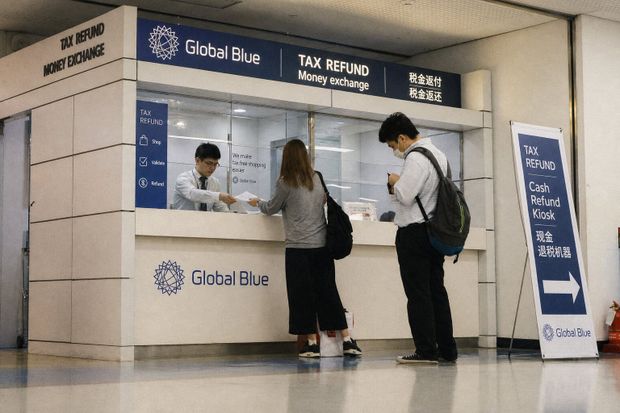
The 5–8% Reality: Why Korea's VAT Doesn't Come Back in Full
Korea's Value-Added Tax (VAT) is set at 10% and is embedded in the retail price of most goods sold across the country. Foreign tourists can apply to reclaim this tax on qualifying purchases — but the refund they receive is not 10% of what they spent. In practice, the net return is closer to 5–8% of the original purchase price [5]. The gap exists because five certified refund operators — Global Blue, Global Tax Free, Easy Tax Refund, CubeRefund, and eTAX FREE — manage the administrative logistics of the refund system on behalf of the Korean government and deduct a processing fee before issuing any payment [3]. When a store collects 10% VAT at checkout, that amount flows to the government through the operator network — the refund tourists receive is funded by the operator, net of its service charge. Higher total spending correlates with a lower proportional fee, nudging the net return slightly closer to 8%, while smaller purchases near the minimum threshold often yield only around 5% back [2].
Quick Answer: Korea charges 10% VAT on most goods, but tourists receive only 5–8% of the purchase price back because certified refund operators (Global Blue, Global Tax Free, and three others) deduct a service fee before issuing payment. Larger purchases edge closer to the 8% ceiling; smaller ones sit nearer 5%.
The practical impact is easy to calculate. A KRW 100,000 purchase returns approximately KRW 5,000–8,000 [5] — not the KRW 10,000 a tourist might expect after reading a store receipt that clearly shows 10% VAT collected. For a KRW 500,000 shopping session, the return is approximately KRW 25,000–40,000. If the refund is issued in a foreign currency rather than Korean Won, an additional forex conversion charge by the operator can reduce the net further [2].
Traveler confusion about this gap is well documented. A discussion thread in r/korea titled "Can someone explain why the tax refund amount is less than VAT?" drew 23 replies from visitors who encountered the same surprise [10]. The consensus across those comments pointed consistently at operator service fees — not any government deduction — as the reason the refund check falls short of the 10% headline rate.
"The refund agent service fee — not a government tax — is what reduces the amount. Savvy shoppers should target high-spend transactions where the proportional fee is lower, and opt for the immediate refund method when possible to avoid airport queue delays." — Community analysis, r/korea Tax Refund Discussion
Who Qualifies: Eligibility Requirements for Korea's Tax Refund
Korea's tourist VAT refund system is designed for short-term visitors — not residents, diplomatic staff, or anyone earning income inside the country. To qualify, a traveler must be a non-resident foreigner who has stayed in Korea for fewer than 6 months during the current visit [1]. A separate eligibility track exists for overseas Koreans: Korean nationals who have lived abroad for 2 or more years may also qualify, provided their current stay in Korea is fewer than 3 months [1]. Both groups must purchase at a certified tax-free store, and the departure from Korea must occur within 3 months of the date of purchase [1].
Several groups are explicitly excluded from the system, regardless of nationality or passport. Long-term residents who have been present in Korea for 6 months or more do not qualify. Diplomatic personnel, US military personnel stationed in Korea, and anyone earning income inside Korea are also ineligible [1]. The exclusion for income-earners applies even to short-term contract workers — the test is whether income was earned in Korea during the visit, not the duration of the stay.
Purchase requirements attach to each transaction individually. The minimum spend is KRW 15,000 per store at most certified tax-free retailers; some participating stores set the floor at KRW 30,000 per receipt [1]. Critically, all goods being claimed must remain new, unopened, and unused at the point of departure. Removing packaging, wearing purchased clothing, or applying cosmetics before leaving Korea disqualifies those specific items from the refund. Border agents conduct spot checks on declared refund goods, particularly for higher-value claims.
For K-POP fans visiting Korea on a concert itinerary and adding a shopping day, the 3-month purchase-to-departure window is rarely a practical concern — most tour schedules are contained well within that limit. The more relevant check is confirming that no income was earned in Korea during the trip, which would immediately void eligibility regardless of how long the stay was.
What You Can Claim in 2026: Eligible and Ineligible Goods
The range of goods eligible for Korea's tourist VAT refund covers most of what visitors typically buy. Clothing, shoes, cosmetic products, electronics, ginseng, and manufactured goods of virtually every category qualify for refund at certified tax-free stores [1]. Accommodation costs at qualifying lodging properties, up to 30 nights per stay, had also been refundable [3]. For fans visiting Korea to attend concerts or fan sign events, this means K-beauty skincare, artist merchandise purchased at brand stores, and electronics from retailers in Yongsan or Hongdae are all potentially refundable — provided the store carries a certified tax-free operator logo.
There is one significant 2026 change that affects many visitors who combine concert travel with clinic appointments. Cosmetic procedures — including Botox injections, filler treatments, and dermatological procedures — previously qualified for a separate refund track available to medical tourists. That track expired on December 31, 2025 and is no longer available from January 1, 2026 onward [4]. The Korean government did not renew the program, which means clinic visits in 2026 carry the full 10% VAT cost with no refund path of any kind.
It is important to keep two categories distinct. Cosmetic products — skincare, sheet masks, serums, toners, and makeup purchased at retail outlets — remain fully eligible for the standard tourist tax refund in 2026 [1]. Only the cosmetic procedures performed at medical clinics were removed. When in doubt, the distinction is straightforward: if it came from a clinic rather than a store shelf, it is not refundable this year.
Items that have never been part of the refund system include cooked food and restaurant meals, goods that are opened or used before departure, items purchased at duty-free outlets, prohibited goods, and package tour services [1]. These exclusions apply regardless of where or how the goods were purchased inside Korea.
Three Refund Methods: Immediate, Downtown, and Airport
Korea's tourist tax refund system offers three primary channels for collecting a refund, each with distinct timing, spending limits, and process requirements. The right choice depends on total spend, how much time is available before departure, and whether settling up at checkout or at the airport is more convenient. Understanding the structure before purchasing — not after — prevents the most common refund mistakes and eliminates the risk of queuing at the wrong airport counter. A fourth fallback method, the Mailbox Refund, exists for rare situations where the three primary channels are inaccessible, but its slow processing timeline and uncertain outcome make it a last resort rather than a planning option.
| Method | When You Receive the Refund | Per-Transaction Limit | Trip-Total Cap | Airport Step Required? |
|---|---|---|---|---|
| Immediate Refund (즉시환급) | At checkout — deducted from purchase price | KRW 15,000–999,999 [5] | KRW 5,000,000 per trip [2] | No — refund complete at point of sale |
| Downtown Refund (도심환급) | At a downtown kiosk or booth before departure | KRW 6,000,000 per receipt [5] | No separate trip cap | Yes — export confirmation at airport is still required |
| Airport / Post-Departure Refund (사후환급) | At the airport, after clearing customs | No stated per-receipt limit | No stated trip cap | Yes — primary processing step |
| Mailbox Refund | By post after departure (timeline uncertain) | N/A | N/A | No — manual fallback only |
The Immediate Refund (즉시환급) is the most convenient option for purchases within the KRW 15,000–999,999 range per transaction. The store deducts the VAT-equivalent amount from the checkout total directly — there is no tax-free receipt to carry through customs and no queue at the airport. The only constraint is the trip-total cap of KRW 5,000,000 across all immediate refund transactions during a single visit [2]. Once that cap is reached, all subsequent qualifying purchases must go through the downtown or airport route, even at stores that normally offer the immediate option.
The Downtown Refund (도심환급) works differently: the tourist pays the full VAT-inclusive price at the store, collects a tax refund receipt, then visits a participating downtown kiosk or refund booth before leaving the city. The operator issues cash or a card credit on the spot for single receipts up to KRW 6,000,000 [5]. There is a critical follow-up step that many travelers miss: even after collecting a downtown refund, the export of those goods must be confirmed at the airport before departure. Skipping this airport confirmation step risks having the refund payment reversed by the operator.
The Airport / Post-Departure Refund (사후환급) is the traditional channel and the one most visitors encounter. The tourist pays full price everywhere, collects every tax refund receipt, and processes the complete refund at the airport after clearing customs. Staffed counters and 24/7 unmanned kiosks are available at all major international departure points in Korea. The airport process in detail follows in the next section.
Airport Refund Process: Before Check-In Through the Duty-Free Zone
The airport tax refund process in Korea runs in two stages: one before check-in and one after immigration. Knowing this sequence prevents the single most costly mistake departing tourists make — attempting to process refund items that are already in checked luggage after the fact. For goods being placed in checked bags, the self-service kiosk must be used to scan passport and tax refund receipt barcodes before those bags are handed to the airline at check-in [5]. The kiosk will either clear the claim automatically or flag specific items for inspection by a customs officer, who will physically verify the goods before check-in. Goods traveling in carry-on baggage can be verified at the customs desk after clearing immigration in the airside zone.
After clearing immigration and entering the duty-free zone, the refund is collected — in cash (KRW or a major foreign currency), as a card credit reversal, or as a mobile wallet transfer, depending on the operator and the traveler's preference. Staffed refund counters operate at Incheon Terminal 1, Incheon Terminal 2, Gimpo, Gimhae (Busan), and Jeju airports at approximately 07:00–22:00 [5]. Travelers on early-morning or late-night flights can use the 24/7 unmanned kiosks available at those same airports to complete the process outside counter hours [5].
One threshold determines which processing path applies: if the total refund amount across all receipts is under KRW 75,000, self-service kiosk processing proceeds without further review; if the total exceeds KRW 75,000, customs inspection of the declared goods is required before the refund is issued [4]. Travelers with large shopping hauls — multiple electronics purchases or several high-value cosmetics receipts — should budget at minimum 30–45 minutes beyond the normal pre-flight routine specifically for refund and customs processing, particularly during peak periods around major concerts or national holidays.
"Make sure you use the kiosk to register your refund items before check-in if they are going into your hold luggage — this is the step most travelers miss, and skipping it means the refund cannot be processed afterward." — Guidance summary, Korea Locally, Tax Refund for Tourists
📍 서울특별시 강서구 하늘길 112
⭐ 4.4 (11,607 리뷰)
📞 1661-2626
🔗 Google Maps에서 보기
How Operator Fees Are Structured Across the Five Certified Companies
Five companies are certified to run Korea's tourist tax refund system: Global Blue, Global Tax Free (formerly Premier Tax Free), Easy Tax Refund, CubeRefund, and eTAX FREE [3]. The operator logo on the tax-free receipt determines which kiosk or staffed counter must be used at the airport — the systems are not interchangeable. Identifying which operator a store is affiliated with before purchasing, rather than discovering the logo on the receipt at the till, gives the traveler more control over which refund channel and currency option will be available at departure.
| Operator | Approx. Net Refund (Small Purchase) | Approx. Net Refund (Large Purchase) | Currency Options | Notable Feature |
|---|---|---|---|---|
| Global Blue | ~5% of purchase price [5] | ~7–8% | KRW cash, foreign currency, card credit | Widest international kiosk network; own terminals at Incheon |
| Global Tax Free | ~5% | ~7–8% | KRW cash, card credit | Strong presence in Lotte and Shinsegae department stores |
| Easy Tax Refund | ~5% | ~7% | KRW cash, card credit | Common in mid-tier retail and Dongdaemun market shops |
| CubeRefund | ~5% | ~7% | KRW cash, mobile wallet | App-based workflow; popular with younger and frequent visitors |
| eTAX FREE | ~5% | ~7% | KRW cash, card credit | Common in department stores and government-adjacent retail |
Note: Percentage figures are approximate industry estimates based on available research [5]. Each operator calculates fees by internal schedule; the exact net rate for any given transaction may vary.
The consistent pattern across all five operators is that small purchases near the minimum KRW 15,000 threshold return approximately 5% net, while large single transactions push the net return toward 7–8% [5]. Consolidating purchases — buying multiple items in a single transaction rather than across separate receipts at different stores — generally produces a better aggregate net rate. Splitting the same total spend into five small receipts at five different stores may result in a noticeably lower combined return.
Refund currency selection matters as much as operator choice. Collecting in KRW and converting later through a low-fee card or transfer service typically yields a better outcome than accepting on-the-spot foreign-currency conversion at the refund counter, where the rate offered by operators tends to be unfavorable [2]. Mobile wallet transfers — available through CubeRefund and select Global Blue terminals — bypass the conversion issue entirely for travelers with a Korean digital wallet account linked to their phone.
Finding Certified Tax-Free Stores and Keeping Your Receipts
Certified tax-free stores display a "Tax Free" sticker or one of the five operator logos — Global Blue, Global Tax Free, Easy Tax Refund, CubeRefund, or eTAX FREE — at or near the store entrance. In Seoul, the concentration of participating stores is highest in Gangnam (including Apgujeong Rodeo and the COEX mall area), Dongdaemun (the fashion wholesale and retail district), Seongsu (the emerging design and sneaker corridor popular with younger shoppers), and Itaewon [3]. Major department stores — Lotte, Shinsegae, and Hyundai — participate almost universally across their branch networks. K-beauty chains including Olive Young and Innisfree also participate widely.
For store lookup before or during a trip, both VisitKorea and VisitSeoul provide searchable store locators organized by district and product category [3]. Downtown refund kiosks are clustered near the main shopping corridors — Myeongdong, Gangnam Station underground mall, and Dongdaemun — and some hotel lobbies in tourist-heavy areas also host refund counters for guests.
Receipt management is non-negotiable. Tax refund receipts are separate documents from the ordinary purchase receipt; if the cashier does not produce one automatically, ask explicitly at the point of sale. Lost or damaged tax refund receipts cannot be replaced at the airport — operators have no system for reissuing documents after a transaction closes [5]. Keep every tax-free slip in a dedicated envelope or zip pocket throughout the trip, completely separate from regular purchase receipts and shopping bags.
📍 View Gangnam Shopping District on Google Maps
📍 View Dongdaemun Shopping District on Google Maps
📍 View Seongsu District on Google Maps
Frequently Asked Questions
Why is my Korea tax refund less than 10% of what I spent?
Korea's standard VAT rate is 10%, but the refund issued to tourists is reduced to approximately 5–8% of the purchase price by service fees charged by the certified refund operator whose logo appears on the tax-free receipt — Global Blue, Global Tax Free, Easy Tax Refund, CubeRefund, or eTAX FREE. These companies manage the administrative logistics of the refund system and deduct a processing fee before issuing any payment. The gross 10% VAT flows to the Korean government; what the tourist receives is funded by the operator, net of its charge. The exact net percentage depends on the operator and the size of the purchase: larger transactions carry a proportionally lower fee, edging toward 8%, while small purchases near the threshold return closer to 5%.
What is the minimum purchase amount to get a VAT refund in Korea?
The minimum is KRW 15,000 per store at most certified tax-free retailers [1]. Some participating stores set a higher floor of KRW 30,000 per transaction — the applicable threshold is usually shown on signage near the register, or the cashier can confirm it. Regardless of the amount, all goods being claimed must be new and unused at the time of departure from Korea. Removing packaging, wearing clothing, or applying a cosmetic product before leaving disqualifies those specific items from the refund, even if the receipt is valid.
Can tourists get a refund on cosmetic procedures in Korea in 2026?
No. The separate refund track that covered Botox injections, filler treatments, and dermatological procedures expired on December 31, 2025 and has not been renewed [4]. From January 1, 2026 onward, cosmetic clinic procedures carry the full 10% VAT with no refund path available under any method. This change does not affect cosmetic products purchased at retail — skincare, toners, serums, and makeup bought at stores like Olive Young or at brand counters remain fully eligible for the standard tourist tax refund. The distinction is procedure (clinic-administered, not refundable) versus product (retail-purchased, still refundable).
Do I have to stand in line at the airport counter or can I use a kiosk?
24/7 unmanned kiosks are available at Incheon Terminal 1, Incheon Terminal 2, Gimpo, Gimhae (Busan), and Jeju airports, so a staffed counter is not required [5]. Staffed counters at those same airports operate from approximately 07:00 to 22:00 [5]. There is one step that must be completed before check-in: if any refund items are going into checked luggage, the kiosk must be used to scan the passport and receipt barcodes before bags are handed to the airline. Items traveling in carry-on bags can be verified after immigration in the airside duty-free zone.
What happens if I leave Korea without claiming my tax refund?
A Mailbox Refund option allows post-departure submission of tax refund receipts by post, but processing times are longer than airport methods and successful payment is not guaranteed. If a Downtown Refund was collected before departure but the export was not confirmed at the airport before leaving Korea, the operator may reverse the refund payment entirely. For the standard Airport / Post-Departure Refund channel, the claim is simply forfeited if not processed before the flight — there is no recovery mechanism available from outside Korea. The practical advice is to allocate a dedicated 30–45 minutes at the airport for refund processing, beyond the normal check-in buffer, to avoid any of these outcomes.
Before You Shop: A Clear-Eyed Look at Korea's Tax Refund
Korea's tourist VAT refund system delivers real value — 5–8% back on clothing, cosmetics, electronics, and most manufactured goods purchased at certified stores — but it rewards travelers who engage with the process deliberately rather than reactively. The decisions that matter most happen before the first purchase: confirming the operator logo at the store entrance, selecting the refund method that fits the planned spend, and committing to keeping every tax-free slip in a dedicated place throughout the trip. The system is well-structured and supported by official tools at Korea Tourism Organization and VisitSeoul, but it does not reward inattention.
For K-POP fans combining a concert visit with shopping, the most practical approach is to use the Immediate Refund method for transactions under KRW 1,000,000, consolidate larger purchases into single receipts to maximize the net rate, and build 30–45 minutes of dedicated airport buffer into the departure plan for refund and potential customs processing. The 2026 removal of cosmetic procedures from eligibility is a meaningful change for medical tourism visitors, but it has no effect on the K-beauty retail purchases that make up most fan shopping hauls. Retail products from clinic-adjacent brands — bought at the store, not administered at the clinic — remain fully covered.
The 5–8% reality is not a flaw in the system; it is the operating cost of a well-administered cross-border VAT reclaim mechanism. Understanding it upfront, before reading the refund check at the airport kiosk, is the difference between a pleasant confirmation and a confusing surprise at the departure gate.
Last updated: 2026-05-18. This article reflects Korea's tourist tax refund rules and certified operator structures as of May 2026. The cosmetic procedures eligibility change (effective January 1, 2026) was verified against Korea Tourism Organization guidance and travel community reports. Readers should confirm current thresholds with their refund operator before travel, as fee schedules are updated periodically.


