
Why 2026 Became K-Pop's Most Compressed Comeback Season
The 2026 K-pop comeback calendar is defined by compression — the deliberate or coincidental stacking of major group releases into a window so narrow it challenged fans, retail channels, and streaming algorithms alike. Between January and late May, legacy acts including BTS, EXO, BLACKPINK, and BIGBANG all returned with full-group or near-full-group projects, a density of simultaneous major-act activity not observed since the pre-pandemic peak of 2019. Alongside these legacy returns, a new generation of high-performing acts — TXT, ILLIT, BABYMONSTER, and aespa — launched releases of their own rather than waiting for clearer chart space. The effect was cumulative and measurable: more top-tier releases competed for chart positions and listener attention per month than in any comparable recent period. According to Korea Times, April 2026 alone constituted a "flooded comeback calendar" — a description that reflects the structural change in how labels are now coordinating (or failing to coordinate) release schedules across generations of artists [5].
Quick Answer: In 2026, K-pop's major legacy acts (BTS, EXO, BLACKPINK, BIGBANG) and leading new-generation groups all returned within a four-month window — the most compressed comeback season since 2019. BTS led commercially: ARIRANG posted 641,000 equivalent album units in its opening week, the highest first-week figure across all genres in 2026.
What distinguishes 2026 from prior dense years is the convergence of previously disrupted timelines. EXO had not released a group album since July 2023 [1]. BTS had not performed as all seven members since 2022 [2]. BLACKPINK had released no full-group material since Born Pink in September 2022 [1]. These layered hiatuses — each driven by military service requirements, contractual disputes, or solo campaigns — all resolved or partially resolved within the same calendar window, creating the concentrated density that defines this year. New-generation labels, reading the Q1 legacy-act domination, held their major releases until April and May as an implicit scheduling concession.
The structural pressure was felt across the industry's commercial infrastructure. Physical album retailers, streaming editorial teams, and fan communities had to absorb and respond to an unusually high volume of major releases within weeks of each other. The global K-pop market reached $9.3 billion in 2023 and is projected to reach $13 billion by 2027, with approximately 200 million active fans worldwide [10] — an audience base large enough to support simultaneous major releases, but one that still creates chart and mindshare competition labels must navigate. Over 40 new groups are debuting in 2026 [9], adding further competition beneath the established-act layer and making the market's absorption of Q1–Q2 legacy comebacks all the more notable.
EXO REVERXE (January 19): Six Members, Absent Three, and the Partial-Lineup Question
EXO's 8th studio album REVERXE, released on January 19, 2026, reopened the group's narrative after the longest gap between studio releases in their history since debut [1]. Six members participated in the release: Suho, Chanyeol, D.O., Kai, Sehun, and Chinese member Lay. Chen, Baekhyun, and Xiumin remained absent, each due to ongoing contractual disputes with SM Entertainment — a situation that has defined the group's post-pandemic public identity as much as any new music has [1]. REVERXE was the first group project since EXIST in July 2023, making the 18-month gap the most significant between consecutive EXO studio albums [9].
The partial-lineup question carries both commercial and symbolic weight. EXO's peak commercial era (2012–2017) featured nine members and produced chart performances at a scale difficult to replicate with six. Releases from that era — XOXO (2013), Exodus (2015), and The War (2017) — benefited from the combined promotional bandwidth of a full ensemble, where stage presence, fan community fragmentation across sub-groups, and the cumulative individual appeal of all nine members created network effects on charting platforms [9]. REVERXE, released into a 2026 market with more sophisticated streaming mechanics but a more segmented listener base, cannot straightforwardly replicate those conditions.
That said, the six-member lineup carries significant weight on its own terms. Lay's continued participation is notable: Chinese market engagement for K-pop groups is measured partly through the presence of Chinese members, and his inclusion supports REVERXE's commercial viability in that market. D.O. and Chanyeol, both returned from military service and active in solo acting careers, brought their individual fan communities back into alignment around the group project. The absence of Baekhyun — historically one of EXO's highest-performing solo acts in terms of chart reach across South Korea, China, and Southeast Asia — is the clearest commercial gap. His contractual exclusion is the most visible indicator of the ongoing dispute's tangible consequences for the group's release scope.
REVERXE's January release date placed it ahead of the BTS and BLACKPINK announcements that would define Q1 and Q2, giving it a window of uncontested legacy-act attention. Whether that was a deliberate label strategy or a function of when the six-member lineup became available for recording and promotion has not been publicly documented. What is clear is that REVERXE established 2026's first major theme: the partial comeback as commercial and emotional reality, where full-group restoration remains aspirational rather than guaranteed. The three absent members and the ongoing contractual impasse are not background details — they shape how REVERXE is received, measured, and compared against EXO's prior catalog. That framing will persist through whatever next group project SM Entertainment and the available members eventually produce.
BTS ARIRANG: No.1 Billboard 200, 641K Units, and the OT7 Effect
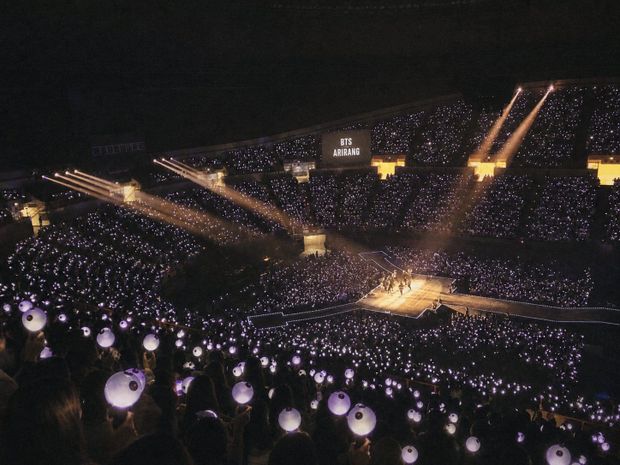
BTS's 10th studio album ARIRANG is the defining commercial event of 2026 K-pop — and by one key metric, of 2026 music overall. Released in late March following a carefully staged OT7 reunion event, ARIRANG debuted at No. 1 on the Billboard 200 with 641,000 equivalent album units in its opening week — the highest first-week total of any album across all genres released in 2026 [2]. Lead single 'Swim' debuted at No. 1 on the Billboard Hot 100, marking the group's seventh Hot 100 chart-topper — a figure that places BTS alongside a historically compact list of acts who have reached that threshold multiple times [2]. The album's commercial performance is not simply large in K-pop terms; it is large in absolute terms across the entire global music market for this year.
The mechanism behind ARIRANG's opening-week figure requires unpacking. On March 21, BTS staged their first all-seven-member live performance since 2022, streamed on Netflix [2]. This livestream event functioned as a pre-release activation that directly collapsed the typical gap between audience engagement and purchase behavior. Streaming equivalents generated by the Netflix event — combined with pre-order physical album sales, digital downloads, and post-release streaming — were all captured within a single Billboard tracking week. It was a deliberate integration of live-event revenue mechanics with album tracking, a strategy that amplified the equivalent unit count beyond what streaming or album sales alone would have generated. According to analysis from Wooski, K-pop listeners in 2026 increasingly stream full albums rather than only lead singles — a behavioral shift that further boosted ARIRANG's equivalent unit total across the reporting window [3].
"BTS's return as OT7 generated first-week equivalent album numbers no other act has approached this year — a performance that resets the commercial scale of K-pop's top tier for 2026," — KpopStarz, April 2026.
The ARIRANG World Tour launched in April in South Korea, extending the album's commercial footprint from streaming and physical sales into live-event revenue. Tours at BTS's scale generate ticket sales, merchandise, and ancillary streaming boosts — as new fans discover catalog during tour cycles — that sustain chart presence well beyond the opening week. The TeeHee Korea May 2026 trending chart places 'Swim' at No. 1 five weeks post-release [8], an indicator of sustained domestic streaming longevity that few acts achieve in a year as crowded as 2026. The OT7 reunion — all seven members performing together for the first time since 2022 — was not merely a promotional device; for a fan base that had waited through mandatory military service rotations, it carried a reunion weight that directly translated into purchase behavior.
| Metric | Figure | Context |
|---|---|---|
| Album | ARIRANG (10th Studio Album) | First full OT7 group album since 2022 |
| Release Activation | Netflix OT7 Livestream — March 21, 2026 | First all-seven-member live performance since 2022 |
| Billboard 200 Peak | No. 1 | Debuted at chart summit |
| First-Week Equivalent Units | 641,000 | Highest first-week total of any album (all genres) in 2026 |
| Lead Single 'Swim' — Hot 100 Peak | No. 1 | Group's seventh Billboard Hot 100 chart-topper |
| May 2026 Domestic Chart Position | No. 1 (TeeHee Korea trending) | Still charting No. 1 five weeks post-release |
| World Tour | ARIRANG World Tour | Launched April 2026, South Korea |
BLACKPINK DEADLINE (February 27) and BIGBANG Coachella (April): Legacy Acts Chart Their Returns
BLACKPINK's third mini-album DEADLINE, released on February 27, 2026, ended a full-group release absence stretching back to Born Pink in September 2022 — a gap of approximately three and a half years without new full-group recorded material [1]. Lead single 'GO' entered charts supported by substantial individual momentum built during the hiatus: Rosé earned three Grammy nominations for solo work [1], Lisa won an MTV VMA [1], and Jisoo charted on the Billboard Hot 100 through individual releases [1]. The strategy — individual-activity-sustaining-group-profile across a multi-year gap — is a deliberate BLACKPINK model, and DEADLINE's chart trajectory reflects it: the album arrived to an audience that had remained engaged with each member individually throughout the dormant period.
BIGBANG's April 2026 appearance at Coachella represented a different kind of return: performative rather than catalog-driven. G-Dragon, Taeyang, and Daesung took the Coachella stage together for the first time since the release of 'Still Life' in 2022 [1] — a single that had itself come after a multi-year collective hiatus. T.O.P did not perform at Coachella; instead, he released his first solo album in 13 years on April 3, 2026 [4], separating his individual return from the trio's joint stage appearance. The Coachella performance functioned as a proof-of-concept for continued group activity without requiring a fully coordinated album release as a precondition.
"A coming-of-age ceremony," — G-Dragon, describing BIGBANG's planned 2026 activity (source: Korea Herald).
G-Dragon's framing suggests the group views 2026 not as a routine comeback but as a definitional moment in their long-term trajectory. What form that takes beyond Coachella remains unconfirmed: whether it means a new group album, an extended tour, or a sustained multi-platform presence has not been fully detailed in public announcements as of mid-May 2026. What is clear from the April performance is that the three-member configuration carries commercial and symbolic traction even in T.O.P's absence, and that Coachella provided international visibility to relaunch the BIGBANG brand to audiences that may have primarily known the group through legacy catalog rather than recent activity.
Taken together, BLACKPINK's DEADLINE and BIGBANG's Coachella appearance represent two distinct recovery models for groups navigating long hiatuses. BLACKPINK used sustained individual member activity to maintain brand presence, then returned with a group release positioned to capture that accumulated energy. BIGBANG used a prestige live event as a re-entry vehicle without requiring full-group participation or new recorded material as a precondition. Both approaches succeeded in generating chart visibility and fan reengagement — which model produces more sustained commercial activity through the remainder of 2026 is a question the next few months of release and touring data will begin to answer.
April's Flooded Calendar: TXT, NCT WISH, ILLIT, and CORTIS by the Numbers
April 2026 was K-pop's most release-saturated single month in recent memory — a density the Korea Times described as a "flooded comeback calendar" in its March 28 report [5]. Within a 17-day window, three significant new-generation releases landed: TXT's 8th mini-album on April 13, NCT WISH's debut full-length on April 20, and ILLIT's 4th mini-album on April 30 — alongside CORTIS previewing new material on the same date as NCT WISH. The cluster created measurable chart competition and compressed fan spending into a period when Q1 legacy-act releases (BTS, BLACKPINK, EXO) were still generating active streaming [5].
"Comebacks flood April in a packed K-pop calendar," — Korea Times, March 28, 2026, describing a release density without precedent in the post-pandemic era.
TXT's '7TH YEAR: A Moment of Stillness in the Thorns' (April 13) carried specific narrative weight beyond its chart position. It was the group's first release following a contract renewal with BigHit Music, framed explicitly as the start of a "second chapter" [5]. Contract renewals in K-pop function as public confidence signals — they indicate both label investment in an act's commercial trajectory and the group's decision to remain within the label infrastructure rather than pursue independence. For TXT, whose discography has expanded steadily since their 2019 debut, the renewal and accompanying 8th mini-album reaffirmed their position as BigHit Music's primary active group during the period following BTS's post-ARIRANG promotional wind-down.
NCT WISH's 'Ode to Love' (April 20, 10 tracks) marked the group's transition from a unit-format debut phase into a full debut album — a critical milestone in an SM Entertainment group's commercial lifecycle, typically associated with expanded domestic promotion, widened physical distribution, and formal fandom registration events [5]. CORTIS, also from BigHit Music, previewed their 2nd mini-album 'GREENGREEN' on April 20 ahead of a full May 4 release — a strategic preview given that their debut EP 'Color Outside the Lines' had reached No. 15 on the Billboard 200 with 2 million cumulative sales [5]. ILLIT completed the April wave on the 30th with 'MAMIHLAPINATAPAI' — their 4th mini-album under BELIFT LAB, notable for a title drawn from a Yaghan loanword describing a shared feeling without verbal expression.
| Artist | Album Title | Release Date | Type | Notable Context |
|---|---|---|---|---|
| TXT | 7TH YEAR: A Moment of Stillness in the Thorns | April 13, 2026 | 8th Mini-Album | First post-contract-renewal release; framed as a "second chapter" |
| NCT WISH | Ode to Love | April 20, 2026 | Debut Full-Length (10 tracks) | Group's first full album; key SM Entertainment commercial milestone |
| CORTIS | GREENGREEN (preview) | April 20, 2026 | 2nd Mini-Album Preview | Debut EP 'Color Outside the Lines' reached No. 15 Billboard 200; 2M cumulative sales |
| ILLIT | MAMIHLAPINATAPAI | April 30, 2026 | 4th Mini-Album | BELIFT LAB act; title references a Yaghan loanword |
May 2026 Wave: BABYMONSTER, I.O.I, aespa, NMIXX and the TeeHee Chart Snapshot
May 2026 brought a second release wave that blended new-generation acts with veteran soloists and a landmark anniversary comeback. BABYMONSTER released mini-album 'CHOOM' on May 4, the same date I.O.I staged their 10th-anniversary return with album 'I.O.I: Loop' and single 'Goodbye With A Smile' [6]. The I.O.I anniversary comeback was particularly resonant for fans who had followed the group since their Produce 101 origin: a decade-later reunion functioning both as nostalgia content and as a commercial experiment in whether first-generation idol reunion acts can sustain chart relevance in a market now dominated by active groups and a constant flow of new debuts. aespa announced a late-May release for their second full-length album 'Lemonade'; NMIXX dropped 'Crescendo'; and ZEROBASEONE, ITZY, and TAEYANG (BIGBANG) also released music in May [6].
Veteran solo acts ran alongside the group activity. Tiffany Young (Girls' Generation) returned on May 8 with 'Summer's Not Over' [7], and LeeHi released 'HON2ST' on May 5 [7]. The presence of Tiffany Young — active since 2007 as a Girls' Generation member — and LeeHi alongside BABYMONSTER and aespa in the same calendar month signals the multi-generational breadth of the 2026 market. These solo returns are not nostalgia-only events: both artists have maintained active international profiles, and their May releases compete for editorial placement and streaming shelf space in the same environment as the new-generation wave.
The TeeHee Korea May 2026 trending chart provides a clear snapshot of domestic streaming power five weeks into Q2. BTS 'Swim' holds at No. 1, BLACKPINK 'GO' sits at No. 2, HUNTR/X 'Golden' from the K-Pop Demon Hunters Netflix soundtrack places at No. 3, Rosé & Bruno Mars 'APT.' sits at No. 4, and IVE 'BANG BANG' places at No. 5 [8]. The continued dominance of Q1 releases — BTS and BLACKPINK — at the top of the May chart, despite the volume of April and May arrivals, is the clearest available evidence of the legacy-act streaming advantage: their releases do not simply compete with the new wave; they persist above it on domestic platforms while new-generation acts establish their own chart footprints. CORTIS's full 'GREENGREEN' release (May 4, previewed April 20) added another BigHit Music entry to a May calendar already dense with HYBE and SM Entertainment acts, intensifying cross-label competition specifically among second and third-generation new acts converting debut momentum into sustained streaming rank before the summer festival season redirects editorial attention.
2026 K-Pop Commercial Patterns: What the Chart Data Actually Shows
Across the first five months of 2026, several clear commercial patterns emerge from the combined chart, sales, and streaming data. The most consistent finding is that full-group or near-full-group lineup restorations produce first-week equivalent album unit totals that significantly outperform sub-unit releases. BTS's OT7 return with ARIRANG generated 641,000 first-week equivalent units [2] — a figure that reflects every member's individual audience contributing to a single tracking week. EXO's six-member REVERXE and BLACKPINK's four-member DEADLINE similarly outperformed what any individual member's solo release had generated in the same period, even accounting for members like Rosé and Lisa who had achieved significant solo chart results during their respective group hiatuses.
The Netflix livestream integration model deployed by BTS on March 21 demonstrated a replicable mechanism for boosting equivalent album units beyond what streaming alone generates [2]. By staging a high-production live event on a platform that generates stream equivalents — and timing it within the Billboard tracking week that included the album's release — BTS and BigHit Music collapsed what might otherwise have been two or three separate commercial events into a single chart-reporting window. This is a strategy that acts with sufficiently large audiences to justify a platform partnership may replicate in subsequent release cycles. According to Wooski's 2026 industry analysis, the average charting K-pop song is now 17 seconds shorter than comparable tracks in 2018, with hip-hop tracks averaging 29 seconds shorter — a structural compression driven by short-form content consumption pressures — while emotional ballads are simultaneously reclaiming chart space as listeners signal appetite for lyric-driven depth [3].
The label scheduling logic visible in April's new-generation cluster reflects a deliberate positioning decision rather than absent coordination. New-generation acts treating January through March as legacy-act territory, and releasing April onward as the market's attention began redistributing, is a legible strategic signal. Whether that positioning produced the intended separation on domestic charts is a more ambiguous question: the TeeHee Korea May trending chart shows Q1 legacy releases still occupying the top two positions [8], suggesting that streaming platform algorithms continue to amplify established legacy-act catalog even as new material arrives. The long tail of BTS 'Swim' at domestic No. 1 five weeks post-release is the most visible data point supporting this conclusion. For the live-event and concert planning layer of the industry, 2026's compressed release season creates a parallel compression in the touring calendar: multiple world tour launches (BTS ARIRANG World Tour, anticipated BLACKPINK touring activity) are overlapping with domestic festival seasons, generating scheduling demands for venues and ticketing infrastructure that will extend through late 2026 and into 2027. The global K-pop market's projected trajectory toward $13 billion by 2027 [10] is partly contingent on live revenue continuing to grow from the post-pandemic base — making the volume and commercial strength of 2026's comeback releases directly relevant to touring and event-market projections.
Frequently Asked Questions
Which K-pop group had the biggest commercial comeback in 2026?
BTS had the largest commercial comeback of 2026 by first-week sales metrics. Their 10th studio album ARIRANG debuted at No. 1 on the Billboard 200 with 641,000 equivalent album units in its opening week — the highest first-week total of any album across all genres in 2026, not just K-pop. Lead single 'Swim' also debuted at No. 1 on the Billboard Hot 100, the group's seventh chart-topper on that ranking. The album's commercial performance was amplified by BTS's first all-seven-member Netflix livestream on March 21, which generated streaming equivalents that combined with physical and digital album sales within a single Billboard tracking week. As of May 2026, 'Swim' remains No. 1 on the TeeHee Korea domestic trending chart five weeks after release — the longest sustained chart lead of any 2026 release to date.
Why did only six EXO members appear on REVERXE?
Three EXO members — Chen, Baekhyun, and Xiumin — were absent from REVERXE due to ongoing contractual disputes with SM Entertainment. The six-member lineup that recorded and released the January 19, 2026 album consisted of Suho, Chanyeol, D.O., Kai, Sehun, and Chinese member Lay. The contractual disputes between the three absent members and SM Entertainment have been a defining backdrop for EXO's activities since the group's post-military-service era, and their exclusion from REVERXE reflects the unresolved nature of those negotiations at the time of recording. REVERXE was EXO's first group album since EXIST (July 2023), marking the longest gap between consecutive EXO studio releases since the group debuted in 2012.
What was BLACKPINK's first full-group release after Born Pink?
BLACKPINK's first full-group release after Born Pink (September 2022) was the mini-album DEADLINE, released on February 27, 2026 — ending a gap of approximately three and a half years without new full-group recorded material. The lead single was 'GO.' During the hiatus, individual members sustained the group's commercial profile through solo activity: Rosé earned three Grammy nominations, Lisa won an MTV VMA, and Jisoo charted on the Billboard Hot 100 through solo releases. DEADLINE is BLACKPINK's third mini-album as a group, and marks their formal return to collective promotion following an extended period of member-by-member individual activities.
Did BIGBANG perform together at Coachella 2026?
Three of BIGBANG's four members — G-Dragon, Taeyang, and Daesung — performed at Coachella in April 2026, marking their first joint stage since the release of 'Still Life' in 2022. T.O.P did not perform with them at Coachella; instead, he released his first solo album in 13 years on April 3, 2026, on a separate timeline from the trio's joint appearance. G-Dragon described BIGBANG's planned 2026 activity as "a coming-of-age ceremony," suggesting additional group activity beyond Coachella, though no further joint album or formal tour announcement had been confirmed as of mid-May 2026.
How can fans track K-pop comeback release dates in real time?
The most reliable sources for real-time K-pop comeback tracking are dedicated schedule aggregators and official fandom platforms. kpopofficial.com and kprofiles.com publish monthly comeback schedules updated as label announcements drop. Official fandom platforms — Weverse (HYBE labels), Lysn (SM Entertainment), and individual artist Instagram accounts — carry pre-release date confirmations before they appear on aggregator sites. For multi-label comprehensive views, fan-operated calendar applications aggregate announcements across major and independent labels into a single interface. The TeeHee Korea trending chart provides a real-time view of what is currently charting domestically, separate from official pre-release schedules — useful for understanding which releases are sustaining streaming traction after their launch week.
What the 2026 Comeback Season Signals for K-Pop's Next Cycle
The 2026 comeback season's defining characteristic — compression — is both a market condition and a forward signal. When legacy acts and new-generation groups occupy the same four-month release window, the result is a stress test for every layer of K-pop's commercial infrastructure: chart systems, physical retail, streaming editorial, fan spending capacity, and concert venue availability. The data from January through May 2026 suggests the infrastructure held. ARIRANG's 641,000-unit opening week is a new benchmark, not evidence of saturation — and the continued domestic chart dominance of Q1 releases through May indicates that streaming platforms are expanding the effective shelf life of major releases rather than displacing them with volume. The 2026 comeback season has not cannibalized itself; it has, at least through mid-May, coexisted in a market large enough to absorb it.
For fans planning around this wave, the practical takeaway is that 2026's release activity creates a corresponding live-event pipeline extending into late 2026 and through 2027. The ARIRANG World Tour launched in April; BLACKPINK touring activity aligned with DEADLINE is anticipated; and BIGBANG's "coming-of-age ceremony" framing suggests additional live events beyond Coachella. Over 40 new groups debuting in 2026 [9] add further layers to what will be an exceptionally active live-event calendar through the remainder of the year. The streaming and chart data from this comeback window will also inform how labels approach release scheduling in 2027: if BTS's legacy catalog continues to dominate domestic trending five weeks post-release, labels may recalibrate whether April's new-generation cluster was genuinely insulated from Q1 competition — or whether new acts need greater calendar separation to build chart momentum without competing against legacy streaming tails. That is a question the data from this season is already beginning to answer, and one that will shape the structure of K-pop's next major release cycle.
Last updated: 2026-05-17. Article reflects album sales data, chart positions, and release schedules confirmed through mid-May 2026. Chart positions and streaming rankings are subject to change as new Billboard reporting weeks conclude.


