Big Four Agency Revenues in 2025–2026: The Scale of the Industry
K-pop's industrial scale in 2025–2026 is no longer a projection — it is a reported financial fact. HYBE, South Korea's largest entertainment conglomerate, posted revenues of 2.65 trillion won (approximately $1.86 billion USD) for full-year 2025, with concert revenue alone surging 69% year-over-year. Rival agencies reported equally strong figures for Q2 2025: JYP Entertainment reached 215.8 billion won, a 125.5% year-over-year increase; SM Entertainment posted 302.9 billion won, up 19.3%; and YG Entertainment reported 100.4 billion won, a rise of 11.6%. These gains reflect a touring cycle that resumed at scale following years of pandemic-related disruption — but they also concentrate revenue in live events and merchandise, exposing all four agencies to significant volatility when touring slows. Beyond concerts, the superfan platform economy — Weverse, Bubble, Berriz, and their competitors — is independently valued at $4.5 billion, roughly one-sixth of the entire global recorded music industry, with Goldman Sachs projecting potential to exceed $10 billion as Western markets deepen adoption.
Quick Answer: The K-pop industry's Big Four agencies posted record revenues in 2025, led by HYBE at 2.65 trillion won (~$1.86B). Concert revenue drove most growth (+69% at HYBE alone), while the superfan platform economy reached $4.5B — with Goldman Sachs projecting it could exceed $10B as Western adoption grows.
Goldman Sachs' projection is underpinned by a structural shift in how K-pop revenue is generated. Touring now accounts for a disproportionate share of income across all four agencies, meaning a prolonged hiatus by a major act — whether due to mandatory military service, health concerns, or internal restructuring — can materially affect quarterly results. HYBE's 2025 spike was partly driven by BTS members returning from or completing military service, restoring high-margin live revenue streams that had been dormant for roughly two years. JYP's 125.5% Q2 jump similarly reflects the absence of equivalent touring activity in Q2 2024 as a baseline comparison.
The concentration of revenue in live events sits in uncomfortable proximity to the labor rights issues examined later in this article. Concert cycles generate billions in revenue, yet the artists producing that revenue have no statutory access to occupational health coverage, sick leave entitlements, or workplace harassment protections under current Korean law. That tension — between the financial scale of the industry and the legal exposure of its central performers — is no longer a peripheral advocacy concern. It has become a mainstream policy debate, triggered by a Ministry of Labour ruling in November 2024 that explicitly named the gap.
| Agency | Revenue (Q2 2025 / FY 2025) | YoY Change | Key Revenue Driver |
|---|---|---|---|
| HYBE | 2.65 trillion won (FY 2025) | Concert revenue +69% | BTS touring return, Weverse platform growth |
| JYP Entertainment | 215.8 billion won (Q2 2025) | +125.5% YoY | World tours, merchandise, content licensing |
| SM Entertainment | 302.9 billion won (Q2 2025) | +19.3% YoY | SM TOWN concerts, DearU/Bubble subscriptions |
| YG Entertainment | 100.4 billion won (Q2 2025) | +11.6% YoY | BLACKPINK solo schedules, acting, brand content |
Fan Tourism in South Korea: Economic Impact and Shifting Geography
K-pop-driven tourism has moved from a cultural novelty to a measurable economic pillar for South Korea. According to data published by the Korea Tourism Organization and reported by Korea Times, the share of foreign visitors citing K-content as a primary motivation for their trip rose from 32.1% in 2023 to 41.8% in Q1 2025. A single BTS concert generates an estimated 1.2 trillion won — approximately $840 million USD — in total economic impact, encompassing accommodation, food, retail, and transport spend. Academic modeling reinforces the structural link: a 1% rise in K-pop album exports correlates to a 0.074% increase in inbound tourist arrivals — a modest coefficient that compounds significantly at the scale of global K-pop consumption. For Korean tourism planners, these are no longer soft cultural metrics; they are figures that shape investment decisions in hospitality, transport infrastructure, and urban programming.
"Tourism geography is shifting away from conventional landmarks toward idol-adjacent experiences — dance studios, drama filming locations, and live award shows." — Korea Times, citing Korea Tourism Organization analysis, February 2026
The most visible marker of this shift is the transformation of experiential spaces within Seoul. Foreign nationals now comprise 70% of beginner-level enrollment at 1MILLION Dance Studio, one of Seoul's most widely recognized contemporary dance academies, reflecting demand for hands-on K-pop skill acquisition as a core travel motivation. Foreign spending at noraebang establishments surged 54.8% year-on-year between January 2024 and June 2025. HiKR Ground, a K-content complex opened by the Korea Tourism Organization, surpassed 2 million visitors within two years of launch. Booking platform Klook recorded a 31.4% increase in domestic cultural tourism traffic from foreign users during the same period. The data points align across multiple platforms, confirming that the shift is visible in transaction flows, not just preference surveys.
Corporate integration of fan tourism reached a new benchmark with HYBE's "The City Arirang Seoul" campaign, which ran from March 20 to April 12, 2026. The initiative wove artist-themed food, exhibitions, and pop-up retail stores across central Seoul in conjunction with BTS comeback concerts at Gwanghwamun on March 21 and Goyang Stadium on April 9, 11, and 12, constructing a city-wide fan experience that deliberately blurred the boundary between concert attendance and broader urban tourism. A parallel movement — the "K-Dive" trend driven in part by Netflix's KPop Demon Hunters — pushed reservation surges at traditional experiences including neighborhood public bathhouses, suggesting the fan travel market now extends well beyond idol-proximity activities into wider cultural participation.
📍 서울특별시 중구 청계천로 40
🕒 월요일–금요일 오전 9:00 ~ 오후 6:00 / 토요일–일요일 휴무일
⭐ 4.3 (216 리뷰)
📞 02-729-9474
🔗 Google Maps에서 보기
📍 View Goyang Stadium on Google Maps
Airport Chaos: When Fan Gatherings Become Safety Incidents
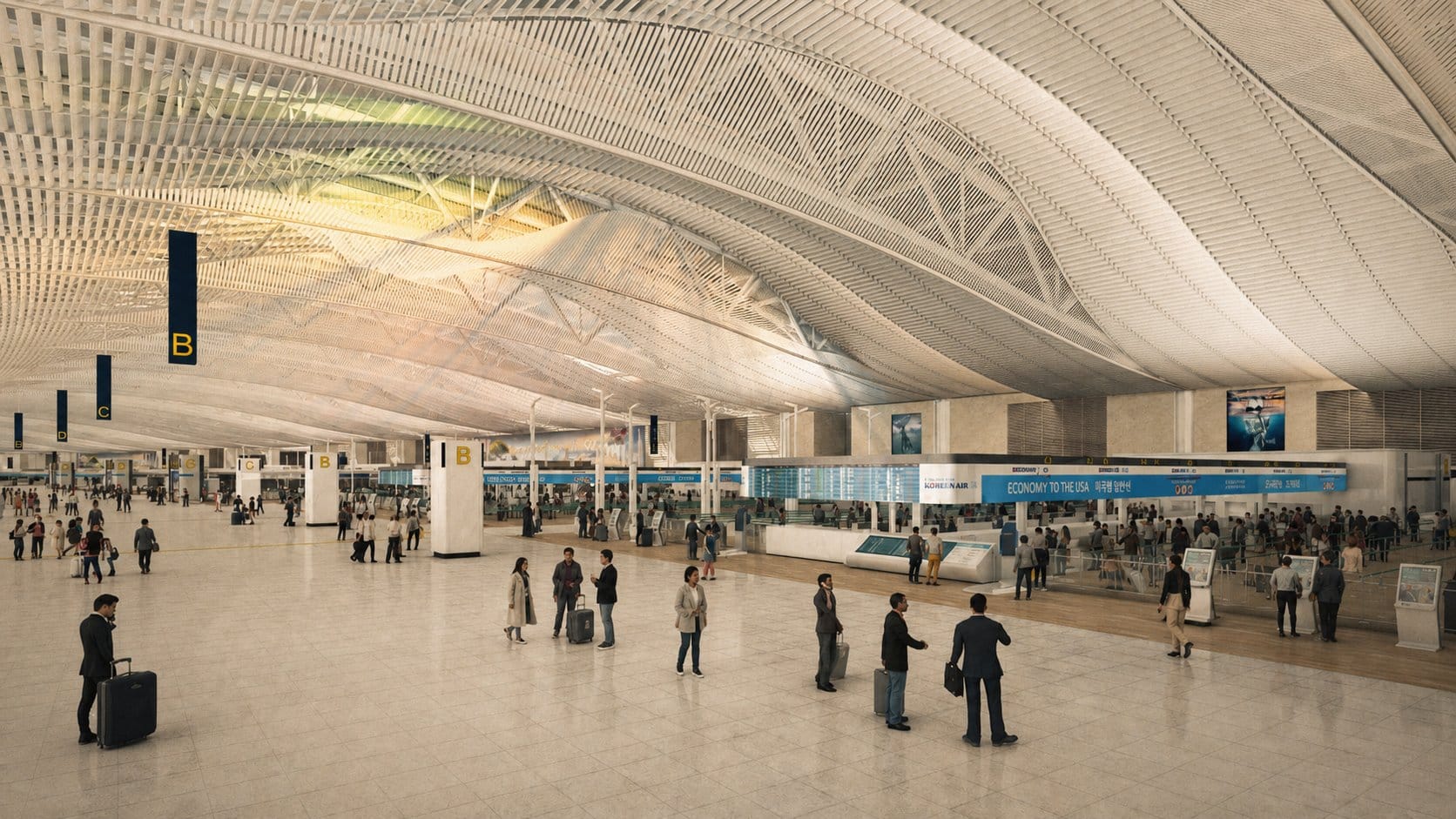
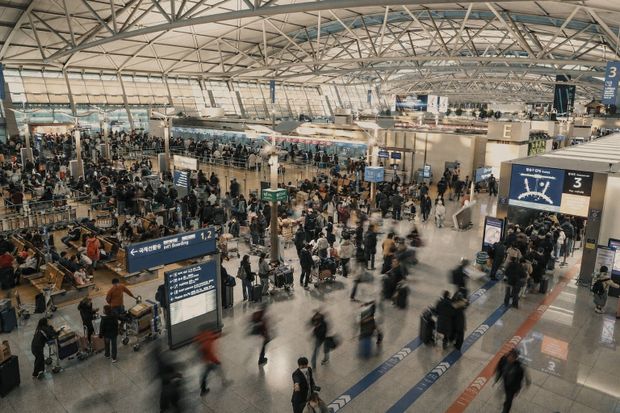
Airports have become the most publicly contested space in K-pop's relationship with public order. Unlike concert venues, which are purpose-built for crowd management, international airports serve a simultaneous dual population: idol fans gathered to witness arrivals and departures, and ordinary travelers with flights to catch. The friction between those two populations produced a series of documented incidents throughout 2025 that eventually prompted a national policy debate. In March 2025, fans and reporters blocked passenger access at Gimpo Airport during a Hearts2Hearts departure; a traveler's visible frustration was filmed and circulated widely online. In August 2025, a manager accompanying Zerobaseone at Incheon International Airport was filmed shoving fans and raising his fist toward the crowd, an incident that redirected media scrutiny from fan behavior to the conduct of private security personnel. A Reddit thread in the r/korea community titled "Imagine missing your flight because a K-pop idol needed 10 bodyguards" accumulated 1,697 upvotes and 147 comments, reflecting a level of general-public frustration that extends well beyond the fanbase.
"Should K-pop stars be required to submit a travel plan to authorities?" — Korea Times, October 6, 2025, framing the question at the center of a national regulatory debate
According to Korea Times reporting from October 2025, the proposal under discussion would require idols to pre-disclose travel itineraries to airport authorities, enabling preemptive crowd management deployments. The proposal has both proponents — primarily airport operators and regular travelers who regard fan gatherings as a public safety problem — and critics who argue it would penalize idols for conduct they did not initiate and impose movement restrictions on people who have committed no offense. As of mid-2026, no regulatory framework governs fan conduct at airports or public transport hubs in South Korea. Existing legal tools — trespass, obstruction, aviation security protocols — apply to individual acts but do not address the systemic character of coordinated fan arrivals organized through unofficial online channels.
The bodyguard conduct dimension introduced a separate layer of complexity. In a documented earlier incident, security personnel accompanying actor Byeon Woo-seok were observed shining flashlights at ordinary passengers and checking boarding passes without any legal authority to do so. Collectively, these incidents exposed a gap between the operational scale of celebrity crowd management in South Korea and the regulatory frameworks — or absence of them — governing how private security teams may behave in public infrastructure spaces. The industry has grown large enough that its informal crowd control practices now intersect with aviation safety in ways that neither airport law nor entertainment industry norms were designed to handle.
The November 2024 Ruling: K-Pop Idols Are Not Workers Under Korean Law
On November 20, 2024, South Korea's Ministry of Labour and Employment issued a ruling with consequences that extend far beyond any single case. NewJeans member Hanni had filed a workplace harassment complaint against personnel at ADOR and its parent company HYBE. The Ministry dismissed the complaint on the grounds that she is not legally a "worker" under the Labor Standards Act: idols receive profit-sharing arrangements rather than wages, work without fixed contractual hours, and sign entertainment agreements that classify them as "exceptional entities" falling outside the statute's scope. The ruling did not assess the merits of Hanni's specific allegations. It made a categorical determination about her employment structure — and by extension, the employment structure of all idols under comparable contracts. That is what gives it its reach as a precedent.
"Korean idols rarely challenge poor conditions, while foreign members struggle more with demanding schedules and contract enforcement." — Professor Lee Jong-im, Kyung Hee University, as reported by Korea Herald (2025)
The practical exclusions are wide-ranging. Without Labor Standards Act coverage, idols cannot access industrial accident insurance — meaning injuries sustained during touring, rehearsal, or promotional events do not qualify for the statutory compensation available to workers in any other field in South Korea. The four major social insurance programs — national health insurance (employee contribution), national pension, employment insurance, and industrial accident compensation insurance — are also inaccessible in their employment-based configurations. The anti-workplace harassment provisions introduced into Korean law in 2019, which represent one of the most significant labor protections enacted in the past decade, apply only to those legally classified as workers — placing idols entirely outside their reach.
The legislative response came quickly, if not yet consequentially. Representative Jeong Hye-kyung introduced what became informally known as the "Hanni Bill" on November 26, 2024 — six days after the Ministry ruling — specifically to extend harassment protections to individuals regardless of their employment classification. As of mid-2026, the bill had not been enacted. Legal scholars and advocacy groups argue that the gap is structural and cannot be addressed by a single piece of harassment-specific legislation: the entire question of occupational health, accident coverage, and income protections requires a reclassification of the idol's fundamental employment relationship, not an amendment to a single provision.
International coverage of the November ruling amplified domestic pressure considerably. Because NewJeans was one of the most globally prominent K-pop acts at the time of the complaint, and because the management conflict surrounding ADOR and HYBE had been extensively covered in international music and entertainment media, the Ministry's determination reached audiences in North America, Europe, and Southeast Asia who translated fan concern into direct pressure on agency reputations. Labor conditions in Seoul became a commercial liability in markets where they had previously been invisible.
Health Incidents and What Non-Worker Status Means in Practice
The abstraction of "non-worker status" becomes concrete when idols take breaks for health reasons. Without coverage under the Labor Standards Act, there is no statutory sick leave entitlement, no occupational health mandate requiring employer-funded treatment, and no accident compensation pathway for work-related injury. Any rest an idol takes is at the agency's discretion — a contractual accommodation, not a legal right. The pattern of health-related interruptions across the industry in 2024–2025 illustrates both the frequency of such events and the absence of a formal protective framework to accompany them. Yoon Ji-yoon of Izna (WakeOne) halted activities just six months after her group's debut, citing health concerns; no statutory provision governed the terms or duration of her break. I.M of Monsta X (Starship Entertainment) took a three-week absence for back pain treatment — rest that was entirely at the agency's discretion rather than protected by any occupational health statute. Park Bom paused 2NE1 activities despite the group's resumption for their 15th anniversary performances. These are three separate cases across three different agencies, all converging on the same structural absence.
"Artists don't always work because they want to, nor can they rest when they want." — agency executive, as reported by Korea Herald (2025)
The physical demands of idol careers are well-documented even without statutory acknowledgment. Touring schedules involve repeated high-intensity performances across multiple time zones, often with compressed recovery windows between dates. Rehearsal periods ahead of album releases and award show appearances regularly extend into overnight sessions. Contemporary K-pop choreography carries musculoskeletal injury risks that are comparable in intensity to professional dance or athletic training — yet athletes competing at equivalent physical intensities are covered by occupational accident insurance that idols cannot access under current classification. The asymmetry is not incidental to the industry's design; it is a direct consequence of the "exceptional entity" classification that the November 2024 ruling confirmed and codified.
The Idol Union Preparatory Committee, comprising approximately 10 active singers, submitted establishment documents to the Ministry of Employment and Labor in September 2025, listing standardized mental health protocols as a core demand alongside legal worker recognition. The committee also raised the question of alleged concealment of idol deaths by agencies — a claim that, if substantiated, would represent the most severe consequence of a welfare system that places all accountability in private hands with no mandatory external oversight requirement.
Superfan Platforms in 2026: Weverse, Bubble, and Berriz Compared
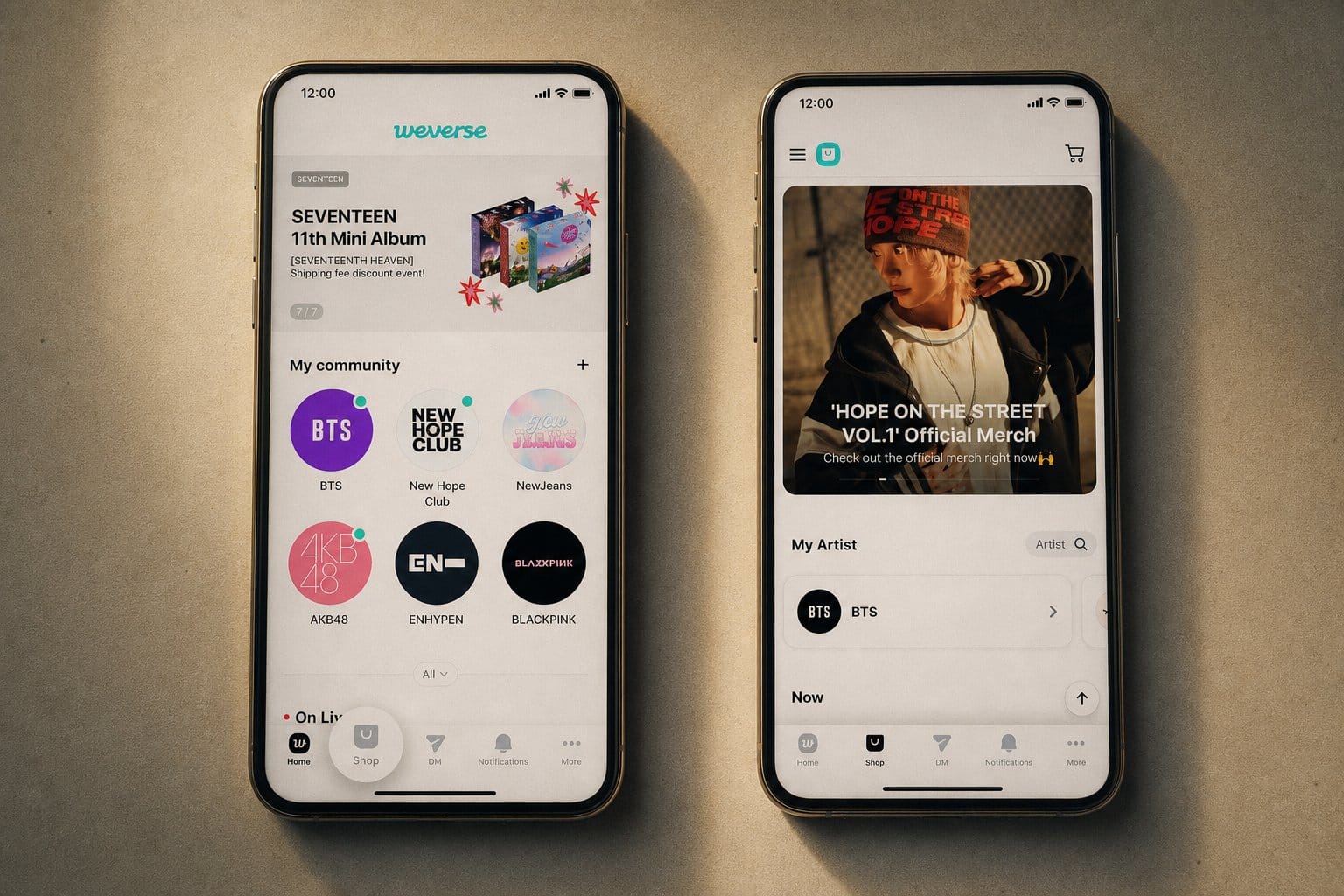
The superfan platform sector is the most rapidly expanding segment of K-pop's revenue base heading into 2026. Weverse, operated by HYBE, reported 13.37 million monthly active users in Q1 2026 — a gain of 42% across the preceding 15 months — with 90% of that traffic originating from outside South Korea and cumulative LIVE view counts exceeding 1 billion for calendar year 2025. Bubble, operated by DearU, a company aligned with SM Entertainment, runs on a direct subscription model of approximately $4 per month per subscribed artist; it uses an interface designed to mimic KakaoTalk-style personal messaging, simulating direct idol contact, and had approximately 2 million paid subscribers at the time of the most recent available data. SM Entertainment valued DearU at approximately $811 million in March 2025. Berriz, Kakao Entertainment's entry into the space, reached users in 202 countries within its first year of operation. Taken together, Goldman Sachs values the combined superfan platform economy at $4.5 billion, with upside to $10 billion as North American and Latin American adoption deepens.
Latin America is Weverse's fastest-growing regional market, with digital merchandise surges of 715% recorded across the region. This is not coincidental: K-pop fanbases in Brazil, Mexico, Colombia, and Chile have historically been among the most organizationally active in the world, running fan-funded billboard campaigns and coordinating global streaming drives. That organizational intensity is now converting into direct subscription spend, and Weverse's product decisions — which artists are on the platform, what content is exclusive, how concerts are broadcast — must increasingly account for user expectations in markets thousands of miles from Seoul.
Bubble's retention mechanism warrants specific attention from anyone analyzing the platform's commercial model. The "anniversary counter" — which tracks how long a user has maintained a continuous subscription and resets to zero upon cancellation — is an explicitly designed churn-deterrent. For a subscriber who has been enrolled for two or three years, the psychological cost of losing that milestone acts as a loyalty lock independent of the content itself. Consumer advocates in markets with stricter subscription transparency requirements have noted the mechanic, though no formal regulatory action had been initiated as of mid-2026. Across all three platforms, the revenue model depends on converting fan emotional investment into recurring monthly payments — a dynamic that intersects awkwardly with the labor rights discussion, given that the content generating that subscription revenue is produced by people with no statutory occupational protections.
| Platform | Operator | Scale (2025–Q1 2026) | Pricing Model | Notable Feature | Fastest-Growing Market |
|---|---|---|---|---|---|
| Weverse | HYBE | 13.37M MAU; 1B+ LIVE views (2025) | Free + paid tiers | 90% non-Korean traffic; digital merchandise integration | Latin America (+715% digital merch) |
| Bubble | DearU / SM Entertainment | ~2M paid subscribers | ~$4/month per artist | Simulated direct messaging; anti-churn anniversary counter | South Korea & Japan (core) |
| Berriz | Kakao Entertainment | 202 countries in year one | Undisclosed | Kakao ecosystem integration | Global distribution from launch |
Industry Reform: Who Is Pushing for Change and What They Want
The gap between K-pop's financial scale and its labor framework has begun generating organized institutional responses with specific legislative agendas. The Idol Union Preparatory Committee, comprising approximately 10 active singing artists, submitted establishment documents to the Ministry of Employment and Labor in September 2025 with a four-point agenda: legal worker recognition under the Labor Standards Act, access to industrial accident insurance, standardized mental health protocols, and protection against excessive personal agency control — including dating bans, compelled access to medical records, and communications surveillance. The committee also filed a petition to revoke HYBE's government-issued "Excellent Company" certification — a symbolic escalation designed to translate the labor classification debate into reputational and commercial consequences for the industry's largest operator.
"Idol protection reform requires not just legislative amendments but a fundamental reclassification of the idol employment relationship under Korean labour law." — buplr.org, December 2025, summarizing the advocacy coalition's core position
Advocacy organizations including buplr.org have focused their proposals on three specific legislative changes: explicitly including idol contract holders within the Labor Standards Act's worker definition; establishing minimum rest guarantees between touring legs and promotional schedules; and regulating working hours for minor trainees, who currently operate with no statutory hour limits despite often beginning intensive training before age 16. The trainee dimension is particularly significant because the current legal void affects not only active idols but the pipeline feeding the industry's next generation — a point that has drawn engagement from child welfare advocates alongside the labor rights community.
Agency responses as of mid-2026 range from silence to voluntary policy updates carrying no binding force. No industry-wide standards body exists to enforce minimum welfare provisions across agencies, and the Fair Trade Commission's oversight role is oriented toward contract terms rather than working conditions. The international dimension of the reform debate has become a commercial pressure point: because K-pop's audience is now predominantly non-Korean, fan-led campaigns targeting agency reputations across social media carry real revenue implications. The Hanni ruling's global coverage demonstrated that labor conditions in Seoul can generate significant backlash in Los Angeles, London, and São Paulo — a dynamic that agencies can no longer treat as a peripheral domestic policy matter. Whether that reputational pressure translates into structural legal reform remains the central open question of K-pop's political economy in 2026.
Frequently Asked Questions
Are K-pop idols considered employees under South Korean law?
No. A ruling issued by South Korea's Ministry of Labour and Employment on November 20, 2024 confirmed that K-pop idols are classified as "exceptional entities" rather than workers under the Labor Standards Act. The Ministry's reasoning was that idols receive profit-sharing arrangements rather than wages and work without fixed contractual hours — a structure it determined falls outside the statute's scope. This classification denies idols access to industrial accident insurance, the four major social insurance programs, and the anti-workplace harassment protections that have applied to all other worker categories in South Korea since 2019. The ruling was triggered by a complaint filed by Hanni of NewJeans and sets a precedent applicable to all idols under structurally similar entertainment contracts.
What was the ZeroBaseOne airport incident in 2025?
In August 2025, a video circulated widely showing a manager accompanying K-pop group Zerobaseone at Incheon International Airport shoving fans and raising a fist in the crowd. The footage triggered national debate in South Korea about the conduct standards of private security personnel at airports — redirecting the conversation from fan behavior to the actions of those employed to manage it. The incident was one of several in 2025, alongside the Hearts2Hearts Gimpo disruption in March and a separate Byeon Woo-seok bodyguard incident, that collectively prompted Korea Times to ask in October 2025 whether idols should be legally required to pre-disclose travel itineraries to airport authorities.
What is the Hanni workplace harassment case?
In 2024, Hanni — a member of NewJeans under ADOR, a subsidiary of HYBE — filed a workplace harassment complaint against personnel at those companies. On November 20, 2024, the Ministry of Labour and Employment dismissed the complaint, ruling that Hanni is not a "worker" under the Labor Standards Act and therefore falls outside its anti-harassment provisions. The ruling became a landmark because it was the first time the Ministry explicitly applied the "exceptional entity" classification to an active idol's harassment claim, creating a precedent with industry-wide implications. Six days later, Representative Jeong Hye-kyung introduced the "Hanni Bill" to extend harassment protections beyond the existing employment classification framework. The bill had not been enacted as of mid-2026.
How does K-pop tourism affect South Korea's economy?
K-content motivation for foreign visits rose from 32.1% in 2023 to 41.8% in Q1 2025, according to Korea Tourism Organization data. A single BTS concert generates an estimated 1.2 trillion won (~$840M USD) in total economic impact, and academic research finds a 1% increase in K-pop album exports correlates with a 0.074% rise in inbound tourists. The tourism geography is shifting from conventional landmarks toward idol-adjacent experiences — dance studios where foreign nationals now represent 70% of beginner enrollment, drama filming locations, and live awards shows — with transaction data from Klook, noraebang operators, and booking platforms all corroborating the directional change. HYBE's "The City Arirang Seoul" campaign in early 2026 represented the corporate culmination of this trend, integrating artist-themed retail and exhibitions with concert dates across central Seoul.
What are Weverse, Bubble, and Berriz?
Weverse, Bubble, and Berriz are competing superfan platforms that monetize idol-to-fan access through subscriptions, exclusive content, and simulated direct communication. Weverse (HYBE) leads with 13.37 million monthly active users in Q1 2026, with 90% of traffic from outside South Korea. Bubble (DearU/SM Entertainment) charges approximately $4 per month per subscribed artist, simulates direct messaging with idols, and uses an anti-churn anniversary counter that resets to zero on cancellation; it has approximately 2 million paid subscribers. Berriz (Kakao Entertainment) reached users in 202 countries within its first year of operation. Goldman Sachs values the combined sector at $4.5 billion, with upside potential to $10 billion as Western adoption deepens.
What the Industry's Scale Cannot Obscure
The financial picture that emerges from 2025–2026 reporting is one of genuine and accelerating growth: four agencies posting record revenues, platform economies expanding across continents, and fan tourism structurally reshaping inbound travel for an entire country. Those numbers are not in dispute, and the commercial momentum they reflect is real. What the numbers cannot obscure is the structural gap between the industry's financial scale and the legal framework governing the people at its center. The November 2024 Ministry ruling did not create that gap — it named it and gave it legal form. The idol labor classification has existed as a feature of Korean entertainment contracts for decades; what changed is that a globally visible case, involving a globally recognized group, produced a formal articulation of what "exceptional entity" status means when someone tries to invoke a harassment protection.
The airport incidents add a parallel dimension to the same question. Whether the subject is a crowd blocking boarding gates or a private security team operating without legal authority in a public terminal, the shared underlying condition is the absence of a regulatory framework designed for the actual scale and public footprint of K-pop in 2026. The industry has grown past the point where informal norms and agency discretion constitute adequate governance — for idol welfare, for fan safety, or for ordinary travelers who have no stake in the event but share the same physical infrastructure.
Reform proposals are substantively on the table for the first time. The "Hanni Bill," the Idol Union Preparatory Committee's submission, and the legislative agenda advanced by organizations like buplr.org collectively map a coherent path toward a more functional legal framework. Whether that path produces binding change will depend on legislative will in Seoul, voluntary cooperation from agencies that have not demonstrated it, and the continued willingness of an internationally distributed fanbase to treat labor conditions as a relevant dimension of their relationship with the music they support.
Last updated: 2026-05-17. This article draws on financial disclosures, government rulings, and reported incidents through May 2026. Labor legislation status and platform statistics are subject to change as the National Assembly session continues and agencies release further quarterly data.
Related Articles
- 2026年K-Pop回归专辑:Billboard榜单、销量与核心数据
- 2026年K-Popカムバックアルバム:Billboardチャート・売上・主要データ
- 2026 K-팝 컴백 앨범: 빌보드 차트, 판매량, 주요 데이터
- 2026 K-Pop Comeback Albums: Billboard Charts, Sales, and Key Data
- 首尔K-Pop粉丝体验:地标、演出与2026年活动
This article was written using information collected and analyzed by NAMANE's in-house K-pop research AI engine. We use AI technology to bring you faster, broader coverage, and in the process some details may occasionally differ from the latest facts. For important information such as dates, venues, and prices, please double-check with official sources.


