
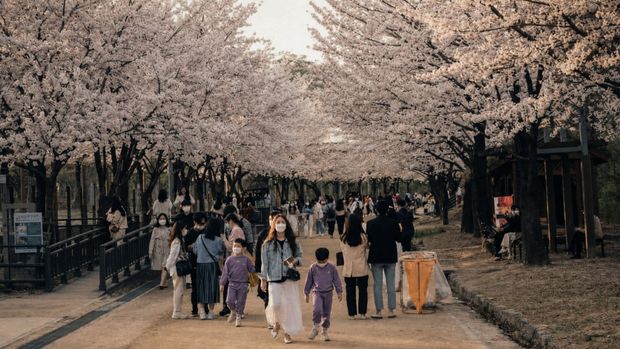
2026 Seoul Cherry Blossom Bloom Timeline
Seoul's cherry blossom season in 2026 opens around April 1, with peak bloom forecast between April 8 and 12 [3] — a window that typically lasts 10 to 14 days under calm spring conditions [3]. Rain or strong winds can cut that window to as few as 4 or 5 days [4], so monitoring local weather apps — KakaoMap, Naver Map, and AccuWeather all carry real-time updates — is a practical necessity, not a bonus step. Korea's bloom travels reliably from south to north: Jeju Island peaks in late March, Busan follows in late March to early April, and Seoul reaches full bloom in early to mid-April [3]. This predictable regional progression makes it straightforward to sequence a multi-city itinerary — traveling Jeju → Busan → Seoul allows a traveler to follow the bloom wave over roughly two weeks and arrive at each destination near its peak rather than before or after it.
Quick Answer: Seoul's cherry blossoms open around April 1, 2026, with peak bloom forecast for April 8–12. The viewing window lasts 10–14 days in calm conditions but can shorten to 4–5 days with rain or wind. All major viewing locations — Yeouido, Seokchon Lake, Anyangcheon Stream, Seoul National Cemetery — are free to enter.
The south-to-north bloom sequence across Korea reflects both latitude and local climate. Jeju Island's king cherry trees (왕벚나무), which are native to the island, typically open several days ahead of mainland Korea's Yoshino variety. Busan's Dalmaji Hill and Nakdong River paths peak around late March to very early April. By the time Seoul's trees reach full bloom in the April 8–12 window, Busan's petals are already beginning to fall — a pattern consistent with historical data across multiple recent years [10]. For travelers building an itinerary around the bloom, this south-to-north sequencing removes the guesswork about where to be and when.
Weather monitoring in the final week of March gives the clearest signal for Seoul timing. The Korea Meteorological Administration publishes official bloom forecasts updated weekly at kma.go.kr. Checking the 10-day forecast for Seoul around March 24–28 provides enough lead time to adjust travel dates if an early or late bloom year is developing. Spring temperatures in Seoul run 12–18°C during the day, dropping to 3–7°C at night [4] — conditions comfortable for outdoor walking but variable enough that a light jacket and compact umbrella are worth carrying throughout the season.
| City / Region | Opening Date (est.) | Peak Bloom (est.) | Notes |
|---|---|---|---|
| Jeju Island | Mid-to-late March | Late March | Native king cherry (왕벚나무); first region to bloom nationally |
| Busan | Late March | Late March – early April | Dalmaji Hill and Nakdong River paths; 3–5 days ahead of Seoul |
| Gyeongju | Late March – early April | Early April | Bomun Lake cherry road; historic district backdrop |
| Seoul | ~April 1 [3] | April 8–12 [3] | Yeouido, Seokchon Lake, Namsan Park primary venues |
| Northern Gyeonggi / Chuncheon | Early-to-mid April | Mid-April | Cooler temps delay bloom 3–5 days past Seoul |
Yeouido Cherry Blossom Festival 2026: Seoul's Flagship Event
The Yeouido Cherry Blossom Festival runs April 3–7, 2026 [1] along Yunjung-ro, a 1.7 km boulevard in Yeongdeungpo-gu [6] lined with 1,886 cherry trees and 87,859 spring flowers — including azaleas and forsythias — planted between Yeouinaru Station and Yeouido Park [6]. Admission is free throughout the five-day festival period. After dark, festival lighting transforms the avenue into a distinctly different atmosphere from the daytime experience — the pink canopy glows against the evening sky with far fewer visitors present than during afternoon peak hours. This is Seoul's most recognized cherry blossom event, drawing visitors from across Korea and internationally, which means crowd management is a real consideration, particularly on weekends during peak bloom week.
Timing is the single most consequential decision at Yeouido. Weekday mornings before 9 AM offer noticeably calmer conditions — the walking pace is unhurried and the 1.7 km stretch is navigable without being pressed from multiple directions [3]. Arriving after 7 PM on weekdays is a second viable option: festival lighting is active, foot traffic has thinned, and the photographic conditions shift entirely from the daytime experience. Weekend mornings between 7 and 9 AM are a workable alternative if weekday visits aren't possible. Weekday mornings before 10 AM are consistently the most manageable window across both the festival dates and the surrounding bloom days [3].
"The Yeouido Spring Flower Festival is not a single-tree event — the combination of cherry blossoms, azaleas, and forsythias along Yunjung-ro is programmed to deliver a full seasonal showcase across multiple flower types simultaneously, extending the visual interest of the boulevard beyond the cherry bloom window alone." — Seoul Tourism Organization, official festival documentation
Subway access is direct and straightforward. Line 5 runs to Yeouinaru Station (Exit 1 or 2), placing visitors at the eastern end of Yunjung-ro. Lines 5 and 9 both serve Yeouido Station for approach from the west [8]. The 1.7 km route is fully flat and walkable from either end. Street food stalls and pop-up vendors operate along the perimeter during festival days, adding atmosphere without requiring any advance planning. Yeouido Park — directly adjacent to Yunjung-ro — provides additional open space for visitors who want a break from the main boulevard density.
For visitors extending their outing past the festival corridor, the Han River Yeouido Park connects to riverside cycling paths heading east and west. Bike rental stations are available along the riverside, making it practical to follow the bloom along the riverbank at your own pace after covering the main boulevard.
📍 View Yunjung-ro (Yeouido) on Google Maps
Seokchon Lake Cherry Blossom Festival 2026
The Seokchon Lake Cherry Blossom Festival runs April 3–11, 2026 [1] — at nine days, it is one of the longest blossom festival windows among Seoul's official events. The lake circuit in Jamsil-dong, Songpa-gu offers a viewing experience distinctly different from Yeouido: the loop path around the lake creates 360-degree cherry blossom reflections in the water, with Lotte World Tower visible in the background as a landmark reference point [3]. Admission to the lake circuit is free. Performances and exhibitions run throughout the nine-day festival period; checking the official Seokchon Lake program in advance for scheduled events on your specific visit day is worth the few minutes it takes.
The location creates a natural full-day itinerary. Seokchon Lake sits directly adjacent to Lotte World theme park and within easy walking distance of Lotte World Tower's observation deck — both are separate-admission venues that complement a morning lake walk with an afternoon activity of a different character. The tower's observation deck provides an aerial perspective of the lake and its surrounding cherry canopy from above, a viewpoint that differs from the lakeside ground-level experience in ways that justify combining both.
Access is via Subway Line 2 to Jamsil Station, with clear signage from the station directing visitors to the lake entrance — roughly a five-minute walk. Line 8 also serves Jamsil Station, making the lake accessible from multiple city zones without transfers. The Jamsil area has a high density of cafes, convenience stores, and restaurants, so meal and break logistics require no advance planning. Seokchon Lake tends to draw more Seoul locals and families than organized tour groups, and the nine-day festival window distributes attendance more evenly than Yeouido's five-day schedule — which generally means fewer crowd spikes, except on peak bloom weekend days [2].
📍 View Seokchon Lake on Google Maps
Namsan Park Cherry Blossom Trail and Spring Events
Namsan Park hosts Seoul's longest mountain cherry blossom trail, winding through the forested hillside of Yongsan-gu at varying elevations — a trail structure that produces tree-canopy views and city panoramas unavailable from any of Seoul's flat promenade venues. The park is free to enter and accessible by cable car, shuttle bus from Chungmuro, or on foot from Chungmuro Station (Lines 3 and 4) or Myeongdong Station (Line 4) with approximately a 25-minute uphill walk [4]. The N Seoul Tower observation deck charges approximately ₩21,000 per adult [2] and provides aerial views of cherry canopies spread across the city below — a perspective not available from any other vantage point in central Seoul. Namsan is a self-contained half-day or full-day activity during blossom season that works well standalone or as an afternoon extension after a Myeongdong morning.
The Blossom TOWER event adds a specific scheduling draw during the shoulder days before peak bloom. The Namsan Wine Fair runs on two separate weekends — March 28–29 and April 4–5, 2026 [1] — pairing wine tastings with the early spring scenery when the blossoms are open but before the main festival crowd concentration has fully arrived. For visitors whose travel dates fall before the April 8–12 peak window, the Wine Fair weekends offer a structured Namsan activity with added atmosphere.
"Namsan's cherry blossom trail is the only spot in central Seoul where you walk through the cherry canopy at elevation, with city views opening between the trees at different points along the path — the experience is fundamentally different from the flat, boulevard-style walks at Yeouido or Seokchon Lake." — The Girl with a Big Bag, Seoul spring travel coverage
Namsan's trail network differs structurally from the festival venues. Rather than a single main boulevard, the park contains multiple paths at various elevations around the mountain. The cable car operates from the base near Myeongdong and deposits riders partway up the mountain, reducing the climb for those who prefer not to walk the full ascent. Shuttle buses run from Chungmuro and Namsan Oreum stops on a schedule that varies by season — confirming the current timetable before arrival prevents unnecessary waits at the base.
Sunset timing (roughly 6–7 PM in early April) produces the strongest combination of conditions on Namsan: golden-hour light falls across the cherry canopy on the hillside while the city's evening illumination begins to appear below. The N Seoul Tower outdoor terrace captures both simultaneously in a way that midday visits don't replicate. The observation deck is a year-round destination, but the blossom season window is when the view adds a layer of visual context that changes the experience significantly.
📍 View Namsan Park on Google Maps
Quieter Cherry Blossom Spots Across Seoul
Seoul's major festival venues handle the bulk of visitor attention each April, but the city has several locations that offer comparable cherry blossom viewing in noticeably less congested settings. The Anyangcheon Stream Embankment in western Seoul, Seoul National Cemetery in Dongjak-gu, Children's Grand Park in Gwangjin-gu, and the Yeonnam-dong neighborhood in Mapo-gu each provide distinct experiences — all free to enter — that function well as primary destinations or as alternatives when Yeouido and Seokchon Lake reach peak weekend density. These spots are particularly valuable for visitors whose travel dates land on peak-bloom weekend days, when the flagship venues are at their most congested [2].
Anyangcheon Stream Embankment
Anyangcheon Stream runs through Yangcheon-gu and Yeongdeungpo-gu in western Seoul, and the cherry blossom path along its banks between Mok-dong Bridge and Omokgyo Bridge is officially Seoul's longest cherry blossom walkway [5]. The riverside promenade draws a fraction of Yeouido's visitor volume despite being on the same subway line — a gap that becomes significant during peak weekend days. Access is via Subway Line 5 to Omokgyo Station (Exit 5), a 468 m walk to the path entrance [5]. The path is popular with cyclists and joggers and carries the everyday character of a local green corridor rather than a designated tourist venue — admission is free and the route has no defined endpoint, allowing visitors to walk as far or as briefly as conditions and time allow.
📍 487 Yangpyeong-dong, Yeongdeungpo District, Seoul
🕒 Daily Open 24 hours
⭐ 4.4 (28 reviews)
🔗 View on Google Maps
Seoul National Cemetery
Seoul National Cemetery in Dongjak-gu features rare weeping cherry blossoms — a variety with long, drooping branch formations that create a curtain-like canopy distinct from the upright Yoshino trees found at Yeouido and Seokchon Lake [2]. The grounds are quiet and serene, consistently far less visited than any of the central Seoul festival sites. Access is via Subway Lines 4 and 9 to Dongjak Station (Exits 2 and 4) [2]. Opening hours are 6 AM to 6 PM daily [2]. Admission is free.
📍 210 Hyeonchung-ro, Dongjak District, Seoul
🕒 Daily 6:00 AM – 6:00 PM
⭐ 4.8 (110 reviews)
📞 02-748-0114
🔗 View on Google Maps
Children's Grand Park
Children's Grand Park in Gwangjin-gu lines its central walkways with uniformly planted cherry trees and forsythia accents, producing a structured corridor bloom path with consistent tree spacing across the park's main thoroughfare. A zoo and botanical garden operate on-site, making it a practical full-visit destination for groups with varying interests. Access is via Subway Line 7 to Children's Grand Park Station (Exit 1) [2]. Park hours run 5 AM to 10 PM daily [2]. Admission is free.
📍 216 Neungdong-ro, Gwangjin District, Seoul
🕒 Daily 5:00 AM – 10:00 PM
⭐ 4.5 (13,016 reviews)
📞 02-450-9311
🔗 View on Google Maps
Yeonnam-dong / Donggyo-ro 41-gil
Donggyo-ro 41-gil in Yeonnam-dong (Mapo-gu) is a short neighborhood street where cherry trees line the road above a ground level of independent cafes, small restaurants, and local shops. The scale is intimate compared to the riverside promenades — this is a neighborhood walk, not a park circuit — but the combination of cherry canopy, walkable cafe culture, and a local residential atmosphere makes it a natural complement for visitors already spending time in the Hongdae area. Access is via Subway Line 2 to Hongik University Station (Exit 3), then approximately a 10-minute walk to the street [2]. No admission charge.
📍 Donggyo-ro 41-gil, Mapo-gu, Seoul
🔗 View on Google Maps
| Spot | District | Subway Access | Signature Feature | Admission |
|---|---|---|---|---|
| Anyangcheon Stream Embankment | Yangcheon / Yeongdeungpo-gu | Line 5, Omokgyo Station (Exit 5) | Seoul's longest cherry blossom path; riverside promenade | Free |
| Seoul National Cemetery | Dongjak-gu | Lines 4/9, Dongjak Station (Exits 2 & 4) | Rare weeping cherry blossoms; uncrowded, serene grounds | Free |
| Children's Grand Park | Gwangjin-gu | Line 7, Children's Grand Park Station (Exit 1) | Uniform cherry tree walkways; zoo and botanical garden on-site | Free |
| Yeonnam-dong (Donggyo-ro 41-gil) | Mapo-gu | Line 2, Hongik University Station (~10-min walk) | Neighborhood street walk; indie cafes under cherry canopy | Free |
Planning Your Visit: Crowd Strategy and Getting Around
Navigating Seoul's cherry blossom season comes down to two variables: timing and transit. At the major festival venues — Yeouido and Seokchon Lake in particular — weekday mornings before 10 AM and weekday evenings after 7 PM offer the most navigable foot traffic conditions [3]. Weekend afternoons during peak bloom (April 8–12) are significantly more congested, with the Yeouido corridor reaching conditions where slow-moving crowds reduce the walking pace to a crawl. If your schedule only allows weekend visits, arriving at opening or choosing one of the quieter alternatives in Dongjak-gu or Yangcheon-gu will produce a better experience than attempting Yeouido on a Saturday afternoon at noon.
KakaoMap and Naver Map are the most practical day-of navigation tools for this context. Both apps carry live crowd density overlays during peak season and update in real time, allowing on-the-spot decisions about whether to proceed to a planned destination or reroute. Both are available in English and support Seoul transit routing with live delay information. Checking either app before leaving accommodation each morning during bloom week takes roughly two minutes and can save significantly more time in the field.
Seoul's subway network covers every spot in this article. A T-money transit card — purchased and loaded at any subway station or convenience store — covers all subway lines, city buses, and the Namsan cable car [4]. Single subway fares run approximately ₩1,400–₩1,600 per journey [4]. No rental car is needed to reach any location in this article. For visitors combining multiple spots in one day, sequencing by subway line minimizes transit time: Line 5 covers both Yeouido (Yeouinaru Station) and Anyangcheon Stream (Omokgyo Station); Line 2 links Seokchon Lake (Jamsil Station) with Yeonnam-dong (Hongik University Station).
Accommodation near Hongdae, Myeongdong, or Gangnam fills quickly during the April 8–12 peak window — booking 4 to 6 months in advance is advisable for those specific dates [4]. Rates rise noticeably in properties near major festival venues during peak bloom weekend. Staying slightly outside the immediate festival zones — Mapo-gu, Yongsan-gu, or eastern Gangnam — typically offers better availability and pricing while remaining within 15–20 subway minutes of the main sites.
Frequently Asked Questions
When do Seoul's cherry blossoms peak in 2026?
Seoul's cherry blossoms are forecast to open around April 1, 2026, with peak bloom expected between April 8 and 12 [3]. Under calm conditions, the viewing window lasts 10 to 14 days. Rain or strong winds during peak bloom can shorten the window to as few as 4 or 5 days [4]. Monitoring the Korea Meteorological Administration forecast alongside KakaoMap or Naver Map crowd overlays in the week before your visit provides the most reliable signal for when to arrive and where to prioritize.
Which cherry blossom festival in Seoul is the largest in 2026?
The Yeouido Cherry Blossom Festival (April 3–7, 2026) is Seoul's flagship event and the most attended, featuring 1,886 cherry trees [6] along a 1.7 km boulevard [6]. The Seokchon Lake Cherry Blossom Festival (April 3–11, 2026) runs nine days — longer than Yeouido — and features lake-reflection viewing with a more relaxed pace [1]. Both are free to attend. Yeouido suits visitors who want the large-scale boulevard spectacle; Seokchon Lake suits those who prefer a longer, less concentrated festival schedule with a distinct visual character.
Are there free cherry blossom viewing spots in Seoul?
Yes — all major spots in this article are free to enter. Yeouido's Yunjung-ro, the Seokchon Lake circuit, Anyangcheon Stream Embankment, Seoul National Cemetery, Children's Grand Park, and Yeonnam-dong's Donggyo-ro 41-gil all charge no admission. The one paid option is the N Seoul Tower observation deck on Namsan, which charges approximately ₩21,000 per adult [2]. Namsan Park itself is free to walk through without ascending the tower — the park trail provides substantial cherry blossom viewing at no cost.
Which Seoul cherry blossom spot is least crowded?
Seoul National Cemetery in Dongjak-gu and Anyangcheon Stream Embankment in Yangcheon/Yeongdeungpo-gu are consistently among the least congested cherry blossom locations in the city during peak season [2]. The Cemetery's weeping cherry variety and quiet grounds attract far fewer visitors than Yeouido, and Anyangcheon's riverside path sits outside the central tourist zone despite being Seoul's longest cherry blossom walkway [5]. Yeonnam-dong's Donggyo-ro 41-gil is a third low-key option with neighborhood character distinct from any of the designated festival sites.
How do I reach the main cherry blossom spots using Seoul's subway?
All major spots are reachable by subway with a T-money card. Yeouido (Yunjung-ro): Line 5 to Yeouinaru Station (Exit 1 or 2), or Lines 5/9 to Yeouido Station. Seokchon Lake: Line 2 to Jamsil Station, follow signs to the lake (approximately 5-minute walk). Anyangcheon Stream: Line 5 to Omokgyo Station (Exit 5), 468 m walk to the path entrance [5]. Seoul National Cemetery: Lines 4 and 9 to Dongjak Station (Exits 2 and 4) [2]. Children's Grand Park: Line 7 to Children's Grand Park Station (Exit 1). Namsan Park has no direct subway station — take Lines 3 or 4 to Chungmuro Station, or Line 4 to Myeongdong Station, then walk approximately 25 minutes uphill or take a shuttle bus.
What to Know Before the Blossoms Arrive
Seoul's 2026 cherry blossom season concentrates into roughly two weeks in early April, anchored by the April 8–12 peak bloom window. The festival calendar is straightforward: Yeouido runs April 3–7 [1] for a high-intensity five-day boulevard experience, while Seokchon Lake extends April 3–11 [1] for a longer, more distributed schedule. Namsan adds the elevation perspective and the Namsan Wine Fair weekends (March 28–29 and April 4–5) [1] for visitors arriving before the main peak. The quieter spots — Anyangcheon, Seoul National Cemetery, Children's Grand Park, Yeonnam-dong — provide the same bloom in settings where the experience is determined by the trees rather than the crowd management required to see them.
The practical infrastructure is already in place: Seoul's subway reaches every location in this article, the T-money card handles all transit in one tap, and KakaoMap provides real-time crowd data that makes day-of routing adjustments possible. The bloom itself is the remaining variable — one that the Korea Meteorological Administration forecast, checked weekly from mid-March onward, tracks with reasonable accuracy. Checking the 10-day Seoul forecast around March 24 is the single most useful action a visitor can take before departure to calibrate arrival timing.
Cherry blossom season in Seoul is a well-documented annual event with predictable geography, consistent transit infrastructure, and a bloom window that follows established regional patterns. The 2026 timeline aligns closely with the historical average. With festival dates confirmed, transit routes mapped, and the quieter alternatives identified, the remaining step is monitoring the weather as April approaches and building enough flexibility into the first few days of your Seoul visit to catch peak bloom at its best.
Last updated: 2026-05-19. Festival dates and bloom forecast data reflect information available as of publication. Admission prices, transit fares, and venue operating hours are subject to change; verify current details with official sources before visiting.


