
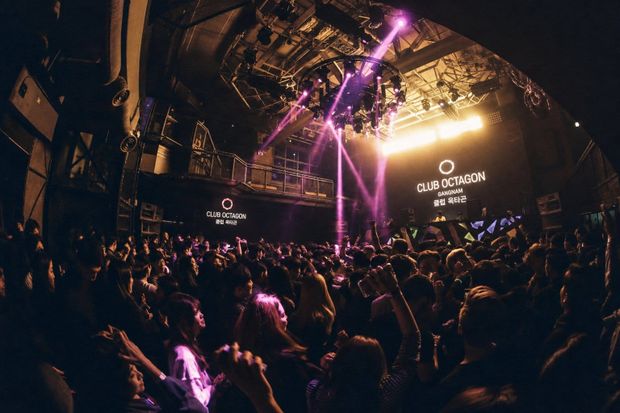
Gangnam: Image-Conscious Clubs and 4 AM After-Parties
Gangnam — covering the Sinsa, Cheongdam, and Apgujeong sub-districts south of the Han River — represents a categorically different spend level and social dynamic from any other Seoul nightlife district. Club Octagon and Race are the landmark mega-clubs here, with VIP table service ranging from ₩300,000 to ₩3,000,000 per set [3] — a price that covers bottles, mixers, and the social positioning that a prominent table provides. The door culture enforces consistent standards: no shorts, sandals, or excessive visible tattoos for men [3], regardless of nationality. Smart casual or standard going-out attire is the safe default. Verify dress code expectations for the specific venue before arriving — interpretation varies between clubs, and being turned away at Gangnam's door after a taxi from Hongdae is a preventable outcome. Budget for the gap: general-admission entry at major Gangnam clubs runs ₩20,000–30,000 without a table, and the surrounding food, transport, and pre-drinks environment is the highest-cost tier in the city.
📍 View Club Octagon on Google Maps
📍 View Club Race on Google Maps
The booking club system is widely misunderstood by visitors and worth understanding before you arrive. It is a staff-managed table service model in which club employees introduce new arrivals to existing table parties — standard operating practice at Gangnam mega-clubs, not a system exclusive to Korean nationals. A language gap can complicate the interaction, but it does not prevent participation. Visitors who prefer to sidestep the booking format can request general admission or remain on the dance floor without a table affiliation; most major venues accommodate both formats simultaneously in the same space.
Gangnam's defining logistical feature — and the one with no parallel anywhere else in Seoul — is its after-club ecosystem. Multiple venues open at 4 AM and run through noon, sustaining a dawn-to-midday crowd segment [3]. This makes Gangnam the natural final district for a full-night circuit: arrive from Hongdae or Itaewon by taxi after 3 AM, exit the after-club before noon, and the complete Seoul nightlife arc is legible in a single outing. The escalating cost across districts makes this a deliberate choice rather than a casual addition — factor it into your total budget before the night starts.
Euljiro, Jongno, and Eating Through the Night
Euljiro and Jongno offer a register completely different from the club-centered districts — old Seoul, low-lit alleys, and food and drink that have maintained their format and price point for decades. The anchor is Nogari Alley (노가리 골목), a stretch of outdoor tables near Euljiro 3-ga Station where draft beer is ₩4,500 per pint and dried pollack (nogari) is ₩2,000 per serving [3] — the most affordable authentic drinking environment in central Seoul by a wide margin. Office workers, construction workers, and tourists share the same plastic stools under the same fluorescent lights without any social friction; the leveling is deliberate. Times Food & Jazz, also in Euljiro, runs nightly live jazz and vocal performances from 18:00 to 01:00 with no cover charge [3]; arrive by 8 PM for stage-side seating. Beyond these two anchors, the broader night food circuit — Gwangjang, Namdaemun, Noryangjin, Dongdaemun — maps a complete landscape of nocturnal Korean eating that extends from 7 PM through 5 AM, as documented by Korea Insider.
| Venue | Operating Hours | Signature Food | Price Range |
|---|---|---|---|
| Nogari Alley (노가리 골목) | Evening–late | Draft beer + dried pollack | ₩4,500–6,500 |
| Gwangjang Market (광장시장) | Until 11 PM–midnight | Bindaetteok, yukhoe + makgeolli | ₩15,000–25,000 |
| Namdaemun Market (남대문시장) | 10 PM–sunrise | Kalguksu, haemul pajeon | ₩7,000–12,000 |
| Noryangjin Fish Market (노량진수산시장) | 24 hours | Live seafood (selected + prepared upstairs) | ₩30,000–60,000 |
| Dongdaemun stalls (APM / Migliore area) | Until 4–5 AM | Tteokbokki, sundae, hotteok | ₩10,000–30,000 |
| Han River parks (Banpo / Yeouido) | Open access; Bamdokkaebi Fri–Sat 18:00–23:00 | Instant ramyeon; chimaek delivery | ₩1,300–20,000 |
Gwangjang Market (광장시장), Seoul's oldest market founded in 1905 [4], runs until 11 PM–midnight with peak activity between 7 and 10 PM. The covered pojangmacha alley specializes in bindaetteok — mung bean pancakes fried in lard and served with kimchi — and yukhoe (beef tartare). A full meal with makgeolli runs ₩15,000–25,000 [4]. It closes earlier than the rest of the night food circuit, so treat it as an early-evening anchor rather than a post-midnight stop. For visitors who want to combine Gwangjang with a broader cultural night, a Creatrip Night View & Late-Night Snack Tour covers Gwangjang, N Seoul Tower, and Changgyeonggung Palace in four hours for ₩100,000 per person [2], departing at 6 PM — a coherent pre-club itinerary for first-time visitors.
📍 View Nogari Alley on Google Maps
📍 View Times Food & Jazz on Google Maps
📍 View Gwangjang Market on Google Maps
Namdaemun Market operates on a genuinely inverted schedule: it opens at 10 PM, runs through the night, and is busiest before sunrise [4]. The post-midnight dish here is kalguksu — knife-cut noodle soup in anchovy or chicken broth — alongside haemul pajeon (seafood pancake), both in the ₩7,000–12,000 range [4]. Noryangjin Fish Market (노량진수산시장) never closes: select live seafood from the wholesale floor downstairs and the upstairs restaurants prepare it for ₩30,000–60,000 per person [4]. Dongdaemun's APM and Migliore complexes stay open until 4–5 AM with street food stalls surrounding them — tteokbokki, sundae (blood sausage), and hotteok for ₩10,000–30,000 [4].
📍 View Namdaemun Market on Google Maps
📍 View Noryangjin Fish Market on Google Maps
📍 View Dongdaemun (APM) on Google Maps
The Han River parks at Banpo and Yeouido anchor their own nocturnal ritual. Buy instant Shin Ramyeon from a GS25 or CU convenience store for approximately ₩1,300 [3], use the in-store hot water, and take it to the riverbank. Delivery apps route chimaek (fried chicken and beer) directly to designated riverside zones. The Bamdokkaebi Night Market (밤도깨비) operates at Yeouido or DDP every Friday and Saturday, 18:00–23:00 [3], with fusion food trucks at ₩8,000–12,000 [3]. It closes at 23:00 — earlier than the rest of the market circuit — making it a strong pre-club stop rather than a post-midnight one.
📍 View Banpo Han River Park on Google Maps
📍 View Bamdokkaebi Night Market (Yeouido) on Google Maps
Getting Around Seoul After the Last Subway
Transport after the last subway train is a solvable problem in Seoul, but it requires preparation rather than improvisation at 1 AM. Final departures on weekdays are approximately 1 AM; on Fridays and Saturdays this extends to around 2 AM on most major lines [3]. If you are moving between districts — Hongdae to Gangnam, for example — execute that transition before midnight on weekdays or before 1 AM on weekends. Riding the subway between districts costs a fraction of what a post-cutoff taxi charges and is faster than any road alternative during peak weekend traffic. Planning this one step in advance prevents the most common logistical failure of a Seoul night out.
Kakao T is the standard taxi-hailing app and works reliably with most foreign bank cards. Expect demand surcharges in the 20–30% range between 1 AM and 4 AM on weekend nights in Hongdae and Gangnam [3] — both districts see supply constraints at the post-club hour. The 900-series night buses run on major corridors from approximately 1 AM to 5 AM, covering Hongdae, Itaewon, and Gangnam on different routes. They are considerably slower than taxis but far cheaper — useful if cost matters more than speed and if you can read route maps in advance using Naver Maps or a translation app.
Cash is not required at clubs or indoor bars, which accept card universally. The street stalls, pojangmacha tents, and outdoor market vendors that define the late-night food experience, however, are frequently cash-only — carry ₩10,000–₩50,000 in notes. ATMs inside GS25, CU, and 7-Eleven stores operate at all hours. The spend gradient across districts follows a consistent pattern: Euljiro and Jongno are the lowest-cost tier; Hongdae is the middle tier; Itaewon and Hannam-dong are premium; Gangnam VIP roughly doubles the Itaewon spend at minimum [3]. Set a per-district ceiling before the night begins rather than recalibrating in the moment — the Gangnam gap surprises visitors arriving from Hongdae without a prior expectation adjustment. One safety note: unmarked private vehicles occasionally approach pedestrians in the 1–4 AM window in Hongdae and Itaewon. Use only officially metered taxis — orange or silver vehicles with a lit roof indicator — or cars dispatched through Kakao T.
Frequently Asked Questions
What time do Seoul clubs actually get busy?
Seoul clubs reach peak energy between 11 PM and 2 AM. In Hongdae, NB1 and m2 see queues forming by 10:30 PM on Fridays and Saturdays — arriving before that window bypasses the longest waits. Gangnam's after-clubs operate on a separate schedule entirely: doors open at 4 AM and the main crowd arrives between 5 and 7 AM. Itaewon venues like Soap Seoul and Faust peak between midnight and 3 AM. For anyone planning a multi-district night, factor in transit time between 12:30 and 1:30 AM before the subway closes — district changes on foot or by taxi after cutoff add cost and time that can compress your evening unexpectedly.
How much does a night out in Seoul typically cost?
The range is wide and depends on district and venue type. A full evening at Nogari Alley in Euljiro — draft beer and dried pollack — costs ₩15,000–20,000 per person. A Hongdae club night with entry and three drinks runs ₩40,000–70,000. Itaewon premium bars like Cinderella Bar push ₩60,000–100,000 with cocktails. Gangnam VIP table service starts at ₩300,000 per set and scales to ₩3,000,000 for premium arrangements. General-admission entry at major Gangnam clubs is ₩20,000–30,000 without a table. The most reliable approach is to set a budget per district before going, rather than escalating venue by venue across a long night.
Is Itaewon safe to visit for nightlife in 2026?
By 2026, Itaewon has substantially recovered following the October 2022 crowd crush that killed 159 people in the Halloween alley network. Venues including Soap Seoul and Faust are fully operational. The municipality has implemented improved pedestrian management protocols on peak Friday and Saturday nights, with crowd monitoring active in the narrower alley corridors. Standard situational awareness remains advisable — particularly around Halloween and other high-attendance dates. The Yongridan-gil cocktail corridor and Homo Hill are both operating normally and are specifically calibrated for international visitors.
How do I get home after Seoul's subway closes?
The most reliable option is Kakao T — download and register the app before your night begins, as account setup with a foreign card can take a few minutes. The app dispatches officially metered taxis and accepts most international credit cards. The 900-series night buses cover major corridors including Hongdae and Gangnam from approximately 1 AM to 5 AM and are significantly cheaper than taxis, though considerably slower. If hailing a taxi on the street, use only officially metered vehicles (orange or silver with a lit roof sign). Do not accept rides from unmarked private cars, which occasionally approach pedestrians in the 1–4 AM window in Hongdae and Itaewon.
Are Seoul clubs accessible to foreign visitors?
Hongdae is the most consistently accessible district for international visitors: English-speaking staff at major venues, relaxed dress codes, and no nationality restrictions at NB1, NB2, m2, or Cocoon. Itaewon and Hannam-dong are designed for a mixed international crowd — Soap Seoul and Faust are listed on global platforms like Resident Advisor and draw visitors specifically for the music programming. Gangnam is more variable: certain venues apply door policies that include nationality considerations, and strict dress code enforcement is standard. Research specific Gangnam clubs before going, and always carry a passport or government-issued photo ID — Seoul clubs are legally required to verify age for entry, and a foreign passport is the clearest accepted form of identification.
What to Keep in Mind Across a Full Seoul Night
Seoul's after-dark landscape does not ask you to choose between clubs and food, or between budget and spectacle — it runs all of these simultaneously across a city that peaks well after midnight. Start with Gwangjang Market or Nogari Alley for an affordable, grounded early evening; move into the Hongdae club zone between 10 PM and 1 AM; transition to Itaewon for underground music or the Yongridan-gil cocktail corridor if you want a step up in specificity; and let Gangnam's after-clubs extend the night if you are still mobile at 4 AM. The Han River is available at any point for a reset — instant ramyeon on the Banpo riverbank at 2 AM is not a fallback; it is a Seoul institution that locals plan around by choice.
The district sequence also has a financial logic that rewards planning. Beginning in Euljiro or Jongno keeps the early hours affordable. Moving toward Gangnam is a deliberate tier decision, not an accidental escalation. Know the subway cutoff before the night starts. Download Kakao T and register a payment method before you need it at 1:30 AM. Carry enough cash for the street-food and pojangmacha circuit. For K-POP fans visiting around a concert at Olympic Park, KSPO Dome, or KINTEX, both Hongdae and Itaewon sit within reasonable post-show transit range and carry dense concentrations of K-POP merchandise stores, fan cafés, and idol-adjacent venues that extend a concert evening naturally into the city's nightlife geography — the overlap between fan culture and after-dark Seoul is not incidental; both developed in the same districts across the same decades.
Seoul after dark is a fully operational system. Navigating it well is a matter of information, not luck — and the information above covers the practical frame for a night that can run from a 7 PM bindaetteok dinner at Gwangjang to an 8 AM Gangnam after-club exit without a single dead hour in between.
Last updated: 2026-05-19. Article reviewed against venue operating data, district-level nightlife reporting, and transport schedules current as of May 2026.


