
Seoul's Neighborhoods in 2026: More Than One District
Seoul's neighborhoods in 2026 each carry a distinct identity that rewards deliberate exploration rather than a rushed single-day circuit. The city layers six centuries of Joseon-dynasty architecture alongside K-pop culture, specialty food markets, and design-forward creative quarters — all connected by one of Asia's most efficient metro networks. National Geographic named South Korea among its top destinations for 2026, recognizing the country's rare ability to merge centuries of tradition with the relentless energy of the Korean Wave. For K-pop fans visiting Seoul, this distinction matters: Seongsu-dong concentrates brand pop-up events and fan cafés, Gangnam anchors major concert and showcase venues, while Insadong and Bukchon provide the cultural backdrop that gives the music deeper context. Knowing which district serves which purpose — and how to cluster them efficiently by subway line — converts a good trip into a genuinely coherent one across half-day blocks; the pillar guide to Seoul 2026 maps the full district matrix and year-round event calendar for visitors planning ahead.
Quick Answer: Seoul's neighborhoods each serve a different purpose: Seongsu-dong for creative pop-ups and K-brand activations, Insadong and Bukchon for heritage, Myeongdong for K-beauty shopping, and Gangnam for concerts and upscale retail. National Geographic ranked South Korea a top 2026 destination, and the Seoul International Garden Show (May–October 2026) adds a city-wide seasonal event across Seoul Forest and Han River parklands.
Seoul's subway map is the practical key to grouping neighborhoods logically. Line 3 (the orange line) connects Gyeongbokgung Palace, Anguk Station (for Bukchon and Insadong), and Jongno 3-ga (for Ikseon-dong) in a single northern corridor. Line 2 (the green loop) links Seongsu-dong, Hongdae, and Gangnam on one continuous ring — making those three neighborhoods a natural same-day cluster. A T-money transit card costs approximately ₩1,400 per ride (~$1.00) for subway trips, or the Climate Card tourist pass covers unlimited subway and bus access for ₩5,000 (one day) or ₩20,000 (seven days), according to Skysonar's Seoul City Guide.
In 2026, two city-wide experiences add seasonal urgency to any Seoul visit. The Seoul International Garden Show runs from May through October across Seoul Forest and the Han River parklands, with free or low-cost entry during the city's warmest months (source: Visit Seoul). Hangang drone light shows illuminate multiple riverside parks through the warmer season on varying schedules. Both events are layered over year-round anchors — Gyeongbokgung's Changing of the Guard, temple visits, and K-pop brand activations — ensuring Seoul consistently rewards visits at any point in the year. For first-time visitors, Real Korea Insider recommends a minimum of three days to cover the essentials, with five to seven days allowing a more thorough pass through each district.
Seongsu-dong and Ikseon-dong: Seoul's Trendiest Micro-Neighborhoods
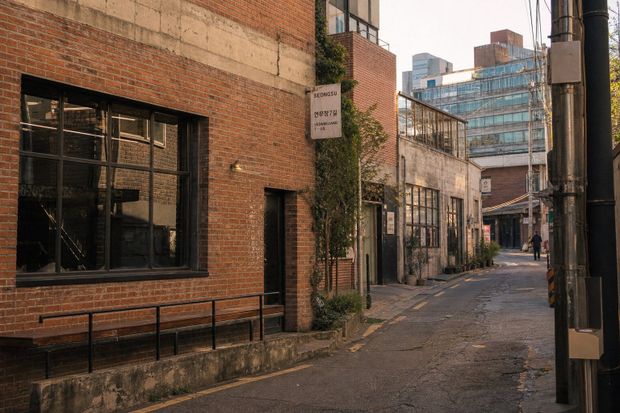
Seongsu-dong and Ikseon-dong represent two very different approaches to creative urban renewal — one built on repurposed industrial scale, the other on the intimacy of preserved hanok alleyways — yet both have become central to how K-pop culture activates physical space in Seoul. Seongsu-dong, located along Line 2 in eastern Seoul adjacent to Seoul Forest, transformed a former leather-factory district into a rotating gallery of specialty coffee roasters, independent design studios, and short-run brand installations. Ikseon-dong, just south of Jongno in the city centre, converts century-old wooden hanok homes into cocktail bars and single-origin cafés packed into a compact grid navigable entirely on foot in under two hours. Both neighborhoods now function as primary sites for K-pop label activations: idol fan cafés, album-release pop-ups, and anniversary events cluster here with enough frequency that checking Visit Seoul's 2026 event calendar before arriving is genuinely worthwhile.
Seongsu-dong | Creative Quarter
Nicknamed "Seoul's Brooklyn" by international travel media and adopted as shorthand in the local design community, Seongsu-dong earned its reputation through a decade-long shift from light manufacturing to cultural production. The neighborhood's defining architecture — low brick warehouses with loading docks and exposed iron frames — provides an ideal canvas for the rotating brand activations that K-pop labels and lifestyle companies schedule here seasonally. Major K-brand pop-up installations typically run for two to four weeks and draw dedicated fan traffic that rivals weekend tourist numbers. Specialty coffee roasters anchor the daytime scene, with several earning regional recognition for sourcing and technique, per Skysonar.
Timing matters in Seongsu-dong. Weekday afternoons offer the most comfortable conditions for exploring: coffee queue times are shorter, pop-up spaces are less congested, and the industrial-residential streets retain their working-neighborhood atmosphere. Seoul Forest — a large park directly adjacent to the district — provides a natural extension of any afternoon here, particularly during the 2026 Seoul International Garden Show season running through October, according to Visit Seoul.
📍 Seongsu-dong 2(i)-ga, Seongdong-gu, Seoul
🔗 View on Google Maps
Ikseon-dong | Hanok Alleyways
Ikseon-dong sits in a compact grid originally developed in the 1920s and 1930s as a residential hanok neighborhood. The wooden structures — with their curved tile rooftops and narrow wooden doors — have been carefully converted into intimate cocktail bars, Korean tea houses, and single-origin cafés while preserving the street-level geometry of the original urban block. The neighborhood's scale is genuinely walkable: the primary area covers roughly four to five city blocks and can be toured fully in one to two hours on foot, as noted by Skysonar's Seoul City Guide.
Ikseon-dong reaches its peak atmosphere in the early evening — from around 6 PM onward — when bars open and lantern lighting warms the alleyways. The neighborhood sits within a short walk of Insadong, making a natural daytime-into-evening loop: Insadong for traditional crafts and tea during daylight hours, Ikseon-dong for cocktails and small plates after sundown. The two together are logical on a single day if pressed for time.
📍 Ikseon-dong, Jongno District, Seoul
🔗 View on Google Maps
"Seongsu has become the reference point for Seoul's creative evolution — every season brings a new brand installation, and the neighbourhood absorbs them without losing its gritty industrial character." — Editorial Team, Skysonar City Guide
Insadong, Bukchon, and the Jongno Cultural Belt
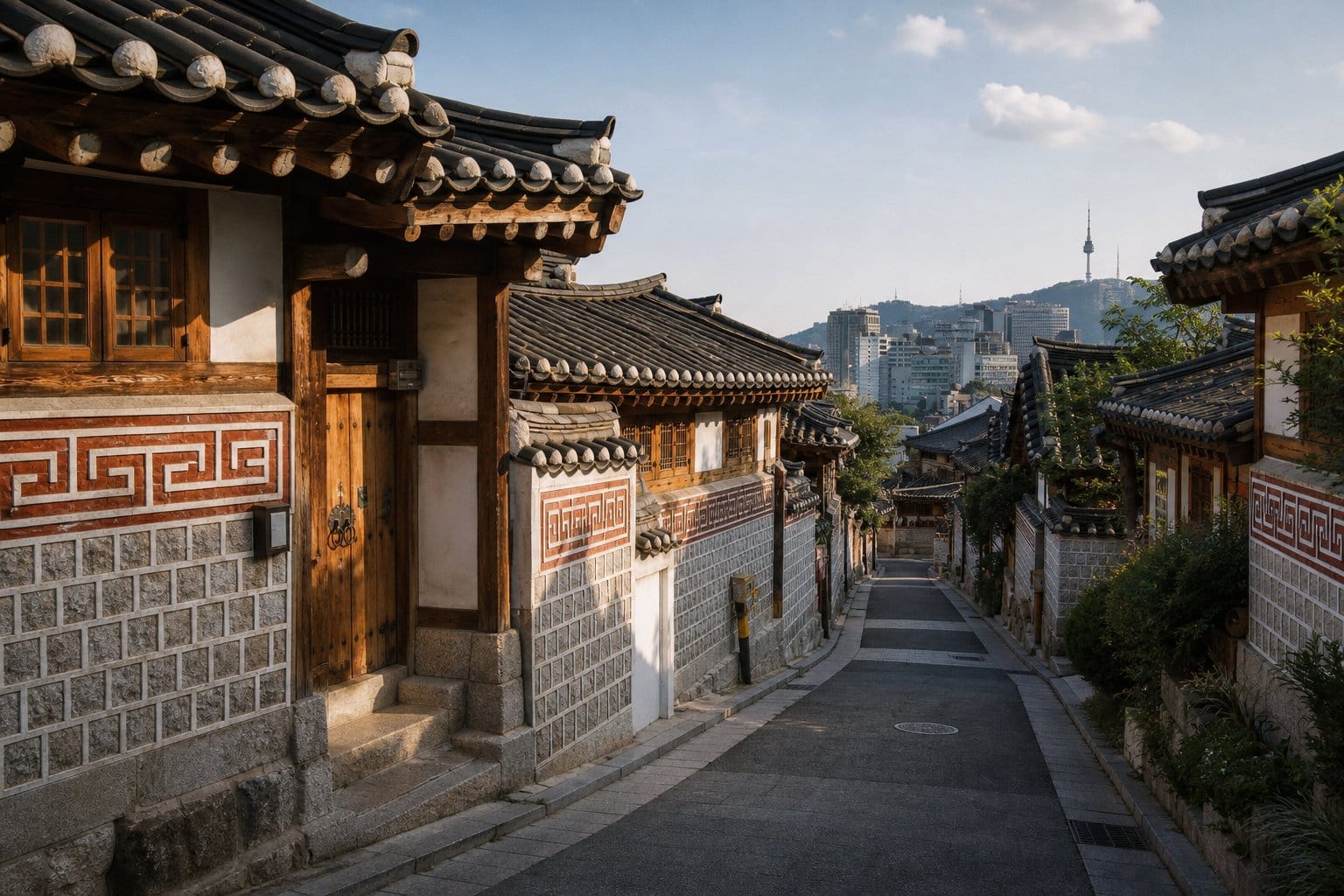
The Jongno cultural belt — spanning Insadong, Bukchon Hanok Village, and the two great Joseon palaces — is the most historically dense corridor in Seoul and the clearest entry point for understanding the city's 600-year heritage. Insadong runs as a pedestrianised street lined with pottery studios, traditional tea houses, antique dealers, and the Ssamziegil courtyard market — the most concentrated single street for Korean craft and souvenir shopping in the city. Bukchon Hanok Village preserves approximately 900-year-old wooden hanok homes on a hillside between Gyeongbokgung and Changdeokgung palaces, with narrow stone-paved lanes that open onto views across both the historic district and the modern skyline beyond. Gyeongbokgung Palace, founded in 1395, remains the grandest of Seoul's five Joseon-era palaces, with entry at ₩3,000 (~$2.20) and the Changing of the Guard ceremony running at 10 AM and 2 PM daily, as documented by Skysonar.
Insadong | Traditional Arts Strip
Insadong's main street runs south from Anguk Station (Line 3) for roughly 700 metres, passing a dense sequence of galleries, Korean craft studios, and tea houses on either side. The Ssamziegil courtyard market — accessible through an inner lane — gathers independent designers, ceramics sellers, and street food vendors under a spiralling open-air architecture. This is the clearest single location in Seoul for acquiring traditional Korean crafts, celadon pottery, and hanji paper goods without navigating a larger commercial centre. Budget two to three hours for a thorough pass through Insadong and Ssamziegil combined, per Museum of Wander's Seoul guide.
📍 Insa-dong, Jongno District, Seoul
🔗 View on Google Maps
Bukchon Hanok Village | Heritage Hillside
Bukchon Hanok Village rises on the hillside between Gyeongbokgung and Changdeokgung palaces and is one of the few areas in Seoul where traditional wooden architecture survives at neighborhood scale rather than as a curated single block. The hanok homes are private residences alongside a smaller number of guesthouses and craft studios, so respectful, quiet movement through the lanes is both expected and enforced by local residents' notices posted at lane entrances. Weekday mornings — before 10 AM — offer the most tranquil conditions for photography and unhurried exploration, according to Skysonar.
📍 Gyedong-gil, Jongno District, Seoul
🕒 Daily 10:00 AM – 5:00 PM
⭐ 4.4 (23,945 reviews)
📞 02-2133-1371
🔗 View on Google Maps
Gyeongbokgung Palace | The Grand Joseon Anchor
Gyeongbokgung Palace, built in 1395 as the primary seat of the Joseon dynasty, is the largest and most intact of Seoul's five grand palaces. Entry costs ₩3,000 (~$2.20) and includes access to the Changing of the Guard ceremony — a formal procession in historical court dress — at 10 AM and 2 PM daily. The grounds extend across 40 hectares and include the National Folk Museum and the National Palace Museum of Korea. Changdeokgung Palace, a short walk east, holds a UNESCO World Heritage designation and includes the Huwon Secret Garden, a separately ticketed area requiring advance booking through the cultural heritage portal; the landscaped formal garden dates to the early 15th century and is considered among the finest surviving examples of traditional Korean garden design.
📍 161 Sajik-ro, Jongno District, Seoul
🕒 Monday 9:00 AM – 5:00 PM / Tuesday Closed / Wednesday–Sunday 9:00 AM – 5:00 PM
⭐ 4.6 (46,201 reviews)
📞 02-3700-3900
🔗 View on Google Maps
Jogyesa Temple | Buddhist Calm in Jongno
Jogyesa Temple, the head temple of the Jogye Order of Korean Buddhism, stands in Jongno within walking distance of both Gyeongbokgung Palace and Insadong. Despite its central urban location, the temple complex — centred on the Daeungjeon main hall set within grounds that contain a 500-year-old white pine — provides a markedly quieter atmosphere than the streets immediately outside. Entry is free. Temple cuisine — vegetarian Buddhist food served with careful presentation — is available at select affiliated dining venues nearby, providing a dimension of Seoul travel that sits outside the standard cultural tourism circuit, as noted by Visit Seoul.
📍 55 Ujeongguk-ro, Jongno District, Seoul
🕒 Daily 4:00 AM – 11:00 PM
⭐ 4.5 (7,950 reviews)
📞 02-768-8600
🔗 View on Google Maps
Seongsu — Seoul's Brooklyn (Industrial-Chic Cafés)
Seongsu-dong's café culture is the most concentrated expression of industrial-chic coffee in Seoul, built directly into the repurposed shells of former tanneries, garment workshops, and printing facilities that lined the neighborhood before its creative transformation. The anchor venue is Café Onion — occupying a century-old concrete warehouse on Achasan-ro — where exposed brick, raw concrete ceilings, and an open rooftop terrace have made it one of the most photographed cafés in South Korea, with weekend queues forming before the 8 AM opening. Fritz Coffee Company operates a landmark Seongsu roastery on Seoulsup-gil, known for meticulous single-origin sourcing and a signature cream-topped iced coffee that has become the district's most-replicated menu item. Anthracite Coffee's Seongsu location occupies a converted shoe factory with original steel beams and polished concrete floors intact — a venue that exemplifies the neighborhood's approach to adaptive reuse, where the industrial setting is as deliberate as the brew method.
The café density is highest in the six-block corridor between Seongsu Station (Line 2) and Seoul Forest, roughly following Seongsui-ro and the connecting side alleys. Blue Bottle Coffee maintains a Seongsu outpost in this corridor — one of its two Seoul locations — while Korean lifestyle brand Granhand operates a hybrid café and fragrance studio that draws design-conscious visitors as a destination independent of its coffee menu. Daelim Warehouse, a decommissioned industrial complex east of the main café strip, functions as a rotating gallery and event space with café service, drawing visitors equally for large-format art installations and for single-origin pour-overs. The full café corridor is walkable end-to-end in under forty minutes at a relaxed pace; weekday afternoons between 2 PM and 5 PM consistently offer the shortest queue times and the most comfortable conditions for pausing at multiple stops before continuing into Seoul Forest for the 2026 Garden Show grounds directly adjacent to the district.
📍 Seongsu-dong 2(i)-ga, Seongdong-gu, Seoul
🔗 View on Google Maps
Insadong — Traditional Crafts and Tea Houses
Insadong's 700-metre pedestrian main street, running south from Anguk Station on Line 3, holds the highest concentration of traditional Korean craft retail in any single Seoul thoroughfare outside a museum context. Studios and small gallery shops along both sides of the street sell celadon and buncheong pottery, hanji paper goods, ink brushes, and norigae decorative pendants made by artisans who have maintained the same Insadong premises for decades. Ssamziegil — the courtyard market accessed through an inner-lane entrance at roughly the midpoint of the street — gathers independent craft makers, ceramics vendors, and handmade goods sellers around a spiralling open-air walkway designed to funnel foot traffic into a single continuous browsable loop, making it the most efficient single location in Seoul for acquiring genuinely handmade Korean goods without navigating a larger commercial complex.
Tea houses punctuate the side streets and interior courts of Insadong-gil at intervals that reward slow walking. Dawon, operating within the grounds of Unhyeongung Palace just off the main street, serves bori-cha (roasted barley tea), yujacha (citron honey tea), and sikhye (sweet fermented rice punch) in a garden courtyard setting — among the few Insadong venues where the physical setting independently justifies a stop. O'sulloc Tea House operates a flagship on Insadong-gil, offering Jeju green tea products and a matcha dessert menu that draws consistent queues from mid-afternoon onward; Suyeon Sanbang, tucked into a quieter lane east of the main street, serves a broader range of traditional medicinal and herbal teas in a residential-scale garden with considerably shorter waits. Budget two to three hours to cover the main street, Ssamziegil, and at least one tea house stop without feeling pressured; the neighborhood sits directly adjacent to Bukchon Hanok Village and Ikseon-dong for logical same-day extension.
📍 Insa-dong, Jongno District, Seoul
🔗 View on Google Maps
Myeongdong — Shopping & Street Food Hub
Myeongdong's pedestrian shopping district extends approximately 1.4 kilometres from Myeongdong Station (Line 4) toward Namsan and operates as the most commercially dense K-beauty retail corridor in Seoul. Innisfree, LANEIGE, Sulwhasoo, Missha, and Etude House all maintain large-format flagship showrooms on the main street and its perpendicular lanes, with multi-floor layouts designed for extended browsing; Olive Young — the Korean health and beauty chain — operates one of its largest Seoul locations here, stocking domestic brands at prices below most international duty-free channels. Duty-free tax refund desks are available throughout the district, and the Myeongdong Underground Shopping Centre extends the retail circuit below street level between the station exits. The Myeongdong Nanta Theatre, located in the upper section of the district near the Ibis Hotel intersection, runs the long-running Korean percussion-comedy performance that has operated continuously since 1997 — a practical ticketed anchor for visitors who want a cultural experience to complement a shopping-focused afternoon.
Street food vendors activate from approximately 3 PM along Myeongdong-gil and the parallel back alley, Myeongdong 8-gil. Core stall items include tteokbokki (spicy rice cakes in gochujang sauce, ₩3,000–5,000), hotteok (filled sweet pancakes, ₩1,000–2,000), tornado potato spiral fries (₩3,000), eomuk skewered fish cake (₩1,000 per stick), and gyeran-ppang egg bread (₩2,000). The back alley stalls on Myeongdong 8-gil typically run with shorter queues than the main street during the peak 5–8 PM window while offering the same core menu at equivalent prices. Myeongdong stays active past midnight on weekends — one of the few Seoul commercial districts with fully operational late-night retail. A fifteen-minute uphill walk from the top of Myeongdong-gil reaches Namsan Seoul Tower and the cable car terminus, providing a natural evening extension for visitors who want a skyline view to close out a full afternoon in the district.
📍 Myeong-dong, Jung District, Seoul
🔗 View on Google Maps
Seoul Food by Neighborhood: Markets, Korean BBQ, and Street Staples
Seoul's food landscape is one of the city's most underrated dimensions, with the most authentic eating experiences concentrated at market stalls and neighborhood restaurants rather than fine-dining venues. Gwangjang Market, open since 1905 and widely regarded as Seoul's premier traditional food market, anchors the Jongno food circuit with bindaetteok mung bean pancakes (₩5,000), mayak gimbap mini seaweed rice rolls (under ₩3,000), and fresh raw beef yukhoe (₩10,000–15,000) — a complete market meal across two to three dishes typically runs ₩15,000–25,000 per person, making it one of the city's most affordable and characterful eating experiences, according to Museum of Wander and Foodprint Tours. Beyond the market, tteokbokki (spicy rice cakes in gochujang sauce, ₩3,000–5,000) remains Seoul's single most iconic street food order, available across every district, while Korean BBQ — specifically samgyeopsal thick pork belly (₩15,000–20,000 per person) and galbi marinated short ribs grilled tableside — anchors the social dining culture most visitors cite as a trip highlight.
Gwangjang Market | Seoul's Oldest Food Market
Gwangjang Market, established in 1905 and running continuously since, occupies a covered hall in Jongno extending across multiple city blocks. The market has two distinct sections: fabric and textile traders occupying the upper floors and outer corridors, and the raw food stalls lining the central and inner covered alleys. The food corridor is the destination for most visitors — low stools and communal tables set alongside stalls where vendors have operated for decades. English menus are available at most food stalls catering to international visitors. Food tour operators run small-group English-language walks departing near Gwangjang Market at 12 PM, 3 PM, and 6 PM, covering Jongno, Euljiro, and Ikseon-dong as part of extended routes, per Foodprint Tours' 2026 Seoul Food Guide.
"Gwangjang is where visitors stop being tourists — the vendors have been here for generations, and the market runs on ritual as much as commerce." — Editorial Team, Foodprint Tours Seoul Guide, 2026
📍 88 Cheonggyecheon-ro, Jongno District, Seoul
🕒 Daily 9:00 AM – 10:30 PM
⭐ 4.2 (43,859 reviews)
📞 02-2267-0291
🔗 View on Google Maps
Korean BBQ clusters most densely in Mapo-gu — home to a well-known pork belly and galbi corridor — and in Jongno, where late-night grilling operations run past midnight. Haejangguk, a restorative bone-broth soup available around the clock, is a standard offering at dedicated restaurants in Jongno and along Cheonggyecheon, serving as a grounding late-night or early-morning option. Bingsu — the Korean shaved milk-ice dessert piled with toppings ranging from red bean paste to fresh mango and rice cakes — runs ₩8,000–15,000 and functions as the essential summer-season dessert across all districts of the city.
| Food Item | Price (KRW) | Price (USD approx.) | Where to Find |
|---|---|---|---|
| Tteokbokki (spicy rice cakes) | ₩3,000–5,000 | ~$2.20–3.70 | Myeongdong, Gwangjang, citywide |
| Mayak gimbap (mini seaweed rolls) | Under ₩3,000 | Under $2.20 | Gwangjang Market |
| Bindaetteok (mung bean pancake) | ₩5,000 | ~$3.70 | Gwangjang Market |
| Yukhoe (fresh raw beef) | ₩10,000–15,000 | ~$7.40–11.00 | Gwangjang Market |
| Samgyeopsal (pork belly BBQ, per person) | ₩15,000–20,000 | ~$11.00–14.70 | Mapo-gu, Jongno |
| Bingsu (shaved milk ice dessert) | ₩8,000–15,000 | ~$5.90–11.00 | Citywide (summer season) |
| Haejangguk (bone-broth soup) | ₩8,000–12,000 | ~$5.90–8.80 | Jongno, Cheonggyecheon |
2026-Specific Events and Cultural Experiences Across Seoul
2026 brings a specific set of events and experiences to Seoul that extend beyond its year-round cultural attractions. The Seoul International Garden Show runs from May through October 2026, spanning Seoul Forest in Seongsu-dong and the Han River parklands — entry is free or low-cost, and the show operates through the city's warmest months when outdoor conditions across the park network are at their most inviting, according to Visit Seoul's official event calendar. The Hangang drone light show — a choreographed aerial performance across multiple Han River parks — runs on a seasonal schedule that varies by park and week; checking Visit Seoul's updated 2026 listings before arriving is the reliable way to match the right park with the right date. These two events layer over Seoul's permanent programming, including the year-round Changing of the Guard at Gyeongbokgung (10 AM and 2 PM daily) and K-pop label activations concentrated in Seongsu-dong and Gangnam.
Beyond the parks and palaces, several experiences in 2026 reward visitors with more time and historical curiosity. The DMZ — the demilitarized zone on the border between North and South Korea — runs as a structured half-day excursion from central Seoul for approximately $50–65 per person, including access to the 3rd Tunnel (a North Korean-dug infiltration tunnel discovered in 1978) and Dora Observatory, which offers a direct line of sight into North Korean territory. The excursion takes approximately four to five hours round-trip from central Seoul pickup points, per Skysonar. For first-time visitors, it provides significant historical context that enriches everything else encountered across the city's districts.
The Seoul City Wall — Hanyangdoseong — is a free hiking and walking route along the original stone fortification that once encircled the Joseon capital. Several trail sections connect directly to the historic northern districts: the Bugaksan and Naksan sections link to the Bukchon and Insadong areas, offering elevated skyline views across both old and new Seoul without entrance fees. Combined with the Han River park events and the year-round palace schedule, 2026 presents a particularly layered set of options for visitors who move beyond a single neighborhood in a day.
📍 View Seoul Forest on Google Maps
Frequently Asked Questions
What is Seongsu-dong known for in Seoul?
Seongsu-dong is Seoul's primary creative quarter, located in eastern Seoul adjacent to Seoul Forest on Line 2. The neighborhood developed from a former leather-factory and light-industrial district into a concentration of specialty coffee roasters, independent design studios, and rotating K-brand pop-up installations. It is commonly nicknamed "Seoul's Brooklyn" in international travel coverage. Weekday afternoons are the most comfortable time to visit — shorter queues, less crowd pressure — and the neighborhood is directly walkable to Seoul Forest, which hosts part of the 2026 Seoul International Garden Show running May through October. K-pop label brand activations and idol fan cafés cluster here with regularity, making Seongsu-dong a practical stop for fans tracking seasonal events.
How much does food at Gwangjang Market cost?
Gwangjang Market, open since 1905, is one of Seoul's most affordable and characterful eating destinations. Bindaetteok (mung bean pancakes) cost approximately ₩5,000 (~$3.70) per plate, mayak gimbap mini seaweed rolls run under ₩3,000 (~$2.20), and yukhoe (fresh raw beef) is priced at ₩10,000–15,000 (~$7.40–11.00). A complete market meal covering two to three dishes typically runs ₩15,000–25,000 per person (~$11–18.50), according to Museum of Wander and Foodprint Tours. English menus are available at most stalls in the food corridor, and food tour operators run group walks departing near the market at 12 PM, 3 PM, and 6 PM.
Is Ikseon-dong worth visiting if I only have one day in Seoul?
Yes, particularly if paired with Insadong — the two neighborhoods are less than ten minutes apart on foot and function as a natural daytime-into-evening loop. Insadong covers traditional crafts, tea houses, and the Ssamziegil courtyard market during daylight hours; Ikseon-dong's hanok cocktail bars and cafés peak from around 6 PM onward. Ikseon-dong's compact alley grid covers the primary area in one to two hours on foot, making it viable even on a tight single-day itinerary. Both are accessible from Anguk Station (Line 3) or Jongno 3-ga Station (Lines 1/3/5), with no backtracking required between them.
What is the Starfield COEX Library and is entry free?
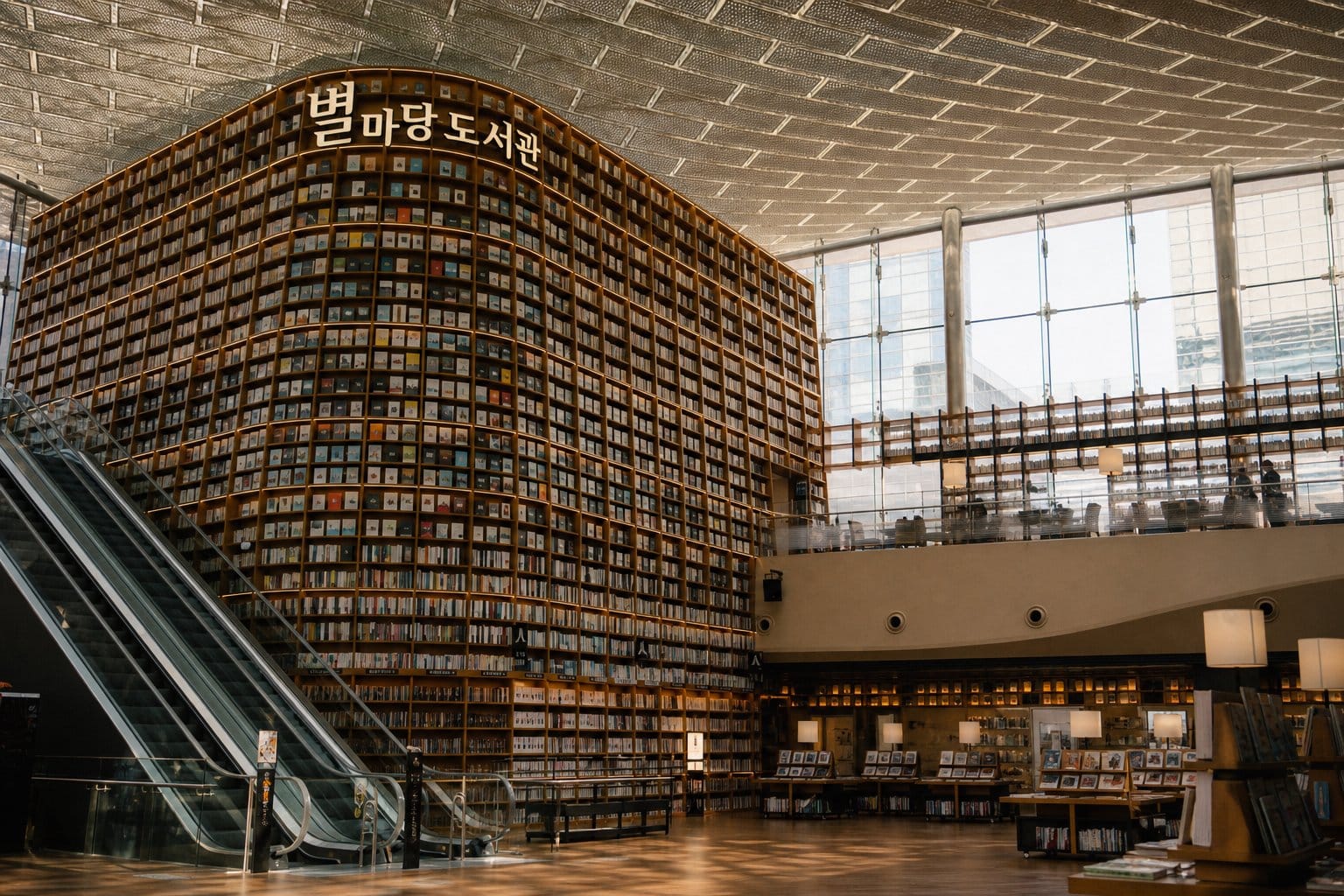
The Starfield COEX Library is a public reading space inside COEX Mall in Gangnam, Seoul, defined by 13-metre-high bookshelves that span the full height of the open atrium. Entry is free, with no ticket or registration required. The library has become one of Seoul's most photographed indoor locations and functions as a casual meeting point alongside a working reading space. Its location inside COEX Mall places it adjacent to COEX Artium and within walking distance of major Gangnam concert venues, making it a common pre- and post-event gathering point for fans. Bongeunsa Temple sits directly across the street and is also free to enter.
What 2026-specific events are happening in Seoul?
The Seoul International Garden Show runs from May through October 2026 across Seoul Forest and the Han River parklands, with free or low-cost entry operating through the city's warmest months. The Hangang drone light show — a choreographed aerial performance — runs seasonally across multiple Han River parks; specific schedules by park and date are available on Visit Seoul's official 2026 event calendar. Year-round anchors include the Gyeongbokgung Changing of the Guard (10 AM and 2 PM daily, ₩3,000 entry), K-pop brand activations and pop-up events in Seongsu-dong and Gangnam, and the free Seoul City Wall (Hanyangdoseong) hiking trails accessible from multiple historic districts without an entrance fee.
Planning Your Seoul Visit: Districts, Days, and What to Expect
Seoul in 2026 rewards a clear-eyed approach to neighborhood selection. The city does not require visitors to attempt every district — it rewards those who commit to a few areas with genuine depth over a scattered sprint across the entire subway map. For K-pop fans, the most productive itinerary clusters Gangnam's concert venues and Seongsu-dong's pop-up scene on the same day (both on Line 2), then dedicates a separate half-day to the Jongno belt — Gyeongbokgung, Bukchon, Insadong, and Ikseon-dong — where the historical context sits alongside the café culture that the same fan community has adopted as its own. Myeongdong functions as a practical add-on to either cluster given its central metro access and distinct K-beauty retail concentration.
Food and transport costs remain genuinely accessible across all neighborhoods. A full day of eating across Gwangjang Market and nearby neighborhood restaurants can run ₩25,000–40,000 (~$18–29) without compromise. The Climate Card transit pass covers unlimited subway and bus access across all districts for ₩5,000 per day. National Geographic's 2026 recognition of South Korea reflects what repeat visitors have long observed: Seoul operates at a scale and quality that consistently outperforms first-time expectations. The 2026 calendar — Seoul International Garden Show through October, Hangang drone performances, year-round palace ceremonies, and K-pop activations across Seongsu-dong and Gangnam — means the city's programming matches its infrastructure regardless of season. A three-day minimum gives enough time to build a real sense of the city's rhythm; five to seven days, per Real Korea Insider's 2026 itinerary guide, is the range where Seoul starts to feel genuinely familiar rather than just visited.
Last updated: 2026-05-13. This article was reviewed against official Visit Seoul event listings, current transport pricing, and 2026 destination coverage published through May 2026.
Related Articles
- 7-Day South Korea Itinerary 2026: Seoul to Busan for Visiting Fans
- Seoul's Historical Soul: Palaces, Hanok, and Creative Districts
- Seoul Street Food Markets & Neighborhood Eats: 2026 Guide
- Korea-UAE K-Pop: Every Major Festival and Concert 2025-2026
- Korean Dramas Starring K-Pop Idol Actors: The 2018 Class
This article was written using information collected and analyzed by NAMANE's in-house K-pop research AI engine. We use AI technology to bring you faster, broader coverage, and in the process some details may occasionally differ from the latest facts. For important information such as dates, venues, and prices, please double-check with official sources.


