
Why Are Runners and K-pop Fans Both Showing Up at Gwanghwamun Square?
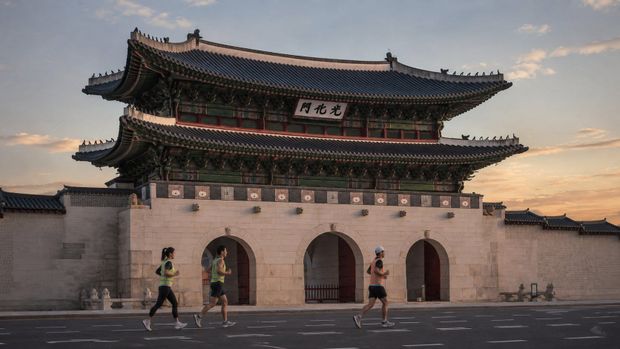
At 7 a.m. the pavement in front of Gyeongbokgung belongs to runners in reflective vests; by afternoon the same stretch fills with fans carrying light-stick totes toward a concert info booth. Two unrelated booms have landed on the same 500 metres of Seoul.
Runners and K-pop fans converge at Gwanghwamun because two separately measured trends happen to share the same geography. Roughly 10 million South Koreans now identify as runners, about double the 2015 figure , while roughly one in four attendees — about 25% — at BTS's Gwanghwamun Square concert on March 21, 2026 were foreign nationals, per Seoul city population data . Neither trend was designed around the other.
Quick Answer: Gwanghwamun hosts two overlapping booms. Korea's runner population roughly doubled to about 10 million since 2015, and the 2.5 km Gyeongbokgung loop sits at its Seoul centre. Separately, roughly one in four attendees — about 25% — at BTS's March 21, 2026 Gwanghwamun concert were foreign nationals, per Seoul city population data.
An important caveat before the itinerary begins: no official source ties run-club routing to K-pop fan demand. Seoul's running programs and its concert-tourism campaigns are administered separately, and the overlap described here is an observation about geography rather than a documented policy. This plan treats it that way — the palace loop and the fan trail are covered as two things you can do in the same neighbourhood, not as one coordinated scene.
The scale of the running side is easy to underrate. Korea's marathon calendar grew from 19 events in 2020 to 254 in 2024, with more than one million total participants that year, and card spending at running specialty stores rose 216% over two years, driven mainly by people in their 30s . The Ministry of Culture, Sports and Tourism's 2025 National Sports Participation Survey found 7.7% of respondents named running, jogging or marathon as their main sport, up from 4.8% a year earlier . The Gwanghwamun corridor sits inside the densest part of that Seoul cluster, with a 2.5 km palace loop and a subway-connected runner hub at Gwanghwamun Station .
The fan-tourism side is measured just as precisely. Joint post-event analysis by the Korea Culture & Tourism Institute, the Korea Tourism Organization and the Culture Ministry — combining on-site surveys with card and telecom data — found Gwanghwamun concertgoers stayed 8.7 days and spent ₩3.53 million on average, roughly 1.4 times a general foreign tourist . Much of that extended stay is spent walking the same blocks runners use at dawn, which is why a single trip can reasonably cover both.
The Gyeongbokgung Loop: What Seoul's Best-Known Palace Running Route Actually Involves
The Gyeongbokgung loop is a 2.5 km circuit around the palace perimeter, and runners treat two laps as a clean 5 km — that is the framing The Korea Times used in its August 31, 2026 report on Seoul's urban running scene . The route is flat, closed to fast traffic on most of its stone-wall sides, and reachable from Gwanghwamun and Gyeongbokgung stations, which is why it functions as a default meeting point rather than a destination run.
Terrain is the reason beginners default here. "The flat, beginner-friendly terrain is a huge plus… especially beautiful at sunset," said Park Eun-kyung, a former running club leader, in the same Korea Times report. That sunset window is also when the loop gets busiest, since it overlaps with the end of the palace's visitor day and the start of evening crew meetups.
Storage is the practical unlock for anyone arriving with a day bag. Seoul operates three subway-connected runner hubs — at Gwanghwamun, Hoehyeon and World Cup Stadium stations — where lockers rent for 2,200 won for four hours . For a visitor, that means the Gwanghwamun hub can hold a camera, a light stick or a merch tote for the length of a run without a hotel round trip.
What the loop looks like in practice:
- Distance: 2.5 km per lap; two laps ≈ 5 km
- Access: Gyeongbokgung Station and Gwanghwamun Station both sit on the loop's edge
- Storage: Gwanghwamun runner hub locker, 2,200 won / 4 hours
- Surrounding effect: nearby cafes shifted to earlier opening hours as the area became a morning gathering point; Camel Coffee Seochon reported morning clientele up about 40%
Night running here carries a specific advisory rather than a stylistic preference. The palace perimeter stays pedestrian-heavy after dark — tour groups, hanbok rental customers and concert-week visitors all use the same pavement — so single-file or two-abreast formation and reflective gear are the standing recommendation, not optional. Seoul parks have already posted limits on large group runs and loud cheering after noise and crowding complaints, and Seocho District has required 2 m spacing for groups of five or more at Banpo Sports Complex since October 2024 . Nothing equivalent is posted for the Gyeongbokgung loop itself, but the same crowd logic applies.
Day 1: Landing, Gwanghwamun Orientation and Seoul's Free Thursday Night Run
Day 1 is built around one fixed time anchor: the free Thursday night run that starts at 7 p.m. Everything else — airport transfer, bag drop, an unhurried daylight scouting lap of the palace perimeter — is scheduled backwards from that. If you land on a Thursday between April and October, the 7979 Seoul Running Crew session held 7–9 p.m. every Thursday is the cheapest way to learn the Gwanghwamun street grid at running pace with pacers who already know it.
Morning — arrival and transfer. From Incheon or Gimpo, take AREX or an airport bus toward the city centre and transfer to Gwanghwamun Station. Exit 6 is the practical orientation point: it is the exit the Korea Creative Content Agency and the Korea Tourism Organization used for their concert-period information booth during the March 2026 Gwanghwamun Square show, alongside a welcome banner mounted on Government Complex Seoul and LED billboard campaigns across the district . Those pop-ups are tied to specific concert dates rather than standing year-round, so treat Exit 6 as a landmark first and a fan-services stop only when an event is actually running.
Bag drop. Seoul operates three subway-connected runner hubs — Gwanghwamun, Hoehyeon and World Cup Stadium stations — with locker rental at 2,200 won for four hours . The Gwanghwamun hub is the one that matters here: it lets you change and stash a daypack without booking a hotel room near the square first.
Afternoon — scout before you run. Walk the palace exterior loop at a slow pace in daylight before committing to it after dark. The loop measures 2.5 km , so a walking lap costs roughly half an hour and shows you where pedestrian density spikes. Break for lunch near Gwanghwamun Station, then rest — the night run is two hours on your first day in a new time zone.
Evening — the 7979 session. Of the Cheonggye Plaza courses, the one that suits a first night is the Sunset Run (6K): Cheonggye Plaza → Gwanghwamun Station → Gyeongbokgung Station → Deoksugung Palace → return . The longer alternative is the Four Gates Run (7K), which adds Cheong Wa Dae, Sajik Tunnel and Dongnimmun Gate . The 2026 season opened on April 16 and runs through October, with three skill tracks — beginner at Gwanghwamun, intermediate at Banpo, advanced at Yeouido — supported by seven pacers .
Registration mechanics. Sign-ups run Monday to Wednesday through the Dongma Runners Club site (dongma.club) or Seoul's public reservation portal, with same-day on-site signup accepted; capacity is 60 per session . Prior seasons logged 4,711 participants over 30 weeks , and 2026 coverage cites 5,013 cumulative participants last year — busy, but not so oversubscribed that walking up is pointless. One caveat worth flagging: Seoul's English-language page does not state a foreigner-eligibility rule either way , so confirm through the reservation portal before you build a travel day around it. Arrive 20–30 minutes early either way.
Day 2: Following the K-pop Concert Tourism Trail Around the Same Square
Day 2 trades running shoes for walking shoes and covers the fan-tourism infrastructure that has accumulated around Gwanghwamun since BTS performed on the square on March 21, 2026 . Everything on this itinerary sits inside a walkable triangle — HiKR Ground, Gwanghwamun Station Exit 6 and Gyeongbokgung Station are roughly 10 minutes apart on foot — so the whole day runs without a single taxi fare. Start mid-morning, keep the afternoon loose, and use the same palace perimeter you ran the night before as your spine.
HiKR Ground | 관광 · 체험
HiKR Ground is the Korea Tourism Organization's free K-culture exhibition space in central Seoul, and it is the clearest single stop for understanding how Korea now packages K-pop for inbound visitors. For the March 2026 BTS concert it was converted into a purple-themed space and kept open until midnight on concert day, part of a coordinated push that also included LED billboard campaigns, a welcome banner on Government Complex Seoul, and a KOCCA-run info booth at Gwanghwamun Station Exit 6 . Programming rotates with whatever comeback or tour cycle is live, so treat the purple build-out as a snapshot rather than a fixture.
📋 주소 · 영업시간 · 대표 특징: Central Seoul, within walking distance of Gwanghwamun Square; hours and current exhibitions are not published in the sources used here, so check KTO's channels before you go. Signature feature: rotating K-pop and K-culture media installations tied to active tour and release cycles .
💡 Go on a non-concert weekday morning. On event days the same space absorbs the entire pre-show crowd, and the exhibits become a queue rather than a visit.
📍 40 Cheonggyecheon-ro, Jung District, Seoul
🕒 Monday Closed / Tuesday–Sunday 10:00 AM – 8:00 PM
⭐ 4.6 (1,119 reviews)
📞 02-729-9498
🔗 View on Google Maps
Gwanghwamun Square and Exit 6 | 거리 · 관광
The square itself is the reason this day exists. Concert-tourism data collected by the Korea Culture & Tourism Institute, the Korea Tourism Organization and the Culture Ministry — combining on-site surveys with card and telecom records — found Gwanghwamun concertgoers stayed 8.7 days and spent ₩3.53 million, roughly 1.4x general tourists . The Goyang shows on April 9 and 11–12, 2026 produced the sharper number: 48,581 foreign visitors to the surrounding administrative district over three days, a 35x year-on-year jump, with foreign card spending at ₩337.8 million, up 38x from ₩8.9 million .
| Concert site | Dates (2026) | Avg. stay | Avg. spend | vs. general tourists |
|---|---|---|---|---|
| Gwanghwamun Square | March 21 | 8.7 days | ₩3.53 million | ≈1.4x |
| Goyang | April 9, 11–12 | 7.4 days | ₩2.91 million | ≈1.2x |
📋 주소 · 영업시간 · 대표 특징: Gwanghwamun Square, Jongno-gu, Seoul; open public plaza, no admission. Gwanghwamun Station Exit 6 hosted the KOCCA information booth during the March 2026 concert push .
💡 Exit 6 is the meeting point locals default to. If you are coordinating with fans you met online, name the exit number rather than "the square" — the plaza is long enough that vague plans cost you 20 minutes.
For meals, the Gwanghwamun blocks now absorb both runner and fan foot traffic, and the neighborhood cafes adapted: Camel Coffee Seochon reported morning clientele up about 40% as the running scene grew, and Cafe Nondo's manager Lee Jong-yeob noted surrounding shops opening earlier to meet it . Budget ₩10,000–18,000 per sit-down meal in the area and expect the 12:00–13:00 office rush to fill the cheaper places first.
If you would rather not assemble the concert-day logistics yourself, NAMANE sells one-stop K-pop concert travel packages combining a concert ticket, a NAMANE prepaid card, hotel and activities; inclusions and current pricing are listed on the event page. This blog is operated by NAMANE Card.
Day 3: A Solo Palace-Loop Run, the 'Puppy Run' GPS Art Trend and Seochon's Morning Cafes
Day 3 is the unguided version of Day 1: run the 2.5 km Gyeongbokgung perimeter loop on your own schedule, then walk straight into Seochon for breakfast. The loop measures 2.5 km, which runners describe as "perfect for a 5 km run with two laps" . Start between 6:00 and 8:00 a.m., before palace-gate tour groups and the Gwanghwamun commuter flow build up, and you get the flattest, emptiest version of the route.
The 2026 alternative is the "puppy run" — a GPS-art trend in which runners trace a dog-shaped outline through Seochon, Samcheong-dong and Gwanghwamun and screenshot the finished shape from their tracking app . There is no official published course file, so runners draw their own on a mapping app before setting out. Practically, that means more stopping, more street crossings and more time on narrow alley pavements shared with residents than the palace loop involves — treat it as a slow 60–90 minute exploration run rather than a tempo session, and stay two-abreast at most where the Seochon lanes tighten.
Transit is the easy part. Gyeongbokgung Station on Line 3 sits at the west edge of the loop, and both Seochon and Samcheong-dong are walkable from its exits, so nothing on Day 3 requires a transfer. You can finish the run, walk five to ten minutes west into Seochon, eat, and be back at a subway entrance without touching a bus.
Cafe Nondo | 카페
Cafe Nondo is one of the Gwanghwamun-area cafes that reorganized its day around the running crowd. Manager Lee Jong-yeob reported that surrounding shops began opening earlier as the area turned into a community hub for runners . That shift is the useful signal for a visiting runner: post-run coffee at 7 a.m. near the palace is now a normal transaction rather than a scramble to find anything open.
📋 주소 · 영업시간 · 대표메뉴/특징 — Gwanghwamun area, Jongno-gu, Seoul; published hours not stated in available sources; positioned as a runner-community gathering cafe.
💡 Confirm opening time on the day you go — the earlier hours are a response to demand, not a fixed published schedule.
📍 10 Jahamun-ro 6-gil, Tongui-dong, Jongno District, Seoul
🕒 Daily 8:00 AM – 7:00 PM
⭐ 4.9 (28 reviews)
🔗 View on Google Maps
Camel Coffee Seochon | 카페
Camel Coffee's Seochon branch is the clearest quantified example of the running boom changing a neighborhood's morning trade: its morning clientele rose about 40% as the local running scene grew . It sits in Seochon, a few minutes' walk from the loop's western side, which makes it a natural breakfast stop rather than a detour.
📋 주소 · 영업시간 · 대표메뉴/특징 — Seochon, Jongno-gu, Seoul, walkable from Gyeongbokgung Station (Line 3); specific hours not published in available sources; specialty coffee, morning-heavy trade.
💡 Arrive before 9 a.m. if you want a seat — the 40% morning increase is concentrated in exactly the window when runners finish.
📍 31 Hyoja-ro, Jongno District, Seoul
🕒 Daily 8:00 AM – 9:00 PM
⭐ 4.5 (95 reviews)
📞 010-6540-4940
🔗 View on Google Maps
What This Trip Costs: Budget, Registration and Packing for a Seoul Running-and-Fan-Tourism Trip
A Seoul running-and-fan-tourism trip is cheap on the running side and variable on the fan side. The organized city night runs cost nothing: Seoul's 7979 Seoul Running Crew holds free two-hour sessions from 7–9 p.m. every Thursday, April through October . The recurring costs are locker rental at 2,200 won for four hours at the city's three subway-connected runner hubs, single transit rides, and meals .
| Item | Typical cost | Notes |
|---|---|---|
| 7979 Seoul Running Crew session | ₩0 | Free, Thursdays 7–9 p.m., April–October, 60 places per session |
| Runner-hub locker | ₩2,200 / 4 hours | Gwanghwamun, Hoehyeon, World Cup Stadium stations |
| Subway or bus ride (T-money) | ~₩1,400 per ride | Gyeongbokgung and Gwanghwamun stations both sit on the loop |
| Casual meal near Seochon / Gwanghwamun | ₩10,000–18,000 | Post-run breakfast or lunch, per person |
| Run-trip travel package | Varies by operator | Hana Tour and regional tourism boards market race-plus-travel bundles |
Registration for the free sessions runs through the Dongma Runners Club site (dongma.club) or Seoul's public reservation portal, with a Monday–Wednesday sign-up window and same-day on-site signup also accepted; capacity is 60 per session . One honest caveat for visitors: the English-language Seoul page does not state a foreigner-eligibility rule either way, so travelers should confirm on-site rather than assume formal tourist enrollment. The 2026 season opened April 16, and program coverage describes three skill tracks — beginner at Gwanghwamun, intermediate at Banpo, advanced at Yeouido — supported by seven pacers, with 5,013 cumulative participants recorded last year .
What to pack splits cleanly along the two halves of the trip:
- Reflective vest or armband. The palace perimeter is pedestrian-heavy after dark, and single-file or two-abreast formation plus reflective gear are the practical night-run advisories .
- Breathable layers. Spring and autumn swing widely between the 7 p.m. start and the 9 p.m. finish.
- Separate walking shoes. The fan-tourism legs around Gwanghwamun Square involve long standing and queueing rather than running.
- A payment card that works on transit and at kiosks. Card and telecom data were what let researchers measure concertgoer spending at ₩3.53 million per visitor around the March 2026 Gwanghwamun show .
On that last point: this blog is operated by NAMANE Card, which sells one-stop K-pop concert travel packages combining a concert ticket, a NAMANE prepaid card, hotel and activities for visiting fans — inclusions and current pricing are listed on the event page rather than here.
Seasonally, the calendar is the constraint. The free Thursday program only operates April through October . Outside that window the 2.5 km Gyeongbokgung loop is still open and runnable — two laps make a 5 km — but you run it alone, without pacers, without the organized start, and without the crowd that makes a winter night on the palace wall feel busy .
Etiquette Around the Palace: When Crowds Make Running (or Fan-Watching) Harder
Group running etiquette in Seoul is now partly formal rule, not just courtesy. Complaints about noise, crowding and shirtless running pushed several city parks to post limits on large group runs and loud cheering, and Seocho District has required 2-metre spacing for groups of five or more at Banpo Sports Complex since October 2024 . Yeouido Park posts its own notices against group running, clapping and shouting . Gyeongbokgung's perimeter carries no equivalent posted restriction in the reporting reviewed here, but it carries something harder to legislate: dense pedestrian and tour-group traffic on a path barely wide enough for two abreast.
The friction is still evolving. A "slow running" trend documented in September 2026 coverage has revived path-blocking complaints, because slower group paces occupy shared walkways longer . Around the palace, where hanbok-wearing visitors stop mid-path for photos, that matters more than it does on a riverside track. The practical formations reported for the area are single-file or two-abreast, plus reflective gear after dark .
Timing solves most of it. Run the 2.5 km loop early morning or inside the Thursday 7–9 p.m. window rather than midday, when tourist density around Gwanghwamun and the palace gates peaks . A few working rules:
- Formation: single file past the main gate and Gwanghwamun Square approaches; two abreast only on empty stretches.
- Volume: no group chants, clapping or countdown starts — the behaviours parks explicitly restricted .
- Dress: keep a shirt on; shirtless running is among the named complaints .
- Photo stops: step off the path entirely; the loop is also a working tourist walkway.
The same timing logic applies to the fan-tourism side, in reverse. The K-pop infrastructure that made Gwanghwamun feel like a fan hub — the info booth at Gwanghwamun Station Exit 6, the purple-themed HiKR Ground opening, the LED billboard campaign — was mounted for the BTS concert on 21 March 2026, not as a permanent daily fixture . Build a trip around those and you may arrive to an ordinary square.
The concrete takeaway: check a concert calendar first, then a running calendar, then book. The loop is there year-round; the crowd, the pacers and the purple lighting are not.
This blog is operated by NAMANE Card. For fans who would rather have the concert ticket, card, hotel and activities arranged as one booking, current inclusions and pricing are listed on the NAMANE event page.
Frequently asked questions
Did Seoul's running crews add Gyeongbokgung Palace to their routes because of K-pop fans?
No published source documents that causal link. What is verifiable is geographic overlap: the Gyeongbok Palace loop is an established 2.5 km running route , and Gwanghwamun Square separately became a K-pop concert destination after BTS performed there on March 21, 2026 . Both trends grew independently and happen to converge on the same square. Treat any claim that crews rerouted for fan tourism as an inference, not a reported policy decision.
Can tourists join the free "7979 Seoul Running Crew" night runs?
The program is open by public registration, but the English-language Seoul page does not state a foreigner-eligibility rule either way, so confirm before you count on a slot. Sessions run 7–9 p.m. every Thursday from April through October, with registration Monday–Wednesday through the Dongma Runners Club site (dongma.club) or Seoul's public reservation portal, capacity of 60 per session, and same-day on-site signup accepted . The 2026 season opened on April 16 . The practical route for visitors is same-day on-site signup at the Gwanghwamun beginner meeting point.
How long is the Gyeongbokgung Palace running loop?
The Gyeongbok Palace loop measures 2.5 km, and runners commonly do two laps for roughly a 5 km session . Former running club leader Park Eun-kyung described the terrain as "flat, beginner-friendly… especially beautiful at sunset" in the same reporting. Nearby support exists: Seoul operates three subway-connected runner hubs at Gwanghwamun, Hoehyeon and World Cup Stadium stations, with locker rental at 2,200 won for four hours .
What's the best season to run near Gyeongbokgung and combine it with K-pop tourism sites?
April through October is the window that matters logistically, because that is when the free 7979 Seoul Running Crew Thursday night runs operate . Within that range, spring and autumn give milder temperatures for both the palace loop and the walking-heavy concert-tourism trail around Gwanghwamun. Outside April–October the 2.5 km loop is still open and free to run on your own; only the organized city program pauses. Concert scheduling is the bigger variable — check the tour calendar before fixing dates.
How much should I budget for a 3-day Seoul trip combining running and K-pop tourism stops?
The running side is close to free; the K-pop side is what moves the number. Subway rides run about ₩1,400 each, runner-hub locker rental is ₩2,200 for four hours , the 7979 night runs cost nothing to join , and casual meals sit around ₩10,000–18,000. For scale on the fan-tourism side, official post-event analysis found Gwanghwamun concertgoers stayed 8.7 days and spent ₩3.53 million on average, roughly 1.4x general tourists — that figure covers a longer trip with tickets and accommodation, so treat it as an upper reference point rather than a three-day estimate.
Enjoyed this article? Subscribe to get new stories by email whenever they're published.
This article was written using information collected and analyzed by NAMANE's in-house K-pop research AI engine. We use AI technology to bring you faster, broader coverage, and in the process some details may occasionally differ from the latest facts. For important information such as dates, venues, and prices, please double-check with official sources.


