Seoul's Street Food Scene: Markets, Stalls & What's Changed in 2026
Seoul's street food culture is built on the pojangmacha (포장마차) — the orange-canopied tent stall that has been a fixture of Korean nightlife and daily meals since the mid-twentieth century. These open-air vendors, along with covered market halls that shelter entire food corridors from Seoul's humid summers and freezing winters, form a two-tier ecosystem running on completely different rhythms. Outdoor pojangmacha are nimble, typically cash-only operations that set up in the late afternoon and run until the early hours; covered halls like Gwangjang Market maintain structured daytime schedules and fixed vendor clusters. The price band across both formats remains among the most accessible in Asia for cooked food — most items sit between 2,000 and 12,000 KRW — meaning a multi-dish street food dinner rarely exceeds 20,000 KRW at a local-oriented market. In 2026, that value proposition still holds, but the landscape has shifted in ways that are worth knowing before you arrive.
Quick Answer: Seoul's street food markets serve most items for 2,000–12,000 KRW, making a satisfying multi-dish dinner achievable for 15,000–20,000 KRW at local markets. In 2026, Gwangjang Market (est. 1905) and Myeongdong's 80-stall pedestrian corridor are the most-visited corridors; Sindang-dong offers a quieter, local-facing alternative with 24-hour venues.
Three shifts define the 2026 landscape. Myeongdong has made visible progress toward card acceptance — driven partly by international tourist volume and partly by vendor competition with organized food tours — though cash remains the safer option at smaller stalls and in covered market halls. More consequentially, visitor forums flagged overcharging incidents at certain Gwangjang Market stalls in early 2026, a pattern covered in detail in the section below. At the premium end, new items have also entered the lineup: grilled cheese lobster tails at 15,000–18,000 KRW became a Myeongdong fixture following their 2024 introduction, a departure from the historically snack-sized, sub-5,000 KRW price points that defined Seoul street food's reputation for affordability.
Timing matters considerably. Evening hours — roughly 5 to 9 PM across most districts — deliver the widest variety and highest vendor energy. This is when pojangmacha fully set up, when the longest queues form at signature stalls, and when the social atmosphere defining Korean street eating is at its most alive. Hongdae runs on a later cycle, with real energy building after 11 PM and vendors operating until 4 AM. Gwangjang's covered hall opens at 9 AM and draws a mixed crowd of market regulars and tourists throughout the day, with lunch hours among the busiest.
"Every single time I visit Korea I make it a point to eat at street stalls — the tteokbokki and odeng are unbeatable, and the price makes it feel almost unreal compared to back home." — Visitor report via r/korea community discussion, from a thread with over 1,110 upvotes
The Classic Trio: Tteokbokki, Odeng & Sundae
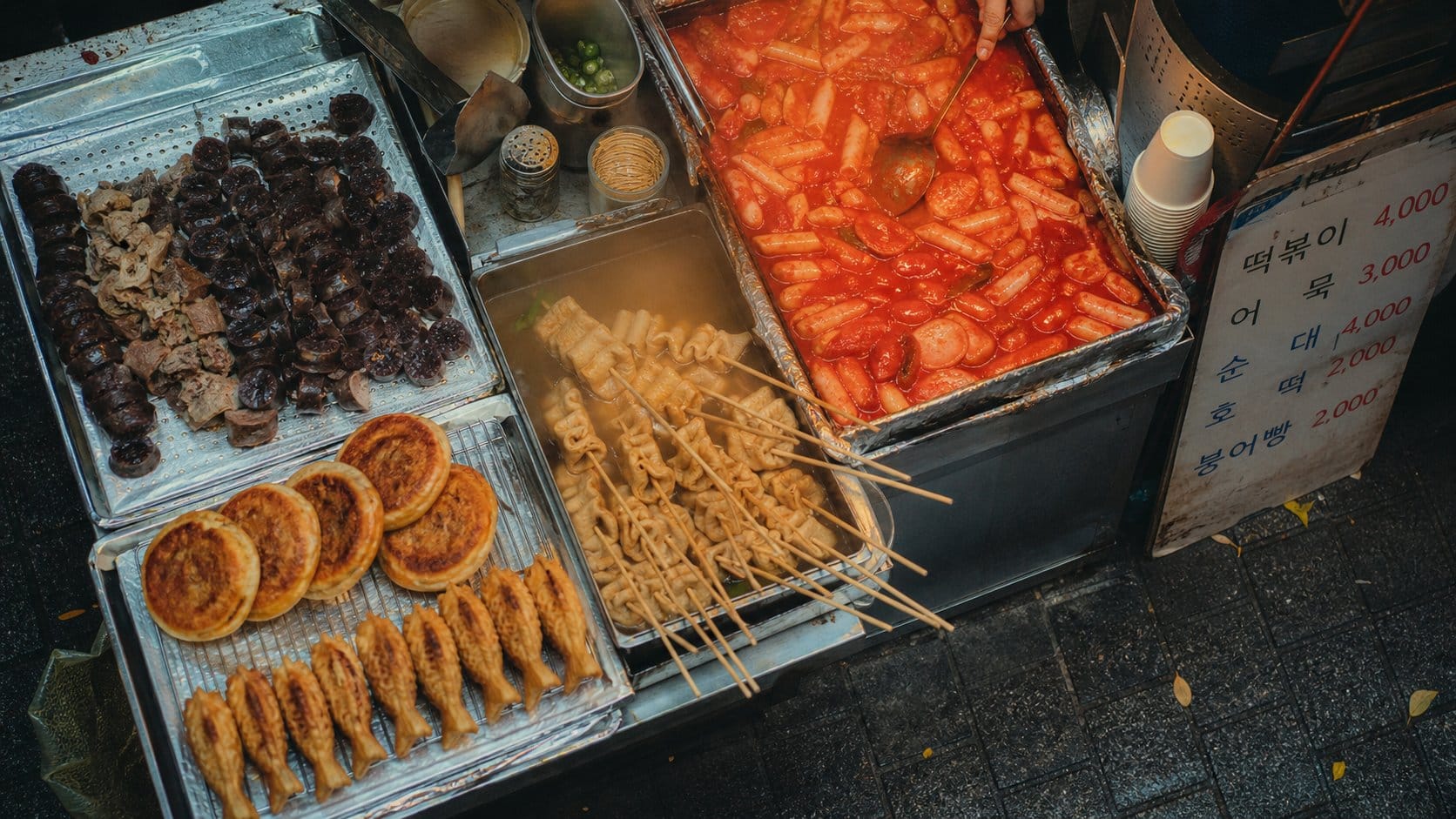
Tteokbokki (떡볶이), odeng (어묵), and sundae (순대) form the foundational trio of Korean street food — present at virtually every market, pojangmacha, and covered hall in Seoul. Tteokbokki is cylindrical rice cake simmered in gochujang (red chili paste), producing a sticky, deeply savory sauce that ranges from medium to scorching depending on the vendor. The base version is all rice cake and sauce; most stalls offer add-ons including sliced fish cake, a halved boiled egg, fresh vegetables, and — in a move that divides traditionalists and younger diners — melted cheese. A full portion in 2026 runs 8,000–12,000 KRW depending on size and additions, though smaller tasting portions exist at some stalls. The dish is the social and logistical anchor around which the other two items of the trio revolve — ordering tteokbokki is often the step that unlocks the complementary extras.
Odeng — also called eomuk (어묵) in standard Korean — refers to processed fish cake formed into sheets or tubes, threaded onto wooden skewers, and simmered in a light dashi-style broth. At most street stalls, the broth is served free in small cups to anyone purchasing tteokbokki or sundae from the same vendor. This hospitality custom — an unspoken rule of pojangmacha etiquette — means visitors can warm up on umami-forward soup without paying for a full skewer order. The skewers themselves are among the cheapest items on any street food menu, typically 500–1,500 KRW each, though market hall vendors in tourist-facing areas charge more. Asking for a broth refill is entirely acceptable; a gesture toward the pot with eye contact is universally understood.
Sundae (순대) is Korean blood sausage: a tube of pork intestine stuffed with glass noodles (dangmyeon), barley, vegetables, and congealed pig blood, then steamed and sliced into rounds. Pronounced "soon-deh" — entirely distinct from the dessert — it is served both as a standalone plate at specialty restaurants and as a shared side alongside tteokbokki and odeng at pojangmacha. At street stalls, an order of the trio typically arrives on a shared tray with a dipping sauce of salted fermented shrimp paste (saeujeot), which cuts through the richness of the sundae while complementing the heat of the tteokbokki. According to Creatrip's visitor food guides, many vendors don't individually price the three items — ordering the combination is the norm.
Spice level is the variable most likely to catch visitors off guard. Gochujang heat differs measurably between vendors — stalls in tourist-facing corridors like Myeongdong often calibrate toward milder profiles; stalls in Sindang-dong and local pojangmacha frequently run significantly hotter. Most vendors don't offer spice adjustments; the practical move is to taste a small amount of sauce before committing to a full portion. Odeng broth, hotteok, tornado potatoes, and bungeo-ppang are all mild alternatives for visitors who want to explore the markets without high-heat dishes as the default.
"I went back for tteokbokki every single day — the spice gets addictive once you adjust, and the free broth with the fish cake is genuinely one of the best deals anywhere in Asia." — Returning visitor account via r/korea two-week Korea trip report
Gwangjang Market: Mayak Gimbap, Bindaetteok & the 2026 Pricing Controversy
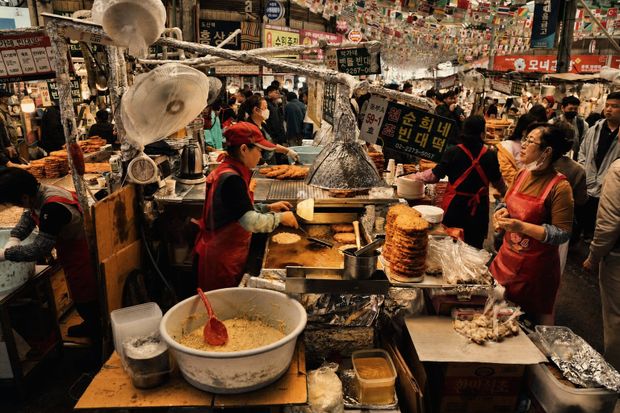
Gwangjang Market (광장시장) is Seoul's oldest continuously operating market, established in 1905 and still drawing thousands of visitors daily to its 200-meter covered food corridor. The inner food hall runs from 9 AM to 11 PM and is accessible from Jongno 5-ga Station on Line 1, Exit 8. The market's layout places food vendors in a dense, lantern-hung corridor running through the building's center, with textile and vintage goods stalls branching off to either side. Within the food hall, vendor types cluster loosely by item: mayak gimbap stalls concentrate near the main entrance, bindaetteok vendors fill the center section, and prepared banchan and raw ingredient sellers occupy the outer edges. Walking the full 200-meter length once before sitting down — to compare menus, posted prices, and available seats — is the most efficient way to navigate it.
The two signature items here are distinct from what dominates other Seoul markets. Mayak gimbap (마약 김밥) — "narcotic rice rolls" — are thumb-sized rolls stuffed with pickled yellow radish (danmuji) and sesame seeds, wrapped in seaweed and rice, served ten to a tray for approximately 3,000 KRW. The name reflects the intensely addictive quality of the flavor combination — the sourness of the radish against the nuttiness of sesame and the neutral rice creates a loop that's difficult to stop. Gwangjang vendors are credited with popularizing the style; what began as a market specialty has since spread to convenience stores and gimbap chains across Korea, but the market versions remain the benchmark for freshness and intensity. Bindaetteok (빈대떡) — crispy savory pancakes made from ground mung beans, pan-fried until golden brown — are the other staple, served hot from iron griddles and best eaten immediately while the edges are still crackly. Both items are typically accompanied by makgeolli (milky rice wine) sold from the same stalls, which has made the pairing a mid-day ritual for locals and a food-tour highlight for international visitors.
The 2026 overcharging controversy has drawn sustained attention on travel forums and visitor review platforms, with multiple accounts reporting prices higher than those displayed on menu boards or quoted verbally before ordering. The reported patterns include stalls charging for items not explicitly ordered, totals that don't match the sum of individually posted prices, and verbal quotes that differ from final bills. The issue appears concentrated at the most tourist-facing stalls near the market entrance rather than across the full corridor. According to Visit Korea Daily's 2026 street food guide, practical countermeasures include: checking price boards before sitting, asking for a verbal confirmation of the total before eating, and prioritizing stalls with large, clearly itemized menus. Vendors in the central portion of the corridor tend to have more established pricing norms and a local regular customer base that discourages deviation.
| Item | Korean | Description | Approx. Price (KRW) | Notes |
|---|---|---|---|---|
| Mayak gimbap | 마약 김밥 | Thumb-sized rice rolls with pickled radish and sesame | ~3,000 / 10 pieces | Gwangjang's signature item; famously addictive flavor |
| Bindaetteok | 빈대떡 | Crispy mung bean pancakes, pan-fried | 4,000–8,000 | Eat immediately; pairs with makgeolli rice wine |
| Tteokbokki | 떡볶이 | Cylindrical rice cake in gochujang sauce | 8,000–12,000 | Confirm total price before ordering in 2026 |
| Sundae | 순대 | Steamed blood sausage with glass noodles | 5,000–9,000 | Commonly ordered alongside tteokbokki |
| Yukhoe | 육회 | Raw beef tartare with pear and sesame oil | 12,000–20,000 | Premium item; one of few markets in Seoul offering raw beef |
📍 서울특별시 종로구 청계천로 88
🕒 매일 오전 9:00 ~ 오후 10:30
⭐ 4.2 (43,870 리뷰)
📞 02-2267-0291
🔗 Google Maps에서 보기
Myeongdong Food Strip: Hours, New Vendors & 2026 Lineup
Myeongdong's street food corridor is a 600-meter pedestrian strip running through one of Seoul's most commercially dense shopping districts, accessible from Myeongdong Station on Line 4, Exits 5 through 8. The strip hosts approximately 80 food stalls at full operation, with vendors setting up from late afternoon and reaching peak capacity between 5 and 9 PM. Outside those hours — particularly in the morning and early afternoon — the selection is sparse and some vendor categories only appear after dark. The crowd is international by nature: Myeongdong draws tourists from across East and Southeast Asia, which has pushed the food lineup toward photogenic, shareable items at somewhat elevated price points relative to neighborhood-facing markets. During peak evening hours, though, the density of options means even selective visitors can put together a varied meal within a few hundred meters without doubling back.
The 2026 Myeongdong lineup has stabilized around a consistent set of performers. Tornado potatoes (회오리감자) — spiral-cut potatoes on long skewers, dusted with flavored powder or shredded cheese — remain among the most photographed items on the strip, priced at 5,000–6,000 KRW. Dak-kkochi (닭꼬치) glazed chicken skewers, sold at 2,000–3,000 KRW each, are among the more filling options and sit at the sweet-savory end of the flavor spectrum rather than the chili-forward end, making them accessible regardless of heat tolerance. Tteokbokki and odeng remain available but are secondary to newer formats in terms of stall count along the main corridor.
The grilled cheese lobster tail — a full spiny lobster tail skewered and grilled with butter and melted cheese — was introduced to Myeongdong in 2024 and is now a fixture of the strip's premium tier. Priced at 15,000–18,000 KRW, it sits above the traditional street food price band but has proven consistently popular with visitors willing to pay for something visually striking and filling. A single haenyeo (해녀) vendor — referencing the Korean female free-diver tradition — also sells raw sea cucumber and raw seafood items along the strip; this stall has become a talking point among food-focused travelers. According to Creatrip's Myeongdong vendor guide, card acceptance among stall operators has increased noticeably through 2025–2026, though cash still covers more vendors without friction, particularly the smaller single-item operations at the corridor's edges.
📍 서울특별시 중구 명동 1-5
🕒 매일 24시간 영업
⭐ 4.3 (1,148 리뷰)
🔗 Google Maps에서 보기
Sindang-dong Tteokbokki Town: The District That Started It All
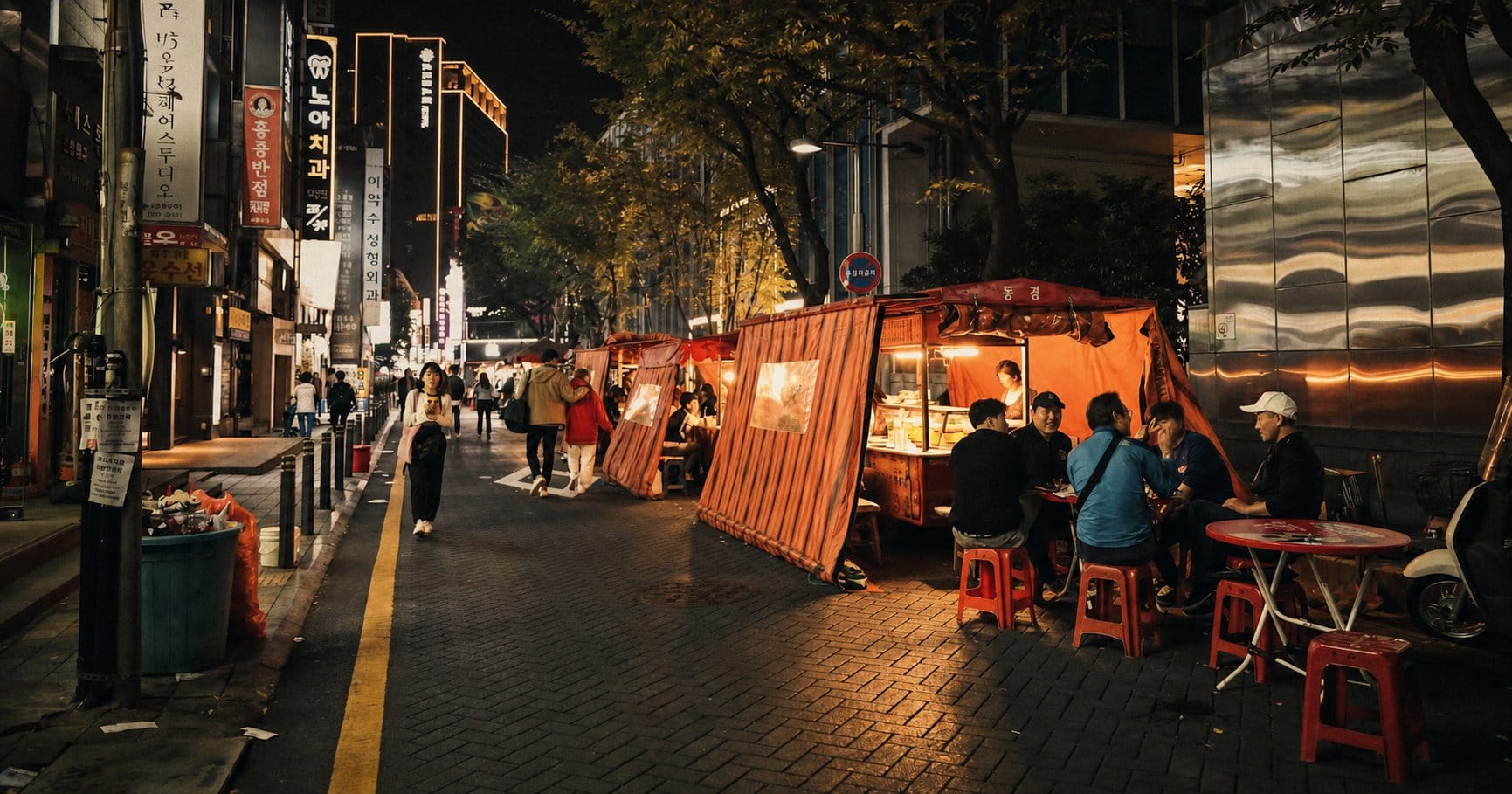
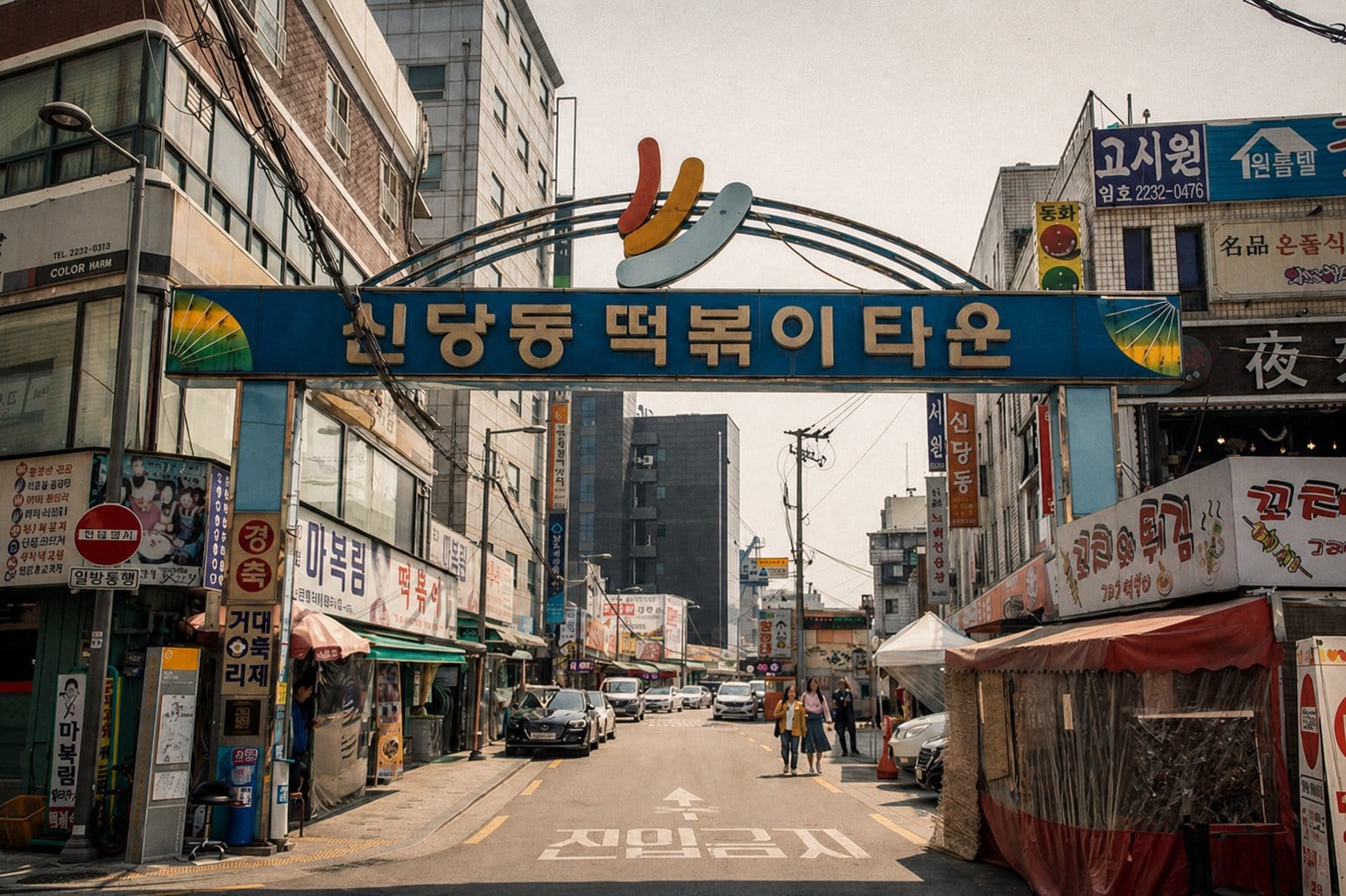
Sindang-dong Tteokbokki Town (신당동 떡볶이타운) is the documented origin of restaurant-style tteokbokki as Seoul knows it today. The founding is attributed to Ma Bok-lim, whose stall opened in 1953 and gradually attracted imitators, turning a narrow neighborhood lane into a concentrated corridor of tteokbokki-focused restaurants through the 1970s and 1980s. The Sindang-dong preparation differs fundamentally from the market-stall version: rather than a shared tray at an outdoor counter, the signature format here is a table-cooked hot pot — rice cake, vegetables, eggs, and ramyeon noodles simmering in a wide pan over a portable gas burner at the table. Portions are larger, the social dynamic is sit-down rather than standing, and the cooking is done tableside. Nearest access is Sindang Station on Lines 2 and 6, Exit 8.
Three long-running venues anchor the district in 2026. Maboklim Tteokbokki (마복림 떡볶이) — the direct successor to Ma Bok-lim's original operation — is open 9 AM to 11 PM and closed on the 2nd and 4th Mondays of each month. Samdae Halmeonne (삼대할머니 떡볶이) has been operating for over 47 years and runs 24 hours, seven days a week. I Love Sindang-dong (아이러브신당동) is also open 24 hours but closed on the 1st and 3rd Mondays of each month. The 24-hour availability at two of the three venues makes Sindang-dong a practical late-night option after evening events anywhere in central Seoul.
📍 서울특별시 중구 다산로33길 10-18
🕒 매일 24시간 영업
⭐ 3.8 (515 리뷰)
🔗 Google Maps에서 보기
📍 View Samdae Halmeonne on Google Maps
📍 View I Love Sindang-dong on Google Maps
The character of Sindang-dong sits distinctly apart from Gwangjang and Myeongdong. The district receives far fewer international tourists, menus are in Korean, and price-to-portion ratios reflect a local customer base rather than a tourist premium. For visitors who have already experienced the classic market-stall version of tteokbokki, Sindang-dong offers both a genuinely different preparation and a slower, more social eating experience — the meal takes 30 to 45 minutes at the table rather than a few minutes standing at a counter. According to Visit Seoul's official district page, the town is regarded as a living culinary heritage site rather than a tourist attraction, and that distinction is visible in the atmosphere.
"Sindang-dong felt completely different from Gwangjang — fewer tourists, mostly Korean being spoken, and the tteokbokki cooked right at the table was a whole different experience. Worth the slightly longer commute from the main tourist areas." — Visitor account via r/korea two-week trip report
Hotteok, Bungeo-ppang & Seoul's Seasonal Street Sweets
Seoul's seasonal street sweets operate on a cold-weather calendar running roughly from October through February. Hotteok (호떡) anchors the category: a flat disc of fried dough filled with a mixture of brown sugar, cinnamon, crushed nuts, and seeds, pressed onto a hot oiled griddle until the exterior caramelizes and the interior becomes a pocket of molten sweet filling. The first bite of a freshly made hotteok produces a rush of warm, slightly smoky liquid sugar that marks it as a cold-weather specific pleasure rather than a year-round snack. The longest queues in Seoul form at Namdaemun Market stalls, where hotteok has been sold for decades and specific vendors have accumulated dedicated followings. A single piece costs approximately 1,000–2,000 KRW across most stalls, putting it among the most affordable items in Seoul's entire street food ecosystem.
Bungeo-ppang (붕어빵) — the fish-shaped pastry made from a pancake-batter shell cooked in a cast-iron carp mold — is strictly seasonal and disappears from the streets in spring and summer. The classic filling is sweet red bean paste (pat), but the contemporary lineup at Seoul street stalls now includes matcha cream, sweet potato paste, chocolate, and custard variants — reflecting the broader flavor diversification happening across Korean dessert culture. Bungeo-ppang are sold from pushcarts and standing stalls at transit hubs and outside covered markets; the areas surrounding Gwangjang and Namdaemun both support multiple vendors through the season, typically from late October onward.
Hoppang (호빵) is the steamed counterpart: a round, doughy bun sold from heated glass-case displays at convenience stores and street kiosks, filled with red bean, vegetables, pizza-style toppings, or cream depending on the store and the season. The major convenience store chains — GS25, CU, 7-Eleven — place hoppang in heated displays at their entrances during the colder months, making it a grab-and-go option for late-night travelers moving between subway stations and market areas. According to Creatrip's street food overview, all three items — hotteok, bungeo-ppang, and hoppang — follow the same seasonal availability window and are difficult to find reliably outside of it. Visits between November and January offer the highest probability of encountering the full seasonal lineup across multiple markets simultaneously.
📍 서울특별시 마포구 동교로 226 서울호떡 1층
🕒 월요일 오전 12:00 ~ 오후 11:00 / 화요일–수요일 오후 12:00~11:00 / 목요일 오후 12:00~5:00 / 금요일–일요일 오후 12:00~11:00
⭐ 4.5 (36 리뷰)
📞 010-4617-2210
🔗 Google Maps에서 보기
2026 Price Comparison: What Each Item Costs Across Seoul Markets
Price variation across Seoul's street food districts is significant enough to affect a travel budget, particularly for visitors planning multiple market visits across several days. The clearest pattern is a tourist-zone premium: Myeongdong items run 30–60% higher than equivalent items at local-oriented markets like Sindang-dong or Namdaemun. Gwangjang occupies a middle position — generally reasonable on posted prices, but with the 2026 overcharging controversy introducing variability that doesn't exist in the other districts. A satisfying street food dinner covering three to four items is achievable for 15,000–20,000 KRW at non-tourist markets in 2026, rising to 25,000–35,000 KRW at Myeongdong if a premium item like the grilled lobster tail is included. The benchmarks in the table below reflect prices observed at each market based on visitor reports and vendor data through early 2026.
| Item | Gwangjang | Myeongdong | Sindang-dong | Namdaemun |
|---|---|---|---|---|
| Tteokbokki (full portion) | 8,000–12,000 | 9,000–13,000 | 8,000–11,000 | 7,000–10,000 |
| Mayak gimbap (10 pieces) | ~3,000 | 4,000–5,000 | Not available | 3,000–4,000 |
| Grilled cheese lobster tail | Not available | 15,000–18,000 | Not available | Not available |
| Tornado potato | 4,000–5,000 | 5,000–6,000 | Not common | 4,000–5,000 |
| Hotteok (per piece, seasonal) | 1,500–2,000 | 2,000–2,500 | 1,000–1,500 | 1,000–2,000 |
| Dak-kkochi (per skewer) | 2,000–2,500 | 2,500–3,000 | 2,000–2,500 | 2,000–2,500 |
The Gwangjang overcharging reports are relevant to any price-based planning. While posted prices at most stalls fall within the ranges above, the reported discrepancy appears when vendors charge for items not explicitly requested, or when a "set" total deviates upward from the sum of its individual posted components. Travelers can mitigate this by agreeing on a full total before eating, using stalls with clearly itemized posted menus, and avoiding stalls where prices are communicated verbally only. At Sindang-dong and Namdaemun, where the customer base is predominantly local, this pattern is absent from visitor reports — the pricing there reflects what a Korean regular would expect to pay. For budget planning purposes, allocating 30,000 KRW per person per market visit covers most scenarios comfortably, with room for one premium item at Myeongdong.
Ordering Tips: Cash, Etiquette & Making Each Market Visit Count
Cash is the most important logistical preparation for any Seoul street food visit in 2026. While Myeongdong has expanded card acceptance, the majority of pojangmacha and covered market stalls remain cash-only, and this applies to virtually all vendors after midnight. The practical carry amounts vary by market: 20,000–30,000 KRW covers a generous meal at Gwangjang or Namdaemun; 30,000–40,000 KRW is a safer buffer for Myeongdong if premium items are planned. Korean won can be withdrawn at ATMs at every major subway exit serving street food markets. GS25 and CU convenience stores near Gwangjang Market's entrance and outside Myeongdong Station maintain English-language ATMs with reliable international card acceptance. Woori Bank and KEB Hana ATMs at Sindang Station Exit 8 are the closest options for the Sindang-dong district.
The free odeng broth custom is worth understanding before visiting a pojangmacha or outdoor tteokbokki stall. Fish cake broth is served in small cups as a courtesy to customers who have ordered tteokbokki, sundae, or fish cake skewers from the same vendor — it's built into the vendor's pricing model rather than an extra. Asking for a broth refill is entirely acceptable; the appropriate moment is after finishing the first cup, and a gesture toward the broth pot with eye contact is universally understood. The custom does not extend to Gwangjang's sit-down stalls or Sindang-dong's table-service restaurants, where soup is a separately priced item.
Ordering without Korean is manageable at most major markets. Myeongdong stalls routinely operate with photo menus and multilingual signage; Gwangjang vendors in the main tourist corridor are accustomed to pointing-and-gesturing transactions. Three phrases cover the large majority of interactions: igeot juseyo (이거 주세요 — "this one, please"), eolma-eyo? (얼마예요? — "how much is this?"), and hanahago hana (하나하고 하나 — "one of each") for ordering two of a kind. At Sindang-dong and Namdaemun, where fewer vendors speak English, these phrases combined with pointing at menu boards are the primary communication tools. Menus at Sindang-dong venues are almost exclusively in Korean, so photographing the boards outside and using a translation app beforehand removes friction.
For concert visitors arriving at Hongdae-area venues, the late-night food corridor runs approximately 6 PM to 4 AM, with the full range of vendors appearing after 11 PM. Items in Hongdae trend 1,000–5,000 KRW per piece, and the area operates cash-only after midnight — a detail worth knowing before exiting a venue with only a card. Access is from Hongik University Station on Line 2 and the Airport Railroad, Exit 9.
📍 View Hongdae Food Alley on Google Maps
Frequently Asked Questions
How much does street food cost in Seoul in 2026?
Most individual street food items in Seoul range from 2,000 to 12,000 KRW in 2026. Snacks like hotteok and bungeo-ppang sit at the low end (1,000–2,000 KRW), while a full tteokbokki portion runs 8,000–12,000 KRW and premium items like Myeongdong's grilled lobster tail reach 15,000–18,000 KRW. A satisfying multi-dish dinner — tteokbokki, odeng broth, and a snack or two — is achievable for 15,000–20,000 KRW at local-facing markets like Sindang-dong or Namdaemun. Myeongdong and other tourist-heavy corridors charge a visible premium of 30–60% for equivalent items, so the same meal may cost 25,000–30,000 KRW there. Budget 30,000 KRW per person per market visit as a comfortable baseline.
Do I need cash for street food markets in Seoul?
Cash is strongly recommended for all street food markets in Seoul. While Myeongdong has been expanding card acceptance through 2025–2026, most stalls at Gwangjang Market, Sindang-dong, Namdaemun, and virtually all outdoor pojangmacha remain cash-only. After midnight in areas like Hongdae, even stalls that accept cards earlier in the evening switch to cash-only. Korean won can be withdrawn at ATMs located at every major subway exit serving street food districts — international debit and credit cards work reliably at Woori Bank, KEB Hana, and convenience store (GS25, CU) ATMs near market entrances. Withdrawing cash before arriving at any market, rather than relying on finding an ATM on-site, is the most friction-free approach.
What is mayak gimbap and why is Gwangjang Market known for it?
Mayak gimbap (마약 김밥) translates loosely as "narcotic rice rolls" — a name that reflects the addictive quality of the flavor combination rather than any actual ingredient. They are thumb-sized rice rolls filled with pickled yellow radish (danmuji) and sesame seeds, wrapped in seaweed, and served ten to a tray for approximately 3,000 KRW at Gwangjang Market. The style was popularized by Gwangjang vendors over several decades and has since spread to gimbap chains and convenience stores across Korea, but the market versions remain the benchmark for freshness and flavor intensity. The sourness of the pickled radish against the nuttiness of sesame and the neutral rice creates a flavor loop that makes it difficult to stop after the first few pieces — hence the name. It's one of the few genuinely Gwangjang-specific items rather than a format available across all Seoul markets.
Is street food in Seoul very spicy?
It depends entirely on the dish. Tteokbokki is the primary spicy item — made with gochujang (red chili paste), it ranges from medium to high heat depending on the vendor, and most vendors don't offer spice-level adjustments. Items like odeng (fish cake), hotteok, tornado potato, bungeo-ppang, dak-kkochi (when glazed sweet-savory), and mayak gimbap are all mild to non-spicy. Sundae is savory but not chili-forward. If heat is a concern, taste a small amount of tteokbokki sauce before committing to a full portion. Asking maepji anha-yo? (맵지 않아요? — "is it not spicy?") can prompt a vendor response, though sauce adjustment isn't always possible. The practical approach is to start with mild items and use the free odeng broth to moderate heat as needed.
What is the Gwangjang Market overcharging controversy in 2026?
Beginning in early 2026, multiple visitor accounts on travel forums reported instances of certain Gwangjang Market food stalls charging prices higher than those posted on menu boards or verbally quoted before ordering. The reported patterns include vendors charging for items not explicitly requested, totals that don't match the sum of individually posted prices, and verbal quotes that differ from final bills. The issue appears concentrated at the most tourist-facing stalls near the market entrance rather than uniformly across the 200-meter corridor. Practical countermeasures: check itemized price boards before sitting down, ask the vendor to confirm the total before you begin eating, and favor stalls with clearly posted menus that list prices per item. Vendors in the central section of the food corridor, where local regulars also eat, tend to maintain more consistent pricing. The controversy has not meaningfully reduced Gwangjang's appeal — it remains worth visiting — but price confirmation is now a standard step rather than an optional one.
What to Expect on Your Seoul Street Food Visit
Seoul's street food markets function best when approached as complementary options rather than competing destinations. Gwangjang and Myeongdong serve different purposes: Gwangjang offers a covered, daytime-accessible historical market with distinct signature items and a longer, more exploratory browsing experience; Myeongdong delivers concentrated peak-hour energy with a rotating lineup of photogenic items and the most tourist-friendly infrastructure. Sindang-dong is the district for anyone who wants to understand where restaurant-style tteokbokki originated — less convenient and less photographed, which is precisely why it offers a more grounded version of the food and a meal that extends well past a quick snack. Namdaemun fills the daytime budget eating slot and is the most reliable location for seasonal sweets; Hongdae handles the post-event late-night window with a 4 AM closing time and a cash-only operation after midnight.
The 2026 context matters for practical planning. Gwangjang's overcharging reports are real and warrant awareness rather than avoidance — the appropriate response is price confirmation before eating, not skipping the market. Myeongdong's improving card infrastructure makes spending easier to track in real time, but cash remains the universal baseline across all five districts. For visitors planning several days in Seoul, rotating across at least three different markets rather than returning to the same corridor provides a meaningfully different read on the breadth of Korean street food — the differences between Gwangjang's covered hall, Sindang-dong's sit-down hot pots, and Hongdae's late-night pojangmacha are substantial enough to feel like separate experiences rather than variations on a theme.
For fans visiting Seoul around concerts or festival events, the timing alignment between evening show schedules and peak street food hours is a genuine convenience. Myeongdong and Gwangjang are at their best during the same 5–9 PM window that overlaps with pre-concert gathering; Sindang-dong's 24-hour venues and Hongdae's 4 AM operation absorb the post-show crowd regardless of how late a performance runs. Planning a pre-show meal at Gwangjang or Myeongdong and a late-night stop at Sindang-dong or Hongdae covers both ends of an event day with minimal logistical effort.
Last updated: 2026-05-18. Article reviewed using official tourism board pages, platform vendor listings, and visitor community reports through early 2026. Price ranges reflect market conditions as of spring 2026 and may shift with seasonal vendor changes.
This article was written using information collected and analyzed by NAMANE's in-house K-pop research AI engine. We use AI technology to bring you faster, broader coverage, and in the process some details may occasionally differ from the latest facts. For important information such as dates, venues, and prices, please double-check with official sources.


