
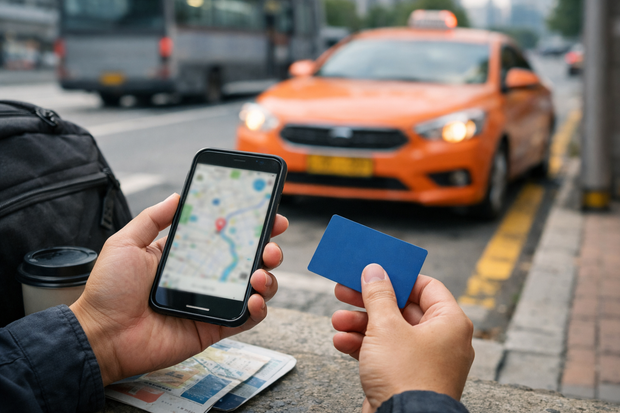
The short answer: Kakao T's English mode is the most reliable way for foreign visitors to call a taxi anywhere in Korea — it shows upfront fare estimates, accepts international Visa and Mastercard, and sends your destination to the driver in Korean automatically. Street hailing still works well at major taxi stands and busy districts, but you will need a Korean address printed or saved on your phone, and payment is less predictable.
If you are visiting Korea, taxis are one of the few transport options that run door-to-door and operate 24 hours. The base fare for a regular Seoul taxi starts at ₩4,800 for the first 1.6 km — roughly comparable to rideshare pricing in most major cities. But the experience of getting into that taxi differs dramatically depending on whether you book through an app or wave one down on the street. This guide breaks down both methods with exact steps, real fare numbers, and the specific situations where each option wins.
Whether you are heading from Incheon Airport to Gangnam at midnight or hopping between Hongdae cafes on a Saturday afternoon, the right approach depends on time of day, location, and how comfortable you are navigating without Korean. Here is everything you need to make that call.
How Do You Call a Taxi in Korea as a Foreigner?
Quick Answer: Download Kakao T (free, English mode available) and register with your foreign phone number and international credit card. The app auto-translates your destination into Korean for the driver, shows an upfront fare estimate, and lets you pay cashless. Street hailing works at taxi stands and in busy areas but requires a Korean-language address and cash.
Kakao T is Korea's dominant ride-hailing platform, handling over 70% of urban taxi trips as of 2025 — a dramatic shift from 2020, when street hailing still accounted for roughly 80% of rides (source: Wise, 2025). The app covers Seoul, Busan, Jeju, and every major Korean city. Its English interface launched in 2023 and has been refined steadily since, making it the single most important transit tool for visitors who do not speak Korean. Registration requires a working phone number (Korean or foreign) and supports Visa or Mastercard for in-app payment.
Street hailing, by contrast, is the original method and still functions well in specific contexts: at designated taxi stands near major train stations, airports, and shopping districts. Regular taxis display a rooftop sign reading "빈차" (bin-cha, meaning "empty/available") when they are free. The challenge for foreigners is communication — most drivers speak limited English, and if your destination is not a well-known landmark, you will need to show the Korean address on your phone screen or a printed card (source: Korea E Tour, 2025).
The practical decision comes down to this: use Kakao T as your default, and treat street hailing as the backup for areas with heavy taxi flow or when your phone battery is dead. Both methods use the same metered fare structure — the difference is in convenience, not cost.
How to Set Up and Use Kakao T English Step by Step
Kakao T is a free ride-hailing app developed by Kakao Mobility, available on both iOS and Android. It connects riders with licensed Korean taxi drivers using GPS-based pickup and destination matching. The app's English mode translates the entire booking flow — including destination entry, fare estimates, and driver communication — so foreign visitors can use it without any Korean language ability. As of April, Kakao T accepts international Visa and Mastercard directly, plus Kakao Pay for users who have set up a Korean-linked wallet (source: Trip.com, 2025).
Downloading and Registering with a Foreign Phone
Search "Kakao T" in the App Store or Google Play and install the app (free, approximately 120 MB). On first launch, tap the language icon in the top-right corner and select English. Registration requires a phone number — your home country number works, though you will receive a verification SMS, so make sure your phone can receive international texts or that you have activated a Korean eSIM or data plan before arriving. Enter your name, email, and add a payment card. Visa and Mastercard are accepted; American Express and Discover are not reliably supported (source: Kakao T App Store listing, 2025).
One common registration issue: if your foreign number fails verification, try switching to email-based login or using a Korean SIM. Some visitors register before departure using their home Wi-Fi and complete card setup on arrival. The entire process takes under five minutes if your card is accepted on the first try.
Booking Your First Ride: Pickup to Drop-off
Open the app and allow GPS access — your current location auto-populates as the pickup point. You can adjust this manually by typing an address or landmark in English; the app translates it to Korean for the driver. Enter your destination the same way. For example, typing "Myeongdong Station" resolves to 29 Myeongdong 10-gil, Jung-gu, Seoul. The app immediately shows a fare estimate: a ride from Hongik University Station (406-10 Seogyo-dong, Mapo-gu) to Gangnam Station typically estimates ₩15,000–₩18,000 during daytime hours.
Choose your taxi type: Regular (주황/은색 — orange or silver plates, ₩4,800 base fare) or Deluxe (검정 — black plates, ₩6,500 base fare for 3 km). Tap "Call Taxi" and wait — average pickup time in central Seoul runs 5–10 minutes. The app displays the driver's name, license plate, and real-time GPS location. When the car arrives, confirm the plate number before boarding. At drop-off, payment processes automatically through your registered card. No tipping is expected or customary in Korean taxis (source: Wise, 2025).
When Does Street Hailing Make More Sense Than the App?
Street hailing is the practice of flagging down a taxi directly from the roadside or joining a queue at a designated taxi stand. In Korea, this method remains viable 24 hours a day at high-traffic locations — particularly at airports, major train stations, and commercial districts where dozens of taxis idle in queues. The key advantage is immediacy: at a busy stand like Incheon Airport's taxi zone or Seoul Station's curbside queue, you can be in a taxi within seconds, versus 5–10 minutes for an app-dispatched vehicle. The disadvantage is communication — without the app auto-translating your destination, you need another strategy (source: Enko Stay, 2025).
Street hailing works best in three specific scenarios. First, at airport taxi stands where staff help direct you and fares to Seoul districts are posted on signs (Incheon to Gangseo-gu: ₩70,000 flat; to Gangnam: ₩90,000 flat). Second, in dense commercial areas like Myeongdong, Dongdaemun, and Hongdae where empty taxis pass every 30–60 seconds during daytime. Third, during surge periods when Kakao T wait times balloon past 15 minutes — paradoxically, a physical taxi stand may have shorter queues because drivers there are not connected to the app dispatch system.
Reading Korean Taxi Signs and Roof Lights
Korean taxis signal availability through a rooftop display panel. The characters "빈차" (pronounced "bin-cha") in red or green light indicate the taxi is empty and available. Once occupied, the display switches to "예약" (reserved) or goes dark. Regular taxis have orange or silver plates; deluxe taxis have black plates and are physically larger vehicles — typically Hyundai Grandeur or Kia K8 sedans with more legroom. International large taxis (대형/jumbo) exist at airport stands and seat up to 8 passengers for a ₩6,500 base fare.
If a taxi with the "빈차" sign slows but does not stop, it usually means the driver checked your destination through the window and chose to pass — this happens more frequently late at night when drivers prefer long-haul airport runs over short hops. Ride refusal is technically illegal in Korea, but enforcement is inconsistent. If this happens, walk to the nearest taxi stand where queued drivers are obligated to take the next passenger in line (source: Korea E Tour, 2025).
Major Taxi Stands in Seoul Worth Knowing
Seoul's busiest taxi stands operate around the clock and rarely have waits longer than five minutes during the day. Seoul Station (405 Cheongpa-ro, Jung-gu) has a large ground-level taxi queue outside Exit 1 — useful if you are arriving by KTX from Busan or the airport rail. Incheon Airport Terminal 1 and 2 have organized taxi zones on the arrivals level (Zones A through E), with attendants who speak basic English and help match you to the correct fare zone. Gangnam Station Exit 10 and Lotte World Mall (240 Olympic-ro, Songpa-gu) both have dedicated taxi pull-in lanes. In Hongdae, the best hailing spot is the main street in front of Exit 9 of Hongik University Station — high taxi density from mid-morning through late night.
Kakao T vs Street Hailing: Full Fare and Feature Comparison
The metered fare structure is identical regardless of how you board the taxi — Kakao T does not add a booking surcharge for regular taxis. The fare meter follows Seoul metropolitan standards set by the city government: ₩4,800 base for the first 1.6 km, then approximately ₩100 added every 131 meters or every 30 seconds when the vehicle is slow or stationary. This means a typical 10 km ride across central Seoul runs ₩12,000–₩15,000 during the day. Deluxe taxis charge ₩6,500 for the first 3 km with a steeper per-kilometer rate (source: Wise, 2025).
When the Korean government increased Seoul's base taxi fare from ₩3,800 to ₩4,800 in February 2023, it was the first hike in over four years. The adjustment reflected rising fuel costs and driver shortages that had been particularly acute during 2022, when late-night wait times in Gangnam regularly exceeded 40 minutes. Today, with app-based dispatch handling the majority of rides, those extreme waits have shortened to 10–15 minutes on most nights — still longer than daytime, but a measurable improvement tied directly to Kakao T's driver allocation algorithms.
| Feature | Kakao T English | Street Hailing |
|---|---|---|
| Language | Full English interface; destination auto-translated to Korean | Driver speaks Korean; show address on phone or paper |
| Fare Transparency | Upfront estimate before booking + live meter | Meter only; no estimate until ride begins |
| Payment | International Visa/Mastercard in-app; Kakao Pay | Cash preferred; some accept cards (not guaranteed) |
| Availability | Nationwide; 5–10 min pickup in Seoul | 24/7 at stands; hailing depends on traffic density |
| Safety Features | Driver ID, license plate, live GPS tracking, ride history | No tracking; note plate number manually |
| Late-Night Surcharge | Shown in-app before confirming (20% from 22:00–04:00) | Same 20% surcharge on meter; some drivers add inter-city premiums |
| Ride Refusal Risk | Rare — driver already accepted digitally | Possible late at night for short-distance trips |
| Best For | All situations; essential for non-Korean speakers | Airport stands, busy districts, dead phone battery |
What Are the Late-Night Surcharges and How Do You Avoid Overpaying?
Late-night surcharges in Korean taxis are a government-mandated percentage increase applied to the metered fare between 22:00 and 04:00. The standard surcharge is 20%, meaning a ₩10,000 daytime ride becomes ₩12,000 at night. In some municipal areas outside Seoul, the surcharge can reach 40%, and combined surcharges (late-night plus inter-city) can stack to 60% in extreme cases — though this is rare within central Seoul (source: Wise, 2025). Kakao T displays the surcharge as part of its fare estimate, so there are no surprises; on a street-hailed taxi, the meter simply ticks faster after 22:00.
The peak difficulty window is Friday and Saturday nights between 23:00 and 02:00, when demand spikes from nightlife districts like Itaewon, Hongdae, and Gangnam. During these hours, Kakao T wait times can exceed 15 minutes, and street hailing becomes competitive or even faster if you are near a taxi stand. A practical strategy: if Kakao T shows an estimated wait over 12 minutes, walk to the nearest major intersection or taxi stand while keeping the app request active — whichever arrives first wins.
To minimize late-night costs, consider timing your return trip. A taxi booked at 21:50 uses the daytime rate for the entire ride, even if you arrive at your destination after 22:00 — the surcharge applies based on the meter start time, not the drop-off time. For airport transfers, pre-arranged flat-rate taxis from Incheon (e.g., ₩70,000–₩95,000 depending on Seoul destination zone) do not carry late-night surcharges and can be booked through airport taxi stand attendants.
| Taxi Type | Base Fare (Daytime) | Base Fare (22:00–04:00) | Per Additional 131m | Best For |
|---|---|---|---|---|
| Regular (주황/은색) | ₩4,800 (1.6 km) | ₩5,760 (1.6 km) | ~₩100 | Short-to-mid city rides |
| Deluxe (검정 / Black) | ₩6,500 (3 km) | ₩7,800 (3 km) | ~₩200 | Airport transfers, comfort |
| Jumbo / International | ₩6,500 (3 km) | ₩7,800 (3 km) | ~₩200 | Groups of 5–8, heavy luggage |
| Incheon Airport Flat Rate | ₩70,000–₩95,000 | Same (no surcharge) | Flat | Airport-to-Seoul, peace of mind |
How to Pay for a Korean Taxi as a Foreign Visitor
Taxi payment in Korea varies significantly between app-booked and street-hailed rides. Kakao T processes payment automatically through your registered international card at the end of each ride — you do not hand anything to the driver. This is by far the smoothest option for foreigners and eliminates the common friction of trying to pay with a foreign card on an in-car terminal that may not support it. For street-hailed taxis, cash in Korean won is the safest universal option. Some drivers accept credit cards via a dashboard terminal, but acceptance is inconsistent, particularly in older vehicles or outside Seoul (source: Enko Stay, 2025).
If you are carrying a NAMANE Card or T-money card for subway and bus rides, note that these transit cards are not accepted for taxi payment in most cases. Taxis operate on a separate payment infrastructure from public transit. The exception is some deluxe taxis equipped with T-money-compatible readers, but this is uncommon enough that you should not rely on it.
A practical payment kit for taxi rides in Korea: keep Kakao T loaded with an international card as your primary method, carry ₩50,000–₩100,000 in cash as backup for street hails, and have Naver Map or KakaoMap installed to show drivers your destination in Korean if communication breaks down. Korean drivers occasionally round fares down to the nearest ₩1,000 as a courtesy — for example, ₩14,200 becomes ₩14,000 — but this is informal and not guaranteed.
For visitors also using public transit, a reloadable Korean prepaid card handles subway, bus, and convenience store purchases, keeping your cash reserves available specifically for taxi situations where app payment is not possible.
What Other Taxi Apps Work in Korea for Foreigners?
While Kakao T dominates the Korean market, it is not the only option. UT (Uber Taxi) re-entered Korea in partnership with local taxi operators and offers an English interface, though its driver pool is smaller than Kakao T's in most cities. i.M Taxi (previously called Tada) operates in Seoul and offers vans for larger groups. Naver Map now integrates taxi calling directly within its map interface, which is convenient if you are already using it for navigation — though the taxi feature defaults to Korean.
For airport transfers specifically, pre-booked international taxi services through Incheon Airport's official website offer flat-rate pricing and English-speaking drivers, though at a premium (typically 15–25% above metered equivalents). The advantage is zero communication friction and guaranteed vehicle availability, particularly useful for late-night arrivals when app wait times spike.
In practice, the recommendation for most foreign visitors is straightforward: install Kakao T as your primary, keep some cash for street hails, and treat everything else as optional. The Korean taxi ecosystem is well-regulated with standardized meters, so the core experience is consistent regardless of which app or method you use (source: Go With Guide, 2025).
Frequently Asked Questions
Can I use Kakao T without a Korean phone number?
Yes. Kakao T accepts foreign phone numbers during registration. You will receive an SMS verification code to your home number, so make sure international SMS is enabled or register while connected to Wi-Fi before departure. Some users report smoother registration when using a Korean eSIM — if your home number fails, this is the most reliable workaround.
Do Korean taxi drivers accept US dollars or other foreign currency?
No. Korean taxis only accept Korean won (₩) for cash payments. Exchange currency at the airport, any bank, or a convenience store ATM before your first taxi ride. ATMs at Incheon Airport are located in the arrivals hall near Gates A and E and dispense won from international debit or credit cards.
Is it safe to take a taxi alone late at night in Seoul?
Korea has one of the lowest violent crime rates among OECD nations, and taxis are considered safe at all hours. For added security, use Kakao T — the app records the driver's identity, license plate, and real-time route. You can also share your live ride status with a contact through the app. If street hailing, note the taxi's license plate number (displayed on the door and dashboard) before entering.
How much should a taxi from Incheon Airport to Myeongdong cost?
Expect ₩65,000–₩80,000 for a regular metered taxi, or a flat rate of approximately ₩75,000 if arranged through the airport taxi stand. The ride takes 60–90 minutes depending on traffic. Tolls on the Incheon Airport Expressway (₩8,600 each way) are typically included in flat rates but added to metered fares. Late-night surcharges (22:00–04:00) add 20% to metered fares but do not apply to flat-rate arrangements.
What should I do if a street taxi refuses my ride?
Ride refusal (승차 거부 / seungcha geoboo) is illegal in Korea but does occasionally happen late at night when drivers prefer longer, more profitable routes. Note the taxi number and report it to Seoul's Dasan Call Center at +82-2-120 (English support available). Alternatively, switch to Kakao T where drivers who accept your request are committed to completing the ride. Taxi stands at major stations are your most reliable street-hailing option since queued drivers must take the next passenger.
Can I request an English-speaking taxi driver?
Kakao T does not offer a language preference filter for drivers. However, Incheon Airport's international taxi service provides English-speaking drivers at a premium rate. Within Seoul, deluxe (black) taxi drivers tend to have slightly better English proficiency on average, though this is not guaranteed. The most effective strategy is using the Kakao T app itself as a translator — since the destination is transmitted digitally, verbal communication with the driver is rarely necessary.
Do Korean taxis have child car seats?
Standard Korean taxis do not carry child car seats, and Korean law currently exempts taxis from child seat requirements. If you are traveling with young children and need a car seat, your best option is to bring a portable travel car seat or book a private car service through your hotel. Some jumbo taxis at airport stands can accommodate bulky child seat installations — request this when approaching the taxi stand attendant.
Bringing It All Together
Korean taxis are clean, metered, and — compared to most global cities — affordable. A cross-town Seoul ride that would cost $30–$40 in New York or London runs ₩12,000–₩18,000 (roughly $9–$13 USD). The infrastructure is solid; the challenge for foreign visitors has always been the language barrier and payment uncertainty. Kakao T English solves both of those problems in a single app. Set it up before you land, add your international card, and you have a Korean-speaking driver summoned with two taps.
Street hailing is not dead — it is just situational. At Incheon Airport, Seoul Station, and the busy corners of Myeongdong and Gangnam, a taxi stand gets you moving faster than waiting for an app dispatch. The key is preparation: have a Korean-text address ready on your phone (screenshot from Naver Map or KakaoMap), carry ₩50,000+ in cash, and know the rooftop "빈차" sign that means the cab is free.
For the rest of your Korean transit needs — subway, bus, convenience stores — a NAMANE Card covers the public transport network and reloads easily at any station kiosk. Taxis sit in their own payment lane, so keep your card for transit and your cash (or Kakao T) for cabs. Between the two, you are covered door-to-door across the country.
Last updated: 2026-04-30. This guide is reviewed and refreshed when official sources (Seoul Metropolitan Government, Korea Tourism Organization, Kakao Mobility) update their fare or service information.
Related Articles
- What's Korea's April Temperature? Introduction to Temperature, Clothing, and Latest Cherry Blossom Bloom Forecast!
- 【Permanent Edition】 Enjoy Your Korea Trip Hands-Free! The Complete Guide to Luggage Delivery Services Between Airports and Hotels
- How to Handle Portable Chargers When Traveling to Korea? From Airline Carry-On Regulations to Tips for Saving Money Locally!
- Recharge with PayPay! Make Korean subway and bus travel even more convenient with your NAMANE Card
- What are the best transportation options when traveling in Korea? Subway, bus, and taxi explained!
This article was written using information collected and analyzed by NAMANE's in-house K-pop research AI engine. We use AI technology to bring you faster, broader coverage, and in the process some details may occasionally differ from the latest facts. For important information such as dates, venues, and prices, please double-check with official sources.


