App Selection Guide: Naver Map · Kakao Map · Citymapper Compared
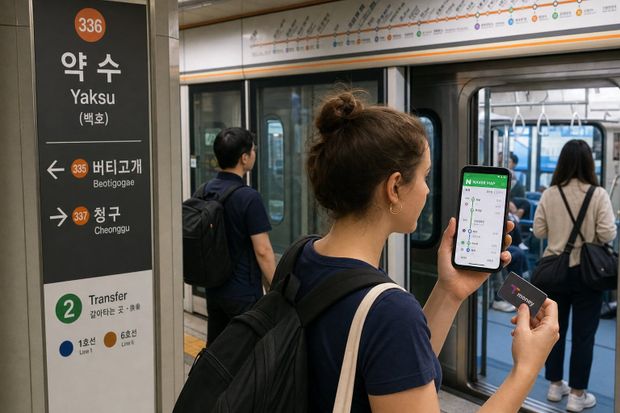
Which app to use for navigating the Seoul subway is one of the most practical questions foreign visitors face right away. The short answer: in Seoul, Naver Map is the de facto navigation standard that replaces Google Maps. Under South Korea's Act on the Establishment and Management of Spatial Data, the export of precision map data to overseas servers is restricted, which means Google Maps can be inaccurate or partially non-functional for route searches within Seoul (source: Korea Locally, 2026). Naver Map supports real-time arrival information, elevator and escalator routing, and English, Chinese, and Japanese interfaces. Kakao Map is designed primarily for domestic users and offers limited foreign-language support, making it better suited as a supplementary tool. Citymapper and the Subway Korea app are useful complementary tools for checking offline maps and quick route searches (source: Korea Locally). Combining these four apps according to the situation is the most effective approach to using the Seoul subway independently.
Quick answer: For Seoul subway apps, using Naver Map as your primary app is the most effective approach. Korean law restricts the export of Google Maps' precision data, making Naver Map the practical alternative — it supports English, Chinese, and Japanese, and provides real-time arrivals and elevator routing.
Naver Map integrates subway, bus, walking, and cycling routes, and even through its English interface you can check real-time train arrival times, destination guidance by exit number, and accessible routes for people with disabilities (including real-time elevator operating status). The "accessible route" setting is also useful for travelers moving with luggage or strollers. Tap the globe icon in the top-right corner of the app to switch languages; once you change the language setting after the initial installation, it applies automatically going forward (source: Unnies Picking, 2025).
Kakao Map (including Kakao Metro) excels at transfer optimization — it shows in detail which car to board for the fastest transfer, the station's internal layout, and the direction from the exit to your destination. However, its foreign-language interface support is limited, so for travelers unfamiliar with Korean it is more realistic to use it as a supplementary tool rather than a primary navigation app. Subway Korea offers full English support and provides subway-specific information including offline maps, fare calculation, first and last train times, and restroom locations, making it ideal as an entry-level app for first-time visitors to Korea (source: Korea Locally). Citymapper has offline caching and multilingual support, making it useful for checking backup routes when data roaming is unreliable.
| App | Foreign Language Support | Real-Time Arrivals | Elevator Routing | Bus Integration | Offline Map | Recommended Use |
|---|---|---|---|---|---|---|
| Naver Map | English · Chinese · Japanese | ✓ | ✓ | ✓ | △ (partial) | Primary navigation |
| Kakao Map | Limited (Korean-centric) | ✓ | △ | ✓ | △ | Transfer optimization supplement |
| Subway Korea | Full English support | ✓ | △ | ✗ | ✓ | Beginner-friendly · subway-only |
| Citymapper | English | ✓ | ✗ | ✓ | ✓ | Offline route backup |
Transfer Rules in Detail: Conditions for Free Transfers and Exceptions
Seoul's subway transfer discount system only applies when using a transit card (T-Money or the Climate Card); single-use paper tickets offer no transfer discounts whatsoever. The basic rules are as follows. Subway-to-subway transfers within the same fare zone are applied automatically without a separate tap. Subway-to-bus or bus-to-bus transfers require boarding the next mode of transport within 30 minutes of alighting for the discount to apply; during nighttime hours (21:00–09:00 07:00), this window is extended to 60 minutes. A maximum of 4 transfers is allowed per single journey (source: Trazy Blog). The most common mistake is missing the tap on the bus exit reader when alighting, which voids the transfer discount eligibility and results in the maximum fare being charged on the next boarding.
The advantage of using a transit card over cash or paper tickets isn't just the transfer discount. Card users receive a ₩100 discount per boarding, and the savings add up on longer journeys (source: Visit Seoul). The Seoul Climate Card (기후동행카드) offers unlimited use of all Seoul subway lines, city buses, and Ttareungyi (public bicycles) for ₩65,000 over 30 days, making it economically advantageous for travelers staying in Seoul for 7 or more days who use public transit frequently. From early 2026, the card can be purchased and topped up at station ticket machines using overseas-issued credit cards (source: GSNSP, 2026).
There are exceptions within the transfer rules that deserve special attention. If you exit through the fare gates and re-enter, this is treated as a new boarding rather than a transfer. For example, if you get off at Myeongdong to shop and then board the subway again, a new base fare will be charged. Transfer discounts are recognized only as a continuous chain of travel — remember that the moment you exit through the fare gates, that chain is broken (source: Trazy Blog).
| Transfer Type | Condition | Additional Tap Required | Nighttime Extension (21:00–07:00) | Max Transfers |
|---|---|---|---|---|
| Subway → Subway | Continuous travel within same fare zone | Not required | N/A | 4 |
| Subway → Bus | Board within 30 minutes of alighting | Tap on bus boarding | Extended to 60 minutes | 4 |
| Bus → Subway | Bus exit tap + within 30 minutes | Bus exit tap required | Extended to 60 minutes | 4 |
| Bus → Bus | Within 30 minutes of exit tap | Bus exit tap required | Extended to 60 minutes | 4 |
| Single-use paper ticket | — | — | — | No discount |
Riding Etiquette: Behavioral Standards to Know on the Seoul Subway
Seoul subway etiquette significantly affects the riding experience even without dedicated signage. One of the most important norms is the priority seating (silver seats). Priority seats are marked in different colors depending on the line (typically in shades of orange, pink, or blue) and are placed at both ends of each car. Even when the seats are empty, it is a long-standing social convention in Seoul for general passengers not to sit in them. This goes beyond simple etiquette and is established as a cultural norm; foreign travelers respecting this practice is a way of honoring local culture (source: Korea Peek). Pregnant women (including those wearing the designated badge) and passengers with infants are also among the priority users of these seats.
"The noise level on the Seoul subway is noticeably lower than in major Western cities. Choosing to text rather than call, and keeping your screen quiet rather than playing videos without earphones, is a consideration for the passengers around you." — Korea VIC, Seoul Subway Guide for Tourists
On the platform, you must wait for alighting passengers to fully exit before boarding. Forming two queues on either side of the floor markings allows those getting off to move through the middle, naturally reducing congestion. During rush hours (07:00–09:00 and 18:00–20:00), boarding with large suitcases or strollers can be realistically very difficult. During these times, waiting for the next train or taking an alternative route such as a bus is a choice that benefits both travelers and locals alike (source: Korea VIC).
Eating and loud phone calls are practically taboo. Eating snacks or drinking beverages on board can look very unusual to locals. Even with earphones in, if the volume is audible to those around you it may draw disapproving glances, so it is best to lower the volume or use noise-canceling headphones. Spreading luggage across the floor or occupying an entire seat with bags is also best avoided on busy lines.
In-Station Amenities: Coin Lockers · Elevators · Restrooms · Nursing Rooms
The amenities inside Seoul subway stations greatly affect how smoothly travelers can move around and how comfortable their stay is. Most major transfer stations have coin lockers (luggage storage) installed; for small-size lockers, the rate is approximately ₩2,000–4,000 per 4 hours. Lockers at large transfer stations such as Seoul Station, Hongik University Station, Gimpo Airport Station, and Express Bus Terminal Station support transit card and credit card payment, but some older lockers accept cash only (coins and bills), so it is safer to keep small change on hand. Storage time limits vary by station but are generally until the last train of the day; exceeding the limit incurs additional charges (source: Korea Peek).
Elevators and escalators are installed at most stations. Setting the route to "accessibility" in Naver Maps lets you check the real-time operating status of elevators at each station. This feature is also practical for travelers pulling luggage or traveling with a stroller. Especially at older stations with many stairs (such as parts of Line 1), checking the elevator location before choosing an exit can save unnecessary walking (source: Enko Stay).
Restrooms are free to use at every Seoul subway station. At large transfer stations, there are separate restrooms both inside and outside the fare gates, so they can be used without a ticket. The "restroom location" feature in the Subway Korea app lets you check the direction of the nearest restroom from your current station. Nursing rooms and baby lounges are available at major stations on Lines 2 and 9 and at large transfer stations (Seoul Station, Gangnam Station, Hongik University Station, etc.). Locations can be confirmed on the in-station map or by asking a station attendant; staff who can assist in English are stationed at most major stations (source: Korea VIC).
Free Wi-Fi on trains is available on the government-provided public Wi-Fi network throughout all lines, all stations, and inside trains. Newer rolling stock (some trains on Lines 1–9) has USB-A charging ports near the seats, allowing you to charge devices while traveling. Convenience stores inside stations (CU, GS25) offer transit card top-ups, snack purchases, and small items such as umbrellas, making them handy for meeting small needs that arise on the go (source: Korea Peek).
Tourist Attraction Lines: Key Segments Frequently Used by Foreign Visitors
As of 2026, Seoul's subway system operates more than 20 lines, including the 9 Seoul Metro lines as well as wider-area lines such as the Bundang Line, Shinbundang Line, GTX-A, and AREX (source: Visit Seoul). There are four lines that foreign tourists use most often when sightseeing in Seoul. Line 2 (green · circular) loops through Seoul's major commercial districts and K-POP-related tourist spots, including Hongik University, Sinchon, Ewha, Gangnam, and Jamsil. Line 4 (sky blue) provides access to Myeongdong, Itaewon, and Daehangno, and passes through Seoul Station, which is a transfer point for the Airport Railroad (AREX). Line 9 (gold) offers express service from Gimpo Airport to Gangnam and is also convenient for reaching Olympic Park and Seokchon Lake. The AREX Express train takes 43 minutes from Incheon Airport T1/T2 to Seoul Station (source: GKomunika, 2026).
"The AREX Express train from Incheon Airport to Seoul Station does not accept the Climate Card or regular T-Money fare. You must purchase a separate AREX ticket in advance at the airport's ticket machines or through online booking before boarding." — GKomunika, Complete Guide to Seoul Public Transportation 2026
Line 2 is the busiest line in Seoul; boarding can be difficult during rush hours. Hongik University Station is the gateway to the Hongdae–Hapjeong area, dense with K-POP venues, clubs, and independent bookstores, while Jamsil Station connects to Lotte World and Lotte Tower. To visit SM Town COEX Artium, Line 2 Samseong Station or Line 9 Bongeunsa Station is the access point. The Yongsan area toward the HYBE headquarters can be reached via Line 1 or the Gyeongui–Jungang Line at Yongsan Station (source: South Korea Hallyu).
AREX (Airport Railroad) operates two types of service. The all-stop train runs from Incheon Airport T1/T2 to Seoul Station in approximately 60 minutes and can be used with T-Money and the Climate Card. The express train takes 43 minutes but charges a separate fare (approximately ₩9,500 one-way for adults) and cannot be used with T-Money or the Climate Card, so a separate ticket must be purchased at AREX-dedicated machines inside the airport or online. If your destination is somewhere other than Seoul Station, transfer to the subway or bus at Seoul Station. When departing the country, the Seoul Station City Air Terminal allows you to complete departure check-in and baggage drop for select airlines in advance, which is very convenient (source: GKomunika).
First Train · Last Train · Late-Night Travel: Transportation Alternatives by Time of Day
On most Seoul subway lines, the first train begins service around 05:30, and the last train departs from its terminal station between 00:30 and 01:00. Last train times vary by a few to over ten minutes depending on the line and terminal station, and whether last trains are extended on weekends and public holidays also differs by line. The exact last train time for the day can be checked in real time in the Naver Maps app by entering the departure and arrival stations and tapping the "last train" option — far more reliable than a pre-printed timetable (source: Korea Peek).
After the last train, there are two main alternatives for late-night travel. First, night buses (N buses) operate on major Seoul routes past midnight; these are routes with an "N" prefix. You can check night bus routes and headways on KakaoMap or Naver Maps. Second, taxis are conveniently hailed through the Kakao T or TADA apps. Kakao T supports an English interface, allowing you to select your destination on a map, check the estimated fare in advance, and pay by credit card (source: Enko Stay).
In 2026, the GTX-A line is in operation, dramatically cutting travel time between southern Greater Seoul and central Seoul on the Suseo–Dongtan corridor. GTX-A is a wide-area express railway that is more expensive than regular subway but significantly faster, making it a practical option for travelers staying in southern Gyeonggi Province or planning to travel toward Dongtan or Pangyo (source: GKomunika). If you need to travel in the 4 a.m. range for an early airport departure, it is safest to book a taxi or airport limousine bus in advance.
Common Situations and On-the-Spot Solutions
Here is a breakdown by type of the most common situations first-time foreign visitors to the Seoul subway encounter. First, an insufficient transit card balance triggers an alarm at the fare gate and results in entry being denied. At that point, find a top-up machine inside the station (available in English, Chinese, and Japanese) and add funds immediately in ₩1,000 increments. If you cannot find a top-up machine, go to the counter of a convenience store inside the station (CU or GS25) and say "T-Money 충전해 주세요" — most staff will handle it. If you use the T-Money GO app (smartphone NFC version), you can top up directly with a foreign card from within the app (source: Trazy Blog).
"Confusion over exit numbers is one of the most common difficulties foreign visitors face. Some Seoul subway stations have more than 20 exits, so coming out the wrong one can mean several extra minutes of walking to your destination. Checking the 'exit guide' feature on Naver Maps when searching for your destination beforehand can significantly reduce unnecessary walking." — Foreigner Home, Seoul Subway Guide 2025
Refunding the deposit on a single-journey ticket is a step travelers often overlook. Single-journey tickets include a ₩500 deposit that can be refunded at a Deposit Refund Machine inside the station before you exit through the fare gate. Refund machines are located near the fare gates or along the corridor toward the platform and are often marked with a yellow or blue casing. Refunds are not possible after passing through the fare gate, so after arriving at your destination station, look for the refund machine before exiting (source: Trazy Blog).
If your T-Money card is lost, the balance can be transferred. You can report the loss in the T-Money GO app and transfer the balance to a new card, or call the customer center (1544-5955, Korean and English assistance available) to receive guidance on the procedure. Since you no longer have the physical card, you must first file a lost card report and then apply for the balance transfer, in that order. Digitizing your T-Money card via your smartphone's NFC or registering it to an account in advance makes it much faster to respond if it is ever lost (source: Trazy Blog).
Frequently Asked Questions
Does Google Maps not work for navigation in Seoul?
It doesn't fail entirely, but navigation accuracy can be low and some features may be restricted. Under South Korea's Act on the Establishment and Management of Spatial Data, the export of precise map data to overseas servers is restricted, making it structurally difficult for Google to fully provide detailed satellite maps and navigation features within Korea. In Seoul, Naver Maps serves as the practical alternative to Google Maps, supporting English, Chinese, and Japanese interfaces with high accuracy for real-time public transit information and walking directions. Kakao Maps also works accurately based on domestic map data, but foreign-language support is limited. If you're visiting Korea for the first time, it's a good idea to install Naver Maps and complete the language settings before you depart (source: Korea Locally).
Do I need to tap my card again when transferring?
When transferring from subway to subway, no additional tap is needed. Transfers within the same fare zone are handled automatically. However, when transferring between buses and the subway, you must tap the card reader both when boarding and alighting the bus for the discount to apply. If you forget to tap when getting off the bus, you lose your transfer discount eligibility and may be charged the maximum fare on your next boarding. The transfer window is 30 minutes after alighting, extended to 60 minutes during late-night hours (21:00–07:00). This benefit only applies when using a transit card (T-Money or Climate Card), and single-use paper tickets offer no transfer discounts whatsoever (source: Trazy Blog).
Can I sit in the priority seat if it's empty?
It's not legally prohibited, but refraining from sitting in priority seats even when they're empty is a long-standing social norm on the Seoul subway. Priority seats are distinguished from regular seats by color — orange, pink, or blue depending on the line — and are located at both ends of each car. These seats are understood to be reserved exclusively for seniors aged 65 and older, people with disabilities, pregnant women (badge holders), and caregivers with young children. By not sitting in these seats even when vacant, the culture encourages consideration so that those who need the seat can use it comfortably. Foreign travelers following this norm is considered a basic sign of respect for local culture (source: Korea Peek).
I have a lot of luggage — are there storage lockers at stations?
Coin lockers are available at most major transfer stations including Seoul Station, Hongik University Station, Gimpo Airport Station, and Express Bus Terminal Station. Sizes range from small (fits carry-on luggage) to large (28-inch or larger suitcases), with rates typically around ₩2,000–3,000 for small and ₩3,000–4,000 for medium lockers per 4-hour period. Newer lockers accepting transit cards and credit cards are installed at major stations, but some older lockers are cash-only, so it's wise to have small bills on hand. During weekends and peak season, lockers can fill up by mid-morning, so storing your luggage early is advisable (source: Korea Peek).
How long does it take to get from Incheon Airport to downtown Seoul by subway?
On the AREX (Airport Railroad Express), there are two options. The all-stop train runs from Incheon Airport T1 and T2 to Seoul Station in approximately 60 minutes and is accessible with T-Money and the Climate Card. The Express Train takes about 43 minutes but charges a separate fare (approximately ₩9,500 one-way for adults) and cannot be used with T-Money or the Climate Card — tickets must be purchased separately at AREX-dedicated vending machines inside the airport or online at korail.com. To reach destinations beyond Seoul Station, transfer to the subway or a bus there. Searching your full route to your final destination on Naver Maps before you travel will help save time (source: GKomunika).
Seoul Subway: Practical Summary and Next Steps
The Seoul subway is a system that foreign travelers can use fully independently. Install Naver Maps as your primary app, and choose T-Money or the Climate Card for your transit card depending on the length of your stay. To take full advantage of transfer discounts, the key is not to miss tapping when getting off the bus; observing priority seat etiquette and waiting behind the boarding lines are the basic signs of respect for local culture. Amenities such as coin lockers, restrooms, and nursing rooms can easily be located at the station office or via the Naver Maps app (source: Visit Seoul).
To visit K-pop landmarks, building your itinerary around Lines 2 and 4 is efficient, and purchasing your AREX ticket at the airport upon arrival from Incheon can cut down travel time. Making it a habit to install the Kakao T app for late-night returns and to check last train times in advance for early-morning schedules will greatly reduce unexpected situations. The Seoul subway system continues to expand and improve in 2026, so it's recommended to check Naver Maps or the Seoul Metro official website for the latest information just before your trip (source: Visit Seoul).
Last updated: 2026-05-04. This article is based on publicly available transportation information and app features as of May 2026. Specific details such as fares and operating hours are subject to change, so please check the official guidance from the relevant authorities before use.
This article was written using information collected and analyzed by NAMANE's in-house K-pop research AI engine. We use AI technology to bring you faster, broader coverage, and in the process some details may occasionally differ from the latest facts. For important information such as dates, venues, and prices, please double-check with official sources.