The short answer: Seoul's subway covers 327+ km across 23 lines and 340+ stations, and the fastest way to use it is with a T-Money card (3,000 KRW card fee, 1,250 KRW base fare) loaded with at least 20,000 KRW before you leave the airport. Tap in at the turnstile, tap out when you exit, and always check the exit number before you surface.
The scenario repeats itself dozens of times a day at major Seoul stations: a first-time visitor emerges from the wrong exit at Gangnam, adds ten minutes of surface walking to a journey that should have taken thirty seconds, and quietly blames the subway for being confusing. The subway is not confusing. It is, in fact, one of the most legible urban rail networks in Asia — but it rewards preparation. Knowing the exit number before you descend, carrying a loaded transit card, and having the right navigation app on your phone are the three variables that separate a smooth commute from a frustrating one.
This guide covers the full system as it operates in 2026: Seoul Metro's 23 lines, its 2023 map redesign (the first in forty years), card options from T-Money to the Climate Card and Discover Seoul Pass, step-by-step purchase instructions, the etiquette codes that locals follow without discussion, and the six mistakes that reliably cost foreign visitors time or money. Whether you're arriving at Incheon on a first trip or returning after several years away, the sections below will answer the practical questions that travel forums answer only partially.
How Does Seoul's Subway System Work in 2026?
Quick Answer: Seoul Metro operates 23 lines, 340+ stations, and 327+ km of track, running roughly 5:30 AM to midnight. A single ride costs 1,250 KRW for up to 10 km using a T-Money card. The 2023 map redesign, the first overhaul in forty years, brought the network up to the international octolinear standard and improved tourist usability by an estimated 30 percent according to Seoul Metro feedback data.
Seoul's subway is not simply large — it is systematically designed. Each line carries a number and a color: Line 1 is dark blue, Line 2 is green, Line 3 is orange, Line 4 is sky blue, and the color-coding continues through the higher-numbered lines and the named private lines (Shinbundang, Gyeongui-Jungang, Airport Railroad). The Soul of Seoul's subway overview notes that the numbered lines form the backbone of the network, while the named lines serve specific corridors — the AREX connecting Incheon Airport to Seoul Station and Hongik University being the most relevant for arriving travelers. The system runs under Seoul, Gyeonggi Province, and Incheon, meaning a single T-Money card can carry you from the capital to satellite cities without switching payment methods.
The 2023 map redesign is worth understanding because it changes the visual experience of planning routes. For forty years, Seoul Metro used a map that prioritized geographic accuracy, which made certain interchange stations look deceptively close together and others unreasonably far apart. The redesigned map adopted the octolinear standard — the same approach used by London Underground and most major European metros — in which lines run only at 45-degree or 90-degree angles. Diagonal sprawl is removed; the visual hierarchy of interchange stations is clarified. Seoul Metro's own research indicated a 30 percent improvement in tourist usability following the redesign. If you downloaded an older version of a subway map before your trip, it is worth replacing it with the current edition, available through the Seoul Metro website and embedded in both KakaoMap and Naver Map.
How to Read Numbered Station Exits
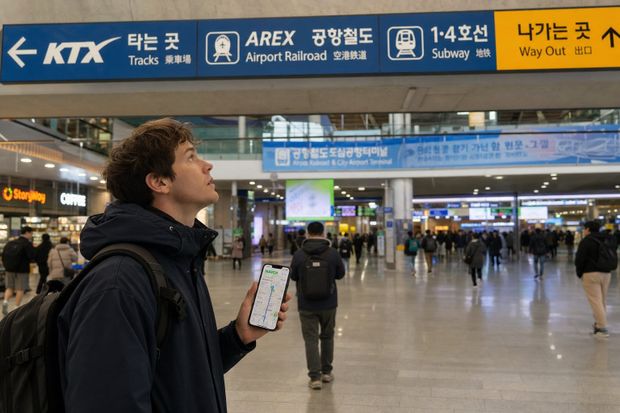
Every Seoul subway station has numbered exits, and large interchange stations can have more than fifteen. The exit number is not decorative — it corresponds to a specific street corner or building entrance, and the difference between Exit 3 and Exit 5 at a major station can mean a ten-minute surface walk. Pelago's Seoul subway guide recommends confirming the exit number from within the app before descending to the platform, not after. Exit information is displayed on platform screen doors, on overhead signage inside carriages (updated in real time on newer trains), and on large wall maps positioned at every corridor junction underground. When navigating an unfamiliar large station, follow line colors and numbers rather than English text — color and number signage is more consistent across the network than translated station names, which occasionally vary between maps and in-station displays.
Escalator etiquette reinforces the system's logic: stand on the right, walk on the left. This is not a suggestion — it is the operating norm, and violating it during rush hour creates friction in narrow corridors. Carriage positioning is also worth learning: KakaoMap's route display shows which carriage number to board for the shortest walk to the exit or transfer at your destination station. This feature, called "smart carriage" or the equivalent in the Korean interface, is practical at large interchanges such as Express Bus Terminal (Lines 3, 7, and 9) where the transfer corridor between lines is several hundred meters long.
Best Apps for Navigating Seoul's Subway
Google Maps works adequately for surface navigation in Seoul but underperforms for transit routing. It lacks real-time data integration with Seoul Metro and occasionally returns outdated transfer times or missing line information. Trip.com's South Korea travel apps guide recommends KakaoMap and Naver Map as the primary tools for Seoul transit — both pull live data from the Seoul Metropolitan Government's transit API, display real-time train arrival times, and include the carriage positioning feature. KakaoMap tends to have a slightly cleaner English interface; Naver Map has deeper integration with business listings, which is useful when you need to navigate to a specific restaurant or venue rather than a station. Both are free downloads. For offline use, the Subway Korea app (available on iOS and Android) stores the full network map locally and displays transfer routes without a data connection — useful if you are managing roaming costs.
Which Transit Card Should You Buy: T-Money, Climate Card, or Discover Seoul Pass?
The right card depends on how many days you are staying in Seoul, how much you plan to use public transit, and whether the attractions bundled into the premium passes align with your itinerary. T-Money is the baseline — a stored-value card accepted on every subway line, bus, and most taxis. The Climate Card is an unlimited-ride pass covering Seoul subway and bus within the city limits. The Discover Seoul Pass bundles transit with attraction entry. The table below compares all five options a first-time visitor is likely to encounter at vending machines or tourist desks.
| Card | Cost (KRW) | Coverage | Where to Buy | Best For |
|---|---|---|---|---|
| T-Money | 3,000 (card) + 1,250–1,450 per ride | All Seoul lines, buses, most taxis, convenience stores | Station vending machines, CU, GS25, 7-Eleven | Most visitors; flexible, reloadable, works nationwide |
| Climate Card (1-day) | 5,000 | Unlimited Seoul subway + city bus | Station vending machines, Seoul Metro app | Full-day explorers covering 4+ subway trips |
| Climate Card (7-day) | 15,000 | Unlimited Seoul subway + city bus for 7 days | Station vending machines, Seoul Metro app | Week-long stays with frequent transit use |
| Discover Seoul Pass (48 hr) | 60,000 | Unlimited transit (48 hrs) + AREX one-way + 30+ attractions | Incheon Airport tourist desks, online | First-time visitors hitting multiple paid attractions |
| Single-trip ticket | 1,250–5,000 (distance-based) | One journey on Seoul Metro only | Station vending machines (English menu available) | One-off rides; no card needed; 500 KRW deposit returned |
Reloading a T-Money or Climate Card is straightforward at station vending machines, which have English-language menus and accept cash. Foreign credit and debit cards, however, work inconsistently at reload machines — TripAdvisor forum discussions on T-Money and Climate Card payments document repeated failures with Visa and Mastercard at reload terminals, particularly for cards issued outside South Korea. The safest approach is to reload with Korean Won cash. The CU convenience store inside Seoul Station (405 Cheongpa-ro, Yongsan-gu, open 24 hours) is a reliable reload point accessible immediately after arriving by AREX. The Myeongdong tourist information center (14 Myeongdong 9-gil, open 9 AM to 6 PM) can also advise on card options. Financial advisors for Korea travel consistently recommend maintaining a minimum balance of 20,000 KRW — enough for roughly fourteen standard rides — so that a low-balance alert at an exit gate does not strand you underground.
T-Money Versus a Korean Prepaid Card: What's the Difference?
T-Money is a transit card. It pays subway fares, bus fares, and the occasional convenience store purchase, but it is not a general-purpose payment card and cannot be used at restaurants, shopping malls, or online merchants. Travelers who want a single card for both transit and everyday spending in Korea need a different tool. The NAMANE Card, a reloadable Korean prepaid card designed specifically for foreign visitors, bridges that gap — it functions as a general-purpose Visa-network card usable wherever Korean card payments are accepted, while T-Money handles the transit layer. The NAMANE service manual explains the full setup process, including how to load Korean Won remotely before your trip so the card is ready at Incheon. Carrying both — a T-Money for tap-in/tap-out speed and a NAMANE Card for everything else — is the most efficient arrangement for a week-long trip.
Step-by-Step: How to Buy, Load, and Use a T-Money Card in Seoul
The mechanics of Seoul's transit card system are tap-in, tap-out: touch the card to the yellow sensor at the turnstile when entering the paid zone, and touch it again when exiting. Forgetting to tap out has a specific consequence — the system cannot calculate your distance traveled, so it charges the maximum distance fare for that journey, which can be several times the actual cost. On buses, the tap-out sensor is located at the rear door, not the front; travelers who exit through the front without tapping are charged the same maximum-fare penalty. The integration rule softens this across modes: if you transfer between subway and bus within 30 minutes of tapping out, the next journey counts as a transfer rather than a new ride, and you pay only the distance increment rather than a new base fare. Beautipin's Korea public transport guide covers the full integration window in detail, including the edge cases for nighttime journeys when transfer windows are shorter.
How to Buy a T-Money Card at a Station or Convenience Store
Station vending machines have English-language menus accessible through a language toggle on the touch screen. The purchase flow is: select language, select "Buy T-Money card," insert cash (machines accept 1,000 and 10,000 KRW notes), add initial load value, collect card. The card arrives loaded with the amount you chose minus the 3,000 KRW card fee. Starting with a 10,000 KRW load gives you roughly five standard rides. For travelers arriving at Incheon Airport, T-Money cards are available at the airport's tourist information desks on both Terminals 1 and 2, and at the CU and GS25 stores within the arrivals halls — buying at the airport means your card is active before you board the AREX into the city. Convenience stores (CU, GS25, 7-Eleven, Ministop) sell T-Money cards at the counter; simply ask the cashier for a "T-Money card" and pay for the card plus your chosen initial load in cash. Cards sold at convenience stores are identical in function to those from vending machines.
If you are arriving with a Discover Seoul Pass, note that it functions as a transit card for its active period and includes a single AREX one-way trip — this removes the need to purchase a separate T-Money card on arrival day. Once the pass expires, you will need a T-Money card or single-trip tickets for remaining journeys.
Fares, Transfer Discounts, and the 30-Minute Integration Rule
The base fare on Seoul Metro is 1,250 KRW for any journey up to 10 km, paid with a T-Money or Climate Card. Beyond 10 km, the fare increases by 100 KRW for every additional 5 km. A journey from Hongik University to Olympic Park — approximately 25 km — therefore costs 1,250 + 300 = 1,550 KRW. Trip.com's Seoul Metro transport guide provides a full distance-fare calculator and notes that children under 6 ride free, children aged 6–12 pay a reduced fare, and seniors aged 65 and over ride free on lines operated by Seoul Metro. Single-trip tickets purchased at vending machines cost 1,250 KRW for standard urban journeys and include a 500 KRW refundable deposit returned when you insert the ticket into the deposit-return machine at the exit. The 30-minute transfer integration window means that a subway-to-bus transfer within half an hour is charged as a continuation of the same journey rather than a new fare — practically, this means that crossing Seoul by combining two modes often costs only fractionally more than a single-mode journey of the same distance.
Rush Hours, Transfers, and Concert-Day Subway Strategy
Seoul's major interchange stations — Express Bus Terminal, Jongno 3-ga, Sindorim, Dongdaemun History & Culture Park — involve transfer corridors that can run 300 to 500 meters underground. KakaoMap's route display includes estimated walking time for transfers, which is accurate and accounts for the actual corridor length. When planning an itinerary that requires an interchange, add two to three minutes to KakaoMap's transfer estimate during rush hours, when corridor congestion slows foot traffic considerably. The table below covers the most-visited destinations for international travelers, with specific exit numbers that eliminate surface navigation uncertainty.
| Destination | Station Name (Korean) | Line(s) | Exit | Notes |
|---|---|---|---|---|
| KSPO Dome | 올림픽공원 (Olympic Park) | Line 5 | Exit 3 | 424 Olympic-ro, Songpa-gu; do not confuse with Line 9 Sports Complex |
| Jamsil Olympic Stadium | 잠실 (Jamsil) | Lines 2, 8 | Exit 6 | Large interchange; allow extra time for Line 2 to 8 transfer |
| Hongdae (Hongik Univ.) | 홍대입구 (Hongik University) | Lines 2, AREX, Gyeongui-Jungang | Exit 9 | Exit 9 for main street; AREX to/from Incheon Airport |
| Myeongdong | 명동 (Myeongdong) | Line 4 | Exit 6 | Tourist info center 5-min walk; shopping street begins at exit |
| Gangnam / COEX | 삼성 (Samseong) | Line 2 | Exit 6 | COEX Mall underground connection from Exit 6; Gangnam Station (Exit 11) for main strip |
| Itaewon | 이태원 (Itaewon) | Line 6 | Exit 1 or 4 | Exit 1 for main street north; Exit 4 for Haebangchon direction |
Rush Hour Strategy on Seoul's Busiest Lines
Line 2 — the green loop line — is Seoul's highest-ridership route and operates at crush capacity between 7 and 9 AM on weekday mornings, particularly between Sindorim and City Hall. Trains on this segment run at two-minute headways but fill to standing-room-only within seconds of the doors opening at major stations. The convention during rush hour is to remove backpacks from your shoulders and hold them in front of you or place them in the overhead rack — large bags worn on the back significantly reduce the number of people who can fit in a carriage, and other passengers will make their displeasure visible. If you need to exit at a busy station, begin moving toward the door two stops in advance and say "naerilgeyo" (내릴게요 — "I'm getting off") clearly. Most commuters will shift to let you through without requiring physical contact. Alternative routing during rush hour: Line 5 parallels part of Line 2's eastern arc; Line 9 (express mode) covers the Gimpo-Gangnam corridor with fewer stops and typically less crowding than Line 2.
Lines that draw the most tourist traffic — Line 4 through Myeongdong and Dongdaemun, Line 2 through Hongdae and Sinchon — are noticeably less crowded between 10 AM and 4 PM, which is the practical window for comfortable sightseeing journeys. The evening rush (5 to 7 PM) is less severe than the morning peak on most lines, with the exception of Line 9's express service, which runs to limited stops and attracts large loads in both directions between Gimpo Airport and Sinnonhyeon.
Concert Day: Getting to KSPO Dome and Managing Post-Show Transit
KSPO Dome (424 Olympic-ro, Songpa-gu) is served by Line 5 at Olympic Park Station, Exit 3. This is a point of consistent confusion for first-time concert-goers: the venue is not served by the station named "Sports Complex" on Line 2, which is several kilometers away and serves Jamsil Arena. KakaoMap disambiguates this clearly — search for KSPO Dome directly rather than the neighborhood name. On concert days, Line 5 platforms at Olympic Park Station are staffed with additional personnel directing crowd flow; follow the yellow line-color signage and exit at the correct turnstile row for Exit 3. Arrive at least 30 minutes before the advertised entry time to clear the station's increased passenger volume without missing the opening. for the full KSPO Dome concert-day guide with venue maps and merchandise line logistics.
Post-show transit is the harder problem. Major concert venues discharge 10,000 to 20,000 people within 30 minutes of the final song, and Line 5 platforms fill immediately. The practical options are: wait 45 minutes inside or near the venue until train frequency absorbs the surge; walk to the adjacent Olympic Park perimeter and take a taxi from the main road; or use Kakao T (the Korean taxi-hailing app, equivalent in function to Uber) to book a pickup with a fixed price shown before you confirm. During New Year's Eve 2025, Seoul Metro extended service on key lines until 2 AM, demonstrating that the network does respond to high-demand events — South Korea Hallyu's New Year's Eve Seoul guide documents the 2 AM extension in detail. Check Seoul Metro's official notices for any service extensions on major concert nights.
Seoul Subway Etiquette: What Foreign Visitors Are Expected to Know
Seoul's subway operates under a visible social code that is rarely explained to visitors but is consistently enforced by ambient peer pressure. Priority seating — designated seats at the ends of each carriage, usually marked in a different color (commonly blue or pink) — is reserved for elderly passengers, pregnant women, passengers with disabilities, and people with infants. The norm is strong: it is common to see young passengers stand for an entire journey rather than occupy a priority seat even when the carriage is not crowded. Foreign visitors who sit in priority seating and are asked to move (occasionally by other passengers, occasionally by a station attendant) will have no difficulty understanding the request regardless of language barriers — the gesture toward the seat marking is universal.
Food, Noise, and Photography Inside Carriages
Eating inside Seoul Metro carriages is strongly discouraged by posted signage and is avoided by the overwhelming majority of commuters. The rule extends to drinks with lids: water is generally accepted, but hot food, aromatic snacks, and alcohol draw immediate social disapproval. Beautipin's public transport etiquette section notes that the no-food norm is particularly consistent on Line 2 and Line 9, which carry the highest proportion of commuters. Phone calls are also considered disruptive — the convention is to text or message rather than speak aloud, and announcements inside carriages specifically request that passengers lower their voices. If you need to take a call, moving to the vestibule between carriages (available on older rolling stock) is the accepted approach. Photography of other passengers without their knowledge or consent is not acceptable; photographing empty carriages, station architecture, and platform art installations is unproblematic.
Headphones are universal among Seoul Metro commuters. If you are playing audio through your phone's speaker in a carriage, expect immediate and noticeable reactions from surrounding passengers. The standard is earphones or silence.
Korean Phrases That Actually Help Underground
Two phrases cover the vast majority of in-station social navigation. "Jamsimanyo" (잠시만요) translates roughly as "excuse me, just a moment" and is used when squeezing past people in a crowded carriage or corridor — it is softer in register than the equivalent English phrase and rarely generates friction. "Naerilgeyo" (내릴게요) means "I'm getting off" and is used when pushing toward the door at your stop; it signals intent clearly enough that most commuters will shift without needing eye contact. Neither phrase requires pronunciation precision to be understood in context. If you need directions or help underground, customer service booths are present at most major stations and are staffed during operating hours; English proficiency varies, but staff can usually interpret a destination written on a phone screen or shown on a map. for neighborhood walking guides from key subway exits, including Hongdae, Insadong, and Bukchon Hanok Village.
Six Subway Mistakes That Cost Foreign Visitors Time and Money
The mistakes below are not random — they follow a pattern. Each one involves assuming that Seoul's subway behaves like a familiar system from another country, or that a workaround available elsewhere (contactless foreign card, Google Maps, casual tap-out) will transfer without friction. It does not. The six errors below account for the majority of avoidable delays and unexpected charges reported by international visitors.
- Using Google Maps for transit routing. Google Maps lacks real-time integration with Seoul Metro's live data and occasionally returns incorrect transfer instructions or outdated fare information. KakaoMap or Naver Map are the correct tools for any Seoul transit journey.
- Not tapping out on buses. The rear-door sensor on Seoul city buses is easy to miss, particularly when exiting a crowded bus quickly. Failing to tap out triggers the maximum distance fare for the journey, which can be three to four times the actual fare.
- Ignoring exit numbers at large stations. At stations with ten or more exits — Gangnam, City Hall, Express Bus Terminal, Jongno 3-ga — surfacing at the wrong exit can add five to fifteen minutes of surface navigation. Confirm the exit number in KakaoMap before boarding.
- Misreading Line 2's loop direction. Line 2 is a complete loop. Trains run clockwise and counterclockwise; taking the wrong direction doubles your journey. The departure board and KakaoMap both show direction — check before boarding, especially at Sindorim, which is also a Line 1 interchange and generates significant platform confusion.
- Attempting to reload a T-Money card with a foreign credit or debit card at station machines. Station reload machines accept cash and Korean-issued cards reliably. Foreign Visa and Mastercard reload failures are well-documented. Reload at convenience stores (CU, GS25) with cash, or use a Korean prepaid card such as the NAMANE Card for purchases where transit cards cannot be used.
- Running balance to zero at the exit gate. If your T-Money card drops below the minimum fare while you are inside the paid zone, the exit gate will not open. You must visit the customer service booth to pay the outstanding fare in cash and exit. Maintaining 20,000 KRW on your card eliminates this scenario entirely.
A related but less-discussed mistake is misreading transfer corridor signage at large interchange stations. At Dongdaemun History & Culture Park (Lines 2, 4, 5), the transfer corridors branch in multiple directions, and the English signage is occasionally supplemented but rarely replaced by the Korean. The Soul of Seoul's analysis of tourist underestimation errors identifies signage misreading as a primary source of time loss. The practical fix: follow the line color and line number, not the English station name. Line 5 is always purple. Line 4 is always sky blue. If you cannot find the purple signage from your current position, you are in the wrong corridor.
Frequently Asked Questions
Can I pay for Seoul subway rides with a foreign credit or debit card?
Directly at subway turnstiles: no. Seoul Metro turnstiles accept only T-Money cards, Climate Cards, single-trip tickets, and a small number of bank-affiliated transit cards issued in Korea. Foreign Visa, Mastercard, or contactless mobile payments are not accepted at gates. At reload machines, foreign cards work inconsistently — documented failures are common enough that relying on a foreign card for reload is a significant risk. The practical solution is to buy a T-Money card with Korean Won cash on arrival and maintain a buffer balance. For general spending in Korea, a reloadable Korean prepaid card covers the situations where T-Money cannot.
What are Seoul subway operating hours?
Most Seoul Metro lines begin service between 5:30 and 5:45 AM and run until approximately midnight. Line 2 typically operates until around 1 AM on weeknights due to its high ridership. The last train time varies by station and direction; the Seoul Metro app and KakaoMap both display last-train information for specific station pairs. On designated high-demand nights — including New Year's Eve — Seoul Metro has historically extended service; for New Year's Eve 2025, service on key lines ran until 2 AM. South Korea Hallyu's New Year's Eve Seoul guide documents the 2 AM extension in detail. Service extensions are announced through Seoul Metro's official channels, usually two to three weeks in advance.
Is there an unlimited-ride day pass for Seoul's subway?
Yes: the Climate Card (기후동행카드) offers unlimited rides on Seoul subway lines and city buses within Seoul for 5,000 KRW (1 day) or 15,000 KRW (7 days). The pass covers only Seoul's city-operated transit — it does not include the AREX express service to Incheon Airport or buses operated by Gyeonggi Province. Climate Cards are purchased at station vending machines and reloaded in the same way as T-Money. They are not sold at convenience stores. If your itinerary includes multiple paid attractions alongside transit, the Discover Seoul Pass (60,000–120,000 KRW for 48 to 120 hours) bundles unlimited transit with entry to more than thirty attractions including Gyeongbokgung Palace and Lotte World, and includes a single AREX one-way trip from the airport — it may deliver better value than buying transit and attractions separately.
How do I find the correct exit number at an unfamiliar station?
The most reliable method is to enter your destination in KakaoMap before you board the train: the app's walking directions from the subway station specify the exit number and the surface-level turn-by-turn route from that exit to your destination. Underground, wall maps at every corridor junction display exit numbers with simplified street layouts above ground. For common K-pop and tourist destinations: Myeongdong's main shopping street begins at Exit 6 (Line 4); Hongdae's main entertainment strip is Exit 9 (Line 2, Hongik University Station); KSPO Dome is Exit 3 from Olympic Park Station (Line 5). These specific exits are worth committing to memory if your itinerary focuses on these areas.
What happens if my T-Money card runs out of balance mid-journey?
If your balance drops below the minimum fare before you exit, the gate will lock. You cannot exit through the standard turnstile. Proceed to the customer service booth (역무실), which is present at every Seoul Metro station. Staff can process a cash payment for the outstanding fare and release the gate manually. This process takes two to five minutes but is entirely routine. To avoid it, maintain a minimum of 20,000 KRW on your card at all times — reload at any CU or GS25 convenience store with cash. The NAMANE service manual also explains how to maintain Korean Won balances across payment tools before and during a trip, which is useful for travelers managing multiple payment methods simultaneously.
Is Seoul's subway safe for solo travelers and women traveling alone?
Seoul Metro's safety record is strong by any international measure. Stations are covered by dense CCTV networks, and each carriage has an emergency button that connects directly to the driver and station staff. Solo and female travelers report high levels of comfort on the system, including late-night journeys. The standard precautions that apply in any large urban transit system — awareness of your surroundings, keeping bags visible, not leaving items unattended — are sufficient. Women-only carriages are not a formal Seoul Metro policy, unlike some other Asian metros, but the heavily populated nature of most lines provides natural security in numbers during all but the very last trains of the evening.
Does the T-Money card work outside Seoul?
Yes, broadly. T-Money is accepted on subway systems in Busan, Incheon, Daegu, and most other South Korean cities with metro networks. It works on the AREX between Seoul and Incheon Airport. Most licensed taxis across the country accept T-Money. It does not work for KTX high-speed rail reservations (those require a separate ticket or Korean Rail Pass). Some rural bus routes — particularly in smaller provinces — are cash-only or use regional transit cards not compatible with T-Money. For nationwide use, the T-Money card is reliable in all urban and most semi-urban transit contexts. Reloading is available at CU and GS25 stores nationwide, so maintaining your balance is straightforward regardless of which city you are in.
Bringing It All Together
The preparation for Seoul's subway takes under an hour and pays dividends across every day of a trip. Before departure: download KakaoMap, identify the exit numbers for your first two or three destinations, and confirm where to buy a T-Money card at Incheon Airport (Terminal 1 arrivals, Level 1, tourist information desk or CU). On arrival: buy the card with cash, load at least 20,000 KRW, and confirm the AREX platform before heading underground. In the city: let KakaoMap choose your route rather than intuition, follow line colors not English text at interchange stations, and tap out every time — on trains, on buses, at every exit.
For travelers whose Seoul itinerary includes K-pop concerts, idol-adjacent neighborhoods, or venues like KSPO Dome, the subway is the correct transit tool for 90 percent of journeys — faster than taxis during rush hours, cheaper than private hire, and direct to the venues that matter. The concert-day additions to standard strategy (arriving early, knowing Exit 3 for Line 5, pre-booking a Kakao T taxi for post-show) are manageable once the baseline knowledge is in place.
For spending beyond transit — convenience stores, restaurants, shopping at Olive Young or in Myeongdong — the NAMANE Card addresses the gap that T-Money cannot fill. A reloadable Korean prepaid card that functions on the Korean card payment network eliminates the friction of foreign card acceptance uncertainty and lets you manage a Korean Won balance from before you arrive. Combined with a loaded T-Money card and KakaoMap on your phone, it covers the payment infrastructure for a Seoul trip without requiring cash for every transaction outside the transit system.
Last updated: 2026-05-02. This guide is reviewed and refreshed when official sources (Seoul Metro, KTO, Visit Seoul) update their information.
Related Articles
- Korean Etiquette and Manners: Practical Guide for Foreign Visitors 2026
- Jjimjilbang Meaning: Practical Guide for Foreign Visitors to Korea's 24-Hour Spa Culture
- TMP Locale Test Archived
This article was written using information collected and analyzed by NAMANE's in-house K-pop research AI engine. We use AI technology to bring you faster, broader coverage, and in the process some details may occasionally differ from the latest facts. For important information such as dates, venues, and prices, please double-check with official sources.


