
Gangnam at a Glance: Seoul's South-of-the-River District
Gangnam District (강남구) is one of Seoul's 25 administrative gu, occupying 39.49 km² directly south of the Han River — "Gangnam" translates literally as "south of the river" (강, gang = river; 남, nam = south). With approximately 556,492 residents organized across 12 administrative dong (neighborhoods) as of July 2025, the district is Seoul's third-largest by area and, by nearly every economic measure, its most valuable, according to Wikipedia's Gangnam District overview. What makes those numbers remarkable is the speed at which they were built: as recently as the early 1970s, the land south of the Han River was largely undrained marshland. A South Korean government-directed urbanization program — routing infrastructure investment and managed population migration across the river — transformed the area into an independent gu by 1975 and into the country's economic and cultural center of gravity within a single generation. Today Gangnam is simultaneously South Korea's corporate heartland, the nerve center of the K-pop industry, and the district that gave the world one of the most-watched music videos in internet history.
Quick Answer: Gangnam District is Seoul's wealthiest gu — 39.49 km² south of the Han River, home to ~556,492 residents across 12 neighborhoods. Transformed from marshland in the 1970s through government-directed urbanization, it now anchors South Korea's corporate economy, houses the K-pop industry's biggest labels, and achieved global name recognition through PSY's record-breaking 2012 song.
The district's 12 dong each carry a distinct character that reflects Gangnam's layered identity. Cheongdam-dong anchors the luxury tier: its streets hold flagship showrooms for global fashion labels, private members' clubs, and the Seoul headquarters of South Korea's largest entertainment companies. Apgujeong-dong, directly to the west, was Seoul's original designer retail corridor — its Rodeo Street predated Cheongdam's current luxury concentration by a decade — and remains the district's center for the beauty and fashion ecosystem associated with the K-pop industry, including the concentration of aesthetic clinics that has made the neighborhood a recurring topic in both Korean and international media.
Daechi-dong presents a different face entirely. Less concerned with visible consumption than with academic achievement, the neighborhood houses South Korea's densest collection of private tutoring academies (hagwon), a feature that directly sustains Gangnam's real estate premium: proximity to Daechi's tutoring infrastructure is among the most heavily weighted factors when Seoul families evaluate where to purchase property. Samseong-dong, meanwhile, anchors the district's convention and corporate functions, housing the COEX complex and key entertainment and multinational offices.
Gangnam's gross regional domestic product stood at 71.85 trillion won (approximately $6 billion USD) as of 2019, with major corporations including KEPCO, GS Group, Hyundai Department Store Group, HiteJinro, and Korea Zinc Corporation all headquartered within the district (source: Gangnam District, Wikipedia). At just 40 km², Gangnam's land mass is a fraction of the 770 km² covered by South Korea's second city, Busan — yet the two rival each other in total land valuation, a measure of the extraordinary per-square-kilometer price density the district has sustained across five decades of concentrated development.
K-pop Industry Headquarters: The Labels That Call Gangnam Home
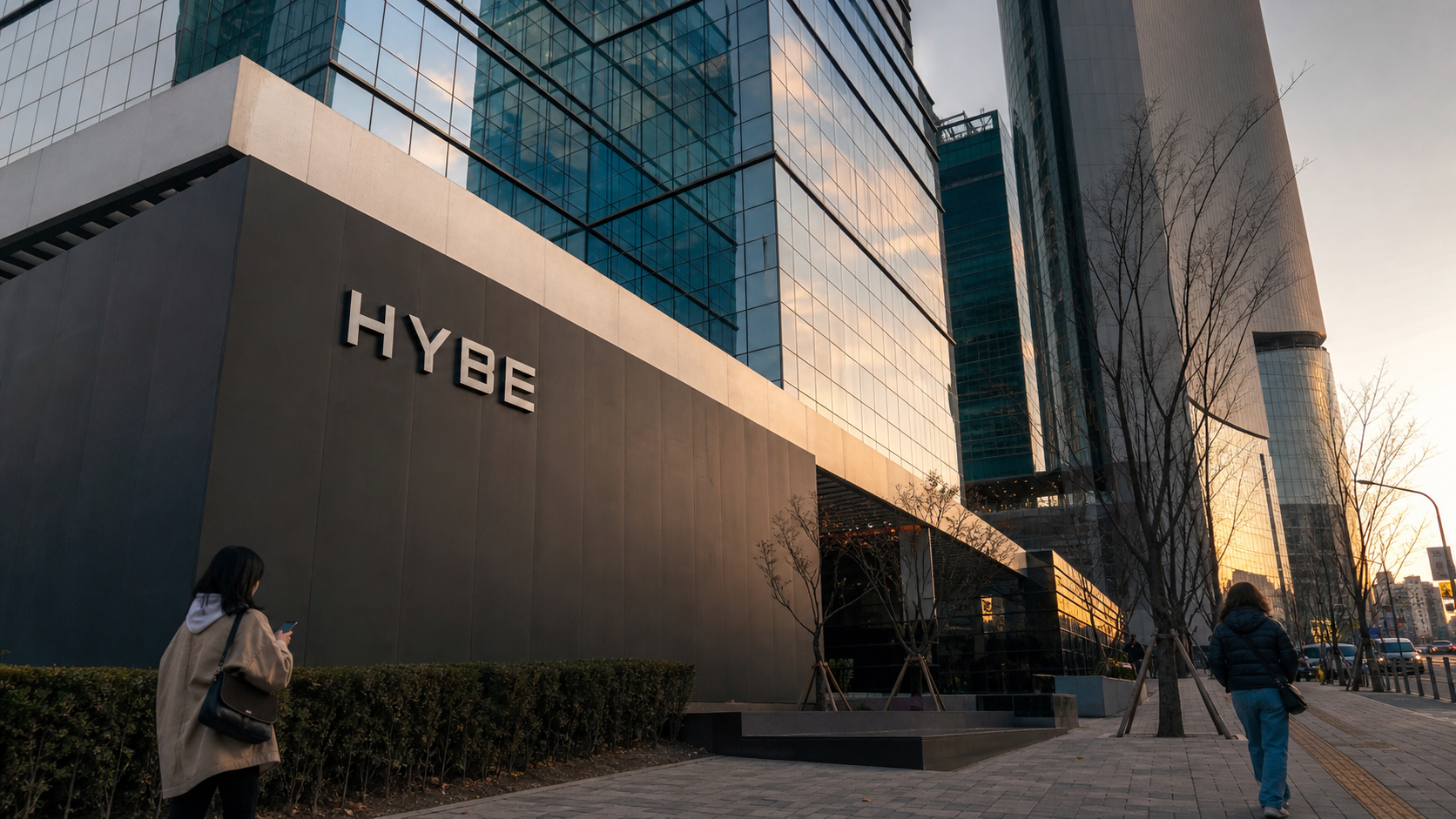
South Korea's K-pop industry is not spread evenly across Seoul — it is concentrated, deliberately and densely, within a corridor running through Gangnam's Cheongdam-dong and Samseong-dong neighborhoods. SM Entertainment, HYBE Corporation (the label group behind BTS), and FNC Entertainment all maintain major operations in this corridor, according to the Gangnam District overview and Airial Travel's K-pop Entertainment District guide. This concentration is not coincidental: as the Korean Wave gathered commercial scale in the late 1990s and 2000s, the companies and professionals who built it — talent scouts, recording studios, choreography directors, management agencies, broadcast-adjacent casting firms — clustered where corporate infrastructure, transit connections, and available real estate all intersected favorably. Gangnam, already South Korea's corporate center, became the default address for an industry that was becoming one of the country's most valuable cultural exports. The density that resulted is a structural advantage the corridor has never lost.
The Intelligent Community Forum's Gangnam District profile notes that the Cheongdam-Samseong corridor operates as a compressed professional ecosystem where the full production chain of a K-pop release — from casting and trainee development to recording, styling, management, and fan event operations — functions within a walkable geographic radius. This clustering effect means that a debut group's entire professional infrastructure can be accessed within a few city blocks, a model that would be difficult to replicate in entertainment markets where industry functions are distributed across an entire metropolitan region.
"Gangnam's Cheongdam-dong and Samseong-dong corridor functions as a self-contained entertainment ecosystem: from talent scouting offices and recording studios to management agencies and fan event venues, the cluster compresses an entire industry's infrastructure into a walkable radius — a structural advantage the area built over two decades and continues to hold." (Source: Airial Travel, K-pop Entertainment District, Gangnam)
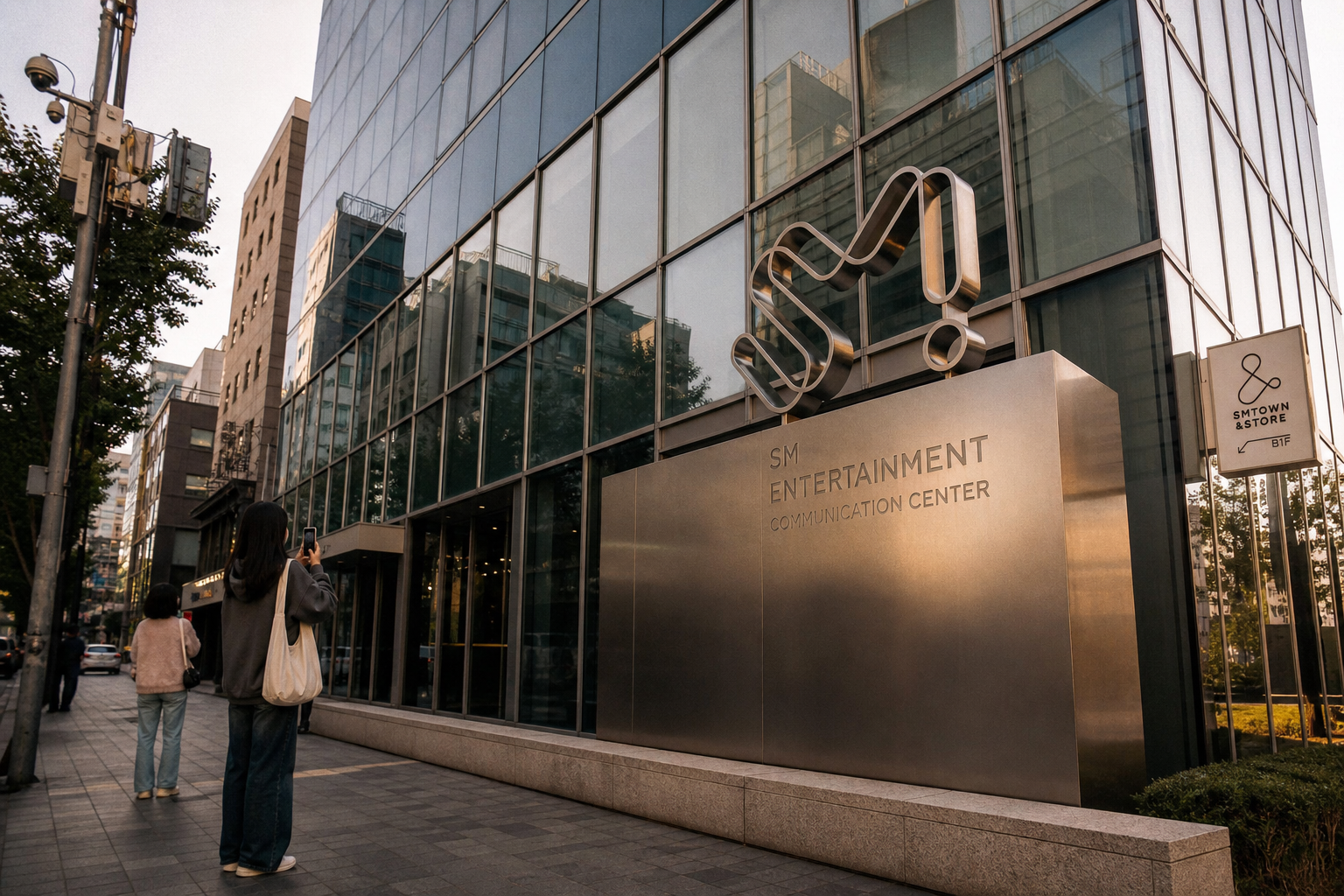
HYBE Corporation, the industry's current largest group by market capitalization, operates its primary creative campus in Yongsan-gu — a district north of the Han River — but the Cheongdam-Samseong cluster predates that facility and continues to anchor day-to-day affiliate label operations, licensing teams, and artist management activities. SM Entertainment has a flagship public-facing presence at SM Town COEX Artium in Samseong-dong, a building that doubles as a fan destination and label facility, housing official merchandise retail, interactive artist exhibitions, and event programming alongside industry offices. FNC Entertainment, home to rock-adjacent acts including FT Island, CNBLUE, and N.Flying, maintains its Cheongdam-dong address within walking distance of its direct competitors — geographic proximity that reflects how compressed the Korean entertainment industry's core infrastructure genuinely is.
| Company | Primary Gangnam Location | Notable Artist Roster |
|---|---|---|
| SM Entertainment | Cheongdam-dong / Samseong-dong (COEX Artium) | EXO, aespa, NCT 127, SHINee, Red Velvet, BoA |
| HYBE Corporation | Samseong-dong (affiliate operations; main campus: Yongsan) | BTS, SEVENTEEN, TXT, NewJeans, Le Sserafim |
| FNC Entertainment | Cheongdam-dong | FT Island, CNBLUE, N.Flying, Cherry Bullet |
For international K-pop fans visiting Seoul, the Cheongdam-Samseong stretch is as much a destination as any designated tourist trail — the physical address of an industry they follow remotely through streaming platforms and social media. The concentration of agencies in a single district also creates network effects that are difficult to quantify: stylists, choreographers, vocal coaches, music producers, and marketing professionals all build careers within this corridor, sustaining a talent infrastructure that feeds the global K-pop output generation after generation.
K-Star Road: Walking the Hallyu Fan Pilgrimage Trail
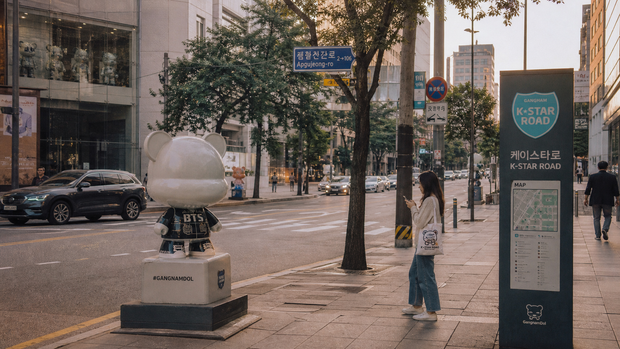
K-Star Road is a designated Hallyu fan tourism route running through Cheongdam-dong and Apgujeong-dong in Gangnam, created to orient international visitors toward the physical landmarks of South Korea's pop culture industry. The route's defining feature is a series of oversized bear-shaped statues — called "K-Bears" — each decorated and styled to represent a major K-pop group, transforming a stretch of ordinary urban streetscape into a navigable fan trail with built-in photo landmarks. According to Visit Gangnam's official tourism guide, the route clusters several of the district's most fan-relevant destinations: the SM Town COEX Artium in Samseong-dong, group-themed fan cafes, idol-associated restaurants and dessert shops, and the exterior facades of entertainment label buildings where artists, trainees, and staff are regularly photographed by waiting visitors. For K-pop followers making their first trip to Seoul, K-Star Road functions as a practical itinerary anchor — connecting the district's scattered fan landmarks into a single walkable experience rather than leaving visitors to navigate them individually.
📍 View K-Star Road on Google Maps
The K-Bear statues are color-coded and accessorized by group, with visual cues drawn from each act's official color palette, fandom symbols, and signature aesthetics. Groups represented along the route have included EXO, SHINee, Girls' Generation, BTS, GOT7, and others, reflecting both longevity in the industry and fandom scale large enough to merit a dedicated public installation. The statues have become popular photo spots in their own right — functioning simultaneously as public art and as a navigational map for fans who already know the visual language of each group's identity.
SM Town COEX Artium, located within COEX Mall in Samseong-dong, anchors the eastern end of the fan experience along the route. The building's exterior regularly draws fan gatherings, and its interior retail floor stocks official SM artist merchandise alongside interactive artist displays and a café space. Separately, group-themed fan cafes — typically operated by fandom communities rather than the labels themselves — cluster in the Apgujeong area, running limited-time events tied to member birthdays, group anniversary dates, or comeback release windows. These venues operate on a cycle that mirrors the K-pop comeback calendar: the specific cafes active at any given time shift seasonally, so checking fandom community boards before visiting produces the most current picture of what is open.
📍 View SM Town COEX Artium on Google Maps
For visitors planning the walk, the route between Apgujeong Station (Line 3) and Samseong Station (Line 2) covers roughly 3–4 km and takes two to three hours depending on stops and time spent at individual fan cafes or label building exteriors. The route operates year-round, with the density of pop-up events peaking around major comeback windows and industry awards season, which typically runs from November through December. Label building exteriors in Cheongdam-dong are on public streets and accessible to passersby, though larger organized gatherings can draw security attention.
Gangnam Style: PSY's Song and the District's Global Identity
Released on July 15, 2012, "Gangnam Style" (강남스타일) was the lead single from PSY's sixth studio album, and it functioned — against almost no one's expectation — as the song that introduced a Seoul district to the rest of the planet. The track debuted at number one on South Korea's Gaon Chart and climbed to number two on the US Billboard Hot 100, the highest position achieved by a South Korean artist on that chart at the time, according to Wikipedia's Gangnam Style entry. By the end of 2012 it had topped charts in more than 30 countries, including Australia, Canada, France, Germany, and the United Kingdom — where it became the first song by a South Korean artist to reach number one on the UK Singles Chart. The music video, filmed on location in Gangnam with the ASEM Tower and Trade Tower visible in multiple shots, became the first YouTube video in history to surpass 1 billion views, reaching that milestone on December 21, 2012.
"We never thought a video would be watched in numbers greater than a 32-bit integer, but that was before we met Psy." — YouTube, official platform statement on upgrading its view counter from 32-bit to 64-bit integers after "Gangnam Style" approached the 2.1 billion ceiling (source: Wikipedia, Gangnam Style)
The song's conceptual framing is social satire, not celebration. PSY described "Gangnam Style" as "poking fun at those kinds of people who are trying very hard to be something that they're not" — the target being the performative luxury signaling that defined Gangnam's nouveau riche culture: expensive coffee shops with conspicuously branded cups, premium fashion worn as status display, and the theater of wealth in a district where property prices already made affluence a basic prerequisite for residency. The horse-trot and lasso-spin choreography, developed over a month with PSY's creative team, became a global phenomenon: flash mobs of 15,000 to 20,000 participants performed it in Seoul, Milan, Paris, and Makassar, while UN Secretary-General Ban Ki-moon and members of NASA staff were among the public figures photographed doing the dance (source: Wikipedia, Gangnam Style). The irony at the core of the song — a satirical critique of wealth culture that became a global wealth-culture phenomenon — mirrors the district itself.
The video held the title of most-viewed on YouTube from November 2012 until July 2017, when it was overtaken by Wiz Khalifa's "See You Again." The technical legacy is concrete: YouTube upgraded its view counter infrastructure from 32-bit to 64-bit integers because no video had approached the 2.1 billion ceiling before "Gangnam Style." The song won Best Video at the 2012 MTV Europe Music Awards, and South Korea's Ministry of Culture awarded PSY the 4th Class Order of Cultural Merit (Okgwan Order) in recognition of its role in amplifying international interest in Korean culture. "Oppan Gangnam Style" was also included in The Yale Book of Quotations as one of 2012's most recognizable expressions worldwide.
Perhaps the most durable contribution of the song is contextual: it embedded the name of a Seoul district into the vocabulary of audiences who had never previously encountered either the city or Korean popular culture, years before BTS converted that latent global awareness into sustained K-pop fandom. Analysts and artists across the industry have pointed to "Gangnam Style" as the inflection point at which Western mass audiences began paying attention to Korean pop — a first-wave impact that built the audience infrastructure later generations of K-pop acts would scale into a global commercial mainstream. PSY's broader discography and career are documented at PSY's Wikipedia entry, and a 10th-anniversary retrospective of the song's cultural impact appears at Billboard.
Luxury Real Estate and the Economics of 40 km²
Gangnam's real estate market operates at a scale that is disproportionate even within the context of Asia's premium property landscape. Average apartment prices within the district were already approximately US$10,000 per square meter as of 2011 — roughly 3.5 times the South Korean national average at that point — according to Gangnam District, Wikipedia. That premium has not narrowed with time. By Q3 2024, the average home price in Gangnam-gu had reached 622.9 million won (approximately $436,000 per unit), a year-on-year increase of 22.8%, according to The Korea Herald. At the apex of the luxury segment, flagship complexes in Cheongdam-dong — including The Penthouse Cheongdam, with units of approximately 408 m² — are trading near $12.2 million per unit, according to Tatler Asia's Seoul property analysis. These figures place Gangnam among the most price-dense residential markets globally, comparable in per-square-meter cost to central Hong Kong, central London, and Manhattan.
| Period | Price Reference | Metric | Year-on-Year Change | vs. National Average |
|---|---|---|---|---|
| 2011 | ~US$10,000 | Per m² (avg. apartment) | — | ~3.5× national average |
| Q3 2024 | 622.9M won (~$436,000) | Per unit (avg. home) | +22.8% YoY | Significantly above national average |
| 2025 (luxury peak) | ~$12.2M | Per unit (Cheongdam penthouse) | — | Among highest in Asia |
The comparison that best contextualizes Gangnam's valuation is geographic: the district's 40 km² rivals the entire city of Busan — covering 770 km² — in total land valuation. A square kilometer in Gangnam carries roughly 19 times the monetary weight of a square kilometer in Busan, which is itself far from inexpensive by regional standards. This price density reflects a compound of structural factors: the school catchment premium from Daechi-dong's hagwon concentration, the corporate density of Samseong-dong's business corridor, the constrained land supply created by the Han River to the north and Seoul's greenbelt policies to the south, and five decades of government-backed urbanization that established the district as the default address for South Korea's professional and managerial class.
The South Korea luxury residential real estate market overall is projected at USD 50.11 billion in 2025, rising to USD 53.89 billion in 2026, according to Mordor Intelligence's South Korea Luxury Residential Real Estate Market report. Gangnam-gu, and Cheongdam-dong in particular, represents the highest-value tier within that market. The entertainment industry's presence in the district is not incidental to this picture: a Gangnam address carries social capital in South Korea that sustains demand independent of pure utility considerations, making the relationship between property values and cultural cachet a reinforcing loop rather than a simple correlation.
Daechi-dong's Hagwon Culture and Education Pressure
Daechi-dong is South Korea's most concentrated private tutoring district — a neighborhood whose identity has been defined for decades by its density of hagwon (학원): private academic cram schools offering instruction in mathematics, English, Korean language, and STEM subjects to students from elementary through high school age. The central stretch of the neighborhood's academy cluster is known colloquially as "Hagwon Alley," and the concentration there is not merely a local feature but a nationally recognized institution, referenced in policy debate and sociological research as the physical embodiment of South Korea's education-focused parenting culture. According to Gangnam District, Wikipedia, approximately 6% of successful Seoul National University applicants in 2010 came from Gangnam District — despite the district representing only around 1% of South Korea's total population. That ratio does not measure raw academic quality in isolation; it reflects the compounding effect of concentrated tutoring investment, peer environment calibrated toward university entrance performance, and parental income directed with sustained intensity toward a narrow educational goal.
The Daechi hagwon ecosystem and Gangnam's real estate premium are directly connected. Korean families with children approaching the university entrance system have long treated Gangnam residency — and Daechi-dong proximity specifically — as an educational investment rather than simply a housing decision. School catchment boundaries matter concretely: the perceived quality differential between a Gangnam public school and a school in another Seoul district is real enough in parental decision-making to sustain significant price premiums for apartments that fall within the right catchment zones. The resulting dynamic is self-reinforcing: high property prices filter for families who can afford concentrated academic investment, which sustains demand for the neighborhood's tutoring infrastructure, which in turn sustains property values.
South Korean government policymakers have repeatedly attempted to regulate hagwon operating hours, fee caps, and curriculum scope in Daechi-dong specifically, with limited durable effect on the overall system. The academic intensity of the district has been examined by journalists and sociologists as a case study in the structural pressures of Korean education culture — a pressure that feeds upward into Gangnam's real estate premium while simultaneously producing a disproportionate share of South Korea's professional and academic leadership across generations. For visitors and fans approaching Gangnam primarily through K-pop, Daechi-dong's academic ecosystem is a reminder that the district's international cultural identity coexists with a very different internal pressure: one oriented not toward performance on a stage but performance on an examination.
Historical Landmarks, Convention Venues, and Cultural Events
Gangnam's contemporary identity — expensive real estate, entertainment industry headquarters, global pop culture references — can obscure a historical record that predates the 20th century entirely. Bongeunsa Temple (봉은사), founded in 794 CE during the Unified Silla period, stands directly adjacent to the COEX Convention and Exhibition Center in Samseong-dong, one of the more striking architectural contrasts in Seoul: a thousand-year-old Buddhist complex and a major international convention venue sharing the same city block. COEX hosted the 2010 G-20 Seoul Summit and the 2012 Nuclear Security Summit, establishing Gangnam as South Korea's logistical anchor for its most significant diplomatic gatherings, according to Gangnam District, Wikipedia. The Seolleung and Jeongneung Royal Tombs — two Joseon-dynasty royal burial grounds within the district — are designated UNESCO World Heritage Sites. For visitors with a K-pop itinerary, all of these sites are within or adjacent to the same Samseong-dong and Cheongdam corridor that houses the entertainment industry's infrastructure, making the district unusually dense with points of interest across very different historical registers.
Bongeunsa Temple | 봉은사
Founded in 794 CE, Bongeunsa is one of the oldest Buddhist temples in the Seoul metropolitan area, operating continuously through the Goryeo and Joseon dynasties and surviving the rapid urbanization that erased most of Gangnam's pre-modern built environment. The temple complex includes multiple historic halls, a large carved stone Maitreya Buddha statue standing 21.9 meters tall, and a traditional lantern corridor that draws significant visitor numbers during seasonal Buddhist festivals. The juxtaposition with COEX's glass-and-steel towers immediately to its south is a product of urban growth catching up to the temple rather than any deliberate planning decision, and the visual contrast is frequently photographed as a symbol of Seoul's historical compression — ancient and contemporary existing within a single frame.
📍 531 Bongeunsa-ro, Gangnam District, Seoul
🕒 Daily 5:00 AM – 10:00 PM
⭐ 4.6 (8,454 reviews)
📞 02-3218-4801
🔗 View on Google Maps
Seolleung and Jeongneung Royal Tombs | 선릉·정릉
The Seolleung (선릉) and Jeongneung (정릉) Royal Tombs are two Joseon-dynasty royal burial grounds designated as UNESCO World Heritage Sites, located within Gangnam District. Seolleung is the tomb of King Seongjong (r. 1469–1494) and his queen consort; Jeongneung is the tomb of King Jungjong (r. 1506–1544). The complex is notable both for its historical significance and for its incongruity within the urban grid: a forested green buffer surrounding 500-year-old royal graves, flanked by office towers and luxury apartment complexes in one of Asia's most expensive real estate markets. Admission is charged and the grounds are walkable in under an hour, making the complex a manageable addition to a Samseong-dong itinerary.
📍 1 Seolleung-ro 100-gil, Gangnam District, Seoul
🕒 Monday Closed / Tuesday–Sunday 6:00 AM – 9:00 PM
⭐ 4.6 (815 reviews)
📞 02-568-1291
🔗 View on Google Maps
Starfield COEX Mall | 코엑스몰
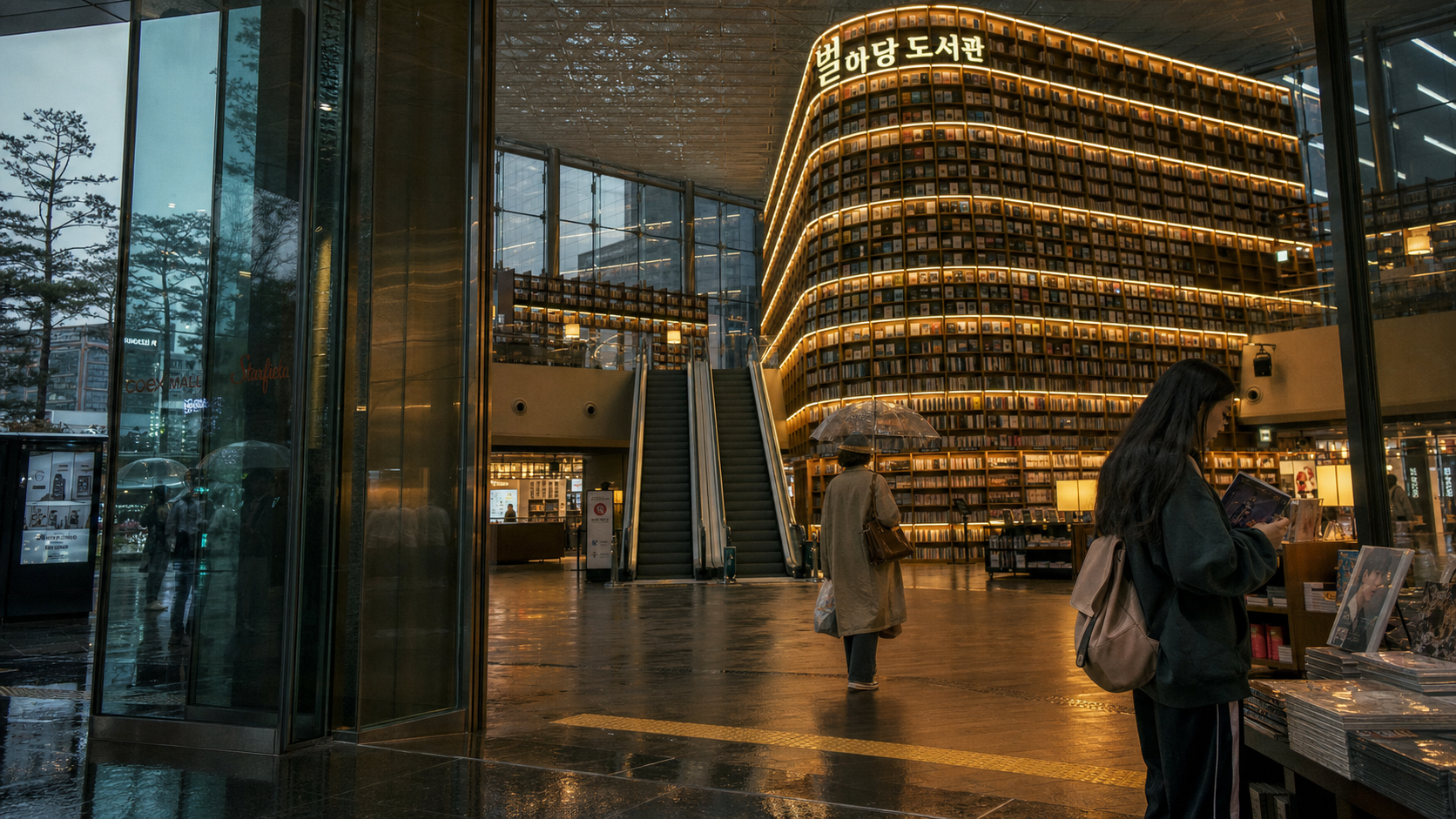
Starfield COEX Mall in Samseong-dong is one of Asia's largest underground shopping complexes and, for K-pop visitors, the address of SM Town COEX Artium. Separately within the mall, the Starfield Library — a large, architecturally distinctive free public reading space built into the mall's interior atrium, with floor-to-ceiling bookshelves rising several stories — has become one of Seoul's most-photographed interior spaces; no admission is required. Above ground near Gangnam Station, Gangnam Square hosts Asia's largest outdoor LED screen, a frequently cited indicator of the commercial and media density packed into the district's public spaces.
📍 513 Yeongdong-daero, Gangnam District, Seoul
🕒 Daily 10:30 AM – 10:00 PM
⭐ 4.3 (24,563 reviews)
📞 02-6002-5300
🔗 View on Google Maps
Garosu-gil | 가로수길
Garosu-gil — "tree-lined street" — is a pedestrian-friendly boutique and café corridor in Apgujeong-dong that runs parallel to the district's luxury retail energy without directly replicating it. The street is lined with independent fashion boutiques, specialty coffee roasters, art galleries, and design studios, offering a street-level Gangnam experience that is walkable, comparatively unhurried, and adjacent to the K-Star Road route. It connects loosely to the fan pilgrimage circuit and sits within reasonable distance of several major label building exteriors in Cheongdam-dong.
📍 Dosan-daero, Gangnam District, Seoul
⭐ 4.2 (311 reviews)
🔗 View on Google Maps
For event-focused visitors, the 2026 Gangnam cultural calendar includes "FUN&FUN Gangnam" street culture performances running every Thursday from April 23 through October 22 — free public events concentrated in the Gangnam Station and Samseong-dong areas — alongside the annual Gangnam Festival scheduled for September and October, according to Visit Gangnam's official events calendar. Both events are free to attend and designed for general public participation, not ticket-holder access.
Frequently Asked Questions
Where exactly is Gangnam located in Seoul?
Gangnam District (강남구) is located south of the Han River in Seoul, South Korea, and is one of the city's 25 administrative gu. It covers 39.49 km² and is served by multiple Metro lines: Line 2 stops at Gangnam Station, the district's central subway hub; Line 7 provides additional north-south connections; and Line 9 links the district to Gimpo Airport and western Seoul. From central Seoul landmarks such as Gyeongbokgung Palace in Jongno-gu, Gangnam is approximately 30 minutes by subway. The district borders Seocho-gu to the west and south, and the Han River forms its northern boundary.
Which K-pop companies are based in Gangnam?
SM Entertainment, HYBE Corporation (the label group behind BTS, SEVENTEEN, TXT, and NewJeans), and FNC Entertainment all maintain major operations within Gangnam's Cheongdam-dong and Samseong-dong neighborhoods. SM Entertainment's flagship public presence is at SM Town COEX Artium in Samseong-dong, which functions as both a label facility and a fan destination. HYBE's primary creative campus is in nearby Yongsan-gu, but Gangnam-area offices continue to serve affiliate label operations. FNC Entertainment's Cheongdam-dong office sits within walking distance of SM's facilities. The tight geographic clustering of these companies is a defining characteristic of how the Korean entertainment industry organizes its core infrastructure.
What does Gangnam Style mean and what is the song actually about?
"Gangnam Style" is a social satire, not a straightforward celebration of Gangnam wealth. Released on July 15, 2012, PSY described the song as targeting people "trying very hard to be something that they're not" — specifically the performative luxury culture of Gangnam's wealthy residents, including expensive coffee shops, branded fashion, and conspicuous consumption. The song debuted at number one on South Korea's Gaon Chart, reached number two on the US Billboard Hot 100 (the highest Billboard Hot 100 position achieved by a South Korean artist at that time), and became the first YouTube video in history to reach 1 billion views on December 21, 2012. It topped charts in over 30 countries and won Best Video at the 2012 MTV Europe Music Awards.
What is K-Star Road and where is it?
K-Star Road is a designated Hallyu fan tourism route running through Cheongdam-dong and Apgujeong-dong in Gangnam District. Its signature feature is a series of oversized bear-shaped statues — called K-Bears — each styled and color-coded to represent a major K-pop group. The route also passes entertainment label building exteriors, group-themed fan cafes, and pop-up merchandise stores, and connects to the SM Town COEX Artium in Samseong-dong. The walkable route runs between Apgujeong Station (Line 3) and Samseong Station (Line 2) and takes roughly two to three hours to complete. It is active year-round, with peak fan activity during comeback seasons and the industry's awards period in November and December.
Why is real estate so expensive in Gangnam?
Gangnam's real estate premium reflects several compounding factors operating simultaneously. Daechi-dong's concentrated hagwon ecosystem creates persistent demand from families seeking access to the district's school catchment areas and tutoring infrastructure — proximity to Daechi is directly priced into nearby apartment values. Samseong-dong anchors major corporate headquarters and the COEX convention complex. The land supply is structurally constrained: the Han River forms the northern boundary, Seoul's greenbelt policies limit southward expansion, and the district covers only 40 km². Decades of government-directed urbanization established Gangnam as Korea's default address for the professional class, creating a self-reinforcing demand cycle. Average apartment prices were already 3.5× the national average by 2011, and by Q3 2024 the average home price had risen a further 22.8% year-on-year to 622.9 million won (~$436,000 per unit), per The Korea Herald.
Gangnam in Context: What the District Tells Us About Seoul
Gangnam is, at its core, a demonstration of how deliberately directed urbanization compounds across generations into something qualitatively different from the city it emerged within. The decision to push Seoul's development south across the Han River in the early 1970s was a policy intervention — not an organic market outcome — and it generated the conditions for every subsequent layer of the district: the real estate premium, the education ecosystem, the corporate concentration, the entertainment industry cluster, and ultimately the global cultural identity that PSY's 2012 song crystallized in four minutes of horse-trot choreography. That the song was a satire of the district's wealth culture rather than a celebration of it did not diminish its effect — it may have sharpened it, giving international audiences both a hook and an irony to carry with them.
For K-pop fans specifically, Gangnam represents the most concentrated single-district expression of what the Korean Wave looks like on the ground: label headquarters, artist training infrastructure, fan retail, and the cultural destinations that connect the industry to international audiences. K-Star Road, SM Town COEX Artium, and the Cheongdam-Samseong label corridor are not incidental features of the neighborhood — they are a central part of its contemporary function, layered over a historical record that includes a 1,200-year-old Buddhist temple, two UNESCO-listed royal tombs, and the site of a G-20 summit. That compression of timescales and cultural registers into 40 km² south of a river is what makes Gangnam genuinely distinctive, even by the standards of a city as layered and dense as Seoul. Visitors arriving for the K-pop landmarks will encounter the history. Visitors arriving for the history will encounter the K-pop industry. In Gangnam, the two are part of the same urban texture.
Last updated: 2026-05-13. Research compiled from Wikipedia's Gangnam District and Gangnam Style entries, The Korea Herald, Visit Gangnam's official tourism and events resources, Tatler Asia, Mordor Intelligence, Billboard, Airial Travel's K-pop district guide, and the Intelligent Community Forum's Gangnam District profile. Event dates and property prices reflect data available as of the publication date and are subject to change.


