
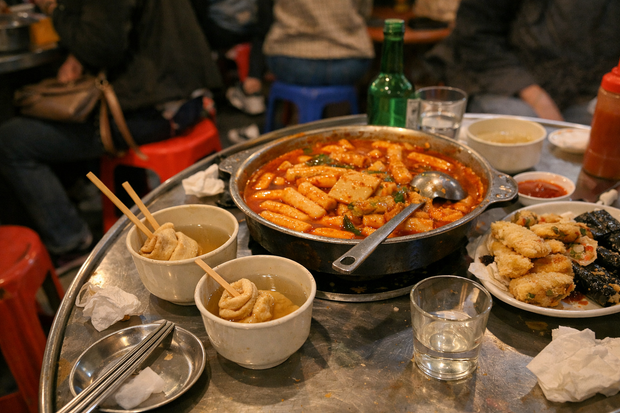
The short answer: Pojangmacha (포장마차, "covered wagon") are Seoul's tarp-wrapped street-food tents, typically open from 6pm to 2am. The densest clusters sit near Jongno 3-ga and Euljiro, where a full meal of tteokbokki, twigim, odeng, and soju costs ₩10,000–15,000 per person — no reservation, no dress code, rarely an English menu.
Few things in Seoul carry as specific a sense of place as ducking under a low orange tarp, squeezing onto a plastic stool at a shared table, and ordering spicy rice cakes from someone who has been running the same burner for twenty years. Pojangmacha are not a tourist attraction in the conventional sense — they are where office workers decompress after late shifts, where friends reconvene after second bars close, and where the smell of fish-cake broth follows you down the alley for a full block. Knowing how to navigate one is the difference between observing Seoul from the outside and actually sitting inside it.
This guide covers the best pojangmacha locations, a full menu and price breakdown, step-by-step ordering instructions in Korean, and practical notes on cash and waste. Prices and hours are verified as of April.
What Exactly Is a Pojangmacha — and Why Does Every Seoul Visitor Talk About It?
Quick Answer: A pojangmacha is a portable Korean street-food tent — a plastic-tarp shelter with a portable gas burner, low stools, and a short menu of fried and braised snacks paired with soju or beer. Most open around 6pm and run until 2am on weekdays, later on weekends. Budget ₩10,000–20,000 per person including drinks.
The word pojangmacha (포장마차) translates literally as "covered wagon," and the name still fits. Each tent is a self-contained unit: a folding cart or wheeled frame draped in vinyl or canvas, a gas burner humming under a wide shallow pan, and perhaps four or six plastic stools tucked under a narrow counter. Regulars squeeze in shoulder-to-shoulder, condensation drips from the low ceiling, and the smell of gochujang-laced tteokbokki mixes with the sharper note of frying batter.
What distinguishes pojangmacha from ordinary street food is the social ritual around anju (안주) — the Korean concept of food eaten specifically as an accompaniment to alcohol. At a pojangmacha, the drink usually arrives before the food, the food is designed to slow the drink down, and the evening can stretch two or three hours over a total bill that rarely breaks ₩20,000. That combination of accessibility, informality, and genuine conviviality is the reason these tents come up in conversations about Seoul's essential experiences.
Pojangmacha are also among the few food venues in Seoul where prices have changed remarkably little over the years. An odeng skewer still costs ₩1,000–1,500. A bottle of soju runs ₩4,000. The economics are intentional: these tents have always existed at the affordable end of the city's food spectrum, and that positioning is both their commercial logic and their social identity (source: letSeoul, 2025).
Seoul's Best Pojangmacha Streets: Where to Go
Seoul has pojangmacha scattered across dozens of neighborhoods, but four clusters stand out for consistency, density, and the distinctly different atmospheres they offer. Each suits a different type of visitor and a different evening dynamic.
Jongno 3-ga: Seoul's Most Famous Pojangmacha Alley
The stretch between Exits 5 and 6 of Jongno 3-ga Station (Lines 1, 3, and 5) is the benchmark against which every other pojangmacha cluster in Seoul gets measured. By 7pm on a weeknight, every stall is occupied. By 9pm on a Friday, overflow crowds stand in the alley waiting for stools to open.
The menu here is archetypal: tteokbokki and twigim (fried items) arrive together as a set for ₩4,000–5,000. Odeng fish-cake skewers cost ₩1,000–1,500 each, and most vendors offer unlimited cups of the warm, savory broth as a free accompaniment — a practice that functions as both hospitality and a mild palate cleanser between bites. Sundae (순대, a steamed sausage of glass noodles and pork intestine) and offal dishes range from ₩5,000–10,000. Soju is ₩4,000 per bottle. A realistic budget is ₩10,000–15,000 per person for food, rising to ₩20,000 if drinks are part of the evening.
Hours run 18:00–02:00 on weekdays and stretch to 03:00–04:00 on weekends. Arriving before 19:00 on a weekday nearly guarantees a seat. After 21:00 on a Saturday, patience is part of the experience (source: letSeoul, 2025).
Euljiro Nogari Alley: The Office Worker's After-Hours Ritual
A ten-minute walk from Jongno 3-ga toward Euljiro 3-ga Station puts visitors in a different kind of pojangmacha district. Euljiro's alley — informally known as Nogari Alley (노가리 골목) — is synonymous with grilled nogari, a small dried pollock charred over a flame and eaten with soju or draft beer. A portion runs ₩10,000–15,000, noticeably pricier than the Jongno fare, and the clientele skews toward office workers in their thirties and forties unwinding after long workdays.
The atmosphere at Euljiro is slightly less frenetic than Jongno. Tables are marginally more spaced. Ramyeon sari (instant noodles added to a communal pot of broth) is a popular closer to the meal, typically ₩3,000–5,000 per addition. Hours mirror Jongno: 18:00–02:00, with weekend closing times varying by vendor. The cluster sits within a five-minute walk of Euljiro 3-ga Station Exits 2 and 3 (source: Time Out Seoul, 2025).
Hongdae: Pojangmacha for a Younger, International Crowd
The Hongdae area near Hongdae Station caters to university students and the city's significant international population. Pojangmacha here lean lighter on the traditional offal-heavy menu and heavier on tteokbokki and twigim, priced ₩1,000–3,000 per item. English is more commonly spoken by vendors, and the general atmosphere runs louder and more performance-oriented — street musicians often set up within earshot. Hours run 18:00–02:00 (source: Mitzie Mee, 2024).
Hongdae is a reasonable starting point for visitors who want to experience pojangmacha culture before moving on to the more traditional Jongno setting. The lower-stakes environment and slightly more tourism-oriented vendors make the first hour easier to navigate, and the subway access (Line 2, Gyeongui-Jungang Line, and the AREX airport rail link) means getting home is straightforward regardless of how late the evening runs.
Myeongdong: The Most Tourist-Accessible Option
Myeongdong is the outlier in this list. Street-food stalls around Exit 6 operate from noon to 23:00 — daytime hours that no traditional pojangmacha would keep — and the format blurs the line between pojangmacha and ordinary food cart. Tteokbokki and twigim sets cost ₩5,000–10,000, reflecting the premium central location. Crucially, Myeongdong vendors more frequently accept card payments, which makes this the most financially accessible location for visitors who have not yet sorted out Korean cash. For an introduction to the food rather than the full cultural experience, Myeongdong serves as a useful warm-up.
| Location | Nearest Subway | Hours | Signature Dish | Budget / Person |
|---|---|---|---|---|
| Jongno 3-ga | Jongno 3-ga (Lines 1/3/5), Exits 5–6 | 18:00–02:00 (Fri–Sat till 04:00) | Tteokbokki + twigim set, odeng | ₩10,000–20,000 |
| Euljiro 3-ga (Nogari Alley) | Euljiro 3-ga (Lines 2/3) | 18:00–02:00 (weekends later) | Grilled nogari, ramyeon sari | ₩15,000–25,000 |
| Hongdae | Hongdae Station (Line 2/AREX) | 18:00–02:00 | Tteokbokki, twigim | ₩8,000–15,000 |
| Myeongdong | Myeongdong Station (Line 4), Exit 6 | 12:00–23:00 | Tteokbokki/twigim sets | ₩10,000–20,000 |
What to Order at a Pojangmacha: The Full Menu Decoded
Pojangmacha menus are short and rarely translated into English. Understanding what each item is — and what to expect from it — removes most of the guesswork and lets visitors order with confidence rather than pointing at whatever the next table has.
The Core Dishes: Tteokbokki, Twigim, Odeng, and Sundae
Tteokbokki (떡볶이) is the dish most visitors recognize by sight before they know its name: cylinders of chewy rice cake in a glossy red-orange sauce built from gochujang (fermented chili paste), gochugaru (chili flakes), sugar, and a dashi-style broth. The heat level ranges from assertive to genuinely challenging. At Jongno tents, tteokbokki almost always comes as a shared pan with twigim (튀김) — battered, deep-fried items including vegetables, glass noodle rolls (japchae twigim), shrimp, and squid rings — which is why the combined set price of ₩4,000–5,000 represents strong value. The fried items cool and soften after a few minutes in the tteokbokki sauce, absorbing the spice and becoming a different dish entirely.
Odeng (오뎅), also called eomuk (어묵), is processed fish cake on a skewer, either folded accordion-style or wrapped around the stick, simmered in a mild kelp-and-soy broth. The skewers cost ₩1,000–1,500 each, and the broth is free — poured into a small cup and replenished on request. Odeng broth functions as the pojangmacha equivalent of a palate cleanser and is one of the most distinctive sensory features of eating at these tents on a cold evening.
Sundae (순대) is a steamed sausage made from glass noodles (dangmyeon), pork blood, and chopped vegetables packed into a pig intestine casing, sliced into rounds, and served with a sprinkle of coarse salt and a dipping sauce. It is a polarizing dish for first-time visitors but a central one for regulars. Offal dishes (gopchang, makchang) are also common at Jongno tents and run ₩8,000–10,000 per portion. Ramyeon sari (라면 사리) — an instant noodle block dropped into remaining broth at the end of the meal — deserves mention as one of the most rewarding things on the informal menu, available at ₩3,000–5,000 (source: letSeoul, 2025).
What to Drink: Soju, Makgeolli, and Beer
The default drink at a pojangmacha is soju (소주), a clear distilled spirit typically 16–25% ABV. At ₩4,000 per 360ml bottle, it is the most economical alcohol available anywhere in Seoul. The most commonly seen brands at pojangmacha are Chamisul and Jinro. Korean drinking etiquette at shared tables involves pouring for companions before pouring for yourself; accepting a poured drink with both hands, or with one hand touching your own forearm, is the conventional gesture of acknowledgment.
Makgeolli (막걸리), a milky fermented rice wine at roughly 6–8% ABV, is less universal at pojangmacha than at traditional restaurants but appears at some Jongno and Euljiro tents, usually served in a bowl. Its rough sweetness cuts through the chili heat of tteokbokki more effectively than soju does. Beer (맥주) — typically canned Cass or Hite — is available at most tents, and mixing soju and beer in a single glass in a ratio of roughly 1:3 produces what regulars call somaek (소맥), a common pojangmacha drink order.
| Item | Korean Name | Description | Typical Price | Notes |
|---|---|---|---|---|
| Tteokbokki + Twigim set | 떡볶이+튀김 세트 | Rice cakes in chili sauce with fried items | ₩4,000–5,000 | Usually shared between 2 |
| Odeng skewer | 오뎅 / 어묵 | Fish-cake skewer, simmered in broth | ₩1,000–1,500 each | Broth refills free |
| Sundae | 순대 | Steamed glass-noodle pork sausage | ₩5,000–7,000 | Served with salt and perilla |
| Offal plate | 곱창 / 막창 | Grilled or stewed pork/beef intestines | ₩8,000–10,000 | Not at all tents |
| Grilled nogari | 노가리 | Dried pollock, charred over flame | ₩10,000–15,000 | Euljiro specialty |
| Ramyeon sari | 라면 사리 | Instant noodles added to shared pot | ₩3,000–5,000 | Order 30 min into the meal |
| Soju | 소주 | Clear distilled spirit, 16–25% ABV | ₩4,000 per bottle | 360ml; Chamisul/Jinro standard |
| Beer | 맥주 | Lager, canned or bottled | ₩3,000–4,500 | Mix with soju = somaek |
How to Navigate a Pojangmacha Without Speaking Korean
The absence of English menus and English-speaking staff at traditional pojangmacha is well-documented and should be treated as a feature of the experience rather than an obstacle. A handful of phonetic Korean phrases and a general sense of how the tent operates are sufficient for a complete, comfortable visit.
A Step-by-Step Ordering Guide for Foreign Visitors
Step 1: Scout before sitting (5–10 minutes). Walk the full length of the cluster before committing to a stall. A busy tent with a visible pot of bubbling tteokbokki is a reliable quality signal. An empty tent in the middle of a busy alley is empty for a reason — move on and choose a crowded one.
Step 2: Confirm the seat. Say "Yeogi anjado dwaeyo?" (여기 앉아도 돼요? — May I sit here?) at shared tables. At half-empty tents, sit directly — the vendor will come to you.
Step 3: Order the basics. Point at the tteokbokki pot and say "Tteokbokki han geot juseyo" (떡볶이 한 거 주세요 — One tteokbokki, please). For spice adjustment: "An maepge haejuseyo" (안 맵게 해주세요 — Make it mild) or "Maepge haejuseyo" (맵게 해주세요 — Spicy, please). For soju: "Soju han byeong juseyo" (소주 한 병 주세요 — One bottle of soju, please). For odeng: "Odeng juseyo" (오뎅 주세요).
Step 4: Manage the meal. Dip twigim pieces directly into the tteokbokki sauce. Hold your empty broth cup toward the pot for a refill — no words needed. Pour soju for others at the table before pouring for yourself. Thirty minutes into the meal, consider adding ramyeon sari: "Ramyeon sari juseyo" (라면 사리 주세요).
Step 5: Pay. "Eolmayeyo?" (얼마예요? — How much?) prompts the bill. Almost all pojangmacha are cash-only. Bring ₩20,000–30,000 per person as a minimum. If uncertain about the total, holding out your cash and waiting for the vendor to count it out and return change is universally understood (source: letSeoul, 2025).
If you are carrying a NAMANE Card — a reloadable Korean prepaid card designed for foreign visitors — you will not be able to use it at a cash-only pojangmacha counter directly. It does, however, handle transit fares, convenience stores (GS25, CU, 7-Eleven), and most mid-range restaurants on the same evening. Keeping the NAMANE Card for daily spending and setting aside ₩30,000–50,000 in separate cash for pojangmacha visits is the practical two-track approach. Setup and top-up instructions are in the NAMANE Card service manual.
Cash, Waste, and Practical Logistics: What to Know Before You Go
Cash and Budget Planning
Most pojangmacha in Jongno and Euljiro accept only cash. Myeongdong is the partial exception — card acceptance has increased there since 2024, particularly at larger semi-permanent stalls along the main shopping street. For safety, treat all pojangmacha as cash-only until confirmed otherwise. A ₩50,000 note covers two people for a full evening with multiple drink rounds to spare.
The nearest ATMs accepting foreign cards are consistently found at convenience stores. GS25 and CU operate 24 hours across Seoul and their ATMs process most international Visa and Mastercard debit cards. Withdrawing at the beginning of the evening — before reaching the tent district — avoids the problem of needing cash after midnight in an alley where ATMs may not be immediately nearby. Budget benchmarks: ₩10,000–15,000 per person for food only; ₩15,000–20,000 with one bottle of soju; ₩20,000–30,000 for a full session with multiple rounds (source: Tiket.com Korea Travel, 2025).
Waste Sorting in Korea: The ₩50,000 Fine You Don't Want
Korea operates one of the world's more rigorous volume-based waste disposal systems, and visitors who buy food from convenience stores or street stalls on the way home will encounter it. Disposing of waste incorrectly carries a fine of ₩50,000 or more.
The core categories: food waste (음식물 쓰레기) goes into yellow designated bags sold at CU and GS25 for roughly ₩190 per 2-liter bag. General waste (일반 쓰레기) goes into white or pink district bags at roughly ₩490 per 20-liter bag. Recyclables — glass soju bottles, plastic cups, aluminum cans — go into open recycling bins sorted by material. Seoul removed most street-level public trash bins as of 2025, meaning there is nowhere to discard packaging casually on a pojangmacha street. The nearest bin is typically inside the adjacent subway station or convenience store.
In practice, pojangmacha vendors manage waste generated at their own serving surfaces. The visitor's obligation is simply not to leave packaging — plastic bags from convenience store purchases, empty cups from takeaway stalls — on the street. A complete breakdown of Korea's recycling rules for foreigners is available at TrulyKR's Korea Recycling Guide.
Pojangmacha History: From Post-War Survival to Seoul Institution
Pojangmacha emerged in Seoul in the years immediately following the Korean War (1950–1953). The war left the city's infrastructure devastated and its population in severe economic distress. The first tents appeared near train stations and market entry points — not as an organized street food culture but as the most viable form of income available to individuals who could afford a portable burner and a modest inventory of ingredients. The portable, low-overhead format was not a design choice but an economic necessity: the tarp shelter could disappear quickly if authorities arrived, and the absence of fixed premises meant no property tax, no lease, and minimal startup cost.
It is worth placing pojangmacha in the context of Seoul's older market traditions. Gwangjang Market (광장시장), established in 1905 during the final years of the Joseon Dynasty, represents a fundamentally different model: a permanent covered market with fixed stalls, structured operations, and a daytime menu — bindaetteok (mung bean pancakes), raw beef yukhoe, mayak gimbap — that has remained essentially stable for generations. Where Gwangjang formalized its food stalls into a destination, pojangmacha expanded specifically into the after-work, after-dark hours that established markets and restaurants had vacated. More than seventy years later, that nighttime, informal niche remains precisely where pojangmacha operates.
Seoul's city government made several attempts to regulate or relocate pojangmacha clusters, particularly in the 1980s and 1990s as the city prepared for the 1988 Olympics and subsequent international events. Most efforts produced limited results. The tents were too mobile and too functionally embedded in working-class nightlife infrastructure to relocate to designated zones without destroying what made them work. Today, clusters like Jongno 3-ga operate with a degree of de facto permanence — vendors who have held the same spot for a decade or more — while technically maintaining no legal address (source: Time Out Seoul, 2025).
Frequently Asked Questions
Are pojangmacha safe to eat at as a foreign visitor?
Food safety at pojangmacha falls under the Korean Food Sanitation Act, the same legislation that covers licensed restaurants, and vendors operating in established districts face periodic spot inspections. The practical quality signal is the same as anywhere in Seoul: eat at high-turnover tents during peak hours (19:00–21:00), when the tteokbokki sauce is freshest and the frying oil for twigim hasn't been in use all day. A busy tent with visible steam rising from the pots and a crowded counter is a reliable indicator of both demand and freshness.
Can I visit a pojangmacha without speaking Korean?
Yes. Five phrases cover every essential interaction: "Yeogi anjado dwaeyo?" (여기 앉아도 돼요? — May I sit here?), "Tteokbokki han geot juseyo" (떡볶이 한 거 주세요 — one tteokbokki, please), "An maepge haejuseyo" (안 맵게 해주세요 — mild spice, please), "Soju han byeong juseyo" (소주 한 병 주세요 — one bottle of soju), and "Eolmayeyo?" (얼마예요? — how much?). Pointing is widely understood. Hongdae tents have the lowest language barrier because the neighborhood draws international visitors regularly; Jongno tents are more traditional but respond well to patient pointing and these five phrases.
What time should I arrive at Jongno 3-ga pojangmacha?
19:00 is the practical sweet spot on weekdays — tents are fully operational, food is freshly prepared, and the 19:00–21:00 peak crowd hasn't yet filled every seat. On weekends, arriving by 18:30 gives the best chance of seating without a wait. The cluster quiets after 22:00 on weeknights. On Friday and Saturday nights it stays animated until past midnight, with the last tents closing between 03:00 and 04:00. Weekday visits are consistently less crowded and involve shorter waits than weekend evenings.
Do pojangmacha accept credit cards or Korean payment apps?
Most do not. Cash is the default at Jongno, Euljiro, and most Hongdae tents. Myeongdong has better card acceptance — roughly half the larger stalls there take credit cards or Korean mobile payment apps such as KakaoPay and Naver Pay. For all other locations, bring Korean won in cash: ₩20,000–30,000 per person covers a full meal with two rounds of soju, with margin remaining. ATMs accepting foreign Visa and Mastercard are inside every major nearby subway station and at GS25 and CU convenience stores in the same neighborhoods.
Is there vegetarian food available at pojangmacha?
Options are limited but exist. Twigim (battered fried items) often includes sweet potato and mixed vegetable tempura pieces that contain no meat or seafood — though the frying oil is typically shared with seafood items. Tteokbokki sauce is traditionally made with anchovy broth, making it non-vegetarian in the strict sense. Gyeran-mari (계란말이 — rolled egg omelette) is available at some tents as an additional order. For strict vegetarian or vegan requirements, pojangmacha are a difficult venue. Communicating "Gogi andwaeyo" (고기 안 돼요 — no meat) or "Saengseon andwaeyo" (생선 안 돼요 — no fish) may prompt the vendor to suggest the most suitable available item.
How late do pojangmacha stay open?
Weekday closing times at Jongno and Euljiro run 01:00–02:00. On Fridays and Saturdays, Jongno 3-ga tents commonly stay open until 03:00–04:00. Myeongdong closes around 23:00 because its customer base is daytime shoppers rather than the late-night crowd. Hongdae runs closest to Jongno weekend hours, typically closing by 02:00. Hours vary by individual vendor and by season — tents may close earlier during severe winter weather or typhoon-adjacent rain. Arriving before 21:00 on any night guarantees all four major locations are in full operation.
What's the best one-night itinerary combining pojangmacha with other Seoul food?
A practical three-stop evening: begin at Gwangjang Market (Jongno 5-ga, Line 1) between 17:00 and 18:30 for bindaetteok (mung bean pancakes) and mayak gimbap — a seated, covered introduction to traditional Seoul market food. Take Line 1 two stops west to Jongno 3-ga by 19:00 for tteokbokki, odeng, and soju. If the evening continues, Euljiro 3-ga's nogari alley is a 15-minute walk east and offers a quieter atmosphere better suited to a final drink. Total budget: ₩30,000–40,000 per person including all food and two rounds of drinks.
Bringing It All Together
Pojangmacha occupy a specific and irreplaceable position in Seoul's food culture. They are not designed for maximum comfort — the stools are low, the lighting is fluorescent, and the menu runs to eight or nine items on a good night. What they offer instead is immediacy: hot food, cold soju, and a counter shared with whoever else happened to sit down that evening. For a city as relentlessly forward-facing as Seoul, that continuity with the 1950s is worth noting.
The practical requirements are modest. Korean won in cash — ₩30,000–40,000 per person covers a generous evening including drinks. Five Korean phrases sufficient to order, adjust spice, and pay the bill. An arrival time before 19:30 at Jongno on a weekday, or 18:30 on a weekend. The rest follows naturally from sitting down. Jongno 3-ga for the archetypal experience; Euljiro for grilled nogari and an older, more local crowd; Hongdae for a lower-stakes introduction with less language friction. Myeongdong for an afternoon version of the format before moving on.
For managing the payment split between cash-only pojangmacha tents and the rest of Seoul's largely cashless economy — subway rides, coffee shops, restaurants, and convenience stores — a Korean travel card for foreign visitors like NAMANE Card handles the electronic side efficiently, leaving cash reserves dedicated to the tents that need them. The two systems work in parallel and cover the full range of a Seoul evening without redundancy.
Last updated: 2026-04-30. This guide is reviewed and refreshed when official sources (KTO, Visit Seoul, ticketing platforms) update their information.
Related Articles
- Korean Breakfast Foods: What Locals Actually Eat
- Must-Visit During Your Next Trip to Korea! Top 5 Famous Starbucks Locations & Exclusive Merchandise
- 【Mega Hit in Korea!】 Who are the contestants of 'Culinary Class Wars 2'? Introducing the curious chefs together with NAVER MAP!
This article was written using information collected and analyzed by NAMANE's in-house K-pop research AI engine. We use AI technology to bring you faster, broader coverage, and in the process some details may occasionally differ from the latest facts. For important information such as dates, venues, and prices, please double-check with official sources.