
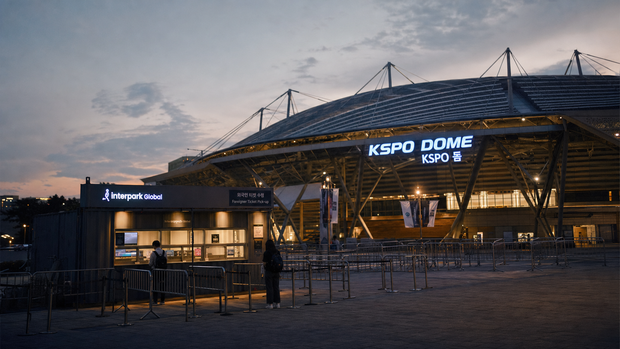
The short answer: To collect and activate a K-POP concert ticket in South Korea as a foreign national, you must present your original passport — not a photocopy, not a digital scan, not an Alien Registration Card — with the name printed on it matching the ticket registration exactly, character by character. Venues enforce this rule at dedicated foreigner lanes, and staff will turn away attendees whose documents do not clear the check, regardless of how far they have traveled.
This guide is written for international fans flying into Seoul specifically to attend concerts by groups such as BTS, SEVENTEEN, aespa, or BLACKPINK. The procedures described here apply to ticketed events at indoor arenas like KSPO Dome in Songpa-gu, outdoor stages like Gwanghwamun Square in Jongno-gu, and mid-size venues across the capital. Whether you booked through Interpark Global, Weverse Shop, or NOL Ticket, the document requirements at the gate are effectively identical.
Concert entry procedures for foreign fans tightened considerably after 2024, driven by two intersecting pressures: the expansion of biometric verification technology on platforms like Interpark Global, and South Korea's amended Performance Industry Promotion Act, which imposed fines equivalent to 5,000 percent of the scalped markup and prompted venues to move toward mobile-only, name-bound tickets. The practical effect is that the workarounds that circulated among fan communities before 2024 — screenshot transfers, proxy buyers, informal name changes — no longer function reliably, and attempting them risks permanent disqualification from future ticket purchases.
What documents do foreign fans actually need to enter a K-POP concert in Korea?
Quick Answer: Foreign fans need one document: their original, physical passport, with the name on the passport matching the ticket registration character for character. No other government-issued ID is accepted at major venues. Biometric Facepass enrollment on Interpark Global can supplement but does not replace passport presentation. Commercial ticket prices at KSPO Dome range from ₩100,000 to ₩300,000.
The passport requirement is not a suggestion. Staff at foreigner pickup counters are trained to reject Alien Registration Cards (ARC), driving licences, national identity cards from other countries, and any digital or printed reproductions of a passport's photo page. Trazy's guide to attending K-POP events in Korea confirms that only an original passport satisfies the ID requirement for foreign nationals — a standard consistent across major venues since at least 2022 and reinforced in 2024 as part of the broader anti-scalping enforcement framework. Practically speaking, this means your passport must travel with you from your accommodation to the venue on event day. Leaving it in a hotel safe is not an option.
Beyond the document type, the name-match rule is the most operationally significant requirement. The name field on your ticket must correspond exactly to the romanization of your name as it appears in your passport. For fans whose names involve romanization variants — "Lee" versus "Yi", or "Park" versus "Pak" — the relevant standard is the spelling on the passport, not the spelling the fan prefers or commonly uses. Birthdate verification is also conducted at some venues, particularly for concerts with age-restricted standing sections, with staff cross-referencing the birthdate on the passport against registration data submitted at purchase.
Interpark Global introduced a biometric option called Facepass in 2024, which allows fans to link a facial scan to their booking during the pre-event period. At venues where Facepass kiosks are operational, this can reduce the physical document check to a secondary measure. However, Facepass enrollment requires a functioning internet connection and a compatible device, and kiosk availability varies by event. Fans with non-English-script passports — Arabic, Thai, Japanese, Chinese — should ensure their ticket was registered using the exact romanization printed in their passport's machine-readable zone. Weverse's official notice on ticket and ID verification notes that name discrepancies discovered at the gate are generally not resolvable on-site, making pre-event verification essential.
Step-by-step: How the ticket pickup and entry process works at Korean concert venues
The mechanics of entry differ slightly between venues and ticketing platforms, but the underlying sequence — queue, ID check, QR scan, wristband issuance — is consistent across major events in Seoul. Understanding the full chain in advance prevents the kind of improvised problem-solving that tends to fail under crowd pressure and time constraints.
Before you leave your accommodation
The night before the event is the most productive moment for preparation. Open your ticketing app and confirm that your ticket status shows as active, not pending or cancelled. If your ticket uses a dynamic QR code — which Interpark Global tickets do, refreshing every 30 to 60 seconds as an anti-transfer measure — note that screenshots taken the night before will be invalid by gate time. What you can usefully capture is a screenshot of your booking confirmation number and event details, which help desk staff will use if your QR fails to render on event day. Cross-check the name on the booking against your passport one final time, letter by letter.
Charge your phone fully and pack a portable battery bank. This is not optional. Concert venues in Seoul are often located near subway stations that require standing waits of two to three hours before gates open, during which fans are typically outdoors in weather that accelerates battery drain. A dead phone at gate time means a dead QR code, and the help desk queue for QR recovery at a venue like KSPO Dome can run 30 to 60 minutes at a sold-out show. A 10,000 mAh battery bank, available at most convenience stores near major stations for under ₩30,000, eliminates this risk entirely.
Arrival and the queue system at major venues
Arriving two to three hours before the stated door-opening time is the practical standard for major K-POP events in Seoul. This buffer accommodates subway delays (Line 9 toward Olympic Park Station is routinely crowded on event days), the time required to locate the correct foreigner lane or pickup counter, and the queue itself. At KSPO Dome (424 Olympic-ro, Songpa-gu), the foreigner lane has historically been positioned to the right of Gate 1. Doors typically open one to two hours before show time, but the foreigner ticket pickup window often closes earlier — meaning a late arrival can result in forfeiture of a purchased ticket.
For outdoor events, logistics differ significantly. The BTS comeback performance at Gwanghwamun Square (1 Sejong-daero, Jongno-gu) in March 2026 opened entry at noon and enforced a 7 p.m. cutoff, meaning attendees who arrived after 7 p.m. were not admitted regardless of reservation status. Korea JoongAng Daily's March 2026 event logistics guide noted that separate lanes were designated for ticket holders versus free reservation attendees, and that the foreigner support desk was staffed with English-speaking personnel. At KSPO Dome, the foreigner lane to the right of Gate 1 is staffed by venue personnel familiar with passport-based verification, though language support beyond basic English is not guaranteed.
ID verification, name-match check, and wristband issuance
The verification interaction itself typically takes 15 to 30 seconds per person when documents are in order. Staff compare the name field on the ticket against the name page of the passport, then scan the QR code displayed on the fan's phone. If the QR code fails to render — due to connectivity loss or app crash — staff will usually attempt a manual booking-number lookup, which is why having the confirmation number accessible offline is useful. Secondary checks, conducted randomly and sometimes involving a second staff member reviewing the same documents, add approximately one to two minutes and are not indicative of a problem.
Once the ID check clears and the QR scans successfully, attendees receive a non-reusable thermal-printed wristband. In 2026, venues including KSPO Dome moved to thermal wristbands that cannot be transferred or re-attached once removed, replacing the earlier cloth-band format. Re-entry is not permitted at most major K-POP concert venues after the initial scan. If you leave the venue after wristband issuance — to retrieve a forgotten item, for example — you will not be readmitted. Plan accordingly: carry everything you need for the full event duration before you cross the gate.
Which ticketing platforms handle foreign fan entry differently?
Three platforms dominate foreign fan ticket purchases for major K-POP events in Korea: Interpark Global, Weverse Shop, and NOL Ticket. Each has a distinct approach to language support, ticket format, and ID verification, and choosing the wrong platform for a given event — or misunderstanding a platform's verification requirements — is a common source of preventable friction at the gate.
| Platform | Foreign-language support | Ticket format | ID verification method | Fan club required? |
|---|---|---|---|---|
| Interpark Global | Full English UI + English support | Dynamic QR (30–60 sec refresh) or Facepass biometric | Passport name match; optional Facepass | Sometimes (presale only) |
| Weverse Shop | Mixed Korean/English UI | Dynamic QR (non-screenshot-transferable) | Passport name match; agency approval for name changes | Often required for membership-priority presale |
| NOL Ticket | English support available for select events | Mobile reservation QR | Passport at event-day check-in counter | No (used for free events, e.g. BTS Arirang) |
For most foreign fans, Interpark Global remains the least friction-intensive option: its English-language interface reduces the risk of misreading name fields, its Facepass option offers a secondary verification path, and its 72-hour name-correction window gives buyers a meaningful opportunity to fix autofill errors before the event. Weverse Shop's mixed Korean-English interface is a documented source of name-entry mistakes, and name corrections on Weverse require written approval from the artist's management agency — approval that is not guaranteed. NOL Ticket was the platform used for the BTS Arirang free event at Gwanghwamun Square: reservations opened February 23, 2026, with English-language customer support — an unusual feature noted by Korea JoongAng Daily's February 2026 coverage of the event announcement.
The five pitfalls that get foreign fans turned away at the gate
Gate denials at K-POP concerts are almost always avoidable, and almost always trace back to one of five specific failure modes. Korea Times's April 2026 concert essentials guide identifies document and timing failures as the leading causes of preventable entry denial for foreign attendees — a finding consistent with fan community reports from KSPO Dome events and the Gwanghwamun Square performance in March 2026.
Name mismatch: the most common reason for denial
The majority of gate denials involving foreign fans stem from a name on the ticket that does not exactly match the passport. The mechanism is almost always the same: autofill software on a ticketing platform populates the name field from a previous form submission, a social media profile, or a saved address book entry that uses a different romanization, a nickname, or a middle name omitted from the passport. Fans who purchase tickets quickly — sometimes within seconds, during high-demand onsales — rarely notice the error until they are standing at the gate.
Interpark Global allows name corrections up to 72 hours before the event, submitted through the platform's customer service portal. Weverse Shop requires written approval from the artist's management agency for any name change, and processing times are unpredictable; fans who discover a Weverse name error less than 72 hours before a show should contact the platform immediately, understanding that resolution is unlikely on that timeline. Regardless of platform, verifying the name field within five minutes of completing a ticket purchase — while the booking confirmation email is still open — is the single most reliable prevention measure available.
Dynamic QR code failure: the dead-phone scenario
Dynamic QR codes on Korean concert tickets refresh every 30 to 60 seconds, a design choice intended to prevent screenshot transfers and scalping. The consequence for legitimate ticket holders is that a phone that dies, loses connectivity, or fails to load the ticketing app at the gate produces a QR code that cannot be scanned. The code visible on a screenshot taken earlier in the day is already expired. This scenario is more common than it might appear: outdoor venues in Korean summer heat accelerate battery drain, and subway stations near major concert venues often have degraded signals due to crowd density.
The help desk process for QR recovery requires staff to manually verify the booking number against the platform's database, confirm passport identity, and issue a paper override ticket or reactivate the app session. At large events, this queue runs 30 to 60 minutes — which, at a venue where the foreigner pickup window closes one hour before show time, can mean the difference between admission and denial. A fully charged portable battery bank connected before you board the subway eliminates this failure mode entirely.
Missing the foreigner pickup window
Many K-POP events operate foreigner ticket pickup as a time-bounded window rather than a continuous service. A representative example: for an 8 p.m. show at KSPO Dome, the foreigner pickup window might run from 5 p.m. to 7 p.m., with general gate scanning beginning at 6:30 p.m. Fans who arrive at 7:10 p.m. expecting to collect their ticket before entering will find the dedicated foreigner counter closed. The two-and-a-half-hour early arrival rule — at the venue two and a half hours before show time — provides adequate buffer for the subway commute, queue positioning, and the pickup transaction itself.
| Pitfall | Root cause | Prevention | On-the-day recovery |
|---|---|---|---|
| Name mismatch | Autofill error or romanization variant | Verify name within 5 min of purchase; use 72-hour correction window | Contact platform immediately; resolution unlikely day-of on Weverse |
| Dead phone / QR failure | Battery drain, connectivity loss, app crash | Full charge + portable battery bank; save booking number offline | Help desk manual lookup; 30–60 min wait; bring passport |
| Missed pickup window | Late arrival, subway delay | Arrive 2.5 hours before show time; confirm window time from official event page | Request supervisor at gate; outcome not guaranteed |
| No original passport | Passport left at accommodation | Always carry physical passport on event day — never leave in hotel safe | Return to accommodation to retrieve; ticket may be forfeited if time runs out |
| Expired fan club membership | Membership lapsed between presale date and event | Confirm membership status in app 48 hours before event; renew if needed | General sale tickets unaffected; contact platform for presale ticket resolution |
How Korea's anti-scalping crackdown reshaped the concert experience after 2024
To understand why Korean concert entry procedures feel more rigorous than those at comparable events in North America or Europe, it helps to understand the scale of the scalping problem that preceded the 2024 reforms. K-POP concerts have historically attracted demand that overwhelms legitimate supply by orders of magnitude: a venue with 20,000 seats serving a global fanbase of tens of millions creates structural conditions for secondary market exploitation that are essentially unique in live entertainment.
The historical reference point most frequently cited in Korean entertainment industry discussions is the BTS concert series at Goyang in the early 2020s. More than 100,000 fans queued in Interpark's virtual waiting room for each onsale. Tickets selling at face value of ₩264,000 appeared on secondary platforms within minutes at prices of ₩10,000,000 — approximately 38 times face value. The practical effect was that dedicated fans who lacked the technical infrastructure to compete in high-speed onsales were systematically excluded from events by commercial scalpers using automated purchasing software. International fans, who typically lacked Korean payment infrastructure and local proxies, were disproportionately affected.
The amended Performance Industry Promotion Act, passed in 2024, established fines equivalent to 5,000 percent of the scalped markup — an amount calculated to make the economic case for scalping negative even at low detection rates. The March 2026 BTS Arirang event at Gwanghwamun Square provided the first major public test of enforcement at scale: 56 police officers were deployed specifically to identify and prosecute ticket scalping in the vicinity of the venue. Korea JoongAng Daily reported that the combination of mobile-only name-bound tickets, Facepass biometric verification, and on-site police presence reduced scalping activity by approximately 90 percent compared to pre-2024 baseline events of comparable scale. For legitimate foreign fans, the tradeoff is straightforward: more friction at the gate, meaningfully better odds of actually having bought a real ticket.
Venue logistics in practice: KSPO Dome, Gwanghwamun Square, and what to prepare
The two venues that have hosted the highest-profile K-POP events for international audiences in recent years — KSPO Dome in Songpa-gu and Gwanghwamun Square in Jongno-gu — operate under meaningfully different logistical conditions. What works as a preparation strategy for one does not automatically translate to the other.
KSPO Dome, Songpa-gu
KSPO Dome is located at 424 Olympic-ro, Songpa-gu, Seoul, within the Olympic Park complex. The nearest subway access is Olympic Park Station, served by both Line 9 and Line 5; Exit 3 leads directly into the park complex, from which the Dome is approximately five to eight minutes on foot depending on crowd density. On event days, the walk from Exit 3 can extend to 15 to 20 minutes due to pedestrian congestion along the park perimeter, which also hosts a merchandise pavilion that sets up before doors open. The foreigner ticket pickup lane has historically been positioned to the right of Gate 1 — look for staff holding a sign marked 외국인 (waegukin / foreigner) near the main approach. Doors open one to two hours before show time. Seated ticket prices at commercial events have ranged from ₩100,000 for upper-level positions to ₩300,000 for floor-adjacent zones, with VIP packages priced separately by the agency.
Gwanghwamun Square, Jongno-gu
Gwanghwamun Square, located at 1 Sejong-daero, Jongno-gu, is the city's principal ceremonial public space and has hosted large-scale free outdoor concerts including the March 2026 BTS Arirang comeback performance. Gwanghwamun Station on Line 5 provides the most direct access, with multiple exits leading to the square perimeter. Because outdoor events at this location are free or low-cost, they attract crowd volumes significantly larger than ticketed indoor events, and the logistical challenges are correspondingly greater: limited shelter from weather, no fixed seating, and a hard entry cutoff (7 p.m. for the March 2026 event) rather than a soft closing. Wristband issuance and passport checks apply at outdoor events for reservation holders just as at indoor venues.
Payment at merchandise booths
Merchandise booths at major K-POP concert venues typically operate across two tiers: primary booths inside or immediately adjacent to the main venue, and satellite booths in surrounding outdoor areas that open before general entry begins. Primary booths at venues like KSPO Dome accept Visa and Mastercard alongside Korean debit cards, at prices ranging from ₩10,000 for photo cards and accessories to ₩50,000 for hoodies and premium bundles. Satellite booths are frequently cash-only. Carrying ₩50,000 to ₩100,000 in Korean won banknotes in addition to a card ensures access to any booth configuration. For managing Korean won across a multi-day concert trip, a NAMANE Card — a reloadable Korean travel card for foreign visitors — handles card-accepting terminals at venues, nearby convenience stores, and Seoul subway top-ups from a single preloaded balance, without per-transaction foreign fees.
Frequently Asked Questions
Can I use a photo of my passport on my phone instead of the original?
No. Venue staff at foreigner ticket pickup counters require the physical, original passport. Digital photographs, scans, and printouts are not accepted under any circumstances documented at major Seoul venues in 2025 or 2026. Keep your passport in your concert bag — not locked in your hotel safe — on event day.
What happens if the name on my ticket doesn't exactly match my passport?
Minor discrepancies — a missing hyphen, a slightly different spacing — may be resolved at the discretion of senior gate staff, but this is not guaranteed and cannot be relied upon as a strategy. Major discrepancies, such as a different romanization or reversed name order, will result in denial. If the event is more than 72 hours away and you are using Interpark Global, submit a name correction request immediately through the customer service portal. For Weverse tickets, contact both the platform and the artist's agency in parallel; resolution before event day is possible but not guaranteed. There is no reliable same-day fix for name mismatches at the gate.
How early should I arrive at a K-POP concert venue in Korea?
The practical standard is two to three hours before the stated door-opening time — not two to three hours before show time. At KSPO Dome, where doors typically open 90 minutes to two hours before the show, this means reaching the venue three to four hours before the performance begins. At Gwanghwamun Square for the March 2026 BTS event, entry opened at noon for a prime-time event, and fans who arrived after 7 p.m. were not admitted. Always check the specific event notice for foreigner pickup window times, which may close earlier than general gate entry.
Do I need to join a K-POP fan club to buy concert tickets as a foreigner?
Fan club membership is required only for presale access, not for general sale purchases. Most major K-POP ticketing events offer a general sale round open to all registered users of the ticketing platform, without membership requirements. Fan club annual membership fees for groups such as BTS (ARMY) or SEVENTEEN (Carat) are typically under ₩30,000 per year through official channels, and the presale seat selection advantage is substantial enough that fans planning to attend multiple concerts find membership worthwhile. Foreign fans can enroll in most fan clubs through the artist's official fan platform, though some require a Korean phone number for full verification.
What payment methods work at Korean concert merchandise booths?
Major in-venue merchandise booths accept international Visa and Mastercard alongside Korean debit cards. Satellite pop-up booths outside the venue perimeter are frequently cash-only. Carrying a mix of Korean won cash and a card that works in Korea without foreign transaction fees is the most flexible approach. The NAMANE Card is a reloadable Korean travel card for foreign visitors that functions at card-accepting point-of-sale terminals across the country without the currency conversion fees typical of international debit and credit cards — useful for the range of venue-day spending from transit to merchandise to food stalls.
What should I do if my phone dies before I can scan my ticket?
Go directly to the venue help desk, typically located near the main entrance or Gate 1. Bring your passport and any purchase confirmation information saved before the battery died — a booking confirmation number written on paper works. Staff can manually verify your purchase against the booking system, but at a sold-out show this process takes 30 to 60 minutes. Prevention is the only reliable strategy: carry a portable battery bank to every concert, connect it before you join the venue queue, and keep the ticketing app loaded and ready before you lose reliable connectivity in the crowd.
Is re-entry allowed at Korean K-POP concert venues?
Generally, no. Most major K-POP concert venues in Seoul, including KSPO Dome, do not permit re-entry after the initial wristband issuance and gate scan. Your wristband alone is insufficient to re-enter after scanning out. Plan meals, bathroom stops, and merchandise purchases before crossing the entry gate. Stepping out mid-show is, in practical terms, leaving for the evening.
Bringing It All Together
The procedures governing K-POP concert entry for foreign fans in South Korea are more formalized than those at comparable entertainment events in most other countries, but they are entirely navigable for a prepared traveler. The core requirements reduce to three actions: purchase your ticket through a platform with clear English-language name fields, verify the name on your booking against your passport within minutes of purchase, and carry your original physical passport to the venue on event day. Every documented case of gate denial traces back to a failure in one of these three steps — none of them are unpredictable, and none require anything beyond standard travel preparation.
Managing Korean won across a concert trip — covering subway fares, merchandise, food near the venue, and incidental expenses — is simplified by using a NAMANE Card, a reloadable Korean travel card for foreign visitors that functions at card-accepting terminals across Seoul without foreign transaction fees. If you need to refill or refund your balance during the trip, the process is handled through the NAMANE platform and is available in English. For the satellite merchandise booths that operate cash-only, having ₩50,000 to ₩100,000 in Korean won pre-loaded or withdrawn before event day prevents the frustration of searching for a working ATM near a sold-out Olympic Park venue on a Saturday night.
On the day of the event, the checklist is short: original passport in your bag, fully charged phone with battery bank connected before the subway, booking confirmation number accessible offline, and arrival at the venue two and a half to three hours before doors open. Gwanghwamun Square and KSPO Dome differ in almost every physical respect — one is an outdoor public space accessible free via NOL Ticket, the other an indoor arena ticketed at ₩100,000 to ₩300,000 and reached via Olympic Park Station Exit 3 — but the document requirements at both are identical. Bring the passport, match the name, arrive early. Last updated: 2026-04-28. This guide is reviewed and refreshed when official sources (KTO, Visit Seoul, ticketing platforms) update their information.
Sources
- Trazy Blog: How to Attend K-POP Events in Korea — Ticket and ID Requirements Guide
- Weverse Official Notice: Ticket Verification and Name-Match Policy for Concert Entry
- Korea JoongAng Daily: Free Tickets to BTS's Comeback Performance to Open on Feb. 23 via NOL Ticket
- Korea JoongAng Daily: Everything You Need to Know for Saturday's BTS The Comeback Live Arirang Performance
- Korea Times: In Seoul for a Show? Here's a List of Concert Essentials for Foreign Attendees
Related Articles
- Inspire Arena: The Complete Guide for Foreign K-POP Concert Visitors
- K-POP Concert Etiquette in Korea: The International Fan's Complete Guide (2026)
- How to Buy K-POP Concert Tickets in Korea as a Foreigner (2026 Guide)
- 【Until 3/13 (Fri)!】 Free K-POP×Taekwondo performance at Dongdaemun DDP! Korean cultural experience recommended for family trips with children
This article was written using information collected and analyzed by NAMANE's in-house K-pop research AI engine. We use AI technology to bring you faster, broader coverage, and in the process some details may occasionally differ from the latest facts. For important information such as dates, venues, and prices, please double-check with official sources.


