
Why Hongdae Is One of Seoul's Most Rewarding Eating Districts
Hongdae — the popular name for the area surrounding Hongik University (홍익대학교) in Mapo-gu, Seoul — is a high-density dining district where late-night Korean BBQ grills, simmering tteokbokki pots, Michelin-listed pork bone broth, and street stalls selling hotteok all operate within a few hundred metres of each other. The neighbourhood is accessible via Hongik University Station, which serves Seoul Metro Line 2, the Airport Railroad (AREX), and the Gyeongui-Jungang Line, placing it 43 minutes from Incheon Airport. Food prices throughout the district are noticeably lower than in Myeongdong or Itaewon because the area primarily caters to Hongik University students and young domestic travellers rather than the international tourist market. A typical sit-down meal runs ₩10,000–₩20,000 per person, while street food items average ₩2,000–₩5,000. According to Korea Travel Post, the combination of affordable restaurants, K-Pop street performances near Exit 9, and stalls that stay open until 02:00 makes Hongdae a genuinely distinctive eating district rather than simply a convenient one.
Quick Answer: Hongdae is one of Seoul's most affordable and lively eating districts, with sit-down meals from ₩10,000–₩20,000 per person and street food from ₩2,000–₩5,000. Accessible via Hongik University Station (Line 2 / AREX, 43 min from Incheon Airport), it is particularly rewarding on weekend evenings when K-Pop busking and food stalls run simultaneously near Exit 9.
The food scene here reflects the neighbourhood's demographic diversity rather than a single tourist-facing identity. Korean classics — dakgalbi, samgyeopsal, jjukkumi, jokbal, and makgeolli — sit alongside international options including Mexican, Scandinavian, and Italian. Late-night hours, common across the district, make Hongdae practical for K-Pop fans who attend busking events or concerts and want to eat afterward. Many tableside grill restaurants remain open until midnight or 02:00, and the pedestrian walking street's stall vendors typically match those hours on weekends.
The K-Pop connection is structural rather than incidental. Street performances near Exit 9 regularly overlap with peak dining hours — roughly 18:00 to 21:00 on Saturdays and Sundays — meaning busking audiences and restaurant-goers share the same footpaths. For visitors arriving from a concert or a K-Pop event elsewhere in Seoul, the neighbourhood's food options are calibrated, by price and operating hours, to absorb that crowd. According to Things Nomads Do, planning 3–5 hours for a self-guided food walk is realistic for covering the main zones without rushing.
Navigating Hongdae's Food Zones: A Map by Exit and Neighborhood
Hongdae's dining geography divides into four overlapping zones, each with a distinct character. The two main entry points are Exit 9 and Exit 7 of Hongik University Station: Exit 9 opens onto the pedestrian Walking Street (Eoulmadang-ro), the tourist-facing corridor of food stalls, dakgalbi vendors, and 24-hour convenience dining. Exit 7 provides direct access to the sit-down restaurant strip, where Hongs Jjukkumi, Ungteori AYCE, and Jangin Dakgalbi are all within 200 metres of the station. North of the station, the residential neighbourhood of Yeonnam-dong — reached in roughly 10 minutes on foot — offers quieter cafés and artisan Korean-fusion spots favoured by Seoul locals and food bloggers. South of the main station area, Sangsu-dong hosts makgeolli bars, jokbal specialists, and pojangmacha (street tent bars) that trade on neighbourhood character rather than tourist volume. A practical orientation guide from Adventures with Nie Nie maps all four zones against landmark streets for first-time visitors.
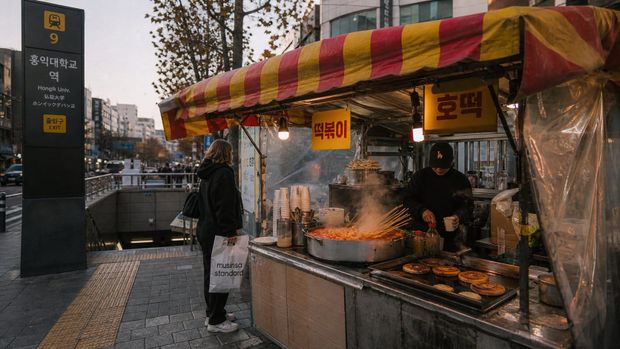
Exit 9 / Walking Street (Eoulmadang-ro corridor): This is where most first-time visitors begin. The pedestrian strip runs with food stalls from around 15:00 until 02:00, and weekend evenings bring a particularly dense overlap of street food, busking stages, and foot traffic. Vendors here rotate but hotteok, Korean corn dogs, tteokbokki cups, and tornado potato are consistently present. Prices and accessibility are calibrated for international visitors — menus are often visual, and payment by card or KakaoPay is increasingly common.
Exit 7 / Sit-Down Restaurant Strip: Immediately west of Exit 7 lies the highest concentration of table-service Korean restaurants in the district. Hongs Jjukkumi at 146 Eoulmadang-ro is 171 metres from the exit, and within the same block visitors can find multiple dakgalbi and samgyeopsal specialists. This strip is where to go for a full sit-down Korean meal with tableside cooking. According to Creatrip's Hongdae food guide, English menus are widely available here, making it a lower-friction introduction to Korean BBQ for first-time visitors.
Yeonnam-dong (10 minutes north): Walking north past the railroad park brings you into Yeonnam-dong, a neighbourhood that Seoul food writers often cite as the more locally authentic face of Hongdae's eating culture. Cafés like Anthracite Coffee Seogyo and specialty dessert spots such as Sobok (serving injeolmi ice ball and grain-based ice cream) are concentrated here. The pace is slower, the aesthetic more independent, and the prices — if anything — even more moderate than the main tourist strip. Yeonnam-dong is the right move for a coffee-and-dessert stop after a heavier meal near the station exits.
Sangsu-dong (south): Sangsu-dong operates on a different rhythm from the rest of Hongdae. Fewer international visitors, lower foot traffic, and a concentration of makgeolli bars and pojangmacha that cater to neighbourhood regulars define the zone. The atmosphere is more intimate than the tourist-facing corridor near Exit 9, and prices reflect that. Jokbal restaurants and late-night drinking tents are the draws; it rewards visitors who want a less curated experience and are willing to walk 10–15 minutes south of the station.
Korean Grilled Meats: Dakgalbi, Samgyeopsal, and Jjukkumi
Tableside-cooked Korean meats are the centrepiece of Hongdae's restaurant scene, and three dishes define the category in this neighbourhood: dakgalbi (spicy stir-fried chicken cooked on a flat iron pan), samgyeopsal (grilled pork belly, typically offered all-you-can-eat in Hongdae's version), and jjukkumi (spicy baby octopus, often combined with pork belly on the same grill). All three are communal formats — shared across the table, cooked live — which suits the neighbourhood's student and group-visitor demographic. Prices are accessible: the Ungteori AYCE samgyeopsal entry is ₩16,800 per person, a full jjukkumi-and-pork-belly set at Hongs Jjukkumi starts from ₩10,000 per person, and the Jangin Dakgalbi two-person lunch set runs ₩24,000. Most restaurants in this category stay open until midnight or later, making them viable post-concert meals for visitors whose schedules push dinner to 21:00 or 22:00. Visit Seoul highlights Hongs Jjukkumi specifically for its English menu, customisable spice levels, and complimentary fried rice finish — practical features that reduce friction for first-time visitors to Korean BBQ.
Hongs Jjukkumi — Spicy Baby Octopus and Pork Belly
Hongs Jjukkumi is located at 146 Eoulmadang-ro, Mapo-gu, 171 metres from Hongik University Station Exit 7. The restaurant specialises in jjukkumi (baby octopus) cooked on a tabletop grill with a choice of accompaniments — pork belly (samgyeopsal), shrimp, or beef brisket (chadol). Spice levels are customisable from mild through very spicy, and an English menu is available at the table. The meal concludes with a complimentary serving of fried rice mixed into the remaining sauce — a particularly satisfying end to the grill session. Prices start from ₩10,000 per person. Hours are daily 11:30 AM to 2:00 AM, making it one of the later-closing sit-down options in the district and a reliable choice for visitors eating after an evening event.
📍 146 Eoulmadang-ro, Mapo-gu, Seoul
🕒 Daily 12:30 – 2:00 AM, 11:30 AM – 12:00 AM
⭐ 4.7 (3,706 reviews)
📞 02-325-7943
🔗 View on Google Maps
Jangin Dakgalbi — Tableside Spicy Chicken
Dakgalbi is Hongdae's most recognisable communal dish: spicy marinated chicken stir-fried tableside on a flat iron pan with rice cakes (tteok), cabbage, sweet potato, and spring onion, finished optionally with melted cheese poured over the top. Jangin Dakgalbi is one of the neighbourhood's established specialists in this format, offering a two-person lunch set for ₩24,000. Hours run 11:30 to 24:00 daily. The tableside cooking format is participatory — diners stir and mix the ingredients as they cook — which has made dakgalbi particularly popular with first-time Korean food visitors who want an interactive dining experience. The cheese finish, while a modern addition to a traditionally simpler dish, has become standard at Hongdae dakgalbi venues and is a significant draw for the district's younger visitor demographic.
📍 17 Myeongdong 9-gil, Myeong-dong 1(il)-ga, Jung District, Seoul
⭐ 4.6 (287 reviews)
📞 1522-1960
🔗 View on Google Maps
Ungteori AYCE — All-You-Can-Eat Samgyeopsal
Ungteori AYCE offers unlimited pork belly (samgyeopsal) grilled on a tabletop grill at ₩16,800 per person, with a minimum group of two; rice is an additional ₩1,000. The all-you-can-eat format is common in Seoul but Ungteori's Hongdae location is consistently cited for value at this price point. Creatrip members receive an additional 5% discount. Samgyeopsal is eaten by wrapping grilled pork in lettuce or perilla leaves with garlic, sliced green chilli, ssamjang (a savoury fermented paste), and kimchi — a format that is easy to adapt to individual preferences and requires no prior experience with Korean food.
"Ungteori's all-you-can-eat samgyeopsal is one of Hongdae's most reliable options for groups — unlimited pork belly at ₩16,800 per person, with a straightforward setup that works well for visitors who are new to Korean BBQ." — Editorial, Creatrip Hongdae Food Guide
📍 118 Eoulmadang-ro, Mapo-gu, Seoul
🕒 Daily 11:00 AM – 11:00 PM
⭐ 4.9 (5,273 reviews)
📞 02-324-9588
🔗 View on Google Maps
| Restaurant | Dish | Price | Hours | Key Feature |
|---|---|---|---|---|
| Hongs Jjukkumi | Jjukkumi (baby octopus) + pork belly grill | From ₩10,000/person | Daily 11:30–02:00 | English menu; customisable spice; complimentary fried rice at meal end |
| Jangin Dakgalbi | Dakgalbi (spicy chicken with rice cakes) | ₩24,000 for 2-person lunch set | Daily 11:30–24:00 | Tableside cooking; optional cheese finish; central Exit 7 location |
| Ungteori AYCE | Samgyeopsal (pork belly) — unlimited | ₩16,800/person (min. 2 people) | Check current hours via Naver Map | All-you-can-eat format; 5% Creatrip discount available |
Beyond the Grill: Tteokbokki, Gomtang, Jokbal, and Stew
Hongdae's non-grill food options range from street-level rice cake dishes to a quietly celebrated Michelin-listed pork bone soup, and they represent the district's depth beyond the tableside BBQ that dominates the tourist-facing strip. Tteokbokki (spicy rice cakes in a gochujang-based sauce) is one of Korea's most ubiquitous street and restaurant foods; two Hongdae restaurants have developed distinct signature versions that go considerably further than the standard preparation. Okdongsik's pork gomtang — a slow-cooked milky bone broth soup with plain rice — represents the opposite end of the flavour spectrum: deeply savoury, MSG-free, and produced in only 100 bowls daily. Myth Jokbal brings 30 years of history to braised pig's trotters, a dish that rewards visitors who try it. Together, these options give Hongdae a food range that extends well past the BBQ venues near Exit 9. According to Korea Travel Post, spanning these different dish categories across a multi-stop food walk is the most efficient way to experience Hongdae's full range in a single visit.
Ttobogetji — Jeukseok Tteokbokki
Ttobogetji specialises in jeukseok (즉석) tteokbokki — a tableside hotpot-style preparation where the rice cakes, fish cakes, and vegetables arrive in a simmering pot and continue cooking as you eat. Unlike pre-made sauce versions common at street stalls, the jeukseok version thickens and concentrates throughout the meal, developing a richer, stickier flavour toward the end. Hours are 11:30 to 21:00, and the restaurant closes on Mondays. The earlier closing time compared to nearby grill restaurants makes Ttobogetji better suited for lunch or an early dinner, particularly combined with a visit to Okdongsik gomtang for a two-stop Korean comfort food afternoon.
📍 South Korea, Seoul, Mapo-gu, Jandari-ro 6-gil, 34-5 2층
🕒 Daily 11:30 AM – 9:00 PM
⭐ 4.2 (214 reviews)
🔗 View on Google Maps
Hong Ma Garlic Tteokbokki
Hong Ma Garlic Tteokbokki takes the standard rice cake dish in a different direction: garlic-infused tteokbokki paired with cream cheese gimbap and garlic fried shrimp. The combination — spicy, garlicky, with a creamy cheese counterpoint from the gimbap — has made it a well-regarded entry point for visitors trying Korean food for the first time. The garlic profile moderates the heat compared to a straight gochujang tteokbokki, and the cream cheese gimbap provides a neutral, familiar texture alongside it. It is noted among Hongdae's recommended food experiences by Adventures with Nie Nie as a suitable option for groups with mixed levels of spice tolerance.
📍 8 Hongik-ro 6-gil, Mapo-gu, Seoul
🕒 Daily 11:00 AM – 10:00 PM
⭐ 4.1 (279 reviews)
📞 02-325-0737
🔗 View on Google Maps
Okdongsik — Michelin-Listed Pork Gomtang
Okdongsik serves pork gomtang: slow-cooked pork bone broth with a milky white appearance and a clean, deep flavour developed over hours of simmering. The restaurant appears in the Michelin Guide and operates without MSG or preservatives. The daily supply is limited to 100 bowls, and the restaurant's reputation means it regularly sells out before closing. The practical implication for visitors is direct: arrive at or before opening, or plan a weekday lunch visit rather than a weekend evening. The dish itself is simple — broth, rice, and a small side of kimchi — which is precisely the point. Okdongsik is a destination for visitors who want to experience Korean soup culture at a verified level of quality, not a casual drop-in option.
"Okdongsik is a rare find in Hongdae — a Michelin Guide-listed spot that keeps things genuinely simple, with slow-cooked pork bone broth and a strict limit of 100 bowls per day. Arrive early or plan on being turned away." — Editorial, Korea Travel Post
📍 44-10 Yanghwa-ro 7-gil, Mapo-gu, Seoul
🕒 Monday–Friday 11:00 AM – 3:00 PM, 5:00 – 10:00 PM / Saturday–Sunday 11:00 AM – 8:30 PM
⭐ 4.3 (1,288 reviews)
📞 02-6012-9915
🔗 View on Google Maps
Myth Jokbal — Braised Pig's Trotters
Myth Jokbal has operated for 30 years and has expanded to multiple nationwide branches, which represents unusual longevity in a district with high venue turnover. Jokbal — braised pig's trotters served with a soy-based dipping sauce — is a dish with a strong following among Korean diners and a tendency to surprise foreign visitors who encounter it without prior context. The meat is tender from hours of slow braising, and the soy-ginger sauce cuts through the richness of the skin and fat. A cold jokbal salad variation, available in summer, provides a lighter entry point for visitors apprehensive about the dish in its full form. Reservations are recommended on weekends. According to Korea Travel Post, Myth Jokbal's three decades in a district that regularly cycles through restaurant concepts is itself a signal worth noting.
📍 21 Myeongdong 3-gil, Jung District, Seoul
🕒 Daily 11:00 AM – 3:00 AM
⭐ 4.3 (1,226 reviews)
📞 02-3789-8799
🔗 View on Google Maps
Makgeolli Bars and Korean Drinking Culture
Makgeolli is a traditional Korean rice wine with a milky white appearance and a mildly sweet, slightly sour, lightly effervescent character. It typically runs 6–8% ABV — considerably lower than soju, which is usually 16–25% — making it a practical entry point for visitors less familiar with Korean spirits. Makgeolli is traditionally drunk from a bowl or shared kettle, and it is always accompanied by anju: drinking snacks that in Korean bar culture are an integral part of the session rather than optional extras. Standard anju budget in Hongdae runs ₩5,000–₩15,000 per dish. In Hongdae, the Sangsu-dong area to the south of the main station is the natural home for makgeolli bars: lower foot traffic, neighbourhood character, pojangmacha (street tent bars), and venues that cater to regulars rather than first-time visitors. According to Korea Travel Post, the contrast between the tourist-facing bars near Exit 9 and the Sangsu-dong drinking scene reflects Hongdae's dual identity as both an international destination and a living residential neighbourhood.
Makgeolli Salon
Makgeolli Salon has been operating for over 10 years, which is notable longevity for a Hongdae venue. The bar stocks regional makgeolli varieties — plain, strawberry, and chestnut among them — some brewed in-house. Standard anju pairings include jeon (Korean savoury pancake), tofu-kimchi, and bossam (boiled pork belly slices served with kimchi wraps). The pairing of jeon and makgeolli is particularly well-established in Korean food culture: the crispy, oily pancake and the slightly fizzy, creamy rice wine are considered complementary textures and flavours that have been combined for centuries. Makgeolli Salon is the right venue for visitors who want to engage with Korean drinking culture in a setting with real depth rather than a tourist-facing bar near the station exits.
📍 South Korea, Seoul, Mapo-gu, 서교동 358-92
⭐ 3.9 (159 reviews)
📞 02-324-1518
🔗 View on Google Maps
Pojangmacha in Sangsu-dong offer a cheaper, less polished version of the same experience. These tent bars — typically a few stools under an orange vinyl canopy, a portable stove, and a menu of makgeolli, soju, and basic anju — operate informally and are weather-dependent in ways that indoor venues are not. They provide one of the more neighbourhood-authentic experiences available in the broader Hongdae area, and the price difference compared to bars on the main tourist strip is meaningful. For visitors coming from a K-Pop event who want to decompress in an unpretentious setting, Sangsu-dong pojangmacha are worth the 10–15 minute walk south from the station.
Street Food on Hongdae Walking Street
Hongdae Walking Street — the pedestrian corridor along Eoulmadang-ro and its branching alleys — is one of Seoul's most active street food zones. Stalls typically open between 15:00 and 16:00 and operate until 02:00, with the peak period coinciding with K-Pop busking hours between 18:00 and 21:00 on weekends. Most items are priced between ₩2,000 and ₩5,000, placing a walkthrough of six to eight snacks at roughly ₩20,000–₩30,000 total. Cash is preferred at individual stalls, though KakaoPay and NaverPay are increasingly accepted. The walking street also functions as a busking performance zone on weekends, meaning the experience of eating street food here physically overlaps with live K-Pop and dance performances — a combination that is genuinely distinctive to Hongdae and not replicated at other Seoul food streets. According to Things Nomads Do, the 18:00–21:00 window on Saturday evenings produces the highest concentration of both performers and vendors simultaneously.
The street food lineup on any given evening typically includes: hotteok — a soft, pan-fried sweet pancake filled with brown sugar syrup, cinnamon, and crushed nuts (₩1,000–₩2,000); eomuk — fish cake skewers simmered in anchovy broth, eaten from the skewer with a cup of the broth on the side (₩1,000–₩2,000); tteokbokki cups — individual-portion rice cakes in spicy gochujang sauce (₩2,000–₩3,000); Korean corn dogs — deep-fried sausage or mozzarella on a stick, often coated in diced fries or finished with a dusting of sugar (₩2,000–₩4,000); and tornado potato — a spiral-cut potato deep-fried on a skewer with seasoning powder toppings (₩3,000–₩4,000). Tanghulu-style candied fruit skewers (strawberry, grape) have become increasingly common, running ₩3,000–₩5,000.
The specific vendor mix rotates, and individual stalls are not permanent fixtures — a gyeranppang (egg bread) vendor present on one visit may have moved by the next. The consistency lies in the format and price range rather than in specific sellers. For visitors with limited time or lighter appetites after a sit-down meal, the walking street functions as a dessert-and-snack circuit at considerably lower cost than a second restaurant visit.
Budget, Hours, and Practical Tips for Visiting Hongdae
Hongdae is among Seoul's more visitor-friendly eating districts in practical terms: prices are lower than comparable tourist areas, English menus are widely available on the main strip, and the neighbourhood connects directly to Incheon Airport via the AREX Airport Railroad. A full three- to four-stop food tour — covering one sit-down meal, a makgeolli or bar stop, and several street food items — runs ₩30,000–₩50,000 per person, within the range of a budget-conscious Seoul day trip. According to Creatrip, the combination of price, hours, and food variety makes Hongdae a practical first or last stop on a Seoul itinerary, particularly given the AREX connection (43 minutes, ₩9,500 single fare from Incheon Airport Terminal 1).
English menus are standard at most restaurants on the main strip around Exit 9 and the sit-down corridor near Exit 7. For Yeonnam-dong cafés or Sangsu-dong bars, Papago and Google Translate's camera function handle Korean menu boards reliably in real time. Naver Map and Kakao Map both provide up-to-date business hours and reviews, and both apps support basic English navigation. The best visiting window depends on objectives: lunch (11:30–13:30) is correct for limited-capacity venues like Okdongsik gomtang, which exhausts its 100 daily bowls quickly. The evening window (18:00–22:00) delivers the fullest Hongdae experience — street food at peak operation, busking performances running, and sit-down restaurants at their most energetic. Late night (22:00–02:00) suits visitors arriving after a concert; most tableside grill restaurants and the walking street stalls are still operating.
| Spending Category | Typical Cost | Notes |
|---|---|---|
| Street food item (single) | ₩2,000–₩5,000 | Hotteok, corn dogs, tteokbokki cups, tornado potato; cash preferred |
| Sit-down meal (per person) | ₩10,000–₩20,000 | Tableside BBQ, tteokbokki restaurant, jokbal, or gomtang |
| Makgeolli bar (drinks + anju, per person) | ₩15,000–₩30,000 | One or two bowls of makgeolli plus 1–2 anju dishes |
| Full 3–4 stop food tour (per person) | ₩30,000–₩50,000 | One sit-down meal, one bar stop, and street snacks combined |
| AREX from Incheon Airport (single fare) | ₩9,500 | Approximately 43 minutes to Hongik University Station |
Frequently Asked Questions
Is food in Hongdae expensive compared to other Seoul districts?
Food in Hongdae is noticeably cheaper than in Myeongdong or Itaewon. The neighbourhood primarily serves Hongik University students and young domestic travellers rather than the international tourist market, and prices reflect that demographic. Sit-down meals typically run ₩10,000–₩20,000 per person at Korean BBQ restaurants, tteokbokki specialists, and pork soup venues. Street food items on the pedestrian walking street are generally ₩2,000–₩5,000 each. A full three- to four-stop food tour covering one sit-down meal, a makgeolli bar visit, and several walking street snacks costs roughly ₩30,000–₩50,000 per person in total.
Do Hongdae restaurants have English menus?
Most restaurants on the tourist-facing strip around Exit 9 and the sit-down corridor near Exit 7 have English menus or visual picture menus. Hongs Jjukkumi specifically lists an English menu as a feature for international visitors, and Ungteori AYCE's format is straightforward enough to navigate without language assistance. Further into Yeonnam-dong or Sangsu-dong, English menus are less common. Both Papago (developed by Naver) and Google Translate's camera function handle Korean menu boards reliably in real time — pointing your phone camera at a printed menu produces a working translation within seconds. Naver Map also provides business information with translation support.
What time should I visit Hongdae for food?
The right time depends on what you want to eat. Lunch (approximately 11:30–13:30) is the window for limited-supply venues: Okdongsik gomtang produces only 100 bowls daily and sells out, so arriving at or before opening is the most reliable approach. The evening window (18:00–22:00) gives the complete Hongdae experience — street food stalls in full operation, K-Pop busking performances running near Exit 9, and sit-down restaurants at their busiest. Late night (22:00–02:00) is viable for tableside grill restaurants and walking street stalls, most of which stay open until 02:00 on weekends, making Hongdae a practical post-concert dining destination for K-Pop fans with late-finishing event schedules.
What is dakgalbi and why is it so popular in Hongdae?
Dakgalbi is a Korean dish of spicy marinated chicken cooked tableside on a flat iron pan with rice cakes (tteok), cabbage, sweet potato, and spring onion, typically finished with a pour of melted cheese. The dish is cooked by the diners themselves at the table, making it an interactive communal meal. Its popularity in Hongdae reflects the neighbourhood's demographic: it is affordable (a two-person set runs ₩24,000 at Jangin Dakgalbi), designed for sharing, and visually engaging — the tableside cooking and cheese-melt finish make it popular with the group-dining culture that defines the area. The communal format also makes it an accessible entry point for visitors trying Korean food for the first time.
Can I reach Hongdae directly from Incheon Airport?
Yes. The AREX Airport Railroad runs directly to Hongik University Station (홍익대학교역), the main station serving the Hongdae district. The journey takes approximately 43 minutes and costs ₩9,500 for a single fare from Incheon International Airport Terminal 1. Hongdae works well as a first stop after arrival — the station has luggage storage facilities — or as a final meal before departure, given the direct rail connection back to the airport. The AREX operates from early morning until midnight, covering both early-morning arrivals and late-night departure windows.
What to Expect from a Hongdae Food Visit in 2026
Hongdae rewards visitors who approach it with an appetite for range rather than a fixed plan. The district's food geography — four distinct zones within a 15-minute walk of each other — means a single afternoon and evening can move from a Michelin-listed bone broth lunch at Okdongsik to a tableside dakgalbi dinner at Jangin Dakgalbi, a post-dinner makgeolli session at Makgeolli Salon in Sangsu-dong, and a pass through the pedestrian walking street for hotteok and tornado potato as K-Pop busking performances run in the background. That sequence is not hypothetical; it is the natural rhythm of a Hongdae food visit when the timing is right.
The K-Pop dimension is built into the neighbourhood's physical structure rather than added on top of it. Exit 9 was designed as a performance zone as much as a shopping street, and the overlap of busking hours with peak street food hours on weekend evenings is a genuine convergence. For fans visiting Seoul for a concert or a comeback event, Hongdae offers a before-or-after eating experience that is both affordable and culturally coherent with the rest of the trip. The AREX connection to Incheon Airport means it functions as a practical first meal in Korea or a final one, with minimal logistical overhead either way.
Prices, hours, and specific vendor availability change, so cross-referencing with Creatrip, Korea Travel Post, or Naver Map before visiting is worthwhile — particularly for the limited-bowl venues and informal pojangmacha that may vary by season. The core character of the district — affordable, late-night, K-Pop-adjacent, and genuinely diverse in its food range — has been consistent for years and is not expected to shift significantly in 2026.
Last updated: 2026-05-13. Pricing, hours, and venue details were reviewed against current sources available in May 2026. Confirm operating hours directly with venues before visiting, as individual restaurant schedules change.


