What Is Hongdae? Seoul's Arts and Music District at a Glance
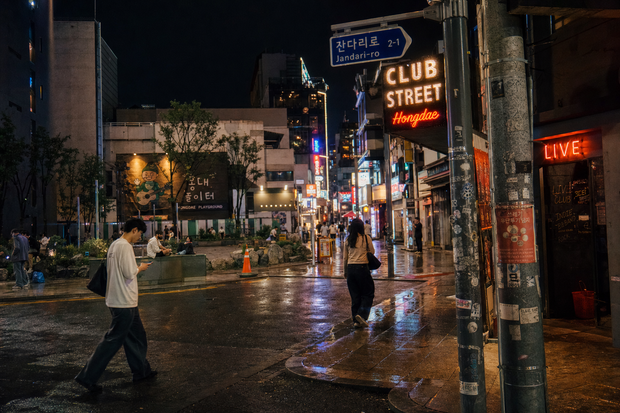
Hongdae (홍대) is an urban district in Mapo-gu, western Seoul, spanning the neighborhoods of Seogyo-dong, Hapjeong-dong, Sangsu-dong, and Seogang-dong. The name is a contraction of Hongik University (홍익대학교), whose fine-arts campus has anchored the area's identity for seven decades. What began as a residential corridor along a coal-freight railway evolved, layer by layer, into one of Asia's most internationally recognized creative districts — a place where K-pop trainees busked before their debuts, where Korea's indie rock ecosystem was born in the 1990s, and where the tension between commercial expansion and independent culture plays out in real time. By 2026, the district functions in three distinct layers: a tourist shopping corridor along Eoulmadang-ro, a live-music and club zone centered on Club Street and Hongdae Playground, and quieter creative back alleys running from Sangsu-dong toward Hapjeong-dong. On December 2, 2021, the Seoul Metropolitan Government officially designated the area its 7th Special Tourist Zone under the name "Hongdae Culture & Arts Special Tourist Zone" (source: Seoul Metropolitan Government).
Quick Answer: Hongdae is Seoul's arts and music district in Mapo-gu, named after Hongik University. Designated Seoul's 7th Special Tourist Zone in December 2021, it operates across three zones in 2026 — tourist shopping, live-music clubs, and independent creative alleys — and connects directly to Incheon Airport via the AREX rail link.
For K-pop fans arriving in Seoul, Hongdae carries particular significance beyond the standard tourist itinerary. The neighborhood's indie music scene directly shaped the broader Korean pop landscape — many now-established artists performed here as unsigned trainees before their formal debuts, and major entertainment companies including YG Entertainment (BLACKPINK, BIGBANG) maintain offices in the wider area. The district's role as a cultural incubator predates the K-pop industry by decades, and the creative infrastructure it produced — live venues, street performance culture, indie labels — became foundational to the sound that would later reach global audiences (source: Wikipedia: Hongdae).
Three subway lines give the district strong transit coverage: Seoul Metro Lines 2 and 6 (Hongik University Station), the Gyeongui-Jungang Line, and the AREX Airport Railroad, which provides a direct connection from Incheon International Airport. This transit infrastructure — combined with the district's reputation across music, fashion, and youth culture — makes Hongdae consistently one of the highest foot-traffic neighborhoods in Seoul, a status reflected in the 66.7% year-on-year surge in convenience-store sales recorded at major Seoul hotspots including Hongdae as of late 2025 (source: Seoul Metropolitan Government).
Hongdae's Origins: From Post-War Residential Area to Arts Hub
Hongdae's transformation from a quiet residential corridor into a cultural district unfolded across five decades of incremental change, anchored at each stage by a single institution. After Japan's occupation ended in 1945, the area running along the Danginseon freight railroad — a coal line crossing western Seoul — was reorganized as an upscale residential neighborhood. That status held for roughly a decade until 1955, when Hongik University relocated its campus here. The university's fine-arts school, which over subsequent years grew into Korea's leading visual-arts institution, became the creative nucleus around which the rest of the district's identity would form. By the 1970s, the presence of art students, instructors, and affiliated cultural workers had established Hongdae as a recognizable arts center — still residential in character but increasingly defined by galleries, workshops, and informal creative gathering spaces. The institutional foundation laid by Hongik University was not incidental to what came later; it was the precondition for it (source: Seoul Metropolitan Government).
Two events in the early 1990s formalized Hongdae's cultural infrastructure and pointed toward the decade of creative explosion that followed. In 1992, club SKA opened as South Korea's first rock-café-style dance club, establishing the physical model — small, independently operated, musically focused — that would define the district's live-music identity for the next three decades. A year later, in 1993, Hongik University launched its first Street Art Exhibition, a deliberate initiative designed to foster cultural activity and bridge the campus's academic creative work with the surrounding neighborhood. Both developments created the conditions for the explosive growth of indie culture in the mid-to-late 1990s: a live-music venue model to replicate, and a public cultural event structure to build on.
"From a luxury residential area, Hongdae has grown into a cultural powerhouse — a place that now represents the intersection of art education, independent music, and youth culture in contemporary Korea." — Seoul Metropolitan Government, Official District Profile
The railroad corridor that originally gave Hongdae its shape — the Danginseon freight line — later became part of the urban fabric connecting the district to adjacent neighborhoods. The Gyeongui Line Forest Park, a converted railway greenway now lined with cafes and pedestrian paths, traces the route of that former freight corridor, functioning as a quieter complement to Hongdae's busier commercial zones. This physical layer of history — visible in the geography itself — distinguishes Hongdae from other Seoul entertainment districts that developed without the same depth of institutional and infrastructural background (source: Wikipedia: Hongdae).
By the late 1980s and into the 1990s, the combination of affordable rents relative to Itaewon, Insadong, or Gangnam, an established arts university, and a growing cluster of independent spaces created the exact conditions for the next chapter: the emergence of Korea's indie music scene, and the birth of what would eventually influence K-pop itself. That transition did not happen by design — it happened because the economic and cultural conditions aligned in a way that made Hongdae the only place in Seoul where it could.
How the 1990s Made Hongdae Korea's Indie Music Capital
The 1990s transformed Hongdae from a neighborhood with arts institutions into a living music ecosystem, and the mechanism behind that transformation was straightforward: cheap rents drew aspiring musicians and artists who could not afford real estate elsewhere in Seoul. These musicians needed spaces to rehearse and perform; club SKA and the small venues that followed provided those spaces. Word spread, more musicians arrived, and labels, promoters, and event organizers followed. Within roughly one decade, the district had developed something Seoul had not produced before: a self-sustaining indie music scene spanning punk, jazz, techno, and hip-hop, all coexisting within the same set of alleys. The bands that emerged from this environment were not marginal figures in Korean music history — they became foundational. Before K-pop dominated global charts, Hongdae was Seoul's underground sound lab, and the creative groundwork it produced echoes through Korean popular music to the present day (source: Let Seoul, 2026).
Crying Nut, a punk rock group formed in Hongdae in the mid-1990s, is widely credited as one of Korea's pioneer punk acts and remains active decades later. Sister's Barbershop and Clazziquai — both products of the same scene — went on to shape Korean indie and electronic music in distinct ways, with Clazziquai's hybrid electronic-jazz sound anticipating the genre fusions that would later characterize K-pop production at scale. The fact that three acts of such different stylistic orientations emerged from the same few alleys in the same decade illustrates how genuinely varied the Hongdae ecosystem was at its creative peak.
"Long before K-pop dominated global charts, Hongdae was Seoul's underground sound lab — a neighborhood where punk, jazz, techno, and hip-hop coexisted in the same alley, and where a decade of cheap rents and creative freedom produced the cultural groundwork for everything that followed." — Let Seoul, 2026 Indie Culture Guide
The internationalization of Hongdae's music culture accelerated after the 2002 Korea-Japan FIFA World Cup. Club Day — a monthly event in which a single wristband granted entry to dozens of Hongdae venues on one night — had already been running as a local institution, but the World Cup brought a significant wave of international visitors to Seoul and introduced the concept to a global audience. By the mid-2000s, Club Day was appearing in travel guides and international media coverage as a model for affordable, accessible urban nightlife programming, a signal that Hongdae had crossed from local phenomenon to recognized international destination.
The legacy of the 1990s Hongdae scene reaches into the present in ways both obvious and less immediately visible. The clubs and venues that opened during that decade created the physical infrastructure still operating in 2026. Less obviously, the aesthetic sensibility of that era — independent, anti-commercial, genre-mixing, community-built — functions as the cultural standard against which Hongdae's current commercial expansion is measured and often found wanting. Longtime residents and cultural workers in the district frequently frame the gentrification debate in terms of what the 1990s represented: a brief window of genuine creative freedom before market forces arrived and rewrote the economic conditions that made it possible.
Hongdae's Three Zones in 2026: Tourist Strip, Club Street, Creative Alleys
By 2026, Hongdae functions as three distinct but geographically overlapping zones, each serving a different population and offering a different version of the district's character. Understanding this layered structure is practical for anyone planning a visit: the experience of Hongdae depends almost entirely on which zone you spend time in and at what hour. The tourist-facing commercial strip, the performance-oriented club district, and the quieter creative back alleys exist within walking distance of each other but operate on different rhythms and cater to different motivations. The zones also reflect Hongdae's ongoing tension between commercial success and the indie culture that originally defined it — a tension that the Seoul Metropolitan Government's 2021 Special Tourist Zone designation has, in some respects, formalized. Rising rents from the mid-2000s onward displaced many early indie artists and small operators, and that gentrification dynamic continues to reshape the district's creative geography even as official promotion highlights its cultural heritage (source: Let Seoul, 2026).
| Zone | Primary Area | Key Offerings | Primary Audience | Active Hours |
|---|---|---|---|---|
| Tourist Hongdae | Eoulmadang-ro / Walking Street | K-beauty chains (Innisfree, Tony Moly), franchise cafes, fast food, K-pop pop-up stores | International visitors, day-trippers | 10 AM – 10 PM |
| Performance Hongdae | Club Street, Hongdae Playground alleys | Live-music clubs, DJ bars, underground hip-hop and R&B venues, nightly busking | Music fans, nightlife visitors, aspiring artists | 6 PM – 4 AM (Fri–Sat) |
| Creative Hongdae | Sangsu-dong to Hapjeong-dong back alleys | Independent bookstores, experimental galleries, artist workshops, concept stores | Local creatives, design-oriented visitors | 12 PM – 9 PM |
Tourist Hongdae centers on Eoulmadang-ro, the main pedestrian corridor commonly called "Walking Street," where K-beauty retailers like Innisfree and Tony Moly operate alongside international fast-food chains and franchise cafes. As of 2026, the dominant retail format in this zone has become the pop-up store: temporary branded spaces — frequently tied to K-pop idol collaborations, luxury brand activations, or webtoon intellectual property — that open for several weeks before rotating out. These short-run installations create recurring reasons for fan-motivated repeat visits and give the tourist strip a calendar of changing content that static storefronts cannot provide (source: Let Seoul, 2026).
Performance Hongdae occupies Club Street and the alleys surrounding Hongdae Playground, where the district's live-music history remains most directly visible. The venues here — Rolling Hall, FF, Gopchang Jeongol — range from mid-size indie stages to underground DJ spaces and operate primarily in the evening and into the early morning hours on weekends. Nightly busking at Hongdae Playground provides a free, street-level entry point to the performance zone and has historically functioned as an informal talent pipeline: many artists who performed on that pavement later appeared on Korean television competition programs or signed with agencies.
Creative Hongdae — the Sangsu-to-Hapjeong back alleys — is the zone most directly affected by the ongoing gentrification dynamic. Rising rents have steadily displaced independent operators, but the zone retains independent bookstores, experimental galleries, and artist-run concept spaces including Musinsa Terrace, which represents the "digital-analog hybrid" character of the current district: high-fashion e-commerce meets physical retail experience. Spaces that shuttered during the COVID-19 period have been incrementally reopening since 2023, injecting new creative energy into the back-alley ecosystem (source: K Culture, 2026).
The gentrification tension is not simply a cultural complaint — it represents a real structural shift with measurable consequences. The early indie artists and small operators who built Hongdae's reputation were priced out as the district's commercial value rose, and the Special Tourist Zone designation, while bringing investment, also signals to property owners that commercial returns will continue to increase. The creative spaces that remain operate in a market environment fundamentally different from the one that produced them, and independent operators in all three zones navigate that gap differently, with varying degrees of success.
Live Music Venues, Club Street, and Nightlife in 2026
Hongdae's live-music infrastructure in 2026 is smaller in independent-venue count than its 1990s or early 2000s peak, but the venues that have survived carry well-established reputations and stable programming. The district's club and live-music zone centers on Club Street and the alleys adjacent to Hongdae Playground, where a walkable cluster of venues covers a range of musical formats — from indie rock on a proper stage to late-night electronic DJ sets and underground hip-hop in small basement spaces. Entry prices at live-music venues typically run ₩20,000–30,000; DJ-format clubs vary by night and lineup. Busking at Hongdae Playground remains free and nightly, beginning around sunset and running into the late evening on most days of the week (source: Let Seoul, 2026). For K-pop fans, the busking culture here is historically significant: the Playground has served as a training ground for artists who later joined major agency rosters.
| Venue | Format | Scale | Entry | Programming Focus |
|---|---|---|---|---|
| Rolling Hall | Live music stage | Mid-size; 20+ years operating | ₩20,000–30,000 | Indie, alternative, rock, cross-genre |
| FF (Formula One) | Club / DJ venue | Large; late-night format | Varies by night | Electronic, hip-hop |
| Gopchang Jeongol | Underground club | Small; curated programming | Varies | Hip-hop, R&B |
| Hongdae Playground | Open-air busking space | Outdoor; open access | Free | Vocal, dance, b-boy, street performance |
Rolling Hall
Rolling Hall has operated continuously for more than 20 years and holds a reputation among Korean music industry professionals as one of the country's most respected independent live-music venues. Its programming spans indie rock, folk, electronic, and cross-genre performances, and its track record includes booking emerging acts before wider recognition alongside established indie artists on return visits. Ticket prices run ₩20,000–30,000 per show, placing it within reach for most music-focused visitors. Advance booking through Korean ticketing platforms — Melon Ticket and Interpark are the primary options — is standard for popular shows; walk-up entry is possible for lower-demand nights.
📍 35 Eoulmadang-ro, Mapo-gu, Seoul
🕒 Daily 10:00 AM – 11:00 PM
⭐ 4.3 (400 reviews)
📞 02-325-6071
🔗 View on Google Maps
FF (Formula One)
FF, commonly called Formula One, operates as an electronic music and hip-hop club catering to both local regulars and international visitors drawn to its late-night DJ programming. The venue is known for sets running deep into the early morning on Friday and Saturday nights and has hosted international DJ acts alongside Korean electronic music producers. Its programming occupies the larger, more commercially oriented end of Hongdae's nightlife spectrum, with door policies and entry fees that vary depending on the lineup.
📍 서울특별시 마포구 서교동 407-8
🕒 월요일–수요일 휴무일 / 목요일–일요일 오후 6:00 ~ 오전 8:00
⭐ 4.9 (1,073 reviews)
📞 010-9025-3407
🔗 View on Google Maps
Gopchang Jeongol
Gopchang Jeongol is a smaller, more focused venue tucked into the Club Street alleys, programming underground hip-hop and R&B with a deliberately curated lineup rather than a rotating DJ format. Its small capacity creates an intimate atmosphere, and its programming philosophy emphasizes genre depth over broad commercial appeal. In 2026, it remains one of the cleaner examples in Hongdae of the original indie-club model still functioning — independent, community-facing, and genre-specific — amid a district increasingly shaped by larger commercial operators.
📍 8 Wausan-ro 29-gil, Mapo-gu, Seoul
🕒 Monday–Thursday 7:00 PM – 3:00 AM / Friday–Saturday 7:00 PM – 4:00 AM / Sunday Closed
⭐ 4.3 (366 reviews)
🔗 View on Google Maps
Hongdae Playground
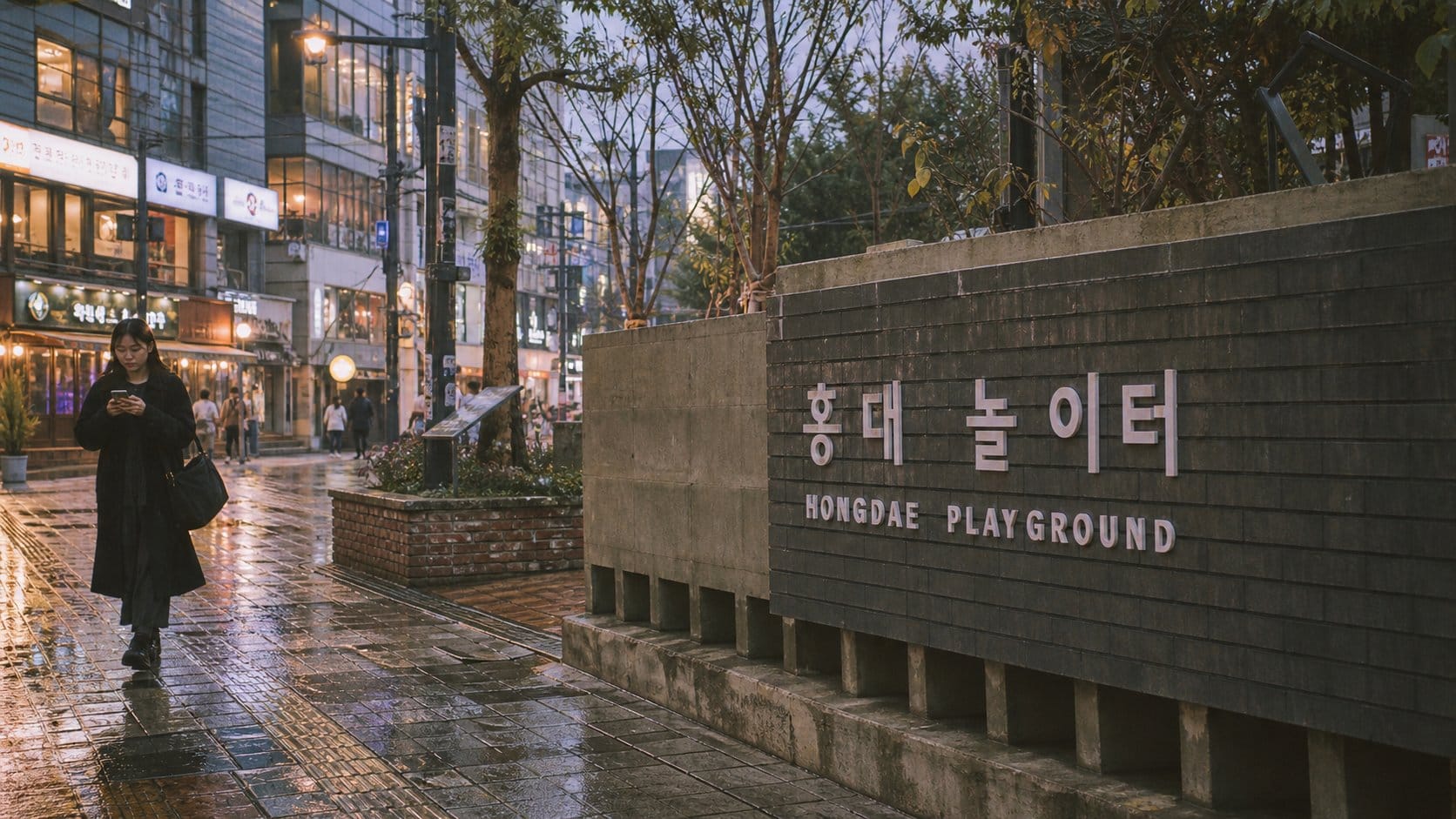
Hongdae Playground is the open-air public space at the center of the district's busking culture. Nightly performances by singers, dancers, and b-boys draw both local crowds and international visitors, and the space functions as an informal entry point into Hongdae's broader performance ecosystem. Many K-pop trainees and unsigned artists have used the Playground as an early proving ground — the audience feedback here is direct and immediate, with no ticketing gate between performer and crowd.
"Hongdae Playground is where careers begin — a public stage where the pressure is real even without a ticket price attached. More than a few artists who now headline arenas first played here to passing crowds on weekend evenings." — Let Seoul, 2026 Indie Culture Guide
📍 South Korea, Seoul, Mapo-gu, 서교동 406
⭐ 3.5 (24 reviews)
🔗 View on Google Maps
Street Culture: Free Market, Annual Festivals, and the Zandari Showcase
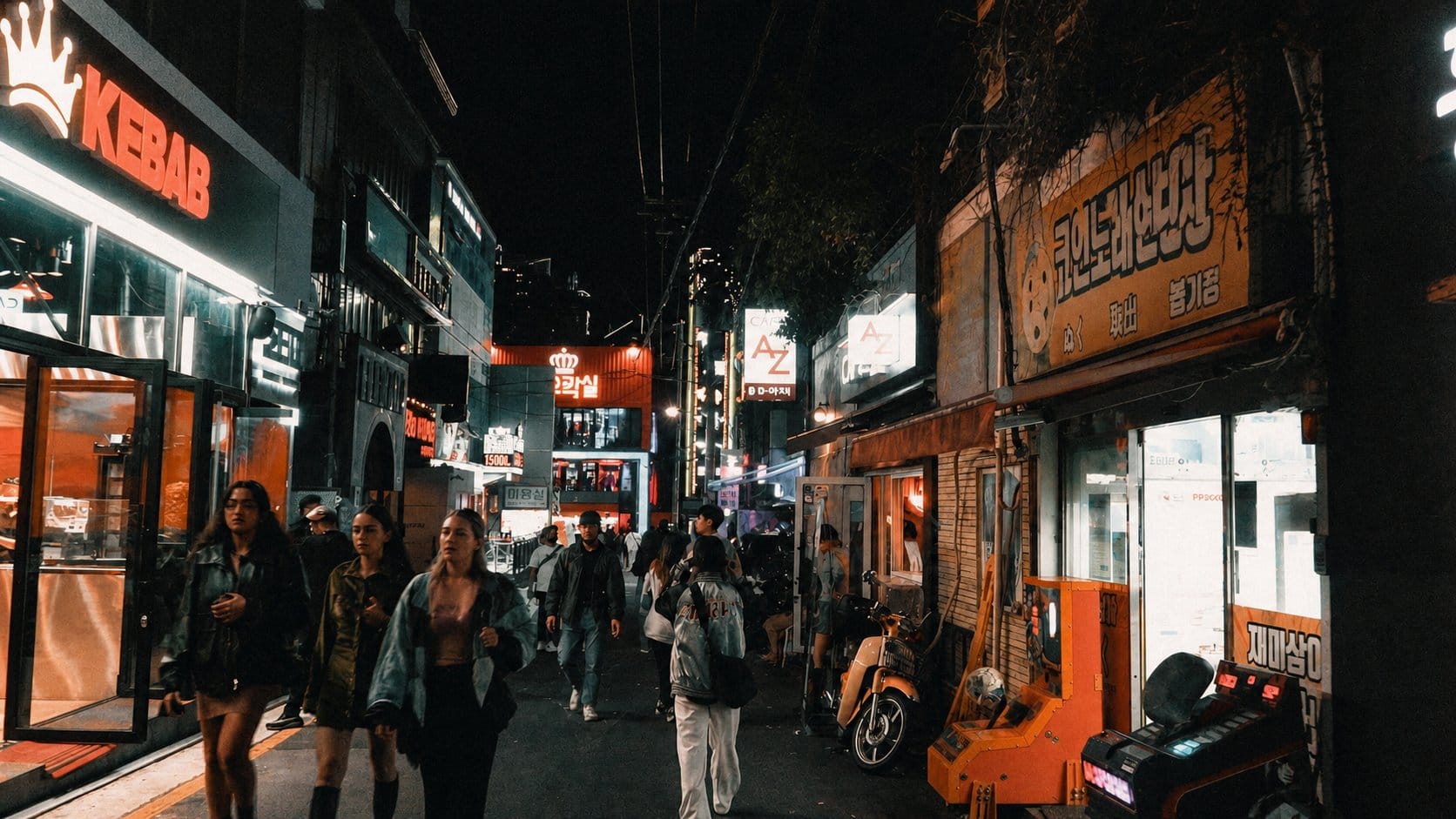
Hongdae's participatory street culture — the recurring events, markets, and festivals that sit outside the commercial club circuit — is what distinguishes the district from a conventional nightlife destination. These events trace their roots to the 1990s and early 2000s, when the neighborhood's creative community organized public cultural activity as a direct expression of the indie ethos: accessible, non-commercial, and produced by the artists themselves rather than event corporations. That foundational character has been tested by two decades of commercial pressure, but as of 2026 several of these structures remain operational and continue to generate genuine community participation alongside growing tourist audiences. The Street Art Festival (since 1993) and the Hongdae Free Market (since 2002) represent the oldest surviving strands of that original organizational culture (source: Wikipedia: Hongdae).
The Hongdae Free Market operates every Saturday and Sunday, functioning as a crafts and art market where independent artists sell handmade goods directly to the public without intermediaries. The market's format — artists apply for booth space and present original work — maintains a quality filter that distinguishes it from generic souvenir markets. For K-pop fans, it can serve as a window into the hand-craft and illustration culture that runs parallel to mainstream idol merchandise; independent artists working in fan-art-adjacent formats occasionally appear here, and the market represents a form of creative commerce that predates the current idol-merchandise economy by a decade.
The Street Art Festival, running annually since 1993, predates the Free Market by nearly a decade. Originally launched as a university-backed initiative to create a bridge between campus creative work and public space, it has continued through the commercialization era as a deliberate assertion of participatory creative culture. Its long institutional history makes it a documented anchor against the district's drift toward pure commercial entertainment — one of the few recurring events in Hongdae that has maintained its non-commercial character across three decades of increasing commercial pressure on the district.
"The Zandari Festa is not simply a music festival — it is a discovery mechanism. Over three days each fall, emerging Korean and international artists perform across Hongdae's live venues in a format explicitly designed to introduce them to industry professionals, international bookers, and informed audiences." — Let Seoul, 2026 Indie Culture Guide
Zandari Festa is the most internationally recognized of Hongdae's recurring cultural events — a three-day showcase festival held each fall across the district's live venues. Recognized as Asia's most prominent indie-music discovery event, it brings together emerging Korean artists and international acts in a format modeled partly on global showcase festivals such as SXSW. For K-pop fans tracking the upstream layers of Korean music culture, Zandari Festa is where genre boundaries dissolve: punk, electronic, hip-hop, jazz, and experimental artists share stages and audiences across the same three-day period, making the range of Korean independent music visible in a compressed, walkable format.
KT&G Sangsangmadang is a multi-use culture complex operating across several floors, hosting exhibitions, live performances, and film screenings. Its free-admission options make it accessible without a nightlife budget, and its programming serves both daytime cultural visitors and evening performance audiences. The complex represents the kind of institutionalized creative space — publicly accessible, multi-format, not exclusively commercial — that the district's back-alley independent sector has historically provided informally.
Hongdae in 2026: Special Tourist Zone Status and Current Landscape
Hongdae's official designation as Seoul's 7th Special Tourist Zone, granted on December 2, 2021, marked a formal shift in the district's status from a culturally significant neighborhood to an officially managed tourism asset. The designation — formally titled the "Hongdae Culture & Arts Special Tourist Zone" — brought targeted city investment, promotional infrastructure, and policy attention that have shaped the district's development trajectory through 2025 and into 2026. The economic signals are clear: convenience-store sales at major Seoul tourist hotspots including Hongdae surged 66.7% year-on-year as of late 2025, reflecting a robust rebound in international inbound tourism in the post-pandemic recovery period. The figure functions as a proxy for foot traffic and visitor spending across the district more broadly, and it confirms that Hongdae has returned to — and in some metrics exceeded — its pre-pandemic commercial activity levels (source: Seoul Metropolitan Government).
Transit access remains one of Hongdae's structural advantages as a destination. Three rail services serve Hongik University Station: Seoul Metro Line 2 (connecting to central Seoul and the Han River corridor), Line 6 (running through Mapo-gu and Itaewon), and the Gyeongui-Jungang Line. The AREX Airport Railroad provides a direct, no-transfer connection from Incheon International Airport to Hongik University Station — a journey of approximately 43 minutes — placing the district within practical reach of international visitors arriving on short itineraries or planning evening arrivals directly from the airport (source: Wikipedia: Hongdae). This transit convergence at a single station serving three lines plus the AREX is a logistical asset few Seoul neighborhoods match.
The 2026 landscape reflects the accumulated outcome of two decades of commercial expansion. Pop-up stores tied to K-pop idol collaborations and brand activations define much of the tourist corridor's retail offering, providing recurring, fan-motivated reasons to visit. The "digital-analog hybrid" character visible across the district — high-tech retail concept stores coexisting with analog bookshops and hand-crafted ceramics studios — is most concentrated in Creative Hongdae, where concept spaces represent the new equilibrium between commercial and independent creative formats (source: K Culture, 2026). Street art remains integral to the district's visual identity, most notably along "Picasso's Street" (Hongdae Mural Street), where graffiti murals function as open-air gallery walls navigable on foot.
The unresolved tension between commercial success and indie preservation remains Hongdae's defining story in 2026. Tourist infrastructure is expanding — new convenience formats, larger brand activations, increased city promotional support — while independent creative spaces continue to contract under rent pressure. The district's reputation as a creative incubator depends on the survival of the back-alley independent sector, which is precisely the sector most vulnerable to the commercial forces that its own cultural reputation attracts. That dynamic is not unique to Hongdae globally, but few neighborhoods have played out this particular cycle with as much documented intensity, across as many decades, in a context as internationally observed as the Korean cultural industry.
Frequently Asked Questions
Where exactly is Hongdae in Seoul?
Hongdae is located in Mapo-gu, western Seoul, spanning four neighborhoods: Seogyo-dong, Hapjeong-dong, Sangsu-dong, and Seogang-dong. The primary transit hub is Hongik University Station, served by Seoul Metro Line 2, the Gyeongui-Jungang Line, and the AREX Airport Railroad, which connects directly to Incheon International Airport in approximately 43 minutes without a transfer. From central Seoul — City Hall or Gwanghwamun — the journey to Hongik University Station on Line 2 takes roughly 20–25 minutes. The neighboring areas of Yeonnam-dong and the Gyeongui Line Forest Park are a short walk from the station and offer a quieter contrast to Hongdae's busier commercial core.
How did Hongdae become Seoul's arts and music district?
Hongdae's identity as an arts and music district developed through four stages. First, Hongik University relocated its campus here in 1955, establishing the fine-arts institutional base that drew students and creative workers into the neighborhood. Second, cheap rents in the 1990s attracted indie musicians who could not afford real estate elsewhere in Seoul, concentrating creative talent in the area. Third, the 1992 opening of club SKA — South Korea's first rock-café-style dance club — created the live-music venue model that others replicated throughout the decade. Fourth, bands including Crying Nut, Sister's Barbershop, and Clazziquai emerged from the scene, establishing Korea's indie music ecosystem. By the early 2000s, Club Day — a monthly multi-venue wristband event — had internationalized the district's reputation further following the 2002 Korea-Japan FIFA World Cup.
What live music venues are operating in Hongdae in 2026?
The primary live-music and club venues operating in Hongdae in 2026 include Rolling Hall (a respected independent live-music venue with more than 20 years of continuous operation; entry typically ₩20,000–30,000 per show), FF — also known as Formula One — (an electronic music and hip-hop club known for late-night DJ sets drawing local and international crowds), and Gopchang Jeongol (a smaller underground space in the Club Street alleys, focused on hip-hop and R&B programming). Hongdae Playground operates as a free, open-air nightly busking venue where singers, dancers, and b-boys perform for street audiences. Advance booking for Rolling Hall shows is recommended through Melon Ticket or Interpark.
What is the Zandari Festa?
The Zandari Festa is an annual three-day indie music showcase held each fall across Hongdae's live venues. It is recognized as Asia's most prominent indie-music discovery event and operates on a multi-venue festival format: emerging Korean and international artists perform across multiple club stages, with the event structured to connect artists with industry professionals, international bookers, and informed music audiences. Genre coverage at Zandari spans punk, electronic, hip-hop, jazz, and experimental formats. For fans of Korean music culture who want to encounter artists before they reach mainstream recognition — similar to the function SXSW serves in North America — Zandari Festa is Hongdae's most internationally relevant recurring music event.
Is Hongdae relevant for K-pop fans visiting Seoul?
Yes — Hongdae is relevant for K-pop fans on several levels. Many artists who later debuted with major agencies first performed at Hongdae Playground as unsigned trainees; the indie scene that developed in the district through the 1990s directly shaped the musical vocabulary and production approaches that K-pop refined into a global format. YG Entertainment, home to BLACKPINK and BIGBANG, maintains offices in the wider area. The district's pop-up store culture in 2026 includes K-pop idol collaborations on the main tourist strip, providing fan-specific retail content. The surrounding neighborhood also contains a concentration of music industry infrastructure — agencies, studios, production companies — that makes the area contextually significant for anyone interested in how Korean pop music is actually made and distributed.
What Hongdae Represents: Continuity, Tension, and Creative Identity in 2026
Hongdae in 2026 holds two identities simultaneously — a commercially successful international tourism destination and a cultural origin story that the commerce both depends on and erodes. The live-music venues, the busking culture, the annual festivals, and the creative back alleys are not decorative; they are the source material for the brand. The indie scene of the 1990s built the reputation that the K-beauty chains and pop-up stores now profit from, and that underlying dynamic shapes every visit, whether or not the visitor is aware of it. For anyone tracking Korean popular music culture — its history, its present infrastructure, its ongoing creative production — the neighborhood offers context that arena concerts and idol cafes in other districts do not.
For K-pop fans specifically, Hongdae provides something rare: proximity to the upstream of the music. This is where the broader Korean popular music culture took its foundational shape — not polished for export, but raw, community-built, and still partially visible in the venues, festivals, and street performances that survive the commercial pressure. The Zandari Festa, Rolling Hall, and Hongdae Playground together represent a through-line from the 1990s indie moment to the present. Artists at different stages of their careers — from Playground buskers to Rolling Hall headliners — exist in the same walkable geography.
Practically, the district rewards visitors who arrive in the evening with a modest entry budget and a willingness to walk. The convergence of free busking at Hongdae Playground, ticketed shows at Rolling Hall, and the Sangsu-to-Hapjeong back-alley creative spaces within a single walkable area makes a multi-format evening achievable without extensive planning. The AREX direct link from Incheon Airport removes the transit barrier for international arrivals, and the density of the district means that even a few hours of exploration covers substantial cultural ground.
Last updated: 2026-05-13. This article reflects available information on Hongdae's venues, district zones, and cultural programming as of May 2026. Venue entry prices and operating hours are subject to change; confirm current details directly with individual venues or through Korean ticketing platforms before visiting.
Related Articles
- 7-Day South Korea Itinerary 2026: Seoul to Busan for Visiting Fans
- Seoul's Historical Soul: Palaces, Hanok, and Creative Districts
- Seoul Street Food Markets & Neighborhood Eats: 2026 Guide
- Korea-UAE K-Pop: Every Major Festival and Concert 2025-2026
- Korean Dramas Starring K-Pop Idol Actors: The 2018 Class
This article was written using information collected and analyzed by NAMANE's in-house K-pop research AI engine. We use AI technology to bring you faster, broader coverage, and in the process some details may occasionally differ from the latest facts. For important information such as dates, venues, and prices, please double-check with official sources.


