
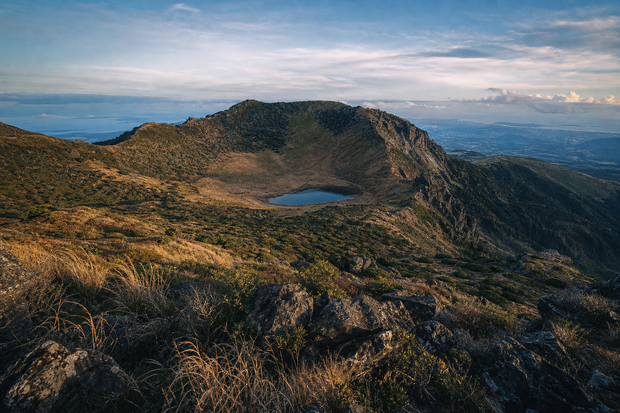
Jeju Island: Geography, Scale, and Autonomous Province Status
Jeju Island (제주도) is South Korea's largest island, covering 1,833.2 km² in the Korea Strait approximately 82.8 km south of the Korean Peninsula, according to Wikipedia. The island stretches roughly 73 km east–west and 31 km north–south, accommodating a population of approximately 665,953 residents as of August 2025 — with the provincial capital Jeju City home to around 501,791 of those residents. Administratively, Jeju operates as South Korea's only Special Autonomous Province, a status that grants it broader self-governing powers than any other province in the country, encompassing areas such as taxation policy, foreign investment regulation, and land-use governance. The island's dramatic terrain traces its origins to submarine volcanic eruptions that began approximately 2 million years ago — a geological foundation that produced the shield volcanoes, lava tubes, and tuff cones that make Jeju visually and ecologically unlike anywhere else on the peninsula.
Quick Answer: Jeju Island is South Korea's largest island (1,833 km²), located roughly 83 km south of the Korean mainland in the Korea Strait. Home to about 665,953 residents as of August 2025, it is the country's only Special Autonomous Province — with broader self-governing authority than any other Korean province — and was shaped by volcanic eruptions beginning approximately 2 million years ago.
Jeju City, situated on the island's northern coast, serves as the administrative and commercial hub, concentrating roughly 75% of the island's total population within its metropolitan limits. The remaining residents are spread across Seogwipo City to the south and a network of smaller towns and rural villages. This demographic distribution reflects the island's rapid urbanisation over the past two decades, driven largely by tourism growth and investment inflow from the mainland. Jeju's Special Autonomous Province status, formally established in 2006, was designed specifically to attract international business activity and to ease visa requirements for visitors from select countries — a policy framework that has shaped the island's economic and spatial development significantly.
Geographically, Jeju sits at the convergence of ocean currents that sustain a humid subtropical climate. Winters are markedly milder than on the Korean mainland, rarely dipping below 0 °C, while summers are hot and humid with a meaningful typhoon risk. This climate, combined with the island's volcanic soils, sustains citrus orchards, tea plantations, and subtropical vegetation uncommon elsewhere in Korea. According to Korea Insider, the island's accessibility across all seasons makes it the most visited domestic destination in South Korea, drawing tens of millions of visitors annually from both the mainland and overseas.
| Feature | Detail |
|---|---|
| Total Area | 1,833.2 km² (707.8 sq mi) |
| Location | Korea Strait, ~82.8 km south of the Korean Peninsula |
| Dimensions | 73 km east–west × 31 km north–south |
| Population (Aug 2025) | ~665,953 (Jeju City: ~501,791) |
| Administrative Status | Special Autonomous Province (South Korea's only) |
| Geological Origin | Submarine volcanic eruptions, ~2 million years ago |
| Climate Type | Humid subtropical; mild winters, hot summers |
Hallasan and Jeju's Volcanic Landscape
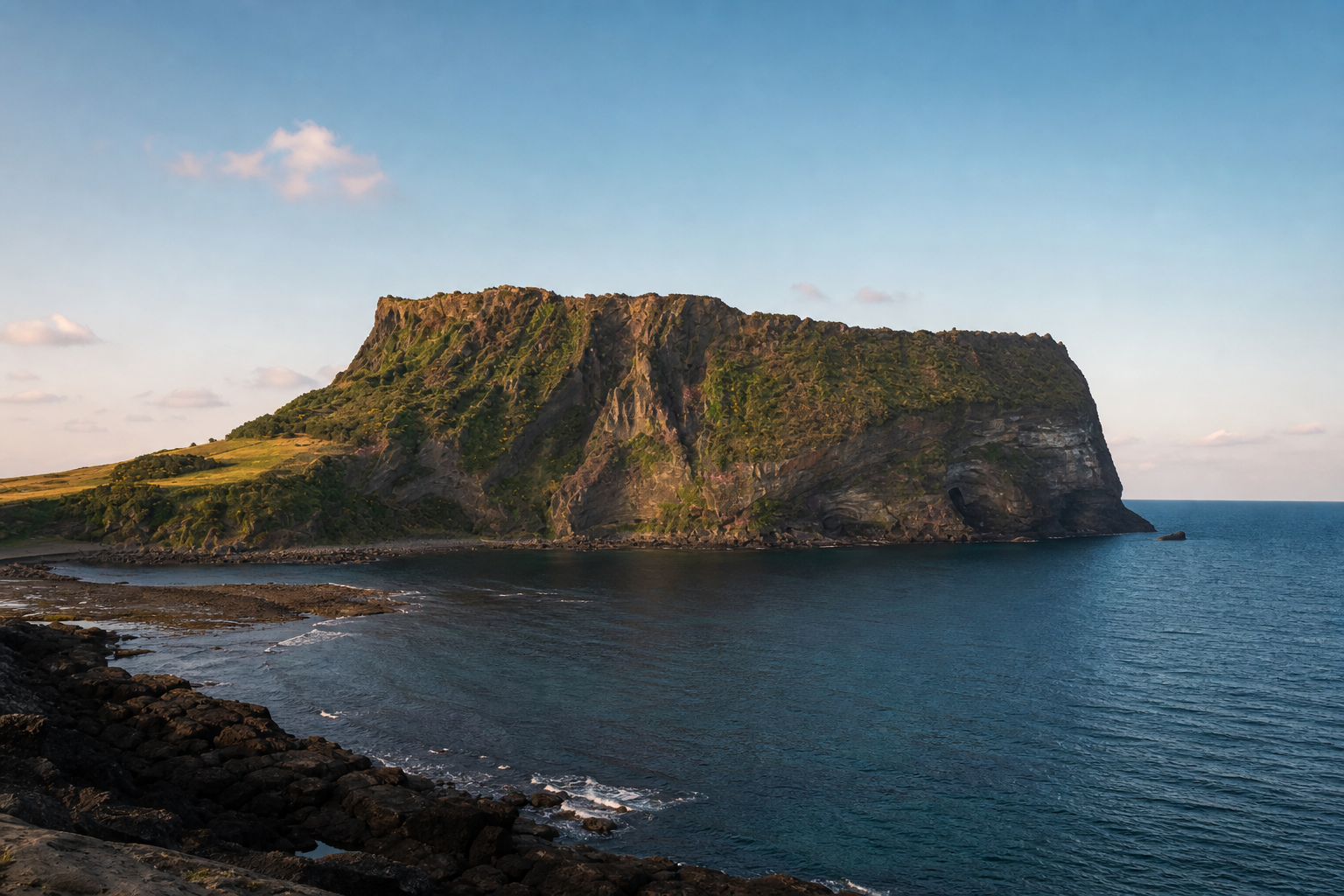
Hallasan (한라산) is the defining geological feature of Jeju's interior — a dormant shield volcano standing at 1,947 to 1,950 metres above sea level, making it South Korea's highest peak, as documented by Korea Insider. Surrounding it are approximately 360 smaller extinct volcanic cones called oreums, a concentration dense enough to place Jeju among the world's premier sites for studying monogenetic volcanic systems. Beyond the summit terrain, the island harbours one of Earth's most extensive lava-tube cave networks — including Manjanggul, among the longest lava tubes globally, and the Geomunoreum system, regarded as the finest of its kind anywhere, with multicoloured carbonate mineral formations lining ceilings above dark volcanic lava walls. On the eastern shoreline, Seongsan Ilchulbong (Sunrise Peak) rises 182 metres from the sea — a tuff cone formed by underwater eruptions roughly 5,000 years ago and one of Jeju's most recognised coastal landmarks.
Hallasan National Park
Hallasan National Park encompasses the volcano's slopes and crater summit, offering two primary hiking routes to the top: the Seongpanak trail (9.6 km one-way) and the Gwaneumsa trail (8.7 km one-way). Both are full-day ascents requiring an early start, as timed entry cutoffs prevent hikers from beginning the upper section too late to descend safely before dark. The summit holds a crater lake — Baengnokdam — visible from the peak on clear days, though cloud cover is common. Lower-altitude trails wind through bamboo forests, volcanic crater ponds, and wildflower meadows that draw visitors across all seasons. The park is one of three components inscribed under Jeju's 2007 UNESCO World Natural Heritage designation.
📍 South Korea, Jeju-do, Seogwipo, 특별자치도, 1100로 2070-61
🕒 Daily 5:00 AM – 6:00 PM
⭐ 4.7 (3,839 reviews)
📞 064-747-9950
🔗 View on Google Maps
Manjanggul Lava Tube
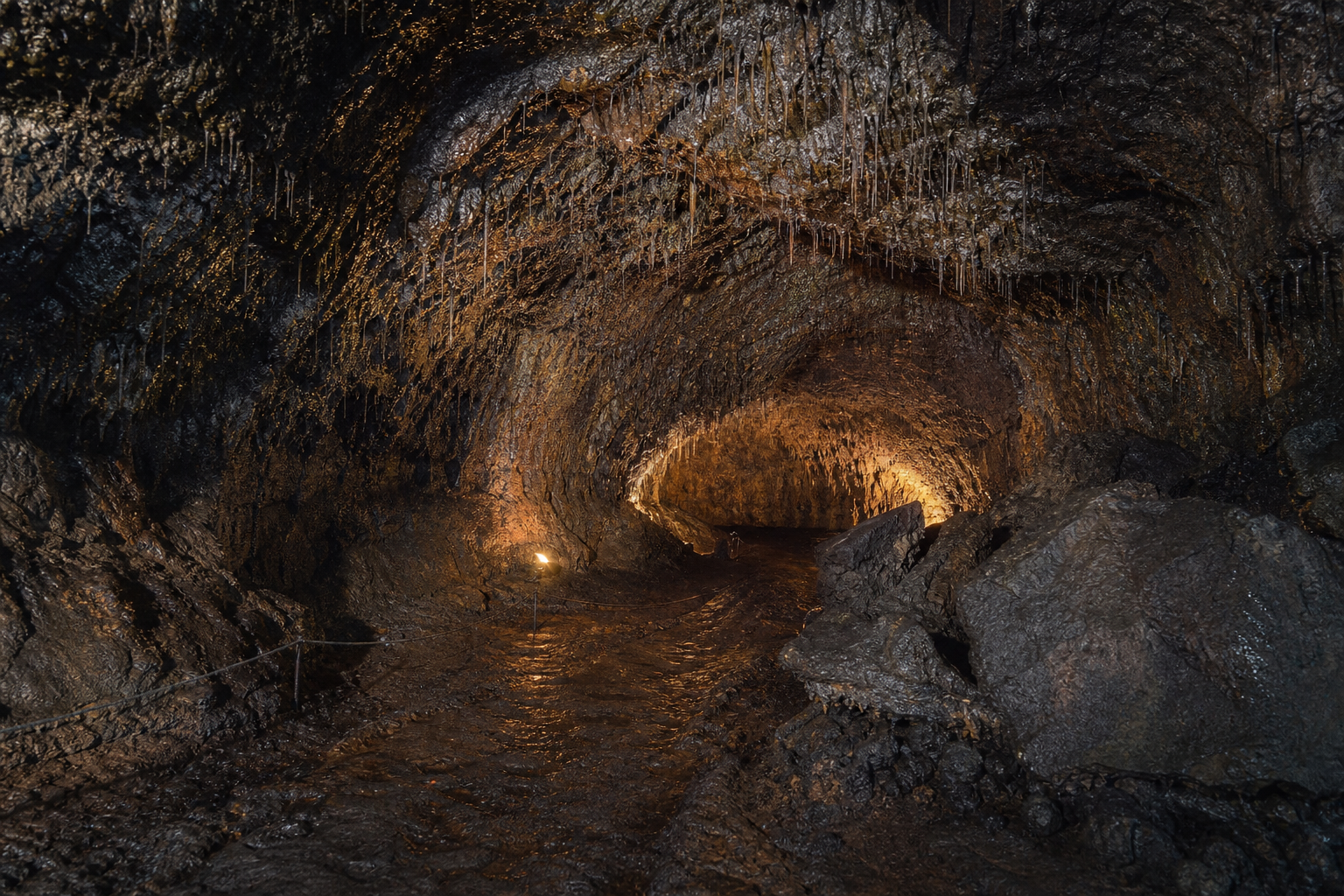
Manjanggul stretches approximately 7.4 km in total length, with roughly 1 km of that passage open to the public. The accessible section moves through a cavern reaching up to 23 metres in height, with well-preserved lava stalactites overhead and a large lava column — one of the world's tallest — near the far end. The tube formed when the outer crust of a flowing lava stream cooled and hardened while molten rock continued to move beneath, eventually draining and leaving the hollow conduit. A constant interior temperature of approximately 11 °C makes Manjanggul noticeably cool throughout the year, offering a natural contrast to Jeju's humid summer heat. The broader Geomunoreum lava tube system, of which Manjanggul is a component, carries its UNESCO World Natural Heritage inscription specifically for the geological and speleothem diversity that no other lava tube network on Earth matches in combination.
📍 182 Manjanggul-gil, Gujwa-eup, Cheju, Jeju-do
⭐ 4.2 (11,853 reviews)
📞 064-710-7903
🔗 View on Google Maps
Seongsan Ilchulbong (Sunrise Peak)
Seongsan Ilchulbong — literally "castle mountain sunrise peak" — was formed when magma erupted through shallow seawater approximately 5,000 years ago, building a tuff cone that now rises 182 metres above the eastern tip of Jeju. At the summit, a broad grass-floored crater roughly 600 metres in diameter is encircled by 99 sharp basalt rock columns, producing an amphitheatre-like silhouette visible from considerable distance at sea. The peak's east-facing aspect and dramatic coastal position make it a popular dawn destination. A staircase route to the rim takes approximately 20 minutes. The small town of Seongsan at the base of the peak offers seafood restaurants, haenyeo dive performance venues on the adjacent beach, and ferry access to nearby Udo Island. Seongsan Ilchulbong is connected to the main Jeju landmass by a narrow tombolo formed by accumulated sediment over centuries.
📍 78 Seongsan-ri, Seongsan-eup, Seogwipo, Jeju-do
🕒 Daily 5:00 AM – 6:00 PM
⭐ 4.6 (4,821 reviews)
📞 064-783-0959
🔗 View on Google Maps
UNESCO Triple Crown: Three Global Designations Explained
Jeju Island holds a rare distinction in global conservation policy: three separate UNESCO designations earned across eight years, plus a fourth recognition for intangible cultural heritage. The first came in 2002, when Jeju was inscribed as a UNESCO Biosphere Reserve in recognition of its ecological diversity — rare plant communities, coastal wetlands, and the biodiversity gradient from sea level to the Hallasan summit. In 2007, three specific components were inscribed as a UNESCO World Natural Heritage site — Hallasan National Park, Seongsan Ilchulbong, and the Geomunoreum Lava Tube System — under criteria covering geological significance and outstanding natural beauty, as recorded by the UNESCO World Heritage Centre. The third designation, Global Geopark status, arrived in 2010, making Jeju one of the earliest such designations in East Asia. Separately, the haenyeo (해녀) free-diving tradition was inscribed on UNESCO's Representative List of Intangible Cultural Heritage of Humanity, a fourth recognition that underscores the island's parallel standing as both a natural and cultural heritage site of global significance.
| Year | UNESCO Designation | Inscribed Components | Category |
|---|---|---|---|
| 2002 | Biosphere Reserve | Entire island ecosystem | Natural / Ecological |
| 2007 | World Natural Heritage | Hallasan National Park; Seongsan Ilchulbong; Geomunoreum Lava Tube System | Natural / Geological |
| 2010 | Global Geopark | Island-wide volcanic geology network including ~360 oreums and Jusangjeolli Cliffs | Geological / Educational |
| 2016 | Intangible Cultural Heritage (Haenyeo) | Haenyeo culture, knowledge systems, and social practices | Cultural / Intangible |
The 2007 World Natural Heritage inscription cited two evaluation criteria: the island's outstanding geological history — specifically the volcanic formation sequence — and its exceptional natural beauty. UNESCO evaluators highlighted the Geomunoreum lava tube system in particular, noting its multicoloured carbonate speleothems as among the most scientifically and aesthetically significant of any lava tube system globally. Hallasan National Park was recognised for its biodiversity and landscape value, while Seongsan Ilchulbong was cited as a rare, well-preserved hydrovolcanic tuff cone with high scientific integrity.
The 2010 Global Geopark designation extended a protective and educational framework to the island's broader geological heritage — the approximately 360 oreums scattered across the interior, the hexagonal basalt columns of the Jusangjeolli Cliffs along the southern coastline, and the volcanic soil landscape utilised for agriculture. This designation encourages geotourism — structured visits to geological sites with interpretive and educational dimensions — and has informed the growth of Jeju's "slow tourism" infrastructure, including guided geopark trail programmes and interpretive centres at major sites. According to Travel and Tour World, Jeju's tourism authorities are actively building visitor experiences that communicate the full scope of these designations to international audiences rather than treating them as background credentials.
Haenyeo: Jeju's Free-Diving Women and an Endangered Heritage
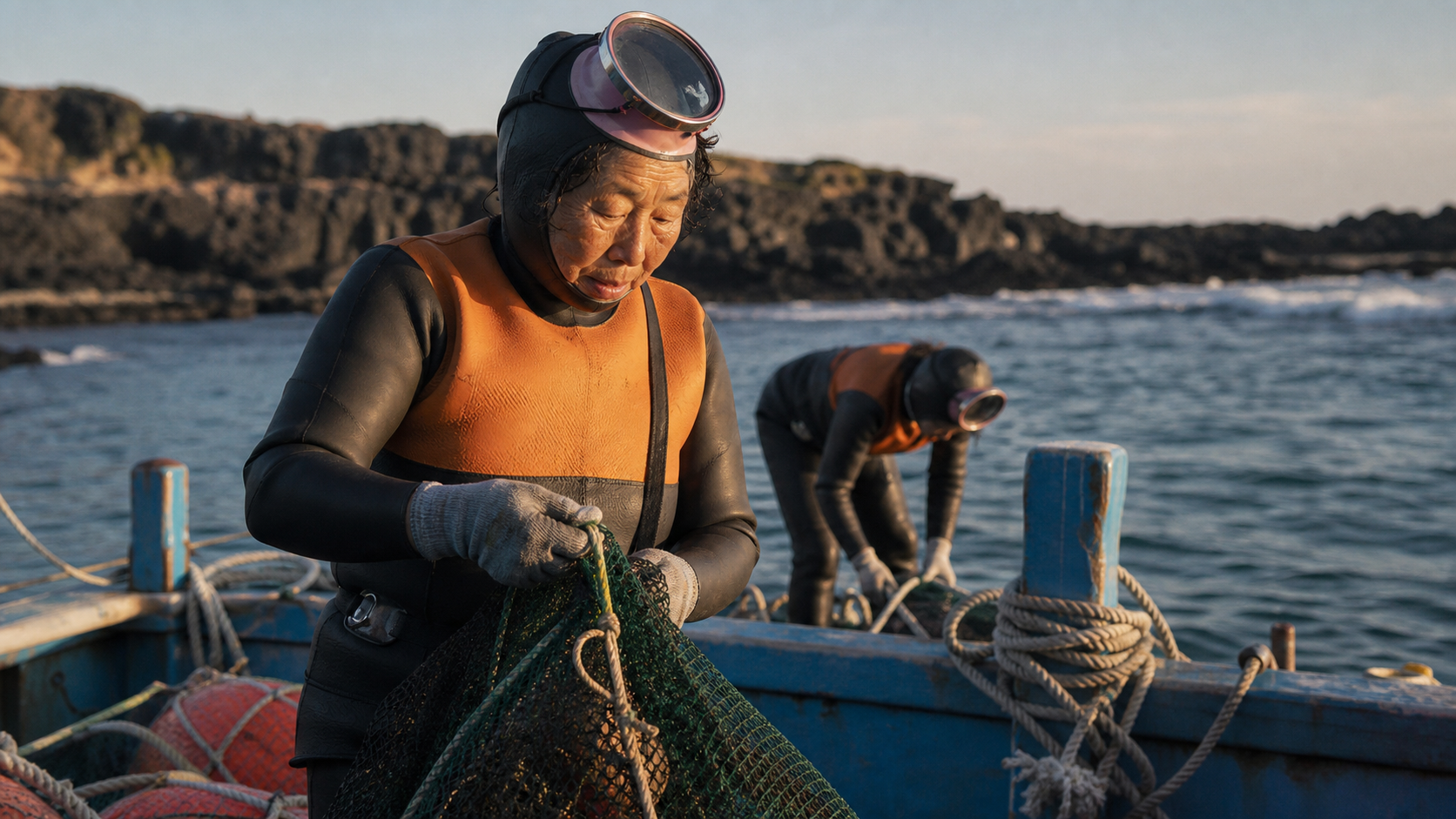
Haenyeo (해녀) are Jeju's female free-divers — women who descend to the seafloor without oxygen tanks to harvest abalone, sea cucumber, turban shells, and other marine produce, a practice documented across several centuries of island history. The tradition is rooted in a specific social structure: haenyeo communities historically organised cooperative diving operations, maintained knowledge of seasonal harvest cycles, and transmitted diving skills from mothers to daughters through direct apprenticeship. According to Korea Insider, fewer than 4,000 active haenyeo remain today, and the vast majority are between 60 and 80 years old — a demographic profile that makes generational succession increasingly uncertain. The profession, once a dominant economic force in coastal Jeju communities, has faced sustained decline as younger generations pursue mainland careers and the physical demands of breath-hold diving prove a barrier to new entrants outside the tradition.
The haenyeo's technique involves breath-hold dives to depths typically ranging from 5 to 20 metres, with experienced divers reaching up to 30 metres. Each dive lasts between one and two minutes. Haenyeo traditionally wore white cotton garments; contemporary practitioners use modern neoprene wetsuits. A defining sonic marker of the practice is the sumbisori — the distinctive whistling exhale produced as a diver surfaces and regulates breathing between dives. The communal dimension is significant: haenyeo dive in groups, historically shared catch across their community, and maintained collective rights over designated coastal harvest zones. This social model gave Jeju's coastal women a degree of economic and social standing within their villages that differed markedly from mainland Korean gender structures of the same periods.
"The haenyeo culture encompasses the knowledge of the sea and nature, social practices and rituals, oral traditions, and community bonds of Jeju's female divers — representing an outstanding example of a sustainable livelihood practice transmitted across generations." — UNESCO World Heritage Centre, in documentation relating to Jeju's intangible cultural heritage inscription
The 2016 UNESCO Intangible Cultural Heritage inscription raised global visibility for haenyeo culture substantially, drawing documentary filmmakers, international journalism, and a new wave of tourist interest to the island's coastal villages. Haenyeo performance tours — typically held at designated beaches near Seongsan Ilchulbong on the eastern coast and in communities around Udo Island — allow visitors to observe dives and interact with active practitioners. These organised experiences have become one of Jeju's mainstream tourism draws, now incorporated into multi-day island itineraries by tour operators. Revenue from tourism-linked haenyeo activities funds some community support programmes; however, as noted by Travel and Tour World, increased international visibility has not reversed the demographic decline — the number of registered haenyeo has continued to fall despite heightened global recognition.
Jeju's Distinct Culture: Language, Shamanic Traditions, and Local Cuisine
Jeju's cultural identity diverges from mainland South Korea across three interconnected dimensions: language, spiritual tradition, and food. Jejueo (제주어), the island's indigenous language, is classified by UNESCO as critically endangered — the highest endangerment category short of extinction — with fluent speakers almost exclusively drawn from an elderly population. The language is structurally distinct from standard Korean to a degree that mutual intelligibility is not assured; some linguists classify it as a separate language rather than a dialect of Korean. Indigenous shamanic traditions, locally called musok, remain more intact on Jeju than in any other region of South Korea, with community rituals still performed at key seasonal points by local practitioners called simbangs. The island's food culture is shaped directly by its volcanic geology and maritime position — producing ingredients and dishes that exist nowhere else in the country, including black-pig barbecue (흑돼지), abalone porridge (jeonbok-juk), and hallabong, a citrus hybrid cultivated only on Jeju's volcanic soils.
"Jejueo, the language indigenous to Jeju Island, South Korea, is critically endangered, with fluent speakers numbering in the hundreds and drawn almost entirely from elderly generations — a classification that places it among the most at-risk languages in East Asia." — UNESCO Atlas of the World's Languages in Danger, cited via Wikipedia
The shamanic tradition on Jeju holds a structure distinct from mainland Korean folk religion. Simbangs — practitioners who serve as intermediaries between the human community and the spirit world — conduct community-level rites called gut that address agricultural cycles, maritime safety, and collective wellbeing. These practices have persisted longer on Jeju in part because the island's geographic isolation buffered it from certain waves of religious and cultural change that reshaped the mainland during the Joseon dynasty and twentieth-century modernisation. Outdoor shrines called danpat, dedicated to specific local guardian figures, can still be found in rural Jeju villages and remain active sites of practice rather than museum-piece installations.
Jeju's food landscape is inseparable from its volcanic geology and marine ecology. Black pigs (흑돼지) — a heritage breed adapted to the island's terrain over centuries — produce pork with a distinctive flavour attributed to the breed's diet and environment. Restaurants concentrated along Jeju City's Heukdwaeji Street serve it grilled over charcoal in dedicated dining strips. Abalone porridge (jeonbok-juk), made from haenyeo-harvested abalone slow-cooked with rice and sesame oil, is a restorative dish tied specifically to the island's marine culture. Hallabong — a sweet-tangy mandarin-orange hybrid developed in Jeju's agricultural research stations and grown in volcanic-soil orchards — is both a signature agricultural product and a cultural emblem of the island's distinctiveness. Rural village stays and culinary immersion tours are increasingly being incorporated into Jeju tourism packages, as local authorities frame food and cultural practice as heritage worth sustaining rather than mere visitor amenity, according to Travel and Tour World.
Getting to Jeju: Flights, 2026 Route Changes, and When to Visit
The Seoul (Gimpo)–Jeju air corridor is consistently ranked among the world's busiest, with flights departing every 15 to 20 minutes throughout the day at fares of approximately ₩40,000 to ₩80,000 one-way, as noted by Korea Insider. The frequency and low pricing reflect the route's role as the primary domestic link in a country where no fixed transport connection to Jeju exists — no bridge, no rail tunnel, no ferry service capable of competing on journey time. A significant change arrived in April 2026: the Incheon International Airport–Jeju direct route was restored after approximately a decade's suspension, operated by Korean Air and select low-cost carriers. According to The Traveler, this development eliminates the domestic transfer step at Gimpo Airport that international arrivals previously navigated, cutting total journey time by one to two hours for travellers connecting from overseas.
For international visitors, the practical impact of the Incheon–Jeju route is considerable. Previously, arriving at Incheon on a long-haul flight required clearing immigration, collecting luggage, transferring to Gimpo Airport — approximately 70 km by bus or rail — checking in again, and boarding a separate domestic service. The restored Incheon route condenses that process to a single connection at the same terminal. Tour operators have already begun restructuring itineraries around this access improvement: the previous two-night Jeju add-on model at the tail end of a Seoul itinerary is giving way to standalone five- to seven-night island stays, as reported by The Traveler. South Korea overall recorded 4.76 million foreign arrivals in Q1 2026 — a 23% year-on-year increase — with Jeju positioned alongside Seoul and Busan as a primary beneficiary, per data from MICE Travel Advisor.
Timing a visit to Jeju depends on what the traveller wants from the island. April and May are widely regarded as favourable months: spring wildflowers — yellow canola fields and cherry blossoms across the interior — cover the landscape, temperatures average 15–20 °C, and rainfall is comparatively low. October and November offer a similar balance, with autumn foliage across Hallasan's slopes and comfortable conditions for hiking. Summer (July–August) is peak season — beaches reach full capacity, and typhoon season introduces weather risk that can disrupt flights and coastal access. Winter is mild relative to the Korean mainland, with average temperatures rarely below 5 °C, and the island is quieter, though some hiking routes and the Hallasan summit trail may close during cold spells or high winds. Jeju has no subway or rail network; car rental — compact models from approximately ₩30,000 to ₩50,000 per day — is considered standard for independent exploration beyond the main bus corridors linking Jeju City, Seogwipo, and the key coastal sites.
Frequently Asked Questions
How do I get to Jeju Island from Seoul?
The standard route is a direct flight from Gimpo Airport (GMP) in western Seoul to Jeju International Airport (CJU), with services departing every 15 to 20 minutes throughout the day. One-way fares typically range from approximately ₩40,000 to ₩80,000, depending on carrier and booking timing. Flight duration is approximately one hour. Since April 2026, a direct Incheon International Airport (ICN)–Jeju service has also operated, served by Korean Air and select low-cost carriers. This Incheon option is particularly useful for international arrivals, as it eliminates the need to transfer domestically at Gimpo — saving one to two hours of total travel time. Travellers coming from overseas should check both Gimpo and Incheon departure options when booking, as fares and schedules differ between the two Seoul-area airports.
What are Jeju Island's UNESCO designations?
Jeju holds four UNESCO recognitions across two categories. In the natural heritage category: a Biosphere Reserve (2002) covering the island's ecological diversity; a World Natural Heritage inscription (2007) for three specific components — Hallasan National Park, Seongsan Ilchulbong, and the Geomunoreum Lava Tube System; and a Global Geopark designation (2010), one of the first in East Asia. Separately, the haenyeo tradition — Jeju's community of female free-divers — was inscribed on UNESCO's Representative List of Intangible Cultural Heritage of Humanity in 2016, recognising the cultural knowledge, social structures, and practices surrounding the diving tradition. Together these four designations place Jeju in a very small global category of locations holding both natural and intangible cultural heritage recognition from UNESCO simultaneously.
Who are the haenyeo and can visitors observe them?
Haenyeo (해녀) are Jeju's female free-divers, who harvest abalone, sea cucumber, and shellfish by holding their breath and descending to the seafloor — without oxygen tanks. The practice has been central to Jeju's coastal communities for several centuries. Fewer than 4,000 active haenyeo remain today, most of them aged between 60 and 80. Visitors can observe dives at haenyeo performance tours held at designated coastal sites, most notably near Seongsan Ilchulbong on the island's eastern coast and in communities around Udo Island. These structured sessions allow guests to watch a dive sequence, hear explanations of the harvest process and the practitioners' breathing techniques, and speak with active haenyeo. Booking in advance is advisable during peak travel months (April–May and July–August), as popular coastal tour slots fill quickly.
What makes Jeju different from mainland South Korea?
Jeju's distinctiveness operates across language, culture, geology, and cuisine in ways that are difficult to find elsewhere in Korea. The island's indigenous language, Jejueo (제주어), is UNESCO-classified as critically endangered and is structurally distinct enough from standard Korean that some linguists treat it as a separate language rather than a dialect. The island maintains shamanic community rituals (musok) that have diminished significantly elsewhere in the country. Geologically, Jeju's volcanic origin produces a landscape — and agricultural soils — that the mainland does not share, enabling crops like hallabong citrus that exist nowhere else in South Korea. Signature foods including black-pig barbecue (흑돼지) and abalone porridge (jeonbok-juk) are tied specifically to this island's ecosystem and the haenyeo harvest tradition. Jeju also operates as South Korea's only Special Autonomous Province, giving it governance structures and investment policies that differ from every other Korean province.
What is the best time of year to visit Jeju Island?
April to May and October to November are the most favourable travel windows for Jeju. Spring (April–May) brings canola fields and cherry blossoms across the island's interior, mild temperatures averaging 15–20 °C, and lower rainfall — conditions well suited to both hiking on Hallasan's trails and coastal exploration near Seongsan. Autumn (October–November) offers similar comfort levels, with seasonal foliage across Hallasan's slopes and noticeably fewer crowds than the summer peak. July and August are the busiest months, with beaches at full capacity and a meaningful risk of typhoons that can disrupt flights and coastal access. Winter is mild compared to mainland Korea and the island is quieter during this period, though some hiking routes and the Hallasan summit trail may close in adverse weather. Whatever the season, car rental is recommended for independent travel, as Jeju has no rail network and bus routes leave significant gaps in coverage of the island's dispersed sites.
Jeju in Context: What the Designations and 2026 Changes Mean in Practice
Jeju Island's position among South Korea's travel destinations is grounded in a combination that few places on Earth share: volcanic geology of global scientific significance, a living intangible cultural heritage under active demographic pressure, a language on the edge of extinction, and a food culture rooted directly in the land and sea rather than adopted from outside. The UNESCO designations — four of them across natural and cultural categories — are not a marketing framework but a substantive international assessment of phenomena that are genuinely rare at the global level. The 2026 restoration of the Incheon–Jeju direct route marks a structural shift in how the island connects to international travel: it reduces the logistical friction that previously pushed overseas visitors to treat Jeju as a brief add-on rather than a primary destination in its own right. South Korea's Q1 2026 arrivals — 4.76 million visitors, a 23% year-on-year increase — suggest the broader travel environment is aligned with that accessibility improvement, according to MICE Travel Advisor.
The island's government is simultaneously pursuing a strategy to develop Jeju as a global resort destination — investing in hospitality infrastructure, cultural content, and a proposed national research centre for Tamra cultural heritage, according to Korea.net. Hotel capacity is expanding in anticipation of longer-stay visitors arriving via the Incheon route, and cargo infrastructure improvements are expected to benefit Jeju's seafood and agricultural export sectors. For travellers factoring the island into a South Korea trip, the practical picture is clear: the Incheon–Jeju link removes the most significant logistical barrier, domestic fares remain affordable, and the island's road network allows a rental car to cover the major volcanic and coastal sites within two to three days. Those focused specifically on the haenyeo experience or the full Hallasan hiking circuit would benefit from a stay of at least four nights.
The deeper challenge Jeju faces — the erosion of Jejueo among younger generations, the aging of the haenyeo community, the pressure that mass tourism exerts on traditional village life — runs in parallel to its rising international recognition. These are not dynamics that visitor numbers alone can reverse; they require sustained community investment, language education policy, and active knowledge transmission. What travel can offer is direct exposure to this heritage while it remains observable. For anyone planning a South Korea itinerary in the coming seasons, Jeju in the spring — volcanic slopes covered in canola yellow, the Incheon route now operational, the haenyeo still diving off the eastern coast — represents a combination of access and authenticity that the island has rarely offered as clearly as it does in 2026.
Last updated: 2026-05-11. This article was reviewed against UNESCO records, official tourism data, and 2026 route announcements current as of publication date.
Related Articles
- 7-Day South Korea Itinerary 2026: Seoul to Busan for Visiting Fans
- Seoul's Historical Soul: Palaces, Hanok, and Creative Districts
- Seoul Street Food Markets & Neighborhood Eats: 2026 Guide
- Korea-UAE K-Pop: Every Major Festival and Concert 2025-2026
- Korean Dramas Starring K-Pop Idol Actors: The 2018 Class
This article was written using information collected and analyzed by NAMANE's in-house K-pop research AI engine. We use AI technology to bring you faster, broader coverage, and in the process some details may occasionally differ from the latest facts. For important information such as dates, venues, and prices, please double-check with official sources.


