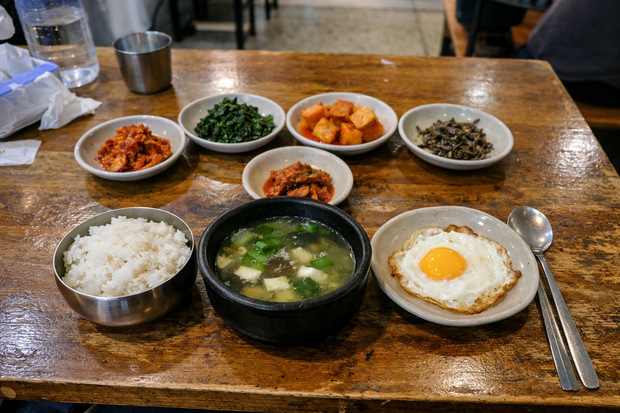
The short answer: A traditional Korean breakfast centers on steamed rice (bap / 밥), three to five small side dishes (banchan / 반찬), and a bowl of soup — but by 2025, the share of Korean adults eating rice in the morning had fallen to roughly 40%, down from about 60% in 2021, as convenience store snacks, bakery cafes, and single-serving meal kits reshaped morning habits across the country.
Korean breakfast is not a fixed institution in the way that, say, a full English or a Japanese teishoku is codified by custom. It is a negotiation between centuries-old culinary tradition and the pressures of modern urban life — rising food costs, shrinking household sizes, and a generation of teenagers who would rather eat a butter-salt bread roll than spoon through fermented soybean paste before school.
This guide is built for travelers and newcomers who want to eat the way locals actually do — not the way tourism brochures suggest. You will find specific dishes, real prices in Korean won, named restaurants and convenience store chains, and the data behind the shifts happening right now. Whether you plan to cook, eat out, or grab something between subway cars, there is a Korean breakfast option that fits your schedule and budget.
Throughout this guide, practical payments and logistics are handled more easily with a prepaid travel card. NAMANE Card is accepted at convenience stores, cafes, and hotel buffets across Seoul, making it a reliable option for visitors managing daily expenses without a Korean bank account.
What Does a Traditional Korean Breakfast Actually Look Like?
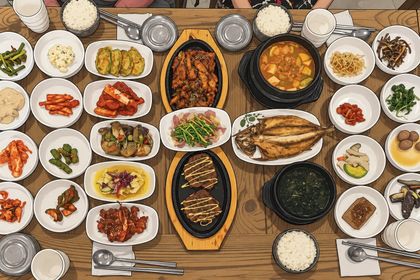
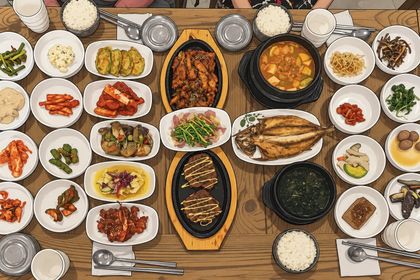
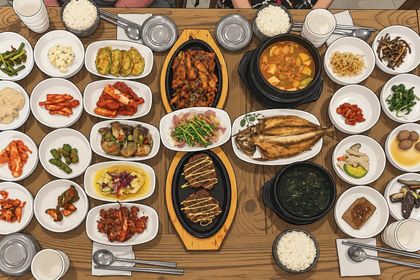
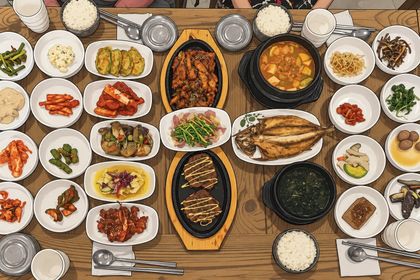
Quick Answer: A traditional Korean breakfast is a full table spread: steamed rice, one hot soup (usually miyeok guk or doenjang jjigae), and three to five banchan including kimchi, seasoned spinach, and stir-fried anchovies. Although rice consumption at breakfast has dropped to around 40% of adults by 2025, this format remains the cultural baseline for Korean morning eating.
Walk into a Korean grandmother's kitchen at 7 AM and you will likely find a gas burner warming a clay pot of soup, a rice cooker keeping bap at exactly the right temperature, and four or five small ceramic dishes already arranged on the table. The aesthetic is deliberate: color, texture, and nutrition are all considered. Nothing about a traditional Korean breakfast is accidental.
The meal is meant to be eaten together, each person with their own bowl of rice and soup, sharing the communal banchan from the center of the table. It is filling, balanced, and — to unaccustomed palates — startlingly savory for the first meal of the day. There is no sweetness, no fruit juice, no toast. Salt, umami, and fermented depth define the flavor profile from the first spoonful.
The Core Components of the Korean Breakfast Table
The architectural unit of a Korean breakfast is the combination of bap (밥 / steamed rice), guk or jjigae (국/찌개 / soup or stew), and banchan (반찬 / side dishes). Each element has a role.
Bap (밥 / steamed rice) is the caloric foundation. Short-grain white rice, cooked until each grain is slightly sticky, is the default. Multigrain rice (japgokbap / 잡곡밥) — a blend of white rice, brown rice, black beans, barley, and millet — is common in health-conscious households and has been gaining market share as dietary fiber awareness grows among Korean adults over 40.
Kimchi (김치) is non-negotiable. Napa cabbage kimchi (baechu kimchi / 배추김치) appears on virtually every Korean breakfast table, whether the household is eating a full traditional spread or just grabbing a quick bowl of rice. It provides acidity, heat, and the probiotic quality that Korean nutritionists frequently cite as central to digestive health.
Sigeumchi namul (시금치 나물 / seasoned spinach) is one of the most common vegetable banchan. Blanched spinach is dressed with sesame oil, garlic, soy sauce, and sesame seeds. It takes about five minutes to prepare and is often made in bulk the night before. Myeolchi bokkeum (멸치 볶음 / stir-fried anchovies) are dried small anchovies pan-fried with soy sauce, sugar, and sometimes gochujang until they are glossy and slightly caramelized — eaten with rice, a few at a time, and kept at room temperature for several days.
Nurungji (누룽지 / scorched rice crust) deserves its own mention. Dating to the Joseon Dynasty (1392–1897), nurungji is the crust that forms at the bottom of a stone or iron pot when rice cooks over direct heat. Some households deliberately cultivate it; others encounter it as a byproduct of cooking in a dolsot (돌솥 / stone pot). Poured with hot water, it becomes a thin, smoky congee. On its own, it is eaten as a dry, crunchy snack — or as the last act of a breakfast, a palate-cleansing finish.
The Role of Soup: Guk Versus Jjigae
Korean distinguishes carefully between guk (국) and jjigae (찌개), and the difference matters at breakfast. Guk is a light, broth-forward soup — thinner, less intensely seasoned, and typically served in individual bowls. Jjigae is a thicker stew, served communally in a clay pot (ttukbaegi / 뚝배기), with ingredients crowding the surface.
Miyeok guk (미역국 / seaweed soup) is the most common breakfast guk. Dried miyeok (sea mustard, a brown seaweed) is rehydrated and simmered in a beef or anchovy broth with sesame oil and a small amount of soy sauce or salt. It is light enough to eat early in the morning without weighing down the stomach, and its cultural significance extends beyond nutrition — miyeok guk is the dish Koreans eat on birthdays, as mothers traditionally consume it after childbirth for its iodine and mineral content.
Doenjang jjigae (된장찌개 / fermented soybean paste stew) is the heartier option, more common at lunch or dinner but still eaten at breakfast in many households, particularly among older Koreans. The base is doenjang (된장), a thick, pungent fermented paste with the complexity of aged miso but earthier and more assertive. Tofu, zucchini, mushrooms, and onion are typical additions. It pairs especially well with multigrain rice.
Why Are Fewer Koreans Eating Rice for Breakfast?
The numbers are clear. Rice consumption at the Korean breakfast table has declined sharply over the past five years: roughly 60% of Korean adults reported eating rice as their morning meal in 2021; by 2025, that figure had dropped to approximately 40% (source: USDA FAS, -01). Among teenagers, the shift is more pronounced — more than half now prefer bread, sandwiches, or cereal over rice at breakfast.
Several structural forces are driving this change. First, household composition has shifted dramatically: 42% of Korean households are now single-person units, a demographic that tends to favor convenience over preparation. Cooking a full rice-and-banchan breakfast for one person requires the same effort as cooking for a family of four, but the motivation is proportionally lower. A convenience store triangular gimbap or a bakery bread roll requires no cooking, no dishes, and no planning.
Second, food prices have risen substantially. The price of a single gimbap roll — itself a convenience food — increased 50.6% between 2020 and 2025, reaching approximately ₩3,800. In April, food price pressures had become severe enough that university students in Seoul were actively seeking meals at temple cafeterias, which offer subsidized or free food to offset the cost burden (source: Korea JoongAng Daily, -04-24). The shift away from rice is, in part, a financial calculation as much as a lifestyle preference.
Third, the structure of the Korean workday has changed. Longer commute times, earlier school start times, and the normalization of eating on the go have compressed the window available for a sit-down meal. Convenience stores have recognized this opportunity and moved aggressively to meet it. Morning sales at CU — one of Korea's largest convenience store chains — rose approximately 17% in 2025 between the hours of 5 AM and 10 AM (source: Korea JoongAng Daily, -03-09).
What Do Koreans Buy at Convenience Stores for Breakfast?
Korea's convenience store sector is among the most sophisticated in the world for ready-to-eat food. Unlike their counterparts in Europe or North America, Korean convenience stores operate as genuine meal destinations — not merely snack depots. Freshly made sandwiches, hot foods, steamed rice dishes, and coffee are all available from opening time, and the quality-to-price ratio is genuinely competitive with fast-casual restaurants.
CU and GS25 Morning Picks
CU and GS25 are the two dominant convenience store chains in Korea, with thousands of locations in Seoul alone. Both operate robust morning food programs. At a CU location in Myeongdong, a typical breakfast purchase runs as follows: samgak gimbap (삼각김밥 / triangular rice ball) for ₩1,200–₩1,800, a standard gimbap roll for ₩3,800, or a sandwich for approximately ₩2,500. Adding a canned coffee or a small iced Americano from the in-store machine brings the total to ₩3,500–₩6,500 — a complete breakfast for under US$5.
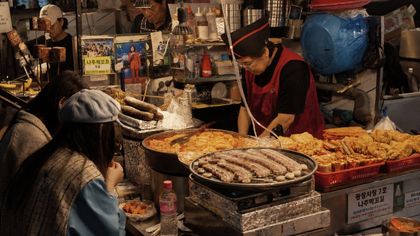
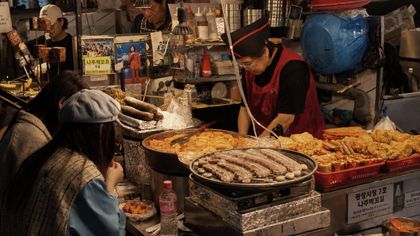
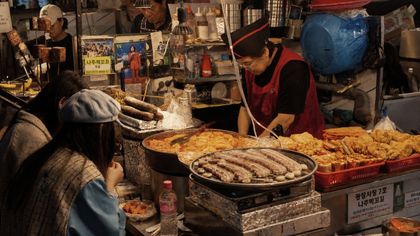
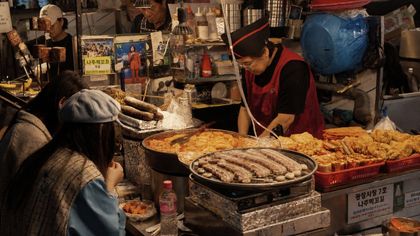
Hot food counters at larger convenience stores offer steamed buns (jjinppang / 찐빵), fish cake skewers (eomuk / 어묵) in warm broth, tteokbokki (떡볶이 / spicy rice cakes), and instant ramen cooked on-site. During winter months, the warm broth counters draw early-morning commuters who stand at the small eat-in counters with their bags still on their shoulders.
For visitors managing payments in Korea, the NAMANE Card service manual details how to load and use the card at CU and GS25 registers, which accept it the same way they accept any contactless payment card. Tapping to pay at a convenience store is standard practice in Seoul — cash transactions are increasingly rare, especially in urban locations.
Gimbap: Not What You Think It Is
Foreign visitors frequently conflate gimbap (김밥) with Japanese sushi rolls, and the visual similarity is real enough to create the confusion. But the two are fundamentally different products. Gimbap uses cooked fillings — egg, ham, crab stick, pickled radish (danmuji / 단무지), spinach, and carrot are standard — and the rice is seasoned with sesame oil and salt, not rice vinegar and sugar. The flavor profile is savory and warm, designed to be eaten at room temperature or slightly above, not chilled.
Samgak gimbap (삼각김밥 / triangular rice ball) is the convenience store variant: a triangular rice parcel wrapped in seaweed, with a filling at the center. Common fillings include tuna with mayonnaise, kimchi pork, spicy pollack roe, and bulgogi beef. The packaging is engineered so that the seaweed stays crisp until the moment of eating — a small design triumph that has made samgak gimbap one of the most popular portable breakfasts in Korea.
Where Do Seoul Locals Go for Breakfast Outside the Home?
Seoul's breakfast-out culture has expanded considerably in recent years. The city's cafe density is among the highest in Asia, and many specialty cafes now open at 8 AM or earlier specifically to capture the morning market. Simultaneously, hotel breakfast buffets have transcended their traditional role as amenities for overnight guests and have become standalone dining destinations for local residents.
Hotel Breakfast Buffets: The No-Bed Trend
In 2025, a notable consumer trend emerged in Seoul: locals — particularly seniors and multi-generational families — began booking hotel breakfast buffets as a leisure activity entirely separate from any overnight stay. Korea JoongAng Daily described this as the "no-bed" breakfast trend, reflecting a significant shift in how luxury hotel dining was being consumed (source: Korea JoongAng Daily, 2025-05-23).
The Shilla Seoul Hotel (신라호텔), located at 249 Dongho-ro, Jung-gu, runs its breakfast buffet daily from 6:30 AM to 10:30 AM. Walk-in guests — those not staying at the hotel — can access the buffet for approximately ₩70,000 per person. The spread includes both Korean and Western options: steamed rice, soups including miyeok guk and doenjang jjigae, a rotating banchan selection, and fresh juices. For Korean families treating Sunday breakfast as a family outing, the price is steep but considered appropriate for the experience. Reservations on weekends are recommended; weekday walk-ins are generally available.
Seongsu and Hongdae: The Cafe Breakfast Circuit
At the other end of the price spectrum, Seoul's specialty cafe districts offer a different kind of morning experience. The Seongsu area (성수동), once an industrial zone of shoe factories and warehouses on the east bank of the Han River, has transformed into a dense concentration of design-forward cafes and bakeries. Italian food media outlet Cook Inc. documented this transformation in a 2025 report, noting that Seongsu's cafe density has created a genuine breakfast culture in a district that was primarily warehouse territory as recently as 2018 (source: Cook Inc., 2025-10-17).
Cafe Onion Seongsu (카페 어니언 성수점), at 25 Achasan-ro 9-gil, Seongdong-gu, is one of the neighborhood's most-visited spots. It opens at 8 AM. The menu centers on freshly baked bread: the signature salt bread (소금빵 / sogeum-ppang) is priced at ₩3,500, with other items ranging from ₩4,000 to ₩7,000. The interior occupies a repurposed warehouse with exposed concrete and steel beams, and the morning light through the skylights makes it a popular destination for those working remotely or taking a slow morning before the city speeds up. In Hongdae, the morning scene skews younger — croissant shops, specialty espresso bars, and egg sandwich counters cluster around the university's exits, catering to students and creative industry workers.
Korean Breakfast Options Compared
The range of Korean breakfast formats — from a full home-cooked rice spread to a convenience store rice ball eaten standing on a subway platform — reflects the genuine diversity of how the morning meal functions in Korean daily life. The table below maps the key options across the dimensions most relevant to travelers and residents alike.
| Type | Items | Price (₩) | Where | Best For |
|---|---|---|---|---|
| Traditional Home-Style | Rice, soup, 3–5 banchan, kimchi | ₩2,000–₩5,000 (ingredients); ₩8,000–₩18,000 (restaurant set) | Home kitchen; Insadong, Jongno restaurants | Full nutritional balance, cultural authenticity |
| Convenience Store | Samgak gimbap, gimbap roll, sandwich, canned coffee | ₩1,200–₩6,500 | CU, GS25, 7-Eleven nationwide | Speed, price, solo travelers, early commuters |
| Bakery Cafe | Salt bread, croissant, Americano, egg sandwich | ₩3,500–₩12,000 | Seongsu, Hongdae, Itaewon, Yeonnam-dong | Slow mornings, remote work, specialty coffee |
| Hotel Buffet | Korean and Western spread, including rice, soups, banchan, fresh juice | ₩40,000–₩90,000 (walk-in) | Shilla Seoul, Grand Hyatt, Lotte Hotel | Special occasions, families, the no-bed dining trend |
| Traditional Restaurant Set | Full jeongshik (정식): rice, soup, 7–10 banchan | ₩8,000–₩18,000 | Insadong, Bukchon, Jongno | First-time visitors wanting the full table experience |
Practical Tips for Foreign Visitors Eating Korean Breakfast
Eating breakfast in Korea as a visitor involves a few logistical realities that are easy to navigate once you know them. The following points cover the most common friction points — from payment to dietary restrictions to timing — based on how the morning food landscape actually works.
- Arrive early at popular cafes. Specialty cafes in Seongsu and Hongdae frequently sell out of signature items by 10 AM on weekends. Arriving at opening time — usually 8 AM — is the only reliable way to get first-pick selection.
- Carry a contactless payment option. Cash is increasingly uncommon at Seoul cafes and convenience stores. A prepaid travel card such as NAMANE Card works across convenience stores, cafes, and hotel buffet cashier desks. Details on loading and using it are in the NAMANE service manual.
- Understand the banchan system. At traditional restaurants, banchan are communal and refillable at no extra cost. Do not feel obligated to finish every dish — it is expected that some remains.
- Hotel buffets accept walk-in guests. You do not need to be a hotel guest to eat at a hotel breakfast buffet in Seoul. Reservations are recommended for weekend visits at properties like the Shilla Seoul.
- Convenience store hot counters run from the early morning. At 24-hour locations, the hot food counter — fish cake broth, steamed buns, tteokbokki — is available from early morning and represents genuine value for money.
- Label reading helps with dietary restrictions. Major convenience store chains now print allergen and ingredient information in English on many items, but not all. Vegetarian and halal options are limited; see the FAQ section for more detail.
- For a broader overview of navigating Seoul's neighborhoods by meal type — including areas where breakfast restaurant culture is strongest — additional neighborhood guides are available through this site.
How Korean Breakfast Compares to Japan and China
Placing Korean breakfast habits in regional context illuminates both what is distinctive about Korean food culture and what patterns are shared across Northeast Asian eating traditions. The most instructive comparison is with Japan, where a similar tension between rice-based tradition and convenience-oriented modernity played out a generation earlier.
In Japan during the 1980s, a rapid shift toward Western-style breakfast foods — toast, coffee, eggs — displaced the traditional ichiju sansai (一汁三菜) format of rice, miso soup, and three side dishes. By the early 1990s, the share of Japanese adults eating rice for breakfast had declined sharply. The response, from the early 2000s onward, was a sustained commercial and institutional effort to revive washoku (和食) breakfast habits through restaurant sets, hotel buffet marketing, and school nutrition programs — a revival that eventually reached official recognition when UNESCO named washoku an Intangible Cultural Heritage in 2013. Korea appears to be navigating an earlier stage of the same arc: rice consumption at breakfast fell from 60% to 40% of adults in four years, and whether a comparable cultural renewal follows will depend on food pricing, government policy, and whether the convenience sector continues developing alternatives that feel culturally grounded rather than merely efficient.
Chinese breakfast (zaofan / 早饭) presents a different model. The Chinese morning meal tradition — congee (zhou / 粥), fried dough sticks (youtiao / 油条), steamed buns (baozi / 包子), and warm soy milk — is already built around portability and street food, making the transition to convenience-oriented eating less disruptive than in Korea or Japan. The flavor profile, like Korea's, skews savory, but the rice base takes liquid rather than solid form, which changes the texture and preparation requirements considerably. Korean breakfast, by contrast, has always emphasized the full solid rice meal, which is why the convenience store pivot involves substituting the meal format entirely rather than simply adjusting its delivery method.
| Dimension | Korea | Japan | China (Northern) |
|---|---|---|---|
| Staple base | Short-grain white or multigrain rice | Short-grain white rice or toast | Rice congee or wheat (baozi, mantou) |
| Key flavors | Fermented, sesame, mild chili, umami | Delicate umami, miso, restrained salt | Savory, mild, oily (regional variation) |
| Convenience equivalent | Samgak gimbap (₩1,200–₩1,800) | Onigiri (¥120–¥200) | Baozi (¥2–¥5) |
| Rice % at breakfast (approx. 2025) | ~40% of adults | ~35% of adults | ~55–65% (varies by region) |
| Budget breakfast cost | ₩1,200–₩6,500 | ¥120–¥500 | ¥5–¥25 |
Frequently Asked Questions
What is the most traditional Korean breakfast dish?
The most traditional Korean breakfast is a format rather than a single dish: steamed short-grain rice (bap / 밥), a bowl of miyeok guk (미역국 / seaweed soup) or doenjang jjigae (된장찌개 / fermented soybean paste stew), and three to five banchan including kimchi, seasoned spinach, and stir-fried anchovies. If one dish had to be named, miyeok guk — with its light broth and deep cultural significance — is the most distinctively Korean breakfast food, eaten daily in many households and specifically associated with birthdays and postpartum recovery.
Where can I eat a traditional Korean breakfast in Seoul?
Traditional Korean breakfast sets (jeongshik / 정식) are available at hanok-style restaurants in Insadong (인사동) and Bukchon (북촌), typically opening between 7:30 and 9 AM. The Jongno (종로) area also has several restaurants specializing in morning rice sets. For a luxury option, the Shilla Seoul Hotel at 249 Dongho-ro, Jung-gu offers a full Korean and Western buffet from 6:30 AM to 10:30 AM daily, with walk-in pricing around ₩70,000 per person. The hotel is accessible from Dongdaemun History and Culture Park Station (Lines 2, 4, 5), Exit 14.
Is Korean breakfast spicy?
It depends on the specific dishes. Kimchi — present at nearly every Korean breakfast table — ranges from mildly tart to moderately spicy depending on fermentation time and recipe. Myeolchi bokkeum (stir-fried anchovies) may include gochujang, adding mild heat. The two most common breakfast soups — miyeok guk (seaweed soup) and plain doenjang jjigae — are not spicy at all. Visitors with low spice tolerance can navigate a traditional Korean breakfast comfortably by focusing on the rice, soup, and non-kimchi banchan. Gochujang is served as a condiment on the side at most restaurants, so heat level is generally within your control.
How much does breakfast cost in Seoul?
Breakfast in Seoul spans a wide price range. At the low end, a convenience store samgak gimbap costs ₩1,200–₩1,800 and a full convenience store breakfast with coffee runs ₩3,500–₩6,500. Specialty bakery cafes in Seongsu charge ₩4,000–₩12,000 for bread and coffee. Traditional restaurant sets cost ₩8,000–₩18,000. Hotel buffets for walk-in guests range from ₩40,000 to ₩90,000. All of these options are accessible via contactless payment, including prepaid travel cards such as NAMANE Card.
Do Korean convenience stores have good breakfast options?
Yes, and the quality is genuinely higher than in most countries. Major chains — CU, GS25, 7-Eleven Korea — stock freshly made sandwiches, gimbap rolls, triangular samgak gimbap, steamed buns, and hot soups prepared daily. Hot food counters at larger locations offer tteokbokki, fish cake skewers in broth (eomuk / 어묵), and instant ramen cooked on-site. Morning sales at CU rose approximately 17% in 2025, reflecting demand from Korean commuters, not just tourists (source: Korea JoongAng Daily, -03-09).
What is nurungji and where can I try it?
Nurungji (누룽지) is the scorched crust of rice that forms at the bottom of a clay or iron pot during cooking, eaten as a dry crunchy snack or softened with hot water into a thin smoky congee. Dating to the Joseon Dynasty, it is one of the oldest recorded Korean breakfast foods. The easiest place to encounter it is in restaurants serving dolsot bibimbap (돌솥 비빔밥 / stone pot mixed rice), where the stone bowl creates nurungji during the meal itself. Traditional set-meal restaurants in Insadong sometimes include it as a closing course. Packaged nurungji snacks are also available at most supermarkets.
Are there vegetarian or halal Korean breakfast options?
Vegetarian options exist but require navigation. Many banchan are plant-based — sigeumchi namul, kongnamul (콩나물 / seasoned bean sprouts), and braised lotus root (yeongeun jorim / 연근 조림) contain no meat. The complication is anchovy-based broth (myeolchi yuksu / 멸치 육수), used in many soups and some vegetable preparations and not always visible from the menu. Strict vegetarians should ask specifically for tofu (dobu / 두부) dishes and vegetable-only preparations. Halal options are limited but growing: the Itaewon and Hanam-dong areas of Seoul have the highest concentration of halal-certified restaurants. Checking packaging carefully at convenience stores is advisable, as English-language labeling is present on many but not all items.
Bringing It All Together
Korean breakfast is a category that contains multitudes. The grandmother's clay pot of doenjang jjigae on a low table in a Mapo-gu apartment and the design-school graduate queuing for salt bread at Cafe Onion Seongsu at 8:05 AM are both accurate pictures of the same meal occasion. The decline in rice consumption — from 60% to 40% of adults in four years — is real and consequential, but it has not displaced the cultural framework that defined Korean morning eating for centuries. Rice, kimchi, and soup remain the reference point against which every alternative breakfast is measured, even among those who rarely eat them.
What the data and the street-level evidence together suggest is that Korean breakfast culture is diversifying rather than eroding. The convenience store sector has developed products — gimbap and samgak gimbap in particular — that are culturally Korean even when eaten standing at a counter with a paper cup of coffee. Hotel breakfast buffets are becoming leisure destinations rather than amenities. Cafe districts in Seongsu and Hongdae are building a new morning vocabulary that incorporates specialty coffee and European-style bread without abandoning the savory, fermented sensibility that defines Korean food at every other meal.
For visitors planning a trip to Seoul, the practical upshot is that breakfast is both inexpensive and abundant, with options running from ₩1,200 to ₩90,000 depending on your preferred setting and schedule. A contactless payment solution such as NAMANE Card covers everything from a triangular gimbap at a 5 AM convenience store to a walk-in buffet at the Shilla. Last updated: 2026-04-30. This guide is reviewed and refreshed when official sources (USDA FAS, KTO, Korea JoongAng Daily) update their information.
Related Articles
- Must-Visit During Your Next Trip to Korea! Top 5 Famous Starbucks Locations & Exclusive Merchandise
- 【Mega Hit in Korea!】 Who are the contestants of 'Culinary Class Wars 2'? Introducing the curious chefs together with NAVER MAP!
This article was written using information collected and analyzed by NAMANE's in-house K-pop research AI engine. We use AI technology to bring you faster, broader coverage, and in the process some details may occasionally differ from the latest facts. For important information such as dates, venues, and prices, please double-check with official sources.