
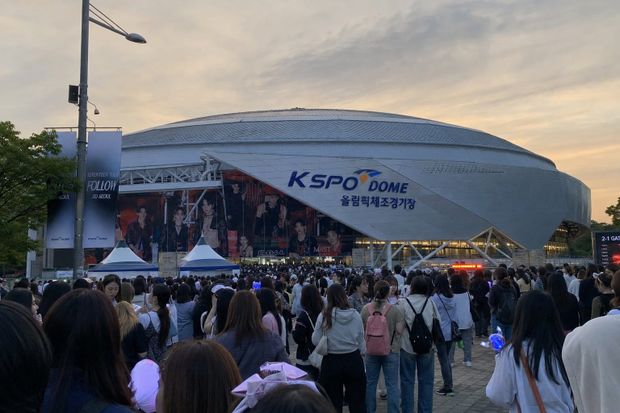
Seoul's K-Pop Venue Landscape: Capacity and Event Tiers
Seoul's K-pop venue landscape is organized around three capacity tiers, each matched to a different scale of production and audience demand. The top tier covers large outdoor stadiums with capacities exceeding 60,000 — including Seoul World Cup Stadium (~66,000 seats) and the Jamsil Olympic Main Stadium (~70,000 seats) — typically reserved for stadium-scale solo tours and year-end broadcast festivals. A middle tier of indoor arenas and domes, ranging from roughly 10,000 to 25,000 seats, represents the most common headline-tour format, with KSPO Dome and Gocheok Sky Dome as its defining venues. A third tier of smaller concert halls (800–6,500 seats) covers dedicated music venues, university auditoriums, and basement clubs favored for fan meetings and debut showcases. One significant development shapes 2025–2026 planning: the Jamsil Olympic Main Stadium has been under major renovation since November 2023, with its reopening not expected until December 2026 (source: NOL). Visitors building a trip around that venue should verify current status before purchasing tickets or confirming travel dates.
Quick Answer: Seoul's K-pop venues fall into three tiers: outdoor stadiums (60,000+), mid-size indoor arenas like KSPO Dome (~15,000 seats) and Gocheok Sky Dome (~25,000 seats), and smaller halls (800–6,500 seats). The Jamsil Olympic Main Stadium (~70,000) remains closed for renovation until December 2026. INSPIRE Arena, adjacent to Incheon Airport, opened in December 2023 as Korea's newest purpose-built concert venue at ~15,000 capacity.
Understanding which tier a concert falls into shapes nearly every logistical decision — from which subway line to take to how far ahead to book nearby accommodation. Outdoor stadium shows at venues like Seoul World Cup Stadium tend to draw the largest global tours and are announced months in advance, while indoor arena dates at KSPO Dome or Gocheok Sky Dome appear on shorter timelines and sell out within minutes of general release. The smallest tier — Yes24 Live Hall, Blue Square's Mastercard Hall, or a university auditorium — typically hosts emerging acts or showcase-format events where tickets are allocated through fan club portals rather than open sales platforms.
The closure of Jamsil Olympic Main Stadium carries real weight for 2026 concert planning. Several artists who previously staged multi-night outdoor runs at Jamsil have shifted to INSPIRE Arena in Incheon or distributed dates across other venues. According to Visit Korea, the broader Jamsil Sports Complex remains fully operational — the Indoor Stadium continues hosting events — but the outdoor main stadium is off the calendar until late 2026. South Korea's concert geography also extends beyond Seoul: Goyang Stadium in Ilsan (~40,000–43,000 seats), BEXCO in Busan, and Incheon Munhak Stadium (~50,500 seats) round out the regional picture for travelers willing to extend their trip.
| Venue | Indoor / Outdoor | Capacity | Subway Line(s) | Nearest Station / Exit | Primary Event Type |
|---|---|---|---|---|---|
| KSPO Dome | Indoor | ~15,000 | Lines 5 & 9 | Olympic Park Station | Mid-scale headline tours |
| Gocheok Sky Dome | Indoor | ~25,000 | Lines 1 & 2 | Sindorim Station, Exit 1 | Major tours, award shows |
| Jamsil Indoor Stadium | Indoor | ~11,000 | Lines 2 & 9 | Sports Complex Station | Mid-scale tours |
| Jamsil Olympic Main Stadium | Outdoor | ~70,000 | Lines 2 & 9 | Sports Complex Station | Stadium tours — closed until Dec 2026 |
| INSPIRE Arena | Indoor | ~15,000 | No subway; airport shuttle | Incheon Int'l Airport | Headline tours, award shows |
| Seoul World Cup Stadium | Outdoor | ~66,000 | Line 6 | World Cup Stadium Station | Stadium tours, festivals |
| Blue Square / Mastercard Hall | Indoor | ~6,500 | Line 6 | Hangangjin Station | Fan meetings, showcases |
| Yes24 Live Hall | Indoor | ~1,500 | Line 5 | Gwangnaru Station | Debut showcases, small tours |
| Peace Hall, Kyung Hee Univ. | Indoor | ~4,400 | Line 1 | Hoegi Station | University concerts, fan events |
| Goyang Stadium (Ilsan) | Outdoor | ~40,000–43,000 | GTX-A | KINTEX Station | Large regional tours |
KSPO Dome: The Benchmark Mid-Size Arena in Olympic Park
KSPO Dome is Seoul's reference-standard mid-size concert arena — the venue fans and event organizers most consistently cite when comparing all-round performance space quality in Korea. With a capacity of approximately 15,000, it occupies a practical sweet spot: large enough to host major headline acts across every K-pop generation, compact enough that sightlines remain strong from every seating tier. The three-floor layout divides the house into VIP floor seats, R-tier (lower bowl), S-tier (mid-level), and A-tier (upper level), and the circular bowl geometry keeps even the highest sections at a noticeably closer distance to the stage than equivalent tiers at larger venues. Built for the 1988 Seoul Olympics as the Olympic Gymnastics Arena, the facility was rebranded KSPO Dome in 2018 under a naming-rights partnership. It sits within Olympic Park in Songpa-gu, accessible via Subway Lines 5 or 9 to Olympic Park Station — a 5–10 minute walk through the park grounds (source: NOL).
"KSPO Dome's three-tier layout gives even upper-level A seats a comparatively clear view of the main stage — a feature fans consistently note when comparing it to Korea's larger dome venues." — Scream FM London, February 2025
KSPO Dome carries considerable weight in K-pop history. BTS, BLACKPINK, and EXO have all used a KSPO Dome date as a career milestone — a signal that an act has reached headline status domestically — according to NOL's venue guide. The venue has hosted album-cycle finales, domestic tour openers, and anniversary concerts for acts spanning every major label group. For fans attending a first live K-pop concert, KSPO Dome's scale — significant but not overwhelming — tends to make the experience unusually immediate compared to a stadium show.
One practical detail that catches visitors off guard: KSPO Dome enforces a strict bag-size rule. Any bag larger than A3 paper (420mm × 297mm) must be checked at the venue's cloakroom, where the fee is KRW 5,000 per item. Smaller bags and clear pouches generally pass through security without issue. Arriving with an oversized backpack or a tote bag full of fan merchandise means spending time at the cloakroom before reaching your seat — worth factoring into your arrival timeline if merchandise queues are also on the agenda. The park setting adds another timing consideration: in summer, the walk from the subway can be warm and slow when large crowds fill the paths simultaneously.
Olympic Park itself provides a practical buffer around the venue. Food stalls, convenience stores, and open green space allow fan communities to gather before shows for photocard trading and lightstick charging. The SK Handball Stadium (~6,500 seats) sits within the same park boundary and occasionally hosts K-pop events for acts at an earlier career stage, so confirming the specific venue name on your ticket — rather than simply navigating to Olympic Park — avoids unnecessary confusion on show day.
Gocheok Sky Dome: Korea's Largest Indoor Arena
Gocheok Sky Dome is Korea's largest indoor concert venue, with a capacity of approximately 25,000. Originally built as a baseball stadium — home ground of the Kiwoom Heroes in the Korea Baseball Organization — it has become one of the primary destinations for headline K-pop tours and major annual award ceremonies, most prominently the Melon Music Awards held here each December. Its scale accommodates productions that KSPO Dome cannot: multi-level stage rigs, elaborate set pieces, and large pyrotechnic sequences that require ceiling height and floor area beyond what a mid-size arena offers. Located near Sindorim Station on Subway Lines 1 and 2 (Exit 1), the venue is a roughly five-minute walk from the station, making transit access relatively direct by Seoul standards (source: What My Trip).
The trade-off for Gocheok's capacity is viewing distance. Upper-level seats — particularly those in the high outfield sections — place fans considerably farther from the stage than equivalent tiers at KSPO Dome. This is partly a function of the dome's baseball-optimized geometry, where the distance from the back row to the field center is substantial even when a concert stage is installed. If your ticket places you in an upper section, bringing binoculars is strongly recommended. Screen coverage is extensive and well-positioned, but for fans who attend primarily for the close visual experience of seeing artists, seat selection carries considerably more weight here than at smaller venues.
Post-show crowd management at Gocheok requires forward planning. When 25,000 people exit simultaneously, the main egress toward Gul Station — adjacent to the dome — can become severely congested. Exiting toward Gaebong Station instead (a 10–15 minute walk from the dome) consistently offers faster boarding times and a less crowded platform, a route documented by Scream FM London and now standard in fan community advice circles. Pre-loading a T-Money card before arrival saves time at the gates when you need to board quickly after the show ends.
In the 2026 concert calendar, Gocheok Sky Dome hosts the Melon Music Awards on December 20, 2026, according to Korea Travel Easy. Award shows at Gocheok feature performances from multiple acts across a single evening — a format that differs meaningfully from a solo tour concert in both atmosphere and ticket-access pathway. Award show tickets are generally allocated through separate, more competitive systems than standard concert ticketing, and seat inventory tends to be tighter relative to the number of fans seeking access.
Jamsil Sports Complex: Multiple Halls, One District
The Jamsil Sports Complex in southeastern Seoul is not a single venue but a cluster of connected sports and event facilities, which regularly causes confusion for first-time visitors navigating ticketing confirmations and venue directions. The two structures most relevant for K-pop events are the Jamsil Indoor Stadium and the Jamsil Olympic Main Stadium. The Indoor Stadium holds approximately 11,000 people in a circular, three-floor layout suited to mid-scale acts performing in-the-round or on a thrust stage. The Olympic Main Stadium, with a capacity approaching 70,000, is an outdoor venue historically used for the largest global tours — but it has been under major structural renovation since November 2023 and is not expected to reopen until December 2026 (source: NOL). Visitors in 2026 whose artist is known to perform at Jamsil should confirm the specific hall before navigating to the complex.
Transit access to the Jamsil Sports Complex is served by Sports Complex Station, reachable via Line 2 or Line 9. Both halls are within walking distance of the station exits, though the Olympic Main Stadium sits farther from the concourse than the Indoor Stadium. Given that Lines 2 and 9 are among the most heavily used in post-concert departures across eastern Seoul — and that Jamsil is a dense residential and commercial neighborhood — platforms can become congested after large shows. Knowing which exit leads most directly to your hall, and having your T-Money card pre-loaded, reduces friction at the end of a long concert evening.
The Jamsil neighborhood surrounding the complex is one of Seoul's better-resourced areas for concert logistics. Numerous restaurants, convenience stores, and cafes cluster around the Sports Complex Station exits, making it practical to eat before a show without extensive advance planning. The nearby Lotte World Tower and Lotte Mall offer additional dining and retail options within a short walk. Hotel availability within a 15-minute walk of the complex narrows rapidly once a major tour is announced; booking 2–3 months in advance is a reasonable baseline for multi-night runs at the Indoor Stadium.
For fans specifically seeking the outdoor stadium scale previously associated with Jamsil's main stadium — the tier that once hosted acts playing to audiences of 60,000 or more — the renovation period points toward alternatives: Seoul World Cup Stadium in Mapo-gu (~66,000 seats, outdoor), or Goyang Stadium in Ilsan (~40,000–43,000 seats, outdoor), now accessible via the GTX-A Line from KINTEX Station, as noted by Trazy Blog.
INSPIRE Arena: Korea's Purpose-Built Concert Venue Near the Airport
INSPIRE Arena is South Korea's first venue designed from the ground up as a dedicated concert arena rather than a converted sports facility or general-purpose hall. Opened in December 2023 on Yeongjongdo Island in Incheon, it sits directly adjacent to Incheon International Airport — a location that gives it distinctive practical advantages for international touring productions whose equipment arrives by cargo flight and for international fans traveling directly from abroad. The arena holds approximately 15,000 people and was built around a 360-degree staging concept, meaning the stage configuration can position the performance area at the center of the room with audience seating extending on all sides. The result is seat-to-stage proximity that is noticeably closer than at Gocheok Sky Dome for many seating sections, despite comparable overall capacity for standard configurations (source: Visit Korea).
"INSPIRE Arena was designed specifically for live entertainment — the acoustic treatment, stage flexibility, and sightline geometry reflect choices that a converted sports venue simply cannot replicate." — What My Trip, K-Pop Concert Guide
The one logistical challenge INSPIRE Arena presents is its distance from central Seoul and the absence of a direct subway connection. There is no metro line running to the venue. The primary access point for most visitors is a free shuttle service from Incheon International Airport, which runs approximately 15 times daily and reaches the arena in about 15 minutes. Traveling from central Seoul to the airport takes roughly 43–60 minutes via AREX (the Airport Express), making the total door-to-venue journey from somewhere like Hongdae or Gangnam closer to 1–1.5 hours each way. Scheduling arrival time accordingly — particularly for evening shows with merchandise queues — is worth building into your itinerary.
INSPIRE Entertainment Resort, the five-star integrated resort adjacent to the arena, provides an on-site accommodation option that removes the commute entirely for multi-day events. For fans attending two or more consecutive nights, or for international visitors combining a concert with their flight schedule, staying on-site is a straightforward solution. Resort room rates during major events increase substantially, so early booking applies here even more than at central Seoul hotels. Korea Travel Easy offers packaged itineraries that bundle airport-area accommodation with concert tickets for select award shows, including the SBS Gayo Daejeon year-end festival (December 25, 2026 at INSPIRE Arena) and the Seoul Music Awards (June 20, 2026), according to their 2026 K-pop tour guide.
Smaller Halls and Regional Venues Worth Knowing
Not every K-pop event takes place in a large arena or stadium. A significant share of the live calendar — fan meetings, debut showcases, anniversary performances, and label showcase events — happens in smaller dedicated venues where the atmosphere, viewing distance, and ticket dynamics operate on entirely different terms. Blue Square / Mastercard Hall, an underground venue near Hangangjin Station on Subway Line 6, is one of the most frequently cited intimate K-pop spaces in Seoul. With a capacity of around 6,500, it is used regularly for fan meetings and showcase-format concerts where artists interact more directly with the audience than is possible in an arena setting, according to Scream FM London. The underground setting and relatively small capacity give events here a distinct atmosphere that fans describe as among the more accessible live K-pop experiences available in Seoul.
Yes24 Live Hall (~1,500 seats) occupies a different role in the ecosystem: it is the venue most closely associated with K-pop debut showcases and early-career label events. Tickets for events here are frequently distributed through fan club pre-registration systems rather than open-market platforms, meaning the process for international fans differs from that of a standard ticketed show. University halls contribute a distinct subset of the smaller-venue circuit. Peace Hall at Kyung Hee University in northeastern Seoul seats approximately 4,400 people within a gothic revival campus setting — the architecture makes it a visually distinctive experience beyond the performance itself — and is reachable via Line 1 to Hoegi Station. Centennial Hall at Yonsei University holds around 800 people and is located within walking distance of Sinchon and Hongdae, a neighborhood consistently popular with younger international visitors to Seoul.
Outside Seoul, the regional venue picture matters for fans whose concert falls outside the capital or who want to extend their trip. BEXCO in Busan is the primary large-scale event venue in southern Korea, functioning as the southern anchor for award shows and touring acts that add a Busan date to a Seoul run. Goyang Stadium in Ilsan, just northwest of Seoul, holds 40,000–43,000 people outdoors and is now accessible from the GTX-A Line at KINTEX Station, making travel from central Seoul faster than in previous years, as noted by Trazy Blog. Incheon Munhak Stadium (~50,500 seats, outdoor) offers another large-capacity option within the greater Seoul metropolitan area for artists seeking an alternative to the closed Jamsil Olympic Main Stadium through 2026.
Buying K-Pop Tickets as a Foreign Visitor: Platform Comparison
Buying K-pop concert tickets as a foreign visitor is manageable with advance preparation, but the process differs meaningfully from purchasing tickets in Western markets. Four main platforms handle the majority of K-pop ticketing in Korea: Interpark holds the largest overall inventory and is the most widely used domestic platform, but requires Korean ID verification that effectively excludes most non-resident foreign visitors from standard accounts. YES24 Ticket offers an intuitive mobile app with broader payment options. Melon Ticket integrates directly with Kakao Pay, widely used in Korea, but requires an additional account setup step for visitors without Korean payment methods. NOL — rebranded from Interpark's international arm — is explicitly designed for overseas fans and remains the most practical starting point for first-time international buyers without Korean credentials, according to What My Trip's K-pop concert guide.
"For international fans, the most practical approach is to create a NOL account and link your passport for identity verification at least several days before the sale date — attempting to complete verification during the actual sale will almost certainly result in missing the queue entirely." — Korea Travel Easy, January 2026
Fan club presale windows are where the most sought-after seats — floor sections and front lower-level tiers — are released first, typically 24–48 hours before general sale opens. These windows are accessible only to registered, verified fan club members, and membership registration itself takes time to process: submitting an application the day before a sale will generally not result in a verified account in time for the presale. For groups with large, organized fan communities — acts like SEVENTEEN, aespa, or TWICE regularly coordinate membership drives ahead of major tour announcements — the fan presale can exhaust the most desirable inventory before general sale begins at all.
Visitors without a Korean phone number face a specific verification challenge during purchase. Most platforms require a Korean mobile number for one-time password (OTP) authentication during the checkout process. The standard workaround on NOL and YES24 is to link a passport to a verified account in place of a Korean ID, but this process must be completed several days before the sale date — not at the moment you attempt to purchase. Attempting identity verification under time pressure during a live sale is nearly universally unsuccessful.
| Platform | Interface Language | Accepted Payment Methods | International Delivery | Fan Club Presale Access |
|---|---|---|---|---|
| Interpark | Korean | Korean cards, bank transfer | Limited (domestic preferred) | Yes (some artist fandoms) |
| YES24 Ticket | Korean (partial English) | International cards, Kakao Pay | Yes (with verification) | Yes (label-based events) |
| Melon Ticket | Korean | Kakao Pay, Korean cards | Limited | Yes (Kakao Fandom-linked) |
| NOL (Interpark Global) | English | Visa, Mastercard, PayPal | Yes (international shipping) | Selective (fewer events listed) |
Tour package operators present an alternative pathway for fans who prefer not to navigate the ticketing process independently. Korea Travel Easy bundles round-trip transport, accommodation, and event tickets for major calendar events including the Golden Disc Awards (January 10, 2026, 40th edition) and year-end festivals, as outlined in their 2026 K-pop concert and tour guide. The trade-off is cost and flexibility: packages typically lock in specific hotels and pre-allocated seat categories that may not align with individual preferences, but they remove the risk of missing a sale entirely.
Venue Etiquette and Day-of Logistics
Attending a K-pop concert in Seoul involves a set of venue-specific rules and informal fan community practices that differ from concert etiquette in most other countries. The most common operational issue for foreign visitors is bag-size enforcement, which varies by venue and is not always clearly communicated in ticket confirmation emails. KSPO Dome enforces the most commonly cited standard: any bag larger than A3 paper (420mm × 297mm) must be checked at the venue's cloakroom for KRW 5,000 per item. Arriving with a large backpack or a full tote bag — especially if it also contains merchandise and fan items — requires a cloakroom stop that can add 15–30 minutes to your pre-show timeline depending on queue length. Understanding these rules before leaving your accommodation, by checking the venue's official policy page or the event organizer's advance announcement, prevents avoidable delays at the entry gate.
Merchandise queues at major K-pop concerts routinely open several hours before the venue doors. Fans seeking limited photocard sets, tour-specific lightstick versions, or clothing items frequently queue from early afternoon for an evening show. Some events now offer online pre-order for official merchandise, allowing fans to collect items at a designated window rather than joining the standard queue — checking the artist's official announcement channels or label social media in the days before the event confirms whether this option is available. For items that sell out at the venue, informal secondary trading among fans near the venue before and after shows is common; this is unregulated, so authenticity verification is the buyer's responsibility.
Official fandom lightsticks (응원봉, eungwonbong) are more than accessories at K-pop concerts. In floor-zone areas, bringing the correct official model is part of the collective visual experience that artists design their shows around; some venues check at floor-zone entry that attendees carry the official version rather than an unofficial alternative. Photography policies vary by artist and event organizer: flash photography and large camera equipment — DSLR or mirrorless bodies with interchangeable lenses — are generally prohibited across all major venues. Smartphone policies range from freely permitted to no filming allowed during any song, enforced by security at floor sections. Checking the event organizer's photography policy in the week before your concert, rather than assuming a default based on past events, is the practical approach.
Frequently Asked Questions
Which K-pop venue in Seoul has the best sightlines?
KSPO Dome in Olympic Park is consistently rated the best all-round venue for viewing quality in Seoul. Its compact three-tier circular layout — approximately 15,000 seats — keeps upper-level sections closer to the stage than comparable tiers at larger venues. The bowl geometry is purpose-built for indoor events, unlike converted sports stadiums. By contrast, Gocheok Sky Dome (~25,000 capacity) has a baseball-stadium-derived structure where upper-level seats are noticeably farther from the action; binoculars are widely recommended for those sections. For smaller shows at venues like Blue Square / Mastercard Hall or Yes24 Live Hall, sightlines are generally strong throughout the house due to the venues' compact overall footprint.
How can I buy K-pop concert tickets without a Korean phone number?
NOL (formerly Interpark Global) and YES24 Ticket are the most accessible platforms for buyers without a Korean phone number. Both allow identity verification using a passport linked to your account in place of a Korean national ID. The critical step is completing account setup and passport linkage several days before the sale date — attempting this verification during a live sale window will almost certainly result in missing available inventory. If the concert includes a fan club presale (typically 24–48 hours before general sale), that window requires advance membership registration with the artist's official fan club, which must also be completed well ahead of time. Same-day fan club signup is not a viable approach for presale access.
How long does it take to travel from central Seoul to INSPIRE Arena?
The total journey from central Seoul — such as Hongdae, Myeongdong, or Gangnam — to INSPIRE Arena takes approximately 1–1.5 hours. There is no direct subway connection to the venue. The standard route is to take the AREX (Airport Express) from Seoul Station or Hongik University Station to Incheon International Airport (approximately 43–60 minutes depending on your starting point and whether you take the all-stop or express service), then board the free shuttle from the airport to INSPIRE Arena. The shuttle runs approximately 15 times daily and takes roughly 15 minutes to reach the venue. Guests staying at the adjacent INSPIRE Entertainment Resort eliminate the commute entirely for multi-night events.
Is the Jamsil Olympic Main Stadium open for concerts in 2026?
No. The Jamsil Olympic Main Stadium (~70,000 capacity) has been under major renovation since November 2023 and is not expected to reopen until December 2026, according to NOL's venue information. The Jamsil Indoor Stadium — a separate, enclosed hall within the same Jamsil Sports Complex (~11,000 capacity) — is fully operational and continues to host K-pop events throughout the renovation period. Visitors whose ticket or event listing mentions "Jamsil" should confirm the specific hall before making any travel arrangements, as the two structures serve entirely different production scales and have different transit orientations within the complex.
What is the bag size rule at KSPO Dome?
Any bag larger than A3 paper size (420mm × 297mm) must be checked at KSPO Dome's cloakroom. The bag check fee is KRW 5,000 per item. Bags within the A3 size limit and clear pouches are generally allowed inside the venue without checking. To avoid delays at the cloakroom — particularly if you also plan to join merchandise queues — arrive with a bag that meets the size requirement, or budget extra time at the start of your visit. This policy applies at each individual event, so confirming the current rules with the event organizer in advance remains advisable in case venue guidelines have been updated since publication.
Planning Your Seoul Concert Trip: Venue, Timing, and Logistics
Seoul's live K-pop landscape in 2026 is both well-developed and in a period of transition. The ongoing renovation of Jamsil Olympic Main Stadium has shifted large-capacity outdoor events toward Seoul World Cup Stadium, Goyang Stadium in Ilsan, and INSPIRE Arena in Incheon. KSPO Dome remains the most consistently recommended mid-size venue for viewing quality, while Gocheok Sky Dome handles the largest indoor productions — Melon Music Awards and comparable events — despite the sightline trade-offs inherent in its baseball-stadium geometry. INSPIRE Arena's December 2023 opening has added a credible alternative for indoor events, building its calendar year-on-year with the Seoul Music Awards (June 20) and SBS Gayo Daejeon (December 25) already confirmed for 2026.
For international visitors, the most time-sensitive preparation is ticketing-related rather than travel-related. Verifying your account on NOL or YES24, completing passport-based identity verification, and registering for fan club membership if a presale is expected — all of these need to happen days or weeks before the sale opens, not hours before. Accommodation near the venue fills quickly once tour dates are announced; a 2–3 month booking window is a practical baseline for major arena shows. Once those foundations are in place, the remaining logistics — navigating the subway, loading a T-Money card, timing your arrival around merchandise queues, downloading Kakao Taxi for post-concert travel — build naturally on a prepared framework. The last Seoul Metro trains run around 11:30 PM–midnight, so planning your post-show transit in advance, or having Kakao Taxi queued up, prevents a difficult end to an otherwise well-organized evening.
The 1330 Korea Travel Helpline (+82-2-1330) offers multilingual assistance 24 hours a day and is a useful resource for logistics questions that arise during travel, as noted by Visit Korea. For current concert schedule listings and venue confirmations, KPop Official's South Korea schedule and Soompi's 2026 K-pop tour masterlist are among the more comprehensive English-language tracking resources available.
Last updated: 2026-05-07. Venue capacities, bag policies, and ticketing platform features are subject to change. Verify current details with official event organizers and venue websites before attending.


