
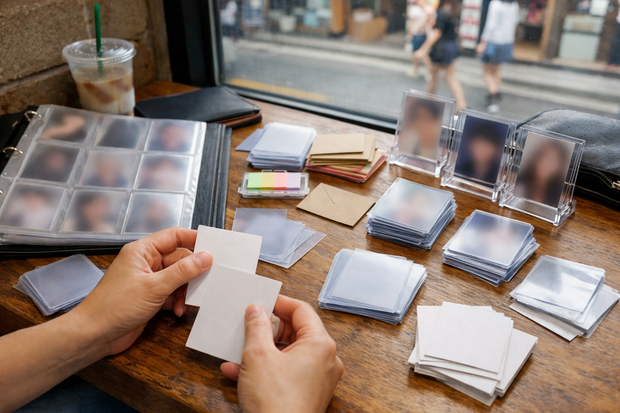
The short answer: K-POP photocard trading in Seoul follows a clear set of etiquette rules — bring cards in protective sleeves, agree on the trade before exchanging, never pressure others, and never trade fakes. The most reliable spots for foreign fans are POCASPOT (Myeongdong and Hongdae branches), Pokaboo in Hongdae, and MusicKorea in Myeongdong, where multilingual staff and organized trading zones make the process accessible even without Korean.
A K-POP photocard is a small, wallet-sized photograph of an idol that is randomly inserted into physical album packages. Because each album release typically includes dozens of different photocard variants — one for each member, sometimes across multiple versions — no two album buyers are guaranteed to receive the same set. This randomness is the engine that drives an enormous secondary market: fans who open albums and receive photocards of members they do not collect seek out fans who have what they need and want to exchange. Trading is not just a commercial transaction. For many fans, it is a social ritual, a way of connecting with the global fandom, and a deeply personal practice tied to idol devotion and collecting identity.
For international fans visiting Seoul, the photocard trading scene can feel overwhelming at first glance. Specialized stores, informal fan meetups, and platform-based trades all coexist in the same city, each with its own norms and expectations. This guide exists to flatten that learning curve. Whether you are planning your first trip to POCASPOT or trying to navigate a fan-organized trading event without speaking Korean, the information here will help you walk in prepared, trade confidently, and leave with exactly the cards you came for — without accidentally violating the community rules that keep this culture healthy and trustworthy.
What Is K-POP Photocard Trading — and Why Did It Become Such a Big Deal?
Quick Answer: K-POP photocard trading is the practice of exchanging the small random idol photographs found inside album packages. Because albums include randomized cards and fans typically collect only specific members, trading allows collectors to complete sets without buying multiple copies of the same album. The culture has grown from informal meetups into a structured global market now supported by dedicated physical stores in Seoul stocking over 1,000,000 individual cards.
A K-POP photocard is a collectible card — typically measuring 55mm x 85mm, printed on high-quality matte or glossy cardstock — featuring a photograph of a specific idol from a specific album version and era. They are included randomly inside sealed album packages, meaning a fan who buys a single copy of any given release has no way of knowing which member's photocard they will receive. This randomization is intentional. It creates a built-in incentive to either purchase multiple copies of the same album (driving sales) or to engage with the secondary market by trading or buying. Because most dedicated fans collect only one or a few specific members, and because major K-POP groups can have seven, twelve, or even more members, the probability of any individual fan completing their target set through album purchases alone is low. Trading closes that gap and, in doing so, has created one of the most active fan-driven secondary economies in the entertainment industry.
The trajectory of photocard trading culture tracks closely with K-POP's global expansion. Before 2018, trades happened informally — through Twitter DMs, Tumblr posts, and local fan meetups organized on fandom-specific forums. As streaming platforms pushed groups like BTS and BLACKPINK to global audiences, the volume of international collectors surged and informal systems buckled under demand. By 2021, the Korean resale platform Bunjang had become a central hub for photocard transactions, and demand was accelerating. The pivot to dedicated physical infrastructure came later in the decade: POCASPOT, founded to serve the Seoul photocard collector market, now stocks over 1,000,000 individual cards across its locations (source: Trazy, 2025-10). The market's intensity is illustrated by individual card prices: a Seventeen Joshua rare photocard from a limited-print run now regularly resells at ₩80,000 or higher, and premium cards for acts like Stray Kids Felix have crossed similar thresholds (source: Business Insider, 2025-10). These are not outliers — they represent the ceiling of a tiered market that operates with increasing sophistication.
The maturity of the photocard market is visible in the vocabulary and systems that collectors now use without explanation. Cards are graded by condition — Near Mint, Light Play, Moderate Play — and priced accordingly. Rarity tiers distinguish standard album inclusions from POB (Purchase On Behalf) exclusives, event-only prints, and signed versions. Serious collectors maintain tracking spreadsheets, document trades with photographs, and build community reputations over years of transactions. This is not a casual hobby for most participants. It is a structured collecting practice with its own norms, its own ethics, and its own economy — one that visitors to Seoul can engage with meaningfully if they arrive prepared.
Where Are the Best Spots to Trade K-POP Photocards in Seoul?
Seoul's photocard trading infrastructure is concentrated in three districts: Myeongdong, a commercial hub that draws both domestic and international tourists and hosts the flagship POCASPOT location alongside MusicKorea and Buruttrak; Hongdae, a university neighborhood with a younger, more local-fan energy where POCASPOT's second branch and Pokaboo's vending machine experience attract a different crowd; and Gangnam, a wealthier residential and commercial district where Ktown4U serves collectors seeking album-adjacent merchandise and rarer cards. Each district has a distinct atmosphere, and knowing what each offers before you visit will help you plan your trading day more efficiently.
POCASPOT Myeongdong: The Largest Dedicated Trading Hub
POCASPOT Myeongdong is the most recognizable and most visited photocard destination in Seoul for international fans. Located at 33 Myeongdong 8na-gil, Jung-gu — a five-minute walk from Myeongdong Station Exit 5 on Seoul Metro Line 4 — the store operates daily from 10 AM to 10 PM and functions simultaneously as a retail shop, a buy-back service, and a trading facilitation point. With over 1,000,000 cards in stock at any given time, organized by group, member, album era, and card version, POCASPOT gives collectors the ability to browse with a level of precision that informal trading meetups cannot match (source: Trazy, 2025-10). Staff members speak English and communicate with Chinese and Japanese visitors as well, making the store genuinely accessible without a Korean-speaking companion.
Pricing at POCASPOT Myeongdong follows a tiered structure that reflects both card rarity and condition. Common album inclusions for active groups typically run ₩5,000 to ₩15,000. Cards designated as rare — out-of-print versions, limited-print era exclusives, or high-demand member cards — begin at ₩20,000 and frequently exceed ₩50,000 for top-tier items. The store also operates a drop-off service: fans can leave cards with staff to be listed and sold on their behalf, receiving payment minus a commission, which is particularly useful for visitors who have brought home duplicates from album openings and want to liquidate them before departing. For fans who want to secure specific cards before arriving in person, POCASPOT offers same-day online order pickup provided the order is placed before 4 PM on the day of the visit.
POCASPOT Hongdae: Same Selection, Younger Energy
The Hongdae branch of POCASPOT, located at 48-14 Wausan-ro 29-gil, Mapo-gu — reachable from Hongik University Station Exit 7 on Seoul Metro Lines 2 and Airport Railroad — operates the same daily hours as its Myeongdong counterpart: 10 AM to 10 PM. The selection quality and the organizational system are identical between branches, so fans who cannot make it to Myeongdong will not miss out on catalogue depth by visiting Hongdae instead. What differs is atmosphere. The Hongdae branch draws a noticeably younger crowd dominated by university-aged Korean fans, and the surrounding neighborhood — packed with live music venues, street food stalls, and independent creative shops — gives the trading experience a more spontaneous, community-embedded feel. For international visitors who want to engage with local fan culture rather than the more tourist-oriented Myeongdong environment, the Hongdae branch is often the preferred choice. It also sits conveniently close to Pokaboo, making a combined visit to both stores within a single afternoon entirely practical.
Pokaboo in Hongdae: Vending Machines and Random Pulls
Pokaboo — sometimes romanized as POCABOO — occupies Unit 103 at 26 Wausan-ro 29na-gil, Mapo-gu, a short walk from the POCASPOT Hongdae branch, and operates daily from 11 AM to 10 PM. The store's signature offering is its photocard vending machines, which dispense randomly selected cards at a fixed price of ₩3,000 to ₩10,000 per pull depending on the machine and group tier. For fans who enjoy the tactile excitement of the original album-opening randomness but want to engage with it in a social, store-based setting, Pokaboo replicates that experience at a lower cost per attempt than buying full albums. English-language instructions are posted on or adjacent to each machine, and staff are available to assist with machine operation and payment (source: Visit Seoul official). Beyond vending machines, Pokaboo also stocks a curated selection of individual cards for direct purchase and occasionally hosts fan trading events in its open floor space, making it a genuine community gathering point rather than purely a retail destination.
MusicKorea, Buruttrak, and Ktown4U: Filling the Gaps
MusicKorea occupies the third floor of the Nature Republic building at 52 Myeongdong 8-gil and operates from 9:30 AM to 10:30 PM daily, making it one of the earlier-opening options in the Myeongdong corridor. Its primary distinction from POCASPOT is its deep stock of POB cards — photocards originally available only as incentives for purchasing albums through specific retailers — making it the right stop for fans seeking to complete POB sets or acquire cards from older eras that have aged out of general circulation. Buruttrak, located at 37-1 Myeongdong na-gil, operates Monday through Saturday from 10 AM to 11 PM and Sunday from 11 AM to 11 PM, with inventory skewing toward vintage and discontinued card types priced ₩10,000 to ₩50,000 and above for rare pre-2020 prints (source: KKday Seoul Guide, 2025).
Ktown4U operates its Gangnam retail presence from the second floor of 18 Teheran-ro 83-gil, placing it in a different district from the Myeongdong and Hongdae cluster. For fans combining a photocard shopping day with broader Gangnam-area activities, Ktown4U is the most convenient option in the district. Its selection focuses heavily on new releases and album-bundled merchandise, making it a strong choice for fans who want to purchase recent albums and access POB cards through official purchase qualification channels rather than the secondary market.
| Store | Neighborhood | Nearest Subway | Hours | Price Range | Best For |
|---|---|---|---|---|---|
| POCASPOT Myeongdong | Myeongdong | Myeongdong Stn Exit 5 | 10 AM–10 PM daily | ₩5,000–₩50,000+ | Largest selection, multilingual staff, online pickup |
| POCASPOT Hongdae | Hongdae | Hongik Univ. Stn Exit 7 | 10 AM–10 PM daily | ₩5,000–₩50,000+ | Local fan atmosphere, same catalogue as flagship |
| Pokaboo (POCABOO) | Hongdae | Hongik Univ. Stn Exit 7 | 11 AM–10 PM daily | ₩3,000–₩10,000 per pull | Vending machine random pulls, community events |
| MusicKorea | Myeongdong | Myeongdong Stn Exit 5 | 9:30 AM–10:30 PM daily | ₩5,000–₩50,000+ | POB cards, older era stock |
| Buruttrak | Myeongdong | Myeongdong Stn Exit 5 | Mon–Sat 10 AM–11 PM / Sun 11 AM–11 PM | ₩10,000–₩50,000+ | Vintage and discontinued card types |
| Ktown4U Gangnam | Gangnam | Gangnam Stn | 10 AM–10 PM daily | ₩5,000–₩40,000+ | New releases, album purchase, POB qualification |
What Are the Unwritten Rules of K-POP Photocard Trading?
Photocard trading operates on community trust. Because trades are peer-to-peer — often between strangers who have no prior relationship and no legal recourse if a trade goes wrong — the norms that govern the process exist to protect every participant. Violating these norms does not just make a single trade uncomfortable; it can result in community blacklisting, public callouts on fan platforms, and permanent exclusion from organized trading events. Understanding the rules before your first trade is not optional courtesy. It is the entry requirement for participating in good faith in a community that has built its legitimacy through consistent adherence to shared standards.
What to Bring and How to Present Your Cards
The cardinal rule of attending any photocard trading event or approaching a trade at a store like POCASPOT is that every card you intend to offer must arrive in a protective sleeve. Bare cards — photocards carried loose in a pocket, bag, or unprotected envelope — signal carelessness about card condition and will immediately undermine your credibility as a trading partner. At minimum, each card should be in a soft plastic sleeve. For higher-value cards, a rigid top-loader sleeve that prevents bending is strongly preferred. Both items are widely available at DAISO locations across Seoul: soft sleeves typically cost ₩1,000 to ₩2,000 for a pack of 50 to 100, while rigid top-loaders and protective binders run ₩5,000 to ₩8,000. Purchasing supplies before your trading day rather than after is worth the small investment.
Organization is the second pillar of preparation. Cards arranged in a binder — sorted by group, then member, then album era, then card version — allow a potential trade partner to browse your available cards quickly and clearly. Random or disorganized binders create friction and often cause interested parties to move on rather than search through an unsorted collection. Labeling dividers by group name is helpful even if the labels are in English, since most collectors recognize their target group's name in any script. Preparing a separate written or digital list of your haves and wants — specifying album era, member name, and card version for each entry — is considered best practice and will significantly speed up the matching process at busy events or store trading zones.
The Step-by-Step Trade Procedure
Even if you know what you want and have found a willing trade partner, executing the trade itself follows a recognized sequence that experienced traders expect to be respected. Deviating from this sequence — even accidentally — can create misunderstandings that sour the interaction. Follow these steps in order:
- Open with a clear, polite offer: Approach a potential trade partner with your binder visible and identify yourself as looking to trade, not sell. State your want specifically — group name, member, era, and version if known — before asking to look at their collection. This establishes intent and avoids time wasted on irrelevant browsing.
- Inspect cards carefully before agreeing: Once a potential match is identified, examine both the card being offered to you and the card you are offering from the other person's perspective. Check corners, surface condition, and print clarity. If you are receiving a card you have never handled before, ask to hold it briefly under light to check for surface scratches or print defects. This is expected and not considered rude.
- Confirm era, version, and condition verbally: Before any agreement is reached, confirm out loud — or via written note or phone translation — the specific album era, card version, and condition grade of both cards involved in the trade. Disputes almost always arise from assumptions one party made without confirming. Eliminate the assumption.
- Reach verbal agreement before any card leaves your hand: Do not extend your card toward the other person until both parties have explicitly agreed to the trade. Handing over your card before agreement is confirmed puts you at a disadvantage and can lead to misunderstandings about whether a trade has been finalized.
- Exchange simultaneously and photograph the completed trade: Pass cards at the same moment rather than sequentially. After the exchange, photograph both cards together — a practice common in the trading community that creates a record of the transaction and reduces the likelihood of post-trade disputes about condition or identity.
What Is Strictly Forbidden at Organized Trading Events
Fan-organized trading events — meetups held in public spaces, fan cafe gathering areas, or designated event floors — operate under stricter rules than casual store-based trades, and the most important rule is that cash transactions are prohibited. Trading events are organized specifically to facilitate card-for-card exchanges, not sales. The prohibition on cash sales exists to prevent the events from functioning as informal markets that could attract regulatory attention or undermine the community ethos of mutual collection rather than profit. Attempting to sell cards for cash at a trading-only event is one of the fastest ways to be asked to leave and reported to event organizers. Many trading communities also enforce an under-13 unaccompanied attendance rule, requiring younger attendees to be accompanied by a guardian, both for safety and to ensure that consent for high-value trades is fully informed.
The most serious violation at any trading event or store interaction is offering counterfeit cards. Fake photocards — unauthorized reproductions that replicate the appearance of genuine cards — circulate in the secondary market and can be difficult to distinguish from authentic cards without careful inspection. Trading a fake card knowingly is considered fraud within the community and results in immediate blacklisting from organized events, public callouts on fan platforms including Twitter and fan cafes, and in some documented cases, escalation to platform-level account bans on resale sites like Bunjang. Even trading a fake card unknowingly — if you received it from another trader and passed it along without verification — can damage your community reputation. The standard expectation is that you authenticate every card in your collection before offering it in trade.
How Do Foreign Fans Trade Photocards in Seoul Without Speaking Korean?
Language is a far smaller barrier to photocard trading in Seoul than most international fans expect before their first visit. At major dedicated stores like POCASPOT Myeongdong, English-speaking staff are present during all operating hours and are accustomed to assisting foreign visitors. The physical organization of the stores — cards sorted in labeled binders and display cases by group name, with most major group names written in both Hangul and Roman script — means that navigation does not require literacy in Korean. At fan-organized trading events, the physical act of showing a binder and pointing communicates intent across language barriers. That said, a small vocabulary of Korean trading phrases will make your interactions significantly smoother and will demonstrate respect for the community's home culture.
Essential Korean Phrases for Trading
Learning four to six key phrases before your visit is a low-effort investment that pays dividends in goodwill and clarity. These phrases cover the core moments of a typical trade interaction:
- 교환하실래요? (Gyohwan hashillaeyo?) — "Would you like to trade?" Use this as your opening phrase when approaching a potential trade partner at a fan event or store trading zone. The polite phrasing signals respect.
- 이거 있어요? (Igeo isseoyo?) — "Do you have this one?" Point to the card image or name on your phone simultaneously. This phrase works in any store and with any trade partner regardless of their English level.
- 얼마예요? (Eolmayeyo?) — "How much is it?" Essential for any purchase transaction at a store. Most staff will also simply show you the price on a calculator or phone screen, but asking in Korean is courteous.
- 가품 아니죠? (Gapum anijyo?) — "This is not a fake, right?" A direct but entirely acceptable question to ask before completing a trade. In the Korean trading community, asking this question is not considered offensive — it is considered responsible. Any legitimate trader will confirm without hesitation.
Online and Proxy Options for International Fans
For fans who want to begin acquiring Seoul-sourced photocards before arriving in Korea — or who cannot travel to Seoul at all — the online secondary market offers viable alternatives, though they require additional steps for non-Korean residents. Bunjang is the dominant Korean platform for photocard resale, and while the site operates primarily in Korean, international fans regularly access it through proxy shopping services that handle payment, communication with sellers, and international shipping on the buyer's behalf. Proxy fees typically run ₩1,500 to ₩5,000 per transaction plus domestic and international shipping costs, making the service economically practical for cards priced ₩10,000 and above (source: Paysable Blog, 2025).
Weverse Shop Global — the official merchandise platform operated by HYBE — has expanded its international direct-purchase and DDP (Delivered Duty Paid) shipping options as of, eliminating customs surprise charges for buyers in many countries and making it the most frictionless official channel for POB card acquisition through album purchase. Group Orders (GOs), organized through fan communities on Twitter, Discord, and fan cafes, offer another route: a Korean-based fan organizer pools purchases from multiple international buyers, collects domestic shipping to a single address, and then ships internationally in bulk, reducing per-unit shipping costs significantly. Verify GO organizers carefully — established GOs have clear payment records and community vouches before participating.
How Do You Authenticate K-POP Photocards and Avoid Overpaying?
Photocard authentication is the practice of verifying that a card is a genuine, officially produced product and not an unauthorized reproduction. As photocard values have risen — with some individual cards now trading at prices equivalent to concert tickets or above — the incentive to produce and circulate counterfeits has grown correspondingly. Authentication is not a skill reserved for expert collectors. It is a baseline competency that any fan engaging in the secondary market should develop before making significant trades or purchases, and the physical markers that distinguish genuine cards from fakes are learnable by anyone willing to examine a few reference examples carefully.
Physical Inspection: What Authentic Cards Look Like
Genuine K-POP photocards from major agencies have several consistent physical characteristics that counterfeit producers struggle to replicate accurately. The most reliable authentication markers relate to print quality, cardstock feel, and — for cards that include holographic elements — the behavior of those elements under light. Holographic stickers or holographic print elements on authentic cards from HYBE-affiliated groups shift color and pattern smoothly and continuously as the card is tilted across a light source. Counterfeit holographics typically show a flatter, less dynamic color shift, and the pattern may appear pixelated or smeared at the edges. Running a fingernail very lightly across the holographic area of a card you suspect is fake — without applying pressure that would damage an authentic card — sometimes reveals whether the element is a printed approximation rather than a genuine foil application.
Cardstock differences between agencies are meaningful authentication tools as well. SM Entertainment photocards from groups including aespa, EXO, and SHINee are printed on notably thicker, more rigid stock than the industry average, with a slightly matte surface texture that feels distinct from HYBE cards. YG Entertainment cards tend toward a slightly warmer color tone and a semi-glossy finish. Counterfeit cards almost universally use thinner, cheaper cardstock that flexes more easily and produces a different sound when lightly flicked at the edge. Edge finishing is another giveaway: authentic photocards have clean, uniform edges with no visible print layering or fiber separation. If the edge of a card appears uneven, shows color layering, or has visible paper fiber pull, it has almost certainly been reproduced rather than professionally manufactured. When in doubt at POCASPOT, staff members are trained in authentication and will inspect a card you are uncertain about at no charge.
| Card Type | Description | Typical Price (₩) | Where to Find |
|---|---|---|---|
| Common Inclusions | Standard random cards included in album packages for active groups, current era | ₩5,000–₩15,000 | POCASPOT, MusicKorea, Buruttrak |
| POB Cards | Purchase On Behalf exclusives, available only through specific retail channels | ₩20,000–₩50,000 | MusicKorea, Ktown4U, Bunjang proxy |
| Rare / Out-of-Print | Limited-print era exclusives, discontinued versions, high-demand member cards | ₩30,000–₩80,000+ | POCASPOT, Buruttrak, Bunjang proxy |
| Random Pull / Vending | Machine-dispensed random cards at Pokaboo and similar venues | ₩3,000–₩10,000 | Pokaboo Hongdae |
| Signed / Event-Only | Artist-signed cards or cards distributed exclusively at concerts and fan events | ₩100,000–₩300,000+ | Bunjang proxy, specialized dealers |
For payment at Seoul photocard stores and trading events, foreign visitors benefit significantly from carrying a payment method that functions reliably across both card terminals and cash transactions. Most dedicated photocard stores in Myeongdong and Hongdae accept major credit cards, but some smaller venues and all fan-organized events operate on a cash-only or Korean payment app basis. The most practical solution for international visitors is the NAMANE Card, a reloadable Korean prepaid card designed specifically for foreign visitors. It functions at any terminal that accepts domestic Korean payment cards, eliminates foreign transaction fees on individual purchases, and can be reloaded in-country as your trading budget requires. Full instructions for reloading the card during your visit are available at the NAMANE Card reload guide. Carrying a combination of the NAMANE Card for store purchases and approximately ₩30,000 to ₩50,000 in physical cash for any event-based or informal trades will cover essentially all payment scenarios you will encounter on a Seoul photocard trading day.
What Should You Pack for a Seoul Photocard Trading Day?
Preparation is what separates a productive photocard trading day from a frustrating one. The collectors who leave Seoul stores with exactly the cards they came for are almost always the ones who arrived with a clear system — organized cards, documented wants, and the right tools to evaluate, transport, and pay for new acquisitions. This packing checklist covers the essentials that experienced traders bring without exception:
- An organized binder with top-loader sleeves from DAISO (₩1,000–₩8,000): Sort your cards by group, member, era, and version before leaving your accommodation. Rigid top-loader sleeves for higher-value cards, soft sleeves for commons. A disorganized binder wastes everyone's time, including yours. DAISO locations near Myeongdong and Hongdae carry all necessary supplies.
- A printed or saved want list with era and version specified: Vague wants — "I need BTS Jimin cards" — slow negotiations dramatically. Specific wants — "BTS Butter version 2, Jimin, near mint" — allow any experienced trader to assess a match within seconds. Save the list as a phone screenshot for offline access in basement store areas.
- Reference photos on your phone for authentication comparison: Download clear, high-resolution photographs of authenticated versions of every card on your want list before leaving. When a card is offered to you, compare print quality, edge color, and holographic behavior against your reference. This takes thirty seconds and can save you ₩20,000 or more on a single transaction.
- Cash ₩50,000–₩100,000 in small denominations plus a loaded NAMANE Card: Small denominations (₩10,000 and ₩5,000 notes) are essential for even trades at events where change is not readily available. The NAMANE Card handles all card terminal purchases and removes the need to carry excessive cash for store transactions.
- A compact rigid cardboard flat or sleeve envelope for new acquisitions: Cards purchased or received in trade need to be transported safely. A flat rigid mailer or a sealed sleeve envelope prevents bending in transit. Rolling cards into a bag pocket — even in sleeves — risks corner damage on valuable new acquisitions.
- Bunjang or Poca Market app installed and logged in for real-time price checking: Before completing any purchase at a fixed-price store, a thirty-second search on Bunjang or Poca Market will show you the current secondary market rate for that specific card. Paying significantly above secondary market price for a card available in quantity is avoidable with ten seconds of research.
Frequently Asked Questions
Can I sell photocards for cash at Seoul trading events?
Cash sales are not permitted at fan-organized trading events. These events are specifically structured for card-for-card exchanges, and introducing cash transactions changes the nature of the gathering in ways that organizers and participants actively prohibit. Attempting to sell cards for cash at a trading-only event is grounds for being asked to leave and may result in a community callout. For cash sales, use store drop-off services at POCASPOT or list cards on Bunjang through a proxy service. Store-based retail environments like POCASPOT and MusicKorea are the appropriate venues for monetizing duplicate cards.
How do I know if a photocard is a fake?
Examine cardstock thickness and rigidity — fakes are almost always thinner and more flexible than genuine cards. Check edge finishing: authentic cards have clean, uniform edges with no visible paper fiber separation or color layering. If the card includes a holographic element, tilt it under a single light source and watch how the pattern moves — genuine holograms shift smoothly and continuously, while counterfeit approximations appear flat or pixelated. Compare the print quality against reference photos of verified authentic cards. When in doubt at POCASPOT, ask staff to inspect the card — they provide this service at no charge.
Do I need to speak Korean to trade at Seoul stores?
No. POCASPOT Myeongdong and Hongdae both employ English-speaking staff and are organized so that navigation does not require Korean literacy. Group names are written in both Hangul and Roman script, and cards are sorted by recognizable categories. Pokaboo's vending machines include English-language instructions. At fan-organized trading events, the physical act of showing a binder and pointing communicates intent across language barriers. Learning four basic Korean trading phrases as outlined in this guide will improve your experience, but it is not a prerequisite for successful trading.
What is a POB card and how is it different from a regular photocard?
POB stands for Purchase On Behalf. A POB card is a photocard distributed not inside an album package but as an incentive for purchasing an album through a specific retailer or fan site. For example, buying a new album through a particular online store might entitle you to a photocard that is not available anywhere else. Because POB cards require specific purchase actions to obtain legitimately, they are inherently rarer than standard album inclusions and typically price significantly higher on the secondary market. MusicKorea in Myeongdong and Ktown4U in Gangnam are the most reliable Seoul stores for POB card stock.
Is it safe to buy photocards through Bunjang as a foreign visitor?
Bunjang is the most-used platform for photocard resale in Korea and transaction volume means that seller reputations are meaningful signals. Sellers with hundreds of completed transactions and high ratings are generally reliable. The primary challenge for international buyers is the language barrier and payment method limitations — Bunjang requires a Korean phone number and payment method for direct account registration. Using an established proxy service resolves both issues. Proxy fees of ₩1,500 to ₩5,000 per transaction are standard (source: Paysable Blog, 2025). Request photo and video verification for any card over ₩20,000 before your proxy commits to the purchase.
What is the best time of day to visit POCASPOT?
POCASPOT Myeongdong is busiest between 1 PM and 7 PM on weekends and during Korean public holidays. For the most comfortable browsing experience with maximum staff availability, visiting on a weekday morning between 10 AM and noon is ideal. The same early-hour advantage applies to the Hongdae branch. If you are using the same-day online pickup service, place your order before 4 PM on the day of your visit — the cutoff applies to card preparation time, not your pickup window.
Can I trade merchandise as well as photocards?
Photocard trading events and dedicated trading stores focus specifically on photocards and occasionally include other flat collectibles like polaroids or photocard-sized prints. Merchandise categories — lightsticks, albums, posters, or apparel — are outside the scope of photocard trading venues. Organized fan markets and conventions are the more appropriate venue for broader merchandise exchanges. POCASPOT's buy-back and drop-off services are limited to photocards only.
Bringing It All Together
K-POP photocard trading in Seoul is more accessible to foreign fans than it might appear from the outside. The combination of dedicated stores with multilingual staff, clearly organized card catalogues, and a trading community that has developed consistent norms over years of practice means that preparation — rather than language fluency or insider connections — is the primary determinant of a successful trading experience. International fans who arrive with organized binders, specific want lists, and a basic understanding of the rules consistently find Seoul trading stores and events welcoming environments where the shared language of collector enthusiasm crosses every other boundary.
For a first photocard trading session in Seoul, start at POCASPOT Myeongdong. The store's size, stock depth, and English-speaking staff make it the lowest-friction entry point for international collectors, and the surrounding Myeongdong neighborhood provides enough dining and shopping infrastructure to anchor a full day of activity. Budget ₩30,000 to ₩80,000 for your first session — enough to acquire several cards across rarity tiers without overcommitting before you have a sense of the market. If time allows, combining your POCASPOT visit with a stop at a saengil cafe (생일카페 / idol birthday cafe) celebrating your target group's anniversary transforms a shopping trip into a full fan experience that captures what makes Seoul's K-POP culture unlike anywhere else.
For payment across all the stores and venues covered in this guide, the NAMANE Card is the most practical financial tool for foreign visitors — it works at card terminals across all major photocard retailers, eliminates foreign transaction fees, and can be reloaded as your collecting budget grows during your stay. The same card covers Seoul subway fares between Myeongdong, Hongdae, and Gangnam, streamlining your entire trading day into a single payment tool with no fumbling for correct transit change.
Last updated: 2026-04-30. This guide is reviewed and refreshed when official sources (KTO, Visit Seoul, POCASPOT, Pokaboo) update their information.
Related Articles
- SMTOWN COEX Artium Closed — Where SM Fans Actually Go in Seoul
- 【Seoul Pilgrimage】 Take a selfie at the same spot as your bias! A collection of Seoul restaurants & cafes visited by your favorite idols
- NAMANE Card is coming! 【CITY of SENSE】 (G)I-DLE Seongsu POP UP!
This article was written using information collected and analyzed by NAMANE's in-house K-pop research AI engine. We use AI technology to bring you faster, broader coverage, and in the process some details may occasionally differ from the latest facts. For important information such as dates, venues, and prices, please double-check with official sources.


