
Seoul's Restaurant Scene in 2026: What Fans Are Finding
Seoul's restaurant scene in 2026 is operating at a different level than most travelers expect. The city secured six restaurants on Asia's 50 Best Restaurants 2026 — a record for Seoul and a clear signal of where it stands globally (source: Haps Korea, 2026). That standing translates practically: within a few square kilometers, a visitor can move from a ₩10,000 bowl of street bibimbap to a ₩300,000+ tasting menu that references the same Korean culinary tradition at two entirely different scales. What's defining the current moment in Seoul dining — beyond the award recognition — are three converging trends: fermentation-forward menus, Korean wine pairings appearing on fine dining lists, and a return to research-driven hanjeongsik formats that revisit traditional full-course Korean dining with academic rigor. For K-POP fans already planning Seoul trips around concert schedules, adding an extra day or two specifically for food has well-supported justification in 2026.
Quick Answer: Seoul placed six restaurants on Asia's 50 Best 2026 — a city record. Dining ranges from ₩10,000 street bibimbap to ₩300,000+ tasting menus in the same city. Defining 2026 trends are fermentation-forward menus, Korean wine pairings, and research-driven hanjeongsik formats, making Seoul a compelling standalone food destination.
The price range across Seoul's dining landscape is genuinely wide and works in favor of visitors at any budget level. A full day of eating — convenience store kimbap at breakfast, tteokbokki at a street stall, samgyeopsal BBQ for dinner with a round of soju — can come in under ₩50,000 per person. At the opposite end, restaurants like Mingles and Mosu sit among Asia's highest-ranked venues and require advance reservations, smart casual attire, and budgets of ₩88,000 to over ₩300,000 per person. Both ends of the spectrum are legitimate, deeply considered expressions of Korean culinary culture rather than separate categories.
The defining characteristic of Seoul dining in 2026 is an increased investment in ingredient sourcing and culinary research. Fermentation has moved from background process to front-of-house concept, with restaurants building entire menus around aged doenjang, kimchi pairings, and fermented grain beverages. Korean wines — produced domestically from local varietals — are appearing on pairing menus at venues that until recently defaulted to imported bottles. Hanjeongsik, the traditional Korean multi-course format, is being revisited by research-driven chefs documenting and recreating historical recipes with documentary precision. For fans scheduling extra days in Seoul around a concert, the city's food scene across every price tier gives them a well-supported reason to stay longer.
Michelin Stars and Asia's 50 Best: Seoul's Fine Dining Map
Seoul's position in the global fine dining hierarchy became more concrete in 2026 when the city claimed six entries on Asia's 50 Best Restaurants, as reported by Stars and Stripes Korea and confirmed by Haps Korea. That figure places Seoul alongside Tokyo and Hong Kong as one of Asia's consistently represented dining capitals. For visitors planning a dining-focused evening in Seoul, the practical question is which restaurant fits the available time, budget, and preference — all six 50 Best entries, plus La Yeon at the Shilla Hotel, operate at different price points and with different culinary philosophies, making the choice genuinely meaningful rather than interchangeable. Smart casual dress is the minimum at all Michelin-recognized venues; concert-day streetwear will not be accepted. Reservations should be secured 2–4 weeks in advance, extending to one month during peak concert and travel periods (source: Let Seoul, 2026).
Mingles
Mingles, ranked #4 on Asia's 50 Best Restaurants 2026 and holding 2 Michelin stars, is led by Chef Kang Min Goo. The restaurant's concept centers on the natural intersection of Korean and Western culinary technique — not a forced fusion but a dialogue between the two traditions through shared values of seasonal sourcing, fermentation, and balance. Lunch runs ₩88,000 per person and dinner ₩220,000, with an optional Korean wine pairing available at dinner. The menu changes seasonally and reflects local sourcing; it is not a static concept but an evolving response to available ingredients.
"Korean and Western culinary traditions share more than people assume — a deep respect for fermentation, seasonal constraints, and what good ingredients actually taste like. At Mingles, those values don't compete. They find each other naturally." — Chef Kang Min Goo, Founder and Head Chef, Mingles (source: Let Seoul)
📍 South Korea, Seoul, Gangnam District, Dosan-daero 67-gil, 19 힐탑빌딩 2층
🕒 Monday Closed / Tuesday–Saturday 12:00 – 3:00 PM, 6:00 – 10:00 PM / Sunday Closed
⭐ 4.5 (861 reviews)
📞 02-515-7306
🔗 View on Google Maps
La Yeon
La Yeon, located on the 23rd floor of the Shilla Hotel in Jung-gu, holds 3 Michelin stars and presents traditional Korean cuisine in a setting that combines panoramic Seoul views with formal table service. Dinner is priced at ₩260,000 per person in a hanjeongsik format — a structured sequence of courses — executed with premium ingredients and a presentation that treats the full-course format as fine dining rather than a casual set meal. This is among the most formal dining experiences in Seoul, and the hotel location makes English communication more accessible than at standalone restaurants, which is a practical advantage for international visitors navigating Korean-only reservation systems.
📍 South Korea, Seoul, Jung District, 장충동 Dongho-ro, 249, THE SHILLA Seoul, 23층
🕒 Daily 12:00 – 2:30 PM, 5:30 – 9:30 PM
⭐ 4.5 (789 reviews)
📞 02-2230-3367
🔗 View on Google Maps
Mosu
Mosu, ranked #41 on Asia's 50 Best and holding 3 Michelin stars, is helmed by Chef Sung Ahn. The restaurant approaches Korean culinary tradition through modern technique, reinterpreting traditional ingredients and preparations in a way that is contemporary in form but grounded in Korean culinary history. Lunch is priced at ₩150,000 per person and dinner at ₩300,000 or more depending on course count and optional additions. Mosu sits at the upper end of Seoul's fine dining price range — comparable in tier and price to equivalent destinations in Tokyo or Copenhagen — and is worth researching well in advance of any Seoul visit.
📍 4 Hoenamu-ro 41-gil, Yongsan District, Seoul
🕒 Monday Closed / Tuesday–Saturday 6:00 – 10:00 PM / Sunday Closed
⭐ 4.6 (287 reviews)
📞 02-6272-5678
🔗 View on Google Maps
Onjium, Eatanic Garden, Bium, and 7th Door
The remaining four Seoul entries on Asia's 50 Best 2026 each represent a distinct direction. Onjium (#14) is research-driven, with a team that documents historical Korean recipes and sources ingredients accordingly — it is among the more academically rigorous restaurants in the city. Eatanic Garden (#26) showcases emerging Korean chefs and updates its menu format regularly. Bium (#43) maintains consistent recognition for its restrained, technique-focused cooking. 7th Door (#49), led by Chef Kim Dae-chun, specializes in fermentation with a fully open kitchen — aged doenjang, kimchi pairings, and fermented grain beverages form the core of the experience. Lunch at 7th Door starts at ₩68,000 with dinner at ₩198,000, making it the most accessible entry point among Seoul's Asia's 50 Best venues.
📍 Onjium — View on Google Maps | 7th Door — View on Google Maps
| Restaurant | Asia's 50 Best 2026 | Michelin Stars | Lunch (per person) | Dinner (per person) | Style |
|---|---|---|---|---|---|
| Mingles | #4 | ★★ | ₩88,000 | ₩220,000 | Korean-Western fusion tasting menu |
| La Yeon | Not ranked | ★★★ | Not offered | ₩260,000 | Traditional Korean hanjeongsik |
| Mosu | #41 | ★★★ | ₩150,000 | ₩300,000+ | Modern reinterpretation of Korean tradition |
| Onjium | #14 | — | — | — | Research-driven historical Korean cuisine |
| Eatanic Garden | #26 | — | — | — | Creative Korean, emerging chefs |
| Bium | #43 | — | — | — | Restrained, technique-focused Korean |
| 7th Door | #49 | — | ₩68,000 | ₩198,000 | Fermentation-focused, open kitchen |
Korean BBQ and Chimaek: The After-Concert Ritual
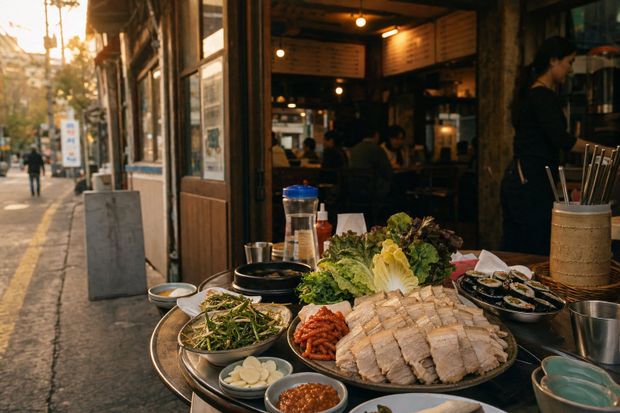
Korean BBQ — specifically samgyeopsal, thick-cut pork belly grilled tableside over a charcoal or gas flame — is the most common first meal for K-POP fans arriving in Seoul, and also one of the most practical formats for a post-concert evening. The dining structure is social and unhurried: pork belly or galbi hits the grill, garlic and onion caramelize at the edges, and the table fills with banchan side dishes refilled without charge. A full dinner for two including soju or beer runs ₩40,000–60,000 at a neighborhood restaurant, according to MileAsia. The wrap — pork belly in a sesame leaf with raw garlic, sliced chili, and ssamjang fermented paste — is the baseline ritual of Korean BBQ, not a variation. Chimaek, the pairing of double-fried Korean chicken with beer, is the late-night alternative, widely available until 2AM and well-suited to concerts that finish at 10PM or later.
Jeong Daepo | 정대포
Jeong Daepo, in the Mapo neighborhood near Gongdeok Station, operates as a neighborhood-style pork belly restaurant without the pricing adjustment that affects venues closer to central tourist corridors. This is the type of venue where local residents in the area eat regularly — communal seating, straightforward menus focused on the quality of the pork itself, and a pace set by local rather than visitor expectations. For fans staying in the western part of Seoul or attending shows at venues on that side of the city, Mapo's samgyeopsal corridor — of which Jeong Daepo is among the most consistently cited examples — provides a neighborhood-level experience of Korean BBQ rather than a tourist-formatted version.
📍 183-16 Dohwa-dong, Mapo-gu, Seoul
🕒 Daily 12:00 PM – 12:00 AM
⭐ 4.1 (562 reviews)
📞 02-713-0710
🔗 View on Google Maps
Yeontabal BBQ Restaurant | 연탄불
Yeontabal, in Gangnam, focuses on charcoal-grilled galbi (short ribs) and bulgogi (thin-sliced marinated beef), placing it in a distinct category from standard samgyeopsal restaurants. Charcoal grilling imparts a flavor that gas alternatives don't replicate, and galbi at a quality charcoal grill delivers a noticeably different result from the standard pork belly format. Gangnam's proximity to KSPO Dome and Olympic Park makes Yeontabal a viable pre- or post-concert option for fans attending shows at those venues. The neighborhood's high density of restaurants also means there are alternatives within walking distance if reservation timing doesn't align.
📍 24 Namdaemun-ro 9-gil, Jung District, Seoul
🕒 Daily 11:30 AM – 10:00 PM
⭐ 4.1 (492 reviews)
📞 02-720-9263
🔗 View on Google Maps
Han Chu Korean Fried Chicken & Beer | 한추
Han Chu, in Gangnam, has been operating for over 20 years and is consistently cited as a reference point for chimaek — the Korean pairing of double-fried chicken and beer that has become an identifiable feature of Seoul's late-night food culture, according to Will Fly for Food. The double-fry method produces a shell that stays crispy longer than single-fry preparations; Han Chu's execution of the style has earned it a benchmark reputation over two decades of operation. Chimaek for two at a sit-down restaurant typically runs ₩30,000–45,000. Two-Two Chicken and Nurungji Tongdalk function as neighborhood alternatives with similar formats. Most chimaek restaurants in Seoul run until 2AM, making them among the most practical post-concert dining options for late-finishing shows.
📍 68 Nonhyeon-ro 175-gil, Gangnam District, Seoul
🕒 Monday–Thursday 2:00 PM – 12:00 AM / Friday–Saturday 2:00 PM – 1:00 AM / Sunday Closed
⭐ 3.9 (1,796 reviews)
📞 02-541-0969
🔗 View on Google Maps
Late-night availability is one of Seoul's clear practical advantages for concert-goers. Most neighborhood Korean BBQ spots serve until midnight; chimaek establishments commonly stay open until 2AM. Compared to European and North American cities where kitchen closing times can make post-concert dining genuinely difficult, Seoul's service hours align naturally with the reality of shows finishing at 10PM or later. For fans arriving from venues like KSPO Dome or Jamsil Arena, the combination of accessible transit and late-running restaurants in both areas removes the logistical friction that affects post-concert dining in many other cities.
Street Food, Classic Dishes, and Seoul's Oldest Restaurants
Seoul's street food and classic restaurant traditions operate independently from its award-winning fine dining scene — and are often the more lasting part of a visit. The dishes that have defined Korean food culture for decades: tteokbokki, bibimbap, naengmyeon, kimchi jjigae, seolnongtang — are available at restaurants that have been preparing the same recipes for generations, often at prices well under ₩15,000 per person. These are not simplified tourist versions but the original reference points that the city's fine dining restaurants are themselves responding to. According to Will Fly for Food, several of Seoul's oldest restaurants have been serving essentially unchanged preparations since their founding dates — making a meal at Imun Seolnongtang or Hadongkwan a direct link to over a century of Korean food history. For a first visit, spending time at these venues provides a grounding in Korean cuisine that no tasting menu can substitute.
Sindang-dong Tteokbokki Town | 신당동 떡볶이타운
Sindang-dong Tteokbokki Town, near Sindang Station on Seoul Metro Lines 2 and 6, has specialized in tteokbokki — chewy rice cakes in a spicy gochujang sauce — since the 1970s. The cluster of restaurants here effectively established the modern standard for the dish and remains the original benchmark. The preparation in this area is typically the classic red sauce version, though individual restaurants have developed their own variations over decades. Compared to the tteokbokki stands in Myeongdong that serve as quick tourist bites, Sindang-dong's version is eaten in sit-down restaurants by local regulars and represents the dish in its traditional sit-down context rather than as a street snack.
📍 10-18 Dasan-ro 33-gil, Jung District, Seoul
🕒 Daily Open 24 hours
⭐ 3.8 (514 reviews)
🔗 View on Google Maps
Imun Seolnongtang | 이문설농탕
Imun Seolnongtang, established in 1904 in Jongno-gu, is Korea's oldest surviving restaurant. The menu centers on seolnongtang — a milky ox-bone broth soup served with rice, kimchi, and green onions — prepared from an unchanged recipe for over 120 years. The soup is seasoned at the table by the diner, not the kitchen; salt and additional green onion are added to taste. The flavor is subtle and nourishing rather than assertive, reflecting its origin as an everyday restorative dish. Eating here carries historical weight: the restaurant has operated through Japanese colonial rule, the Korean War, and the country's industrialization without altering its core menu. That continuity is part of what makes a meal here meaningful beyond the food itself.
📍 38-13 Ujeongguk-ro, Jongno District, Seoul
🕒 Monday–Saturday 8:00 AM – 3:00 PM, 4:30 – 9:00 PM / Sunday 8:00 AM – 3:00 PM, 4:30 – 8:00 PM
⭐ 3.9 (2,592 reviews)
📞 02-733-6526
🔗 View on Google Maps
Hadongkwan | 하동관
Hadongkwan, established in 1939 in Myeongdong, is recognized for gomtang — beef bone soup with a clear broth and thinly sliced beef — in a location that sits naturally on any Myeongdong shopping or sightseeing day. Unlike seolnongtang's opaque milky broth, gomtang is clear and lighter in body, though equally rich from hours of bone simmering. Hadongkwan's Myeongdong placement puts it within reach of many first-time visitors, and the restaurant's reputation predates the neighborhood's transformation into Seoul's primary tourist shopping corridor. The soup is served in heavy stone bowls with white rice and basic banchan.
📍 12 Myeongdong 9-gil, Jung District, Seoul
🕒 Monday–Saturday 7:00 AM – 4:00 PM / Sunday Closed
⭐ 3.6 (2,117 reviews)
📞 02-776-5656
🔗 View on Google Maps
Several other dishes and venues are worth noting across the city. Bibimbap — rice topped with seasoned vegetables, egg, beef, and gochujang — is served in traditional Jeonju-style at Jeonju Yuhalmeoni (over 50 years established) and Gogung; the dolsot stone bowl version, which forms a crispy rice crust at the bottom, runs ₩10,000–15,000. Naengmyeon, cold buckwheat noodles in icy beef broth, is a classic post-BBQ palate cleanser available at Woo Lae Oak and Jeongin Myeonok, both cited as references for the dish (source: ZenKimchi). Kimchi jjigae — deeply fermented kimchi stew with pork and tofu — is served at Omori Jjigae in Jamsil and Gwanghwamun Jip near Gwanghwamun Square.
"I've been pulling these noodles by hand and making the same broth for nearly 30 years. The recipe hasn't changed because it doesn't need to." — Cho Yonsoon, kalguksu vendor, Gwangjang Market, Jongno-gu (source: Will Fly for Food)
Gwangjang Market, established in 1905 in Jongno-gu, is worth a dedicated visit for its bindaetteok (mung bean pancakes), mayak gimbap (small, addictive rice rolls), and hand-stretched kalguksu noodles. Lunch for two at the market runs ₩20,000–30,000. The market has long-term vendors — not tourism-facing setups — who have operated their stalls for decades. Tosokchon in Jongno-gu is the reference venue for samgyetang, whole chicken with glutinous rice in a ginseng broth, particularly popular as a restorative meal.
📍 Gwangjang Market — View on Google Maps | Jeonju Yuhalmeoni — View on Google Maps | Tosokchon — View on Google Maps
Seoul Neighborhoods for Eating: Where Concerts and Food Overlap
Seoul's dining districts and its major concert venues map onto each other with enough alignment that a fan can plan both the show and the meal in the same area without significant cross-city travel. The city's main concert infrastructure — KSPO Dome, Olympic Park, Jamsil Arena, Jamsil Stadium, KINTEX, and Gocheok Sky Dome — is distributed across neighborhoods with distinct food characters. Gangnam holds the highest density of Michelin-starred restaurants and quality Korean BBQ closest to multiple concert venues. Jamsil's late-night BBQ corridors and Omori Jjigae are practical for fans leaving Jamsil Arena or Stadium. Hongdae's affordable, late-running street food and chimaek scene extends naturally from concerts at nearby venues. Jongno and Insadong hold Seoul's historic restaurant cluster — Imun Seolnongtang, traditional tea houses, hanjeongsik specialists — in a walkable zone. Itaewon and Haebangchon offer English-friendly menus and international options that lower the navigation barrier for first-time solo visitors, as noted in coverage by MileAsia.
| Neighborhood | Nearby Concert Venues | Food Character | Typical Price Range (per person) |
|---|---|---|---|
| Gangnam | KSPO Dome, Olympic Park | Michelin restaurants, charcoal-grill BBQ (Yeontabal), chimaek benchmark (Han Chu) | ₩40,000–₩300,000+ |
| Jamsil | Jamsil Arena, Jamsil Stadium | Late-night Korean BBQ corridors, Omori Jjigae kimchi stew | ₩15,000–₩60,000 |
| Hongdae | Hongdae-adjacent venues | 24-hour kimbap, affordable chimaek bars, late-night street food and ramyeon | ₩10,000–₩40,000 |
| Jongno / Insadong | Central Seoul access (multiple Metro lines) | Imun Seolnongtang, Gwangjang Market, hanjeongsik specialists, traditional tea houses | ₩10,000–₩100,000+ |
| Mapo / Gongdeok | Western Seoul venue corridor | Neighborhood samgyeopsal (Jeong Daepo), local-style pork belly without tourist pricing | ₩20,000–₩50,000 |
| Itaewon / Haebangchon | — | International menus, Korean fusion, English menus standard, lowest navigation barrier | ₩20,000–₩80,000 |
Gangnam is the most practical area for fine dining before or after a concert at KSPO Dome or Olympic Park. It holds the highest density of Michelin-recognized restaurants in Seoul, along with a range of quality Korean BBQ options at various price points that don't require advance reservation. The neighborhood's transit connections are also reliable for post-show movement. Jamsil's BBQ corridor runs along streets adjacent to the stadium complex and stays open late; Omori Jjigae in Jamsil is a reliable option for kimchi stew on colder evenings, within easy walking distance of both arena and stadium.
Hongdae's eating scene runs on affordability and hours: 24-hour kimbap shops, chimaek bars with outdoor seating, and street food stalls operating into the early morning. The neighborhood's energy after 10PM aligns naturally with a concert crowd looking to extend the evening. Jongno and Insadong represent a slower tempo — the historic restaurants here generally close earlier and suit a pre-show day trip or a morning-after visit better than a late-night post-concert meal. Itaewon and Haebangchon function as the lowest-friction option for visitors not yet comfortable navigating Korean-language menus; English is standard in most restaurants, and international cuisine variety is genuinely wide.
Seoul Dining Costs in 2026: Budget by Meal Type
Seoul's dining costs in 2026 span a wider range than most other major Asian cities, with a floor low enough that a full day of eating well is achievable on ₩50,000 or less, and a ceiling reaching ₩300,000+ per person at the city's top tasting menu restaurants. The street food and casual tier — bibimbap, tteokbokki, gimbap, convenience store meals, and market snacks — runs ₩10,000–20,000 per person for a satisfying meal. A sit-down Korean BBQ dinner for two, including banchan and a round of soju or beer, lands in the ₩40,000–60,000 range at a neighborhood restaurant without tourist pricing, according to MileAsia. Understanding the cost structure before arriving allows for realistic trip planning — particularly for fans who are simultaneously budgeting for concert tickets, accommodation, and merchandise.
Fine dining tasting menus occupy a distinct tier. The range runs from ₩68,000 at lunch at 7th Door to ₩300,000 or more for dinner at Mosu. Most Michelin-starred venues sit in the ₩150,000–₩260,000 per person range for dinner, with lunch menus typically available at 40–60% of the dinner price — a meaningful discount for a broadly comparable experience. The optional Korean wine pairing at venues like Mingles adds to this figure but represents something without a direct equivalent elsewhere: domestic Korean wine served alongside a Korean-Western tasting menu in the restaurant that made both concepts central to its identity.
Chimaek for two — double-fried chicken and beer at a sit-down restaurant — runs ₩30,000–45,000, making it one of the better-value shared meal formats in the city. A realistic daily food budget for a mid-range traveler in Seoul in 2026 is ₩50,000–80,000 per person, covering a café or convenience store breakfast, a street food or market lunch, and a sit-down Korean BBQ or jjigae dinner. That figure rises to ₩120,000–150,000 if one meal involves a mid-tier restaurant, and to ₩200,000+ on any day that includes a fine dining tasting menu. Tipping is not expected or customary anywhere in Seoul. Banchan (side dishes) are complimentary and refillable without charge at virtually every sit-down restaurant — both factors that make the effective cost of a meal lower than menu prices alone suggest.
Booking, Hours, and Practical Notes for Visitors
Navigating Seoul's restaurant booking landscape requires a few adjustments from what international visitors are typically used to. Fine dining reservations — Michelin-starred venues and Asia's 50 Best entries — should be made through Naver Reservation (네이버 예약), which is the dominant booking platform in Korea, or directly through restaurant websites. English-language booking interfaces are not consistently available; hotel concierge assistance is a reliable alternative for guests at international hotels, and most Seoul Michelin venues can accommodate email reservations in English. The minimum reservation window is 2–4 weeks, extending to one month during major K-POP concert weekends in Seoul, when reservation demand tightens measurably across the city's recognized dining venues. Booking dining alongside concert tickets — rather than as an afterthought — removes the risk of finding top venues fully committed for the relevant dates.
Dress code is a practical concern for fans spending a concert day in Seoul and considering fine dining the same evening. Smart casual is the minimum at Michelin and Asia's 50 Best restaurants. Concert-day streetwear, fan merchandise, and performance-style outfits may not be accepted at these venues. If a fine dining dinner is planned for the same day as a show, either change attire before the meal or schedule the restaurant booking for a different day.
Navigation in Seoul is handled more accurately by Naver Maps than by Google Maps, which underperforms for Korean business hours, transit routing, and walking directions in urban areas. Download and test Naver Maps before arriving. For restaurants with Korean-only menus — common in neighborhood BBQ spots, traditional market stalls, and pojangmacha tents — Naver Papago's camera translation mode or Google Translate's live camera function handles Korean text accurately enough for menu identification. Credit cards (Visa/Mastercard) are accepted at most sit-down restaurants; smaller market stalls and pojangmacha tents may be cash-only, so carrying some Korean Won is practical throughout the trip.
Frequently Asked Questions
What Korean dishes should I try on a first visit to Seoul?
Six dishes cover the core of Seoul's food culture across different meal contexts. Samgyeopsal (pork belly Korean BBQ): grilled tableside, wrapped in sesame leaf with garlic and ssamjang fermented paste — ₩20,000–30,000 per person at a neighborhood restaurant including drinks. Bibimbap (dolsot stone bowl version recommended): rice with seasoned vegetables, egg, beef, and gochujang — ₩10,000–15,000. Tteokbokki: chewy rice cakes in spicy gochujang sauce, a street food and casual restaurant staple — ₩5,000–10,000 per serving. Naengmyeon: cold buckwheat noodles in icy beef broth, traditionally ordered after BBQ — ₩10,000–15,000. Kimchi jjigae: deeply fermented kimchi stew with pork and tofu, reliable at almost any Korean restaurant — ₩8,000–13,000. Samgyetang: whole chicken stuffed with glutinous rice and ginseng in clear broth, particularly restorative — ₩15,000–25,000. Each is widely available across Seoul's dining neighborhoods at the price ranges listed.
Do Seoul restaurants have English menus?
Availability varies by venue type. Michelin-starred restaurants and Asia's 50 Best entries consistently provide English menus or English course descriptions — international guests are an expected demographic at this level, and language accommodation is standard. Mid-range sit-down restaurants in tourist-adjacent neighborhoods like Myeongdong, Insadong, and Itaewon commonly offer bilingual Korean/English menus or detailed picture menus. Neighborhood Korean BBQ spots, traditional market vendors at Gwangjang Market and Tongin Market, and pojangmacha street tents are likely Korean-only. For these venues, Naver Papago's camera translation mode or Google Translate's live camera function handles Korean menu text reliably enough for dish identification. Pointing at pictures or ordering by number works in most BBQ restaurants where the menu format is visually structured.
How far in advance should I book Seoul fine dining?
A minimum of 2–4 weeks in advance applies to Michelin-starred restaurants like Mingles, La Yeon, and Mosu under normal travel conditions. During major K-POP concert weekends — when large volumes of international fans converge on Seoul — that window extends to one month or more, as reservation demand tightens across the city's recognized dining venues simultaneously. Most Seoul fine dining venues use Naver Reservation (네이버 예약) as their primary booking system, which requires a Naver account or Korean phone number. International visitors can typically work around this through direct email booking in English or via hotel concierge service. Same-day walk-in availability at Michelin venues is not realistic. Lower-priced entries on the Asia's 50 Best list — 7th Door's ₩68,000 lunch, for example — may have more flexibility, but advance booking is still strongly recommended regardless of tier.
Which neighborhoods are best for eating near Seoul's main concert venues?
The main concert venues each map to a practical food area. KSPO Dome and Olympic Park (Songpa-gu/Gangnam-adjacent): Gangnam's restaurant district is the most practical — Michelin options, Yeontabal charcoal-grill BBQ, and Han Chu chimaek are all accessible with short transit or taxi rides. Jamsil Arena and Jamsil Stadium: Jamsil's own BBQ corridors and Omori Jjigae kimchi stew restaurant are within easy walking or short taxi distance of both venues. KINTEX (Ilsan, Gyeonggi-do): local Korean restaurants are available but the area lacks the specialized dining concentration of central Seoul — planning to eat before traveling to KINTEX, or taking transit back to the city afterward, is more practical. Gocheok Sky Dome (Guro-gu): Guro has neighborhood Korean dining but is not a food destination in its own right; a Metro or taxi ride to Hongdae or Mapo opens significantly more options. For any major concert weekend, advance dining reservations are more reliable than walk-in attempts.
What is a realistic daily food budget for a Seoul trip in 2026?
Three tiers are useful for planning. A budget day — street food, convenience store meals, one sit-down jjigae or bibimbap — runs ₩30,000–50,000 per person (approximately $22–37 USD / ¥3,300–5,500 JPY). A mid-range day — café or convenience store breakfast, casual street food or market lunch, Korean BBQ or chimaek dinner — runs ₩80,000–120,000 per person (approximately $59–88 USD / ¥8,700–13,100 JPY). A fine dining day with one tasting menu dinner at a Michelin or 50 Best venue runs ₩200,000+ per person (approximately $147+ USD / ¥21,800+ JPY), with the upper end reaching ₩300,000+ at venues like Mosu. Tipping is not expected anywhere in Seoul, and banchan (side dishes) are included and refillable at no charge at sit-down restaurants — both factors that reduce the effective out-of-pocket cost relative to menu prices alone. USD and JPY equivalents are approximate based on 2026 mid-market exchange rates.
Planning Around the Concert Schedule: A Practical Summary
The practical picture for Seoul dining in 2026 is that the city accommodates a wide range of food intentions without requiring a specialist itinerary. A fan spending two days in Seoul around a concert can eat well at every meal — Gwangjang Market's bindaetteok at lunch, a neighborhood samgyeopsal spot in the evening — without advance planning beyond the concert reservation itself. Adding one or two days specifically for food, or booking a fine dining dinner at Mingles or 7th Door, opens a different tier of the city's culinary range. Neither approach is required for a satisfying experience; both are available to the same visitor in the same trip.
The neighborhoods closest to Seoul's major concert venues each carry a distinct food character that shapes what's practical. Gangnam's concentration of upscale BBQ and Michelin venues is within reach of KSPO Dome and Olympic Park crowds. Jamsil's late-night corridors serve Jamsil Arena and Stadium attendees. Hongdae's casual, late-running scene absorbs concert energy from nearby venues. The single consistent constraint is time — fine dining venues require advance booking that has to align with a travel schedule that may be confirmed weeks before the concert date. Anyone planning a Seoul trip with a meaningful food component should treat restaurant reservations with the same planning lead time as concert tickets, particularly for recognized venues during peak season.
Seoul's dining scene in 2026 is not a background feature of a concert trip. It is, for many visitors, a separate and sufficient reason to extend the stay.
Last updated: 2026-05-09. Prices, rankings, and reservation requirements reflect information current as of May 2026. Restaurant menus, tasting menu prices, and Asia's 50 Best rankings are subject to annual revision; verify current pricing and availability directly with each venue before booking.


