
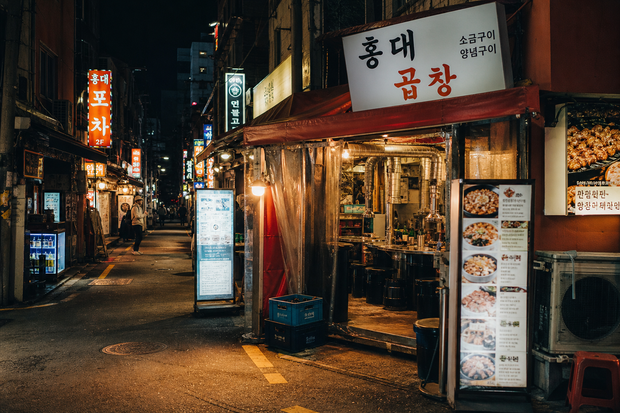
Seoul's Dining Districts: A Neighborhood Overview
Seoul's food landscape in 2026 is organized around distinct neighborhoods, each carrying its own culinary personality and price tier. Six districts cover the majority of what visitors and K-POP fans traveling to concerts will encounter: Jongno and Insadong for centuries-old Korean cooking, Hongdae and Mapo for grilled meat and late-night street food near major venues, Myeongdong and Sinchon for accessible and tourist-familiar eating, Gangnam and Apgujeong for upscale Korean dining south of the Han River, Sindang and Jamsil for specialist dishes near concert venues including KSPO Dome, and a tier of Michelin-starred restaurants distributed across the city center. Street food runs ₩3,000–₩15,000 per item; sit-down neighborhood meals average ₩15,000–₩40,000 per person; fine dining tasting menus range from ₩88,000 to ₩300,000 or above, according to Mile Asia's 2026 Seoul food guide. Understanding the neighborhood map before arrival saves time — particularly on concert days when dining windows are narrow and venues fill rapidly after shows end.
Quick Answer: Seoul's six main dining neighborhoods each specialize in distinct food styles and price points. Street food costs ₩3,000–₩15,000, sit-down meals run ₩15,000–₩40,000 per person, and Michelin tasting menus reach ₩300,000+. For concert-goers, Hongdae and Mapo is the go-to dining corridor for shows at AX Korea and Olympic Hall.
The table below maps each district to its defining dish, nearest subway line, and whether reservations are necessary. For fans navigating show-day schedules, the subway column matters most: virtually every major Seoul concert venue sits within one transfer of a Line 2, Line 3, or Line 9 station, making cross-district dining practical even on tight timelines. Walk-in culture dominates below the fine-dining tier — the city's BBQ restaurants and street food corridors absorb post-show crowds without bookings.
| District | Signature Dish | Subway Access | Walk-in or Reservation |
|---|---|---|---|
| Jongno / Insadong | Seolnongtang, samgyetang, bibimbap | Line 3 (Gyeongbokgung, Anguk) | Walk-in — queue early for popular spots |
| Hongdae / Mapo | Samgyeopsal, chimaek, street food | Line 2 (Hongdae Ipgu), Line 6 (Gongdeok) | Walk-in — no advance booking needed |
| Myeongdong / Sinchon | Gomtang, tteokbokki, Korean set meals | Line 4 (Myeongdong), Line 2 (Sinchon) | Walk-in |
| Gangnam / Apgujeong | Bulgogi, galbi, chimaek | Line 2 (Gangnam), Line 9 (Sinnonhyeon) | Walk-in (casual) — 2–4 weeks ahead (Michelin) |
| Sindang / Jamsil | Tteokbokki, kimchi jjigae | Line 2 (Sindang), Lines 2 & 8 (Jamsil) | Walk-in |
| Fine Dining (city-wide) | Seasonal tasting menus, hanjeongsik | Varies by restaurant | Reservation required — 2–4 weeks minimum |
Jongno and Insadong: Seoul's Oldest Dining Corridors
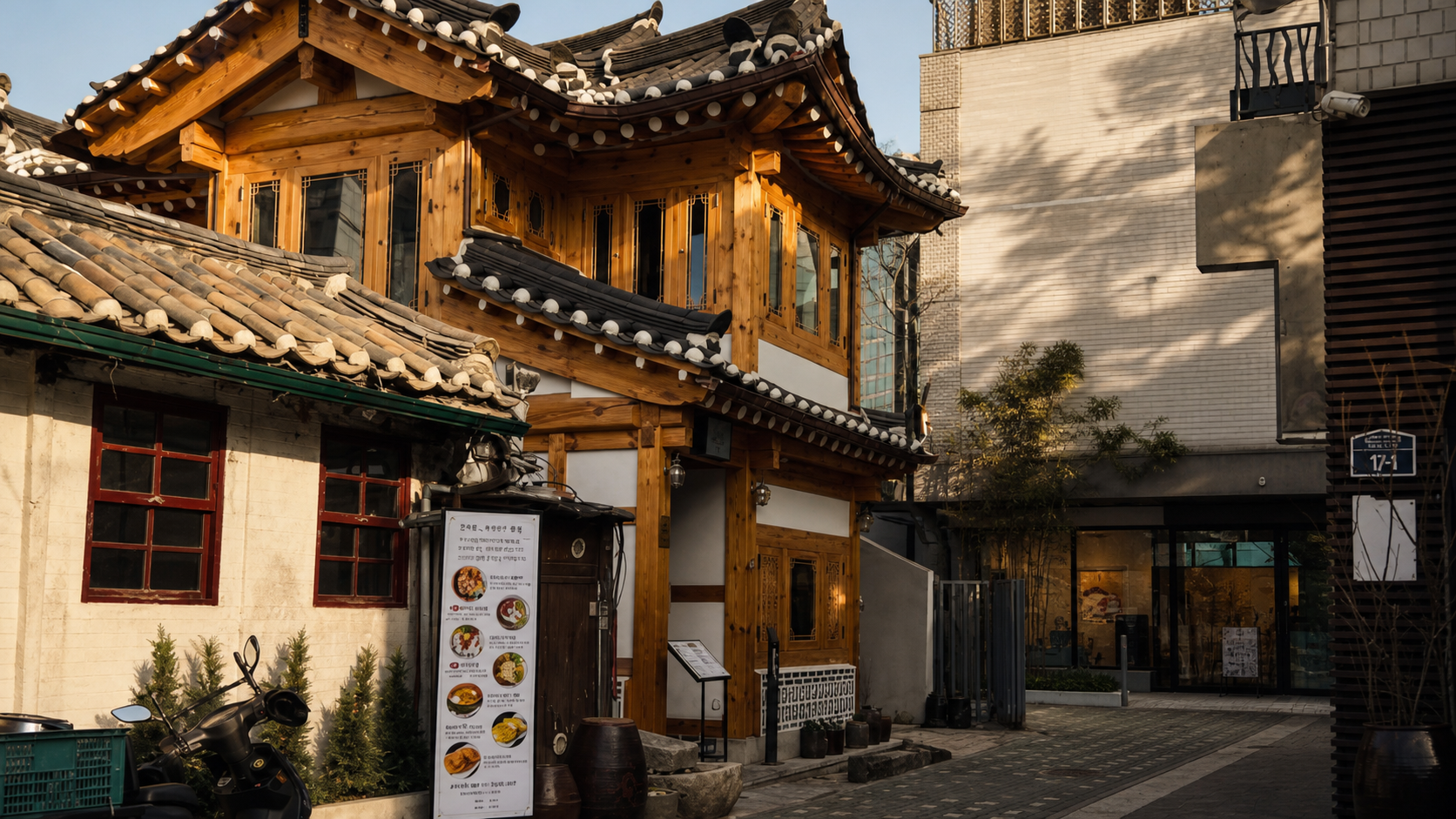
Jongno and Insadong form the historical spine of Seoul's dining culture, home to restaurants that have served the same dishes for multiple generations without interruption. The area is walkable from Gyeongbokgung Palace and directly accessible via Subway Line 3, which stops at both Gyeongbokgung and Anguk stations — making it a natural first destination for visitors arriving from the palace district. The defining characteristic here is longevity: Imun Seolnongtang, established in 1904 in Jongno-gu, holds the distinction of being Korea's oldest continuously operating restaurant, having served its milky ox-bone soup for more than 120 years at prices that remain under ₩15,000 per bowl, according to Will Fly for Food. That combination — historical continuity, strong value, and proximity to the city's most visited landmarks — makes Jongno a natural contrast to Gangnam's polished modernity. Arriving before noon is advisable; the neighborhood's most popular restaurants queue early, and peak hours at Tosokchon can mean a 30- to 45-minute wait at the door.
이문설농탕 | Imun Seolnongtang
Imun Seolnongtang (이문설농탕) is Korea's oldest continuously operating restaurant, having opened in 1904 in Jongno-gu. The menu is deliberately narrow: the house speciality is seolnongtang, a pale, slowly simmered ox-bone broth that turns milky white after many hours over low heat. Diners season the soup themselves at the table with salt and chopped green onion — a ritual that has remained unchanged across more than a century of service. A bowl costs under ₩15,000. The modest dining room fills quickly at lunch, and queues form before the doors open on weekend mornings. No English menu is provided, but ordering is straightforward: the restaurant serves one dish.
📍 38-13 Ujeongguk-ro, Jongno District, Seoul
🕒 Monday–Saturday 8:00 AM – 3:00 PM, 4:30 – 9:00 PM / Sunday 8:00 AM – 3:00 PM, 4:30 – 8:00 PM
⭐ 3.9 (2,592 reviews)
📞 02-733-6526
🔗 View on Google Maps
토속촌 | Tosokchon Samgyetang
Tosokchon in Jongno-gu is Seoul's most recognized destination for samgyetang — a whole young chicken stuffed with glutinous rice, ginseng root, jujube, and garlic, then simmered slowly in an herbal broth until the meat falls from the bone. According to Mile Asia, Tosokchon draws year-round queues that form by 11am regardless of season — including on cold winter days when the warming broth is particularly in demand. The restaurant opens at 10:30am; arriving just before the doors open is the most reliable strategy for avoiding a long wait. Pricing runs ₩17,000–₩20,000 per serving. The dish carries cultural weight beyond its taste: Koreans eat samgyetang on sambok — the three hottest days of the traditional calendar — as an application of "fighting heat with heat" (이열치열), the practice of consuming warming foods in summer to restore energy.
📍 5 Jahamun-ro 5-gil, Jongno District, Seoul
🕒 Daily 10:00 AM – 10:00 PM
⭐ 4.2 (11,851 reviews)
📞 02-737-7444
🔗 View on Google Maps
전주유할머니 | Jeonju Yuhalmeoni Bibimbap
Operating for over 50 years in the Jongno district, Jeonju Yuhalmeoni serves the royal-court style of bibimbap — rice layered with seasoned vegetables, a raw egg yolk, thin slices of beef, and gochujang — that originates from Jeonju's ceremonial cooking tradition. The dolsot (stone bowl) version arrives sizzling hot, allowing the bottom layer of rice to form a scorched crust as the bowl stays on the heat — a texture that distinguishes this preparation from the simpler café versions available across Seoul. Each bowl is priced ₩12,000–₩15,000 and arrives with a spread of house-made banchan. The restaurant operates with Korean-language menus and a cash-preferred payment system; pointing at neighboring tables' dishes or the illustrated wall menu is an accepted ordering approach. As noted by ZenKimchi, Jeonju-style bibimbap carries a specific heritage — its presentation and ingredient ratios trace back to a court cuisine context where each component had a defined ceremonial role.
📍 12-2 Bukchang-dong, Jung District, Seoul
🕒 Monday–Friday 11:00 AM – 3:00 PM, 5:00 – 10:00 PM / Saturday–Sunday Closed
⭐ 4.3 (324 reviews)
📞 02-752-9282
🔗 View on Google Maps
Hongdae and Mapo: BBQ, Late-Night Street Food, and Concert-Area Eats
Hongdae and the adjacent Mapo district function as Seoul's most active pre- and post-concert dining corridor. The area surrounds Hongdae Ipgu station on Line 2 and extends west toward Gongdeok on Line 6, placing it within short walking or transit distance of AX Korea and Olympic Hall — two of Seoul's most consistently programmed mid-capacity concert venues. The neighborhood's food profile spans thick-cut samgyeopsal restaurants with tableside charcoal grills through to open-air street food vendors operating past 2am on weekends, covering virtually every price point between ₩3,000 street snacks and ₩60,000 BBQ dinners for two, as detailed in Mile Asia's Seoul food guide. Because shows at AX Korea and Olympic Hall typically conclude between 9pm and 11pm, the Hongdae corridor absorbs the post-show crowd without difficulty: stalls remain stocked, BBQ restaurants continue burning charcoal, and chimaek spots run through the early hours.
정대포 | Jeong Daepo Samgyeopsal
Jeong Daepo near Gongdeok Station is a Mapo-district institution for thick-cut samgyeopsal — pork belly sliced to a width that holds structural integrity on the charcoal grate rather than shrinking away during cooking. The tableside grilling ritual is part of the experience: meat is placed on the grill, cut with scissors as it cooks, and diners assemble wraps using garlic cloves, raw green chili, perilla leaves, and fermented soybean paste (ssamjang). A complete dinner for two, including two servings of pork alongside side dishes and soju or draft beer, typically runs ₩40,000–₩60,000.
"The Mapo neighborhood has maintained the highest concentration of quality samgyeopsal in Seoul over the past decade — there is a standard here that is distinct from the tourist-facing BBQ options elsewhere in the city," observes Mile Asia's Seoul dining correspondent, whose coverage of the Mapo corridor identifies Gongdeok-area restaurants as the practical benchmark for charcoal-grilled pork belly in the capital.
📍 183-16 Dohwa-dong, Mapo-gu, Seoul
🕒 Daily 12:00 PM – 12:00 AM
⭐ 4.1 (562 reviews)
📞 02-713-0710
🔗 View on Google Maps
홍대 걷고싶은거리 | Hongdae Walking Street
The Hongdae Walking Street vendor cluster runs parallel to the main entertainment strip and stays active until 2am on Fridays and Saturdays. Typical offerings include hotteok (sweet sesame-filled pancakes), tteokbokki, tornado potatoes, gyeran-ppang (an egg baked inside a small bread roll), and Korean-style corn dogs stretched with mozzarella and coated in panko. Individual items run ₩3,000–₩7,000. Cash remains preferred at most stalls, though mobile payment via QR code is increasingly accepted. On concert nights at AX Korea, the walking street crowd roughly doubles between 10pm and midnight — arriving just before showtime or waiting until after the initial post-show rush eases navigation considerably.
📍 109 Eoulmadang-ro, Mapo-gu, Seoul
🕒 Daily 8:30 AM – 12:50 AM
⭐ 4 (72 reviews)
🔗 View on Google Maps
투투치킨 / 누룽지통닭 | Neighborhood Chimaek
Two-Two Chicken (투투치킨) and Nurungji Tongdalk (누룽지통닭) are the neighborhood-grade chimaek destinations — fried chicken paired with beer — within Hongdae's footprint. Both price a full chicken order with two draft beers under ₩30,000 for two, fitting the budget profile of most concert-night dining without requiring advance planning. Nurungji Tongdalk's signature uses a scorched-rice batter technique that produces a denser, nuttier exterior compared with standard double-fried versions. Both operate walk-in only; a short queue on show nights is typical but moves quickly. Chimaek venues in this area generally stay open until 1am on weekdays and 2–3am on weekends.
📍 37.2 Dorim-ro, Guro District, Seoul
🕒 Monday–Saturday 3:30 PM – 1:00 AM / Sunday Closed
⭐ 4 (1 reviews)
📞 010-5230-9661
🔗 View on Google Maps
Myeongdong and Sinchon: Accessible Eating for First-Time Visitors
Myeongdong and Sinchon anchor the accessible, tourist-familiar tier of Seoul dining — areas where four-language signage, late-night hours, and concentrated variety make navigation straightforward without requiring local knowledge. Myeongdong is served directly by Line 4 and hosts a compact street food corridor running alongside the main retail strip, where tteokbokki, hotteok, and Korean corn dogs are the identifying fixtures. Sinchon, on Line 2, serves the student populations of Yonsei and Ewha universities, producing a dense band of affordable set-meal restaurants averaging ₩8,000–₩12,000 per person — one of the lowest-cost reliable sit-down dining options in central Seoul. Night activity in both areas extends well past midnight: Myeongdong's street vendors operate until midnight or later, and Sinchon's student-facing restaurants and pojangmacha (street tent bars) peak on Friday and Saturday evenings, according to Will Fly for Food.
하동관 | Hadongkwan
Hadongkwan opened in Myeongdong in 1939 and has served a single dish — gomtang, a clear long-simmered soup of beef bones and brisket — for nearly 90 years. Unlike seolnongtang's opaque milkiness, gomtang is crystalline and deeply savory, finished tableside with salt, chopped green onion, and a bowl of rice on the side. A complete set costs under ₩15,000. The dining room is spare and efficient: long communal tables, rapid turnover, and no reservation required. Lines form before the 10am opening on busy weekday mornings when the nearby Myeongdong office and shopping district generates substantial foot traffic. Hadongkwan is one of Seoul's clearest examples of a restaurant whose longevity is tied directly to the constancy of its offering — same dish, same format, same price bracket across multiple generations of regulars.
📍 3 Eunhaeng-ro, Yeongdeungpo District, Seoul
🕒 Monday–Saturday 7:00 AM – 4:00 PM / Sunday Closed
⭐ 4 (1,279 reviews)
📞 02-785-9292
🔗 View on Google Maps
The Myeongdong street food corridor runs along a pedestrianized stretch adjacent to Line 4's main exit and packages several of Seoul's most photographed snacks into a single walkable loop. Gyeran-ppang (egg baked into a small bread loaf, served warm for ₩2,500–₩3,500) and hotteok (brown-sugar and sesame-filled pancakes for ₩2,000–₩3,000) are the most reliably available. Tteokbokki carts compete for space, and the Korean corn dog — stretched with mozzarella, coated in panko or sugar-dusted rice flour — has been a fixture since approximately 2019. Most stalls operate with Korean, Japanese, and English price signs; payment by card via QR code is increasingly common, though cash remains faster at peak hours.
The Sinchon student dining belt offers a practical alternative for visitors who want substantial sit-down meals rather than street snacks. Restaurants near Yonsei University's main gate serve Korean set meals — rice, soup, and four to six freely refillable banchan — for ₩8,000–₩12,000 per person, with generous portions. The neighborhood's late-night scene extends beyond the restaurants: pojangmacha serving anju (Korean bar snacks) alongside soju and beer run until 2am on weekends, and a cluster of 24-hour kimbap chains anchors the strip for post-midnight hunger. No tipping is expected anywhere in Seoul, which simplifies the budget across every price level.
Gangnam and Apgujeong: Upscale Korean South of the Han River
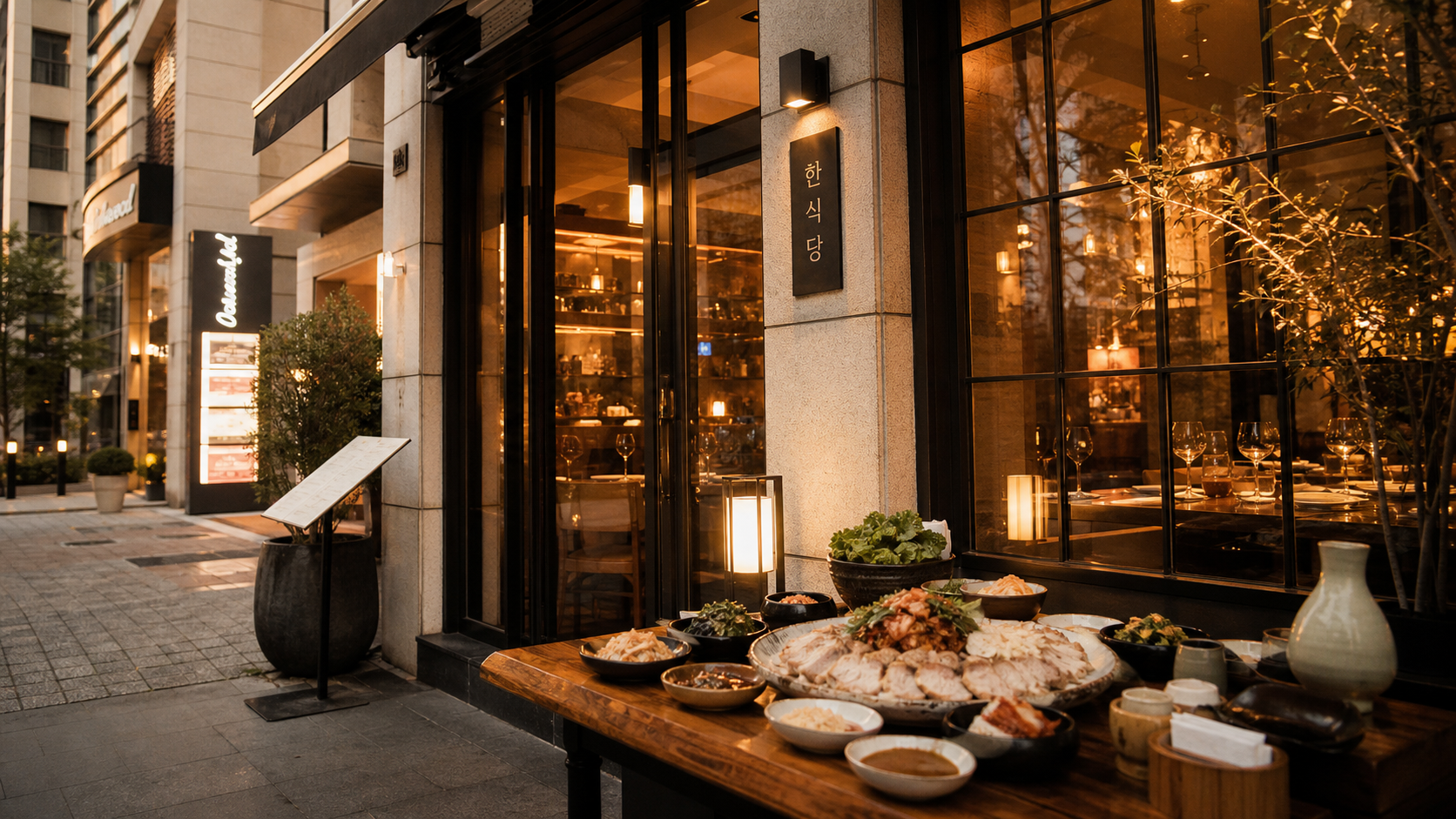
Gangnam and Apgujeong represent the high-end tier of Seoul's dining spectrum, where the distance between a neighborhood chicken joint and a two-Michelin-star tasting menu can be measured in city blocks. The area south of the Han River on Line 2 (Gangnam station) and Line 9 (Sinnonhyeon station) contains Seoul's highest concentration of quality Korean BBQ restaurants, internationally ranked fine dining, and a chimaek scene that has maintained a consistent standard for over two decades. Price gradients within walking distance run from ₩20,000–₩30,000 for a neighborhood chicken dinner through ₩220,000 for a full tasting menu at Mingles, reachable via Line 9. For K-POP fans with shows at venues in the Gangnam entertainment corridor, the neighborhood provides the widest range of pre-show dining options at any budget tier — from walk-in chimaek to advance-booked fine dining — within a compact footprint.
연탄발 | Yeontabal BBQ Restaurant
Yeontabal in Gangnam specializes in charcoal-grilled bulgogi and galbi — the two cuts most associated with Korean BBQ internationally. The restaurant uses actual charcoal rather than gas-flame grates, a distinction that produces a smokier flavor profile and requires tableside management from experienced staff who regulate cooking timing. According to Will Fly for Food, Yeontabal is a consistent Gangnam recommendation for quality charcoal-grilled meat in a setting that occupies a middle ground between casual and formal — smart casual attire is appropriate and no advance reservation is typically required for dinner.
📍 18 Yeouidong-ro, Yeouido-dong, Yeongdeungpo District, Seoul
🕒 Daily 11:30 AM – 10:00 PM
⭐ 4.1 (165 reviews)
🔗 View on Google Maps
한추 | Han Chu Korean Fried Chicken & Beer
Han Chu has operated in Gangnam for more than 20 years, long enough to serve as a practical reference point for the Seoul chimaek standard. The kitchen uses a double-frying method — two passes through oil at ascending temperatures — producing a batter shell noticeably crisper than single-fry versions. A full serving of chicken with draft beer runs ₩20,000–₩30,000 for two. Walk-in only; waits extend on weekends. As covered in ZenKimchi's guide to essential Korean food, Han Chu is consistently cited as a benchmark for the Gangnam chimaek category, where the quality floor is notably higher than equivalent spots in more tourist-concentrated neighborhoods.
📍 68 Nonhyeon-ro 175-gil, Gangnam District, Seoul
🕒 Monday–Thursday 2:00 PM – 12:00 AM / Friday–Saturday 2:00 PM – 1:00 AM / Sunday Closed
⭐ 3.9 (1,796 reviews)
📞 02-541-0969
🔗 View on Google Maps
The Michelin tier in Gangnam is anchored by Mingles (2 Michelin stars, #4 on Asia's 50 Best 2026), accessible from Sinnonhyeon station on Line 9. Lunch is priced at ₩88,000; the dinner tasting menu runs ₩220,000, with optional Korean natural wine pairings. Reservations open two to four weeks ahead and fill quickly in spring and autumn. For concert-goers, Mingles works as a pre-show dinner option only if the show starts at 8pm or later — service runs through the mid-evening, and the kitchen does not rush tables. The broader Apgujeong area, a short taxi ride north, extends the range into additional high-end Korean dining, international restaurants, and café dessert culture for those building a full evening around a Gangnam-area show.
Sindang and Jamsil: Specialist Spots Worth the Detour
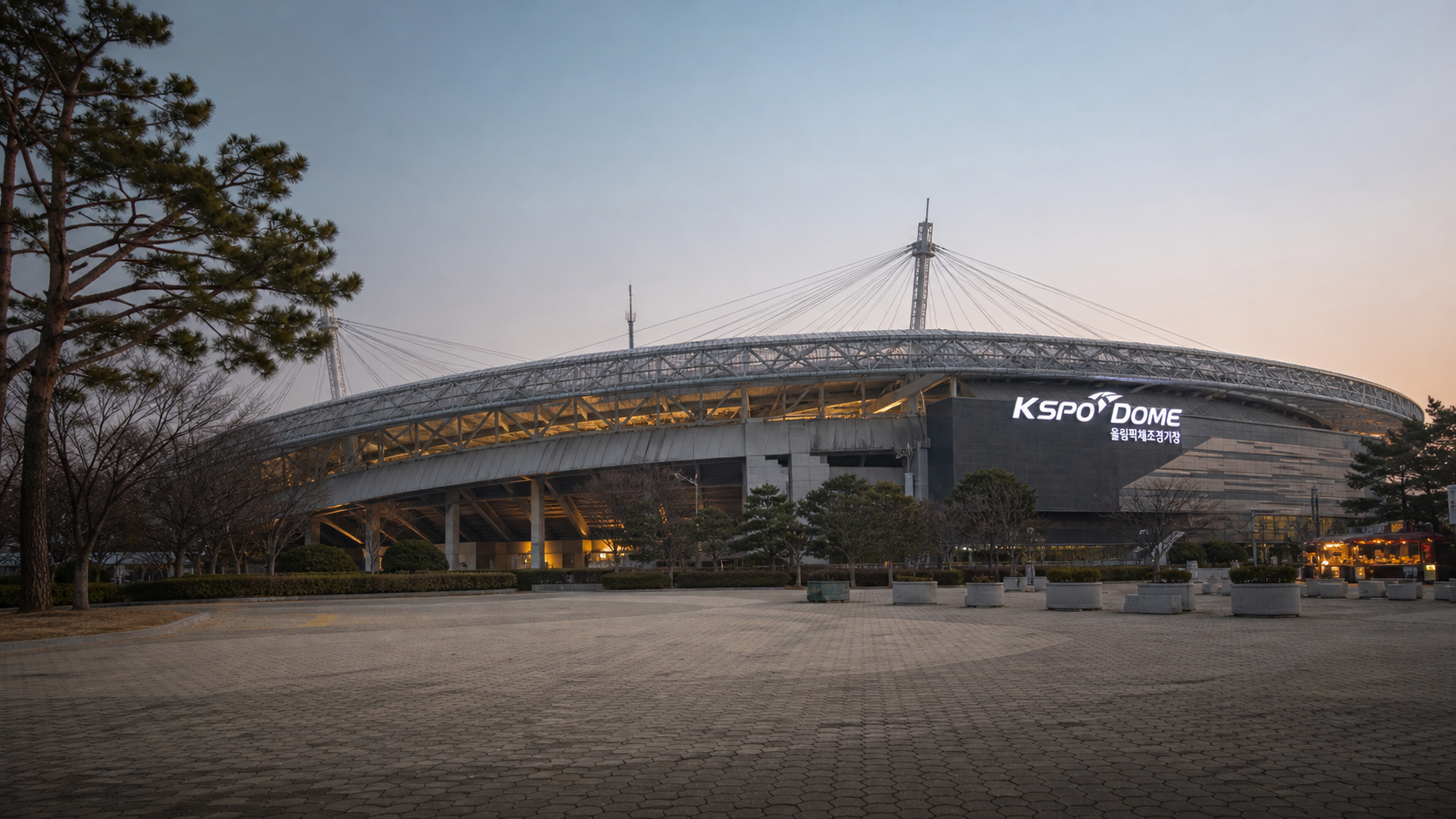
Sindang and Jamsil occupy different parts of Seoul's eastern geography but share a common characteristic: they reward visitors who look beyond the standard tourist circuit. Sindang, on Line 2 (Sindang station), contains one of Seoul's most historically specific food clusters — a block of tteokbokki stalls that has been operating in the same format since the 1970s. Jamsil, reachable via Lines 2 and 8 (Jamsil station), sits adjacent to KSPO Dome and Olympic Park, positioning it as the practical dining neighborhood for fans attending concerts at either venue. Both areas operate on local pricing with minimal English signage, which generally means larger portions and lower prices than equivalent dishes in Myeongdong or Insadong. A working knowledge of basic Korean food vocabulary helps navigation, though pointing at displayed dishes or neighboring tables' orders remains universally understood, as noted in Mile Asia's neighborhood breakdown.
신당동 떡볶이 타운 | Sindang-dong Tteokbokki Town
Sindang-dong Tteokbokki Town is a concentrated cluster of stalls near Sindang Station that has specialized in tteokbokki — chewy cylinder-cut rice cakes in a gochujang-based sauce — since the 1970s. The original Sindang-dong preparation is distinctly different from the sweeter, milder café-style tteokbokki that has proliferated across tourist-facing areas: it is spicier, less sweet, and typically served with fish cake strips and a hard-boiled egg in a shared tabletop pot, with rice on the side. Prices per serving run ₩5,000–₩10,000. The dozen or so competing stalls each assert some claim to originality; in practice, the preparation is consistent across the cluster. This area is a consistent reference point in Seoul food coverage precisely because the recipe has not been simplified for international palates — it remains a working neighborhood dish.
📍 10-18 Dasan-ro 33-gil, Jung District, Seoul
🕒 Daily Open 24 hours
⭐ 3.8 (514 reviews)
🔗 View on Google Maps
오모리찌개 | Omori Jjigae
Omori Jjigae in Jamsil occupies the fermentation-forward end of Seoul's jjigae tradition. The kimchi jjigae is built from deeply aged kimchi — fermented for months rather than days — combined with fatty pork and firm tofu in a broth whose sourness and complexity represent a different flavor register from the fresher-kimchi versions common in tourist-area restaurants. Visitors accustomed to lighter versions may find the flavor more assertive than expected; that depth is the point. A single serving with rice costs approximately ₩10,000–₩12,000. Omori Jjigae is also useful for Jamsil concert logistics: KSPO Dome is within a 10-minute walk, making it a practical and affordable dinner option for fans attending evening shows at that venue.
📍 471 Songpa-daero, 석촌동 Songpa District, Seoul
🕒 Monday 10:00 AM – 12:00 AM / Tuesday–Saturday Open 24 hours / Sunday 12:00 AM – 10:00 PM
⭐ 3.6 (1,758 reviews)
📞 02-2203-0067
🔗 View on Google Maps
Jamsil's broader dining ecosystem extends beyond the specialist jjigae category. The area adjacent to Lotte World includes a strong cluster of Korean-Chinese fusion restaurants serving jajangmyeon (black bean noodles) and tangsuyuk (sweet-and-sour pork), popular for group dining. Olympic Park's surrounding streets have a growing café and bakery corridor that works well for pre-show coffee and light meals. Naver Map provides more reliable location data than Google Maps for smaller Sindang and Jamsil restaurants, many of which have limited international digital presence despite being well-established locally.
Seoul's Michelin Stars and Asia's 50 Best 2026: Fine Dining by the Numbers
Seoul confirmed six placements on Asia's 50 Best Restaurants 2026, establishing the city as a benchmark for Korean fine dining alongside Tokyo, Bangkok, and Singapore. The ranking — reported by Stars and Stripes Korea and HAPS Korea — places Mingles at #4 (2 Michelin stars), Onjium at #14, Eatanic Garden at #26, Mosu at #41 (3 Michelin stars), Bium at #43, and 7th Door at #49. Beyond the 50 Best, La Yeon at the Shilla Hotel holds 3 Michelin stars and a 23rd-floor position above the Jung-gu district with panoramic city views. These restaurants cover a wide range of philosophies — from fermentation-driven open-kitchen coursework at 7th Door to research-based historical reconstruction at Onjium — across price points stretching from ₩68,000 lunch menus to ₩300,000+ dinner experiences, as documented in Let Seoul's 2026 fine dining guide.
| Restaurant | Asia's 50 Best 2026 | Michelin Stars | Lunch Price | Dinner Price | Culinary Style |
|---|---|---|---|---|---|
| Mingles | #4 | ★★ | ₩88,000 | ₩220,000 | Korean-Western fusion, seasonal tasting menu |
| Onjium | #14 | ★★ | Seasonal coursework only | Seasonal coursework only | Research-driven historical Korean reconstruction |
| Eatanic Garden | #26 | ★ | Available | Available | Emerging creative Korean cuisine |
| Mosu | #41 | ★★★ | ₩150,000 | ₩300,000+ | Korean tradition through modern technique |
| Bium | #43 | ★ | Available | Available | Contemporary Korean |
| 7th Door | #49 | ★ | ₩68,000 | ₩198,000 | Fermentation-forward, open kitchen |
| La Yeon (Shilla Hotel) | Not listed | ★★★ | — | ₩260,000 | Traditional Korean kaiseki, panoramic city views |
밍글스 | Mingles
Chef Kang Min Goo's Mingles in Gangnam ranks #4 on Asia's 50 Best 2026 and holds 2 Michelin stars, making it the most internationally visible entry point into Seoul's fine dining scene. The restaurant's Korean natural wine program is one of its most discussed features: domestic wines from Korea's growing wine regions are paired alongside the seasonal tasting menu, offering an experience distinct from the European-pairing norm at comparable venues. Lunch at ₩88,000 is a well-priced introduction to the format by the standard of two-star dining globally.
"At Mingles, the philosophy is that Korean and Western culinary traditions are not in competition — they complete each other. Each seasonal menu is designed so the two influences are genuinely integrated rather than alternating," — Chef Kang Min Goo, Mingles, as reported by Let Seoul (2026).
📍 South Korea, Seoul, Gangnam District, Dosan-daero 67-gil, 19 힐탑빌딩 2층
🕒 Monday Closed / Tuesday–Saturday 12:00 – 3:00 PM, 6:00 – 10:00 PM / Sunday Closed
⭐ 4.5 (861 reviews)
📞 02-515-7306
🔗 View on Google Maps
모수 | Mosu
Mosu, helmed by Chef Sung Anh and ranked #41 on Asia's 50 Best 2026, holds 3 Michelin stars. The kitchen applies modern technique — fermentation, controlled dehydration, precision temperature management — to ingredients drawn from Korean regional traditions, producing a menu that presents as contemporary fine dining while remaining grounded in Korean ingredient sourcing and flavor logic. Lunch is priced at ₩150,000; the full dinner experience runs ₩300,000 or above. Reservation windows at Mosu open approximately three to four weeks ahead of dining date. An international sommelier program is available, with pairings curated across both Korean and French wine programs.
📍 4 Hoenamu-ro 41-gil, Yongsan District, Seoul
🕒 Monday Closed / Tuesday–Saturday 6:00 – 10:00 PM / Sunday Closed
⭐ 4.6 (287 reviews)
📞 02-6272-5678
🔗 View on Google Maps
라연 | La Yeon at The Shilla Hotel
La Yeon occupies the 23rd floor of the Shilla Hotel in Jung-gu and holds 3 Michelin stars — matching Mosu for the joint-highest designation in Seoul. The menu presents traditional Korean court cuisine in a kaiseki-influenced seasonal coursework format, with a city panorama as a consistent backdrop. Dinner is priced at ₩260,000 per person. La Yeon maintains an internationally oriented sommelier program pairing Korean court dishes with both domestic and European wines. Reservation windows extend to four weeks during April–May and October peak seasons, when spring and autumn tourism combines with high demand from Seoul's business dining calendar.
📍 South Korea, Seoul, Jung District, 장충동 Dongho-ro, 249, THE SHILLA Seoul, 23층
🕒 Daily 12:00 – 2:30 PM, 5:30 – 9:30 PM
⭐ 4.5 (789 reviews)
📞 02-2230-3367
🔗 View on Google Maps
오준임 / 7th Door | Onjium and 7th Door
Onjium (#14) takes a research-driven approach to Korean flavor — the kitchen reconstructs historical Korean dishes using archival study of royal court records and regional recipe traditions. There is no printed menu; seasonal coursework changes based on ingredient availability and ongoing culinary research. 7th Door (#49), led by Chef Kim Dae-chun, specializes in fermentation: aged doenjang (fermented soybean paste), kimchi at various maturation stages, and traditional Korean preservation methods form the foundation of every course, served in an open-kitchen setting where the fermentation vessels are visible during the meal. Lunch runs ₩68,000 — the most accessible price point in Seoul's entire 50 Best cohort. Both venues represent the fermentation and historical-study currents that have shaped Seoul's international fine dining reputation since approximately 2020.
Reservations, Dress Code, and Budget: Planning Your Seoul Meals
Planning Seoul meals in 2026 involves decisions that diverge sharply by dining tier. At the Michelin level, advance reservation is not optional — Mingles, La Yeon, and Mosu routinely fill two to four weeks ahead under normal conditions, and up to a full month in advance during spring (April–May) and autumn (October), when Seoul's peak tourism period coincides with Korean cultural festival programming. At the opposite end of the spectrum, the city's BBQ restaurants, chimaek spots, and street food markets are fully walk-in and require nothing beyond locating the address, as detailed in Let Seoul's 2026 dining planning resource. The gap between these two worlds is wide in terms of logistics, but navigating both in a single trip is straightforward once the distinction is clear.
Dress code at Seoul's starred restaurants is smart casual at minimum — clean footwear, dark trousers or jeans, and a collared shirt or blouse satisfy most venues without formal attire. Mosu and La Yeon project a slightly more formal dining room atmosphere; neither has published a strict dress policy, but both skew toward business casual among their regular clientele. BBQ restaurants, tteokbokki stalls, and street food corridors carry no dress expectations whatsoever — most diners arrive directly from concerts or afternoon sightseeing. Charcoal smoke from tableside grilling is considered entirely normal; factoring that into your outfit choice before an evening show is practical rather than precious.
For non-Korean speakers, the primary logistical challenge at Michelin venues is the reservation system itself. The Catch Table app, which manages bookings for many of Seoul's top restaurants, operates primarily in Korean, though an English-language interface has been expanding since 2024. Hotel concierge services at major Seoul properties — the Shilla, Lotte, Four Seasons, and Park Hyatt — are the most reliable workaround; concierge teams at these hotels regularly navigate Korean-language booking systems on behalf of international guests and can often access reservation slots that appear unavailable through direct channels. For navigation within the city, Naver Map provides more accurate location data than Google Maps for smaller specialty restaurants, many of which have limited international digital presence despite operating for decades.
One universal fact about dining in Seoul: no tip is expected or customary, from street stalls to three-star restaurants. Banchan (complimentary side dishes) are freely refillable at every sit-down Korean restaurant — asking for more is normal and welcome. Payment by card is standard across the city's restaurants; cash remains preferred at Sindang-dong Tteokbokki Town and some traditional market stalls. The Papago translation app (developed by Naver) provides reliable real-time camera-based translation of Korean menus, which is useful in Jongno, Sindang, and Jamsil where Korean-only menus remain the norm.
Frequently Asked Questions
Which Seoul neighborhood has the most concentrated Korean BBQ restaurants?
The Mapo district near Gongdeok Station has Seoul's densest concentration of quality samgyeopsal restaurants, with Jeong Daepo being the neighborhood's most consistently cited specialist. Hongdae, directly adjacent on Line 2, offers broader variety — BBQ alongside chimaek, street food, and ramyeon — and has the advantage of late-night hours, with charcoal grills running past midnight on weekends. Gangnam also maintains a strong BBQ corridor, where Yeontabal BBQ Restaurant is the most recommended charcoal-grill option, though prices run slightly higher than the Mapo average. For the combination of concentration, late-night access, and proximity to major concert venues (AX Korea, Olympic Hall), the Hongdae–Mapo corridor covers the widest range of options in a single walkable area.
How far in advance do I need to book a Michelin-starred restaurant in Seoul?
The standard booking window for Seoul's Michelin-starred restaurants is two to four weeks ahead. During spring (April–May) and autumn (October) peak seasons, extend planning to a full month in advance — Mingles (#4 Asia's 50 Best, 2 Michelin stars) and La Yeon (3 Michelin stars, Shilla Hotel) fill particularly quickly during these months. Reservations are primarily managed through the Catch Table app, which operates mainly in Korean, though an English interface is available and expanding. Hotel concierge services at major Seoul properties are the most reliable booking resource for non-Korean speakers. Some restaurants, including Onjium (#14 Asia's 50 Best), operate seasonal coursework only with no printed menu, so confirming availability and current format before your travel dates is worth doing.
What are the best areas to eat near major Seoul concert venues?
For concerts at AX Korea and Olympic Hall, Hongdae and Mapo are the default dining districts — both venues are within a 10- to 15-minute walk or one subway stop of Hongdae Ipgu station (Line 2), and the street food and BBQ corridor here operates until 2am on weekends, covering post-show dining without difficulty. For KSPO Dome and Olympic Park events in Jamsil, the district's local restaurant cluster — including Omori Jjigae and the broader Korean-Chinese and Korean barbecue options near Lotte World — provides practical pre-show meals with pricing well below tourist-area averages. Gangnam's restaurant corridor, accessible via Lines 2 and 9, serves fans at venues in the southern entertainment district, with options spanning neighborhood chimaek at ₩20,000–₩30,000 for two through Michelin tasting menus at ₩220,000+.
What does a typical meal cost in Seoul in 2026?
Street food items run ₩3,000–₩15,000 per item. A sit-down neighborhood meal — rice, soup, and banchan at a local jjigae restaurant, bibimbap house, or student set-meal spot — averages ₩10,000–₩15,000 per person. Korean BBQ for two (samgyeopsal with drinks) runs ₩40,000–₩60,000. Fine dining tasting menus at Michelin-starred restaurants range from ₩68,000 (7th Door lunch) to ₩300,000+ (Mosu dinner). No tipping is expected at any level. Seoul remains significantly more affordable than Tokyo, Hong Kong, or Singapore at equivalent quality levels outside the Michelin tier, making it possible to eat well throughout a week-long stay without a large food budget.
Do Seoul restaurants offer English menus?
Michelin-starred restaurants, including Mingles, La Yeon, Mosu, and 7th Door, typically provide English menus and employ English-speaking staff — this is standard practice at internationally ranked venues. Tourist-concentrated areas including Myeongdong offer four-language signage (Korean, English, Japanese, Chinese) across most stalls and restaurants. Traditional restaurants in Jongno — such as Imun Seolnongtang and Tosokchon — operate Korean-only menus, but ordering is manageable through photo menus on walls, pointing at neighboring tables' dishes, or using the Papago app's camera-translation function on printed menus. The Naver Map app (rather than Google Maps) provides more accurate listings and operating hours for smaller specialty restaurants that may not have international-facing digital profiles.
Seoul's Dining Neighborhoods and Your Concert Itinerary: Bringing It Together
Seoul's food districts are not independent destinations — they connect across the subway network in a way that makes cross-neighborhood dining practical even on show days. The Jongno and Insadong corridor is strongest for morning and lunch meals, with its historic restaurants opening early and the palace area providing a natural framework for the first half of the day. Hongdae and Mapo take over in the evening and run late, anchored by the concert-venue footprint around AX Korea and Olympic Hall. Gangnam covers the full arc from business lunches at Michelin tables through late-night chimaek. Sindang and Jamsil reward fans who plan specifically around KSPO Dome shows, offering local-priced specialist cooking within walking distance of those venues. Myeongdong and Sinchon function as consistent fallbacks: always open, multilingual, and reliable across both street food and sit-down tiers.
The fine dining layer that sits across all of this — six Asia's 50 Best entries in 2026, two venues with three Michelin stars, and a range of tasting menu formats from fermentation to historical reconstruction — represents a depth of culinary ambition that has grown substantially over the past five years. Seoul's Michelin constellation and its place on the Asia's 50 Best list are now stable enough to plan around, with Mingles (#4) and Onjium (#14) holding positions that attract significant international attention. For visitors building Seoul itineraries around K-POP concerts, the overlap between the city's entertainment geography and its food geography is a genuine logistical convenience: every major venue sits within two subway stops of a significant dining district.
The single most consequential planning variable for visitors who want to cover both ends of the price spectrum in a single trip is time: walk-in Seoul is generous, but reserved Seoul is exceptional. Booking Michelin tables four weeks out, then letting the city's BBQ corridors and street food markets fill the remaining evenings spontaneously, produces the most complete picture of what Seoul's dining landscape looks like in 2026.
Last updated: 2026-05-09. Restaurant rankings reflect Asia's 50 Best Restaurants 2026 and the Michelin Guide Seoul 2026 edition. Prices listed are in Korean won (₩) and represent standard menu pricing as of May 2026; tasting menus may change seasonally.
Related Articles
- 7-Day South Korea Itinerary 2026: Seoul to Busan for Visiting Fans
- Seoul's Historical Soul: Palaces, Hanok, and Creative Districts
- Seoul Street Food Markets & Neighborhood Eats: 2026 Guide
- Korea-UAE K-Pop: Every Major Festival and Concert 2025-2026
- Korean Dramas Starring K-Pop Idol Actors: The 2018 Class
This article was written using information collected and analyzed by NAMANE's in-house K-pop research AI engine. We use AI technology to bring you faster, broader coverage, and in the process some details may occasionally differ from the latest facts. For important information such as dates, venues, and prices, please double-check with official sources.


