
Seoul Food Markets: Gwangjang, Noryangjin & What to Order
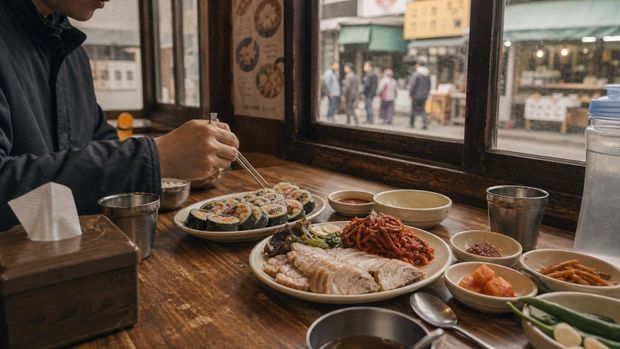
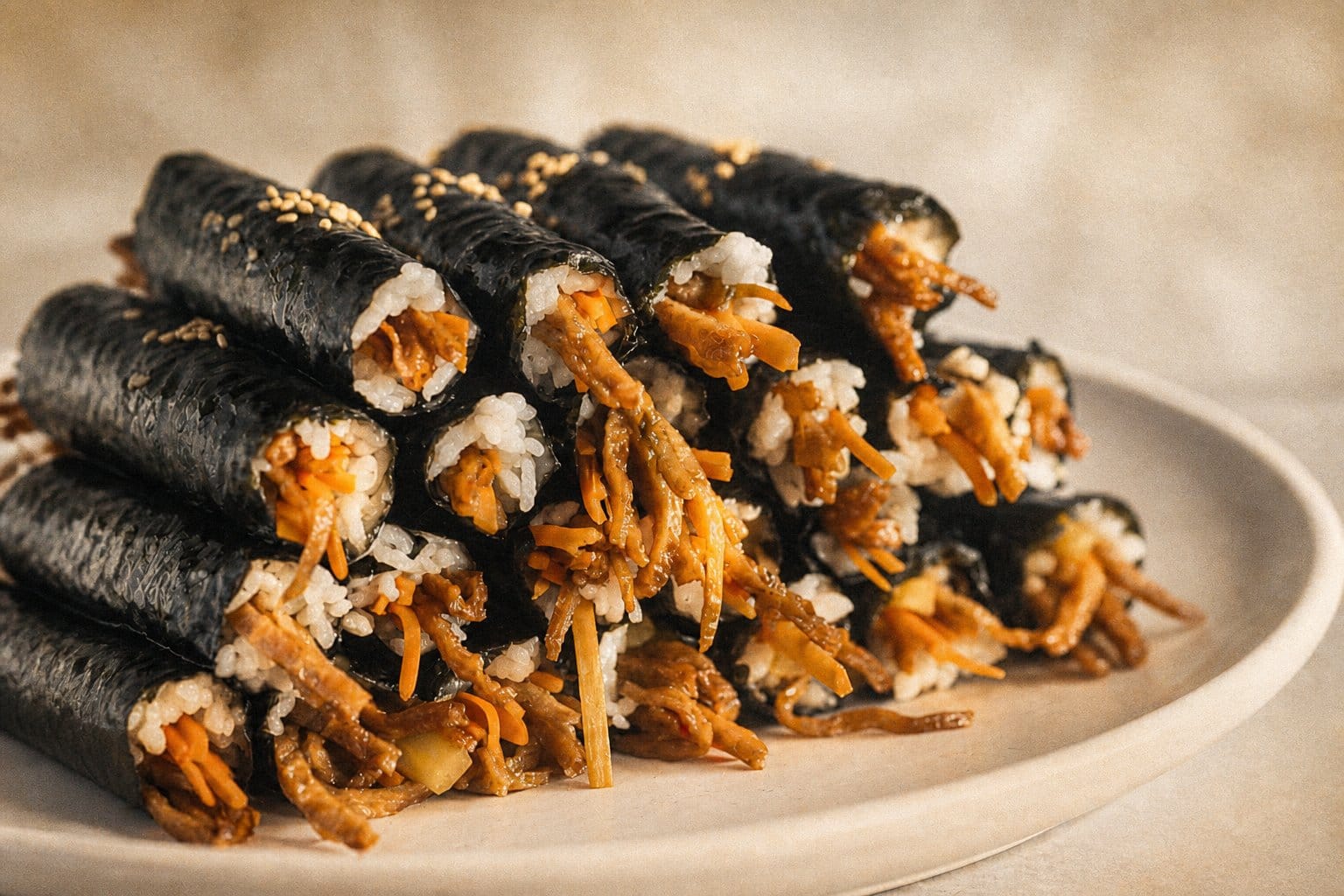
Seoul's food markets function differently from the loose outdoor vendor arrangements common elsewhere in Asia: they operate as organized indoor commercial spaces where specific dishes have been standardized and refined over decades, and where vendor families occupy the same stations across generations. Gwangjang Market, founded in 1905 near Jongno 5-ga Station, is Seoul's oldest traditional market and one of its most food-focused destinations. Open Monday through Saturday from 8:30 AM to 6 PM, it runs on a small core menu — bindaetteok (crispy mung bean pancakes cooked on cast-iron griddles), mayak gimbap (small rice rolls with sesame-soy flavoring, nicknamed "addictive" for their concentrated taste), yukhoe (raw seasoned beef with Asian pear and pine nuts), and kalguksu (knife-cut noodle soup). A full meal for two, including drinks, runs ₩20,000–30,000, according to Mile Asia. Noryangjin Fish Market, operating 24 hours, offers a structurally different experience: a wholesale seafood floor where visitors select live seafood and arrange preparation at upstairs restaurants.
At Gwangjang, weekday mornings before 11 AM are the quietest window — stalls are fully operational, the food is fresh, and foot traffic is lighter than at weekends. Weekend afternoons draw considerably more visitors, particularly near the central aisle where the most-photographed bindaetteok and mayak gimbap stalls operate. Cash is strongly preferred throughout the market; bring small-denomination bills (₩1,000 and ₩5,000 notes), as change can be limited during busy periods.
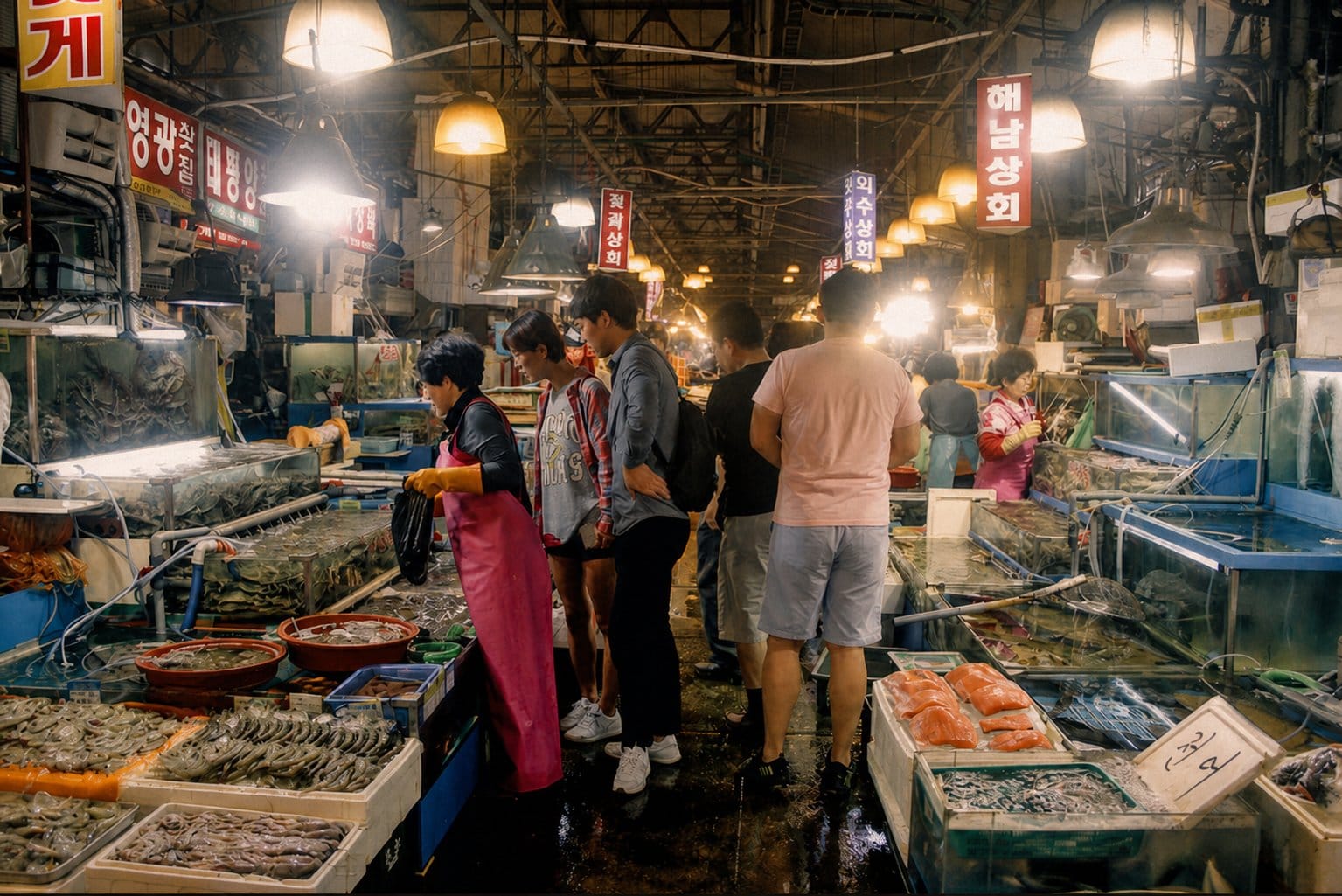
Noryangjin Fish Market's signature draw for visitors is sannakji — live octopus, cut into pieces tableside and served immediately while still moving. The experience is optional; the market's upstairs restaurants also prepare sea bream, abalone, and snow crab in standard Korean preparations: raw (hoe), steamed, grilled, or as jeongol stew. The standard process is to buy from the wholesale stalls on the main floor and take your selection upstairs to a partnered restaurant for preparation — stall vendors typically direct buyers to specific partners. The widest selection is available during the early-morning wholesale hours (4–7 AM), though the market is active at any hour.
Beyond these two anchors, Tongin Market near Gyeongbokgung Palace operates a distinctive lunchbox (dosirak) system using bronze coins, with a full assembled lunch from multiple vendors costing around ₩5,000 — one of Seoul's more economical midday eating experiences, documented by Will Fly for Food as a practical alternative to the larger markets.
Neighborhood Eating Map: Hongdae, Mapo, Gangnam & Jongno
Seoul's food landscape shifts considerably from one neighborhood to the next, and understanding those differences helps travelers make more deliberate choices based on time of day, budget, and preferred atmosphere. Hongdae, centered around Hongik University Station (Line 2), runs on late-night student energy: fried chicken spots, casual Korean BBQ, patbingsu cafés (fluffy shaved milk ice topped with red beans, most popular in summer), and 24-hour kimbap shops dominate, with peak activity between 7 PM and midnight. Mapo and Sangam, stretching west toward the Han River, are where local office workers eat — smoke-filled BBQ rooms with minimal English signage and pricing that reflects a local clientele. Gangnam, Seoul's southern financial district, anchors the fine dining and upscale food hall scene: tasting-menu restaurants share blocks with department store basement food courts stocked with regional Korean specialties from across the country. Jongno and the Gyeongbokgung area carry Seoul's oldest dining traditions — century-old soup restaurants, traditional tea houses, Gwangjang Market, and Tosokchon all within comfortable walking distance.
In Hongdae, the street food cluster near Exit 9 of Hongik University Station runs active from around 6 PM, with tteokbokki stalls, grilled skewers, and Korean-style corn dogs alongside sit-down restaurants. The area around Yonsei University, a short walk north, offers a slightly quieter version of the same scene. For travelers arriving on a late KTX train, Hongdae's 24-hour kimbap shops and convenience store seating serve as reliable options well past midnight when most restaurants have closed.
In Gangnam, Garosu-gil in Sinsa-dong provides a mix of accessible cafés and mid-range restaurants running parallel to the higher-concentration fine dining in Cheongdam-dong. Department store food halls — particularly those inside COEX Mall and Hyundai Department Store in Apgujeong — offer an efficient way to sample regional Korean cuisines from a single location, with vendors representing Jeonju-style, coastal, and Gyeongnam preparations. According to Museum of Wander, the Euljiro district has grown into a destination for younger Seoul residents, with natural wine bars and Korean fusion restaurants occupying former industrial spaces between Euljiro 3-ga and 4-ga stations.
The Jongno and Insadong area forms Seoul's most walkable concentration of traditional Korean food: Gwangjang Market for street food, Gwanghwamun Jip and Imun Seolnongtang for historic soup, Tosokchon for samgyetang, and multiple traditional tea houses serving yujacha (citrus tea), sikhye (sweet rice punch), and boricha (barley tea). Dedicated vegetarian Korean restaurants — still relatively uncommon elsewhere in the city — are also most frequently found in Insadong and Samcheong-dong side streets.
Practical Tips: Reservations, Budgets & Dietary Needs
Planning food in Seoul requires different strategies depending on where in the price spectrum you are eating. Fine dining restaurants like Mingles and Onjium book out 4–8 weeks ahead; reservations go through Catch Table, Korea's primary dining reservation platform, which provides an English-language interface and supports credit card holds for strict cancellation policies — most top restaurants require 24–48 hours' notice to avoid fees. Casual neighborhood restaurants, BBQ spots, soup houses, and local lunch counters require no reservation; the standard approach is to arrive before noon or after 2 PM to sidestep the lunch rush, as noted by Mile Asia. Seoul's food costs are reasonable by major international-city standards: market stall meals run ₩5,000–15,000 per person, casual sit-down dining ₩10,000–25,000, Korean BBQ for two ₩40,000–60,000, and fine dining tasting menus ₩150,000 or more per person.
Two structural features of Korean dining reduce costs significantly for budget travelers. First, banchan — the small side dishes (kimchi, seasoned spinach, bean sprouts, braised tofu) arriving with every Korean meal — are complimentary and refillable at no additional charge, which means a ₩10,000 rice dish functions nutritionally as a full meal. Second, tipping is not practiced anywhere in Korea; service charges are built into stated prices. The largest variable for cost control is alcohol: adding beer or soju to a meal roughly doubles the bill at casual restaurants.
Vegetarian travelers face a genuine challenge in Seoul. Korean cuisine uses fish sauce, anchovy broth (myeolchi yuksu), and salted shrimp paste as base flavorings in many dishes that appear vegetarian on the surface, including most kimchi and banchan preparations. Dedicated vegetarian and vegan restaurants exist but cluster primarily in Insadong and Hongdae; Sanchon restaurant in Insadong, which serves Buddhist temple food prepared without meat, onion, or garlic, is a frequently recommended option. Carrying a short written dietary explanation in Korean to show staff is practical — language barriers at older neighborhood restaurants can complicate verbal communication. Apps like Papago and Google Translate's camera mode handle Korean menus and signage effectively.
Frequently Asked Questions
What is the most iconic Korean food experience in Seoul?
Korean BBQ — specifically samgyeopsal (pork belly) or galbi (short ribs) cooked tableside on a charcoal grill — is the dining ritual most closely associated with Seoul for travelers. The process involves wrapping cooked meat in fresh perilla or lettuce leaves with raw garlic, sliced green onion, and fermented soybean paste (doenjang). A full dinner for two at a neighborhood BBQ restaurant runs ₩40,000–60,000. For the most representative version of the experience, restaurants in Mapo or Sangam are a better choice than the tourist-concentrated Myeongdong strip, where prices tend to run higher for the same food.
How much does food cost in Seoul?
Seoul's food costs fall into clear tiers. Market stalls and street food run ₩5,000–15,000 per item. A casual sit-down meal at a neighborhood restaurant costs ₩10,000–25,000 per person. Korean BBQ for two at a mid-range restaurant is typically ₩40,000–60,000. Fine dining tasting menus at restaurants like Mingles or Onjium cost ₩150,000–300,000 per person. By the standards of major international cities, Seoul is affordable at every level below fine dining. Banchan — complimentary, refillable side dishes served with every meal — add meaningful value to even basic restaurant orders, and tipping is not practiced anywhere in the city.
Do Seoul restaurants have English menus?
Restaurants in tourist areas and fine dining establishments almost always provide English menus or multilingual QR code menus. Older neighborhood restaurants, historic soup houses, and market stall vendors may not. For those situations, Papago (Naver's translation app) and Google Translate's camera mode both handle Korean text well enough to navigate handwritten menu boards and printed signs — pointing a phone camera at Korean text and receiving a real-time translation overlay is a practical and widely used approach. Many restaurants that have expanded in recent years also offer QR menus with Korean and English options side by side.
Is Gwangjang Market worth visiting for food?
Yes. Gwangjang Market, founded in 1905 and located near Jongno 5-ga Station (Line 1), is Seoul's oldest surviving traditional market and one of its most food-focused destinations. The signature items are bindaetteok (crispy mung bean pancakes), mayak gimbap (small sesame-soy rice rolls), and yukhoe (raw seasoned beef with Asian pear). Open Monday through Saturday, 8:30 AM to 6 PM. A full meal for two runs ₩20,000–30,000. Weekday mornings before 11 AM offer the quietest experience; weekend afternoons are considerably busier. Cash is preferred — bring small-denomination bills.
How do I book a table at Mingles or other top Seoul restaurants?
Catch Table is Korea's primary restaurant reservation platform and the standard booking method for top-tier restaurants including Mingles and Onjium. The platform is available in English, supports credit card holds, and displays each restaurant's cancellation policy clearly. For Asia's 50 Best entries, book 4–8 weeks ahead — popular weekend dates fill that far in advance. Some restaurants also accept reservations directly through their own websites; checking a restaurant's site directly is a useful step if Catch Table shows no availability, as direct bookings occasionally remain open when the platform listing is full.
Seoul Food in 2026: Planning Your Eating Itinerary
Seoul's food landscape spans a wider range than any single visit can cover fully: from a 122-year-old ox-bone soup restaurant near Jonggak Station to six tasting-menu venues on Asia's 50 Best list to a 24-hour wholesale fish market where live octopus is the signature draw. What connects that range is a consistent emphasis on specificity — Korean food culture is built on dishes prepared in particular ways, at particular establishments, by people who have spent years or decades refining a narrow repertoire. That specificity rewards travelers who research individual restaurants rather than simply walking into the nearest option in each neighborhood.
For first-time visitors, a practical approach is to anchor the trip around one or two clearly defined categories — fine dining reservations made weeks ahead through Catch Table, or a full day built around the Jongno corridor's markets and historic restaurants — rather than attempting to sample every neighborhood in a single visit. The price tiers are clear and predictable: market meals under ₩15,000 per person, neighborhood restaurants at ₩10,000–25,000, BBQ for two in the ₩40,000–60,000 range, and fine dining as a planned evening expense. Navigating with Naver Map or Kakao Map — both of which carry more accurate Korean public transport data than Google Maps — makes the logistics manageable. Tipping nowhere, banchan everywhere.
The city's food scene continues to add new layers: the Euljiro natural wine and Korean fusion district has grown substantially since 2022, and restaurants focused on regional Korean cuisines from outside Seoul — Jeolla Province, Gyeongnam, Gangwon — have expanded beyond their traditional home neighborhoods. What remains constant is the underlying principle running from Imun Seolnongtang to Mingles: in Seoul, the most reliable food is almost always the food that someone has been preparing the same way, in the same place, for the longest time.
Last updated: 2026-05-07. This article draws on Asia's 50 Best Restaurants 2026 rankings, food guides published by ZenKimchi, Mile Asia, and Will Fly for Food, and market operating information verified as of early 2026. Restaurant hours, prices, and rankings are subject to change; confirm details before visiting.
Related Articles
- 7-Day South Korea Itinerary 2026: Seoul to Busan for Visiting Fans
- Seoul's Historical Soul: Palaces, Hanok, and Creative Districts
- Seoul Street Food Markets & Neighborhood Eats: 2026 Guide
- Korea-UAE K-Pop: Every Major Festival and Concert 2025-2026
- Korean Dramas Starring K-Pop Idol Actors: The 2018 Class
This article was written using information collected and analyzed by NAMANE's in-house K-pop research AI engine. We use AI technology to bring you faster, broader coverage, and in the process some details may occasionally differ from the latest facts. For important information such as dates, venues, and prices, please double-check with official sources.


