
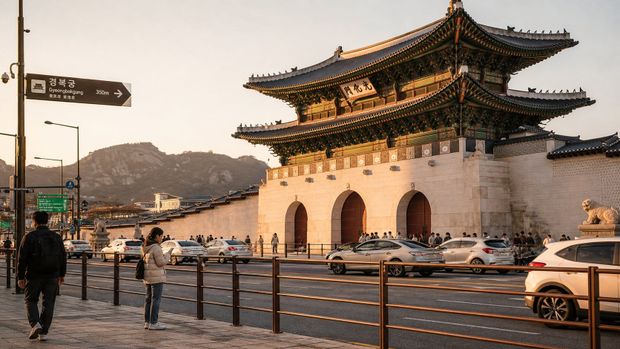
Seoul's Three Royal Palaces: The Joseon Foundation
Seoul's royal palaces are the ideological bedrock of a civilization that endured for more than five centuries. Gyeongbokgung, built in 1395 as the founding palace of the Joseon Dynasty (1392–1910), was not merely a royal residence — it functioned as the operating center of a Confucian-ordered state where court scholars advised the king, governance rituals were performed daily, and architectural space itself encoded political hierarchy. Nearby, Changdeokgung Palace — a UNESCO World Heritage Site since 1997 — carries the same design ambition in its stone paths, deliberately rough to make approaching visitors lower their gaze, and in its iron canopy hooks, which once held royal shade from the sun. Deoksu Palace, the third major palace in central Seoul, adds a living ceremonial dimension: a recreated changing-of-the-guards ceremony runs three times daily (except Mondays), performed by costumed guards with traditional instruments including a massive ceremonial drum. Together they form an irreplaceable historical corridor stretching across the Jongno district.
Quick Answer: Seoul's three main royal palaces — Gyeongbokgung, Changdeokgung (UNESCO World Heritage Site since 1997), and Deoksu Palace — trace the full arc of the Joseon Dynasty (1392–1910). Admission ranges from 1,000 to 3,000 KRW; visitors wearing hanbok enter free. Deoksu Palace hosts a changing-of-the-guards ceremony three times daily, except Mondays.
Gyeongbokgung Palace, whose name translates roughly as "Palace Greatly Blessed by Heaven," stretches across 410,000 square meters in the Jongno district at the northern foot of Bugaksan Mountain. At its conceptual core stood Geunjeongjeon, the throne hall where the king received officials and conducted affairs of state. The Confucian social order was embedded in the courtyard layout: civil officials assembled on the eastern side, military officials on the west — a spatial metaphor for the kingdom's governance philosophy made permanent in stone. Visitors today can access most of the compound, including the National Folk Museum of Korea located within its grounds.
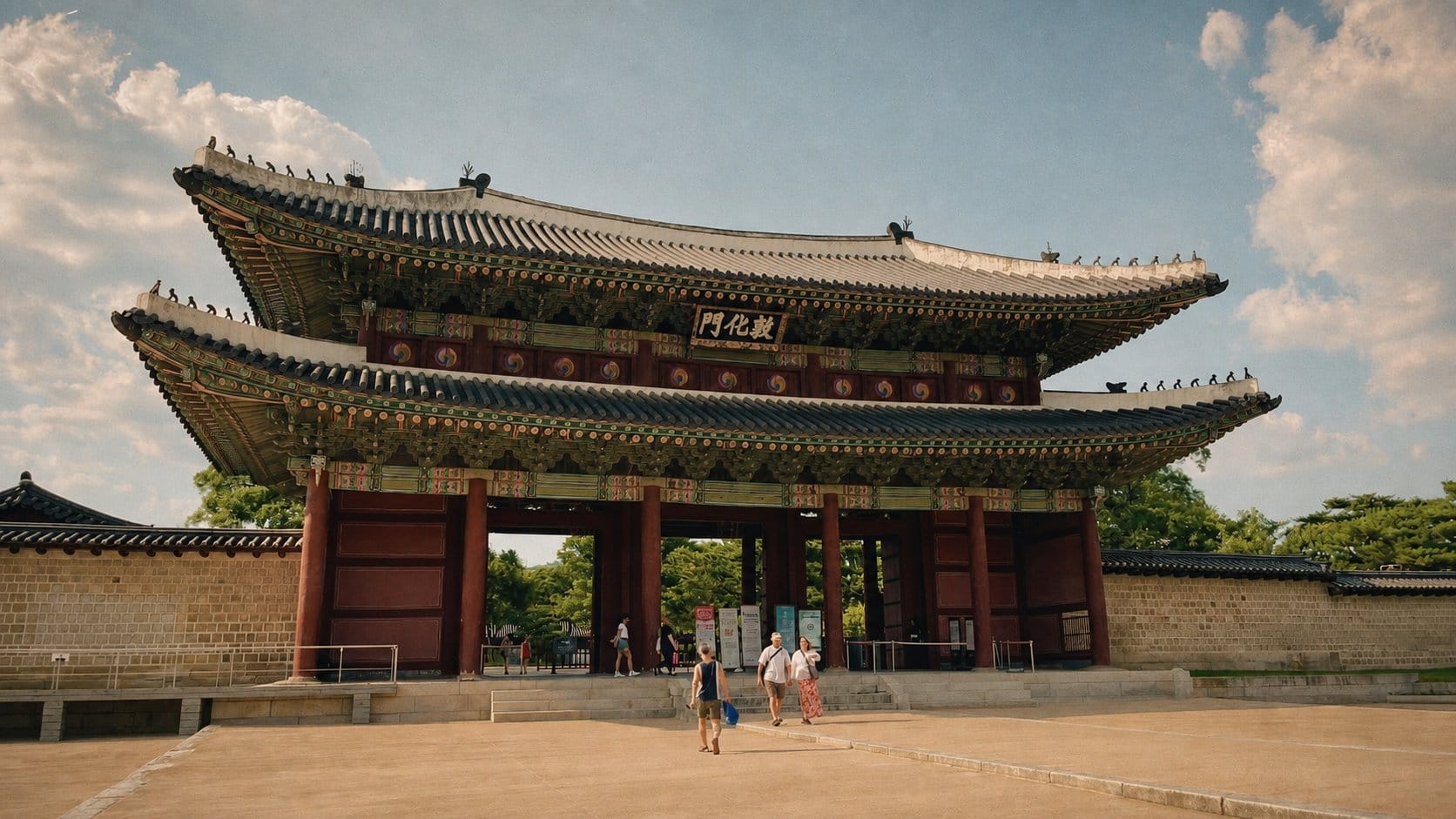
Changdeokgung, located slightly northeast of Gyeongbokgung, became the residence preferred by many Joseon kings after Gyeongbokgung was burned during the Imjin War of 1592–1598. Its crowning feature is the Secret Garden (Huwon) — a 32-hectare naturalistic rear garden accessible only via guided tour — which UNESCO recognized as an outstanding example of Far Eastern garden design when it inscribed Changdeokgung on the World Heritage List. The garden's pavilions, lotus ponds, and ancient trees represent five centuries of royal horticultural vision.
"The design of Joseon's palaces was never purely aesthetic — every incline, every material choice, every line of sight was a statement about power. The rough stone path that forced approaching officials to bow their heads was as deliberate as any written law," — Seoul cultural historian, GoWithGuide Seoul Historian Tour.
Deoksu Palace occupies a uniquely layered position in Korean history. Built originally as a royal villa in the 15th century, it became a primary palace by necessity when Gyeongbokgung lay in ruins after the Imjin War. In the late 19th and early 20th centuries it became the residence of Emperor Gojong during Korea's turbulent transition from dynasty to empire and then to colonial administration. The Dondeokjeon Hall — Deoksu Palace's Western-style reception building — recently reopened to visitors following a restoration period.
| Palace | Adult Admission | General Hours | UNESCO Status | Nearest Subway Exit |
|---|---|---|---|---|
| Gyeongbokgung | 3,000 KRW (free in hanbok) | 09:00–18:00 (Mar–Oct); 09:00–17:00 (Nov–Feb); closed Tuesdays | National Historic Site | Line 3, Gyeongbokgung Stn, Exit 5 |
| Changdeokgung | 3,000 KRW (free in hanbok) | 09:00–17:30 (seasonal); closed Mondays | UNESCO World Heritage Site (1997) | Line 3, Anguk Stn, Exit 3 |
| Deoksu Palace | 1,000 KRW (free in hanbok) | 09:00–21:00; closed Mondays | Historic Site | Line 1/2, City Hall Stn, Exit 2 |
Admission figures are indicative for 2026; verify at the official ticket office on the day of your visit.
📍 서울특별시 중구 세종대로 99
🕒 월요일 휴무일 / 화요일–일요일 오전 9:00 ~ 오후 6:00
⭐ 4.7 (479 리뷰)
📞 02-751-0753
🔗 Google Maps에서 보기
📍 View Changdeokgung on Google Maps
📍 View Deoksu Palace on Google Maps
Bukchon Hanok Village: Living Heritage, Not a Museum
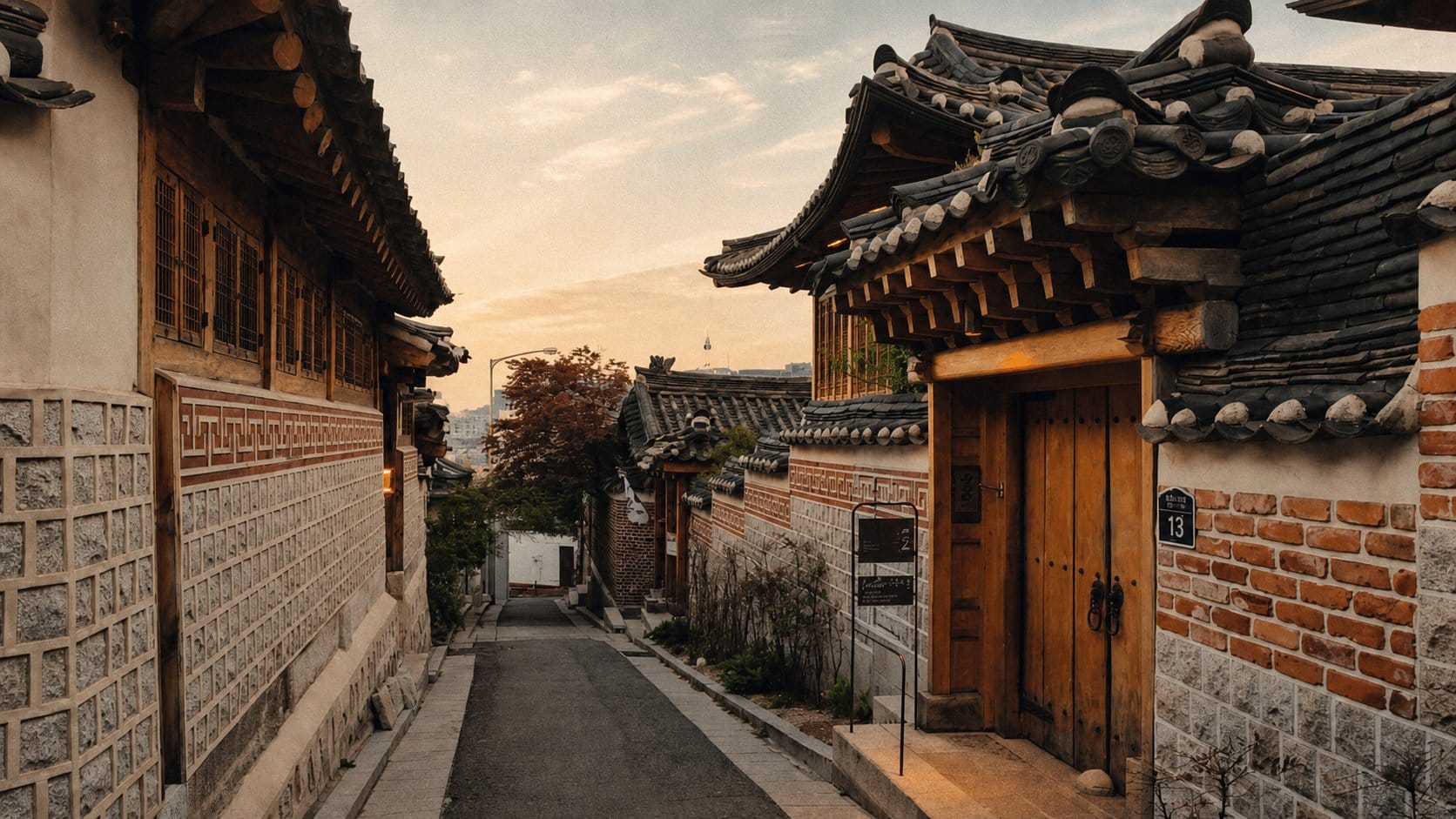
Bukchon Hanok Village is a residential neighborhood in Jongno-gu, Seoul, that preserves hundreds of traditional single-storey hanok homes — many dating to the Joseon Dynasty — within an active, inhabited urban environment. What distinguishes Bukchon from open-air folk museums is that real families live here: the narrow stone-paved lanes between curved clay-tile rooflines are not stage sets but daily commuter routes. During the Joseon era it was a prestige quarter for scholar-officials — the learned bureaucrats who administered the Confucian state and lived within walking distance of the royal courts at Gyeongbokgung and Changdeokgung. As of November 2024, Seoul City formally designated Bukchon a Special Management Area, restricting public access to 10:00 AM–5:00 PM and introducing strict protocols: group size capped at 10 people, no amplified sound, and no photography of house interiors. Entry is free. The nearest access point is Subway Line 3, Anguk Station Exit 3, approximately 516 metres from the village entrance.
The physical character of Bukchon's streetscape reflects the architectural values of late Joseon construction: curved clay-tile rooflines (기와), whitewashed mud-and-timber walls, and stone-flagged lanes that follow the natural topography of the hillside rather than a grid plan. Standing at Bukchon Haenmaru No. 2 viewpoint — the most photographed vantage point — the staggered rooftile sea runs directly toward the glass and steel towers of the modern city in the background, creating the visual collision that has made this neighborhood one of Asia's most recognizable urban landscapes. The juxtaposition is not incidental: it is precisely the kind of image that K-pop art directors and visual producers have borrowed from and built upon.
The Special Management Area designation, introduced following years of resident complaints about dawn-to-dusk tourist volumes, reflects a broader Seoul policy shift toward community-first tourism management. Fan events and social media filming crews contributed significantly to the overtourism pressure in the years leading up to the restrictions. Visitors planning a trip in 2026 should note that entry before 10:00 AM or after 5:00 PM is not permitted, and compliance is monitored by area wardens. The 10-person group cap means organized tour groups must split into smaller cohorts before entering. The quieter pace these restrictions enforce has, by many accounts, returned something of Bukchon's pre-viral atmosphere to the lanes.
📍 서울특별시 종로구 계동길
🕒 매일 오전 10:00 ~ 오후 5:00
⭐ 4.4 (23,961 리뷰)
📞 02-2133-1371
🔗 Google Maps에서 보기
Insadong and Ikseon-dong: Art Alleys and Retro Streetscapes
Insadong is Seoul's longest-running traditional culture corridor — a street and surrounding alley network in Jongno-gu that has functioned as the city's center of art commerce since the Joseon period. Along its 700-metre main strip, visitors pass galleries dealing in ink-wash painting and contemporary Korean art, studios specializing in hanji (traditional handmade paper), antique furniture dealers, calligraphy supply shops, and ceramics studios producing work in lineages going back centuries. The adjacent Ikseon-dong Hanok Street, a compact grid of repurposed hanok buildings converted into artisan cafes and independent boutiques, has become one of the city's most photographed walking zones — its retro streetscape presenting a low-rise, human-scaled counterpoint to Seoul's dominant high-rise commercial aesthetic. The suggested walking route for first-time visitors is straightforward: Insadong main strip → Ssamziegil courtyard → Ikseon-dong alleys.
The cultural density of this corridor is directly relevant to understanding K-pop's visual language. K-pop's art direction — particularly in album packaging, music video production design, and idol fashion — draws consistently from a tradition of surface craft and decorative pattern-making rooted in Korean folk art (minhwa), celadon ceramics, and hanji textile aesthetics. The Insadong corridor is where that tradition remains commercially and creatively alive — not in a heritage preservation sense, but as a functioning market and supply network. Label art directors, stylists, and set designers use Insadong's gallery and supplier ecosystem as both a reference point and a sourcing destination.
"Insadong isn't a museum of the past — it's a living supply chain for contemporary Korean aesthetics. The hanji paper workshops, the ink suppliers, the ceramics studios: these are still feeding into fashion, into music video production, into album design," — cultural commentator, cited in Knycx Journeying, Seoul Attractions 2026.
Ssamziegil, a four-story circular courtyard complex at the midpoint of the Insadong strip, consolidates independent designer boutiques, craft studios, and food stalls into a single pedestrianized space. It opened in 2004 as a deliberate counter to generic mall culture and remains a reference for how Korean urban developers have integrated commercial space with cultural programming. From Ssamziegil, the roughly 10-minute walk east into Ikseon-dong passes through a tighter residential hanok grid where the conversion of historic single-story homes into specialty coffee shops and vintage boutiques has been particularly dense since 2018. The density of craft references within a single walkable route — hanji, ceramics, calligraphy, celadon-inspired surface pattern — makes this corridor one of the most efficient ways to understand the material vocabulary that Korean visual culture has been drawing from for centuries.
📍 서울특별시 종로구 익선동
🕒 월요일–화요일 오전 10:00 ~ 오후 9:00 / 수요일 오전 11:30 ~ 오후 9:00 / 목요일–일요일 오전 10:00 ~ 오후 9:00
⭐ 4.3 (8,288 리뷰)
📞 02-2148-5243
🔗 Google Maps에서 보기
📍 View Ikseon-dong on Google Maps
📍 View Ssamziegil on Google Maps
Gwangjang Market: Seoul's Oldest Commercial Stage
Gwangjang Market, founded in 1905, is Korea's first permanent covered market — established just years before the formal annexation by Japan and predating the modern commercial infrastructure of the Korean peninsula by decades. Located in Jongno-gu along the Cheonggyecheon stream corridor, the market served as both a commercial hub and a communal anchor for a city undergoing radical transformation — first under the pressures of modernization, then under Japanese colonial administration, then through the Korean War and the decades of reconstruction that followed. Today it functions simultaneously as a working textile and fabric market, a destination street food venue, and a living social institution that connects contemporary Seoul to its pre-liberation commercial culture.
The market's food stalls run along the central arcade and have achieved international recognition through food media and travel coverage. Bindaetteok (mung bean pancakes, cooked fresh on cast-iron griddles), mayak gimbap (tiny sesame-seed-rolled rice portions sold in sets), and yukhoe (Korean raw beef dressed in sesame oil, pear, and egg yolk) are the market's defining dishes — each with traceable cultural provenance in Korean culinary history. The stalls are family-operated, many by third- or fourth-generation vendors, and the preparation is done in open view at counter-level stations facing the central walkway.
What is less visible to most visitors is Gwangjang's origin as a wedding-supply market. The upper floors and peripheral sections of the complex remain dedicated to fabric, silk, and hanbok (traditional dress) tailoring — a trade that served generations of Korean families preparing for weddings and ceremonial occasions. This dual identity — street food stage on the ground floor, textile commerce above — reveals the market's historical function as a social equalizer: a place where merchant families and scholar-official households both sourced the goods that marked life's significant transitions. That layering of commercial and ceremonial purpose in a single covered space is as Joseon-era as anything at Gyeongbokgung.
📍 서울특별시 종로구 청계천로 88
🕒 매일 오전 9:00 ~ 오후 10:30
⭐ 4.2 (43,865 리뷰)
📞 02-2267-0291
🔗 Google Maps에서 보기
Seongsu-dong: Industrial Heritage Reborn as Creative Hub
Seongsu-dong, on the north bank of the Han River in Seongdong-gu, was for most of the 20th century a working-class industrial district: leather tanneries, printing plants, and light manufacturing facilities occupied low-rise factory buildings across streets that carried the persistent smell of ink and chemicals. Beginning in the 2010s, a wave of creative conversion transformed these buildings into what has since become Seoul's most dynamic neighborhood for concept retail, specialty coffee, and contemporary art — a process that accelerated sharply after the opening of HAUS NOWHERE, Gentle Monster's 14-story flagship complex, in early 2025. The district's appeal rests on a specific synthesis — local grit and global cool — that has made it a reference point for K-pop label creative teams, music video location scouts, and idol concept developers working in the high-production visual economy of Korean popular culture.
HAUS NOWHERE is the clearest single expression of Seongsu-dong's creative ambition. The 14-story complex integrates four distinct brand experiences across a single architectural structure: Gentle Monster's eyewear showrooms occupy multiple floors alongside immersive contemporary art installations; TAMBURINS presents its fragrance and beauty lines in gallery-like environments; NUDAKE offers gourmet desserts in a space that functions as much as an art venue as a patisserie. The building exemplifies a design philosophy — experiential retail as cultural production — that Gentle Monster has refined into a globally recognized brand signature and that directly parallels K-pop's own approach to fan experience design.
"Seongsu works because it doesn't pretend the factories never existed. The exposed concrete, the loading bays turned into café entrances, the printing-press texture still visible in some buildings — that industrial memory is exactly what K-pop's visual production world keeps returning to," — design critic, cited in Knycx Journeying, Seoul Attractions 2026.
The influence of Seongsu-dong's repurposed industrial aesthetic on K-pop visual production is measurable rather than theoretical. Multiple idol group music videos released between 2023 and 2025 used Seongsu warehouse and factory locations — raw brick, steel columns, high skylights — as set design backdrops that communicated a particular register of urban authenticity. The district's visual grammar has been absorbed into idol album artwork and concept photography, with label creative teams citing Seongsu's texture as a counterweight to the polished studio environments that defined earlier K-pop visual production.
Additional concept retail and gallery spaces in repurposed Seongsu industrial buildings were announced for late 2025, continuing the neighborhood's expansion beyond HAUS NOWHERE as its central anchor. Fan shoots, label pop-up events, and unofficial merchandise drops have become a regular feature of the district's cultural calendar, particularly on weekends.
📍 서울특별시 성동구 성수이로 78
🕒 매일 오전 11:00 ~ 오후 10:00
⭐ 4.2 (2,781 리뷰)
📞 02-499-9669
🔗 Google Maps에서 보기
📍 View Seongsu-dong on Google Maps
Hongdae: Youth Culture, Street Performance, and K-Pop Origins
Hongdae — shorthand for the neighborhood surrounding Hongik University in Mapo-gu — is where contemporary K-pop's performance culture took root before the idol training system existed in its current industrial form. Through the 1990s, Hongdae developed as Seoul's student-driven counterculture epicenter: live music clubs, independent record stores, graffiti murals, and open-air performance plazas created a scene where artists worked for live audiences rather than audition panels. The busking culture that emerged on Hongdae's pedestrianized streets became an informal proving ground — a place where dancers, vocalists, and performance artists tested material before the formal agency audition circuit became the dominant path into the industry. Several artists who later debuted through major entertainment companies have cited Hongdae's street performance scene as a formative influence on their stage craft.
Today, Hongdae occupies a structurally different role in Seoul's K-pop geography. Fan merchandise districts cluster along streets within walking distance of label flagship locations and pop-up event spaces. SM Entertainment, JYP Entertainment, and several smaller agencies maintain offices or event venues within or adjacent to the Hongdae and Hapjeong neighborhoods, creating a concentration of fan-facing infrastructure — official goods shops, entertainment cafes, scheduled fan sign venues — within a walkable zone centered on Hongik University Station.
The contrast between Hongdae and the Gangnam/Apgujeong corridor to the south reveals a structural split in Seoul's K-pop urban geography. Hongdae's creative energy remains grassroots-adjacent — independent venues, student participation, street performance, spontaneous pop-ups. Gangnam and Apgujeong, by contrast, host the institutional infrastructure of the Korean pop industry: agency headquarters, trainee academies, high-end PR studios, and the promotional machinery that drives chart performance. Visiting fans who want the commercial K-pop experience go to Apgujeong; those interested in Seoul's performing-arts subculture in its less mediated form come to Hongdae after dark.
Street performance (busking) remains legal and active in Hongdae's pedestrianized zones, operating under a city-managed permit system. Performances run most evenings and on weekend afternoons, with the area directly in front of the park near Hongik University Station serving as the traditional hub. The energy level increases noticeably on Friday and Saturday nights, when both local performers and visiting artists use the space as an informal showcase for work that would otherwise require a ticketed venue.
📍 서울특별시 마포구 양화로 141
🕒 매일 오전 11:00 ~ 오후 10:00
⭐ 4.7 (1,283 리뷰)
📞 02-322-9631
🔗 Google Maps에서 보기
New Cultural Landmarks Opening in 2025–2026
Seoul's cultural infrastructure expanded significantly across 2025–2026, with the most internationally significant addition being Centre Pompidou Hanwha — the first outpost of the Paris contemporary art institution in East Asia, scheduled to open on June 4, 2026. Located in the renovated base of the 63 Building on Yeouido Island — Seoul's financial district on the Han River — the 12,000 m² space was designed by architect Jean-Michel Wilmotte of Wilmotte & Associés, whose translucent double-glazed facade takes deliberate formal inspiration from the curves of traditional Korean roof tiles. The institution is the product of a four-year partnership established in 2023 between the Centre Pompidou in Paris and the Hanwha Group, and aims to function as "a cultural bridge between Korea, France, and the international art community".
The inaugural exhibition at Centre Pompidou Hanwha — "The Cubists: Inventing Modern Vision" — will be followed by a 2026–2027 season featuring monographic shows dedicated to Chagall, Kandinsky, Matisse, and Fauvist painting. For Seoul's position in global cultural geography, the Pompidou branch carries specific significance: it places the city in a tier alongside Tokyo and Shanghai as a node of international contemporary art exchange rather than a regional cultural destination. Seongsu-dong expansion — additional concept retail and gallery spaces in repurposed industrial buildings — was also announced for late 2025, extending the neighborhood's creative footprint beyond HAUS NOWHERE as its central anchor.
| Institution | District / Location | Opening | Primary Focus |
|---|---|---|---|
| Centre Pompidou Hanwha | Yeouido (63 Building base) | June 4, 2026 | International contemporary art; inaugural Cubism exhibition |
| Seo-Seoul Museum of Art | West Seoul | March 2026 | Contemporary visual arts |
| Park Seo-Bo Museum | Seoul (location TBC) | 2026 | Dansaekhwa Korean monochrome painting |
| Floating Museum | Han River | 2026 | Contemporary art on water |
| Hwaseong Arts Centre | Suwon / Greater Seoul | 2026 | Performing arts |
📍 View Centre Pompidou Hanwha (63 Building, Yeouido) on Google Maps
Navigating Seoul's Cultural Neighborhoods: A Practical Framework
Seoul's cultural neighborhoods divide into two distinct geographic corridors that require different planning logic. The historical corridor — Gyeongbokgung Palace, Bukchon Hanok Village, Insadong, and Gwangjang Market — runs roughly north to south through Jongno-gu and is walkable in sequence, with each destination approximately 500 metres to 1 kilometre from the last. The full corridor spans approximately 2 kilometres and can be covered on foot without any subway transfer. This makes it an efficient half-day route: palace gates open at 09:00, Bukchon's restricted access window begins at 10:00 AM, Insadong's gallery and shop concentration peaks between 11:00 AM and 2:00 PM, and Gwangjang Market's food stalls operate from 10:00 AM through the early evening.
The creative corridor — Seongsu-dong and Hongdae — occupies a different geographic logic. Seongsu-dong lies on the Han River's north bank in Seongdong-gu, accessible via Subway Line 2 (Seongsu Station or Seoul Forest Station). Hongdae is to the northwest in Mapo-gu, also on Line 2 (Hongik University Station). These two districts are geographically separated and require either a Line 2 loop or a transfer, so visiting both in a single day is possible but requires deliberate sequencing rather than a walkable stroll. Seongsu concept stores and gallery spaces are generally most active from midday onward; Hongdae's street performance and fan district culture builds through the afternoon and peaks on Friday and Saturday evenings.
For K-pop fans structuring a Seoul visit around both cultural depth and fan-district access, the day-pairing logic is straightforward: the historical corridor in the morning (Gyeongbokgung → Bukchon → Insadong, before the midday crowds) and the creative and fan districts in the afternoon and evening (Seongsu-dong for concept stores and MV location scouting, or Hongdae for fan merchandise, label pop-ups, and street performances). Gangnam and Apgujeong — the institutional K-pop corridor with agency headquarters and training facilities — are a separate afternoon destination accessible via Line 3 southbound from the historical corridor.
Key subway lines for this framework: Line 3 (orange) serves the historical core — Gyeongbokgung Station and Anguk Station (Bukchon entry point). Line 2 (green) connects Hongdae (Hongik University Station) and Seongsu-dong (Seongsu Station). Line 5 (purple) stops at Gwangjang Market (Jongno 5-ga Station). A T-money transit card, loaded at any convenience store near a station, covers all subway and most bus journeys at standard fare.
Frequently Asked Questions
What are the visiting hours for Bukchon Hanok Village?
Since the November 2024 Special Management Area designation, visitor access to Bukchon Hanok Village is restricted to 10:00 AM – 5:00 PM daily. Silent tourism protocols apply throughout: groups are capped at a maximum of 10 people, no microphones or amplified sound are permitted, and photography of house interiors is prohibited to protect residents' privacy. Admission is free. The nearest access is via Subway Line 3, Anguk Station Exit 3, approximately 516 metres from the village entrance.
Do I need to pay to enter Seoul's royal palaces?
All three main royal palaces charge entry fees. Gyeongbokgung and Changdeokgung each charge approximately 3,000 KRW for adults; Deoksu Palace charges approximately 1,000 KRW. Visitors wearing hanbok (traditional Korean dress) enter all three palaces free of charge. Some national and public holidays also offer free admission. Changdeokgung and Deoksu Palace require separate tickets — a combined pass is not currently available. Confirm current pricing at the official ticket office, as fees are subject to annual revision.
What is Seongsu-dong and why do K-pop fans visit it?
Seongsu-dong is a former industrial district on the Han River's north bank in Seongdong-gu that has been converted into Seoul's leading creative neighborhood, home to concept stores, specialty coffee roasters, and contemporary art installations in repurposed factory buildings. K-pop fans visit primarily for HAUS NOWHERE — Gentle Monster's 14-story flagship complex that opened in early 2025, housing eyewear, fragrance (TAMBURINS), gourmet desserts (NUDAKE), and immersive contemporary art across a single architectural landmark. The district's repurposed industrial aesthetic shares a visual grammar with recent idol album concepts and music video direction, making it a regular destination for fan shoots and label pop-up events. Access via Subway Line 2, Seongsu Station.
What is the Centre Pompidou Seoul and when does it open?
Centre Pompidou Hanwha is an international branch of the Paris-based Centre Pompidou contemporary art institution, developed in partnership with the Hanwha Group through an agreement established in 2023. It is located in the renovated base of the 63 Building on Yeouido Island, occupying approximately 12,000 m² of space designed by architect Jean-Michel Wilmotte of Wilmotte & Associés, whose facade draws from the curves of traditional Korean roof tiles. The scheduled opening date is June 4, 2026. It is the first Pompidou outpost in East Asia. The inaugural exhibition is titled "The Cubists: Inventing Modern Vision," to be followed by shows dedicated to Chagall, Kandinsky, and Matisse in the 2026–2027 season.
How does Hongdae connect to K-pop history?
Hongdae's connection to K-pop is foundational rather than derivative. Through the 1990s, the neighborhood surrounding Hongik University in Mapo-gu developed as Seoul's student-driven indie music and live performance scene — clubs, street busking, and independent creative culture that created the city's live performance infrastructure before the idol training system scaled into its current form. Hongdae's busking circuit served as an informal proving ground for performers before formal agency auditions became the dominant entry point into the industry. Today, entertainment agency offices, fan merchandise districts, and label pop-up venues are concentrated within the Hongdae–Hapjeong corridor, making it both a working fan district and a historical origin point for the performance culture that K-pop industrialized.
Seoul's Cultural Layers: Connecting the Dots
Seoul's character is inseparable from the layering that defines its urban fabric. The Joseon palaces, the hanok rooflines of Bukchon, the calligraphy studios of Insadong, the Gwangjang textile traders, the Seongsu-dong factory conversions, the Hongdae busking stages, and the incoming Centre Pompidou all exist within a city of approximately 10 million people — and within a transit system that connects most of these sites in under 30 minutes. For K-pop fans visiting Seoul, the cultural infrastructure described here is not background context — it is the operating environment that gave K-pop its visual grammar, its performance vocabulary, and its reference points. The idol system's art directors, choreographers, and concept designers grew up in this city; these neighborhoods are where they worked out what Korean cool looked like before the rest of the world was watching.
The practical takeaway is that Seoul rewards itinerary design built around geographic corridors rather than individual attraction lists. The historical corridor (Gyeongbokgung → Bukchon → Insadong → Gwangjang) and the creative corridor (Seongsu-dong → Hongdae) each offer a coherent half-day of walking, culture, and food. Combining them across a two-day structure, with Centre Pompidou Hanwha added when it opens in June 2026, covers the full range of Seoul's cultural offering from its Joseon-era foundation to its present position at the intersection of East Asian heritage and global contemporary art.
The opening of Centre Pompidou Hanwha in June 2026 marks a moment of consolidation for Seoul's cultural geography: the city is not building toward recognition as a global cultural capital — it already functions as one, with the institutional infrastructure to support that status now arriving in permanent form.
Last updated: 2026-05-16. This article was reviewed against official Seoul tourism, UNESCO, and Centre Pompidou source data current as of May 2026.
Related Articles
- 7-Day South Korea Itinerary 2026: Seoul to Busan for Visiting Fans
- Seoul Street Food Markets & Neighborhood Eats: 2026 Guide
- Korea-UAE K-Pop: Every Major Festival and Concert 2025-2026
- Korean Dramas Starring K-Pop Idol Actors: The 2018 Class
- K-Pop Fan Experiences in Seoul: Landmarks, Shows, and 2026 Events
This article was written using information collected and analyzed by NAMANE's in-house K-pop research AI engine. We use AI technology to bring you faster, broader coverage, and in the process some details may occasionally differ from the latest facts. For important information such as dates, venues, and prices, please double-check with official sources.


