
Seoul's Food Scene in 2026: Markets, Neighborhoods, and What's Trending
Seoul's food scene in 2026 is one of the most layered and accessible in Asia, running from 4,000-won tteokbokki at a covered market stall to 300,000-won tasting menus in Gangnam's fine dining corridor [1]. Six distinct food districts each carry a different character — Gwangjang and Namdaemun for traditional market cooking, Hongdae and Sinchon for late-night chimaek bars, Gangnam for Michelin-tracked tasting menus, Mapo and Sangam for neighborhood BBQ away from tourist pricing, and Euljiro for post-industrial contemporary Korean dining that has drawn a younger crowd into repurposed factory spaces. What makes Seoul's food geography unusually practical is its concentration: the major markets and dining neighborhoods sit within Seoul Metro's reach, making cross-city food exploration achievable within a single afternoon. A visitor covering Gwangjang, Tongin, and Insadong in sequence travels no more than 30–40 minutes by subway [3].
Quick Answer: Seoul's food markets and dining neighborhoods span a wide price range — from 4,000-won tteokbokki street snacks to 300,000-won Michelin tasting menus — across six distinct districts, all reachable by Seoul Metro within 30–40 minutes of the city center. The standout 2026 trend is rose tteokbokki, a cream-and-gochujang hybrid now mainstream citywide.
The standout food trend of 2026 is rose tteokbokki — a cream-and-gochujang hybrid that tempers the dish's signature heat with a carbonara-style richness — now mainstream across both casual restaurants and dedicated tteokbokki towns [6]. It reflects a broader pattern in Seoul's food culture: established dishes absorbing global technique without surrendering their core identity. At the fine-dining end, the Michelin Guide Seoul & Busan 2026 — the guide's 10th anniversary Korean edition — recognizes 42 starred restaurants in a field where Korean fermentation traditions now anchor world-class menus [2].
Seoul's six primary food zones each reward a different kind of visitor. Traditional market eaters gravitate toward Jongno-gu, where Gwangjang Market concentrates the canonical market dishes in a single indoor hall. Late-night seekers find the highest density in Hongdae and Sinchon, where chimaek bars stay open well past midnight near live music venues. Local-preferred neighborhood barbecue clusters in Mapo and Sangam, away from areas with tourist pricing. Seafood enthusiasts route through Noryangjin, where the wholesale fish market operates around the clock. And Euljiro's growing restaurant strip, housed in repurposed factory buildings, represents Seoul's most current dining culture — natural wine, seasonal menus, and contemporary Korean cooking with no fixed script.
Gwangjang Market: Seoul's Most Storied Traditional Food Hall
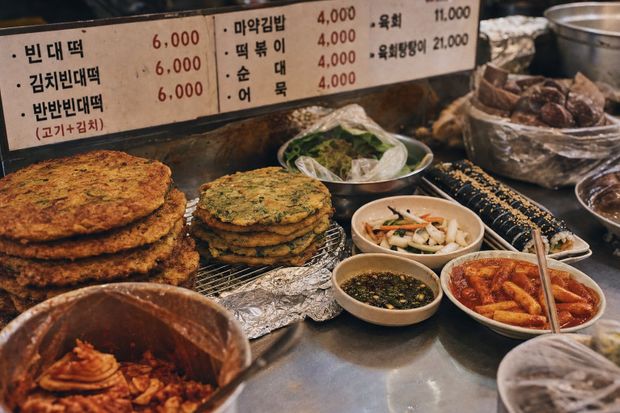
Gwangjang Market is Seoul's oldest continuously operating traditional market and its most food-concentrated indoor hall, located in Jongno-gu near Jongno 5-ga Station, Line 1 Exit 7 [3]. The market opens daily at 9am and closes at 6pm, with peak crowds running from 11am to 2pm — the window when most vendors are at full operation and the bindaetteok line queues form at the most established stalls [3]. A meal for two at an inner-aisle sit-down stall runs approximately 20,000–30,000 won (~$15–$22 USD), making it one of the more affordable full-meal stops on Seoul's food circuit [1]. The market's reputation as the primary destination for bindaetteok, mayak gimbap, and yukhoe has held across decades of shifting Seoul dining trends, and it remains the most consistently recommended single-stop market experience for first-time visitors to the city.
The three signature dishes at Gwangjang each represent a different facet of Korean market cooking. Bindaetteok — thick mung bean pancakes fried to order on a wide iron griddle — arrive at the table golden-edged and steaming, eaten with a dipping sauce of soy, vinegar, and sliced green onion. Mayak gimbap are thumbnail-sized seaweed rice rolls; the name translates roughly as "narcotic" gimbap, a reference to their addictive sesame-rice filling. A single order yields enough rolls to sustain an hour of browsing [3]. Yukhoe — seasoned raw beef with sesame oil, soy, garlic, and a raw egg yolk — is found at only a handful of stalls and represents one of the city's more difficult dishes to source elsewhere at comparable quality and price. Sundae (blood sausage with glass noodles) also appears across the inner stalls and provides a filling complement to the lighter gimbap orders.
Navigation inside Gwangjang is the practical detail most visitors overlook. The outer perimeter of the market is dominated by dry goods, bolts of fabric, and non-food retail — heading directly inside without adjusting for this wastes time. Food stalls cluster in the inner aisles, where vendors sit behind griddles or prep stations flanked by plastic stools and low communal tables. Vendors cook tableside, so dishes arrive minutes after ordering rather than from a separate kitchen. Cash remains the preferred tender at most stalls, and informal discounts for cash-paying customers are common [3]. Arriving before the 11am–2pm peak is possible but results in fewer vendors at full operation; arriving after 2pm means some griddle stations have wound down for the day.
| Dish | Description | Approx. Price (per order) |
|---|---|---|
| Bindaetteok | Mung bean pancakes, fried to order on cast iron | 4,000–6,000 won |
| Mayak Gimbap | Bite-sized sesame rice rolls, served in multiples | 3,000–5,000 won |
| Yukhoe | Seasoned raw beef with sesame oil, soy, and egg yolk | 10,000–15,000 won |
| Sundae | Blood sausage with glass noodles and vegetables | 5,000–8,000 won |
| Combined meal for two | Multiple shared dishes across signature items | 20,000–30,000 won |
📍 서울특별시 종로구 청계천로 88
🕒 매일 오전 9:00 ~ 오후 10:30
⭐ 4.2 (43,865 리뷰)
📞 02-2267-0291
🔗 Google Maps에서 보기
Namdaemun and Tongin Markets: Two Contrasting Experiences
Namdaemun Market and Tongin Market sit at opposite ends of the Seoul market experience — one a sprawling commercial hub with Joseon Dynasty roots, the other a compact neighborhood market built around a communal coin-and-tray eating concept — and together they cover two fundamentally different ways Seoul's traditional market culture operates [3]. Namdaemun is Korea's largest traditional market, with origins tracing to the Joseon era, and operates at a scale that makes it feel more like a dense urban district than a single venue [7]. Tongin, by contrast, is a single-alley neighborhood market near Gyeongbokgung Palace that has built an international following on a 5,000-won brass-coin token system unique within Seoul's market circuit. Both are reachable via Seoul Metro within 20 minutes of central Seoul, making them feasible additions to any itinerary that already passes through the Jongno-Gyeongbokgung corridor.
At Namdaemun, the food anchor is Kalguksu Alley — a dedicated corridor of hand-cut noodle restaurants where ordering a bowl of knife-cut noodles in anchovy broth typically comes with a spread of complimentary side dishes as a matter of course [7]. The standard price for a bowl sits among the lowest of any sit-down noodle meal in Seoul. Beyond the noodle alley, Namdaemun's street-facing stalls sell hotteok (sweet pancakes filled with brown sugar and nuts), mandu (steamed and pan-fried dumplings), and japchae (glass noodles stir-fried with vegetables and sesame) at prices that consistently undercut tourist-area alternatives elsewhere in the city. The market's size means it rewards deliberate navigation — food sections, textile sections, and produce areas rotate depending on the block, and wandering without a reference point loses time.
📍 서울특별시 중구 남대문시장길 17-4
🕒 매일 오전 11:00 ~ 오후 9:00
⭐ 4.2 (597 리뷰)
🔗 Google Maps에서 보기
Tongin Market, located near Gyeongbokgung Palace and accessible from Line 3 Exit 3, operates on a model with no equivalent elsewhere in Seoul [3]. At the market's dosirak (lunchbox) cafe, visitors exchange 5,000 won for 10 brass yeopjeon tokens redeemable across multiple stalls — the equivalent of assembling a lunch tray from a rotating cast of vendors rather than ordering from a single restaurant. Oil tteokbokki is the market's most frequently cited signature item: the same rice cake dish found across Seoul, but cooked here in oil rather than broth or gochujang sauce, producing a crispier, less spicy result that reads as a direct contrast to Sindang-dong's original recipe. The communal experience of assembling and comparing trays with other visitors distinguishes Tongin from a conventional market food stop and makes it particularly suited to visitors traveling in pairs or small groups.
📍 View Tongin Market on Google Maps
Sindang-dong Tteokbokki Town and Noryangjin Fish Market
Sindang-dong Tteokbokki Town, located near Sindang Station on Seoul Metro Lines 2 and 6, is the documented birthplace of gochujang-based tteokbokki — the spicy rice cake dish that became Seoul's most recognized street food [3]. The street's restaurants trace their lineage to the 1950s, when the dish transitioned from an older palace-style preparation using soy sauce to the gochujang version that subsequently spread across Korea [3]. In 2026, the street operates as both a historical eating destination and an active test site for the dish's evolution: original recipes run alongside rose tteokbokki — the cream-and-gochujang hybrid that migrated from social media into permanent restaurant menus citywide — and most Sindang-dong establishments now list both versions [6]. The coexistence of the 1950s original and the 2026 variation on the same menu makes Sindang-dong the most direct place in Seoul to compare the dish's baseline and its contemporary derivative.
Rose tteokbokki is defined by its preparation method: gochujang sauce is blended with cream to produce a milder, carbonara-like flavor profile that retains the dish's characteristic chewy rice cake texture without the full heat intensity of the standard recipe [6]. The "rose" name refers to the coral color the cream gives to the red gochujang base. While the variation originated as a social media phenomenon, it has since become a standard menu item at casual tteokbokki restaurants across all of Seoul's food districts — not exclusively Sindang-dong. For visitors less tolerant of spice who still want to engage with the city's signature street food, the rose variation is the practical entry point.
📍 서울특별시 동작구 노들로 674
🕒 매일 24시간 영업
⭐ 3.9 (30,293 리뷰)
📞 02-2254-8000
🔗 Google Maps에서 보기
Noryangjin Fish Market, in Dongjak-gu and accessible via Noryangjin Station on Lines 1 and 9, is a 24-hour wholesale seafood market operating from 7am through midnight [3]. Unlike retail fish markets oriented toward tourist traffic, Noryangjin primarily serves Seoul's restaurant industry — which accounts for both the volume and pricing that sit well below what a restaurant would charge for equivalent seafood. The standard approach is to select a fish, shellfish, or sashimi platter from a ground-level vendor stall, have it prepared — sliced raw or grilled on the spot — then carry it upstairs to one of the restaurants that charge a modest seating and side dish fee for use of their tables. Fresh sashimi platters assembled this way represent a meaningful price gap versus comparable servings at standalone Seoul restaurants, and vendors are practiced at preparing cuts for visitors unfamiliar with the wholesale market process.
📍 View Noryangjin Fish Market on Google Maps
Seoul's Essential Dishes and What They Cost
Seoul's food pricing in 2026 operates across four clear tiers: street food under 6,000 won per item, market sit-down meals at 20,000–30,000 won for two, neighborhood restaurant dinners at 40,000–60,000 won for two, and fine dining beginning at 150,000 won per person [1]. These tiers correspond to setting as much as dish type. Korean BBQ is a restaurant item, not a street stall item; tteokbokki is a street food tier dish regardless of where it appears on a menu; and Michelin-level tasting menus require advance reservation and sit entirely outside the walk-in restaurant category. Understanding these distinctions before arriving saves budget miscalculation in both directions.
Korean BBQ — samgyeopsal (pork belly) and galbi (marinated short ribs) grilled tableside — costs approximately 40,000–60,000 won (~$29–$44 USD) for two at neighborhood restaurants in Mapo or Sangam [1]. Restaurants operating charcoal grills rather than gas typically charge an additional 5,000–8,000 won for charcoal service — a premium most regulars consider worth paying for the flavor difference. A complete BBQ meal accounts for included banchan (side dishes), rice, wrapping lettuce, and frequently a finishing bowl of doenjang jjigae (fermented soybean paste stew). Chimaek — double-fried Korean fried chicken paired with draft beer — runs 25,000–35,000 won for two at Hongdae and Sinchon bars, making it the default late-night option near live music venues and the most common post-concert meal for visitors in that part of the city [1].
Everyday Korean staples sit at the mid tier. Sundubu jjigae — soft tofu stew served bubbling in a stone pot, with a raw egg cracked tableside — costs 10,000–14,000 won per bowl at neighborhood restaurants [1]. Bibimbap (mixed rice with seasoned vegetables, egg, and gochujang in a sizzling dolsot bowl) and naengmyeon (cold buckwheat noodles served in icy beef broth, particularly popular through Seoul's summer months) both fall in the same range. At the street food tier, tteokbokki — including the rose cream variation — runs 4,000–6,000 won per serving [1], while hotteok and mandu at Namdaemun and Myeongdong evening stalls are typically under 3,000 won per piece or small portion [3].
| Dish | Setting | Price (2026) | Notes |
|---|---|---|---|
| Tteokbokki (original or rose) | Street stall / casual restaurant | 4,000–6,000 won | Rose (cream-gochujang) variation widely available in 2026 |
| Hotteok / Mandu | Street stall | Under 3,000 won | Namdaemun and Myeongdong evening stalls |
| Market meal for two | Gwangjang / Namdaemun sit-down stalls | 20,000–30,000 won | Bindaetteok, gimbap, yukhoe combinations |
| Sundubu jjigae | Neighborhood restaurant | 10,000–14,000 won per bowl | Stone pot, raw egg, side dishes included |
| Bibimbap / Naengmyeon | Neighborhood restaurant | 10,000–14,000 won | Dolsot bibimbap adds stone-pot premium |
| Korean BBQ (samgyeopsal / galbi) | Neighborhood restaurant | 40,000–60,000 won for two | Charcoal service adds 5,000–8,000 won; Mapo/Sangam recommended for local pricing |
| Chimaek | Bar / casual restaurant | 25,000–35,000 won for two | Late-night standard in Hongdae and Sinchon |
| Michelin tasting menu | Fine dining restaurant | 150,000–300,000 won per person | Gangnam concentration; advance reservation required |
Where to Eat by Neighborhood: A District-by-District Breakdown
Seoul's dining geography in 2026 rewards visitors who align neighborhoods with their intended experience rather than defaulting to the most tourist-visible options. Hongdae and Sinchon, Jongno and Insadong, Mapo and Sangam, Gangnam, and Euljiro each represent a functionally different dining environment — in price range, operating hours, cuisine type, and audience [1]. For visitors whose primary purpose is attending concerts or events, the neighborhood of the venue determines the most practical dining options before and after the show, and in most cases local restaurant density is sufficient to cover the full price range without routing to a different district.
Hongdae and Sinchon are Seoul's late-night dining core for the 18–35 demographic, concentrated around Hongik University's live music and club circuit. Chimaek bars dominate the after-midnight window, but the area also supports a high density of Korean fusion, Japanese-influenced casual restaurants, and affordable set-meal spots that open for lunch and stay operational through the early hours. The district is walkable from most concert venues near Sangam World Cup Stadium and Ax-Korea [1].
Jongno and Insadong are the city's traditional Korean cuisine districts. Anguk Station, Line 3 Exit 6, places visitors at the start of Insadong's gallery-and-teahouse strip, where Korean set meals (hanjeongsik), tea ceremonies, and traditional restaurants occupy spaces that have operated for decades. The area suits visitors seeking a structured, sit-down Korean meal experience, and its proximity to Gyeongbokgung and Changdeokgung palaces makes it a natural lunch anchor for a morning sightseeing circuit.
Mapo and Sangam are the neighborhoods most consistently cited as the local-preferred alternative to tourist-facing BBQ districts in Itaewon or central Gangnam. Neighborhood samgyeopsal restaurants here carry no tourist premium, and the density of charcoal-grill BBQ spots makes them the practical choice for a representative Korean BBQ meal at market price [1]. Gangnam operates at the opposite end, housing the city's highest concentration of Michelin-tracked fine dining alongside Korean chains and Japanese imports. Casual BBQ and set-meal restaurants exist at most price points, but the district's primary food reputation rests on the 150,000–300,000 won tasting menu tier near COEX and the Apgujeong strip. Euljiro, in Seoul's former manufacturing district, has become the most discussed contemporary dining neighborhood, with natural wine bars and Korean restaurants occupying repurposed factory buildings in a configuration that has no direct equivalent elsewhere in the city.
"Seoul's neighborhood dining scene has expanded to the point where fine dining is no longer confined to Gangnam — every major district now has its own culinary identity and price tier," — Haps Korea, Seoul Fine Dining Report 2026
Seoul's Michelin Scene in 2026: Fermentation Takes Center Stage
The Michelin Guide Seoul & Busan 2026 — marking the guide's 10th anniversary in Korea — covers 233 total restaurants, with 178 located in Seoul [2]. Of those, 42 hold Michelin stars: 1 Three-Star restaurant, 10 Two-Star restaurants, and 31 One-Star restaurants [2]. The 2026 edition also expanded its sustainability recognition, with 4 Korean restaurants now holding a MICHELIN Green Star. The defining editorial theme of the 2026 selection is Korean fermentation: doenjang (fermented soybean paste), kimchi, and jangajji (traditional pickled vegetables) now serve as the anchoring ingredients on fine dining menus rather than appearing as supporting elements alongside European technique.
Mosu, led by chef Mingoo Kang, retains its three Michelin stars for a menu built on jang (Korean fermented pastes — doenjang, ganjang, gochujang) and cho (traditional Korean vinegars) within contemporary, globally-minded plating [2]. Mosu's position as Korea's sole current Three-Star restaurant represents the 2026 guide's clearest statement on what Seoul fine dining looks like at its apex: rooted in fermentation-based Korean pantry traditions, executed with a precision that has drawn international comparison well beyond the Korean market.
"The 2026 selection reflects how Korean chefs are now confidently reinterpreting their culinary heritage — particularly fermentation traditions that have existed for centuries — through a fine-dining lens that is entirely their own," — Michelin Guide Editorial, Seoul & Busan 2026
Mitou, a Two-Star restaurant, earned a new MICHELIN Green Star in the 2026 edition for sustainability practices across its supply chain and kitchen operations [2]. Gosari Express is a notable 2026 debut on the Bib Gourmand list — Michelin's recognition tier for quality meals below the fine-dining price threshold — with a plant-forward menu centered on vegetable-based Korean dishes that reflect the fermentation trend at a more accessible price point [2]. For visitors seeking Michelin-recognized dining without the tasting-menu price commitment, Gosari Express and the broader Bib Gourmand list represent the most practical entry points. The full starred and Bib Gourmand listings are maintained on the Michelin Guide's official site. For an expanded look at what the 2026 starred list includes at multiple price points, Seoul Korea Asia's 2026 Michelin restaurant breakdown covers the range from Bib Gourmand to Three-Star.
Frequently Asked Questions
Which Seoul food market is worth visiting first?
Gwangjang Market is the most compact and food-concentrated option for a first visit — bindaetteok, mayak gimbap, and yukhoe are all available within a single indoor hall near Jongno 5-ga Station (Line 1, Exit 7), and a full meal for two runs approximately 20,000–30,000 won. It operates daily from 9am to 6pm, with the 11am–2pm window being peak operation. Tongin Market, near Gyeongbokgung (Line 3 Exit 3), is the better choice for visitors who prefer a pick-and-mix tasting format via its 5,000-won brass-coin token system. Namdaemun is the stronger option for hand-cut noodles — Kalguksu Alley is its food anchor — and street-side stalls for hotteok and mandu at among the lowest prices in the city.
How much does street food cost in Seoul in 2026?
Entry-level street food in Seoul starts at 4,000–6,000 won for a serving of tteokbokki (including the rose cream variation), and hotteok or mandu at Namdaemun and Myeongdong evening stalls are typically under 3,000 won per item. A sit-down market meal for two at Gwangjang — covering combinations of bindaetteok, gimbap, and yukhoe — runs 20,000–30,000 won (~$15–$22 USD). A full Korean BBQ dinner for two at a neighborhood restaurant in Mapo or Sangam runs 40,000–60,000 won, not including drinks, with an optional 5,000–8,000 won surcharge for restaurants using charcoal rather than gas grills.
What is rose tteokbokki?
Rose tteokbokki is a 2026-trending variation of the classic Korean spicy rice cake dish. The standard gochujang (red pepper paste) sauce is blended with cream to produce a milder, carbonara-like flavor — the "rose" name refers to the coral color the cream creates in the red sauce. The dish retains the chewy rice cake texture of the original but significantly reduces the heat level, making it accessible to visitors less tolerant of spice. Rose tteokbokki is now widely available in Sindang-dong Tteokbokki Town alongside the original 1950s recipe, and has spread across casual restaurants citywide, frequently listed as a menu option alongside the standard preparation.
Where should fans staying near a concert venue eat in Seoul?
Near venues in the Hongdae and Sinchon area — including Ax-Korea and halls near Sangam World Cup Stadium — late-night chimaek bars are the standard post-show option, with most staying open well past midnight and priced at 25,000–35,000 won for two. Korean fusion and affordable set-meal restaurants in the same district cover the pre-show window. Near Gangnam-area venues including COEX Artium and Olympic-district halls, casual Korean restaurant chains and neighborhood BBQ spots are available at most price points, with Michelin-recognized options starting around 150,000 won per person for those who book a tasting-menu reservation in advance.
How many Michelin-starred restaurants does Seoul have in 2026?
Seoul has 42 Michelin-starred restaurants in the 2026 edition of the Michelin Guide Seoul & Busan: 1 Three-Star restaurant (Mosu, chef Mingoo Kang), 10 Two-Star restaurants, and 31 One-Star restaurants. The 2026 guide also recognizes 4 Green Star restaurants across Korea for sustainability practices, including Mitou (Two Stars, newly awarded Green Star) and Gosari Express, which debuted on the Bib Gourmand list — Michelin's recognition tier for quality meals below the fine-dining price threshold. The full list is available directly on the Michelin Guide's official Korea selection page.
Seoul Food in 2026: Key Takeaways
Seoul's food landscape in 2026 is not a single district or a single price tier — it is a city-wide circuit running from the inner aisles of Gwangjang Market to the tasting menus of Mosu, with most of the meaningful stops reachable via Seoul Metro within a practical session. The structure for most visitors follows a natural cadence: markets and street food in the late morning, neighborhood restaurants for lunch and early dinner, and the late-night window in Hongdae or Sinchon for chimaek, or Gangnam for reservation-held fine dining. The 2026 fermentation trend at the Michelin level and the rise of rose tteokbokki at the street level both reflect the same underlying pattern in Seoul's food culture: Korean culinary tradition absorbing global technique on its own terms, without losing the identity of the original dish.
For K-POP fans visiting Seoul around a concert or event, the food geography aligns naturally with venue geography. Sangam-area shows route to Mapo BBQ or Hongdae chimaek bars within a short taxi or subway ride. Gangnam and Olympic-district events have both casual and Michelin-tracked options within walking distance. Gwangjang, Namdaemun, and Tongin are logical daytime stops for any itinerary that passes through the Jongno-Gyeongbokgung corridor, with each market requiring two to three hours and a moderate amount of cash. Further practical detail — including current pricing comparisons and neighborhood-by-neighborhood restaurant lists — is available from Museum of Wander's Seoul food guide and Mile Asia's Korea food coverage.
The most consistent practical note for 2026 travel: use Naver Maps rather than Google Maps for accurate Seoul navigation, carry cash for market vendors, and target the 11am–2pm window at Gwangjang. Everything else in Seoul's food circuit adapts to most schedules and most budgets.
Last updated: 2026-05-16. Article reflects Michelin Guide Seoul & Busan 2026 data, market pricing current as of May 2026, and Seoul Metro routing as of the 2026 operating schedule.


