K-ETA and Entry Requirements for 2026
The K-ETA (Korea Electronic Travel Authorization) exemption is South Korea's pre-departure clearance system that, throughout 2026, does not apply to travelers from approximately 67 qualifying countries — meaning those nationals may board flights to Seoul without any prior online registration with Korean immigration authorities. South Korea's Ministry of Justice extended this exemption through December 31, 2026, covering nationals from the United States (including Guam), Canada, United Kingdom, Australia, New Zealand, Japan, Singapore, Hong Kong, and most EU member states including Germany, France, Italy, Spain, and the Netherlands (source: Visit Korea, 2026). Standard tourist stays of up to 90 days remain visa-free for qualifying nationals. One requirement that applies regardless of K-ETA exemption status is the e-Arrival Card — a separate mandatory digital form introduced on February 24, 2025 — which all travelers must submit online up to three days before departure.
Quick Answer: Travelers from approximately 67 countries — including the US, UK, Canada, Australia, Japan, and most EU nations — do not need a K-ETA to enter South Korea through December 31, 2026. The separate e-Arrival Card (mandatory since February 2025) still applies to all visitors and must be submitted online before boarding.
The e-Arrival Card is distinct from the K-ETA and is not optional for any nationality. It can be completed through South Korea's official immigration portal up to three days before departure — the process requires passport details, flight information, and a confirmed accommodation address in Korea. Processing takes under 10 minutes, and the completed form is verified at the boarding gate or upon arrival at the airport.
One planning consideration for anyone booking forward travel: the K-ETA exemption expires at midnight on December 31, 2026. From January 1, 2027, nationals of currently-exempt countries will need to register for a K-ETA before travel — a pre-arrival authorization process that carries a processing fee. Travelers booking stays that cross into 2027 should monitor Visit Korea's official immigration announcements for updated reinstatement procedures well before their departure date.
| Region | Countries / Territories Exempt from K-ETA (through Dec 31, 2026) |
|---|---|
| North America | United States (incl. Guam), Canada |
| Oceania | Australia, New Zealand |
| Asia-Pacific | Japan, Singapore, Hong Kong |
| Europe (EU) | Germany, France, Italy, Spain, Netherlands, and most EU member states |
| Europe (Non-EU) | United Kingdom |
| Total covered | ~67 countries and territories |
Getting to Seoul: Airport to City
Incheon International Airport connects to Seoul's city center via the AREX (Airport Railroad Express) network — the fastest and most practical ground transport option for the vast majority of visitors. The AREX express service runs non-stop from the airport to Seoul Station in approximately 43 minutes at ₩9,500 one-way (roughly $7 USD). For travelers staying in mid-city neighborhoods such as Hongdae or Digital Media City, the all-stop AREX service covers additional stations in around 60 minutes at a reduced fare of ₩4,800 (source: Trip.com Seoul Guide). Both services run at regular intervals throughout the day and include dedicated luggage areas onboard. Seoul's 10-line metro system, with multilingual signage in Korean, English, Chinese, and Japanese, extends comprehensive coverage to virtually every major neighborhood once in the city.
For ongoing city-wide travel, the Climate Card (Tourist Pass) is the most cost-effective option: it bundles unlimited subway, bus, and public bike-share rides for approximately ₩5,000 per day, or ₩20,000 for a weekly pass (source: Real Korea Insider, 2026). Cards are available at Incheon Airport arrival halls and major metro stations. One navigation note worth knowing before arrival: Naver Map significantly outperforms Google Maps for Seoul public transit routing — Google has reduced its real-time transit data coverage for Korean networks. Downloading Naver Map before landing takes a few minutes and avoids friction on the ground.
Taxis from Incheon to central Seoul are available but cost considerably more than the AREX, particularly during weekday rush hours (7:30–9:00 AM and 5:30–7:30 PM) when road traffic inflates both travel time and fare. For visitors arriving for concerts or major evening events, the metro runs late on most lines and handles post-event crowd volumes efficiently.
Top Cultural Landmarks and Palaces
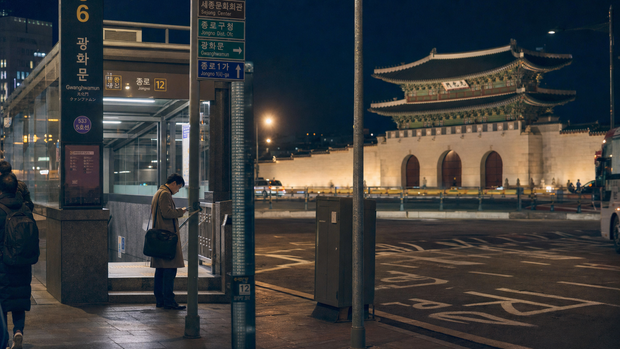
Seoul's built heritage spans six centuries of Joseon Dynasty architecture, Buddhist mountain temples, and a UNESCO-recognized residential neighborhood — most of it accessible within the city limits by metro. Gyeongbokgung Palace, constructed in 1395 as the founding and largest royal complex of the Joseon Dynasty, remains the most architecturally complete of Seoul's five palace sites. General admission is ₩3,000 (approximately $2 USD), and visitors wearing a rented hanbok — traditional Korean formal dress available from shops directly outside Gwanghwamun Gate — enter free of charge (source: The Broke Backpacker). The hourly changing-of-the-guard ceremony runs from 10:00 AM to 4:00 PM daily except Tuesdays. Special night openings are scheduled May 8 through June 15, 2026, from 7:00 to 9:30 PM — tickets are separate from daytime admission and typically sell out within days of release.
Gyeongbokgung Palace
Beyond the changing-of-the-guard, the palace grounds include the National Folk Museum of Korea and the National Palace Museum of Korea, both accessible with the ₩3,000 entry ticket and substantial enough to fill several additional hours. The rear gardens and Hyangwonjeong Pavilion pond offer notably quieter spaces compared to the front ceremonial courtyards. Night opening tickets for the May–June 2026 window are released through the official Gyeongbokgung booking portal and the Visit Seoul platform; monitoring both in the days after release announcements is the most reliable way to secure a spot before allocations close.
"The night opening program at Gyeongbokgung transforms the palace into something entirely different from the daytime experience — the illuminated architecture against the dark mountain backdrop, combined with the reduced crowd size, makes it one of the most distinctive cultural experiences Seoul offers." — Visit Seoul editorial
📍 161 Sajik-ro, Jongno District, Seoul
🕒 Monday 9:00 AM – 5:00 PM / Tuesday Closed / Wednesday–Sunday 9:00 AM – 5:00 PM
⭐ 4.6 (46,201 reviews)
📞 02-3700-3900
🔗 View on Google Maps
Bukchon Hanok Village
Bukchon Hanok Village is a living residential neighborhood of traditional hanok houses spread across the hillside corridor between Gyeongbokgung and Changdeokgung palaces. Unlike a museum reconstruction, the lanes here contain occupied private homes — a distinction the Seoul city government marks with signage asking for quiet during early morning and evening hours. Entry is free. Visiting at sunrise or shortly after minimizes pedestrian congestion in the narrowest residential lanes, and the elevated position of the upper village provides unobstructed views across central Seoul toward Namsan Mountain (source: The Broke Backpacker). The adjacent Insadong district makes a natural pairing for the same half-day.
📍 Gyedong-gil, Jongno District, Seoul
🕒 Daily 10:00 AM – 5:00 PM
⭐ 4.4 (23,945 reviews)
📞 02-2133-1371
🔗 View on Google Maps
Bukhansan National Park
Bukhansan National Park begins at the northern edge of Seoul's metropolitan boundary — making it one of the few major national parks in the world fully accessible by city metro. The park's granite ridge trails offer panoramic views of the Seoul skyline, and multiple routes pass ancient Buddhist temples and Joseon-era fortress walls. Trails range from straightforward walking paths to technical ridge scrambles. No admission fee applies; standard park rules covering open fires and waste removal are enforced by rangers at the main trailheads. Most central Seoul accommodations can reach a Bukhansan trailhead via metro in under an hour (source: The Broke Backpacker).
📍 262 Bogungmun-ro, Seongbuk District, Seoul
🕒 Daily 4:00 AM – 5:00 PM
⭐ 4.6 (2,900 reviews)
📞 02-909-0497
🔗 View on Google Maps
Trending Neighborhoods for K-Culture Fans
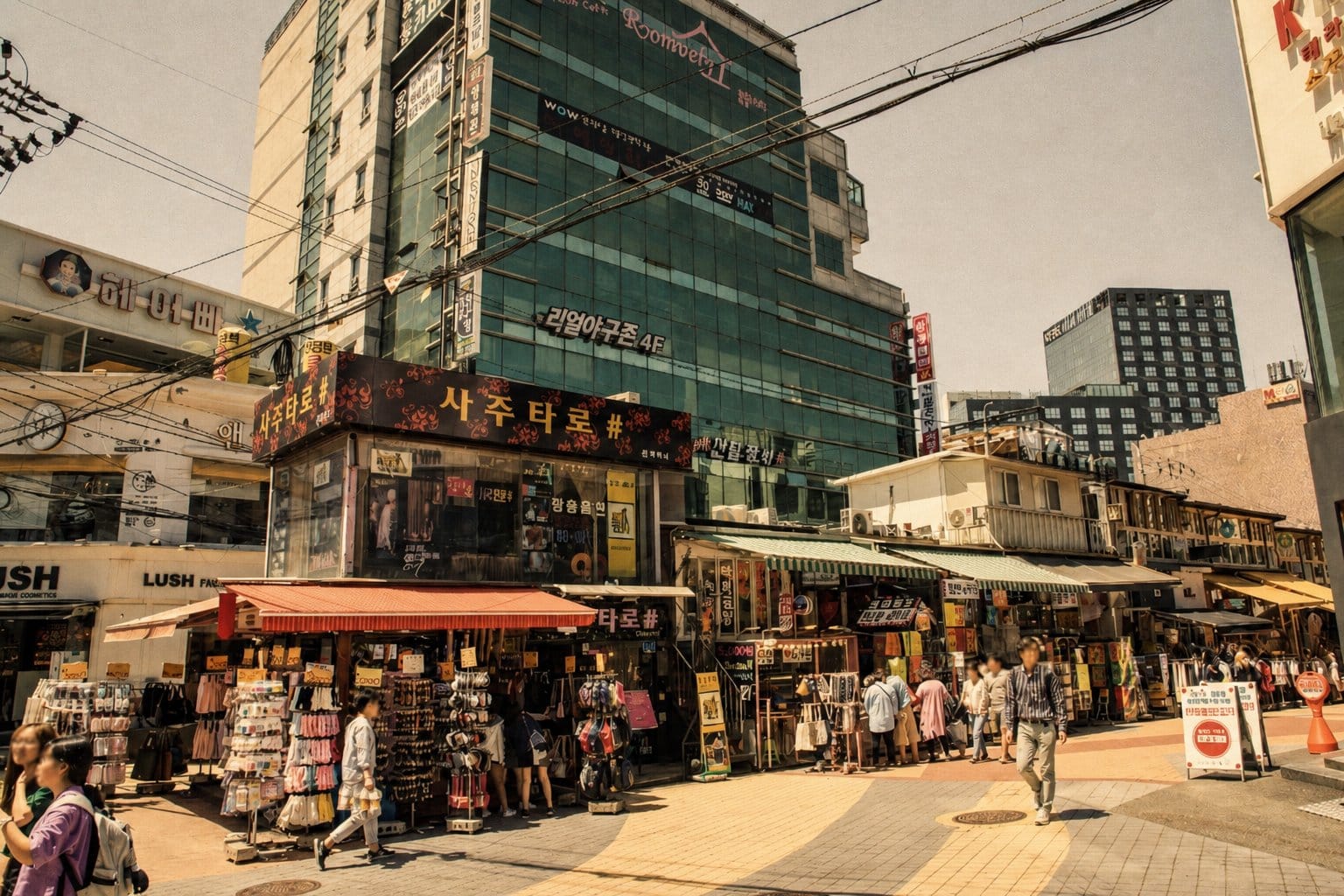
Seoul's neighborhood identities are unusually distinct, with each district carrying a different demographic, aesthetic, and cultural function that shifts noticeably even block to block. For visitors whose focus is Korean pop culture, fashion, and entertainment, the most active areas in 2026 are Seongsu-dong in the east, Myeongdong in the commercial center, and the Namsan corridor connecting them. Seongsu-dong, frequently described as the "Brooklyn of Seoul," is a former industrial zone that has evolved into the city's most visible creative district over the past several years — defined by concept cafes, street art murals, pop-up boutiques, and fashion studios that K-brands use as a proving ground before wider releases (source: Real Korea Insider, 2026). Myeongdong operates on a different register: dense, internationally-facing, and built around K-beauty retail and evening street food.
Seongsu-dong
Seongsu-dong's appeal for K-culture visitors extends well beyond aesthetic tourism. The neighborhood functions as an active launch environment where Korean fashion labels, beauty brands, and entertainment companies run limited-duration pop-up installations — sometimes for a single weekend — before broader national releases. In 2026, the district remains heavily documented on Korean social platforms, so cross-referencing real-time activity on Instagram and KakaoTalk channels before a visit helps identify which installations are currently active. The Seongsu station area (Seoul Metro Line 2) is the practical starting point; the main cluster of cafes and studios extends roughly 15 minutes on foot from the exit.
"Seongsu-dong in 2026 functions less as a conventional tourist destination than as an active creative district — the pop-up cycle rotates quickly enough that the neighborhood looks genuinely different from month to month." — Real Korea Insider
📍 Seongsu-dong 2(i)-ga, Seongdong-gu, Seoul
🔗 View on Google Maps
Myeongdong
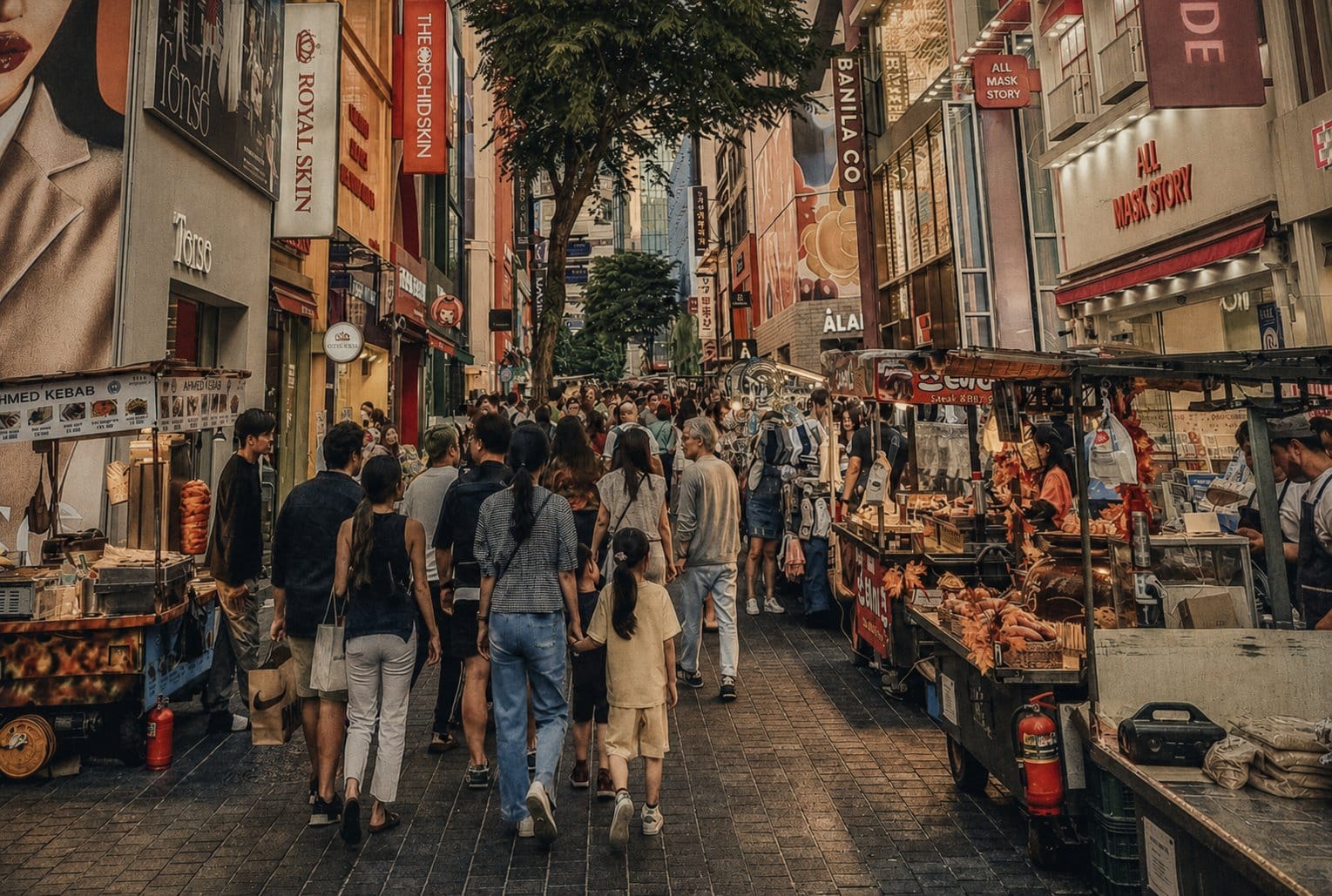
Myeongdong's daytime character is anchored by K-beauty retail — an almost continuous corridor of flagship stores from Innisfree, Etude House, Missha, and Olive Young alongside international cosmetics brands. After approximately 5:00 PM, the main pedestrian streets fill with street food vendors selling hotteok (sweet brown-sugar pancakes), Korean cheese corn dogs, skewered seafood and meat, and regional variations of tteokbokki. Cash is strongly preferred at most food stalls, though card terminals are present in higher-traffic areas. The district is also within walking distance of Myeongdong Cathedral and the base of Namsan Park.
📍 Myeong-dong, Jung District, Seoul
🔗 View on Google Maps
N Seoul Tower on Namsan Mountain
N Seoul Tower sits atop Namsan Mountain at 479m above sea level and delivers 360-degree views across the Seoul metropolitan area. It is accessible by cable car from Myeongdong or via a walking trail through Namsan Park. The tower's exterior lighting system changes color in real time to reflect the current air quality index — a practical signal that has also become an informal local landmark visible from much of the city after dark. The paid observation deck inside the tower is separate from the public outdoor viewing areas around the base, which are free and often preferred by visitors for evening panoramas.
📍 105 Namsangongwon-gil, Yongsan District, Seoul
🕒 Monday–Friday 10:30 AM – 10:30 PM / Saturday–Sunday 10:00 AM – 11:00 PM
⭐ 4.5 (66,794 reviews)
📞 02-3455-9277
🔗 View on Google Maps
Lotte World and Seoul Sky Observatory
Lotte World, in the Jamsil district, holds the record as the world's largest indoor theme park and shares its complex with the Lotte World Tower — 555m tall, 123 floors, and among the five tallest buildings globally. Seoul Sky Observatory occupies the upper floors of the tower, with access bundled within the complex ticket structure. Theme park day passes run ₩50,000–₩67,000 depending on season and package (source: Trip.com Seoul Guide). The complex also houses the COEX Aquarium, a large retail mall, and as of April 3, 2026, a new MapleStory-themed zone — a collaboration with the Korean gaming franchise that draws both gaming communities and K-culture visitors looking for brand-integrated experiences.
📍 300 Olympic-ro, Songpa District, Seoul
🕒 Monday–Thursday 10:30 AM – 10:00 PM / Friday–Sunday 10:30 AM – 11:00 PM
⭐ 4.6 (6,229 reviews)
📞 02-3213-5000
🔗 View on Google Maps
2026 Seoul Events and Seasonal Highlights
Seoul's 2026 event calendar is concentrated in spring and early summer, stacking multiple concurrent cultural programs across different venues and formats. The most time-sensitive events for visitors planning May or June 2026 trips are the Gyeongbokgung Palace night openings (May 8–June 15, 7:00–9:30 PM), the Changdeokgung Palace moonlight tours (April 16–May 31), and the Seoul International Garden Show at Seoul Forest (May 1–October 27) — all three running simultaneously through portions of May (source: Visit Seoul, 2026). The Lotus Lantern Festival, typically held in mid-May, brings lantern parades and cultural performances to multiple neighborhoods citywide. At the Hangang riverside parks, a drone light show running April 10–June 5 provides free nightly entertainment visible from multiple embankment access points without ticketing.
| Event | Dates (2026) | Location | Admission |
|---|---|---|---|
| Seoul International Garden Show | May 1–Oct 27 | Seoul Forest (Seongsu) | Ticketed (varies) |
| Drone Light Show | Apr 10–Jun 5 | Hangang riverside parks | Free |
| Gyeongbokgung Palace Night Openings | May 8–Jun 15, 7:00–9:30 PM | Gyeongbokgung Palace | Ticketed (sells out) |
| Changdeokgung Moonlight Tours | Apr 16–May 31 | Changdeokgung Palace | Ticketed |
| Lotus Lantern Festival | Mid-May | Citywide parade route | Free (public parade) |
| Cheonggyecheon Outdoor Reading Library | Apr 23–Jun 28 (Fri–Sun) | Cheonggyecheon Stream | Free |
| Banpo Bridge Rainbow Fountain | Nightly (seasonal schedule) | Banpo Bridge, Han River | Free |
| MapleStory Zone at Lotte World | Opened Apr 3, 2026 (ongoing) | Lotte World, Jamsil | Included with park admission |
| Hermitage Museum Digital Exhibition | Apr 30–Jul 30 | Seoul exhibition venue | Ticketed |
| Seoul Outdoor Library | Apr 23–Nov 1 | City parks (various) | Free |
The Banpo Bridge Moonlight Rainbow Fountain operates nightly during spring and summer months and is documented as the world's longest bridge fountain at 1,140 meters — free displays visible from the Banpo Hangang Park embankment on both sides of the river (source: Trip.com Seoul Guide). Display schedules follow a fixed seasonal timetable with potential interruptions for weather; confirming current timings through the Visit Seoul app or city website before visiting is practical.
For visitors attending both May palace night events, Gyeongbokgung and Changdeokgung offer distinct experiences: Gyeongbokgung's scale and illuminated grandeur work well for first-time visitors, while Changdeokgung's moonlight tour format — smaller-group, guided, centered on the UNESCO-recognized Huwon Secret Garden — runs at a more deliberate pace. Tickets for each require separate purchases through different booking portals and both sell out significantly in advance of the dates.
📍 View on Google Maps — Seoul Forest
📍 View on Google Maps — Changdeokgung Palace
📍 View on Google Maps — Banpo Bridge Rainbow Fountain
Food Culture: Markets and Street Eats
Seoul's market and street food culture is embedded in daily city life rather than staged separately for visitors — the communal counters, bench seating, and open-air stalls are spaces where residents eat alongside tourists as a matter of course. Gwangjang Market, founded in 1905 as Korea's first permanent covered market, runs Monday through Saturday from 9:00 AM to 10:00 PM and has developed strong international recognition around three dishes: bindaetteok (mung bean pancakes, pan-fried to order at open counters), tteokbokki (spicy rice cakes in gochujang sauce), and mayak kimbap — bite-sized sesame-seasoned rice rolls nicknamed "narcotic kimbap" for their addictive seasoning profile (source: The Broke Backpacker). Eating here follows a communal, informal format: shared bench seating at vendor counters, ordering directly from the cook, and no table service.
Gwangjang Market
The market's covered main hall separates fabric and clothing vendors from the food corridor, with the food section busiest from midday through early evening. Prices are low relative to the quality: a full plate of fresh bindaetteok typically runs ₩8,000–₩12,000. Most vendors still prefer cash, though card payment has become increasingly accepted at larger stalls. The market's location in the Jongno district puts it within reasonable walking distance of Dongdaemun and Insadong, making it a natural anchor for an eastern central Seoul day.
"Gwangjang Market is one of those places where the food is the setting — you're eating what's being cooked directly in front of you, at the oldest permanent market in Korea, and the atmosphere is just the room that surrounds that transaction." — The Broke Backpacker
📍 88 Cheonggyecheon-ro, Jongno District, Seoul
🕒 Daily 9:00 AM – 10:30 PM
⭐ 4.2 (43,859 reviews)
📞 02-2267-0291
🔗 View on Google Maps
Myeongdong Evening Street Food
Myeongdong's street food stalls activate after approximately 5:00 PM along the main pedestrian corridor and branching side streets. The offerings here are more internationally familiar than Gwangjang — hotteok (sweet pancakes filled with brown sugar and crushed nuts), Korean corn dogs battered with mozzarella, skewered seafood and meat, and multiple tteokbokki variations. Cash is preferred at the majority of stalls. Individual item prices generally run ₩3,000–₩6,000, keeping a full evening of street food within a modest budget. For visitors with a longer stay, the areas around Hongdae and the late-night pojangmacha (tented street stalls) near university districts extend the street food circuit considerably beyond the Myeongdong corridor.
Admission Costs and Practical Budget Notes
Seoul presents an unusually favorable ratio of free and low-cost cultural experiences relative to its standing as a major international capital. The majority of the city's outdoor landmarks, national parks, and historic walking districts require no admission at all. Bukchon Hanok Village, Bukhansan National Park, Banpo Bridge Rainbow Fountain, and the Cheonggyecheon outdoor reading library (Fridays through Sundays, April 23–June 28) are all free to access (source: Visit Seoul, 2026). Among formal cultural sites, Gyeongbokgung Palace charges ₩3,000 (approximately $2 USD) — effectively free for visitors who rent a hanbok from the shops outside Gwanghwamun Gate. Airport transit via AREX express runs ₩9,500 one-way from Incheon, and the Climate Card covers unlimited daily city transit for approximately ₩5,000 per day.
The notable per-visit costs concentrate at commercial entertainment complexes. Lotte World's indoor theme park runs ₩50,000–₩67,000 depending on season and ticket configuration. Seoul Sky Observatory access on the 123rd floor of Lotte World Tower is bundled within the complex's ticket structure. These represent the clearest daily cost outliers in a city where most cultural experiences are low-cost or free. Ticketed palace night events add a modest additional line item — though availability, not cost, is the practical constraint there.
As a reference for daily planning:
- AREX airport express (one-way from Incheon): ₩9,500 (~$7 USD)
- Climate Card daily transit pass: ₩5,000 (~$4 USD)
- Gyeongbokgung Palace admission: ₩3,000 (~$2 USD), or free with hanbok rental
- Street food and market meals (per day): ₩10,000–₩20,000 (~$7–$15 USD)
- Lotte World theme park (day pass): ₩50,000–₩67,000 (~$37–$50 USD)
Seoul's 24/7 multilingual tourism hotline — 1330 — provides live assistance in English, Japanese, Chinese, and Russian and is available at no charge from within Korea. The US State Department's Level 1 travel advisory for South Korea reflects one of the most stable safety profiles for any major international destination, with violent crime targeting tourists described as extremely rare.
Frequently Asked Questions
Do I need a K-ETA to visit South Korea in 2026?
Travelers from approximately 67 countries — including the United States, United Kingdom, Canada, Australia, New Zealand, Japan, Singapore, Hong Kong, and most EU member states — do not need a K-ETA to enter South Korea through December 31, 2026. Standard tourist stays of up to 90 days are visa-free for qualifying nationals under the extended exemption confirmed by South Korea's Ministry of Justice. However, the e-Arrival Card is still mandatory for all travelers regardless of nationality or K-ETA status — it must be submitted online before boarding and takes under 10 minutes to complete. The K-ETA exemption ends on January 1, 2027, so travelers booking stays into the new year should check the latest guidance from Visit Korea's official immigration page before confirming travel plans.
How long does it take to get from Incheon Airport to Seoul city center?
The AREX express train connects Incheon International Airport to Seoul Station in approximately 43 minutes, with a one-way fare of ₩9,500. The all-stop AREX service takes around 60 minutes and costs ₩4,800, covering additional mid-city stations including Hongdae and Digital Media City — useful for visitors whose accommodation is in those neighborhoods. Both services run frequently throughout the day and include onboard luggage storage. Taxis are available but cost significantly more, particularly during weekday rush hours (7:30–9:00 AM and 5:30–7:30 PM), when road congestion adds substantially to both travel time and metered fare. For most visitors, the AREX express is the default recommendation.
When are the Gyeongbokgung Palace night openings in 2026?
Gyeongbokgung Palace night openings are scheduled for May 8 through June 15, 2026, running from 7:00 PM to 9:30 PM each evening during the program. Tickets are separate from daytime admission and must be purchased in advance through the official Gyeongbokgung Palace booking system or the Visit Seoul platform — allocations typically sell out within days of opening. Concurrently, Changdeokgung Palace is running moonlight tours from April 16 through May 31, 2026, which offer a different, smaller-group guided experience focused on the UNESCO-recognized Huwon Secret Garden. The two programs require separate tickets through separate portals and can be combined in the same trip to Seoul with some planning.
Which Seoul neighborhoods are worth visiting for K-culture fans?
Seongsu-dong (east Seoul, accessible via Line 2) is the current focal point for K-fashion pop-ups, concept cafes, and street art installations — it functions as an active creative and brand launch district where the programming changes frequently. Myeongdong (central Seoul) covers K-beauty retail comprehensively, with hundreds of skincare and cosmetics stores in a walkable area alongside evening street food. Hongdae, the university district near Mapo, is the established center for indie music, live performances, vintage fashion, and late-night culture — a detailed guide to Hongdae covers it separately. Each district operates at a different pace and serves a different creative function; visiting all three provides a much broader picture of how Seoul's K-culture ecosystem actually operates across different audiences and price points.
Is Seoul an expensive city for tourists?
Seoul is moderately affordable compared to other major Asian capitals. Many of the city's cultural landmarks require no admission — including Bukchon Hanok Village, Bukhansan National Park, and Banpo Bridge Rainbow Fountain. Gyeongbokgung Palace costs ₩3,000 (approximately $2 USD), or nothing with a hanbok rental from shops outside the main gate. Street food and market meals typically run ₩3,000–₩15,000 per item or meal. Daily city transit on the Climate Card costs approximately ₩5,000. The primary spending items for most visitors are commercial theme park entry (Lotte World at ₩50,000–₩67,000) and ticketed palace night events. A visitor who prioritizes palaces, markets, parks, and public transit will find daily costs substantially lower than equivalent days in Tokyo, Singapore, or Hong Kong (source: Museum of Wander Seoul Guide).
What to Prioritize for Your Seoul Visit
Seoul in 2026 rewards visitors who plan around its event calendar rather than treating the city as a backdrop for generic sightseeing. The spring window — particularly the overlap between late April and early June — stacks Gyeongbokgung and Changdeokgung night programs, the Lotus Lantern Festival, the International Garden Show at Seoul Forest, and the Hangang drone light show simultaneously. For visitors with K-culture as a primary focus, Seongsu-dong's pop-up ecosystem, Myeongdong's retail concentration, and the concert and performance infrastructure across Jamsil, Mapo, and Hongdae give the trip a clear structural logic: days organized around district exploration, evenings oriented toward ticketed or free cultural events.
Entry logistics for 2026 are among the simplest Seoul has offered in years for travelers from qualifying countries — no K-ETA required through December 31, with the e-Arrival Card as the only mandatory pre-departure step. Budget planning is straightforward given that the majority of palaces, parks, and outdoor events are free or priced under ₩5,000, with theme parks and ticketed night programs as the main exceptions. Transport from Incheon via AREX and the Climate Card for daily city movement keeps transit costs predictable and low. The US State Department's Level 1 travel advisory for South Korea confirms what most visitors report: Seoul is a city where logistical concerns rarely compete with the actual agenda.
For visitors arriving specifically for K-POP concerts or large-scale fan events, Seoul's infrastructure handles event-volume travel efficiently. Major venues in Jamsil, Olympic Park, and Sangam sit within direct metro reach of most accommodation zones, and the Climate Card simplifies post-concert late-night transit without requiring cash or per-trip planning. The 1330 tourism hotline covers multilingual assistance around the clock for any questions that arise on the ground.
Last updated: 2026-05-13. Entry requirements, event schedules, and pricing reflect information available as of May 2026. Admission costs and event dates are subject to change — verify directly with official sources, including Visit Seoul and Visit Korea, before booking.
Related Articles
- 7-Day South Korea Itinerary 2026: Seoul to Busan for Visiting Fans
- Seoul's Historical Soul: Palaces, Hanok, and Creative Districts
- Seoul Street Food Markets & Neighborhood Eats: 2026 Guide
- Korea-UAE K-Pop: Every Major Festival and Concert 2025-2026
- Korean Dramas Starring K-Pop Idol Actors: The 2018 Class
This article was written using information collected and analyzed by NAMANE's in-house K-pop research AI engine. We use AI technology to bring you faster, broader coverage, and in the process some details may occasionally differ from the latest facts. For important information such as dates, venues, and prices, please double-check with official sources.


